A unique window into the world of Cajun music between 1928 and 1965. Compiled histories from websites, books, news articles, liner notes, and interviews. Most come from my personal 78 collection. Also covering Creole, Cajun-Country, and Cajun swing.
Early on, Dennis McGee and Sady Courville recorded some of the first Creole tunes by mixing together their French vocals with old fiddle tunes. Their song "Chere Bebe Creole" would be copied and transformed into several similar tunes over time, including one by Joe Falcon entitled "La Nuit De Samedi (Saturday Night Waltz)". It was an unusual Decca session in 1937 in Dallas, TX where Joe and Cleoma re-recorded some of their earlier popular tunes such as "Lafayette" and "Waltz That Carried Me To My Grave". Clearly their original songs were waning in popularity and they felt the pressure to release more music, including popular radio tunes such as "Bonnie Blue Eyes", "It's A Sin To Tell A Lie" and "Lulu's Back In Town".
Tous ces grands samedis au soir,
Je les ai passés moi tout seul,
Jolie fille, chère, tu connais, mon nègre,
Ça c'est dur pour moi et pour toi.
Tu veux plus d'ton pauvre vieux nègre,
Mais jolie fille, chère,
Ça c'est dur, beb, tu connais, tite fille,
J'mérite pas donc tout ça.
Faudra bien (que) moi j'm'en vas,
À la maison, moi tout seul,
Ça c'est dur, chère, tu connais, tite fille,
J'mérite pas ça, quoi t'as fait.
T'aurais voulu m'écouter,
Tu serais pas ayou toi t'es,
Toi tu serais, belle, avec moi même, tite coeur,
À la maison, joli coeur.
Cleoma Breaux and Joe Falcon
By 1947, Happy Fats would name it "Dans Le Platin". In the 1950s, Chester "Pee Wee" Broussard used the melody in his "La Valse De Bayou Blanc". Much later, it would become the well-known song "La Valse De Samedi Soir", made popular by Dallas Roy, Blackie Forestier and later the Balfa Brothers in 1974.
All of these big Saturday evenings,
I've passed by, all alone,
Pretty girl, my dear, you know, my friend,
That this is hard for me and for you.
What more do you want from your poor old man,
Well, pretty girl, my dear,
That this is hard, babe, you know this, little girl,
I don't deserve all of that.
It's best that I should go,
To my house, all alone,
That is hard, dear, you know this, little girl,
I don't deserve that, what you have done.
You should listen to me,
You won't where you are,
You will be beautiful with me, my little sweetheart,
To the house, my beautiful sweetheart.
Daily Advertiser Apr 12, 1937
Over time, the tune made it's way into other songs such as "La Valse de Bayou Blanc" by Pee Wee Broussard around 1953, "Frugé Waltz" (#2) by Wade Frugé in 1998. Other songs such as "'Tit Canard Mulet" by Wallace "Cheese" Reed had some similarities.
The name most mentioned by respected Cajun musicians when asked for the most influential of all south Louisiana French musicians is Amede Ardoin. Ardoin, who died more than 70 years ago, was a black Creole French-speaking accordion player who single-handedly created the modern Cajun style. The three-dozen songs he recorded in New Orleans San Antonio and New York City (mostly accompanied by Cajun fiddler Dennis McGee) were hugely popular when they were released in the Twenties.2
Aye ye yaille, moi je m'en vas,
Oh, oui, moi je m'en vas,
Oui, je m'en vas à Church Pointe,
Oh, je m'en vas.
Oh, je m'en vas moi tout seul,
Oui, je m'en vas moi tout seul,
Y a oui, pas personne, ouis, qui veut venir avec moi, à Church Pointe,
Oh ye yaille, c'est la valse de Bellard.
Oh, ye yaille, moi j'après m'en aller,
Je m'en vas là-bas, oh, à Church Pointe.
Y en a pas personne qui veut venir avec moi,
Pour la voir, c'est la valse de Bellard, ye yaille.
Oh ye yaille, moi je m'en vas c'ez moi, mon tout seul pour aller,
Droite sur la route aujourd'hui,
C'etait un dimanche matin j'ai parti, je vas aller la rejoindre,
Oh la Bellard, je crois je vas aller, pense c'est dur le dimanche,
Elle toute seule.
Amede Ardoin
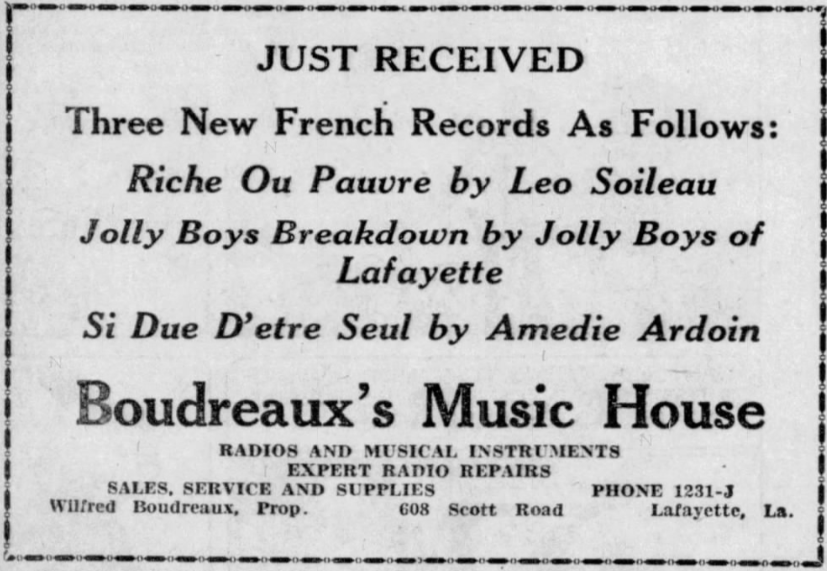
Here, Ardoin recorded alone in New York City were he waxed "La Turtape De Saroied" (#17023), also known as Saroied's Two Step, in 1934. Amede's Afro-Creole accent indirectly became titles such as "turtape" and "tostape", which were misunderstood words for "two-step". Interestingly enough, similar to his "Tostape De Jennings", neither songs were two-steps. Rather they were steady waltzes. According to Dan Nishimoto,
Ardoin’s accordion-playing is remarkably consistent, whether he is squeezing out clusters of notes on “Si Dur D’etre Seul” or leaning into the oompah-beat of “La Turtape de Saroied.”1
Aye ye yaille, I'm leaving,
Oh yeh, I'm going,
Yeh, to Church Point,
Oh I'm leaving.
Oh, I'm going alone,
Yes, I'm going all alone,
There is, yeh, nobone who wants to come with me to Church Point.
Ye yaille, it's Bellard's waltz.
Aye ye yaille, I'm leaving,
I'm going over there to Church Pointe,
Noone wants to come with me,
To see her, it's Bellard's waltz, ye yaille.
Oh ye yaille, I'm going to my house, all alone, I'm going,
To hit the road today,
It was a Sunday morning I left, I went to go meet her,
Oh Bellard, I believe I'm going to go, remember it's hard, on Sunday,
She'll be all alone.
The name "Saroied" has been lost to time. Was he referring to the French word for syrup (sirop)? Was there someone in the audience named Saroied? Was he referring to the name Savoy as suggested by record producer Chris Strachwitz? It's unknown. In addition, there's another mystery between this song and his "La Valse Du Ballard". Although the session notes list this recording as Saroied, given the lyrics of the tune specifically mentioning "c'est la valse de Bellard", the fact that both were recorded during the same Decca session and sound engineers occasionally mis-labeled French recordings on session sheets, there's a high probability that these two song titles were swapped.
Find: Louisiana Cajun Music Vol. 5: The Early Years 1928-1938 (Old Timey, 1973) I'm Never Comin Back: Roots of Zydeco (Arhoolie, 1995) Authentic Cajun & Rare: 1929 - 1934 (JSP, 2008) Mama I'll Be Long Gone: The Complete Recordings of Amede Ardoin (Tompkins Square, 2011)
By the mid 1940s, Bill Quinn was interested in recording local Texas musicians such as Harry Choates. Bill Quinn's recording techniques were odd for the time, but were born out of necessity. Bill started in the record business during the war and his first record was an item on the Gulf label by Woody Vernon. He had a hard time getting someone to press the discs, the big companies tried to keep the up-shoots out of the picture by refusing to press for them, but Bill found an old press in New York which he bought and brought to Houston. The war was still on and he couldn't get any 'biscuit', the stuff records are made of. So he bought up old stocks of records which he would grind up and melt down in what he now refers to jokingly as "biscuit days." He often paid as high as 10 cents per record for the old ones, but at least he could put out some of his and soon the war ended and things began to look up for Gold Star Records. According to Arhoolie music producer Chris Strachwitz:
Most collectors will still curl up when they think how many records were ground up to make the Gold Star label.1
Hé ma chere mignonne,
Tu m'a quitté pour ton aller avec un autre,
Tu vas du regret à sa tas fait à ton vieux neg
Tu vas venir un avenir mais chere mignonne.
Chere mignonne, ça fait peché,
Mon je connait pas comment je vas faire resté mon seul,
Mon je connait tu aurais du regret avon long temps,
Pour ton venir, mais chere mignonne, mais, c'est trop tard.
Bill Quinn
One of his artists was Harry Choates, which made his business soar after the sales of "Jole Blon" in 1946. He got Harry and his band with Ernest Benoit on vocals in the fall of 1949 to record "Chere Meon" (#1385). In this similar rendition of the Leo Soileau's song "Grand Mamou", "meon" is the corrupted spelling of the French word "mignonne", meaning "Dear Cutie". It was a phrase Harry would repeatedly use over again in many of his songs.
Gold Star studio
Bill didn't want to bother with publishing songs and all the red tape that goes with it, so he told his artists that they would have to use original material if they wanted to record for him.1Chere Meon, itself, was just a cover of an old 1928 Leo Soileau tune called "Basile", also known as "Grand Mamou". He must not have been aware that half of everything Harry recorded for him were old Cajun covers.
Hey, my dear cutie,
You left me, went away with another,
You're going to regret the stuff done to your old man,
You'll come back eventually, my dear cutie.
Dear cutie, it's sinful,
I don't know how I will handle this alone,
I know you would be regretting before too long,
Well, you will eventually, my dear cutie, but it'll be too late.
The following year, Harry would later re-record the tune and entitle it "Gra Mamou" on the Macy's label.
http://arhoolie.org/the-houston-record-men/
Lyrics by Jerry M
Find: Devil In The Bayou - The Gold Star Recordings (Bear Family, 2002)
Cleoma Breaux Falcon and Moise Morgan paired up in this 1936 Decca recording (#17015) done in New Orleans at the Roosevelt Hotel called "Jeusté Parcqué (Just Because)". Based on the 1928 tune "Just Because" by the Nelston's Hawaiians, it would be one of many popular tunes Cleoma covered as traditional Cajun music was on the decline. The group "Nelston" was the combination of musicians Hubert Nelson and James D. Touchstone.
Juste parce qu'tu croyais que t'etait jolie,
Juste parce tu crois que tu es plus qu'moi,
Comme juste parce tu croyais que que t'avais quelque chose,
Quelque chose moi j'avais pas.
Te m'as fait gaspiller tout mon argent,
Tu croyais moi j'étais vieux Santa Claus,
Sapristi! Ouais, asteur j'ai fini-z avec toi,
Juste parce (que) je te veux plus.
The French word "sapristi", meaning "Oh heavens!", is still used in France but in a comical way because it's colorful and old-fashioned, so people have tenderness for this word. "Sapristi" is not vulgar, however, its a way to swear without being dirty or offending God. It's an expression of surprise, impatience, or hopelessness and may come across as sarcastic out of frustration. Saying this is a way to curse without cursing, by referring to something religious. "Just Because" was a prolific tune, covered by many groups of the day. The craze for Hawaiian music in America started in the early 20th century. The Hawaii Territory Department of Tourism when on a huge ad campaign in 1934, with marketing videos showing the people and sights, even having president Roosevelt visit the islands. The exotic sounds of Hawaiian guitars and ukuleles were featured everywhere in pop and country music of that time and Hawaiians' musicians were blending their own styles with jazz and country influences. Blues musicians were inspired by the slides techniques and made it their own, using bottlenecks and knives.
The Hawaiian falsetto singing was echoed by the yodel in the voice of country singers like Jimmy Rodgers and Gene Autry and steel guitar would soon become an essential part of western swing and modern country music.
Just because you thought you were pretty,
Just because you thought you're better than me,
Just because you thought you had something,
Something I didn't have.
You made me waste all my money,
You believed I was Santa Clause,
Oh heavens! Yeh, right now, I'm finished with you,
Just because, I want you no more.
A few other Cajun renditions were released around the same time such as "Jus Parque" by Happy Fats' Rayne Bo Ramblers and "Just Because" by the Hackberry Ramblers.
J. B. Fuselier joined the string band craze in the mid 1930s, first joining banjo player Beethoven Miller and guitarist Preston Manuel. Over time, Miller left the group and J. B. and Preston formed J. B. Fuselier and the Merrymakers. They played in many of the same dance-halls around south Louisiana in which hosted Joe Werner, Hackberry Ramblers and Happy Fats.
Tard dans l'après-midi, joue rose, dans le champ du blé,
Tard dans l'après-midi, joue rose, dans le champ du blé,
Dans le champ du blé, joue rose, dans le champ du blé,
Tard dans l'après-midi, joue rose, j'vais t'en revenir.
J'vais t'en revenir, joue rose, j'vais t'en revenir,
Tard dans l'après-midi, joue rose, dans le champ du blé.
Jongle a moi, joue rose, jongle a moi,
Jour et nuit, joue rose, jongle a moi,
Tard dans l'après-midi, joue rose, dans le champ du blé,
Tard dans l'après-midi, joue rose, dans le champ du blé,
Champ du blé, joue rose, dans le champ du blé
Tard dans l'après-midi, joue rose, mais, j'vais t'en revenir.
Jour et nuit, joue rose, je (suis) dessus mes genoux,
Jour et nuit, joue rose, je (suis) dessus mes genoux,
Dessus mes genoux, joue rose, je (suis) dessus mes genoux,
Jour et nuit, joue rose, pour toi qu'est si doux.
Champ du Blé
The tune is based on an old traditional American folk song known as "Down In The Valley" or "Birmingham Jail".1This song is thought to have originated in the British Isles centuries ago. It appeared in the Southern mountains, populated by English, Scotch and Irish immigrants, around 1803. Later on the song was sung by the people traveling westward over the mountains of Tennessee and Kentucky into Arkansas and Missouri. The song was passed down through the generations by memorization, in the true folk-song tradition, and has remained popular through the years.2 The first appearance of the lyrics were in sheet music by H. M. Belden in 1909. It was first recorded by Darby and Tarleton in 1927 for Columbia Records as "Birmingham Jail". Two years later, they would record it again as "Down In The Valley" followed by Ezra Hill & Henry Johnson the same year. Later in 1934, John Lomax published the song as a prison convict tune in his "American Ballads and Folk Songs" publication. The melody resembles another song called "Bird In A Cage". Many numbers by Fuselier contained the words "Ma Chére" in the title such as "Ma Chére Catain", "Ma Chére Jolite", "Ma Chére Vieux Maison Suet", "Ma Chére Bouclett" and "Ma Chér Bassett". "Chére" and "chér" itself is a corrupted form of the French word "chérie" which means "dear", commonly used as a term of endearment. In this 1938 Bluebird recording entitled "Ma Chere Joui Rouge" (#2041), he refers to his "dear, rosy cheeks".
Late in the afternoon, little rosy cheeks, in the wheat field,
Late in the afternoon, little rosy cheeks, in the wheat field,
In the wheat field, little rosy cheeks, in the wheat field,
Late in the afternoon, little rosy cheeks, I'm going to return to you.
I'm going to return to you, little rosy cheeks, I'm going to return to you,
Late in the afternoon, little rosy cheeks, in the wheat field.
I reminisced, little rosy cheeks, I reminisced,
Night and day, little rosy cheeks, I reminisced,
Late in the afternoon, little rosy cheeks, in the wheat field,
Late in the afternoon, little rosy cheeks, in the wheat field,
The wheat field, little rosy cheeks, in the wheat field,
Late in the afternoon, little rosy cheeks, I'm going to return to you.
Day and night, little rosy cheeks, I am on my knees,
Day and night, little rosy cheeks, I am on my knees,
On my knees, little rosy cheeks, I am on my knees,
Day and night, little rosy cheeks, for you are so sweet.
Joue rose can be found in the title of the Balfa Brothers song "Chere Joues Roses" covered by Steve Riley, Joel Sonnier, and others.
By the late 1930s, old-time string bands were being replaced by brother acts like the Delmores and the Sheltons. There were also new sounds of the Western swing groups to attract the public's ear. Cajun music on record also changed. Out went the accordion and in came the western string bands.1 The Jolly Boys of Lafayette were just one of many that landed a recording session with Decca in 1937.
Francis "Red" Fabacher
The song was a cover of the Angelas Lejeune recording "Perrodin Two Step" originally recorded in 1929. The song is most notably known as The Perrodin, allegedly named after two brothers who often requested it at dances.2 Here, the band named it after themselves, calling it the "Jolly Boys Breakdown" (#17032). The Jolly Boys were Francis "Red" Fabacher and Leon "Crip" Credeur.
The same melody would be used by Miller's Merrymakers called "Round Up Hop" in 1937. Some refer to it as "Mamou Breakdown" as recorded by Wallace "Cheese" Read. By 1947, Decca re-issued the song on their black "script" label.
Daily Advertiser Sep 20, 1937
Courtesy of Katherine Prater from Lake Charles
Cajun Country 2. Pat Harrison. Liner Notes.
MADE IN LOUISIANA. VRCD 325. MARC SAVOY - Accordion. DEWEY BALFA - Fiddle. D. L. MENARD - Guitar. Liner notes.
Find: Cajun Louisiane 1928-1939 (Fremeaux, 2003) Cajun Country, Vol. 2, More Hits from the Swamp (JSP, 2005) The Best Of Cajun & Zydeco (Not Now, 2010)
Douglas Bellard is said to be the first black Cajun/Creole to record, just before Amede Ardoin, thus making him arguably the spiritual father of Zydeco music. His records are rarely heard, but for all their roughness, they are deep American roots music of the highest order. They became the first rural Afro-Creoles from southwest Louisiana to record the earthy, raw music of the black Creoles. This stark masterpiece of fiddle, accordion and vocal emphasizes the rhythm and beat while understating the melodic line.7 Vocalion released four Bellard-Riley sides, including the classic la-la lament "La Valse La Prison" (#15847). This would become only one of four songs recorded by Bellard (misspelled Bellar). Most listings correct the phrase writing "La Valse De La Prison". Around 1974, during an interview with producer Jean-Pierre Bruneau, Bee Fontenot explains the song was based on Douglas' time in prison due to killing a man in his coop he caught stealing his chickens.8
Oh toi cher 'tite fille quoi ça t'es après faire.
T'auras jamais de bonheur dans ta vie.
Oh te'm'fait t'aimer, jamais toujours, chere,
Te tourne ton doux d'moi.
Oh te fais mal, la pauv' vieille maman, à la porte de prison,
Ses deux mains sur sa tête en pleurant pour moi.
Bonsoir chère maman,
Bonsoir pour tous tes jours, c'est tous mes tiens.
J'ai fini de te voir, maman,
J'ai fini de te voir sur la terre du bon dieu.
Oh toi, chère maman, pleure pas pour moi.
'Mande à tes amis pour t'aider.
Pars prier pour moi,
Pars des prières pour sauver moi nom des flammes de l'enfer.
Oh, quand jai dit ça à ma maman,
Elle a fait "mmmmmmm, hmmmmmmm"
Ville Platte Gazette Oct 5, 1929
Douglas Bellard played with Creole accordionist Amede Ardoin and taught this tune to a younger Canray Fontenot who popularized the song as "Barres De La Prison".7 Author Barry Ancelet states:
"Les Barres De La Prison", Canray Fontenot's classic blues waltz based on Bellard's original recording of "La Valse de la Prison", for example, is a traditional gallows blues lament or prisoner's farewell which recalls the old French "Chanson de Mandrin".
It was recorded in New Orleans in 1929 and afterwards, Douglas would spend alot of time traveling to play music. At some point Douglas separated from his wife and moved near the Fontenot family. Canray and Adam Fontenot recall Bellard leaving to record and play:
I used to go fool with [his] fiddle. I had learned how to tune it and everything from him. He started getting kind of popular and most of the time that doggone Douglas was gone. I didn't have nothing to practice. I was just getting in the groove to learn something, no he keeps taking the fiddle.1
Douglas Bellard By Robert Crumb
Not much is known about the Afro-Creole accordionist Kirby Riley. It's believed he was born in St. Landry parish in 1904 to Thomas and Cora Riley. When not playing music, he worked on cars in a garage, greasing and cleaning engines. By the time he entered WWII in 1942, he was still single.
On tunes like "La Valse De La Prison", we’re able to easily discern the dark, rolling rumble of Riley’s accordion behind Bellard’s lively fiddling. Bellard would go on to influence other musicians around the area including Canray Fontenot and Wade Fruge. Canray recalls Douglas playing with Amede Ardoin:
They played together; they played good music together. They both wanted to start the tune and if one would start the other one couldn't catch up. And they both liked to sing; they were always in a big brawl about that.5
Wade Fruge recalls:
He was really good. His bow looked like a rainbow. I've seen him play with some number eight sewing thread.5
Oh you, dear little girl, what have you done?
You are never happy in life.
Oh you made me love you, forever always, dear,
You turned sweet to me,
Oh, it hurts you, poor old mother, at the prison door,
Her hands at her face, weeping for me.
Good night, dear mom,
Good night forever, that's my wish.
I'll finally see you, momma,
I'll finally see you in heaven.
Oh you, dear mother, weep not for me,
Ask your friends for help.
Go pray for me, go pray to save me my name from the fires of hell,
Oh, when I said that to my mom, she was like "mmmmmmm, hmmmmmmm".
Outside of Geeshie Wiley’s "Last Kind Word Blues", it is hard to imagine a more dark, moody, and backwoods-y performance from this time period.7