A unique window into the world of Cajun music between 1928 and 1965. Compiled histories from websites, books, news articles, liner notes, and interviews. Most come from my personal 78 collection. Also covering Creole, Cajun-Country, and Cajun swing.
In 1947, Harry Choates recorded for Jimmy Mercer’s Swing Records in Paris, Texas on his new label, Cajun Classics, created just for Choates.1 In his early days, Mercer was pressing on highly fragile, reclaimed shellac -- he ground up used 78s, cooked them, dried them, and pressed new records out of them, just as Bill Quinn had done. In light of this, combined with the fact that distribution was probably limited to Dallas and Fort Worth, it's a miracle that even one copy exists today.2
J’ai passé devant ta porte,
J’ai crié, “Bye-bye la belle.”
Y'a personne qui m'as pas répondu,
O yé yaille, mon cœur fait mal.
J’avais vu une petite chandelle allumée,
J'avais été courir z-à la porte,
Ils m'ont dit que ma belle était "gone",
O yé yaille, mon cœur fait mal.
J'avais vu une (...) la blonde dans la porte,
J'avais été (...) pour la belle,
Ils m'ont dit que la belle était "gone",
O yé yaille, mon cœur fait mal.
J’ai passé devant ta porte,
J’ai crié, “Bye-bye la belle.”
Y a personne qui m'a pas répondu,
O yé yaille, mon cœur fait mal.
poss. Grady Mann, Curzy Roy, Johnnie Manuel, Harry Choates, Joe Manuel, Eddy Pursley, Ronald Ray "Pee Wee" Lyons
His group consisted Ronald Ray "Pee Wee" Lyons on steel guitar, Esmond "Eddie" Pursley on guitar, B D Williams on bass, Curzy "Porkchop" Roy on drums, Johnnie Ruth Manuel on piano and her husband Joe Manuel on banjo. Joe, from southwest Louisiana, had originally created his group for hillbilly music when they added Harry to the mix. In this tune, Harry stepped back from the vocals and let Joe sing an old Cajun classic originally recorded by Cleoma Breaux in 1929 as "Mon Coeur T'Appelle". It was entitled "Je Pasa Durvan Ta Port" (#1005), a corrupted spelling of the phrase "j'ai passé devant ta porte" or "I walked passed your door".
Release Info: Je Pasa Durvan Ta Port | Cajun Classics 1005 Tip-E-Te-Tip-E-Ta Ameon | Cajun Classics 1006 Find: Harry Choates – The Fiddle King Of Cajun Swing (Arhoolie, 1982, 1993) Cajun Fiddle King (AIM, 1999) Devil In The Bayou - The Gold Star Recordings (Bear Family, 2002)
Harry Choates, the earliest of post-war Cajun groups to record, had joined Leo Soileau's group around the late 1930s or early 1940s. He had gained a reputation of an excellent fiddle player around southwest Louisiana. While filling in, he would remember several of their signature tunes and later borrow them while recording with his Melody Boys by the mid 40s. Having played in Leo Soileau's band during the war years, "Cajun Hop" (#1326) was merely an updated version of Soileau's "Les Blues de Port Arthur". It was recorded in 1947 at Bill Quinn's Gold Star studios and the "hop" is a generic name Bill Quinn usually gave to any fast Cajun tune.
Eh, 'tite fille, tu m'as lesse pour t'en aller,
Malheureuse, moi j'connais, mérite pas ça.
Eh, chere, jolie fille, jolie cœur,
Quoi t'as fais, mais, avec moi, (que misérable).
Eh, eh, eh, ha, ha.
Eh, 'tite fille, t'apres la peine.
Eh, chere, jolie fille, jolie cœur,
Eh, mais, moi j'connais m'aimer (...)
Eh, 'tite fille, eh villian moyens,
Moi j'connais, quoi t'as fais, t'as fais pas bien.
Hollywood Club B.D. Williams, Curzey "Porkchop" Roy, Harry Choates Johnnie Manuel, Joe Manuel, Eddie Pursley, Ronald Ray "Pee Wee" Lyons
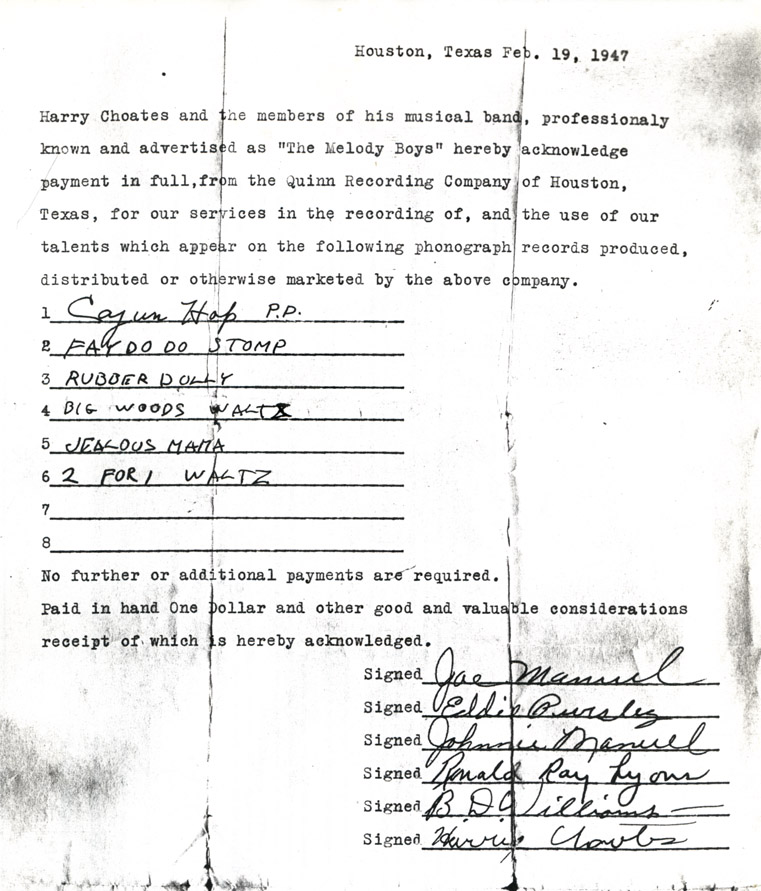
The "Cajun Hop" session is unique because Bill Quinn actually typed up a session sheet which the entire band signed, and, miraculously, this sheet actually survived and is now in the University of Texas archives. This is one of only two session sheets to survive for any Gold Star session, by anyone. It listed the band members: Joe Manuel on banjo, Eddie Pursley on guitar, Johnnie Manuel on piano, Ronald Ray "Pee Wee" Lyons on steel, and B.D. Williams on bass.
Gold Star session, 1947
Quinn's motivation was apparently to prove that he had paid the band for their services in case one of them tried to sue him later (as Jimmie Foster would do later that year for his non-credit on "Jole Blon"), though since he's only paying them $1.00 each, the contract is purely a formality. Either that, or the Melody Boys worked very cheap. The song was the flip side of "Harry Choates Special" for Goldstar but the Bihari's released it on the other side of "Rubber Dolly".
Typically, though, his records show him as a Cajun Bob Wills, interspersing his singing and fiddling with cries of "eh,ha ha!". It was a common phrase he used, especially when playing live, due to having a limited Cajun french vocabulary and constantly forgetting the lyrics mid-song.
Hey, little girl, you have left me to go away,
Naughty woman, I know, I don't deserve that,
Hey, dearie, pretty girl, pretty sweetheart,
What you've done, well, with me, (that's miserable).
Hey, hey, hey, hah, hah.
Hey, little girl, you're painful.
Hey, dearie, pretty girl, pretty sweetheart,
Hey, well, I know I love (...),
Hey, little girl, hey, naughty ways,
I know, what you've done, you've not been good.
Country Music Originals: The Legends and the Lost By Tony Russell
Release Info: 1326-A Cajun Hop | Gold Star 1326-A 1326-B Fa-De-Do Stomp | Gold Star 1326-B 1331 Rubber Dolly | Modern 20-528A 1326-A Cajun Hop | Modern 20-528B Find: Harry Choates – The Fiddle King Of Cajun Swing (Arhoolie, 1982, 1993) Devil In The Bayou - The Gold Star Recordings (Bear Family, 2002)
Perhaps the name most linked with the Cajun swing sound was Harry Choates. He was an outstanding fiddle player, equally at home with traditional Cajun material or western swing. He was also a wild and eccentric character, a heavy drinker who would appear on stage in a formerly white cowboy hat, which, in the words of a band member, "looked like a hundred horses had stomped on it when it had been stuck in a grease barrel". As well as being a great fiddler, he also played guitar, accordion, and steel guitar, yet probably never owned an instrument, preferring to borrow whatever he needed.3 Not to interfere with his Gold Star contract, he quietly traveled to Paris, TX in 1947 and recorded an old Leo Soileau tune called "Hackberry Hop" (#1007) for Jimmy Mercer's label.
Hé le Hip et Taïau, ouais,
Qu’a volé mon traineau, chérie,
Quand ç’a vu j’étais chaud, ouais,
Il a ramené mon traîneau.
C'est le Pitre et Bosco, ouais,
Qu'a volé mon gilet, chérie,
Quand il a vu j'suis d'venu chaud, ouais,
T'as ramené mon gilet.
Hé le Hip et Taïau, ouais,
Qu’a volé mon chariot, chérie,
Quand il a vu j’étais devenu chaud, ouais,
Il a ramené mon chariot.
C'est le Pitre et Bosco, ouais,
Qu'a volé mon gilet, chérie,
Quand il a vu j'suis d'venu chaud, ouais,
T'as ramené mon gilet.
Amos Comeaux, Harry Choates, Wally Bryant Courtesy Andrew Brown4
Since Harry had played with Leo, covering his version of "Hackberry Hop" for quite some time in the 1930s and 40s, it's probably where he got the title for this tune. Sung by his banjo player Joe Manuel, it was a cover of the well-known Cleoma Breaux song "Ils La Volet Mon Trancas", better known as "Hippy Ti Yo". Manuel and Choates was backed by Ronald Ray "Pee Wee" Lyons on steel guitar, Eddie Pursley on guitar, B.D. Williams on bass, Johnnie Ruth Manuel, and Curzy "Pork Chop" Roy on drums.
It's Hip and Taïaut, yeah,
That stole my sled, dearie,
When they saw I had become hot, yeah,
They brought my sled back.
This is Pitre and Bosco, yeah,
That stole my vest, dearie,
When they saw I had become hot, yeah,
They brought my jacket back.
It's Hip and Taïaut, yeah,
That stole my cart, dearie,
When they saw I had become hot, yeah,
They brought my cart back.
This is Pitre and Bosco, yeah,
That stole my vest, dearie,
When they saw I had become hot, yeah,
They brought my jacket back.
Daily Advertiser Sep 10, 1948
Although some speculate this session was done at a radio station in Lake Charles, it's quite possible, the recordings for this session were done at Mercer's studio located in his store called Melody Lane Record Shop. According to collector Jared Mariconi:
I've looked into the Cajun Classics and Jimmy Mercer and it seems like he was pressing them in a small pressing facility that he built himself in Paris, Tx in 1947. He had a record store called Melody Lane, which he shut down at the end of '46 to open the factory. They said that he recorded [musicians] in the music shop.2
By 1950, Mercer had moved the location of the plant to Main St. and changed the name to Southern Plastics1. Joe Manuel would eventually reform a new band in 1949 and re-record the tune as "Creole Hop" on Deluxe Records.
Release Info: 1005 Hackberry Hop | Series 1007 Cajun Classics 1009 Jole Brun | Series 1009 Cajun Classics 1005 Hackberry Hop | Cajun Classics CC1007 1010 Yes I Love You | Cajun Classics CC1010 Find:
Harry Choates – The Fiddle King Of Cajun Swing (Arhoolie, 1982, 1993) Cajun Fiddle King (AIM, 1999)
Harry Choates was born in either Rayne or New Iberia, Louisiana, yet early on, he moved with his mother, Tave Manard, to Port Arthur, Texas, during the 1930s. By the time he reached the age of twelve he had learned to play a fiddle and performed for tips in Port Arthur barbershops. The Melody Boys, originally formed with Joe Manuel, Eddie Pursley, and local swing musicians around Lake Charles, were in desperate need of a fiddle player. Harry was quickly added to the mix and eventually became the band's front man. Joe knew Harry and his talent from playing together in Leo Soileau's group in 1941 and by 1946, they teamed up for his famous "Jole Blon" recording. The following recording session, Joe convinced Harry to have Johnnie play piano in the group. The group could become Harry first consistent band for many of the early Gold Star releases.
Daily Advertiser May 31, 1947
He, mignonne.
"I know I'm leaving Port Arthur", jolie fille, chérie,
Oh, chère, mais, moi j'connais, j'mérite pas ça.
He, petite, mais, moi j'connais, mignonne,
Oh, pourquoi t'as fais, moi j'connais, tu voir, t'es regret,
Eh, chérie, moi j'connais, mignonne,
Oh, il y a pas longtemps, mais, malheureuse, ça fait d'la peinne.
Ooh, petite, malheureuse, chere, cherie,
Eh, chère, mais, moi j'connais, t'as m'fais pitié.
Harry Choates, Johnnie Ruth Manuel, Joe Manuel, Eddie Pursley, B.D. Williams Speedy's Broken Mirror, Sulphur, LA, 1947 Image by Tim Knight
With the runaway success of "Jole Blon" apparent by the fall of 1946, Quinn quickly brought Choates back to his studio for a follow-up release. Suddenly Cajun music was commercial, and, for the time being, Quinn would insist that Harry exclusively record traditional material. "Port Arthur Waltz" (#1319) may have been a traditional piece of material, although Choates claimed authorship.4According to good friend Levan Meyers, he and Harry were returning from a gig in Sulpher, Louisiana.
Before leaving to return to Port Arthur, Harry purchased a fifth of Jack Daniel's whiskey and by the time they reached Orange Bridge, Harry had consumed the entire fifth, all the while singing what he called the "Port Arthur Waltz". He was making up the entire song as they drove along.2
Lake Charles American Press Feb 27, 1947
The band consisted of Edmond Pursley on guitar, Abe Manuel on guitar, Joe Manuel on banjo, B.D.Williams on bass, Curzy "Porkchop" Roy on drums, and a honky-tonk pianist by the name of Johnnie Manuel. According to author Tim Knight, his band recorded the "Port Arthur Waltz", which along with "Jole Blon" were hot sellers in the Port Arthur, Beaumont, and Orange County market.2
Hey cutie.
I know I'm leaving Port Arthur, my pretty girl, dearie,
Oh, dear, well, I know, I don't deserve that,
Hey, little one, well, I know, cutie,
Oh, what you've done, I know, you'll see, you'll be sorry.
Hey, dearie, I know, cutie,
Oh, over there it won't be long, well, oh my , that's painful.
Oooh, little one, oh my, dear, dearie,
Hey, dear, well, I know, you've made me pitiful.
Released on the flip-side of another traditional tune, "Allons A Lafayette", "Port Arthur Waltz" would not become the national hit that "Jole Blon" was. In fact, neither Quinn nor Choates would ever had another one of those. But it did sell well in Louisiana and Texas, and that market was large enough to justify Quinn's continuing interest.4 After 1959, Starday purchased most of the rights to the Gold Star records, re-releasing some of Harry's tunes.
Release Info: Allons A Lafayette | Gold Star 1319-A Port Arthur Waltz | Gold Star 1319-B ST 2318 Louisiana Boogie | Starday 224 ST 2296 Port Arthur Waltz | Starday 224 Find: Harry Choates – The Fiddle King Of Cajun Swing (Arhoolie, 1982, 1993) Devil In The Bayou - The Gold Star Recordings (Bear Family, 2002)
Creole Hop! It was a rendition of the famous Cleoma Breaux tune "Ils La Volet Mon Trancas". Joe, familiar with the tune from the years playing it as "Hackberry Hop" with Leo Soileau, sang the song in 1947 with Harry Choates as "Hackberry Hop" for Jimmy Mercer's Cajun Classics. Two years later, he recorded it himself for the Joe Leibowitz's DeLuxe label, entitling it "Creole Hop" (#6039), naming if after the small town in Cameron Parish where many of the Manuels lived. Hé le Hip et Taïau, ouais, qu’a volé mon traineau, chérie,
Quand ç’a vu j’étais chaud, ouais, ç’a r’venu mon traineau,
C’est les filles de Créole, ouais, qu’a volé traineau, chérie,
Quand ç’a vu j’étais chaud, ouais, ils ont r’venu mon traineau.
Hé le Hip et Taïau, ouais, qu’a volé mon gilet, p’tite fille,
Quand ç’a vu j’étais chaud, ouais, ils ont r’venu mon gilet,
C’est les filles de Créole, ouais, qu’a volé gilet, ouais,
Quand ç’a vu j’étais chaud, p’tite fille, ils ont r’venu mon gilet.
Crowley Daily Signal Oct 11, 1949
Every Friday afternoon, he ran a radio show on KSIG called T-Joe Manuel & Radio Stars featuring the best western string band tunes of the time. His group consisted of probably Eddie Caldwell on guitar, Abe Manuel on fiddle, Dusty Rhodes on steel guitar, and Crawford Vincent on drums. It was essentially the same setup and lineup that Abe had on his recording of "Hippy Ti Yo".
Hey, the Hip and Taïau, yeh, that stole my sled, darling,
When they saw I was hot, yeh, they returned my sled, darling,
It's the girls of Creole, yeh, that stole my sled, darling,
When they saw I was hot, yeh, they returned my sled.
Hey, the Hip and Taïau, yeh, that stole my vest, little girl,
When they saw I was hot, yeh, they returned my vest,
It's the Creole girls, yeh, that stole my vest, yeh,
When they saw I was hot, little girl, they returned my vest.
Daily World May 20, 1949
Lyrics by Jordy A
Release Info:
D 946 Cherie Ba Sate | 6039-A DeLuxe D 947 Creole Hop | 6039-B DeLuxe
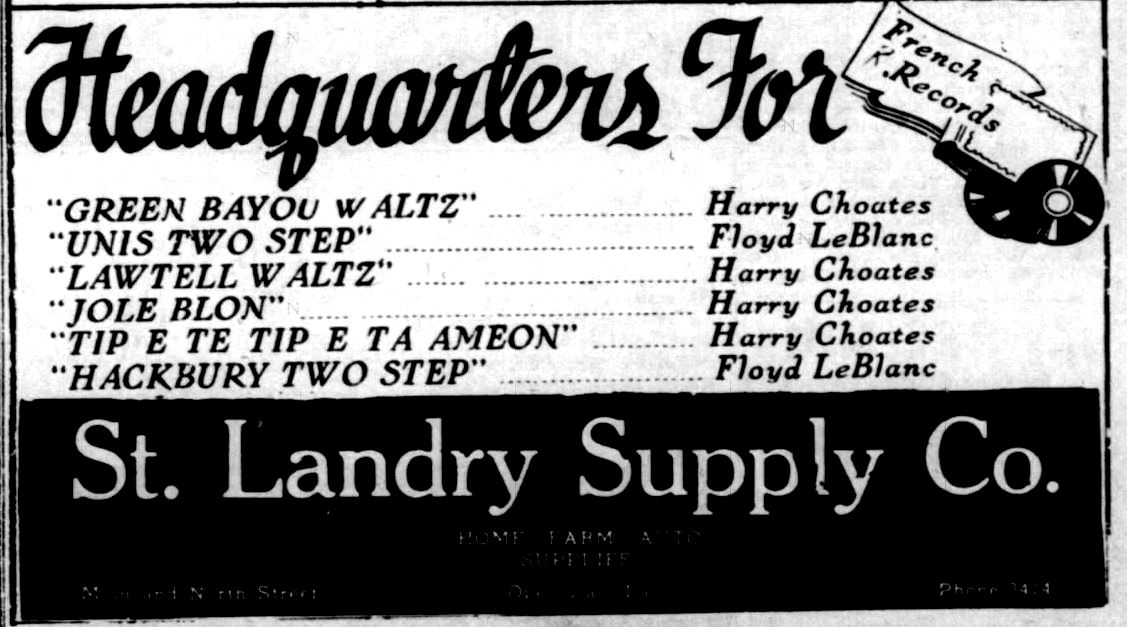
In the late 1940s, Jimmy Mercer of Paris, TX had created a new label called "Cajun Classic" in the hopes of getting Harry Choates to record for him. By 1947, he made good on his promise and coaxed Harry to head there with his band and record several tunes, one of which was a traditional Cajun tune called "Tip-E-Te Tip-E-Ta Ameon" (#1006) for his Cajun Classics label. The song known as "T'es Petite et T'es Mignonne" was an old Cajun tune, first recorded by the Fawvors in 1929. Mercer and Harry had the song sung as a duet by his band members-- banjoist Joe Manuel and his guitarist Esmond "Eddie" Pursley. The band rounded out with Ronald Ray "Pee Wee" Lyons on steel guitar, B.D. Williams on bass and Curzy "Porkchop" Roy on drums.
Daily World Aug 12, 1948
T’es petite et t’es mignonne,
Et galeuse, cherie, j’t’amie quand même,
Ah, mais ouais, la belle, chérie, se pas la belle,
Ah, mais ouais, la belle, chérie,
Vous allez et laver.
T’es petite et t’es mignonne,
T'es trop galeuse, cherie, pour faire ma femme
Ah, mais ouais, la belle, chérie, se pas la belle,
Ah, mais ouais, la belle, chérie,
Vous allez et laver.
T’es petite et t’es mignonne,
Et galeuse, cherie, j’t’amie quand même,
Ah, mais ouais, la belle, chérie, se pas la belle,
Ah, mais ouais, la belle, chérie,
Vous allez et laver.
T’es petite et t’es mignonne,
Et galeuse, cherie, j’t’amie quand même,
Ah, mais ouais, la belle, chérie, se pas la belle,
Ah, mais ouais, la belle, chérie,
Vous allez et laver.
After Gold Star's producer Bill Quinn accidentally found out about this session, the two producers settled on an arrangement. Harry Choates had been playing with his Melody Boys for quite some time and the following year, in 1948, he and the Manuels were touring around east Texas and south Louisiana. That year, they re-recorded the tune "Te Petite" (#1343) for Gold Star records. It featured a young pianist by the name of Johnnie Ruth Smyrle, sometimes listed as "Johnnie Mae", from San Angelo, Texas.
This would be the last recording with his original group involving the Manuels. According to researcher Andrew Brown, rumor abound that Harry had an affection for Joe's wife Johnnie. They had been touring through Texas and at some point, a band member caught the couple in the midst of "private relations". This caused an immediate breakup of the band including, allegedly, the dissolving of Joe and Johnnie's marriage. Many would never play with Harry again.
Johnnie and Harry
To make matters worse, back in Louisiana, Choates’s wife was three months pregnant with their daughter, Linda. Despite the difficulties of his own making, in April 1947, Choates and Johnnie Manuel booked a month long engagement at Dessau Hall in Austin, Texas. By May or June, he had a show on KWBU in Corpus Christi. When Linda was born in September, Choates was still with Johnnie but it didn't last long. According to bassist Grady "Tarzan" Mann, after a night of drinking, Choates grabbed the electric guitar and his dark side appeared:
One time we were playing at Dessau Hall. [Choates] always liked for me to be right up there beside him with that upright bass. Johnnie told him, "Are you gonna play for the people, or are you gonna play for Tarzan?" And he turned around and knocked her clean off that piano stool!.1,2,5
Choates turned to the crowd and stated, "That's all right, folks. We just had to get some things straight around here."5
You're small and you're cute,
And shabby, dearie, I like you anyways,
Ah, well yeah, pretty girl, dearie, she's not beautiful,
Ah, well yeah, pretty girl, dearie,
You go and wash up.
You're small and you're cute,
You're too shabby, dearie, to be my wife,
Ah, well yeah, pretty girl, dearie, she's not beautiful,
Ah, well yeah, pretty girl, dearie,
You go and wash up.
You're small and you're cute,
And shabby, dearie, I like you anyways,
Ah, well yeah, pretty girl, dearie, she's not beautiful,
Ah, well yeah, pretty girl, dearie,
You go and wash up.
You're small and you're cute,
And shabby, dearie, I like you anyways,
Ah, well yeah, pretty girl, dearie, she's not beautiful,
Ah, well yeah, pretty girl, dearie,
You go and wash up.
Harry Choates, Johnnie Ruth Smyrle Manual, Joe Manuel
Other family members dispute the relationship rumors, stating Johnnie loved Harry like a brother and that they stayed friends until his death. Choates didn’t worry too much about switching band members, as the Golden Triangle—the area of Texas just across the Sabine River from Louisiana where he spent most of his time—was jumping with musicians. Eventually, he'd record with other groups and form other bands including one with tenor banjoist and Port Arthur resident Ivy Gaspard. According to Gaspard,
This area was a hotbed of good musicians. You had as many good musicians here as you had anywhere.4
Often times when he found himself broke, Quinn would have him sit in for a session, regardless if he needed him or not. Sadly, many of those impromptu session recordings never materialized.
Devil In The Bayou - The Gold Star Recordings by Andrew Brown. Liner notes.
Image by Museum of the Gulf Coast
http://www.offbeat.com/articles/harry-choates/
All Over the Map: True Heroes of Texas Music By Michael Corcoran
Release Info: Je Pasa Durvant Ta Port | Cajun Classics 1005 Tip-E-Te-Tip-E-Ta Ameon | Cajun Classics 1006 Find: Harry Choates – The Fiddle King Of Cajun Swing (Arhoolie, 1982, 1993) Devil In The Bayou - The Gold Star Recordings (Bear Family, 2002)
Facts about Harry Choates' early life are lost to the sands of time, though it’s likely that he spent his early childhood in Rayne and New Iberia before his family moved to the booming oil town of Port Arthur, Texas in 1929. Beyond his birth certificate, the first concrete evidence of Choates’ existence came in the form of his first recorded appearance with Happy Fats’ Rayne-Bo Ramblers in 1940. Harry was now 17, and he emerged from childhood with two fully developed talents, the yin and yang that would define the highest and lowest moments of the rest of his life: the ability to drink most dedicated booze-hounds under the table and the musical genius to blow just about anybody off of the bandstand.1
Austin American Oct 4, 1947
His 1947 instrumental, "Rubber Dolly" (#1331), for Gold Star records came to south Louisiana from the American hillbilly musicians of the Appalachian region. It became a marching song during WWI. Quoted in the book “To the Last Ridge” by WH Downing, first published in 1920, he writes about hearing a wounded man out in no-man’s-land at Fromelles, singing it in his delirium.2,3,4
Rumored to be the origins of an English nursery rhyme, it was later popularized by Woody Guthrie, Bill Parsons, Ella Fitzgerald and the Light Crust Doughboys.4 Earlier Cajun musicians such as Angelas Lejeune borrowed the melody for his popular "Bayou Pom Pom One Step". Other derivatives of the melody found it's way into Joe Falcon's "Osson One Step", Adam Trahan's "Waltz Of Our Little Town" and Amede Ardoin's "Tortope d'Osrun". Post-war Cajun versions can be found in Iry Lejeune's "Bayou Ponpon Special" and Austin Pitre's "High Point Two Step" and his "Janot Special".
Record producer, Bill Quinn, had such a large following of Harry Choates' music, he licensed out several songs from this session to Modern Records Hollywood of Los Angelas. Listeners can hear Harry call out steel guitarist Ronald Ray "Pee Wee" Lyons. Among the other musicians were Joe Manuel on banjo, Eddie Pursley on guitar, B.D. Williams on bass, Johnnie Ruth Manuel on piano and Curzy "Pork Chop" Roy on drums. Banjoist Chester "Pee Wee" Broussard, who played with Happy Fats at some of the same places Choates performed, related to Kevin Coffey:
[Harry Choates' Melody Boys] liked to drink, liked to smoke, and money just burned a hole in their pockets. We’d play a dance and get back to Rayne, and they’d go find a slot machine. Before we finished eating our breakfast, which was usually three in the morning, they were already broke and trying to borrow money from somebody else.1
Release Info: 1331 Rubber Dolly | Gold Star 1331 1326-BFa-De-Do Stomp | Gold Star 1326-B 528A Rubber Dolly | Modern 20-528A 528B Cajun Hop | Modern 20-528B Find: Western Swing, Vol. 1 (Old Timey, 1966) Harry Choates – The Fiddle King Of Cajun Swing (Arhoolie, 1982, 1993) Devil In The Bayou - The Gold Star Recordings (Bear Family, 2002)
The main catalyst for exposing interest in Cajun music after the war was fiddle player Harry Choates. Choates had just recorded his hit song "Jole Blon" and was looking for any work he could find. He and record producer Jimmy Mercer figured they could take his themed title, rename it, and make even more money on a different recording label. He renamed the tune "Jole Brun (Pretty Brunette)" and changed some of the lyrics for the Cajun Classics label (#1009). Still under contract with Bill Quinn's Gold Star label which he scored his hit "Jole Blon", he either recorded in a radio station in Lake Charles, or possibly ventured out to Paris, Texas where Jimmy Mercer had created his own pressing plant and recording studio. His makeshift studio located in the plant allowed the whole process to occur onsite. Together with Harry, he brought along Esmond Pursley on guitar, Joe Manuel on banjo, Pee Wee Lyons on steel, B.D. Williams on bass, Curzy Roy on drums, and Johnnie Manuel on piano.
Oh, pourquoi t'as fais, mais, ça t'as fais à ton pauvre 'tit chien.
Oh, mais malheureuse, mais, jolie brun, t'as chagrin,
Oh, vilaines manières, malheureuse, ça fait pitié.
Oh, jolie brune, ma petite jolie cœur,
Eh, ha ha! Eh, malheureuse.
Oh, mais, malheureuse, tu connais ça a pas fais bien,
Oh, pourquoi t'as fais, mais, avec moi, si mal, bébé,
Oh, j'connais, chère petite, tu va avoir du regret,
Tu vas venir un jour, jolie brune, oh, ça, (dans) pas longtemps.
The Paris News Nov 24, 1946
In 1946, Jimmy Mercer had obtained a hydraulic record press from Chicago and had it shipped to Texas. He started with his first label, Swing, and called his place Swing Record Manufacturing. He boasted the machine could produce a record in 18 seconds and had the capacity of 2700 records a day. According to Mercer:
We are engaged in manufacturing records for a number of well known companies and we also intend to put out two records under our own label, "Swing" and "Downbeat". We hope to be able to give talent in Northeast Texas an opportunity to audition so that they might possibly become recording artists.3
Oh, well, pretty brunette, well oh my, dear little girl,
Oh, why have you done this, well, that you've done to your old little dog.
Oh, well, oh my, well, pretty brunette, you're sad,
Oh, your terrible ways, oh my, made it pitiful.
Oh, pretty brunette, my little pretty sweetheart,
Eh , ha ha! Eh, it's terrible.
Oh, well, oh my, you know that it's not been well,
Oh, why have you done that, well, with me, so bad, baby,
Oh, I know, dear little one, you're going to have regrets,
You will come back one day, pretty brunette, oh, it won't be that long.
The Paris News March 29, 1949
By 1947, Choates was now in considerable demand and he had no qualms about contracts. Surprisingly at one point, Quinn narrowly stopped Choates from recording with Decca in violation of his contract. In February, Choates recorded for Jimmy Mercer’s Swing Records in Paris, Texas (author Andrew Brown states Lake Charles, Louisiana) on his new label, Cajun Classics, created just for Choates, including “Jole Brun.” Cajun Classics was part of a family of labels operated by Jimmy Mercer in Paris from 1946 to 1950. When the records went on sale, Quinn contacted Mercer, only to find Choates had signed a contract with him as well so he and Mercer settled on an arrangement.1
Mercer had many labels over his career including All Spice, Cajun Classics, Hillbilly Hit Parade, Personality, Royalty, Swing, Vox, Western Magic, Zest, and Zip labels. However, Mercer had run into trouble in 1949 when he was "convicted of shipping obscene (party) records across state lines". According to the FBI, a complaint was filed alleging that Mercer transported "obscene, lewd, lascivious matter of indecent character" to St. Louis. He was arrested by a US deputy marshal at his home and was released on bond. This spelled the end of all of Mercer's recording activities.2