Monday, November 23, 2020

"Jamais Marriez" - Walker Brothers

In 1928, Leo Soileau had helped RCA Victor Records make a huge impact on their southern music sales across Cajun prairies with his accordion-led recordings with Mayuse Lafleur.  By 1935, the company spun off their subsidiary company Bluebird Records and began offering recording sessions to many Cajun string-band musicians such as the Hackberry Ramblers, the Rayne-Bo Ramblers, J.B. Fuselier and others.  The first of these string-bands to be invited by Bluebird were the Walker Brothers and Soileau's Three Aces.  Accordion player Lawrence Walker, who had recorded earlier in Dallas in 1929, was familiar with the music scene of the area.   How these musicians were discovered by RCA scouts has been forgotten but each one of these groups received invitations during the year.  As long as they could make it to New Orleans, they packed up their instruments and joined A&R Eli Oberstein for sessions at the field studio.   

Jeunes filles de la campagne,
Mariez-vous autres jamais
'Gardez comme moi j'ai fait,
J'ai mis dans la misère.

Tu vu (de) ton vieux nég,
Rejoindre ton pauv' vieux nég,
Qui c'est, mais, pour toi-même,
Qui c'est boo-boo t'aimes ça.

Eh, petite!

Quand j’étais jeune z-enfant, 
J’étais un bambocheur, 
Et asteure que j'suis marié, 
Ça va tout le temps pareil.

Petite, t'es trop mignonne,
Pour faire la criminelle,
Pour faire, moi, m'en aller
Tu vas voir, mais, pour toi-même, 
Je mérite pas tout ça, 
Tout ça, mais, t'es après faire. 
Petite, tu me fais quitter, 
Quitter, ouais, toi tout(e) seul.


Dallas Centennial, 1936

Walker, his brother Elton and Junior covered the old Cajun song "Jeunes Gens De La Campagne" as "Jamais Marriez" (#2195).  First recorded by Dennis McGee in 1929, it would be popularized later by Iry Lejeune in 1954 as "Don't Get Married".  Instead of addressing a young gentleman, Lawrence and Elton sung of the concerns of a young woman getting married too soon. 

The recordings made Walker a local known name among musicians and led to him playing ever more frequently in the dance-halls.  However, it was in Dallas during the great Texas Centennial the following year that the versatile French accordion player played to more Texans than he had ever dreamed.  In 1936, he entered a French accordion music contest in Rayne, competing with three other men.  To his surprise, he had won an all-expenses paid trip to the Centennial.  He was accompanied by folklorist and columnist Lauren Post, professor at Louisiana State University and head of the Louisiana Delegation for the event.


Marksville Weekly News
Jul 4, 1936


Young girls in the countryside,
Never get married to anyone,
Look at what I did,
I've placed myself in misery.

You saw your old man,
Come back to your poor old man,
Who is the one, well, for you,
Who is the boo-boo that you love.

Hey, little one.

When I was a young child,
I was a reckless one,
And now that I'm married,
It's the same thing, all the time.

Little one, you're too cute,
To be this bad,
You're making me go away,
You'll see, well, for yourself,
I do not deserve all that,
All that, well, you're doing,
Little one, you making me leave,
Leaving, yeah, all alone.

In addition to playing for the largest crowd he had ever experienced, he was scheduled to play on five different programs, including on KRLD, Dallas' Columbia radio broadcast.  Lawrence recalled:
I played the old French tunes like "Jolie Blonde", "Chere Tout Tout", and "Bye Bye La Belle", going from bandstand to bandstand over the Centennial grounds.  I'll never forget how amazed I was when Lauren Post checked the clocking device and told me I was playing to over 36,000 people.1  


Listen to sample: "Jamais Marriez" - Walker Brothers
  1. RT. 1968
  2. Lyrics by Stephane F
Release Info:
BS-87610-1 La Valse Des Pins | Bluebird B-2195-A
BS-87611-1 Jamais Marriez | Bluebird B-2195-B

Tuesday, November 17, 2020

"Lake Charles Two Step" - Nathan Abshire

By late 1949, Nathan's band was driving the new Cajun honky-tonk sound with Will Kegley on fiddle, Atlas Fruge on steel guitar, Ernest Thibodeaux on guitar, and Jim Baker on bass. Based on Amede Ardoin's "One Step Des Chameaux", Nathan covered the song with a new set of lyrics entitled "Lake Charles Two Step" (#106).  It was a melody that became very popular in 1950 in which led Jimmy Newman and Herman Durbin to record their version entitled "Fais Do Do Two Step".   As Nathan's popularity began to soar on the radio and in jukeboxes, his local presence in dance-halls increased as well.  According to fiddler Wilson Granger, who recorded and filled in with the band,

We would play [at the Crystal Grill] five nights a week.  That used to be between Lake Charles and Sulphur.   We'd play an hour on the radio every day, on KPLC.  Saturday night, we'd go to the Avalon Club; Sunday night, we'd play at Lawtell, Step Inn Club.  They had two clubs there, Step Inn Club and the Green Lantern Club.  Sometimes, we'd go play in Riceville on a Sunday night. We played seven nights a week.1  


Oh, chère 'tite monde, pourquoi, mais, te comme ça?

C’est tout rapport à toi et tes vilains manières.


Oh, ye yaille, 'tite monde, connais tes après malfaire,

Tes tout temps après me quereller, pourquoi que je mon va.


Oh, ye yaille, 'tite monde, tu as tout mes aujourd’hui,

Toi tes voul ton negre, connait que t’es voul l'voir.


Earl DeMary, Wilson Granger,
Eldrige Guidry, unknown on drums,
Nathan Abshire, and Ernest Thibodeaux


Although producer Virgil Bozman tried to sell the record from the back of an old hearse, sales were scarce and finding a copy of this recording after 1949 seemed to be harder and harder.  Record collector and writer Lyle Ferbrache discovered one and used it on his iconic Cajun Honky Tonk Vol.2 CD.  He states:

Until a copy turned up on eBay ten years ago, this record was thought not to exist. So why is it rare? The bass back beat is over cooked and might have had trouble with the big sixteen-inch speakers on the jukeboxes.2  


Oh, dear little world, why, well, you like that?

It's all about you and your nasty ways.


Oh, ye yaille, little world, I know you're doing wrong,

You're always quarreling, that's why I'm leaving.


Oh, ye yaille, little world, you have me today,

You wanted your man, know that you'll see him.


  1. Wilson Granger interview. Andrew Brown. 2005.
  2. Post War Cajun 78 RPM Nuggets by Lyle Ferbrache
  3. Lyrics by Herman M
Release Info:
Grand Mamou | OT 106-A
Lake Charles Two Step | OT 106-B

Find:
Cajun Honky Tonk: The Khoury Recordings Vol. 2 (Arhoolie, 2013)

Wednesday, November 11, 2020

"Myself" - Dennis McGee & Sady Courville

Dennis McGee, regarded as the "Dean of Cajun fiddlers", kept the older Acadian fiddle sounds of the 1800s alive almost into the 1990s. He was one of the earliest Cajun fiddlers to be recorded.3  According to record producer Chris King:
Getting really obsessed with how the Cajun music can affect you so deeply, I got really curious on how McGee did it. Because, not only does he do it to me, but he does it to others.  And I was wondering 'What the hell he was doing?'1  


Dis, "Bye bye" à ton papa, ta maman, mais, t'en aller, malheureuse, 

Dis ,"Bye bye", t'(es) après t'en aller,

Avec mon bien aimé, pour toujours, mais, (chére*) Joline, malheureuse, 

Dis, "Bye bye", dis, 'Bye bye" à ta maman.


J'(suis) après m'en aller, m'en aller avec mon nég', malheureuse, 
Eh, dis "Bye bye" à ton pap et ta maman, 
Pour toujours nous en aller, s'en aller, mais, là joline, 
M'en aller avec mon bien aimé pour toujours et finir mes jours.


Eh, t'es jolie, t'es mignonne et t'es bien (ai)mable, malheureuse,
Eh, t'es jolie, t'es aimable joli cœur. 
Fais pas ça, ça fait moins cœur, ah oui, m'en aller,
Z-avec tous mes chagrins, malheureuse, dis "Bye bye".

(Re)gardez-donc, mais, joli cœur, comment-donc, mais, moi j'vas faire, 
Dis après me quitter par la faute à ta maman,
Oh, yéyaie, chérie, malheureuse, 
Mais, (re)gardez donc, j'vas m'ennuyer de toi.

Sady began playing music on the violin since the age of 16 when his father quit playing.  He played with Dennis for about eight years straight.6  Before the Dennis McGee and Sady Courville ever recorded, they were invited to play on KWKH in Shreveport in 1927 as part of a promotional campaign for Cajun music.  Courville recalled the Shreveport event:
Eunice News
Mar 22, 1929

There was an old man in the community who was always promoting different things. First of all, he got us to go to Shreveport to broadcast on the radio. "Old man Marks".  He was a sort of leader, you know.  He did a lot for the Boy Scouts and different things. So he asked Dennis and me to go to Shreveport. That was the closest broadcasting station around here outside of New Orleans.  So we went over there and broadcasted and we came back over here. That was about 1927.4 

In 1929, they were approached by Sady's employer, a local furniture store owner named Mattius "Mat" Fruge, to record in New Orleans.  Fruge had originally began as a door-to-door milkman as a boy.  After receiving education in Texas, he fought in WWI and returned to Eunice working in a cotton gin.  By 1924, he became manager, and later owner, of Teer Furniture Company where Sady worked as an assistant. It becomes Fruge's phonograph and record distribution connections to companies such as Okeh, Brunswick and Vocalion which provide Dennis and Sady's first recording opportunity.   Courville recalled carrying his fiddle to New Orleans in a flour sack.7  

Dennis McGee and Sady Courville


Say, "Bye bye" to your dad (and) your mom, well, you're going, oh my,

Say, "Bye bye", you're going to go,

With my beloved, forever, well, (dear*) Joline, oh my,

Say, "Bye bye", say "Bye bye" to your mom.


I am leaving, I'm going away with my man, oh my,
Hey, say "Bye bye" to your dad and your mom,
Always, we're going, going to go, well, over there, Joline,
I'm going away with my beloved forever and live out my days.

Hey, you're pretty, you're cute and you're sweet, oh my,
Hey, you're pretty, you're sweet, pretty sweetheart,
Don't do that, that's heartless, oh yeah, I'm going,
With all my sorrows, oh my, say, "Bye bye".

So look, well, pretty sweetheart, so how, well, will I handle this,
Told you I'm leaving because it's your mother's fault,
Oh, ye yaille, dearie, oh my,
Well, so look, I'll miss you.


Eunice News
Apr 14, 1927

McGee's tune "Myself" (#5348), with Sady Courville on second fiddle, represented the story of most of his recordings, a lover discussing leaving her mother to be wed.  Sady never recorded for a major label again however, he continued to be Fruge's top salesman throughout the 1930s.5  He played his last dance in Lacassine in September of 1929 and didn't pick up playing music again until 1968.6  Dennis McGee continued his commercial recording career, performing and recording with black accordionist Amede Ardoin in the late 1920s and early 1930s in the first racially mixed duo. Their music laid the groundwork for the style and repertoire of Cajun music as we know it today.3  In the 70s, the duo reunited for a series of field recordings as well as a studio session at Swallow records in Ville Platte. 

"Myself" is done in a different tuning, GDAG, which according to folklorist Will Spires was a popular tuning for old dances in the key of G. Both the fiddle and the vocal wail out on this number and Dennis displays his effortless high, piercing singing.8 It still resonates with musicologists today. According to record producer Chris King:
When you listen to this really closely, he's tuned wayyyyy low.  That's the thing about McGee that when he would go and record something, where as most people would keep their fiddle in standard or they might cross-tune, he re-tuned his fiddle for every piece he performed, because he realized, by changing the pitch this much, or increasing the pitch this much, it affected people in this particular way.1


  1. Vinyl Asides Episode 8 - Christopher King
  2. https://oldtimeparty.wordpress.com/2014/06/18/himself/#more-10194
  3. J'ai Ete Au Bal Vol. 1.  ARhoolie CD 331.  Liner notes.
  4. Ye Yaille Chere by Raymond Francois
  5. The Eunice News (Eunice, Louisiana) 14 Sep 1934
  6. The Eunice News (Eunice, Louisiana)12 Jun 1973
  7. The Ville Platte Gazette (Ville Platte, Louisiana) 07 Jan 1988
  8. Dennis McGee ‎– The Complete Early Recordings.  Liner notes.
  9. Lyrics by Stephane F

Release Info:
NO-110 Myself | Vocalion 5348
NO-111 Vous M'Avez Donne Votre Parole | Vocalion 5348 

Find:
Dennis McGee ‎– The Complete Early Recordings (Yazoo, 2006)

Friday, November 6, 2020

"Mamie Que J'Aime Tant (Mamie I Love So Much) - Patrick "Dak" Pellerin

"Mamie That I Love So Much".  Raised in Breaux Bridge, Patrick Dak Pellerin's love for music was cemented when he became a national vocal celebrity, touring the country with other contemporary vocal artists.  His professional music reputation was founded upon his ability to cover French pop songs of the era for large socialite gatherings.  Pellerin's rural upbringing and the driving force behind his professional recording were seemingly at odds.   Having spent time traveling the country learning French ballads to perform, Brunswick picked him up for a mix session of Cajun accordion songs, comedic monologues, and crooning vocal and banjo songs.  Given the song choices at hand, it seems that Brunswick wanted more native and creolized performances, regardless of the jazz crooning style he was so accustomed.   

His mixture of old world folk songs commonly sung in Cajun prairies with Americanized jazz forms heard on the radio produced this unique, albeit curious, piece entitled "Mamie Que J'aime Tant" (#510).   In the song, the author is late for a gathering and has nothing to wear, though a friend has promised a variety of clothes to wear: some shoes, a tie, some underwear, a hat, a shirt, and a belt.  Until this friend arrives, no one is going anywhere.1  


Si j’aurais mes souliers,
Que ma'mie ma donnés,
Si j’aurais mes souliers,
Que ma'mie ma donnés,
Mes souliers sont ronds, (oh, j't'aime),
Ma'mie, que j'aime tant.

Si j’aurais les chaussons,
Que ma'mie ma donnés,
Si j’aurais les chaussons,
Que ma'mie ma donnés,
Mes chausson sont égamés,
Mes souliers sont ronds, (oh, j't'aime),
Ma'mie, que j'aime tant.

Si j’aurais les culottes,
Que ma'mie ma donnés,
Si j’aurais les culottes,
Que ma'mie ma donnés,
Mes culottes est défoncée,
Mes chausson sont égamés,
Mes souliers sont ronds, (oh, j't'aime),
Ma'mie, que j'aime tant.

Si j’avais les ceintures,
Que ma'mie ma donnés,
Si j’avais les ceintures,
Que ma'mie ma donnés,
Mes ceinture est débouclée,
Mes culottes est défoncée,
Mes chausson sont égamés,
Mes souliers sont ronds, (oh, j't'aime),
Ma'mie, que j'aime tant.

(crooning scat)

Si j’avais les caleçons,
Que ma'mie ma donné,
Si j’avais les caleçons,
Que ma'mie ma donné
Mes caleçons n'ont pas de corde
Mes ceinture est débouclée,
Mes culottes est défoncée,
Mes chausson sont égamés,
Mes souliers sont ronds, (oh, j't'aime),
Ma'mie, que j'aime tant.

Si j’avais les chemise,
Que ma'mie ma donnés,
Si j’avais les chemise,
Que ma'mie ma donnés,
Mes chemise à courte fine,
Mes caleçons n'ont pas de corde,
Mes ceinture est débouclée,
Mes culottes est défoncée,
Mes chausson sont égamés,
Mes souliers sont ronds, (oh, j't'aime),
Ma'mie, que j'aime tant.

Si j’avais la cravate,
Que ma'mie ma donnés,
Si j’avais la cravate,
Que ma'mie ma donnés,
Ma cravate est crique et craque,
Mes chemise à courte fine,
Mes caleçons n'ont pas de corde,
Mes ceinture est débouclée,
Mes culottes est défoncée,
Mes chausson sont égamés,
Mes souliers sont ronds, oh, (j't'aime),
Ma'mie, que j'aime tant.

Si j’avais les chapeaus, 
Que ma'mie ma donnés,
Si j’avais les chapeaus, 
Que ma'mie ma donnés,
Mon chapeau est défoncé,
Ma'mie, que j'aime tant.


Lucille and Patrick Dak Pellerin
St. Louis Post-Dispatch, 1935
Four years later, the Hoffpauir sisters, Julien and Elida, were found in New Iberia, Louisiana by folklorist Alan Lomax.  He recorded them during a field session in 1934 where they sang "Si J'Avais Les Souliers", also known as "La Cravate".  Their interpretation differed slightly from Pellerin's commercialized version, however, the theme is clearly sourced from some primitive tune.  During the 30s, Ann Buchanan of Lafayette collected Acadian folk songs, including the lyrics to "Mamie Que J'aimais Tant", in which she thought were over a hundred years old.2  Author Josh Caffery explains some of the aspects of possible origins:
This song is an example of what [French Canadian scholar] Conrad Laforte calls an "énumération à reprises récapitulative": an enumerative song in which the enumerated elements are recapitulated with each verse.  Evidence indicates that this song was performed at charivaris in rural France and it may have originated as a wedding sons, which later passed into the children's song and round dance repertoire.  
Lyrically speaking, the older songs are, as the Lomaxes perceived, meticulously rendered and pristinely metered examples of European song, with little linguistic divergence from nineteenth-century sources.1     

If I had my shoes,
That my friend gave me,
If I had my shoes, 
That my friend gave me,
My shoes are worn, oh I like,
My friend, that I like so much.

If I had my socks,
That my friend gave me,
If I had my socks,
That my friend gave me,
My socks are shredded,
My shoes are worn, oh I like,
My friend, that I like so much.

If I had my trousers,
That my friend gave me,
If I had my trousers,
That my friend gave me,
My trousers are torn,
My socks are shredded,
My shoes are worn, oh I like,
My friend, that I like so much.

If I had belts,
That my friend gave me,
If I had belts,
That my friend gave me,
My belts are without buckles,
My trousers are torn,
My socks are shredded,
My shoes are worn, oh I like,
My friend, that I like so much.

(crooning scat)

If I had drawers (boxers),
That my friend gave me,
If I had drawers (boxers),
That my friend gave me,
My drawers don't have a drawcord,
My belts are without buckles,
My trousers are torn,
My socks are shredded,
My shoes are worn, oh I like,
My friend, that I like so much.

If I had shirts,
That my friend gave me,
If I had shirts,
That my friend gave me,
My shirts are short (thin),
My drawers don't have a drawcord,
My belts are without buckles,
My trousers are torn,
My socks are shredded,
My shoes are worn, oh I like,
My friend, that I like so much.

If I had the tie,
That my friend gave me,
If I had the tie,
That my friend gave me,
My tie is cricked and cracked (crooked),
My shirts are short (thin),
My drawers don't have a drawcord,
My belts are without buckles,
My trousers are torn,
My socks are shredded,
My shoes are worn, oh I like,
My friend, that I like so much.

If I had some hats,
That my friend gave me,
If I had some hats,
That my friend gave me,
My hat is smashed,
My friend, that I like so much.
Other iterations of this song as "La Cravate" can be found in recordings by Marie Pellerin, Louis Noel, Caesar Vincent & David Courvert, Elizabeth Brandon & Corinne Saucier, and Harrison Fontenot.1    


Listen to sample: Mamie Que J'Aime Tant


  1. Traditional Music in Coastal Louisiana: The 1934 Lomax Recordings By Joshua Clegg Caffery
  2. https://louisianadigitallibrary.org/islandora/object/state-lwp%3A4939
  3. Lyrics by Herman M and Stephane F
Release Info:
NO-6702 Mamie Que J'Aime Tant (Mamie I Love So Much) | Brunswick 510
NO-6705 Le Garcon Boulanger (The Baker Boy) | Brunswick 510

Sunday, November 1, 2020

"Bayou Lafourche" - Happy, Doc And The Boys

Throughout the 1930s, Leroy "Happy Fats" Leblanc and his Rayne-Bo Ramblers became the first Cajun band from south Louisiana to play on a radio show broadcast nationally over the CBS network.  However, the outbreak of WWII caused his band to go into hiatus.  Once the war was over, he filled in as a backup musician for country star Tex Ritter in Hollywood.  By the time he arrived back home, the Louisiana Hayride show in Shreveport was looking for new talent.  According to Happy, he recalled playing in the same lineup with Hank Williams on the Hayride radio show.  It was a half-hour show where the rules dictated "no repeats!"  Happy explains to author Ryan Brasseaux:
So, we played "Jole Blonde" there was a tremendous crowd that night.  Hank Williams was there playing.  We got on and we played "Jole Blonde" and when we got through playing it they started clapping.  Horace Logan, the station manager, was there so I though he wanted us to quit.  "No", he said, "play it again!"  "Well, you said no repeats".  We had to repeat on that network three times!2

Bon heures tous les matins,
J'peux voir mon vieux papa,
Partir à la pêche dessus la mer,
C'est su' le Bayou Lafourche,
Il vient toutes les dimanches,
À l'église du bon dieu pour prier.

Y'en a pas qu'est si riche,
Y'en a pas qu'est si pauvre,
Juste les bons Acadiens, apprise faire une vie,
Et c'est là  j'sus parti,
Pour la balance d'ma vie,
Sur le côté du beau Bayou Lafourche.


Lake Charles American Press
Oct 29, 1952


After his last contract recording with RCA in 1946, he quickly reformed a group called Happy, Doc And The Boys.  "Bayou Lafourche" (#1011), recorded in Crowley, Louisiana at J.D. Miller's studio between 1947 and 1949, marked Happy's attempt at converting his popular pre-war hit "Les Veuves de la Coulee" into a waltz-tempo ballad.  The bayou translated to "Fork Bayou") is one of the major navigable tributaries of the Mississippi River and flows through lands once owned by displaced colonial French Acadian and Spanish Isleno settlers.  Along with Oran "Doc" Guidry on fiddle, Bradley "Sleepy" Stutes on steel guitar, and possibly the Redlich brothers , Happy's ultimate goal was to break into the Nashville scene and become the next big country music star, similar to Hank Williams.   According to Happy:

Hank Williams had a lot of influence down here.  He was on the Louisiana Hayride.  It covered about a quarter of the nation, it was a 50,000 watt station.  And Hank, you've got to give him that, he was good, he was really good.  He was on, like I was, for Johnny Fair's Syrup.  He left to go to the Grand Ole Opry.  He gave me the job, the Old Syrup Sopper. 
Rayne Tribune
Oct 24, 1952


Early every morning,
I can see my old papa,
To go fish near the waters,
It's on the Bayou Lafourche,
He comes every Sunday,
To the church for the Good Lord to pray.

There isn't anyone too rich,
There isn't anyone too poor,
Just good Acadians, trying to make a living,
And that's where I'm leaving to go,
In order to set my life straight,
To the shores of the beautiful Bayou Lafourche.


The Drifting Cowboy and Happy Fats reunited in 1952 when Williams invited the Cajun guitarist to tour around the US.2


  1. Rayne's People and Places By Tony Olinger
  2. Cajun Breakdown: The Emergence of an American-Made Music By Ryan Andre Brasseaux
  3. Image by Mark P
  4. Lyrics by Stephane F, Francis M, Jerry M and Herman M
Release Info:
Bayou LaFourche | Fais Do Do F-1011-A
Sothe Fermon | Fais Do Do F-1011-B

Find:
Acadian All Star Special - The Pioneering Cajun Recordings Of J.D. Miller (Bear, 2011)

Tuesday, October 27, 2020

"Chere Poulette" - Papa Cairo

Adapting to the style of the Light Crust Doughboys and Jimmie Rodgers, Cajun steel-guitar pioneer Julius "Papa Cairo" Lamperez began playing guitar at the age of fourteen.  He eagerly built a guitar from a wooden box and a piece of lumber.   He dabbled in other instruments as well until he "got commercial" in 1935.  After getting a chance to watch Bob Dunn of the Texas Wanderers at a dance in Mermentau, Papa was immediately enamored by the steel-guitar and purchased one.6 He formed the band called the Daylight Creepers with Irby Thibodeaux, Leonard Campbell, and J.D. Miller.  But, after meeting Happy Fats and Doc Guidry, he found himself recording with other string bands such as the Rayne-Bo Ramblers, Harry Choates, and Joe Werner.6,7   Papa recalled, 
The first fiddle player we had around here who could really play [Cajun music] was Doc Guidry.  The second one was Harry Choates. He was a fine musician.6  
After the war, Papa joined up with Leo Soileau's band playing places like the Moulin Rouge Pleasure Club.  Leo remembered him as a serious player that didn't drink.   Having recorded previously with Chuck Guillory for the Bihari's Modern Records of Hollywood, Papa began eyeing different options on forming his own group.  However, not everyone was a fan of Papa's style, rather, they appreciated his determination and self-promotion.  According to Leo,
He'd play all night on two Coca-Colas.  No high ball, no nothing. That's one boy that didn't drink.1  
He decided to rig up a band.  He was selling though.   That's the reason I got him, he was selling.1   

Julius "Papa Cairo" (steel guitar),
Harry Choates (fiddle), Joe Manuel (banjo),
Eddie Pursley (guitar), Johnny Crain 
Poss. Hollywood Club, Rayne, Louisiana
Dec 1946
Courtesy of Arhoolie Foundation


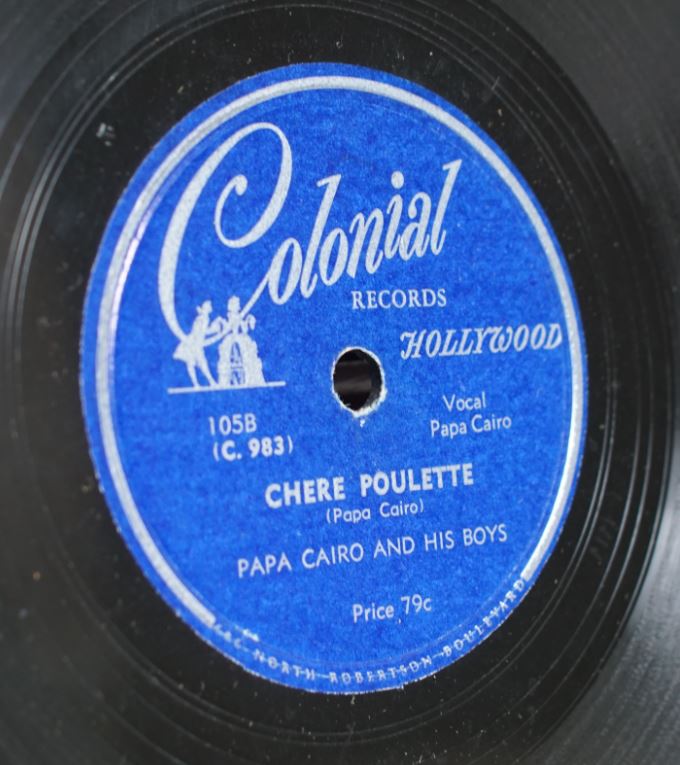
Riding high on the popularity of his previous recording of "Big Texas", he contacted Joe Bihari and together with Chuck Guillory's group, they recorded four more songs.  The first was an English language follow-up to his popular recording, entitled "Big Texas #2".  Then, he created two more songs, a rendition of his original French pre-war recording of "Alons Kooche Kooche" and a Western swing cover of the J.B. Fuselier tune "Chere Tout Tout" entitled "Chere Poulette" (#105).  Similarly, "Chere Poulette" was recorded as "The LeGrange Waltz" by Floyd Leblanc and "Tolan Waltz" by  Papa Cairo and his Boys consisted of Don Lane on xylophone, Murphy Smith on fiddle, Herman Durbin on piano, Albert Roy on guitar, possibly Pete Duhon on bass and Curly Mertz on percussion.   While terms of endearment such as "poulette" and "pou-lute" seem to have been lost to time, in turn-of-the-century France, cute women in Paris were referred to as "poupoule"; as noted in the late 19th century song "Viens Poupoule".  


Oh, mais, chere pou-lute,
'Gardez-donc, mais, quoi t'as fais?
Tu m'as quitte, pour t'en aller,
Pour t'en aller, à lac Arthur, mais, toi tout seul.

Oh, mais, chere 'tit poulette,
'Gardez-donc, mais, quoi t'as fais?
Tu m'as quitte, pour t'en aller,
Pour t'en aller, z-avec un autre, mais, loin de moi.

Oh, mais, chere pou-lute,
'Gardez-donc, mais, quoi t'as fais?
Tu m'as quitte, pour t'en aller,
Pour t'en aller, à lac Arthur, mais, toi tout seul.

Oh, mais, chere 'tit poulette,
'Gardez-donc, mais, quoi t'as fais?
Tu m'as quitte, pour t'en aller,
Pour t'en aller, z-avec 'tit poulette... 


The actual location of this recording session is a bit confusing.  When author Mike Leadbitter of Blues Unlimited caught up with Papa Cairo in 1968 and asked him about the Colonial recording, Papa claims "he was taken back to N.O (New Orleans) to record [Big Texas] under his own name."7  However, other researchers disagree with these details. Author John Broven spoke to Joe Bihari about the session.
I recorded at a radio station in Crowley, Louisiana, the Cajun hillbillies, the original ‘Jole Blon,’ the old French Cajuns. We knew we could sell the records there, purely to sell in Texas and Louisiana, some in Mississippi, too.  They recorded inside out. Their machines recorded from the inside of the disc and came to the outside, instead of the outside to the inside. That’s the way their equipment was set up. Not really a problem, all acetates.8  

Daily Advertiser
Oct 12, 1951

Although record producer JD Miller had a recording studio in Crowley and eventually worked with Papa Cairo and Chuck Guillory separately, the recording quality of these issues suggest that the band wasn't using studio quality equipment.  Author Nick Leigh goes on to affirm the notion, 
Surely these were not Miller tracks.  I don't think it was a case of JD recording Guillory/Cairo and then leasing out the tapes (or acetate) masters, but a Bihari operation during one of his many field trips to the south.5  

Broven thinks maybe the location could have been New Orleans, but not at a formal facility such as Cosimo Matassa's studio.

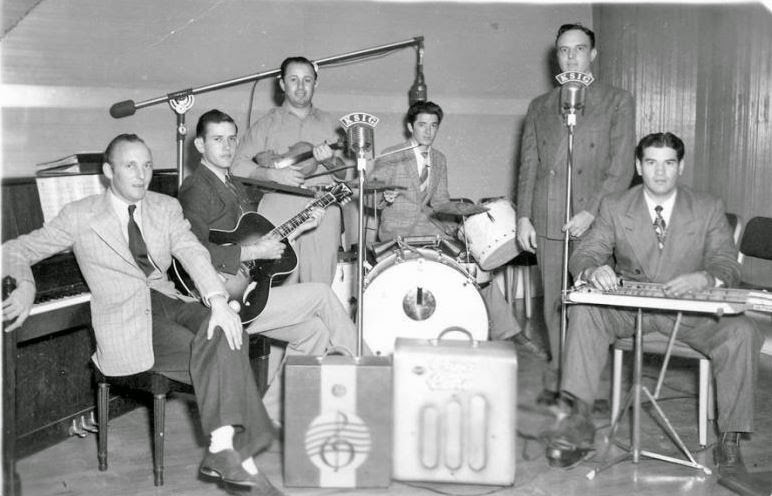
My feeling is that the Chuck Guillory session was cut at KSIG in Crowley in the summer of 1948. After the Modern recordings did fairly well, there were two Papa Cairo sessions in New Orleans in January and February 1949.  As there were still "inside start" acetates  being used, according to the Ace Records, London, database, I think we can assume the sessions were held at a New Orleans radio station.9  


Herman Durbin, Jimmy Newman,
Murphy "Chuck" Guillory, Kersey "Pork Chop" Roy,
R.R. Sagg (emcee), Julius "Papa Cairo" Lamperez
KSIG, Crowley, LA


Oh, well, dear little one,
So look, well, what have you done?
You left me, to go away,
To go away, to Lake Arthur, well, you're all alone.

Oh, well, dear little one,
So look, well, what have you done?
You left me, to go away,
To go away with another, well, far from me.

Oh, well, dear little one,
So look, well, what have you done?
You left me, to go away,
To go away, to Lake Arthur, well, you're all alone.

Oh, well, dear little one,
So look, well, what have you done?
You left me, to go away,
To go away with another... 


After the Biharis folded their Colonial operation and focused on their new label Flair, the following year, Papa teamed up with JD Miller to re-record both an English and French version of "Big Texas" on Miller's Feature label.  However, after Hank Williams released his 1952 hit "Jambalaya", Papa Cairo ceased recording ever again.  After his death, his family kept most of his memorabilia, including his signature steel guitar, with his name embossed on it.


Listen to sound clip sample: Chere Poulette

  1. http://arhoolie.org/leo-soileau-interview/
  2. South to Louisiana: The Music of the Cajun Bayous By John Broven
  3. Record Makers and Breakers: Voices of the Independent Rock 'n' Roll Pioneers By John Broven
  4. Discussions with John Broven
  5. Discussions with Nick Leigh
  6. "Crowley native newest member of CFMA Hall of Fame".  CPS 8-19-2018.  Wade Falcon
  7. 1968 Blues Unlimited - Papa Cairo.  Mike Leadbitter. 
  8. Joe Bihari interview.  John Broven.  2004.
  9. Discussions with John Broven.  10-22-2020
  10. Image courtesy of Brittany L
  11. Lyrics by Stephane F and Herman M

Release Info:
C 982 Kooche Kooche | Colonial 105A
C 983 Chere Poulette | Colonial 105B

Wednesday, October 21, 2020

"Country Girl" - Abe Manuel

Coming from a musical family, Abraham "Abe" Manuel watched his brother Joe help form the Melody Boys with famed local fiddler Harry Choates.  By 1949, Harry was on his own and Joe and Abe teamed up to form a new band with many of Harry's old band members.  The group started touring southern and eastern Texas and south-west Louisiana, using both their own names as well as obscure pseudonyms.


Tout les veuve de la coulée, 
Sont partie z-au village,
Pour acheter de coton jaune a la boutique.
Pour achter des coton jaune,
Pour fait des 'tite mémines,
Pour amener la belle 'tit fille au bal à soir.

All the country gals have gone,
To buy some fancy clothes from town,
They will see the country boys this Saturday night,
They will flutter their little eyes,
Wear lipstick or knot some ties,
Trying to get those poor old boys this Saturday night.

Tout les veuve de la coulée, 
Sont partie z-au village,
Pour acheter de coton jaune a la boutique.
Pour achter des coton jaune,
Pour fait des 'tite mémines,
Pour amener la belle 'tit fille au bal à soir.

They'll go to the fais-do-do,
Where the pretty boys all go,
They'll dance away their cares and do things light,
Gunna turn on all their charm,
As they dance in boyfriend's arms,
When they go a-steppin' on a Saturday night.


Louisiana Hillbillies, KTAG, 1954
Bradley Stutes (steel guitar), Dottie Manuel (guitar),
Amos Comeaux (drums), Abe Manuel (fiddle),
Wiley Barkdull (piano)


By 1954, Abe married into another musical family and his wife Dottie assumed the role of guitarist and part-time vocalist in the band. Her father Jules "Chun" Vincent was a Cajun fiddler from Cameron Parish. The band had a show on KTAG as well as a radio spot on KAOK.1  Together with Buston Olsen, Jerome Stubbs on steel guitar, Merton Thibodeaux or Popeye Broussard on piano, and Ronald "Tinky" Bisette on bass, they covered the famous Happy Fats' original "Le Veuve De La Coulee" as "Country Girl" (#1098) in 1955 for J.D. Miller's Feature Records.


Daily World
Apr 28, 1954


All the widows of the gully,
Have gone to the village,
To buy yellow cotton at the store,
To buy yellow cotton,
To make little bloomers,
To bring the beautiful little girl to the dance tonight.

All the country gals have gone,
To buy some fancy clothes from town,
They will see the country boys this Saturday night,
They will flutter their little eyes,
Wear lipstick or knot some ties,
Trying to get those poor old boys this Saturday night.

All the widows of the gully,
Have gone to the village,
To buy yellow cotton at the store,
To buy yellow cotton,
To make little bloomers,
To bring the beautiful little girl to the dance tonight.

They'll go to the fais-do-do,
Where the pretty boys all go,
They'll dance away their cares and do things light,
Gunna turn on all their charm,
As they dance in boyfriend's arms,
When they go a-steppin' on a Saturday night.


Abe's recording career eventually faded away and he continued to perform until the mid-1960s when Miller invited him to join Cajun fiddler Rufus Thibodeaux for a recording session as a tribute to the late Harry Choates. 


  1. "Cajun Dancehall Heyday" by Ron Yule
  2. Lyrics by Herman M

Release Info:
Hippy-Ti-Yo | Feature 1098
Country Girl | Feature 1098

Find:
Acadian All Star Special - The Pioneering Cajun Recordings Of J.D. Miller (Bear, 2011)