Showing posts with label Breaux Brothers. Show all posts

Wednesday, April 25, 2018

"Home Sweet Home" - Breaux Brothers

Another great cajun musician from the old days, Amedie Breaux, along with his brothers Ophy, Clifford, and his sister Cléoma were sons and daughter of a great accordion player, Auguste Breaux. Auguste was never recorded but his sons made many sides under the name "Breaux Frères" from 1929 through 1934. The Breauxs were one of those big Louisiana family where Cajun music was passed down from father to son and all the children learned to play at a very young age. Amedie was the one who took the accordion.  He learned the instrument quickly, started to play at house-parties at age 14 and became a great player like his father.1


Amedie Breaux

In the fall of 1934, the Breaux brothers traveled to San Antonio, Texas for a recording session for Vocalion where they cut several titles, including this version of "Home Sweet Home."   Clifford Breaux is listed as the lead vocalist, with his brothers credited as additional vocalists.  According to Anthology of American Folk Music author Harry Smith, he points out that this version of the popular song is performed in waltz time:

A well known popular song is here played in waltz time, a dance of much greater importance to the French speaking rural population. The freedom with which the melody is treated, particularly in incorporating long downward runs, is also very typical of Louisiana.

Moi, j'm’en vas de la maison, 

Moi tout seul comme un pauvre, 

Malheureux, mais, c’est toi, 
R’garde, c’est dur après tout ça, 
Oh, c’est dur d'quitter,
Hé mignonne, petite fille,
De m’en aller, hé, tout seul,
Oh malheureux, oh chère, chagrin.

Ah,moi, j'm’en vas de la maison.

Ça c'est dur de m'en aller d'la maison, moi tout seul, 
En tournant , en disant c'tte mignonne fille, "Chère petite fille,
Ça c'est dur, j'ai quitté, chère mignonne, 
Petite fille, m'en aller à la maison, hé, pour ça!"

Ta maman et ton papan étaient contre moi,
Et c’est toi, par rapport à les conseils.
The “Home Sweet Home” (#02961) played by the Breaux Brothers is a very “Cajun-ized” version of a very famous song written in 1823 by dramatist and actor John Howard Payne with a melody by English composer Sir Henry Bishop (the later claimed that it was originally a “sieilian air”, a traditional melody from Sicily). Composed for Payne’s opera “Clari, maid of Milan”, the song became very popular throughout America and even abroad (It is known in Japan as “Hanyū no Yado”). With its beautiful and simple melody and its nostalgic lyrics (“There’s no place like home…”) it was a favorite among soldiers from both sides during the Civil War and of Abraham Lincoln and his wife.2 French-Canadian Joseph Allard recorded a version in 1928, set as a reel entitled "Quadrille de chez nous (Our House/Home Quadrille)", and again in 1945, this time as "Reel de Tadoussac."4  Like the Breauxs, songs like this influenced other Cajun musicians such as Leo Soileau.  He stated: 
When I first started playing, I learned "Home Sweet Home" and "Dixieland" like nobody's business.  I used to play that in school.5 


I'm going home,
All alone like a poor person,
Oh my, well, it's because of you.
Look, it's hard after all that
Oh, it's hard to leave,
Hey cuitie, little girl,
I'm leaving, hey, all alone,
Oh my, oh dear, it's sorrowful.


It's hard to go home alone,
Turning around, saying to that cute girl, "Dear little girl,
All of that is hard, I am leaving, dear cutie,
Little girl, I'm going away to the house, hey, because of all that."

Your mom and your dad were against me,
With you, because of the advice given.

Cowboys and frontier people loved to sing the song too and even made their own versions. It was also a favorite among opera singers and many versions were put on records during the early years of the phonograph.  The song was heard as well in many rural homes and entered the folk repertoire, both as a song and as an instrumental piece. In the South, it became a favorite number to play on the 5-string banjo, and bluegrass players included it in their repertoire.1

The Breaux Frères were not the only Cajun band to record “Home Sweet Home”. Versions can be found by Creole players like Alphonse “Bois Sec” Ardoin and the Carrière Brothers.


  1. https://oldweirdamerica.wordpress.com/2010/08/29/39-home-sweet-home-by-the-breaux-freres/
  2. http://theanthologyofamericanfolkmusic.blogspot.com/2010/03/home-sweet-home-breaux-freres-clifford.html
  3. Harry Smith.  Anthology of American Folk Music.  Liner notes.
  4. http://tunearch.org/wiki/Annotation:Home_Sweet_Home_(1)
  5. http://arhoolie.org/leo-soileau-interview/
  6. Lyrics by Jordy A
  7. NOTE:  Only a few Vocalion labels with the black lettering on a gold box design were ever issued.   This design only appears with a few issues and was short lived.  It is shown at the top.
Find:
Anthology Of American Folk Music Volume Two: Social Music (Folkways, 1967)
Pioneers of the Cajun Accordion (Arhoolie, 1989)
Cajun Vol. 1 Abbeville Breakdown 1929-1939 (Columbia, 1990)
Les Triomphes De La Country Music (Habana, 2002)
Shine on Me - Classic American Folk Songs and Anthems (Get Gone, 2014)

Thursday, January 19, 2017

"Le Blues De Petit Chien" - Breaux Brothers

By 1929, the Breaux Brothers were following in the footsteps of their sister, Cleoma.   They were recording tunes for major labels and playing music alongside many other musicians throughout the countryside prairies.  In June of 1934, John Avery Lomax began touring the Cajun prairies in search of musicians to record for the Library of Congress.  He found the Breaux Brothers in Crowley and setup his portable recording machine, probably at one of their homes.   There, he recorded a tune with the brothers on fiddle, accordion and guitar.  You can make out the bluesy rhythm backed by the first line of English vocals "Let me be your little dog, mama, till your big dog come".   Apparently the recording cuts the song short, but does demonstrate the brother's abilities to sing and play the blues.   Lomax entitled it "Little Dog Blues".1,2 

Oh, laisse moi être ton p'tit chien

Jusqu'à le gros chien vient.

Oh, laisse moi être ton p'tit chien

Jusqu'à le gros chien vient.

Là je voulais t'dire 'tite fille
Tout ça ton gros chien t'a fait.

Oh 'yoù t'as resté hier au soir?
T'as des cheveux tous mêlés,
Et ton linge te fait pas bien.

Oh moi j'ai peur, ton père est après filer.
Si t'as pas un père,
Tout à perdre d'un bord.

1934 Lomax Session Notes
The sexual innuendo is obvious, especially in the insinuation that the lover is actually a whore, leaving for the night, coming back with her clothes all tattered.   According to French musician Marc Chaveau, the term is even more scandalous:

Petit Chien, or "little dog", is sometimes used to refer to a [male] prostitute. 
By October that year, the Breaux Brothers (known as Breaux Freres), left for San Antonio and re-recorded the tune "Le Blues De Petit Chien" (#03053), this time in it's complete form for Vocalion Records and in their native Cajun French.   It is this song that most likely became the main inspiration for the Nathan Abshire's melody in "Pine Grove Blues".3 
Oh, let me be your little dog,
Until the big dog comes,
Oh, let me be your little dog,
Until the big dog comes,
I wanted to tell you, little girl,
All that your big dog has done.

Oh, where were you sleeping last night?
You have your hair all messed up,
And your clothes are not good. 

Oh, I'm afraid your father has taken off,
If you have no father,
You'll lose everything over the edge.

The Breaux's last verse is quite confusing and mysterious.   In one version, the returned lover is being told her father has fled and she might lose her mind.  In another interpretation, there's no father at all.  He's interpreted as "Oh, moi j’ai faim, t’as fait ça pour m’quitter, si t’as pas de cœur, tout à perdre d'un bord" meaning he's hungry, wondering why she left him and that he's going to lose his mind. Other artists used similar droning melodies and blues scales on accordion, such as Lawrence Walker and his 1935 recording of "What’s the Matter Now".

According to author Josh Caffery, the fact that the Breaux brothers performed an English version for a folkloric collection and a French one for a commercial recording could be because record companies were marketing to a French speaking region and Lomax saw this sort of music commercialized enough to only want it sung in English; a version of the song he may have considered "more authentic".3


  1. http://memory.loc.gov/diglib/ihas/loc.afc.afc9999005.27151/default.html
  2. http://www.lomax1934.com/little-dog-blues.html
  3. Traditional Music in Coastal Louisiana: The 1934 Lomax Recordings By Joshua Clegg Caffery
  4. Lyrics by Marc C and Bryan L
Find:
Cajun Dance Party: Fais Do-Do (Legacy/Columbia, 1994)
Cajun Early Recordings (JSP, 2004)

Tuesday, November 17, 2015

"Tiger Rag Blues" - Breaux Brothers

The Breaux Brothers (listed as "Breaux Freres") became one of the earliest to record standard Cajun tunes on with an accordion led group.   Many of the brothers played several instruments, often switching out during house dances.  

"Tiger Rag" by Charles Dornberger & His Orchestra had become very popular in 1927 and while there's no similarity between the two songs, it's possible this was an ode to the group and their popular song. 

Like the original "Tiger Rag", it's a quick pace accordion-led song, labeled as "blues", yet becoming one of the first Cajun interpretations of New Orleans jazz.

The Vocalion session in San Antonio in 1934 really produced the largest single set of songs by the Breauxs that they ever attempted to record.  The following year, his brother-in-law Warnes "T-Neg" Schexnayder backed up Happy Fats and Nathan Abshire on guitar with their version entitled "Gueydan Breakdown".  

Amede Breaux and Ophy Breaux1
One has to question why the brothers never recorded for a major label again after this point. Their family issues became well known and most likely had an effect on their future music career.  


  1. Image by Chris Strachwitz


Find:
Louisiana Cajun Music Vol. 2: The Early 30s (Old Timey/Arhoolie, 1971)
Cajun Dance Party: Fais Do-Do (Legacy/Columbia, 1994)
Cajun Origins (Catfish, 2001)
The Perfect Roots & Blues Collection (Sony, 2015)

Monday, May 4, 2015

"Fais Do Do Negre" - Breaux Brothers

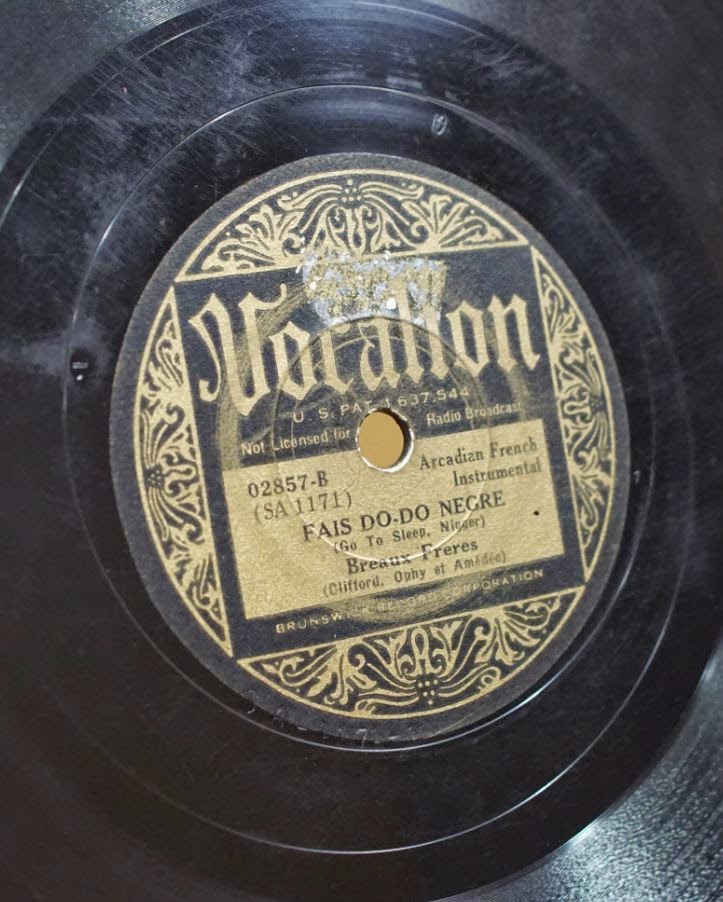
Once the Breaux brothers (listed as Breaux Freres) showed the recording industry the type of success they could generate by recording "Ma Blonde Est Partie" in 1929 for Columbia, the Vocalion label had them come to San Antonio in 1934 for a marathon recording session. There without Cleoma, they laid down many tracks which would become standards in years following. One of the tunes they recorded in October that year was "Fais Do Do Negre" (#2857) with Ophy Breaux on fiddle, Amadie Breaux on accordion and vocals, and Clifford Breaux on guitar.  

Fais do-do, fais do-do mon nègre,
Dans les bras de ta chère vieille maman.  
Va donc là-bas, réveille toi, 
C’est l’heure d’aller à l’ouvrage. 
Hey, vaurien !


Pour la cause tu connais (?) 
‘Tit nègre mais chère maman  
Réveille-toi, bon matin, 
C’est l’heure d’aller à l’ouvrage.

Fais do-do ‘tit nègre, 
Dans la bras d’ta mam, 
Fais do-do, ‘tit nègre, 
Réveille-toi. 
Hey, hey.

Réveille-toi ils disent.
The song is a fast paced waltz, casually asking a little boy to sleep in his mother's arms followed by waking him up to go to work.  It's one of the earliest Cajun songs to have developed in the prairies. It became one of the most favorite waltzes during the 1920s outside of "Jolie Blonde" and "Allons A Lafayette".3  

Fais do-do is also a name for a Cajun dance party, originating before World War II. According to Mark Humphrey, the parties were named for "the gentle command (‘go to sleep’) young mothers offered bawling infants.” He quotes early Cajun musician Edwin Duhon of the Hackberry Ramblers, 


“She’d go to the cry room, give the baby a nipple and say, ‘Fais do-do.’ She’d want the baby to go to sleep fast, ’cause she’s worried about her husband dancing with somebody else out there.” 

Do-do itself is a shortening of the French verb dormir (to sleep), used primarily in speaking to small children. Comparable to the American English ‘”beddy-bye”, it is still commonly used by French-speaking people. According to author Stivale, "neg" and "negresse" are corrupted forms of the word "negre" which in Cajun french has an endearing meaning such as "hey, my man" or "hey, honey", completely void of racial tones.
Sleep, sleep, my little boy, 
In the arms of your dear old mom. 
Now, get out there! Wake up! 
It's time to go to work. 
Hey, ya rascal!


You know the reason, 
Little boy, for your dear mother, 
Wake up! It's morning!  
It's time to go to work.


Sleep, my little boy,

In the arms of your mom.

Sleep, my little boy,

Wake up!

Hey, hey!

Wake up, we said!


  1. https://oldweirdamerica.wordpress.com/2010/08/29/39-home-sweet-home-by-the-breaux-freres/
  2. Disenchanting Les Bons Temps: Identity and Authenticity in Cajun Music and Dance by Charles J. Stivale 
  3. The Eunice News (Eunice, Louisiana) 30 Aug 1962


Find:
Louisiana Cajun Music Vol. 2: The Early 30s (Old Timey/Arhoolie, 1971)
Cajun Dance Party: Fais Do-Do (Legacy/Columbia, 1994)
The Perfect Roots & Blues Collection (Sony, 2015)

Wednesday, September 17, 2014

"Vas Y Carrément (Step It Fast)" - Breaux Brothers

During the Breaux Brother's first session in 1929 where they recorded the first version of Jole Blon called "Ma Blonde Est Partie", they also recorded "Vas Y Carrément" better known as "Step It Fast". Columbia and Okeh released this song on the flip side. This instrumental melody would be a hard driving, rhythmic song with a relatively quick tempo for Cajun music of the time. 

Cleoma can be heard strumming the guitar vigorously. Alan Lomax would travel to Louisiana in 1934 and record the Segura Brothers sing and play a similar melody entitled "Les Filles a Albert Moreau". The songs was about a fictional pimp named "Albert Moreau" and his ladies of the night.

Leo Soileau used the melody in one of his first string band recording sessions, entitling it "Paroi Acadia Breakdown".  In 1937, the song title would change slightly with the Hackberry Rambler's song called "Pas Aller Vita", also referred to as Step It Fast. This Cajun swing instrumental would be recorded in New Orleans for Bluebird stylized by Luderin Darbonne's fiddle playing. In 1949, Nathan Abshire would record this melody live at a radio station in Lake Charles, Louisiana. 
Amedie Breaux, 1960

Even though Nathan Abshire would eventually wax the tune as "Step It Fast" on Khoury's, in 1949, and "Ain't No More" by the Texas Melody Boys, it would Joe Bonsall and The Orange Playboy's 1963 recording of the song "T'en as eu, T'en auras plus" that brought along the melody's popularity.  

It's one of the quickest melodies in all of Cajun music.


  1. South to Louisiana: The Music of the Cajun Bayous By John Broven
  2. Louisiana Women: Their Lives and Times edited by Janet Allured, Judith F. Gentry
  3. Crossroads: A Southern Culture Annual edited by Ted Olson
  4. Traditional Music in Coastal Louisiana: The 1934 Lomax Recordings By Joshua Clegg Caffery
Find:
Louisiana Cajun Music Vol. 5: The Early Years 1928-1938 (Old Timey/Arhoolie, 1973)
Cajun, Vol. 1: Abbeville Breakdown 1929-1939 (Sony/Columbia, 1991)
Les Cajuns Best Of 2002 Les Triomphes De La Country Volume 12 (Habana, 2002)
Cajun Music (Goldenlane, 2009)
The Perfect Roots & Blues Collection (Sony, 2015)

Monday, August 25, 2014

"Ma Blonde Est Partie (My Blonde Went Away And Left Me)" - Breaux Brothers

The original "Jole Blon".  This Cajun melody is over 100 years old and originates as 3 different tunes almost all at the same time. 

The first instance is recorded by Amade Breaux, written by his sister Cleoma, entitled "Ma Blonde Est Partie" in 1929 for Columbia (40510-F) and Okeh (90010). It was almost a year after "Lafayette" was recorded.  Joe and Cleoma were invited by Columbia to travel there and record more songs.  This time, they brought along Cleoma's brothers, Amedie and Ophy. According to Cleoma's daughter, while Amede Breaux is credited with writing the song, it was his sister Cleoma Breaux who actually wrote the lyrics while Amede sang the song. The family claims Cleoma wrote the tune about Amede's first wife.  

However, Dennis McGee claims the melody was much older, performed by Angelas Lejeune during WWI.  According to Wade Fruge', "We'd play 'Jole Blon' and my grandpa learned them from people before him. That makes the song about 200 years old".6  In those days, "Jolie Blonde" was known to musicians as the "Fruge Two Step", "The Courville Waltz" or "The Savoy Waltz".  Cajun music was passed down from father to son.7 
Cleoma Breaux and Joe Falcon


Jolie blonde, regardez donc quoi t'as fait,
Tu m'as quitte pour t'en aller,
Pour T'en aller avec un autre, oui, que moi,
Quel espoir et quel avenir, mais, moi, je vais avoir?
Jolie blonde, tu m'as laisse, moi tout seul,
Pour t'en aller chez ta famille.
Si t'aurais pas ecoute tos les conseils de les autres
tu serait ici-t-avec moi aujourd 'hui
Jolie blonde, tu croyais il y avait just toi,
Il y a pas just toi dans le pays pour moi aimer.
Je peux trouver just une autre jolie blonde,
Bon Dieu sait, moi, j'ai un tas.
Amede Breaux

Separately, Angelas Lejeune would record the same melody and call it "La Fille De La Veuve" in 1929 and both Amadie Ardoin and John Bertrand would record the melody calling it "La Valse de Gueydan" in 1929 for Paramount and Brunswick.   The Leo Soileau's cousin Alius and Oscar Slim Doucet took this melody and created "When I Met You At The Gate" the same year.  It wouldn't be until 1936 when the tune is recorded with the title "Jolie Blonde" by the Hackberry Ramblers.

The original Cajun version is a brief address to a "pretty blonde" who had left the singer and moved back in with her family, and is also now in the arms of another man. The singer concludes that there are plenty other women, and pretty blonde women out there that he can find. 


Pretty blond, look at what you've done,

You left me to go away,

to go away with another, yes, than me,

What hope and what future am I going to have?

Pretty blond, you've left me all alone

To go back to your family.

If you had not listened to all the advice of the others

You would be here with me today.

Pretty blond, you thought there as just you,

There is not just you in the land to love me.

I can find another pretty blond,

Good God knows, I have a lot.

Yet, the song doesn't become famous until Harry Choates records it in 1946 for Goldstar giving it the title "Jole Blon".  Afterwards, the song ends up getting recorded by many musicians including Bruce Springsteen. Jole Blonde is often referred to as the Cajun national anthem due to widespread popularity and due to the historical nature of the song.

In 2017, the influence of their song made it's way into the PBS documentary "American Epic", discussing the life and times of the Breaux Brothers along with the importance of their signature song.


  1. http://www.knowla.org/entry/1395/
  2. Encyclopedia of Great Popular Song Recordings, Volume 2 By Steve Sullivan
  3. Louisiana Women: Their Lives and Times edited by Janet Allured, Judith F. Gentry
  4. Cajun Country By Barry Jean Ancelet, Jay Edwards
  5. Continuum Encyclopedia of Popular Music of the World Volume 8: Genres: North ... edited by John Shepherd, David Horn
  6. Cajun Breakdown : The Emergence of an American-Made Music By Ryan Andre Brasseaux
  7. Poor Hobo: The Tragic Life of Harry Choates, a Cajun Legend by Tim Knight
Find:
Louisiana Cajun Music Vol. 5: The Early Years 1928-1938 (Old Timey, 1973)
Cajun Early Recordings (JSP, 2004)
Cajun Dance Party: Fais Do-Do (Legacy/Columbia, 1994)
Cajun Origins (Catfish, 2001)
Jole Blon - 23 Artists One Theme (Bear, 2002)
The Perfect Roots & Blues Collection (Sony, 2015)
Cajun Capers: Cajun Music 1928-1954 (Proper, 2005)
The Beginner's Guide to Cajun Music (Proper/Primo, 2008)
The Perfect Roots & Blues Collection (Sony, 2015)