A unique window into the world of Cajun music between 1928 and 1965. Compiled histories from websites, books, news articles, liner notes, and interviews. Most come from my personal 78 collection. Also covering Creole, Cajun-Country, and Cajun swing.
Showing posts with label Angelas Lejeune. Show all posts
Showing posts with label Angelas Lejeune. Show all posts
Petite Ou Gros! The famous Creole melody that inspired so many covers, most notably "Les Flammes D'Enfer" in the later years of Cajun repertoire. The original tune, "Adieu Rosa", would be covered in it's raw form by Dennis McGee. Other musicians such as Joe Falcon, Leo Soileau, Moise Robin and Douglas Bellard all created their own renditions of this bye-gone song. It's about a love-interest begging a mother for either of her daughters' hands in marriage. Either the skinny one or the large one—it doesn't matter.
Ah, ye yaille, la malheureuse.
Aye, ye yaille.
Madame donnez-moi les, ouais,
La petite ou bien la grosse,
La petite elle est mignonne,
La grosse, elle est si belle.
Aye ye yaille, petite.
Madame donnez-moi les, ouais,
La petite ou bien la grosse à cause,
Si j'en ai une,
C'est tout que moi je voudrais.
Quitte-moi, vous dire,
Comment j'veux t'croire,
J'en aurais pas une,
Ni la petite ni bien la grosse,
Falloir dire, ouais madame,
Moi j'vas voler la grosse,
Vas pas la garde la belle,
Ça m'lesse tout seul.
Ah, ye yaille, la malheureuse.
Richard Voynow
Angelas' first session was produced by Brunswick's A&R representative Richard Voynow. A jazz pianist and composer for The Wolverine Orchestra, Voynow dabbled in finding artists for the record label. During a lengthy expedition into the south, he supervised Lejeune, Fruge and McGee's 1929 session with several area musicians from the Opelousas area. By November of 1930, the label held their final session in New Orleans in which Angelas and Ernest were waxing another set of songs to disc. For this recording, "Madame Donnez Moi Les" (#527), Angelas put down his accordion and let his vocals ride along Ernest's fiddle melody. It's one of the few recordings that allow listeners to hear Fruge's fiddling talent dominate and it would be the duo's very last recording ever.
Oh, ye yaille, miserable woman.
Oh, ye yaille.
Madam, give them to me, yeah,
The little one or the big one,
The little one, she is cute,
The big one, she is so beautiful.
Oh, ye yaille, little one.
Madam, give them to me, yeah,
The little one or the big one because,
I have to have one,
That's all I want.
Leave me, you said,
How I wanted to believe you,
(Now), I won't get one,
Neither the small one nor the big one.
Have to say, yeah madam,
I'm going to steal the big one,
Don't protect the beauty,
It hurts me to be alone.
Oh, ye yaille, miserable woman.
The melody influenced many other pre-war Cajun tunes such as Joe Falcon's "Acadian One Step", Leo Soileau's "Demain C'Est Pas Dimanche" and Bixy Guidry's "Ella A Plurer Pour Revenir". Leo would rework the song in the 1930s as "Petit Ou Gros", made famous by Joe Bonsall in the 1960s.
Lyrics by Stephane F and Herman M
Release Info:
NO-6727 Valse A Aristil Creduer | Brunswick 577
NO-6728 Madame Donnez Moi Les | Brunswick 577
Find:
Let Me Play This For You: Rare Cajun Recordings (Tompkins, 2013)
Cajun accordionist Angelas Lejeune and fiddler Ernest Fruge made their last recording session in 1930 alongside other artists such as Dennis McGee and Amede Ardoin. The session was conducted by musician and artist scout Richard Voynow. He had recently spent three months on the road recording artists in southern towns such ad Knoxville, Memphis and San Antonio. He recalled that his entire session included the types of records known in the trade as the 'hillbilly, French-Cajan, race and popular.'1 Afterwards, Lejeune returned to his home community of Pointe Noire, located near the area of Marais Bouleur.
Oh petite, chère,
Moi j'suis là, jolie,
Quoi faire tu m'fais ça?
Oh petite, chère,
Mais, toi t'es partie,
Tu m'laisses dans les misères.
Oh jolie,
Mam'zelle, j'aime pas
Tu m'parles comme tu m'parles.
Oh, j'connais pas quoi,
Petite, j'pourrais dire c'que j'suis aujourd'hui,
Oh j'suis condamné,
Pour tout(e) ma vie, à la misère.
Oh petite, chère,
Rappelle-toi quand j'ai parti pour m'en aller
Tu t'as mise à pleurer,
C'est là eyoù j'ai pris la parole,
Que j't'ai demandé, chère, fais donc pas ça.
Pour en revenir, (petite*),
Tu connais mon cœur est aussi gros qu'le tien,
Mais, donne moi une chose,
Que j'peux supporter et si vrai qu'le tien.
Add caption
"One Step Du Maraist Bouler" (#511) is a lively tune named after an area north of Scott, Louisiana where the low lying area retained water. The name "Bouleur", however, has been a source of speculation. According to reverend Donald Hebert, who was a pastor there, heard an old a story about how a horse named Bouleur liked to stay in a swampy area, the marais, where he could roll in the mud. According to the story, that’s how the place became Bouleur’s Marais and then Marais Bouleur. Hebert said he heard the same story from several people and it was the only consistent version of how the place got its name.2 Others had speculated that the name identified a bully of the swamp, as suggested by author Darrell Bourque in his "Plainsongs Of The Marais Bouleur" and Barry Jean Ancelet's "Rednecks, Roughnecs and the Bosco Stomp". Aldus Roger's wife Bernice provides an alternative source of the name:
Marais Bouleur was just this side of Bosco. When my grandmother, the Boullion generation, came from New Orleans, they settled there. A marais is like a swamp. Wild ducks would come there.3
Oh, little dearie,
I'm here, pretty one,
What are you doing to me?
Oh, little dearie,
Well, you left,
You left me in misery.
Oh, pretty one,
Mademoiselle, I don't like that,
You said what you said.
Oh, I don't know what,
Little one, I could say that I am today,
Oh, I am condemned,
For all my life, in misery.
Oh, little dearie,
Remember when I left to go,
You had started to cry,
This is where I had said the words,
That I asked you, dear, don't do that.
Coming back, little one,
You know my heart is as big as yours,
Well, give me one thing,
That I can carry and that it's truly yours.
In 1967, Cajun accordionist Ambrose Thibodeaux, who was familiar with many of Angelas' tunes, re-recorded the song as the "Pointe Noir Two Step" as an ode to Lejeune's home town.
Release Info: NO-6708 One Step Du Maraist Bouler | Brunswick 511 NO-6709 La Valse A Tidom Hanks | Brunswick 511 Find: Let Me Play This For You: Rare Cajun Recordings (Tompkins, 2013)
Cajun accordion player Angelas Lejeune had learned to play at a young age. By World War I, teenage Lejeune had become part of the region's musical network, collaborating and interacting with both Amede Ardoin and Dennis McGee. LeJeune developed into a visible figure on southwest Louisiana's dance circuit, sometimes performing five nights a week at house dance in and around the rural Pointe Noire community.2 Demand for French music also called the accordionist away to play lucrative gigs as far away as Texas. After playing a dance in Lake Charles, Louisiana, McGee, Lejeune, and fiddler Ernest Fruge continued west to perform in Shiner, Texas. Dennis recalled:
And over there, they tapped their feet. They jumped up, they cried out...they danced, danced, sweated, sweated.2
Oct 1, 1929
Eh, chère, malheureuse, petite,
Criminelle, quoi faire tu fais ça avec ton nègre.
Oh, toi, quand j'ai parti pour aller,
Dans le Texas t'as parti, quoi mieux* 'tit monde, malheureuse.
Oh, éyou, (que) j'ai eu tout ma misère,
C'est quand j'ai parti pour en revenir dans la Louisiane, qui est misérée.
Oh chère, si t'aurai voulu m’écouter,
Tu serais pas dans les chemins aujourd'hui, mais, comme t'es,
Tu connais, chère, tu vas voir ton erreur,
Tout ça là, pour tout ça tu m'as fait, malheureuse.
The receptive Texas audience paid the three musicians $80 for their appearance. After winning an accordion contest back home, he and Ernest Fruge, along with many other Cajun musicians from the area descended on New Orleans in 1929 for a massive Vocalion/Brunswick recording session. He would be called up the following year with Fruge and the duo would wax the tune "La Valse Du Texas" (#530). In 1934, Ardoin took the melody and stepped it up from a waltz to a two step, creating the "Le Midland Two Step". McGee recalls playing with all of them:
I played with both accordion players. Angelas and Ernest and I played together as a trio. When I played with Amede, we played just the two of us.1
Angelas Lejeune (accordion)
Hey, dear, oh my, little one,
You're terrible, why have you done that to your man?
Oh, you, when I left to go,
To Texas, you left me, for the best*, little everything, oh my.
Oh, where are you, I've been in complete misery,
That's when I left to return to Louisiana, which has been miserable.
Oh dear, if you had just wanted to listen to me,
You would not be wandering today, well, like you are,
You know, dear, you'll see your mistake,
All that over there, for all that you've done, oh my.
Angelas never continued his recording career and the song lost it's popularity until after World War II, when accordion player Belton Richard converted the tune into his more well-known 1967 "Cherokee Waltz". Musician and native of Angelas' home town, J.C. Leger explains:
I love Angelas' playing so much. I find that all those accordion players born between 1890 and 1910 had a similar attack on the accordion, playing a discernible melody on a hard rhythm with space in the phrasing. It transcended race or region. I like to believe their playing to be the embodiment of the spirit of their culture at the time. They learned without the influence of recorded Cajun music. It's pure and beautiful and alive.3
Release Info: NO-6715 One Step A Cain | Brunswick 530 NO-6716 La Valse Du Texas| Brunswick 530 Find: Let Me Play This For You: Rare Cajun Recordings (Tompkins, 2013)
One the most impassioned stories in Cajun folklore that has been mostly lost to time is that of Adam "Tit 'Dom" Hanks and Alice Royer: The Cajun Romeo and Juliet.3 Angelas Lejeune and Ernest Fruge teamed up together to tell the legend of Hanks and Royer. It involved a horse named Henri.2 According to columnist William Thibodeaux of Lafayette:
It's an Amercian love story, not unlike a lot of others. Adam "Tee Dom" Hanks and Alice Royer were sweethearts, but Alice's papa didn't approve of Tee Dom. Figured he wouldn't make a good son-in-law and so they disapproved of their engagement. They obeyed Alice's papa. Alice soon married someone else and left Tee Dom with a broken heart.1
Oh, chère, malheureuse, chère, petite.
Oh, chère, criminelle, oh, quoi t'as fait z'ave(c) moi aujourd'hui.
Oh, Alice 'garde Adam, il est après venir,
Oui prépare toi moi j'veux voir il est apres venir, aujourd'hui.
Ça qui fait j'te dis ça, moi j'le vois il est après venir, (sur) le grand wrack* sur Henri,
Moi, j'le connais pas tu vu ton vieux nég'.
Oh chère, 'garde ton neg' qu'est après arriver, pour toi aujourd'hui.,
Quoi faire que tu m'fais tout ça, toi tu m'fais.
'Garde, tu m'fais plus d'mal à moi,
Dis (à) 'ton nég' que t’écoutes les conseils que les autres t'en mal.
Chère, tu connais si tu voudrais observer pour toi-même,
Tu peux te sauver des misères à pas écouter les conseils.
Adam "Tee Dom" Hanks Courtesy of Pierre Daigle
Researcher Pierre Daigle uncovered the true story in the early 1970s. In the original tune, Tee Dom sang "Il a la jogg au plombeau, et le chapeau sur une coté". The reason for their disapproval was that Tee Dom loved to ride his horse Grand Henri while drinking from a whiskey jug. He would ride with his chapeau (hat) cocked to one side, meaning, he didn't give a hoot about a thing. The heartbreaking story of Tee Dom and Alice spread throughout the land, and a beautiful waltz was created. Finally, Tee Dom relented an married Armena Thibodeaux, and together they raised seven children. Years went by, but time didn't mend Tee Don's broken heart. He was still in love with Alice. According to Pierre,
Despite being married, whenever Tee Dom went to house dances he would sing and play his accordion to the melody of "La Valse a Tee Dom" as tears flowed down his cheeks.1,2
Alice eventually married Edmond Miller and the family moved around the Scott/Judice area of Lafayette. In 1930, Angelas was given permission by Tee Dom to use the lyrics of his song when he recorded "La Valse a Tidom Hanks" (#511) in New Orleans. Pierre searched for Angelas Lejeune and he explained,
It's true. The night before I went to cut the record, I talked to Tee Dom and asked him if I could use his words. He said I could.2
Angelas Lejeune
Oh, dear, oh my, dear little one.
Oh, dear, it's criminal, oh, what you've done with me today.
Oh, Alice, look at Adam, he's coming back,
Yeah, prepare yourself, I want to see, he's coming back, today.
That, which I've done told you that, I see he's coming back, on the big horse* Henri,
I don't know if you see your old man.
Oh, dear, look at your man who is arriving, for you, today,
What you've done to me, all of that, you've done to me.
Look, you've hurt me the most,
Tell your man that you listening to the advice of others has hurt you.
Dear, you know if you'd like to see for yourself,
You can save yourself from misery by not listening to advice.
Alice Royer Miller Courtesy of Pierre Daigle
When he arrived home, while playing a dance in Duson, a woman approached Angelas. Angelas explained,
A woman came to the bandstand. "Are you Angelas Lejeune?" she asked. "Yes," I answered. "Are you the one that recorded 'La Valse a Tidom Hanks'?" "Yes, I am". "Would you play it and sing it as you did on the record?" she asked. So I played it. And all that time that I played she stood behind me on the band stand. When the song ended, she walked away. She looked... well, moved.2
Pierre eventually found Alice living in Judice. She claims that one night at a dance near Bosco, Tee Dom told the late Lawrence Walker the words to the song. The legend would carry on into Walker's "Chere Alice", referring to the sweet Alice Royer, a melody borrowed from his earlier "Country Waltz". The melody can also be found earlier in Joe Falcon's "La Valse de Baldwin", Leo Soileau's "Valse de Josephine" and later in Austin Pitre's "Rainbow Waltz". Alice eventually confessed to Pierre,
[Tee Dom] is the man I would have married had it not been for Papa.2
"The Legend of Tee Dom and Alice". Discussions with William J. Thibodeaux. The Daily Advertiser (Lafayette, Louisiana) 13 Nov 2011
Tears, Love and Laughter by Pierre Daigle
"Du Chicot": A Collection of Essays by Randy Whatley
Lyrics by Stephane F
Release Info:
NO-6708 One Step Du Maraist Bouler | Brunswick 511
NO-6709 La Valse A Tidom Hanks | Brunswick 511
Find:
Let Me Play This For You: Rare Cajun Recordings (Tompkins, 2013)
As the traditional melody of Jolie Blonde made its way around the prairies of south Louisiana, the theme and associated lyrics took on different forms in niche areas throughout the 1920s. Unlike the musicians living in Rayne and Crowley such as the Breaux Brothers, the musicians living in and around Church Point had their own unique theme for the song. Accordionist Angelas Lejeune and fiddler Ernest Fruge introduced their version of the tune during a recording session in 1930 called "La Valse De La Veuve" (#558). As fiddler Wade Fruge recalled, the melody was much older than when the Breaux Brothers had first decided to record it. However, instead of singing about a jolie blonde, Angelas chose to sing about a lonely widow and her daughter. During an interview, Lejeune was asked who the fille de la veuve (daughter of the widow) was. He recalls:
She was the daughter of a man we called "Doo Doo" Matte. She later became Mrs. Dave Ledoux. But at the time the words were composed, she lived with her mother. Her father was dead. They lived in Pointe Noir.1
Tu fais ça avec ton nèg', après m'quitter, pour m'en aller.
Oh, chère tite fille, la fille de la veuve, oui, qui est là,
T'étais si belle et si mignonne, oui, ton toupet qui était si bien coupé.
Oh, petite!
Oh, chère tite fille, tu connais t'es tout le temps, oui-z aimer,
Mais, doucement avant de mourir, les flammes d'enfer, pauvre vieille mam' avec ton nègre.
...
The fille was Emma Matte Ledoux. Her father was known in the community as Joseph "Doo Doo" Matte and his wife, Josephine Doucet, was affectionately known as Madame "Doo Doo". What makes this version unique is the phrase "toupet qui était si bien coupé", referring to the way she cut her hair, typically the front bangs. Originally issued on the Brunswick recording label, it seems Melotone (#18052) re-issued these recordings much later, possibly in 1934. Author Tony Russell explains:
Melotone was an American-manufactured series marketed to French-speaking Canadians, whether in Québec or in New England.2
This issue with the dark green logo on the gold circle seems to be the last one in that particular series.
Oh, it's terrible, it's criminal, it's miserable.
Oh, dear pretty one, dear little girl, how come you've done this?
You did that to your old man, leaving me, to go away.
Oh, dear little girl, daughter of the widow, yeh, who is there,
You were so beautiful and so cute, yeh, your forelock that was cut so well.
Oh, little one!
Oh, dearl little girl, you know you're always, hey, lovely,
Well, I'm slowly dying, into the flames of hell, your poor old mom with your dad.
...
This version must have had made some influence further south since Vermilion Parish musicians, the Segura Brothers, recorded essentially the same song in 1934 for John and Alan Lomax. By 1954, inspired by his cousin Angelas' recording, Cajun accordionist Iry Lejeune resurrected the tune, in which Eddie Shuler mis-titled it as "La Fitte La Vove". In it, he specifically calls out Madame Doo Doo. Cousin Rodney Lejeune would do the same for Swallow Records in 1958. Regarding Angelas' music, collector Eric Simkin states:
I just find these Cajun melodies overwhelming beautiful. Other-world. The primitive-ness of the sound countered by tremendous playing talent is so moving. Like the greatest blues.3
Tears, Love, and Laughter: The Story of the Acadians by Pierre Daigle
Discussions with Tony Russell
Discussions with Eric S
Lyrics by Stephane F
Release Info:
NO-6700 La Petite One Step | Brunswick 558 Melotone M18052-A NO-6701 La Valse De La Veuve | Brunswick 558 Melotone M18052-B
Find: Pioneers of the Cajun Accordion (Arhoolie, 1989) Let Me Play This For You: Rare Cajun Recordings (Tompkins, 2013)
Angelas LeJeune, who was great-uncle of Iry LeJeune from the Point Noire area near Church Point and known to the community as Nonc Jack, won an accordion contest in Opelousas in 1929. First prize was a trip to New Orleans to record with legendary fiddlers Denus McGee and Ernest Fruge. While there, he recorded a fast-paced instrumental that would later become the well-known "Crowley Two Step" made popular by Aldus Roger.
The Brunswick/Vocalion session in New Orleans that fall was an iconic one, featuring some of the most influential of early Cajun artists such as Moise Robin, Ernest Fruge, Douglas Bellard, Leo Soileau and Dennis McGee. Many of them would later play dances with each other.
Angelas Lejeune
Dennis joined Angelas and others after sharecropping for years:
When I stopped playing music, I stayed a long time without playing again. I don't know why, I was just tired of all that. I didn't enjoy playing any more. I worked in the fields. I couldn't work hard in the fields all day and play all night. Then, I decided that I was tired of that and I started playing the fiddle again. That's when I started playing with Amede Ardoin and Angelas Lejeune and Ernest Fruge.1
One of those plantations that many people farmed on in St. Landry parish was the Isaiah Cain plantation. "One Step A Cain" (#530) may have been an ode to this prominent area farmer and land owner.
In 1934, Amede Breaux re-titled the song as "Le One Step A Martin", adding a handful of lyrics to the tune. Angelas' song would live on, reinvented around 1962 by Aldus Roger. Not to be confused with the Doc Guidry recording of the same title, the "Crowley Two Step" would become the staple of Aldus' TV performances on KLFY, often heard as the first song during the show's opening.
Release Info: NO-6715 One Step A Cain | Brunswick 530 NO-6716 La Valse Du Texas| Brunswick 530 Find: Let Me Play This For You: Rare Cajun Recordings (Tompkins, 2013)
Angelas Lejeune became one of the unsung heroes of Cajun music who helped propel Dennis McGee into the fiddle-playing limelight. Growing up around Pointe Noire, Louisiana, he, Dennis and Ernest Fruge teamed up to play as a trio around south Louisiana. During one of his sessions in New Orleans for Brunswick records, he recorded the tune "Valse De La Lousianne" (#369). Similar to Columbus Fruge's "Pleur Plus" and Bixy Guidry's Qu'Est Que J'Ai Fait Pour Etre Peuni Si Longemps?", and Anatole Credure's "Lacassine Waltz", it was a tune that inspired Iry Lejeune's 1954 "La Valse de Cajun". According to Neal Pomea:
One listening to the Vieille Valse de la Louisiane, especially the bridge or "turn," will show what a powerful player he was. Brilliant! 1
Ohh, p’tit bébé, viens-toi-z-avec ton pop, ouais, dans la Louisiane.
Ohh, quittes ta mom pour t’en venir avec ton pop pour finir tous nos jours.
Ohh, gardez-donc comment ton pauvre papan est tout le temps dans les douleurs.
Ohh, quittes ton pop et ta mom pour t’en venir avec ton neg dans la Louisiane.
Ohh, jongle bien, tu vas avoir les misères que je passe pour, malheureuse.
Angelas Lejeune
Like many musicians living in south Louisiana, he was a fan of playing music for family. His music was remembered and enjoyed by those that remembered him. According to neighbor and friend Debi Morain:
How well I remember him playing...he always joined us on Christmas Eve and played for our gatherings. When I'd visit, he'd always play and sing for us, sitting outside on his porch. His wife was a 'traiteuse' and treated us for sun and heat strokes. What wonderful memories I have of them and, of course, his music!
According to his niece Candance McIntyre:
How I loved his music and his singing and the "get-togethers" we all had as a family. His wife aunt Doris was such a sweet lady and she and my grandmother were the greatest of friends. We would have old time home dancers and that is where I learned to dance and how I love to dance. Listening to this music brings back such warm memories.
Oh, little baby, come with your pop, yeh, to Louisiana.
Oh, leave your mom to come with your pop forever.
Oh, so look at that, how your poor papas always in great sorrow.
Oh, leave your pop and your mom, you come with your man to Louisiana.
Oh, remember well, you'll have the same misery which I passed (lived through), oh my.
According to Cajun accordion player Ambrose Thibodeaux,
I learned La Vieille Valse de la Louisiane from Angelas Lejeune. He recorded it and I listed to him play it. I recorded it in my head. I heard it several times and I'd replay it till I knew it. Angelas was like me, he liked that old waltz a whole lot.3
According to Cajun musician and accordion builder, Bryan Lafleur, he states:
It's an early version of "Cajun Waltz". I especially love the way he does the turn, which I haven't heard anyone do like him except Michael Doucet in his recording called "Angelas' Waltz", which seemed to be a fiddle copy of Angelas' song.2
http://npmusic.org/artists.html
Discussions with Bryan L
Ye Yaille Chere by Raymond Francois
Lyrics by Jordy A and Stephane F
Find:
Let Me Play This For You: Rare Cajun Recordings (Tompkins, 2013)
A mostly obscure artist, many of modern Cajun tunes can be traced back to some of the earliest recordings of musician named Angelas Lejeune. Angelas Lejeune was a fantastic, skilled accordion player that played for friends and family. Here, he sings about a mythical place called Bayou Pom Pom, made popular by the comedian Walter Coquille in the 1920s and 30s. Also spelled Pon Pon, he named the tune after this location "Bayou Pom Pom One Step" (#370). The song has become one of the most popular recorded Cajun songs since the 1950s.
Oh, c’est malheureux, chère,
C’est malheureux de t'voir,
Apres m'quitter.
Oh, rappelle-toi bien la fois,
J’étais avec toi su l'pont,
Du Bayou Pon Pon, chere.
Oh, c'est malheureux de m'voir,
Comment j'suis là, aujourd'hui,
Tout l'temps dans la misère.
Oh, tout partout ou je peux aller,
Mais, où ça s'rassemble il faudrait,
Que je t'voye avec ton neg.
Oh, moi j'connais ca tout a l'heure,
Tu vas regretter tes accroires,
T’es après faire avec moi.
In 1929, Angelas recorded during a Brunswick/Vocalian session that lasted from Septempber 30th to October 2nd in New Orleans. It was sponsored by an Opelousas newspaper that chose the trio to wax a few records. Angelas Lejeune, Dennis Mcgee and Ernest Fruge borrowed an old fiddle folk tune called "Rubber Dolly" and converted it to "Bayou Pom Pom". According to folklorist Glen Pitre, the phrase "pom pom" is a humorous, child-like way of referring to one's buttocks, making the reference even more comical.2Attending the session on that day was comedian Walter Coquille, where he was slated to record part 3 of his "Mayor of Bayou Pom Pom" monologues. It's most likely here where Angelas met Walter and decided to name the song after his fictional character. The session also featured Cajun musicians Douglas Bellard and Leo Soileau with Moise Robin. Moise recalls seeing Angelas and Douglas during his recordings:
When I went over there, the last time I made a record in New Orleans with Leo Soileau, Angelas Lejeune, he made Bayou Pon Pon and I was there when he made Bayou Pon Pon. And there was a black [man], he made a record, Les Flammes D'enfer.1
Oh, it's sad, dear,
It's unfortunate to see you,
After you went away.
Oh, remember the good times,
I was with you by the bridge,
Of Bayou Pon Pon, dear.
Oh, it's sad to see me,
How am I even here today?
I'm miserable all the time.
Oh, wherever I go,
Wherever I run into you,
I must see you with your man.
Oh, I know at this moment,
You're going to regret your lies,
Now that you're done with me.
Bayou PomPom Grocery New Orleans, 1937
While the location of Bayou Pom Pom is not known, some have speculated it's located somewhere in Lafourche parish. Legend has it that it lies north of Thibodaux, Louisiana near a community called Choupique. Modified iterations of "Pon Pon" can be found in Joe Falcon's "Osson One Step" and Adam Trahan's "Waltz Of Our Little Town". Amede Ardoin also used it for his "Tortope d'Osrun" in 1934. Angelas had become a mentor for Iry Lejeune. Because Iry's parents had no money to buy an accordion, he used to visit Angelas' house almost every day to practice on his uncle's accordion while Angelas worked in the fields. And so in 1953, with his recording career in full swing, Iry re-recorded the tune as "Bayou Ponpon Special". In 1951, Jimmie Davis along with Hank Williams recorded an English version of the tune. Later, Austin Pitre would use some of the melody for his "High Point Two Step" and his "Janot Special".
http://arhoolie.org/moise-robin/
Discussions with Glen P
Lyrics by Raymond Francois
Find: Louisiana Cajun Music Vol. 5: The Early Years 1928-1938 (Old Timey, 1973) Cajun Louisiane 1928-1939 (Fremeaux, 2003) Cajun Country, Vol. 2, More Hits from the Swamp (JSP, 2005) Let Me Play This For You: Rare Cajun Recordings (Tompkins, 2013)
One of the most influencial melodies in Cajun music. Next to "Jolie Blonde" and "Grand Texas", this melody has generated popular tunes, most of them after WWII. Angelas Lejeune's Brunswick session generated a slew of songs which would become standards throughout Cajun music. If it weren't for a stroke of luck, entering and winning an accordion contest, Angelas' music may never have been heard for future generations. According to Moise Robin, many musicians were passed up to record for this session:
They had a contest in Opelousas. They awarded the best player in the contest. The winner was going to make a record in New Orleans. So, they refused Joe Falcon and his wife and they refused Leo Soileau and me to go because we had made records already. They wanted somebody who hadn't made records yet. So that's why they gave Angelas the best player in the contest. So he went with Dennis McGee.1
Oh! Malheurse, criminal, chère, malheurse.
Oh, Si souvent, moi j'vois tes, chèrs "tit yeux, qu'est si doux après me regarder moi.
Oh! Jongles chère tu vas voir ton erruer, fait pas ça, toi t'as fait malheureuse.
Oh! Quoi t'as fais avec ton nèg, te connai moi je prends ça aussi dur.
Oh! Quand prends jonglé, chère, tout l'temps, moi j'pourrai même pleurer tout(es) les nuits, mais, pour toi.
Angelas Lejeune
Pointe Noire was a small community in Louisiana which the Lejeune family originated. It was a an area known to be a rowdy and rough, similar to the Marais Bouleur community. According to author Barry Ancelet:
When the men from Marais Bouleur came to Ossun, there was a fight. When the men from Pointe Noire came to Marais Bouleu, there was a fight. And if men from Marais Bouleur and Pointe Noire came to Ossun, there was a big fight.2
His fiddle player backing him was Ernest Fruge and Dennis McGee, who himself had previously recorded with Amede Ardoin. Together, the three-piece group recorded "Valse De Pointe Noire" (#370) in 1929. It was very similar to the Fawvor Brother's version of "La Valse De Creole" and Bixy Guidry's "Vien a la Maison Avec Moi" recorded the same year. Amede Ardoin would borrow similar stylings for his "La Valse Du Ballard" in 1934. According to the local papers in Opelousas and Crowley:
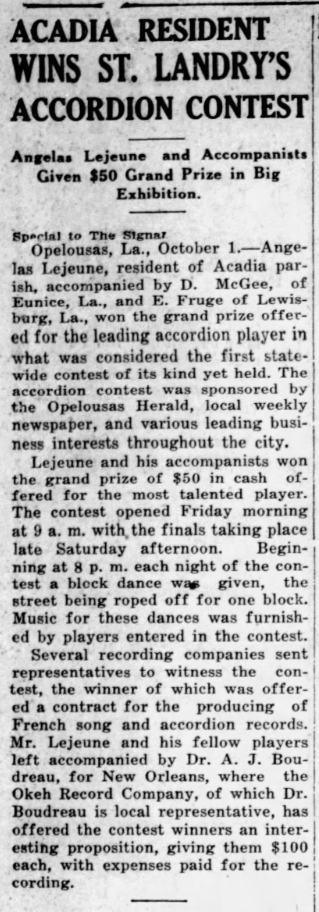
Angelas Lejeune a resident of Acadia parish, accompanied by D. McGee, of Eunice, LA., and E. Fruge of Lewisburg, La., won the grand prize offered by the leading accordion player in what was considered the first state-wide contest of its kind yet held. The accordion contest was sponsored by the Opelousas Herald, local weekly newspaper, and various leading business interest throughout the city.
Oh! Oh my, it's terrible, dear, oh my.
Oh, so often, I see your dear little yes, which are so sweet looking after me.
Oh! Reminiscing, dear, you'll see your mistake, don't do that, you've made yourself so unhappy.
Oh! What've you done to your old man, you know I'm taking this hard, also.
Oh, When I take to reminiscing, dear, all the time, I could even cry all night, well, for you.
Anglelas' song stayed mostly forgotten until after WWII when a slew of musicians used the melody for their own songs. Floyd Leblanc first used it in his "Brow Bridge Waltz" in 1947 followed by Abe Manuel and his "Ville Platte Waltz" Most notably, Nathan Abshire's "Kaplan Waltz" in 1949 and his "Texas Waltz" in 1954 adopted the melody.
http://arhoolie.org/moise-robin/
Cajun Country By Barry Jean Ancelet
Lyrics by Jerry M and Stephane F
Find: Louisiana Cajun Music Vol. 5: The Early Years 1928-1938 (Old Timey, 1973) Cajun Country, Vol. 2, More Hits from the Swamp (JSP, 2005) Let Me Play This For You: Rare Cajun Recordings (Tompkins, 2013)