Showing posts with label Norris Savoie. Show all posts

Friday, February 25, 2022

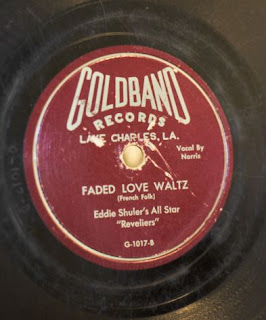
"Faded Love Waltz" - Eddie Shuler

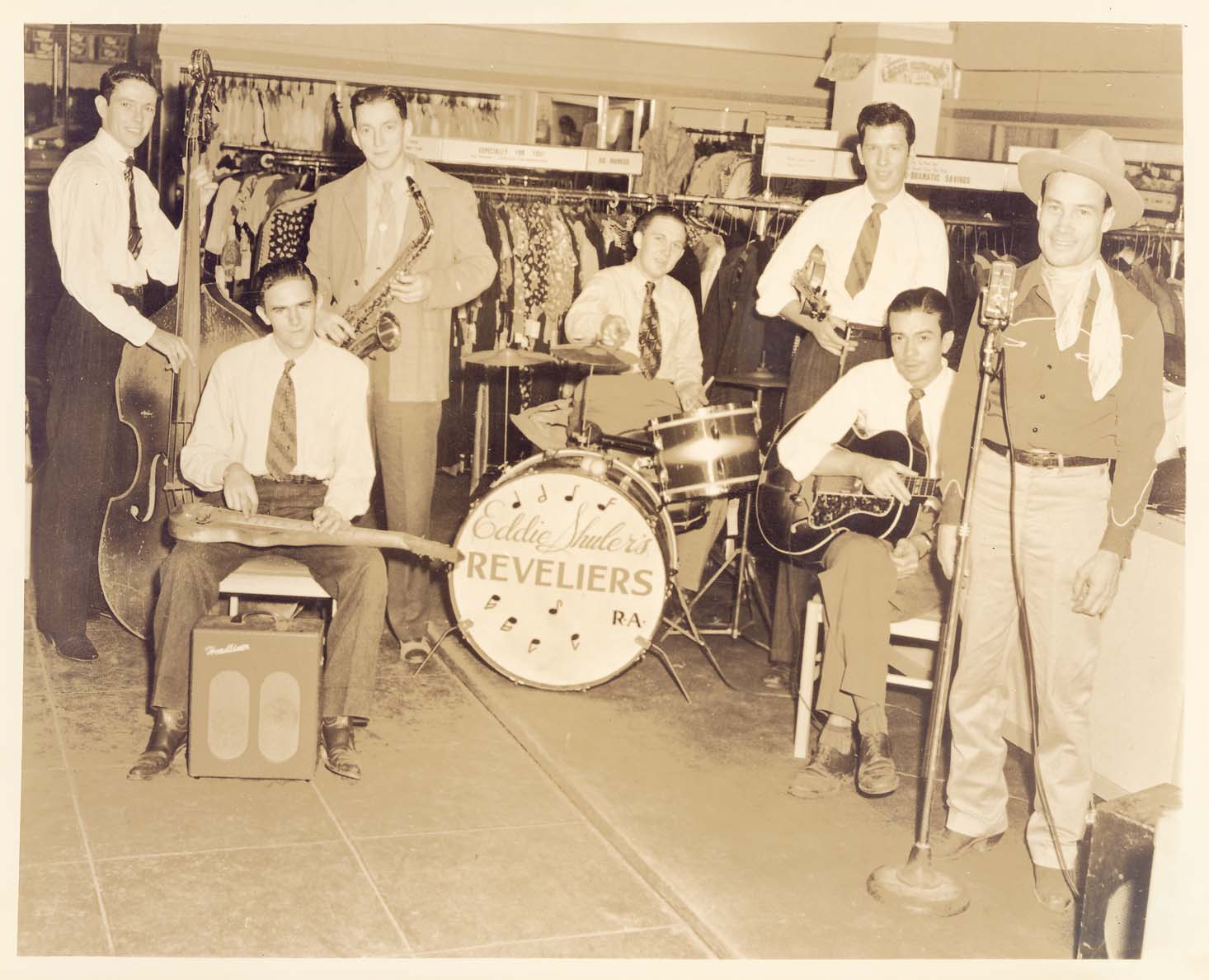
Eddie Shuler spent much of the 1940s filling in western swing groups and Cajun string bands such as the Hackberry Ramblers.   By the end of WWII, he managed to assemble his own group called the Reveliers and decided a new record label was needed in order to promote his new group.  In doing so, he couldn't ignore the sudden increased demand for Cajun music.  Eddie was surrounded by Cajun people who wanted more of those records.   His band had to adapt to the music demand. He recalls:
Oh yes, I sold a lot of records to the jukebox operators; that was where you sold most of your records in those days.  There were not all that many record shops, and then the people didn't have all that much money to buy records, except the richer people.  That's where you sold most of those pop records.  But the jukebox operators had to have what they called race records and hillbilly records; they had to have that stuff and the Cajun records, too.  So we got into the Cajun thing.1

Oh, chère, mais, j'ai prié, mais, pour t'avoir,
J'ai pas vu,  joli 'tite monde, comment je vas faire.

Oh, chère, mais, quel espoir, mais, que tu connais,
Moi de mourir de plus t'avoir, joli 'tit monde.

Oh, chère, mais, pourquoi-donc, mais, (.........),
Tu vas voir que je mérite pas tout ça tu m'fais.


Liberty Vindicator
Dec 11, 1947

Shuler wanted to record his own songs and focus more on hillbilly music, like his main influence, Bob Wills. He explained:
Any country band was hillbilly. It didn't make no difference who you were, you were hillbillies. There wasn't no country music then. They hadn't even invented the word.2  

Between 1944 and 1945, Shuler cut the first record for the Reveliers, featuring Shuler's compositions "Broken Love" and "Room in Your Heart For Me Darling."   By 1946, Cajun music was ramping up among the population of south Louisiana and he brought in Norris Savoy to assist in singing some classic Cajun songs.  Along with Pee Wee Lyons on steel guitar and Johnny Babb on bass, they recorded the melody of the 1936 "Ma Valse Favori" by Cleoma Breaux in which he entitled it "Faded Love Waltz" (#1017).  The melody is the same as Lawrence Walker's 1929 recording of "La Vie Malheureuse" and Happy Fats' 1935 recording of "La Valse De L'Amour". Shuler called his new record label Goldband Records. 
It had something to do with my mentality. I said, 'This is going to be a goldmine, so I'll just call it Goldband.'2  


Oh, dear, well, I prayed, well, to have you,
I couldn't see, pretty little everything, how I'll do this.

Oh, dear, well, what hope, well, that you know,
I'm dying to have you anymore, pretty little everything.

Oh, dear, well, so why, well, (........),
You'll see that I don't deserve all that you've done. 


  1. Record Makers and Breakers: Voices of the Independent Rock 'n' Roll Pioneers By John Broven
  2. http://theind.com/article-168-the-record-man.html
  3. Lyrics by Stephane F
Release Info:
Hey Cushmall | Goldband G-1017-A
Faded Love Waltz | Goldband G-1017-B

Find:
Eddie Shuler & His All Star Reveliers: Grande Mamou (BACM, 2016)

Tuesday, July 27, 2021

"La Valse De L'Amour" - Happy Fats

Leroy "Happy Fats" Leblanc turned into a musician as a young boy trying copy Jimmie Rodgers tunes.  His mother would feed and house traveling musicians with a deal to help her young son become a better player. One of those players was a black blues guitarist that he found playing music on the streets of Rayne. Happy remembered,
Sometimes when I'd bring those fellows home with me, momma would fuss a little, but she always took care of things for me.2  

With better instruction, now, Happy Fats took a job as night waiter in the old Farmer's Cafe in Rayne, and between customers, he'd spend the long night hours practicing his guitar.2  He recalled,
I worked 12 hours a night, but I had plenty of time to practice.  And once, while I was there, I met Gene Autry, who was passing through Rayne on his way to New Orleans.2  


Oh, chère, j’ai prié, ouais, pour t'avoir,
J'ai pas pu, oui, comment, moi j’vas faire.

Oh, chère, quelle espoir, moi j’peux t'nir, 
Pour t’avoir, jolie ‘tite fille, malheureuse.

Oh, chère, viens donc ‘oir la grosse erreur,
T’vas ‘oir, jolie ‘tit cœur, ça t’as fait.


Farmer's Cafe
Rayne, LA

In 1935, he scored his very first recording contract with RCA.  He rounded up band members Norris Savoy on fiddle and Warnes "Tee Neg" Schexnayder on guitar and recorded a familiar melody as "La Valse De L'Amour" (#2172).  It had similarities with Joe Falcon's 1929 "Poche Town", and almost identical in melody to Lawrence Walker's 1929 "La Vie Malheureuse", the Hackberry Ramblers' 1935 "Crowley Waltz", and Cleoma Falcon's 1936 "Ma Favori"   RCA's Bluebird A&R executive, Eli Oberstein was in charge of the session.  He had previously worked alongside Amede Ardoin and Joe and Cleoma Falcon in San Antonio the previous year.  Happy recalled the first recording session:


Eli Oberstein was in charge, he was a very jolly man, I'd call him a jolly giant.  I'd say he was a man about six feet, five inches tall, a Jewish man.  He could be a stormy type of fellow, though, if you didn't get things done right he'd get awful mad for a few seconds.  Then he'd come back and say, "let's cut a good one!"1  
The following year, Cleoma Falcon would record the song as "Ma Valse Favori", slowed down and shifted in key. 

Oh, dear, I prayed, yeah, to have you,
I couldn't, yes, how will I handle this?

Oh, dear, what hope can I hold onto?
To have you, pretty little girl, oh terrible woman.

Oh, dear, so come see your big mistake,
You'll see, pretty little sweetheart, what you've done. 


Happy Fats and
Clarence Locksey
1979


For years, Happy kept the identity secret of this early guitar "teacher" that had kick-started his love for the instrument until 1979.  Author John Broven asked Happy how he got started,
I taught myself and if I'd see a hobo or something with a guitar, I'd go pick him up and bring him home, give him dinner, maybe learn a few chords with him.  Then there was a colored boy here in town that I learned a lot from, a fellow by the name of Clarence Locksey, he's still living. He knew some chords, he'd play this black blues stuff.1   


In 1979, during a celebration of his life and career, Happy introduced Rayne native Clarence Locksey to join him in the celebration and have him play some of the "mean blues" which he does so well.3  Born in 1910, Locksey lived his life as a sharecropper and his wife Adeline worked as a housekeeper in the landlord's house.  Many people recalled seeing Clarence walk up and down the streets of Rayne with a guitar, playing the blues.  In the 1950s, record producer J.D. Miller spotted the musician and invited him to record four songs for his label with Lazy Lester on percussion and lead guitar.  The tracks remained unreleased until Flyright Records issued them on LP in 1989.  Locksey lived to be over 100 years old. 


  1. South to Louisiana: The Music of the Cajun Bayous By John Broven
  2. Interview with John Uhler.  1954.  CDS
  3. The Rayne Acadian-Tribune (Rayne, Louisiana) 08 Nov 1979
  4. Lyrics by Smith S and Stephane F
Release Info:
BS-94402-1 La Fille De St Martin | Bluebird B-2172-A
BS-94403-1 La Valse De L'Amour | Bluebird B-2172-B

Thursday, July 16, 2020

"Hey Cushmall" - Eddie Shuler

An immigrant from Texas, musician and record producer Eddie Shuler was operating a tiny music store when he started Goldband as a private label around 1945 to promote his western outfit, the All Star Reveliers.1  An excellent group that went toe-to-toe with Cliff Bruner, Leo Soileau, Harry Choates, the Hackberry Ramblers, and the other top Gulf Coast swing bands of the time.2  He recalls:
I had this eight-piece band and I had a packed house because I had a radio show down there on KPLC Radio.  That was a thirty-minute show in the afternoon.1


Eh, jolie, 

Moi j'm'en va, va à la maison,

C'est pour t'voir, mais, chère 'tite fille, 

Que si mignonne, mais, pour ton nèg.


Eh, couche mal, tu m'a dit, mais, tu m'aimais,

Oh, jolie, mais, aujourd'hui, t'après m'quitté. 


Eh, jolie, 
Moi j'm'en va, va à la maison,
Tout fais ça, mais, tu m'aimer, ça m'fait du mal, mais, aujourd'hui.


Sears in Lake Charles
Johnny Babb, Pee Wee Lyons, Johnny Reems,
Ronald Ardoin, possibly Johnny Porter,
unknown, Eddie Shuler

Many of Eddie's singles are solid western swing, Cajun, and country efforts comparable to anything else coming out in those genres at the time.2  Shuler cut his first records using the facilities of two Lake Charles radio stations, KPLC and KAOK, since the nearest dedicated recording studios were in distant New Orleans and Houston.  He said:

There wasn't no tape recorders back in those days.  You had to cut the thing on an acetate disc. So you'd go into the radio station and give the engineer ten dollars and a bottle of booze, and he'd make you an acetate.1  


Hey, pretty one,

I'm going, going home,

It's to see you, well, dear little girl,

That's so cute, well, for your man.


Hey, naughty one, you told me, well, you loved me,

Oh, pretty one, well, today, you're leaving me.


Hey, pretty one,
I'm going, going home,
All that's done, well, you loved me, that makes me sad, well, today.
Norris Savoie

During one of those sessions in 1948 or 1949, Eddie and Norris Savoy recorded the french tune "Hey Cushmall" (#1017) for his Goldband records.  The slang term "couche mal" was a Cajun nickname used to describe a "naughty person", which fell out of favor soon after the war.   It wasn't an overly impressive recording, sounding more like a country hillbilly band rather than a Cajun recording. Eddie was very much into English country tunes but Norris helped change that.

We was into the Bob Wills sound. Oh, we played French music ‘cause I had a French singer. I wasn’t crazy; I wanted that money too. I had a couple of [French singers], but the one who stayed the longest was Norris Savoie. He sang high, higher than a woman, and he played the fiddle.2  


  1. Record Makers and Breakers: Voices of the Independent Rock 'n' Roll Pioneers By John Broven
  2. http://wired-for-sound.blogspot.com/2011_11_24_archive.html


Release Info:

Hey Cushmall | Goldband G-1017-A
Faded Love Waltz | Goldband G-1017-B

Find:

Eddie Shuler & His All Star Reveliers: Grande Mamou (BACM, 2016)

Thursday, May 7, 2020

"La Valse De Boutte Dechuminen" - Nathan Abshire & Rayne-Bo Ramblers

End Of The Road Waltz!   It's one of Happy Fats and Nathan Abshire's very first recordings.  Happy was always interested in music from the earliest years.  It all started in the early 20's when Happy was earning his summer spending money by shining shoes of Rayne businessmen.  He recalls getting his first guitar through a pharmacy in Rayne owned by Walter McBride:
I made a deal with Mac, though. I traded him a sack of rough rice that Mama gave me for the guitar.1  
In those days, rice sold for approximately per sack, so Happy Fats felt he got the better of the bargain.


Ma 'tite fille ça t'as fait avec moi,

Tu m'a quitté, mais, aujourd'hui,

Fallait écouter tous les conseils de nous autre.


Malheureuse, tu peux voir, que mon j'suis tout seul,

Aujourd'hui dans la misère,
Et les chagrins par rapport à tes manières.

Malheureuse, mais, quoi tu veux?

Happy Fats


By 1935, he had teamed up with accordion player Nathan Abshire to record for Bluebird records creating some of the earliest Cajun-country music. Happy and Nathan were backed by Warnest "Tee Neg" Schexnyder on guitar and Norris Savoy on fiddle. They recorded "La Valse De Boutte Dechuminen" (#2178), a corrupted spelling of bout du chemin or "end of the road".   It was Happy and Nathan's version of the Breaux Brother's "Ma Blonde Est Partie".   It would become one of many recordings using this familiar melody, one that Abshire had been playing since at an early age.  He recalled:
I was six years old when I started to play French music.  I put [the accordion] on my lap and I started playing with it.  It was my uncle's.2    


My little girl, what you've done to me,

You left me, well, today,

Should have listened to the all the advice of others.


Oh my, you can see, that I'm all alone,

Today, I'm in misery,
And suffering because of your nasty ways.

Oh my, well, what do you want?


Nathan Abshire

When Nathan got a chance, he would sneak into his uncle's room and play the accordion, but the marks left on top of the furniture gave him away.  
He was working....and we have them old closets which we put clothes in, that's called an armoire.  And he hid it on top and it would mark.  He would put that accordion between the marks and I would not see that.  And when he would go to work, I would get the accordion and start playing. When he'd come back, he'd give me a good whip again.   I would never say a word.  When he'd go back to work, I'd go get the accordion and start playing again. That went on about two months and he'd whip me twice a day, but I never stopped.  He got mad at me and sold it to me for $3.50.2  


  1. Interview with John Uhler.  1954. CDS.
  2. "The Good Times Are Killing Me".  PBS, 1975.
  3. Lyrics by Stephane F and Jordy A
Release Info:
BS-94412-1 One Step De Laccissine | Bluebird B-2178-A
BS-94413-1 Le Valse De Boutte Dechuminen | Bluebird B-2178-B

Wednesday, February 26, 2020

"Le Fille De St. Martin" - Happy Fats

Leroy "Happy Fats" Leblanc got his recording career started with the national record label known as RCA.  He turned professional when he was 14 years old and had been a musician most of his teenage life.  He got his first job playing with an accordion band that catered to country dances in the Rayne area.  His earnings, the, were "sometimes as much as $1.50 to $2 per night."1  He recalled:
In the early days, I played with a lot of well-known musicians.  Among them were Joe Fabacher, Joe Falcon, Lawrence Walker, Blackie Alleman, Lester Hoffpauir and many others.1  

Hillbilly singing was rapidly rising in popularity in the Depression days of the early 30s, but the majority of the music was played individually.  When Happy organized his band, it was one of the first all-hillbilly bands in the United States.1  


Je suis venu à Saint Martin pour voir les belles 'tites filles, 
C'est dommage (qu'elles) sont si canailles , (il) y a pas manière, (mon coeur)*.

'Gardez-donc, jolie 'tite fille, ça t'as fait avec moi,
Te connais, malheureuse, j'veux pas (ta coeur ca autant)*.

Je t'ai demandé si tu m'aimais, toi jolie 'tite fille,
Tu m'as dit "non", malheureuse, et ça, ça m'fais du mal.


Daily Advertiser
Jun 1, 1935

"Le Fille De St. Martin" (#2172) was an ode to a lover living St Martin parish.  Recorded in New Orleans in 1935, it's considered Happy Fats' very first professional recording he ever wrote.   It would kick off an almost 40 year recording career for the young hillbilly singer.  During the late 40s, songs such as this and Fuselier's "Lake Arthur Stomp" inspired other tunes like Floyd Leblanc's "Louisiana Stomp" and Harry Choates "Fa De Do Stomp".   However, the melody seems to be one of the founding sources for the zydeco song known as "Jolie Catin", later recorded by people such as Boozoo Chavis and John Delafose.  In the 1950s, Happy recalled those early years.  ,
The first song I ever wrote was called "La Fille De St. Martin".  Since then, I guess I've written about 150 songs all together.1  


I came to St. Martin to see the beautiful little girls,
It's a shame that they're so mischievous, there's no way, my sweetheart.

So look, pretty little girl, what you've done to me,
You know, terrible woman, I don't want your heart that much.

I asked you if you loved me, you pretty little girl,
You told me "no", terrible woman, and that, that made me sad.


Listed as the Rainbow Rambler String Band of Midland, he quickly acquired nearby Riceville native Nathan Abshire to accompany him on some of his earliest RCA recordings.  But soon after, he moved to Rayne and renamed the group Rayne-Bo Ramblers.  With Warnes Schexnyder on guitar and Norris Savoy on fiddle, he recalled,
It wasn't much of a band, as bands go today.  In fact, there were only three of us...Warnes Schexnayder who played steel guitar, Norris Savoy, who played violin, and myself.  But we played only hillbilly music, and I used to sing all my songs in Cajun French.  People seemed to like us.1  


  1. Interview with John Uhler.  1954.  CDS
  2. Lyrics by Stephane F

Release Info:
BS-94402-1 Le Fille De St. Martin | Bluebird B-2172-A
BS-94403-1 La Valse De L'Amour | Bluebird B-2172-B

Tuesday, September 3, 2019

"One Step De Morse" - Nathan Abshire & Rayne-Bo Ramblers

Happy Fats kicked off his first recording session with 12 songs for Bluebird records, including six lead with an accordion.  Afterwards, he maintained a busy schedule of produce sales and late-night music performances.  Following his marriage, Happy Fats was employed by a local produce company buying frogs, chickens and eggs from farmers in the area. On the weekends, he and his band traveled about Southern Louisiana playing for dances.

During the first session in 1935, he took his group along with Cajun accordion player Nathan Abshire to record an instrumental about a small town in south Louisiana called "One Step De Morse" (#2174).   Morse is a railroad town in Acadia Parish not far from Nathan's childhood home.  Happy recalled:
We were contacted by [RCA] Victor through a fellow here in Rayne by the name of Hillman Bailey.  This fellow, Hillman Bailey, he had a radio shop here and a music store, and he had contact with the Werleins of New Orleans.  And we were brought to New Orleans for the first time, and we recorded there in the old St. Charles Hotel.3
Nathan Abshire

Happy had Nathan backed up with himself and Warnes Schexnyder on guitars, and Norris Savoy on fiddle. However, during the mid-1930s, the interest in Cajun accordion-led bands was waning.  Happy dropped the accordion from his lineup and watched his Cajun string band sound take off.


We finally booked enough dances to permit me to quit working, so I enlarged the band and we did seven or eight engagements a week.2 
Nathan himself felt the affect of losing out during the string band craze.  Dance-halls and recording companies were no longer interested in the old accordion sound.
There was one time the accordion went away.  There was no more accordion here in Louisiana. I started to play the fiddle. I'd walk about 20 miles to go play a dance for $3.  No electricity, nothing.   A guitar, a fiddle and some triangles. Home brewed beer.  Home brewed whiskey in them days.4 

Overtime, the name of Happy and Nathan's melody would be forgotten. Lawrence Walker would re-work the tune, into the well known "Mamou Two Step", adding it's signature bridge section.  Nathan also reworked his song into what he called the "Musical Five Special". 


  1. Negotiating Difference in French Louisiana Music: Categories, Stereotypes ... By Sara Le Menestrel
  2. Interview by John Uhler. 1954.  CDS
  3. South to Louisiana: The Music of the Cajun Bayous By John Broven
  4. "The Good Times Are Killing Me".  PBS, 1975.
Release Info:
BS-94409-1 La Valse De Riceville | Bluebird B-2174-A
BS-94410-1 One Step De Morse | Bluebird B-2174-B

Find:
Cajun Country, Vol. 2, More Hits from the Swamp (JSP, 2005)

Friday, August 9, 2019

"My Jolie" - Eddie Shuler

Before Edward "Eddie" Wayne Shuler Jr entered into the record business, he had played and wrote many of his own songs.  He played guitar with The Hackberry Ramblers before forming his own band, The All-Star "Reveliers", which performed on the radio station KPLC.   

By 1945, he figured having his own label would allow him to promote his Reveliers band and so he created the Goldband record label.  Most of Shuler's pressings were done by Buster Williams' "Plastic Products" out of Memphis, TN.  Eddie Shuler recalls selling his records of himself:
I’d sell ‘em out of the back of my car. See, what I’d do, I’d take my records and put ‘em in the back of my car and go call on all the jukebox operators. And they didn’t know who I was, ‘cause I’d just tell ‘em “Goldband.” I didn’t want ‘em to know that I was the artist, ‘cause the jukebox operator’s not gonna buy a record from the artist, ‘cause they never are any good, according to them.1   


Viens t'en donc dans la maison, mais, chère Joline,

Pour toujours, mais, moi j'connais, tu vas pleurer, 'tite fille.


Tu m’as dit, mais, tu m'aimais, mais, chère jolie,
Aujourd'hui, t'es après m'quitter, pour ton bon à rien, chérie.

C'est rapport à ta vieille maman que tu me fais ça,
Moi j'connais tu vas pleurer, mais, pour l'avenir,
Plus personne, mais, pour m'aimer, comment j'vas faire?
Tu connais, mais, chère mignonne, ça me fait du mal.

Ton bon à rien, moi j'connais, mais, tu comme ça,
Viens me rejoindre, petite, m'voir, que je mérite pas, chérie.
KPLC Radio inside Majestic Hotel
Eddie Shuler, Glenn Croker, Venola Brunker,
Nookie Martin, Charles Broussard

Living in Lake Charles, he was exposed to quite a bit of Cajun music; something he referred to as "French Folk" music from the local area.  In 1948, he recorded "My Jolie" (#1018).  It featured Eddie on guitar and Norris Savoy on vocals and fiddle, however, it's possible Hector Stutes played fiddle for this recording. It was a slow country version of Papa Cairo's "Allons Kooche Kooche" and "Gran Texas", similar to the Breaux Brother's "La Valse du Bayou Plaquemine".

His music didn't garner near the attention he had hoped for. In 1955 the Reveliers disbanded. Eddie commented: 
"Not only was I tired of all the long nights and travel but also it was wreaking havoc on my marriage. You know how musicians always tend to attract the girls," he always said with a wink.2,3  


So, come to the house, well, dear Joline,

Forever, well, I know you're going to cry, little girl.


You have said, well, you loved me, well, dear pretty one,
Today, you are leaving, you good-for-nothing, dearie.

It's because of your old mom that you've done this to me,
I know you're going to cry, well, eventually,
No one, well, to love me, how am I going to handle this?
You know, well, dear cutie, it hurts me so.

You good-for-nothing, I know, well, you're like that,
Come join me, little one, to see me, that I don't deserve (this), dearie. 


  1. http://wired-for-sound.blogspot.com/2011_11_24_archive.html
  2. http://www.bluesart.at/NeueSeiten/2005EddieShuler.html
  3. http://www.bluesworld.com/EddieShuler.html


Release Info:

Friends Gather | Goldband G-1018-A
My Jolie | Goldband G-1018-B

Find:
Eddie Shuler & His All Star Reveliers: Grande Mamou (BACM, 2016)

Wednesday, February 13, 2019

"One Step De Laccissine" - Nathan Abshire & Rayne-Bo Ramblers

The first introduction to Cajun blues in Louisiana came from the Afro-Creoles that created some of the first Cajun standards in Louisiana.  Other musicians took note, copying their style, and inserting their own soul into the music.  Nathan Abshire was especially taken with the spirited playing and singing of Creole accordionist/singer Amédé Ardoin, and Ardoin often invited Abshire to play with him. 
Every Saturday we used to go to John Foreman’s saloon. I’d see Amédé Ardoin coming down the way. He’d say, ‘Abshire, you’ve got to help me tonight.’ I’d say. ‘Amédé, I can’t help you.’ ‘Oh yeah,’ he’d say, ‘We’re both going to play. I’ll play for awhile, you play for awhile.’ I’d say, ‘I don’t feel much like going Amédé.’
Nathan Abshire
But I’d go and we’d sure make some music. As far as that goes, we made some great music.1

During his very first recording session, in 1935, along side Happy Fats' Rayne-Bo Ramblers, the team of Norris Savoy on fiddle and Warnes "Tee-Neg" Schexnyder on guitar traveled to New Orleans to record a tune named after a small town in Louisiana: "One Step De Laccissine" (#2178). Typical of national recording labels, they rarely cared about proper names; misspelling Nathan's name as "Nason Absher" and Lacassine as "Laccissine".  In standard Abshire style, Nathan used the accordion to foreshadow his interest in Cajun blues.  According to author Ryan Brasseaux:
The "One Step de Laccissine", for example, is a vibrant romp that flirts with the melody that would become "Pine Grove Blues".2


  1. http://www.offbeat.com/articles/masters-of-louisiana-music-nathan-abshire/
  2. Cajun Breakdown: The Emergence of an American-Made Music By Ryan Andre Brasseaux
Release Info:
BS-94412-1 One Step De Laccissine | Bluebird B-2178 A
BS-94413-1 Le Valse De Boutte Dechuminen | Bluebird B-2178 B

Find:
Le Gran Mamou: A Cajun Music Anthology (CMF, 1990)
Cajun Country, Vol. 2, More Hits from the Swamp (JSP, 2005)
Cajun Capers: Cajun Music 1928-1954 (Proper, 2005)

Monday, July 9, 2018

"La Valse De Meche" - Eddie Shuler

Goldband Records founder Eddie Shuler made immeasurable contributions to Louisiana music before his death.  Behind his folksy, down-to-earth demeanor, Shuler was a shrewd businessman and the driving force behind Goldband Records. Without him, Louisiana's musical heritage wouldn't be what it is today.  Shuler was born in Texas and grew up on a farm. By the mid 1940s, he had moved to Lake Charles and opened up business.  According to Shuler
My first store was in a trailer house. I started about June of 1944. I didn't have too much of a business because I didn't have too much stock.  I had no pianos and no sheet music.  Yeh, I sold records in the store too, the pop music.  And we were fixing radios, too, on the side.   That's back in the radio days.1 
I went to work as an insurance company salesman, and, of course, I was already a musician by that time, because I had been playing with the Hackberry Ramblers before all this stuff come about.  Then I decided I wanted to make records, so I found an ad in Billboard magazine, a place in New York, because I had written to all the record companies and nobody even answered my letter.  I said "Well, that's not going to work; I'm going to to it anyway [myself]".1 


Ooh, chérie, mais, moi, j'm'en vas, mignonne, 
Mais, c’est pour voir ma jolie petite fille

Ooh, chérie, mais, quel espoir, mignonne, 
Que, moi, je peux avoir, c’est de te voir t’en aller 

Ooh, chérie, mais tu m’as dit, mignonne, 
Que tu m'aimais, mais aujourd'hui, t’après m'quitter 

Ooh, chérie, mais quel espoir, mignonne, 
C'est de te voir t'en aller avec un autre
Sears in Lake Charles
Johnny Babb, Ronald Ray "Pee Wee" Lyons, 

Johnny Reems,
Ronald Ardoin, possibly Johnny Porter,
unknown, Eddie Shuler

Eddie took his band and using his own methods cut the song "La Valse De Meche" (#1015) in 1946 (although some sources say 1947), playing the guitar, while Norris Savoy accompanied on fiddle and vocals.  Similar to the Walker Brothers' tune "La Valse de Louisiane".  It's possible that Ronald Ray "Pee Wee" Lyons filled in on steel guitar and Johnny Babb backed them up on bass.
The first Cajun record was "La Valse De Meche" by Eddie Shuler and his Reveliers with Norris Savoy doing the vocal in French, and we cut that in KLOE radio down on Clarence St in the middle of the studio.1  


Oh, dearie, well, I'm going, cutie,
Well, it's to see you, my pretty little girl.

Oh, dearie, well, what hope (is there), cutie,
That I can have, seeing you go away.

Oh, dearie, well, you said, cutie,
That you loved me, well, today, then you left me.

Oh, dearie, well, what hope (is there), cutie
Seeing you, you went away with another. 


His first pressing batch in the 40s lacked the name of his band, and above all, Eddie's name.  He fixed this by having all the issues stamped with "Eddie Shuler" in gold and silver lettering.  Later, in 1955, he would open up a new studio in a white frame building along Church Street in Lake Charles, which was once home to an Assembly of God church before Shuler purchased it.  It's at this time, he re-released the tune on the flipside of Hackberry Rambler's "The Misery Of A Broken Heart", keeping the same catalog number #1015.   Over the years, others would record the song including Sidney Brown, Nathan Abshire, the Balfa Brothers, Maurice Barzas, Nolan Cormier, Rufus Thibodeaux and Octa Clark.


  1. Record Makers and Breakers: Voices of the Independent Rock 'n' Roll Pioneers By John Broven
  2. http://theind.com/article-168-the-record-man.html
  3. Lyrics by Jordy A

Find:
Eddie Shuler & His All Star Reveliers: Grande Mamou (BACM, 2016)

Monday, June 4, 2018

"Rayne Breakdown" - Happy Fats

The early years of Leroy "Happy Fats" Leblanc's career can be summed up by his first music teacher, Eva McBride of Rayne, Louisiana. Eva brought her musical talents with her to Rayne when she married Walter J. McBride, and was at McBride's Pharmacy to "encourage the arts" at every opportunity.   At the left, far corner was an array of musical instruments from which families in Rayne purchased everything from clarinets and flutes to the smaller horns. She believed a family didn't just buy an instrument for a youngster, Eva was there to give "first lesson" on any instrument in the store.1

But the one instrument that had "intrigued" young soda-jerk and shoeshine boy, Happy Fats, was this guitar, which McBride always "strummed" at her every visit to the store. Happy would build up his courage one day to ask if "Miss Eva" might teach him " a chord or two" on the guitar.   After he paid for the guitar with a sack of rough rice given to him by his mother, who worked a the local mill, it began Happy Fats' musical career.1
Eric Arceneaux, Louis Arceneaux, Happy Fats
1936 Blue Goose Dancehall2


By 1935, he formed his group and kicked off his string-band recording career with "Rayne Breakdown" in New Orleans for Bluebird Records.  It was an old traditional melody made famous by Angelas Lejuene known as "Perrodin Two Step".  His group had Warnes Schexnayder on guitar and Norris Savoy on fiddle.  Happy played his guitar on street corners up and down Adams Avenue, formed his Rayne-Bo Ramblers, performed at the Louisiana Hayride and the Grand Ole Opry.   He published music in both English and French and associated with the likes of Tex Ritter, Hank Williams, and Louisiana's Jimmie Davis.1  


  1. Plan Of Rayne by Sidney Stutes.  Rayne Tribune. 2014.
  2. Rayne's People and Places By Tony Olinger
Release Info:
BS-94404-1 Rayne Breakdown | Bluebird B-2176-A
BS-94405-1 Dor, Baby, Dor | Bluebird B-2176-B

Find:
Cajun Country, Vol. 2, More Hits from the Swamp (JSP, 2005)
Cajun Capers: Cajun Music 1928-1954 (Proper, 2005)