Friday, July 15, 2022

"Creole Stomp" - Pee Wee Broussard

Chester Isaac 'Pee Wee' Broussard was born in Henderson, Louisiana into a musical Cajun family. His father, Sosthène Broussard, played mandolin and clarinet as well as accordion, while his grandfather played accordion and fiddle. Two brothers played guitar: Jules played rhythm and Jim played "4-string guitar".1  

In 1952, a New Iberia DJ arranged Pee Wee to record at J.D. Miller's studio in Crowley along with Walter Guidry on steel guitar, and Nathan Latiolais on drums.1   Popularized by Aldus Roger, "Creole Stomp" (#1051) is one of the most covered post-war Cajun instrumentals.  The group added two Breaux Bridge natives, rhythm guitarist Andy Johnson and fiddler Jean "Kaiser" Perez.   

Kaiser Perez played fiddle with several musicians around the Lafayette and St. Martin area.   His aunt gave family nicknames based on leaders and generals, in this case, naming Jean after Germany's Kaiser Wilhelm.2     


Daily Advertiser
Dec 2, 1952

Teche News

Perez, who had spent time serving in WWII, had stumbled into music quite literally.  According to son Rickey Perez, 
While overseas in Germany, he found two fiddles in a building he was searching.  He took one and shipped it back home.  When he got home, his mother handed him the package she received and he started playing with it until he learned something.2  

Perez spent his time filling in with many bands such as Belton Richard and playing on the TV show Passe Partout.  In the 1970s, he open up Kaiser's Place dance and pool hall in Breaux Bridge. 


  1. Acadian Two Step.  Bruce Bastin. Liner notes.
  2. Discussions with Rickey P
Release Info:
Chere Tu Tu | Feature F-1051-A
Creole Stomp | Feature F-1051-B

Find: 

Acadian Two Step (Flyright, 1987)
Acadian All Star Special - The Pioneering Cajun Recordings Of J.D. Miller (Bear, 2011)

Thursday, June 16, 2022

"Pauvre Garcon" - Falcon Trio

By 1936, it had been over a year since Joe and Cleoma Falcon had stepped foot in a studio before they had scored another contract with RCA.  Eli Oberstein and other recording executives had arrived the week before Mardi Gras and began loading their equipment into the second floor of the building.   There, they planned a three-day session where bands such as Bo Carter and the Arthur Smith Trio were waiting for their turn.1    

Feeling the need for a fiddle player, Joe convinced Crowley native and musician, Moise “Mose” Morgan join their duo.  Mose had learned to play the fiddle as a young child and grew up learning popular tunes.  The trio recorded a song Joe called "Pauvre Garçon (Poor Boy)" (#2185).  In typical form, Joe often held the verses beyond the standard meter, allowing the chord changes to match the lyrical changes. 


Comment tu crois, mais, que moi j’peux faire, chère?

Mais, avant hier soir, mais, t’après faire avec moi,

Moi j’vois pas quoi moi j’va faire, moi seul.


Garde-donc toi, ‘tite fille qui crois bien pourquoi toi t’as dit, toi chère,

Il y a pas, mais, si longtemps tu m’as donc promis de jamais oublier,

Mais, ‘garde-donc toi t’après faire avec moi,

Tu devrais donc, chère, user ta tête, ouais, tu vois les promesses,

J’mérite, mais, oui, pas tout la misère que toi t’après me faire avec moi.


Au jour d’aujourd’hui, mais, moi j’connais, chère,

Tu vas r’venir, oui, mais, donc me r’joindre, oui chère,

Mais, pour des bonnes excuses à moi avant longtemps.


Tu connais, ‘tite fille, mais j’mérite pas, mais, donc tout ça, toi chère,

Le seul Bon Dieu va m’mettre la main, ça c’est moi, oui, pour toi, oui chère,

Mais, malheureuse, ‘garde moi donc, moi j’va faire, oui, tout seul.


Joe Falcon
Courtesy of Squalor Illustrations
squalorillustrations.bigcartel.com

Other bands such as the Hackberry Ramblers and the Dixie Ramblers were on the docket that day, awaiting their turn to record as well.  To avoid possible conflicts with any earlier contract that Joe and Cleoma may have signed with the Kapps at Decca, Oberstein got creative and renamed the group, The Falcon Trio. When RCA Bluebird pressings arrived in stores, eager buyers discovered Falcon Trio songs stamped on the flip-side of some Hackberry Ramblers recordings as well as on the flip-side of some Dixie Ramblers pressings.1  


How do you think, well, that I'll be able to do this, dear?

Well, before last night, well, what you've done to me,

I don't see what I'm going to do, I'm alone.


So look, little girl, who really believed what you said, my dear,

It wasn't, well, so long ago (that) you promised to never forget me,

Well, so, look at what you've done to me,

So, dear, you should use your head, yeah, you'll see the promises (made),

I don't deserve, well yeah, all of the misery that you've done to me.


As of today, well, I know, dear,

You have returned, yeah, well, so join me, yeah dear,

Well, apologies to me before long.


You know, little girl, well, I don't deserve, well, all of that, you dear,

Only the Good Lord will hold my hand, mine, yes, for you, yes dear,

Well, oh my, so look at me, i'm doing (this), yeah, all alone. 


  1. "Allons A Lafayette: The First Families of Commercial Cajun Music" by Wade Falcon
  2. Lyrics by Marc C

Release Info:
BS-99227-1 Mon Vieux D'Autrefois (My Old Used To Be) 
| Bluebird 2185
BS-99228-1 Pauvre Garcon (Poor Boy) | Bluebird 2185

Find:
Raise Your Window: A Cajun Music Anthology 1928 - 1941 (The Historic Victor-Bluebird Sessions Vol. 2) (CMF, 1993)
Cajun Early Recordings (JSP, 2004)

Monday, May 16, 2022

"Amadie Two Step" - Amede Ardoin & Dennis McGee

Before there was zydeco music, early French-speaking musicians in Southwest Louisiana were creating French-Creole music. And, one of the earliest recording artists of this style was accordion player Amede Ardoin, whose life on the Creole music trail went from stardom to tragedy. Ardoin was a virtuoso on the accordion, and he wrote and recorded a series of songs from 1929 to 1934.  According to author Darrell Bourque:

He was kind of like a rock star of his own day and time.  The most repeated a line in his songs, other than wanting a girl to pay attention to him, ... this thing about not having a home, you know, being exiled.1


Oh, bonsoir, catin, ouais, je m'en va, jolie,

Moi, je m'en va, donc, moi tout seul, droite à la maison,

Moi, je voudrais si vous-autres peuvent faire,

Ouais, pour toi, qu'es aussi mal,

Tu t'en va à ta maison, toi, tu me quittes derrière.


Oh, bonsoir, catin, quoi tu veux (que) je peux faire?

Moi, je te vois, mais, t'en aller, ouais, ça me fait du mal,

Si tu vas, comment je peux faire quand je jongle à toi?

Toi, peut-être j’aurais le courage, ouais, de m’en aller.


Oh, bonsoir, catin, peur tout le temps fait ça,

C’est pour faire plaisir, catin, pourqoui à tes parents,

Quand ton neg’ radotte sur moi, je crois, toi, tu me fais ça,

Tu me fais du mal, c’est toi, catin, (qu'es) assez pour moi pleurer.


Daily Advertiser
Aug 13, 1931
It had been almost a year since Dennis Mcgee and Amede Ardoin had made their ground-breaking recordings for Columbia, which were co-pressed on Okeh. The Great Depression had taken a toll on the recording industry. November of 1930 was quite late into the Depression for recording labels to attempt marketing new Cajun music, but Brunswick decided to try one last time.  They gathered Dennis and Ardoin together and recorded a song that reflected the pain in which Ardoin was so familiar with... the loss of a lover.  While he attempts to blame her parents, he also passes blame on her as well.  Unlike Columbia and Okeh, Brunswick did not employ a special numberical series for its Cajun records.  Instead, the firm released all of these titles, which consisted of waltzes, one-steps, two-steps and blues, under the bill of McGee and Ardoin in its "Songs from Dixie" series.3  He continued to play with McGee and his black Creole neighbor Douglas Bellard into the early 1930s. 


Oh, goodnight my pretty doll, yeah, I'm leaving, my pretty,

I'm leaving, so, all alone, straight to the house,

I'd like it if you could do this,

Yeah, for you, who's also sad,

You have gone to your house, you've left me behind.


Oh, goodnight my pretty doll, what do you want (that) I can do?

I see you, well, you're going, yeah, it makes me feel sad,

If you're going, how will I handle this when I'm thinking about you?

You, maybe I'll have the courage, yeah, to go away.


Oh, goodnight my pretty doll, always scared to do that,

Trying to please, pretty doll, your parents,

When your father rambles on about me, I believe you've done that to me,

You've made me sad, it's you, pretty doll, (who did) enough to make me cry. 

The popularity of the song gave way to Happy Fats' 1935 "Les Fille De St. Martin" and Nathan Abshire's 1950 "Choupique Two Step" and his 1960 "Jolie Catin".  In the 1980s, Marc Savoy recorded a different melody giving it the same name. Because of the confusion it caused, he explains:

In the 1980s the Savoy-Doucet Cajun Band recorded Arhoolie CD #316 entitled "Two-Step Amédé." Initially, the title song, which I had composed out of love and admiration of Amédé Ardoin's music, was supposed to be called "Tribute to Amédé Ardoin." Even though the submitted track list clearly described the title correctly, the producer went to press having changed it to "Two-Step Amédé" not realizing that there was already a completely different song entitled "Amédé Two-Step" by Amédé Ardoin recorded in the 1930s. My recording of "Two-Step Amédé" was never meant to be a version of Amédé's wonderful song. Instead it was my feeble attempt to compose a tune to honor his contribution to Cajun/Creole Music.2 


  1. http://www.fox8live.com/story/37771315/heart-of-louisiana-the-story-of-amede-ardoin
  2. https://folkways.si.edu/arhoolie 
  3. Hidden in the Mix: The African American Presence in Country Music edited by Diane Pecknold

Release Info:
NO-6717-A Amadie Two Step | Brunswick 576 

NO-6718-A La Valse A Austin Ardoin | Brunswick 576

NO-6717-A Amadie Two Step | Melotone M18050
NO-6718-A La Valse A Austin Ardoin | Melotone M18050

Find:
I'm Never Comin' Back: The Roots of Zydeco (Arhoolie, 1995)
Cajun Country, Vol. 2, More Hits from the Swamp (JSP, 2005)
Mama, I'll Be Long Gone : The Complete Recordings of Amede Ardoin, 1929-1934 (Tompkins Square, 2011)

Monday, May 2, 2022

"Se Mallereux" - Happy Fats

Records had been available regionally since the late 1920s and a few of them got played elsewhere from time to time, but it was in 1939 that Leroy "Happy" Fats LeBlanc and the Rayne-Bo Ramblers became the first band from south Louisiana to play on a radio show broadcast nationally over the CBS network. Old-timers will recall that Fats and his band were regular performers at the OST Club in Rayne and Tee Maurice Club near Vatican.1 


T'as quitté hier au soir,
Avec un gros en or,
T'as revenu à ce matin,
Tu sentais le vin blanc.

C'est malheureux, (c'est malheureux,) 
C'est malheureux tu m'fais comme ça,
C'est malheureux tu m'as quitté, 
Quoi faire tu veux venir.

Quoi faire donc, pitié, 
Tu fais ça z-avec moi,
T'es après faire du mal,
À ton pauvre nègre.

C'est malheureux, (c'est malheureux,)
C'est malheureux tu m'fais comme ça. 
C'est malheureux tu m'as quitté, 
Quoi faire tu veux venir.


Happy Fats
Fats was reared on a rice farm near Rayne, Louisiana and got his first guitar by trading a sack of rice for it. He was working in a rice mill for $1.50 a day when he started his band as a way to earn a little bit of money during the Depression. "We'd play dances for ten dollars for the whole band," he said in an interview some years ago. "That was two dollars apiece and two dollars for traveling expenses."1  

By 1938, after having many musicians in and out of his band, he regrouped with the Guidry's, Roy "Blackie" Romero and a talented 17-yr-old pianist from the St. Martinville area named Robert Thibodeaux.  Together, they formed a western swing outfit for a recording session at the St. Charles Hotel in New Orleans and recorded a French version of Deep Elem Blues entitled "Se Mallereux" (#2089).


You left last night,
With a big man in wealth,
You've returned this morning,
You smelled of white wine.

That's terrible, that's terrible,
That's terrible, you did like that,
That's terrible, you left me,
How you want to come back.

So, what's done, pitiful,
You did that with me,
You're going to hurt,
Your poor old man.

That's terrible, that's terrible,
That's terrible, you did like that,
That's terrible, you left me,
How you want to come back.


  1. Jim Bradshaw. "Happy Fats Heard Nationwide". The Abbeville Meridional, published in Abbeville, Louisiana on Sunday, January 29th, 2012
  2. Lyrics by Stephane F
Release Info:
BS-022035-1 Ma belle Mellina | Bluebird B-2046-A
BS-022036-1 Se Mallereux | Bluebird B-2046-B

BS-022036-1 Se Mallereux | Bluebird B-2089-A
BS-022023-1 Cherie a you toi te? [Hackberry Ramblers] | Bluebird B-2089-B

Find: 
HAPPY FATS & His Rayne-Bo Ramblers (BACM, 2009)

Wednesday, March 30, 2022

"A Ute" - Leo Soileau

Cajun fiddler Leo Soileau made a name for himself after waxing four sides for Victor Records in 1928.  He became the second Cajun recording artist after the Falcons and was the first fiddler to record for a major label.  After his partner Mayuse Lafleur died in a senseless tragedy, he continued to record until the Great Depression took hold.


Eh, bébé, éyoù toi t'es?
Pourquoi-donc toi t'es fais,
Jolie fille, avec moi,
Jolie fille, pour ton vieux nègre?

Eh, bébé, pourquoi-donc,
T'as fait ça à ton vieux nègre,
Jolie 'tite fille, faudra que tu viens,
Pour faire t'as fait avant longtemps.

Eh, chère, comment ç(a) se fait,
Ma jolie, t'as jamais vu,
J'vu jaimais, jolie fille, 
Pourquoi-donc tu t'en reviens pas?

Oh, chère, éyoù toi t'es,
Jolie 'tite fille, ton vieux nègre,
Cher tit monde, pour trop tard,
Tu viens pas t'en revoir ton nègre.

Ah, mon nègre, moi j'm'en va,
Oui, là-bas, z'à grand Crowley,
Oh, mon nègre, pour te rejoindre,
Pourquoi-donc tu fais tout ça?


Crowley Post Signal
Dec 9, 1935
By 1935, RCA's new Bluebird recording division contacted Leo about recording again and this time he assembled a string band group.  By 1936, Leo had been switched over from Bluebird to Decca Records where he used the opportunity to re-record two of his original Victor pieces, one entitled "A Ute (Where Are You)" (#17017).   A clear mis-spelling of the phrase éyoù toi, the song was a string band version of the classic Mayuse Lafleur song "Mama Where You At?".

Leo was backed by fellow guitarists Bill Landry, Floyd Shreve and probably drummer Tony Gonzales, all billed as the Four Aces of Crowley. The melody remained in the popular Cajun repertoire among area musicians until after WWII, when the song became more commonly known as "Hey Mom". 


Hey, baby, where are you at?
So, what have you done,
Pretty girl, with me,
Pretty girl, with your old man?

Hey, baby, so what,
You'd done that to your old man,
Pretty little girl, you have to return,
To do what you've done before long.

Hey, dear, how that feels,
My pretty one, you'll never see,
I'll never see, pretty girl,
So why don't you return.

Oh, dear, where are you at?
Pretty little girl, you old man,
Dearest everything, it's too late,
You won't return to see your man.

Ah, my friend, I'm leaving to ,
Yea, over there, to big Crowley,
Oh, my friend, you'll come back,
So why have you done all that?


  1. Lyrics by Stephane F

Release Info:
NO-60795 A Ute (Where Are You) | Decca 17017 A
NO-60792 Je M'Ennui Ce Soir (I'm Lonesome Tonight) | Decca 17017 B

Friday, February 25, 2022

"Faded Love Waltz" - Eddie Shuler

Eddie Shuler spent much of the 1940s filling in western swing groups and Cajun string bands such as the Hackberry Ramblers.   By the end of WWII, he managed to assemble his own group called the Reveliers and decided a new record label was needed in order to promote his new group.  In doing so, he couldn't ignore the sudden increased demand for Cajun music.  Eddie was surrounded by Cajun people who wanted more of those records.   His band had to adapt to the music demand. He recalls:
Oh yes, I sold a lot of records to the jukebox operators; that was where you sold most of your records in those days.  There were not all that many record shops, and then the people didn't have all that much money to buy records, except the richer people.  That's where you sold most of those pop records.  But the jukebox operators had to have what they called race records and hillbilly records; they had to have that stuff and the Cajun records, too.  So we got into the Cajun thing.1

Oh, chère, mais, j'ai prié, mais, pour t'avoir,
J'ai pas vu,  joli 'tite monde, comment je vas faire.

Oh, chère, mais, quel espoir, mais, que tu connais,
Moi de mourir de plus t'avoir, joli 'tit monde.

Oh, chère, mais, pourquoi-donc, mais, (.........),
Tu vas voir que je mérite pas tout ça tu m'fais.


Liberty Vindicator
Dec 11, 1947

Shuler wanted to record his own songs and focus more on hillbilly music, like his main influence, Bob Wills. He explained:
Any country band was hillbilly. It didn't make no difference who you were, you were hillbillies. There wasn't no country music then. They hadn't even invented the word.2  

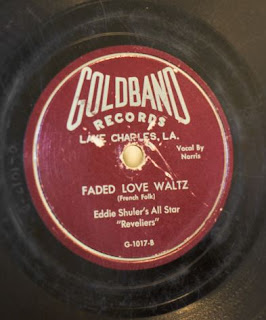
Between 1944 and 1945, Shuler cut the first record for the Reveliers, featuring Shuler's compositions "Broken Love" and "Room in Your Heart For Me Darling."   By 1946, Cajun music was ramping up among the population of south Louisiana and he brought in Norris Savoy to assist in singing some classic Cajun songs.  Along with Pee Wee Lyons on steel guitar and Johnny Babb on bass, they recorded the melody of the 1936 "Ma Valse Favori" by Cleoma Breaux in which he entitled it "Faded Love Waltz" (#1017).  The melody is the same as Lawrence Walker's 1929 recording of "La Vie Malheureuse" and Happy Fats' 1935 recording of "La Valse De L'Amour". Shuler called his new record label Goldband Records. 
It had something to do with my mentality. I said, 'This is going to be a goldmine, so I'll just call it Goldband.'2  


Oh, dear, well, I prayed, well, to have you,
I couldn't see, pretty little everything, how I'll do this.

Oh, dear, well, what hope, well, that you know,
I'm dying to have you anymore, pretty little everything.

Oh, dear, well, so why, well, (........),
You'll see that I don't deserve all that you've done. 


  1. Record Makers and Breakers: Voices of the Independent Rock 'n' Roll Pioneers By John Broven
  2. http://theind.com/article-168-the-record-man.html
  3. Lyrics by Stephane F
Release Info:
Hey Cushmall | Goldband G-1017-A
Faded Love Waltz | Goldband G-1017-B

Find:
Eddie Shuler & His All Star Reveliers: Grande Mamou (BACM, 2016)

Monday, January 31, 2022

"Cow Island Special" - Cliff Lemaire

A native of Cow Island, George Clifford "Cliff" Lemaire led a group during the late 1940s, playing Cajun music in the western swing style.  By 1950, he assembled a backup band called "The Swingsters" made up of local musicians from New Iberia.  Cliff and the Romeros arranged a shuffle-style tune called "Cow Island Special" (#104).  Cow Island (also known as Ile des Vache) is a small community in Vermilion Parish that got it's name from a hill in the midst of a marsh where herds of wild cattle roamed.2  

Musician Harold Romero Sr. learned at a young age to make fiddles and by the time he was a teenager, he was learning to build and repair guitars and mandolins. Harold recalled the early years,
We were pretty popular, I guess.  There was a demand for string bands.  I remember the first Saturday night we played we got $20 a piece—that was a lot of money back then.3  

Toutes mes chères catins,
Quoi faire tu brailles tout les temps?
...
...

J’ai fait des nuits ennuyant,
Et c’est toujours la cause,
De jouer l’accordéon,
Là-bas à Chez Ménard's.

Quand j’étais garçon,
C’est la, j’ai passé mon temps,
Et courtiser,
J’attend l’accordéon.

Asteure, j’sus marié,
Mais, ina une dizaine,
Que j’ai la moyère coullion,
Mais, ma vielle dit,
“J’vas t’aimer tout les temps”.

Et c’est toujours la cause,
Eh, des nuits ennuyant,
Jouer l’accordeon,
Là-bas à Chez Ménard's.

Quand j’étais garçon, 
C’est la, j’ai passé mon temps,
Et courtiser,
J’attend l’accordéon.

Asteure, j’sus marié,
Mais, ina une dizaine,
Que j’ai la moyère coullion,
Mais, ma vielle dit,
“J’vas t’aimer tout les temps”.

J’ai fait des nuits ennuyant,
Et c’est toujours la cause,
De jouer l’accordéon,
Là-bas à Chez Ménard's.

Quand j’étais garçon,
C’est la, j’ai passé,
Et courtiser,
Et aimer les filles.


Cliff Lemaire

Hot Rod record producer Virgil Bozman brought the group to the Harold Romero's Music Shop in downtown New Iberia and recorded a song entitled "Cow Island Hop".  It was an ode to the Cliff's hometown and the small club known as Menard's.  Located between HWY 82 and the Forked Island bridge, the small dance-hall was just south of the more well known Rock-A-Bye Club.  

"The Swingsters" comprised of Harold Romero Sr. on fiddle, Johnny Romero on drums, and Louis "Bee" Romero on bass.   Cliff owned a nightclub in Kaplan, owned an amusement company, became good friends with George Jones, and according to musicologist and author Lyle Ferbrache,
At one time, he played at the Louisiana Hayride and was on the bill the night Elvis changed the course of country music.1  
Cliff recorded for Khoury's of Lake Charles in the mid 1950s but left the music business soon after for a career in auto sales.


All my dearest dolls,
Why do you cry all the time,
...
...

I have lonely nights,
And it's always the reason,
To play the accordion,
Down there at Chez Menard's

When I was a boy,
It's there, I passed my time,
And courted,
Waiting for an accordion.

Right now, I'm married,
Well, it's been 10 years,
Since I've had foolish ways,
But, my old lady says,
"I'm going to love you forever."

And it's always the reason,
On these lonely nights,
To play the accordion,
Down there at Chez Menard's.

When I was a boy,
It's there, I passed my time,
And courted,
Waiting for an accordion.

Right now, I'm married,
Well, it's been 10 years,
Since I've had foolish ways,
But, my old lady says,
"I'm going to love you forever."

I have lonely nights,
And it's always the reason,
To play the accordion,
Down there at Chez Menard's

When I was a boy,
It's there, I passed by,
And courted,
And loved the girls.


Harold Romero

While running their music store during the day, the three Romero brothers later created their own group called the "Teche Playboys" which played everything from country music to rock n roll.  They played at places such as the Showboat Club in New Iberia an the Lafitte Club in Abbeville.3   Bee Romero would continue on throughout the 50s playing rockabilly music with his band called the Down Beats. 


  1. Discussions with Lyle F
  2. http://files.usgwarchives.net/la/vermilion/history/cowisl.txt
  3. The Daily Advertiser (Lafayette, Louisiana) 20 Mar 1996
  4. Lyrics by Smith S

Release Info:
Rou Li Aie | Hot Rod 104
Cow Island Special | Hot Rod 104