Showing posts with label Adam Trahan. Show all posts

Wednesday, March 25, 2020

"The Waltz Of Our Little Town" - Adam Trahan

Joe Falcon's breakthrough recording of "Lafayette" for Columbia records in 1928 spawned other players to take up the challenge.  By the time Joe arrived back from his second session, Cow Island native Adam Trahan had challenged Joe Falcon to an accordion contest, convinced he, himself, was a better player.  His denouncement of Joe's abilities at best garnered him the attention of a local furniture store owner and the Columbia executives.  At 19 years old, Adam received a telegram from Columbia Record Company representative, F. Mackey.  It directed him to "hop on the next train to New Orleans" where he would meet with the Columbia record contacts.1

He arrived in New Orleans in December of 1928 where he waxed the song "The Waltz Of Our Little Town" (#40501). The accordion melody has some similarity with Angelas Lejeune's 1929 recording of "Bayou Pon Pon", played as a waltz instead of a one-step, however, the lyrical melody resembles Joe Falcon's 1928 recording of "Osson".  It borrowed some similarities from an old fiddle melody called "Rubber Dolly". By 1934, Amede Ardoin traveled to NYC and recorded the song for Decca with many similarities, giving it the title "Tortope d'Osrun".   After the war, Austin Pitre sped up the tempo and created his "High Point Two Step" and "Janot Special". 


Si 't'avais écouter ton papa et ta maman, 

Aujourd'hui toi tu serais avec moi à la maison, 

J'ai courtaillé, j'ai roulayé, pour essayer, 
De t'avoir, malheureuse, j'ai pas pu.

Tu m'as pris de la maison comme un pauvre orphelin,
Tu m'as promis de t'soigner jusqu'à le jour de ma mort.


Abbeville Meridional
Dec 15, 1928

Sadly, Adam's guitarist and Milton native Edney Broussard, improvised all the chord changes, causing his session to sound terribly dissonant.   Columbia Records invited Trahan back for a second recording session, but he declined, having already sold his accordion.1  But his reputation as an excellent accordion player lingered in the community.  According to the Abbeville Meridional in 1929,
Adam Trahan has made a few records for the Columbia Phonograph Company, and is considered a wicked key snapper.  His ability to coax seductive melodies from the ol' wind box borders on the marvelous.  With the first strains from Adam's accordion the puritanical toe shakes off its solemnity--acquires a new cunning and swings into line with the dictates of nature.2  


If you'd listened to your dad and your mom,

Today, you'd be with me at home,

I had courted, I had ran around, trying,
To have you, miserable one, I just couldn't.

You took me from the house like a poor orphan,
You promised to take care of me until the day I die. 
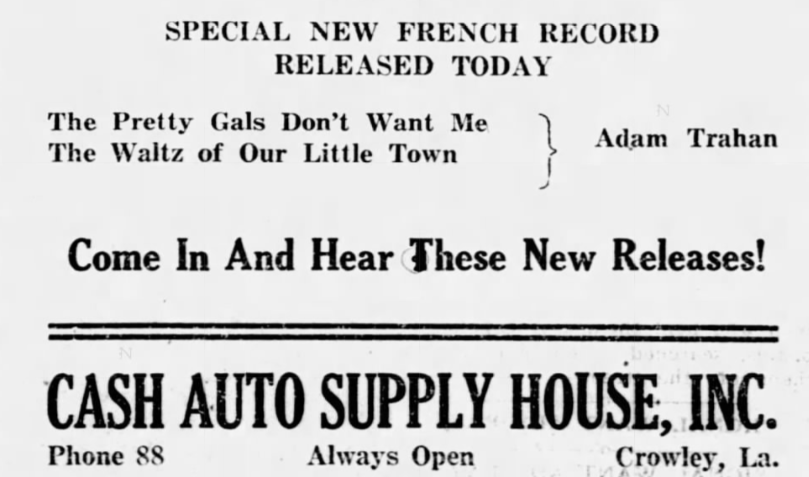


Crowley Daily Signal
Apr 18, 1929


  1. Accordions, fiddles, two step & swing: a Cajun music reader by Ryan A. Brasseaux, Kevin S. Fontenot
  2. Abbeville Meridional (Abbeville, Louisiana) 24 Aug 1929
  3. Lyrics by Stephane F


Release Info:

W147634-2 The Waltz Of Our Little Town | Columbia 40501-F
W147635-2 The Pretty Girls Don't Want Me | Columbia 40501-F

Find:
Cajun: Rare & Authentic (JSP, 2008)

Tuesday, October 31, 2017

"The Pretty Gals Don't Want Me" - Adam Trahan

By the summer of 1928, it had become quite apparent to Columbia's record company executives that an intriguing development was taking place.  Their new experiment with Cajun music was proving to be an unexpected success.  The bayou and prairie country of Cajun Louisiana, almost totally ignored by record companies up to this point, had overnight become a potential hotbed for record sales.1
Toutes les belles filles veut donc pas de moi,
"T’as des vilains manière" dit pop,
"Toutes les filles veut pas te marier,
Tu va te prendre une délaissé",
Toutes les belles filles veut donc pas de moi,
Rapport que je suis un bambocheur,
T’as parti le but que moi j’aime tant,
Mais, aller avec ton père.

C’est Madame Aubert* que je veux me marier,
C’est la belle que je veux voir,
J’ai bien suit pour l’attraper,
Et parti à pleurer.

Adam Trahan grew up around Abbeville and had learned the accordion before he was eighteen.  Once he had mastered the basics, one of his uncles took him to Rayne where he purchased a Monarch accordion for $22.50.  Inspired by Cajun-area musicians such as Joe Falcon, he kept practicing until, in his own words:
I got to be pretty good. I learned the accordion by myself--on my own--no one ever really taught me how to play it.1
After entering an accordion contest in Acadia parish, his name became known among other Columbia Cajun musicians.   While still single, living at home, Trahan received a telegram from F. Mackey, a Columbia Record representative.    The telegram directed him to "hop on the next train to New Orleans."1   

Crowley Daily Signal
Apr 18, 1929


All the beautiful girls don't want me,

"You have bad ways", says pop,

"All the girls do not want to get married,

You will have to take a forsaken one."
All the beautiful girls do not want me,
Because I am a rambler.
You've left with purpose, the one I love,
Well, to go with your father.

It's Madame Aubert which I want to marry,
It's the beauty which I want to see,
I have followed to catch her,
And went away crying.
With no time to lose, Adam went first to the Gueydan rice mill where Obrey Clark and Otise Monceau worked, only to find that his two fellow bandmembers employed there were unable to take off work.   The owner of a shoe shop in Kaplan suggested his guitar playing brother, Edney Broussard, who was willing to travel to New Orleans.   There he recorded "The Pretty Gals Don't Want Me" (#40501), a melody loosely borrowed from an old children's tune, "The Rabbit Stole The Pumpkin".   It was an intense fast-paced song that demonstrates Trahan's expertise on the accordion.   Unfortunately, Broussard's guitar chords on the recording are out of musical phase with Trahan's accordion much of the time.1


  1. Accordions, Fiddles, Two-Step & Swing: A Cajun Music Reader by by Ryan A. Brasseaux (Editor), Kevin S. Fontenot  (Editor), Wayne W. Daniel (Foreword).  Interview by Ron Brown. 
  2. Lyrics by Jordy A
Find:
Cajun: Rare & Authentic (JSP, 2008)

Friday, April 8, 2016

"Do You Think Work Is Hard?" - Adam Trahan

One of many Cajuns which headed the call by Columbia executives to record the music of their lives.  Adam Trahan (misspelled Trehan) headed to New Orleans briefly and recorded two songs, one which was about comparing hard work to the heartache of a loved one, "Do You Think Work Is Hard?" for Columbia (#40509).


Y'en a qui dit que travailler c'est dur,
Mais, travailler, mais ça c'est rien du tout,
Laissez-moi vous dire mais quoi c'est qu'est dur,
C'est quand on aime et qu'on est pas aimé,
S'en aller, oui, de la maison,
Mettre la table et pas capable d' souper,
S'en aller, oui, dehors pour se coucher,
Se mettre à jongler et pis se mettre à pleurer.

Y'en a qui dit mais travailler c'est dur,
Mais travailler, mais ça c'est rien du tout,
Laissez-moi vous dire mais quoi c'est qu'est dur
Lordy! Est d'aller auras de la belle,
et puis qu'elle te tourne le dos.

Nothing is more dissonant than hearing the impromptu guitarist's failure of finding the chords while the bass side of the accordion carries on with the song. Allegedly, Adam's guitarist couldn't make it and someone unfamiliar with the song, filled in. According to Ron Brown, the excessive demands upon Trahan's time conflicted with his plans to marry and get a 'responsible' job.1,2  By the time Columbia approached Adam to record again, he had already sold his accordion.2  Cajun musicians either fully embraced commercialization and it's fringe benefits or skirted the periphery like Trahan, disillusioned with the lifestyle.1


They are people who say that work is hard,

However, work, that's nothing,

Let me tell you what is hard otherwise,

This is when you love and are not loved back,

Go, yeh, to the house,

Set the table and not be able to have dinner,

Go, yeh, lie down outside,

Begin to reminiscence and worse, begin to cry.


They are people who say it's hard work,

However, work, that's nothing,

Let me tell you what is hard otherwise, 

Lordy! You to go to her,

And worse, she turns her back on you.


  1. Cajun Breakdown : The Emergence of an American-Made Music By Ryan Andre Brasseaux
  2. Accordions, Fiddles, Two-Step & Swing: A Cajun Music Reader by Ryan A. Brasseaux
  3. Image by Devon F.
  4. Lyrics by Jordy A, James P and Stephane F
Find:
CAJUN-Rare & Authentic (JSP, 2008)
Cajun Swamp Stomp, Vol 1 (Lumi, 2012)

Thursday, July 2, 2015

"Arcadian Waltz" - Adam Trahan

In 1928, as Columbia was looking for more Cajun material similar to Joe and Cleoma's music, other amateur musicians watching starry-eyed from the sidelines longed for recognition and a recording contract.  Nineteen-year-old Adam Trahan practiced his accordion assiduously after hearing "Lafayette" and eventually landed a deal with Columbia Records--$100 plus travel expenses--with the help of a local record retailer with ties to the New York--based company.  In December 1928, Columbia records released two Trahan records, one containing the instrumental "Arcadian Waltz" (#40509), before the disenchanted musician slipped into obscurity, never to step foot into a studio again.

Like most national record companies, Columbia's engineers misspelled Cajun words, in this case, his name Trehan and the word Acadian.  There is a distinct dissonance between the accordion's bass and the guitar throughout the songs. According to an interview with Trahan in the 1960s, he explained when it was time for him to go to New Orleans to make that record, his regular guitarist either couldn't (it was at harvest time) or wouldn't make the trip.  So, he picked up Edney Broussard of Milton, Louisiana, who didn't know the material. The rhythm of the guitar is perfect, but the chords are nearly 100% wrong.

According to Ron Brown, fans and club owners bombarded the musician with requests to perform for dances following Trahan's debut release, however he declined having a music career.


  1. Cajun Breakdown : The Emergence of an American-Made Music By Ryan Andre Brasseaux
  2. Accordions, fiddles, two step & swing: a Cajun music reader by Ron Brown, Ryan A. Brasseaux, and Kevin S. Fontenot
  3. Image by Devon F.
Find:
CAJUN-Rare & Authentic (JSP, 2008)
Cajun Swamp Stomp, Vol 1 (Lumi, 2012)