A unique window into the world of Cajun music between 1928 and 1965. Compiled histories from websites, books, news articles, liner notes, and interviews. Most come from my personal 78 collection. Also covering Creole, Cajun-Country, and Cajun swing.
Showing posts with label Leon "Crip" Credeur. Show all posts
Showing posts with label Leon "Crip" Credeur. Show all posts
Joe Fabacher was a talented accordion player that hailed from Acadia Parish. He began his band in 1935, modeled after other successful area groups such as the Hackberry Ramblers, the Dixie Ramblers, and the Rayne-Bo Ramblers, and Leo Soileau's Aces. He kicked off his recording career with his very first recording done in Dallas, Texas. Decca's A&R man, David Kapp, made pilgrimages through the south in areas such as Memphis, New Orleans, Dallas, San Antonio and Charlotte. He stated
"In Dallas we got a lot of Cajuns coming in. I've seen some of those artists drive 500 miles in tumble-down cars to get an audition".1
Joseph Fabacher, Leon "Crip" Credeur
By 1937, Decca invited the group, composed of Leon "Crip" Credeur on fiddle and vocals, Joseph Fabacher on accordion and Francis "Red" Fabacher on guitar, to Dallas where they performed the "Cata Houla Breakdown" (#17029) in the Adolphus Hotel. Named after a small town east of Lafayette called Catahoula, it featured the rarely heard accordion talent of Joseph Fabacher. It was a rendition of the Breaux Brother's "Le One Step A Martin". When he wasn't playing music, he was busy managing venues such as Rene Guilbeau's Dance Hall in Carencro. His brother Francis played guitar and during much of the late 1930s, the two had similar bands that performed in the same dance-hall circles. The Jolly Boys continued to play in places such as A. Romaire's Hall, Voorhies Roof Garden, Dixie Bar Dance Hall in Iota, Welcome Club in Crowley, Lucky Star Dance Hall, and the Armory Hall. Songs like "Cata Houla Breakdown" became better known as Aldus Roger's "Crowley Two Step".
Daily Advertiser July 14, 1939
Billboard Magazine. Hotel Room Recording Studios. Apr 3, 1971.
Release Info: 61912-A Cata Houla Breakdown | Decca 17029-A 61919-A La Valse De Lafayette | Decca 17029-B
The Jolly Boys got their start in 1937 with their only recording session with Decca. Joe Fabacher led his group during the late 1930s through the 1950s. It included his brother Red and Leon "Crip" Credeur". Francis "Red" Fabacher was a brilliant guitar player. By 1940, Red was playing radio shows on KVOL along with Nason Guidry and the Sons Of Acadians. However, soon after, he was drafted into WWII.
(Moi) tout seul dans la peine,
Moi tout seul, chère 'tit monde,
Mérite pas ça, ça t'as fais,
Mais, ça t'as fais, jolie.
Quand ton nègre est avec toi,
C'est "chère" ici et "chère" là bas,
Mais, quand ton nègre est-z-à-coté,
T'as bien prié ton pauvre vieux nègre.
Crowley Daily Signal Sept 7, 1950
The song was their version of Amede Ardoin's "Eunice Two Step". It spawned other post-war versions such as Virgil Bozman's "Tell Me If You Love Me" and Lee Sonnier's "Chere Ici Et Chere La-Ba". The phrase chère ici et chère là bas eludes to a lover's quarrel, where in the love interest acts differently when her man is at her side versus when he's away.
(I'm) all alone in pain,
I'm all alone, dear little everything,
Don't deserve that, that you've done,
Well, that you've done, pretty.
When your man is with you,
It's "dearie" here and "dearie" there,
Well, when your man alone by your side,
You had better pray for your poor old man.
While Red got his start playing Cajun swing music, he also was adept to playing country and rock in the later years. By the time he got out of the service, he had joined Harry Choates band, playing full rhythm guitar and occasionally filling in for Happy Fats.
Lyrics by Stephane F
Release Info: 61914-A Tant Que Tu Est Avec Moi (As Long As You're With Me) | Decca 17036 A 61915-A High Society | Decca 17036 B Find: Cajun: Rare & Authentic (JSP, 2008)
Attesting to the endurance of Jolie Blonde as a true Cajun song, it's melody can be found in numerous recordings, both before the war and afterwards. As the Hackberry Ramblers were reveling in their recent release of "Jolie Blonde" for Bluebird records in late 1936, Decca had the Jolly Boys of Lafayette covered the same tune in early 1937 at a session in Dallas, Texas, but with a different title called "Jolie Brunette" (#17032). The melody came from the first recording of "Ma Blonde Est Partie" by the Breaux family.
Jolie brune, ouais, tu connais,
J’ai mérité pas, ça t’après m'faire,
Et moi, je connais tu vas pleurer,
Avant longtemps d’avoir fait ça tu m’as fait.
Joli cœur, moi je connais,
T'auras du regret de pas bienfait,
Mais, ça t’as fait il y pas longtemps,
Fais pas ça à ton pauvre vieux negre, malheureuse.
The Jolly Boys of Lafayette consisted of the Fabacher brothers, Francis "Red" on guitar and Joseph accompanying, along with Leon "Crip" Credeur on vocals and fiddle. As shown in an early test pressing, Decca had originally attempted to call it "Jole Le Blon" however, for unknown reasons, the title was changed. It was most likely an attempt to capitalize on the popularity of the melody and Decca made sure the name wouldn't cause any issues. The melody was used twice during the session, changing up the lyrics for their tune "La Valse De Lafayette".
Daily Advertiser Mar 1, 1947
Pretty brunette, yeah you know,
I do not deserve this you've done to me,
And me, I know you have cried,
Before long, what's been done to me.
Pretty sweetheart, I know,
You will regret when you're not doing so well,
Well, you did that not long ago,
Do not do this to your poor old man, oh my.
Courtesy of Katherine Prater from Lake Charles
While the group wasn't well known, their short recording session added to the Cajun music repertoire of the late 1930s. By 1946, Harry Choates would propel the song into the American culture. By 1947, Decca re-issued the song, entitled "Jolie Blon" quite possibly to capture a new audience.
By the late 1930s, old-time string bands were being replaced by brother acts like the Delmores and the Sheltons. There were also new sounds of the Western swing groups to attract the public's ear. Cajun music on record also changed. Out went the accordion and in came the western string bands.1 The Jolly Boys of Lafayette were just one of many that landed a recording session with Decca in 1937.
Francis "Red" Fabacher
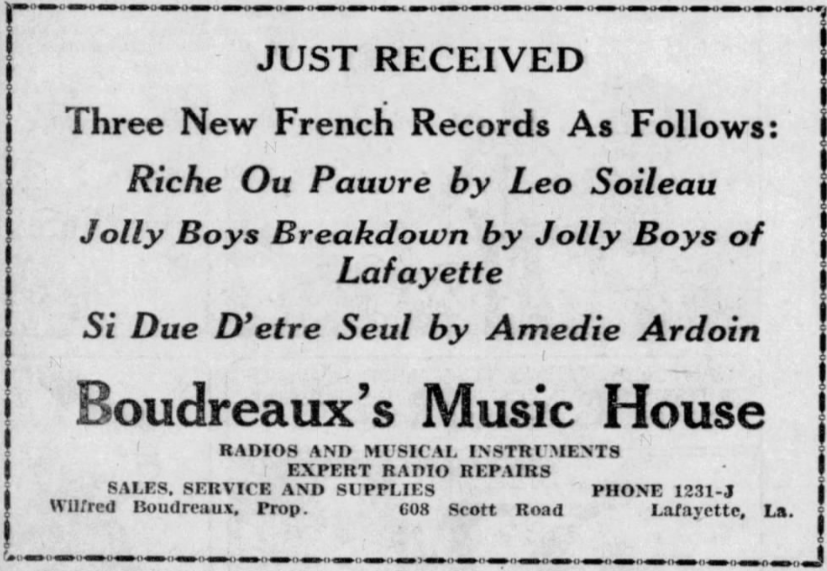
The song was a cover of the Angelas Lejeune recording "Perrodin Two Step" originally recorded in 1929. The song is most notably known as The Perrodin, allegedly named after two brothers who often requested it at dances.2 Here, the band named it after themselves, calling it the "Jolly Boys Breakdown" (#17032). The Jolly Boys were Francis "Red" Fabacher and Leon "Crip" Credeur.
The same melody would be used by Miller's Merrymakers called "Round Up Hop" in 1937. Some refer to it as "Mamou Breakdown" as recorded by Wallace "Cheese" Read. By 1947, Decca re-issued the song on their black "script" label.
Daily Advertiser Sep 20, 1937
Courtesy of Katherine Prater from Lake Charles
Cajun Country 2. Pat Harrison. Liner Notes.
MADE IN LOUISIANA. VRCD 325. MARC SAVOY - Accordion. DEWEY BALFA - Fiddle. D. L. MENARD - Guitar. Liner notes.
Find: Cajun Louisiane 1928-1939 (Fremeaux, 2003) Cajun Country, Vol. 2, More Hits from the Swamp (JSP, 2005) The Best Of Cajun & Zydeco (Not Now, 2010)
After 1933, Decca began looking to record more southern American music including hillbilly and Cajun music. Their A&R man, David Kapp, made pilgrimages through the south in areas such as Memphis, New Orleans, Dallas, San Antonio and Charlotte. He stated
"In Dallas we got a lot of Cajuns coming in. I've seen some of those artists drive 500 miles in tumble-down cars to get an audition".
One of those many Cajun bands was the Jolly Boys of Lafayette. Lafayette is a city in the heart of Cajun country. Composed of Leon "Crip" Credeur on fiddle and vocals, Joseph Fabacher on accordion and Francis "Red" Fabacher on guitar, they would travel to Dallas in 1937 and record 10 songs. Allegedly, Oran Doc Guidry claimed he and the band recorded earlier for Decca in 1934, however, there is no record of this in the Decca archives.
S'en aller là bas à Abbeville
C'est pour voir ma chère mignonne petite veuve
Quelques jours passés, je lui ai envoyer une lettre
Elle m'a jamais renvoyé de ses nouvelles
Petit coeur tu connais t'auras du regret
D'avoir eu fait tous les misères que t'es après me faire
Mais oh y aïe moi j'connais tu vas pleurer
Tu vas pleurer, c'est pour ça que t'es après faire
Francis Fabacher
The Fabacher brothers descend from a Bavarian family that settled in the region during the 1870s. Joseph's German accordion would have been very familiar to the families older generation. One of the songs recorded included the country influenced entitled "Abbeville" (#17026), named after a town south of Lafayette. The tune is typical of the country-hillbilly sound which influenced Cajun music in the late 1930s. An old country-western tune called "Lonesome Pine", which Cleoma Breaux covered as "Pin Solitaire" in 1936, most likely was the influence. The first recording of this melody as a Cajun tune was by the Guidry Brothers called "Le Garcon Negligent" in 1929. The melody was previously recorded by her brothers the year before as "La Valse Du Bayou Plaquemine". The melody would later influence "Alons Kooche Kooche" and "Grand Texas" tunes by Papa Cairo. All of these tunes would lead to Hank Williams' "Jambalaya".
Going away to there Abbeville,
It's for my cute dear little widow,
Past few days, I've been sending letters,
She never sent me anything new.
Small heart, you know you'll regret this,
Having made me miserable after all of this,
But oh yaille, I know you're going to cry,
You're going to cry, it's what will happen.
Daily Advertiser Apr 12, 1937
In the same fashion, the group would also record the song "Jolie Brunette", a different take on the famous "Jole Blon" melody. The group didn't last and disbanded. Francis would later end up playing guitar with Happy Fats and both steel guitar and electric guitar with Harry Choates. Leon would later work with Leroy Broussard of the Happy-Go-Lucky Band. Joe is believed to have played with Pee Wee Broussard and the Melody Boys.
Louisiana Fiddlers By Ron Yule
Billboard Magazine. Hotel Room Recording Studios. Apr 3, 1971.