Showing posts with label Wilbur "Pee Wee" Maples. Show all posts

Friday, October 5, 2018

"Devil In The Bayou" - Harry Choates

One of the stranger, spookier recordings that Cajun fiddler Harry Choates ever created was a haunting instrumental he laid down in Houston for Gold Star records.  Far from anything he had done before, one of Harry Choates’ most enduring compositions was the 1948 "Devil in the Bayou" (#1340).  Not a great hit in its day, the song somehow embodies the stereotype of sinister, supernatural Louisiana.  The manic violin coupled with a relentless piano backing and interspersed with demonic laughter, has a spooky appeal to modern listeners.  More than novelty, it demonstrates Choates’ extraordinary musical ability, achieving a huge range of sounds on the fiddle.3  

He was backed up by three of his original Melody Boys, Pee Wee Lyons on steel guitar, Johnnie Manuel on piano and Wilbur "Pee Wee" Maples on guitar, but replaced the other members with Grady Mann on bass and Amos Comeaux on drums.   The bizarre song is another one of Choates' original pieces. Played entirely in the key of A minor (virtually unheard of in hillbilly and Cajun music), author and researcher, Andrew Brown states:
"Devil" reminds one more of the soundtrack to an early horror movie than a country record, with Choate's sinister laughs accompanied by bassist Grady Mann's screams.5  

It had no commercial potential, but record producer Bill Quinn released it anyway.5    According to writer Thomas Townsley,
"Devil in the Bayou" continues to fascinate [Harry's] contemporaries and intrigue listeners. Demons are often a common topic in Cajun-Creole folklore. Among the most famous (and creepy) stories of haunted bayous is the account of feu follets.1  

According to the book, Swapping Stories: Folktales From Louisiana, feu follets  (known as will-o'-the-wisps in American culture) were reportedly unexplained glowing apparitions seen floating along the bayou at night. Many believed these glowing balls of light were demons that wandered the bayou, seeking to lead people astray into the dark. Choates in his song "Devil In the Bayou" brings to light the anxieties and terrors felt by the early superstitious Cajun peoples living along the bayou.1   

Harry himself succumbed to "demons" his whole life, mainly through the effects of his drinking. Legend has it that Harry never owned an instrument in his life; all his music was made on a $7.00 fiddle he borrowed from a friend and never bothered to return.2  He had the ability to drink most dedicated boozehounds under the table and the musical genius to blow just about anybody off of the bandstand.4  According to Brown,
There are a lot of musicians I talked to whose only remembrance of Harry is just this notorious alcoholic drunken bum guy. A lot of people don’t remember anything else but him just getting rip roaring drunk off his ass.4  
In 2002, Andrew Brown commemorated the recording by using it on his Harry Choates CD project, calling it "Devil In The Bayou".


  1. http://neworleansreligion.blogspot.com/2013/03/cajun-devil-folklore.html
  2. The Best of Country Music by John Morthland
  3. https://www.waveglobe.fm/harry-choates-fiddle-king-cajun-swing/
  4. http://www.offbeat.com/articles/harry-choates/
  5. Devil In The Bayou by Andrew Brown.  Liner notes.
Release Info:

1340-A Rye Whiskey | Gold Star 1340-A
1340-B Devil In The Bayou | Gold Star 1340-B

Find:
Harry Choates ‎– The Fiddle King Of Cajun Swing (Arhoolie, 1982, 1993) 
Devil In The Bayou - The Gold Star Recordings (Bear Family, 2002)

Monday, October 23, 2017

"Poor Hobo" - Harry Choates

Cajun swing fiddler Harry Choates' memory is lived in legendary tales of his life.  Never content to staying in one place or settling down with his family, he truly led the life of a vagabond.   He never owned a fiddle, allegedly; borrowing them as he needed to make enough money for drinking.  Money was never around and found refuge wherever he could in between paying gigs.

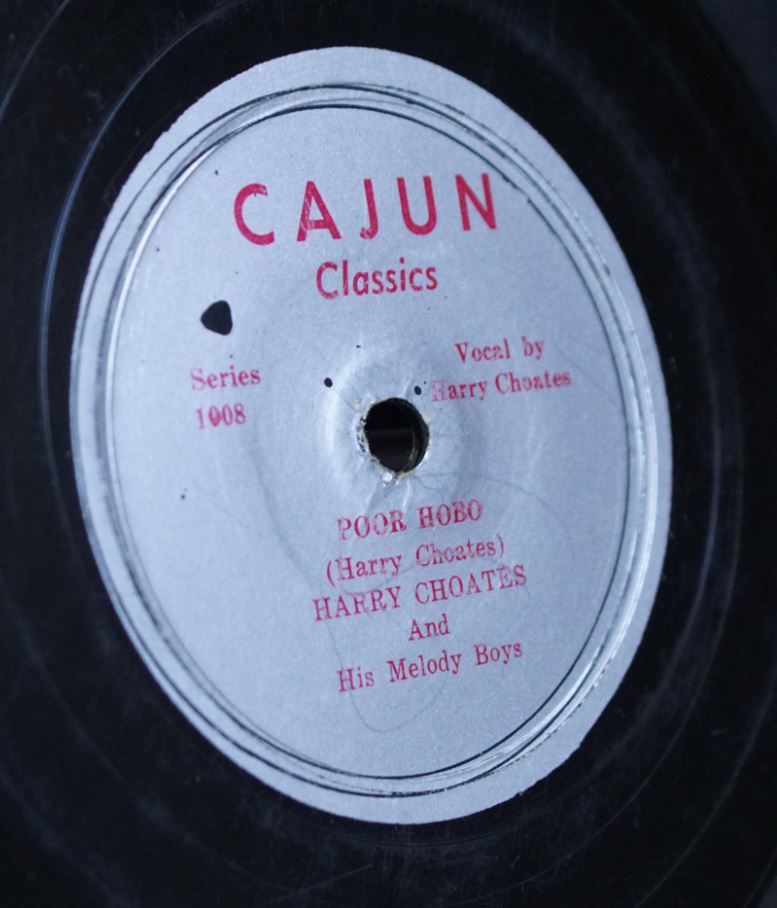
"Poor Hobo" was recorded twice by Harry.  Once for Mercer's Cajun Classics in early 1947 (#1008) and then again for Bill Quinn's Gold Star label in late 1947 (#1336).  The song is based on the Breaux brother's classic "Les Tracas Du Hobo Blues" recorded for Columbia back in 1929.   Harry's drummer, Curzy "Pork Chop" Roy remembers the recording session:
I remember those because Quinn who was a tough customer had us do several retakes on those songs.  We didn't receive any money for this.  Harry received a check.3


Hé Ha Ha.


Oh, je peux me voir, mais, comme un pauvre hobo,

Pas personne qui me veux pas, mais, ça m’a fait pitié.

Hé, malheureuse, quoi faire tu fais comme ça,

Oh, je connais, c'est par rapport à la mienne.


Oh, petite, pour moi tu fais comme ça,

Quoi t'a fait, mais, moi, je connais sera pas longtemps,

Mais, moi, j'connais chérie, hé hé hé,

Oh chère, je vas t'emmener un jour, chérie.

Rio Vista Club, Bandera, 1950
Frank Lamanski, Phil Marx, Harry Choates,
Louis Oltremari, Ivy Gaspard, Junior Keelan
 

It was a tune his most likely picked up while playing with Leo Soileau in the late 1930s, known as "Chere Liza".  His session at Goldstar was backed up by Wilbur "Pee Wee" Maples on guitar, Pee Wee Lyons on steel guitar, Grady Mann on bass, and Johnnie Ruth Manuel on piano.  Although author Tim Knight lists Amos Comeaux as the drummer, Curzy specifically remembers playing the drums on this recording session.  Apparently, after the band finished recording, Quinn took them all to a Mexican restaurant.  Curzy recalls:
We got paid in hot tamales.3


Oh, I can see that, well, I'm like a poor hobo,

Not a single person that does not want me, well, that makes me sad,

Hey, it's terrible, why are you doing this like that,

Oh, I know, it's because of how I look (feel).


Oh, little one, you've done this to me like that,

What you have done, well, I know it won't be long,

Well, I know, dear, hey, hey, hey,

Oh dear, I'm going to take you away one day, dear.

Later 45 releases by Starday and D Records (ST212 and D1043) mis-titled Harry's "Louisiana" as "Poor Hobo".  Author Tim Knight would use this title of this song for his biography on Harry Choates; a fitting description of what his life was like.  Success and stability were never important to him.  He had a naive innocence about himself, and said he was only interested in making people happy. According to Harry's daughter, Linda:

“My daddy just loved people with an almost childlike trust.”1


Poor Hobo - Early 1947 - Cajun Classics


Poor Hobo - Late 1947 - Goldstar


  1. http://therecordlive.com/2009/12/16/harry-choate-and-jolie-blon-cajun-musics-founding-father/ 
  2. Image by Tim Knight
  3. Poor Hobo: The Tragic Life of Harry Choates, a Cajun Legend by Tim Knight
  4. Lyrics by Stephane F and Jordy A
Release Info:
Louisianna | Gold Star 1336-A
Poor Hobo | Gold Star 1336-B

Louisianna | Modern 20-595
Poor Hobo | Modern 20-595

Poor Hobo | Cajun Classics Series 1008
Jole Brun | Cajun Classics Series 1009

Poor Hobo | Starday 212
Opelousas Waltz | Starday 212


Find:
Harry Choates ‎– The Fiddle King Of Cajun Swing (Arhoolie, 1982, 1993)
Cajun Fiddle King (AIM, 1999)

Tuesday, June 16, 2015

"Dragging The Bow" - Harry Choates

One of Harry Choates' best demonstrations of his talent was ability to show off his solo fiddle rides on certain tunes.   Here, in early 1948, he takes the opportunity with his band to record for Bill Quinn's Houston-based Gold Star label one of his more well known instrumentals called "Dragging The Bow" (#1343).

His band had shifted some players and by 1948, the group consisted of Wilbur "Pee Wee" Maples on guitar, Red Fabacher on steel guitar, Junior Keelan on bass, Amos Comeaux on drums, and Johnnie Ruth Manuel on piano.  Throughout the song, you could hear him shift the attention to his friend Francis "Red" Fabacher by calling out his name.   Red had earlier worked with his brother Joseph in the group called Jolly Boys of Lafayette. He met Harry around the time both were helping Happy Fats during the early 1940s.


Red Fabacher, Ronald Ray "Pee Wee" Lyons,
Johnnie Ruth Smyrl, Harry Choates,
Amos Comeaux, Curly Maples
Originally recorded by Henry Hartley and the Travelers as "Raggin' The Fiddle", it's a cover of the famous western swing player Curt "Dott" Massey's 1935 Vocalion recording called "Draggin’ the Bow".  Most likely, Harry picked up the tune while playing with Shelley Lee Alley & his Alley Cats, given they recorded the tune in 1938 as "Alley Cat Stomp".  Harry had previously recorded it with Happy Fat's Rayne-Bo Ramblers in 1940 for Bluebird and their subsidiary Montgomery Ward label, calling it "Lake Charles Shuffle". The song title refers to the action of a smooth fiddle player.  While the phrase has mysterious origins, it most likely refers to a player's ability to keep the bow constantly on the strings, while moving from string to string, in one sweeping fashion. 


Goldstar would end up selling the masters to Pappy Daily's "D" records which re-released the song (#1024), sometimes changing the name slightly, such as "Draggin The Fiddle" (Starday #273, D 1023)  and "Drag That Fiddle" (Starday #258).

Harry's lifestyle was erratic.  According to Red:

I drank when I was on the bandstand, but [Harry] drank all day long.


Daily Advertiser
Feb 19, 1941


  1. Country Music Originals: The Legends and the Lost By Tony Russell
  2. http://www.vithefiddler.com/draggin-the-bow-fiddle-tune-a-day-day-110/
Find:
Fiddlin' country style (Melodisc, 1961)
Harry Choates ‎– The Fiddle King Of Cajun Swing (Arhoolie, 1982, 1993)
Harry Choates - Jole blon: The Original Cajun Fiddle of Harry Choates CD (D, 1999)
Cajun Fiddle King (AIM, 1999)
Devil In The Bayou - The Gold Star Recordings (Bear Family, 2002)