Showing posts with label Elise Deshotel. Show all posts

Saturday, January 4, 2020

"Two Step De Avalon" - Elise Deshotel

Elise Dehotel's Louisiana Rhythmaires were very popular between Basile and Lake Charles. Deshotel, together with family members, had previously played with Nathan Abshire in south Louisiana venues including the Avalon Club, a place owned by the rough and tumble Quincy Davis. Doug Kershaw recalls playing at the club:
Me & my brothers, Pee Wee & Rusty would play the afternoon dance at Club Avalon in Basile then either Iry or Nathan Abshire would play the night dance. Quincy could be rough if he had to, but he looked after us kids.  When he re-opened the Broken Mirror in West Lake, he let us play there.

Elise jumped into the recording arena around the same time Nathan had brought back the accordion into Cajun music.  Deshotel's six song session, comprised of three vocals and three instruments, was the first in which Dewey Balfa took part on fiddle, as well as handling all the vocals.  The instrumentals from the session were assigned as the "A" sides and stomping accordion pieces dominated by Maurice Barzas. As researcher David Sax mentions:
"Two Step De Avalon" in particular, with it's wonderfully heavy handed drumming from Deshotel's wife Esther, seems to bring to mind a wild early morning encore near closing time at the Avalon Club.1  
"Avalon" seems to be a slightly different take on Lawrence Walker's "Creole Stomp". Elise had himself on guitar, Maurice Barzas on accordion, Dewey Balfa on fiddle, Rodney Balfa on guitar, and Esther on drums.  The band members fluctuated often and by this point, Atlas Fruge was added on steel guitar.  Sadly, his astounding steel guitar playing and Balfa's fiddle are barely heard here. 


KSIG in Crowley
Elise Deshotel, Cleveland "Cat" Deshotel,
Atlas Fruge, unknown girl, unknown guitar,
Eldridge "Coon" Guidry


  1. Cajun Honky Tonk: The Khoury Recordings, Vol. 2. Liner notes.
Release Info:
Two Step De Avalon | Khoury's KH-619-A
La Valse De Courage | Khoury's KH-619-B

Find:
Cajun Honky Tonk: The Khoury Recordings Vol. 2 (Arhoolie, 2013)

Tuesday, April 3, 2018

"La Valse Da Courage" - Elise Deshotel

During World War II, a 16-year-old Dewey Balfa left home to work in a Texas shipyard followed by a stint in the Merchant Marines. He maintained his chops with Texas swing, containing a heavy swing influence, and maybe it was here, being away from home where he felt the missing connection with his cultural music. In 1948, he returned to Louisiana and formed the Musical Brothers, a popular string dance band, with brothers Harry, Will and Rodney. By then Dewey had blossomed into a virtuoso with his accurate, flowing style and was often requested to gig with other musicians.1 

Ton papa et ta maman m’a toujours dit, chère,

Pas te quitte, ouais, notre amour d'être gouverné,

Quoi faire donc, ‘tit monde, t’après faire ça, chère, 

Tu connais je mérite pas tous ces misères.


Quoi faire donc, ‘tit monde, toi, tu fais ça, chère,

T’après m'quitter, mon tout seul dans les misères,

Tu connais, ‘tite fille, avant longtemps, chère, 

Tu voudras t’en revenir, découragé.


Atlas Fruge, Will Kegley, Nathan Abshire, 
Cleveland "Cat" Deshotel, Elise Deshotel

During this early period, Dewey met musician Elise Deshotel.   Elise Deshotel and fellow accordion player, Maurice Barzas, teamed up with the young fiddle player named Dewey Balfa in a makeshift recording studio in Opelousas.   One the Dewey's earliest releases with Elise Deshotel, "La Valse De Courage", (#619), recorded in 1951 was Dewey's take on the well-known 1928 Joe and Cleoma Falcon tune "Waltz That Carried Me To My Grave".  The tune manifests itself in other original forms such as Bixy Guidry's "La Valse Du Bayou" and the Breaux Brothers "La Valse des Pins".  It has a melody that seems to borrow from Nathan's "La Valse de Bayou Teche" but steers itself in a slightly different direction.  Meant to be "La Valse Découragée", it tells of a love interest who has left, leaving the lover discouraged.  The recording had Dewey's brother Rodney Balfa on guitar, Atlas Fruge on steel guitar, and Ester Deshotel on drums.  In 1953, Iry borrowed Cleoma's tune for his better known "La Valse de Grand Chemin".

Your dad and your mom always told me, dear,

Don't you let, yeah, our love be controlled,

Why did you do, my little everything, all that you've done, dear,

You know I do not deserve all of this misery.


Why did you do, my little everything, what you have done, dear,

You have left me, all alone in misery,

You know, little girl, before long, dear,

You'll want to come back, discouraged


In the ’50s, Dewey’s notoriety was reaching new heights. Around the same time, he began his lifetime association with Nathan Abshire, the jovial, soulful accordionist who rightfully has his own place in the annals of Cajun music. But just as music was making a come back, the Balfas considered it be a celebratory past-time, not taken seriously as a profession. In order to support a growing family, at various times Dewey worked as a farmer, an insurance salesman, a school bus driver, a disc jockey and a furniture store owner.1  It wouldn't be until the 1960s when Dewey would try to revitalize his recording career with Floyd Soileau. 


  1. http://www.offbeat.com/articles/masters-of-louisiana-music-dewey-balfa/
  2. Discussions with Lyle F.
  3. Lyrics by Jordy A
Release Info:
A Two Step de Avalon KH-619-A Khoury's
B La Valse de Courage KH-619-B Khoury's

Find:
Cajun Honky Tonk: The Khoury Recordings, Volume 1 (Arhoolie, 1995)

Thursday, October 5, 2017

"Le Two Step De Villeplatte" - Elise Deshotel

The Deshotels lived near Basile and were involved with many bands and line-ups from that area for their dances.  Elise, his wife Ester, and Cleveland "Cat" Deshotel all played with Nathan Abshire at the Avalon Club.  The Dehotels and his band were like most bands of the era; people came and went depending on work obligations. 

Meanwhile, record producer George Khoury knew how to spot successful Cajun musicians.  After working closely with Nathan Abshire, he gathered one of Nathan's biggest fan bands, led by Elise Deshotel. The two groups worked closely during the early 50s playing in the same dance halls around Evangeline parish, not far from the small town of Ville Platte.  They made their recording debut in 1951 with an instrumental called "Le Two Step de Villeplatte" (#618), which was captured on a home recorder and released as a 78 RPM single.  It featured Dewey Balfa on fiddle, Atlas Fruge on steel guitar, Elise Deshotel on rhythm guitar and Ester Deshotel on drums.

Elise's wife Ester was more than likely the drummer on some recordings since she played live with them.  Her driving style kept the band's rhythm in tact.  With Ester playing drums with Nathan, she became one of three female drummers for the band.  The other two were Bernella Fruge and Will Kegley's sister, Ozide.  Cat played both bass and fiddle with Nathan until the Swallow-label recordings ended.
Atlas Fruge, Ester Deshotel, Wilson Granger,
Nathan Abshire, Elise Deshotel

In fact, these women join the ranks of the few females playing and singing Cajun music during the 1950s.      People such as Marie Solange Falcon, Theresa Meaux Falcon, Johnnie Ruth Smyrle Manuel, Laura Broussard, Corita Thibodeaux and Yvonne Leblanc highlight the rarity of Cajun women playing music in male-dominated industry.


  1. All Music Guide to Country: The Experts' Guide to the Best Country Recordings edited by Michael Erlewine
  2. http://www.offbeat.com/articles/masters-of-louisiana-music-dewey-balfa/
  3. Discussions with Lyle F

Find:
Cajun Music - The Early 50s (Arhoolie, 1969/1975)
Cajun Honky Tonk: The Khoury Recordings, Volume 1 (Arhoolie, 1995)
Bayou Two-Step - Cajun Hits From Louisiana 1929-1962 (Jasmine, 2015)

Thursday, May 5, 2016

"La Valse De Tamper Tate" - Elise Deshotel

Elise Deshotel of Mamou, Louisiana, featured a young fiddler and singer named Dewey Balfa.   With the Balfas in tow, in 1951 the group used an old Cleoma Breaux tune called "La Valse Crowley" and entitled it "La Valse De Tamper Tate" (#620) for Khoury's label.  Tamper Tate is the corrupted form of the location Tepetate; a small community near Eunice, Louisiana.  The group featured accordionist Maurice Barzas.
Ouais, tit monde, t’après me quitter, chère, 

Après me quitter pour t’en aller à Tepetate, yaille.

Eh, quoi faire toi t’est fais ça, catin, 

Te connais quoi t’après faire un erreur, yaille.


Eh, tit monde, garde t’après faire, chère, 

Te connais un jour avenir tu vas voir du regret, tit monde,

Eh, catin, tes voudrais t'en venir,

T'en venir serais trop tard pour ton erreur, yaille.
Elise Deshotel, Cleveland "Cat" Deshotel,
Atlas Fruge, unknown girl, unknown guitar,
Eldridge "Coon" Guidry

As the popularity of the accordion waned in the late '30s and early '40s, Maurice Barzas decided to hang it up. After World War II, when the accordion became more popular than ever, the Balfa Brothers came to see him one afternoon to form a band. Maurice didn't even own an accordion anymore. New ones weren't available anymore from Germany, so he borrowed one for two or three dances and then bought a used one from JM LaFleur's country store in Lawtell. The band began playing on Saturday nights at the Dixie Club in Eunice.

Yeh, my little everything, you left me, my dear,

You left me and went away to Tepetate, oh my,

Well, what are you worrying for, little doll,

You know that you made a mistake, oh my,


Well, my little everything, look at what you've done, dear,

You know one day, in the future, you're going to regret this, my little everything,

Well, little doll, you would like to come back,

You've come too late for this is your mistake, oh my.

Dewey Balfa
Later Elise Deshotel, a guitar player from Basile with his wife Ester on drums, formed a band with Dewey and Rodney Balfa and Maurice on accordion.  The group, known as Elise Deshotel and the Louisiana Rhythmaires, played around the Lake Charles and Creole area, and made three 78s at KSLO in Opelousas, all on the Khoury label.  However, on this recording, allegedly, they were done at Dewey's home and Maurice wasn't featured.

Maurice played with this group through about 1951, but also formed the Mamou Playboys during that time.   He and Vorance Barzas created the more popular version of this melody, the "Eunice Waltz".


  1. Maurice Barzas and the Original Mamou Playboys.   Liner notes.
  2. http://www.downtowncajunband.nl/sitewillem/Acadiana%20Gateway/music/originalmamouplayboys.htm.html
  3. Discussions with Lyle F
  4. Lyrics by Jerry M and Herman M


Find:
Cajun Honky Tonk: The Khoury Recordings, Volume 1 (Arhoolie, 1995)

Thursday, February 4, 2016

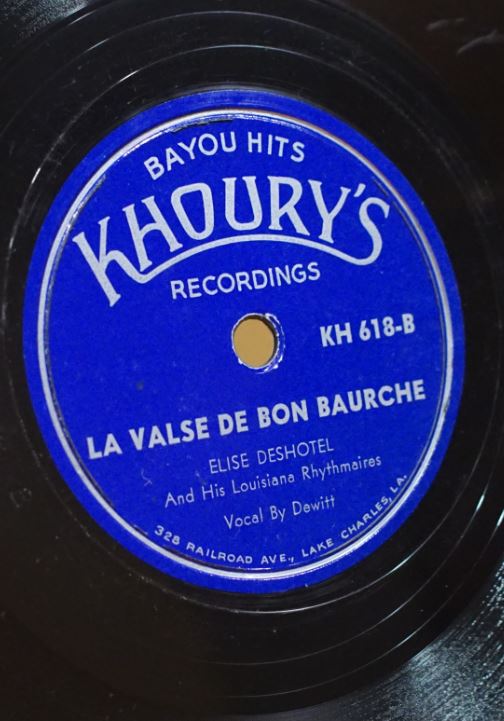
"La Valse De Bon Baurche" - Elise Deshotel

Another popular French song tradition transplanted to Acadia and Louisiana was the drinking song, called in the New World, la chanson de bamboche. This type of song was especially popular at social gatherings like Christmas and New Year celebrations, wedding receptions and house dances.5 

An impassioned ambassador for Cajun music and culture, fiddler and singer Dewey Balfa was a driving force in the revival of traditional Cajun music. Together with his brothers Will, Rodney, Harry, and Burkeman, and later his nephew Tony and daughter Christine, Balfa introduced the vibrant sound of Cajun music to countless people around the world and used his role as a musical ambassador to reawaken a deep and abiding sense of pride in Cajun music amongst his fellow Cajuns. Dewey's strong sense of tradition was based on a deep musical heritage going back generations in his family. Dewey states:


"My father, grandfather, great-grandfather, they all played the fiddle," he told an interviewer, "and you see, through my music, I feel they are still alive."4

Dewey Balfa made his recording debut in 1951 with "Le Two Step de Ville Platte", which was captured on a home recorder and released as a 78 RPM single.  He and Elise Deshotel cut several primitive sides including "La Valse de Bon Baurche," (#618)  an original that would be the linchpin of the Balfa Brothers’ eventual recording career.   Backed by Elise band, consisting of many of Nathan Abshire's musicians and Maurice Barzas, he sang this song about a sorrowful drunkard.  The song warns the libertine (the literal meaning of "bambocheur") of the evils of drink and high living.3

It was an old melody, first recorded by Dennis McGee as "La Valse Du La Penitentiaire" and again Leo Soileau in the 1930s known as "Quand Je Suis Bleu".  The melody also influenced Joe Manuel to record a string band version called "Since The Age Of 14".  It is a hard-driving waltz, with a quick beat and soulful vocals, influenced not only by tradition, but also by the fact that the Balfa Brothers were discovering how to provide the energy level required by large festival crowds who were listening more than dancing.2
Hey, yaille, depuis l'âge de quatorze ans,
J'après rouler manche à manche,
Pour essayer d'en trouver,
D'en trouver une autre comme toi,
T'es la seule mon couer désire.

Hey, yaille,
Aujourd'hui n'importe ayoù,
N'importe ayoù moi j'peux passer,
Blanc et noir, ça me pointe au doigt, chère,
En disant, "Gardez-là! Gardez-là grand bonrien, 
Le rouleur et bambocheur".

Hey, yaille, aujourd'hui chaque fois je pars,
Chaque fois je pars de la maison,
Pop et mom se mettent à pleurer,
Ça me suit jusqu'à la porte du cour,
En disant, " Toi t'es un bonrien",
Fait pas ça, viens, donc nous rejoindre.

Oh, ye yaille, mais moi j'ai toujours dit,
Toujours dit à mon vieux pop et à ma chère vieille bonne maman, yaille,
Moi, je connais j'suis un bonrien,
J'suis un bonrien pour moi-même,
J'ai jamais fait rien pour personne.

Oh, ye yaille, aujourd'hui j'suis condamné,
Condamné à rouler,
Ma bourouette sur ma planche de six pouces,
Quatre-vingt dix neuf ans,
Quatre-vingt dix neuf ans, c'est la limite d'un bon a rien,
Ça c'est le restant de ma vie,
Aussi loin de cette la moi j'aime.
Dewey and Will Balfa in the studio
Photo courtesy of the Ralph Rinzler Archive
The recording didn't really take off and by the 1960s, the Cajun music sound began to change with the sounds of Belton Richard. However, people were asking Floyd Soileau of Swallow records for this song on record.  Around 1963, Dewey approached Floyd about doing traditional tunes he remembered and had previously recorded. Floyd states: 


I was always working in the front counter because I could get a feel of what kind of records my people wanted to buy.  And I wanted to record "La Valse De Bon Baurche', but nobody knew it.  And Dewey Balfa came to see me many a time trying to convince me that I should record him and his brothers.  I said, 'No, I want something with an accordion, if I don't haven an accordion I don't want it.'  He happens to mention that he had recorded 'La Valse De Bon Baurche' many years ago.  I said, 'Why didn't you tell me this in the first place! I have been trying to get somebody to do this song for the longest."  So we went in and we did 'La Valse de Bambocheurs'.   From then on we went on doing the Balfa Brothers.1 
Dewey Balfa
Photo courtesy of the
Ralph Rinzler Archive,
Center for Folklife and
Cultural Heritage,
Smithsonian Institution

The release sold well, but more importantly, it brought the old-style, traditional sound back into consideration on the local level.   The old Creole adage "condemned for 99 years" is less of a physical sentence, but more of an emotional one, in which the heartbroken feels this is the longest someone could survive without their lover.   It's a way to say "dying of a broken heart".

Hey, ye yaille, since the age of fourteen,

I've rambled from road to road,

Rambling with my bottle in hand,

Trying to find another like you,
You're the only one my heart desires.

Hey, ye yaille, today, no matter where I go,
The whites and the blacks point their fingers at me,
Saying, "Look there, look there at the good for nothing,
The drunkard and rambler".

Hey, ye yaille, each time I leave,
Each time I leave my house,
Pop and mom start crying,
They follow me to the gate of the yard,
Saying "You're good for nothing,
"Don't do that. Come back and join us."

Hey, ye yaille, I always said,
Always said to my old pop and to my dear old mom,
"I know I'm a good for nothing,
I'm good for nothing for myself,
I never did anything for anybody".

Hey, ye yaille, today I'm condemned,
Condemned to ramble,
My wheelbarrow on my six-inch plank,
For ninety --nine years,
Ninety-nine years, that's the limit for a good for nothing,
That's the rest of my life,
So far from the one I love.
The Balfa Brothers,
Festival of American Folklife
Washington, DC. July 4, 1969
Courtesy of Smithsonian Center for
Folklife and Cultural Heritage.
It was this song that attracted the attention of Newport Folk Festival fieldworker Ralph Rinzler, leading to an invitation to the Balfa Brothers to perform at the Newport festival in 1964.2  To their amazement, rather than laughing at them, the largely urban audience of 17, 000 went wild. As Dewey recalled many years later:
 "I had played in house dances, family gatherings, maybe a dance hall where you might have seen as many as 200 people at once. In fact, I doubt I had ever seen 200 people at once. And in Newport, there were 17,000. Seventeen thousand people who wouldn't let us get off stage."4 

With renewed pride in Cajun culture, as well as a sense of its commercial potential outside Louisiana, Dewey returned to Louisiana and in 1965, with his brothers Will, Rodney, and Harry on fiddles, guitars, and triangle and Hadley Fontenot on accordion, established the Balfa Brothers Band.

By 1965, Floyd launched the Balfa's first single, giving it the English title "Drunkard’s Sorrow Waltz".  Austin Pitre and Milton Molitor would re-title the song "Ninety Nine Year Waltz", even though it has no similarity with Iry's "Convict Waltz". 


  1. All Music Guide to Country: The Experts' Guide to the Best Country Recordings edited by Michael Erlewine
  2. http://cds.library.brown.edu/projects/MusicAtlas/Volume4/playpagevol4ch5.html
  3. Old-Country Music in a New Land: Folk Music of Immigrants from Europe and the Near East New World NW 264.  Liner notes.
  4. http://www.folkways.si.edu/dewey-balfa-master-cajun/music/article/smithsonian
  5. Cajun Music: It's Origins and Development by Barry Jean Ancelet


Find:
Cajun Honky Tonk: The Khoury Recordings, Volume 1 (Arhoolie, 1995)

Friday, July 24, 2015

"Two Step De Kindergarden" - Elise Deshotel

As Nathan Abshire's post-war recordings with George Khoury become more popular, friends of Nathan began recording, trying to gain popularity.  It wasn't uncommon to have the same musicians of one band play in other bands.   Given the variety of places to play, musicians such as Dewey Balfa, and Elise Deshotel formed other groups in order to capitalize on the dance hall music business.

In the ’50s, Dewey’s notoriety was reaching new heights. In 1951, he waxed his first recording with the Louisiana Rhythmaires led by Elise Deshotel and Maurice Barzas for George Khoury’s Lake Charles-based label. Exactly when this recording was done is unknown but at some point Elise and some of his group recorded the "Two Step De Kindergarden" (#620).  It's a quick-paced, accordion-led instrumental named after the Kinder Garden dance-hall, located in the fork of a road in Kinder, LA.  According to James Perry,
Guitarist Harry LaFleur told me he was playing a gig in there when it caught on fire and burned down. 
Atlas Fruge, Will Kegley, Nathan Abshire,
Cleveland "Cat" Deshotel, Elise Deshotel

Nathan's group would play with Elise from time to time as well as Elise playing with Nathan's group.   When Nathan Abshire's regular guitar player, Ernest Thibodeaux, wasn't available, his substitutes on guitar were Harry Lafleur, Preston Manuel, or Elise Deshotel.


  1. Louisiana Music by Lyle Ferb
  2. http://www.offbeat.com/articles/masters-of-louisiana-music-dewey-balfa/
Find:
Cajun Honky Tonk: The Khoury Recordings Vol. 2 (Arhoolie, 2013)