Showing posts with label Gold Star Records. Show all posts

Tuesday, October 12, 2021

"Cajun Hop" - Harry Choates

Harry Choates, the earliest of post-war Cajun groups to record, had joined Leo Soileau's group around the late 1930s or early 1940s.   He had gained a reputation of an excellent fiddle player around southwest Louisiana.  While filling in, he would remember several of their signature tunes and later borrow them while recording with his Melody Boys by the mid 40s. 

Having played in Leo Soileau's band during the war years, "Cajun Hop" (#1326) was merely an updated version of Soileau's "Les Blues de Port Arthur".   It was recorded in 1947 at Bill Quinn's Gold Star studios and the "hop" is a generic name Bill Quinn usually gave to any fast Cajun tune.


Eh, 'tite fille, tu m'as lesse pour t'en aller,
Malheureuse, moi j'connais, mérite pas ça.
Eh, chere, jolie fille, jolie cœur,
Quoi t'as fais, mais, avec moi, (que misérable).

Eh, eh, eh, ha, ha.
Eh, 'tite fille, t'apres la peine.

Eh, chere, jolie fille, jolie cœur,
Eh, mais, moi j'connais m'aimer (...)
Eh, 'tite fille, eh villian moyens,
Moi j'connais, quoi t'as fais, t'as fais pas bien.

Hollywood Club
B.D. Williams, Curzey "Porkchop" Roy, Harry Choates
Johnnie Manuel, Joe Manuel, Eddie Pursley,
Ronald Ray "Pee Wee" Lyons


The "Cajun Hop" session is unique because Bill Quinn actually typed up a session sheet which the entire band signed, and, miraculously, this sheet actually survived and is now in the University of Texas archives. This is one of only two session sheets to survive for any Gold Star session, by anyone. It listed the band members: Joe Manuel on banjo, Eddie Pursley on guitar, Johnnie Manuel on piano, Ronald Ray "Pee Wee" Lyons on steel, and B.D. Williams on bass.
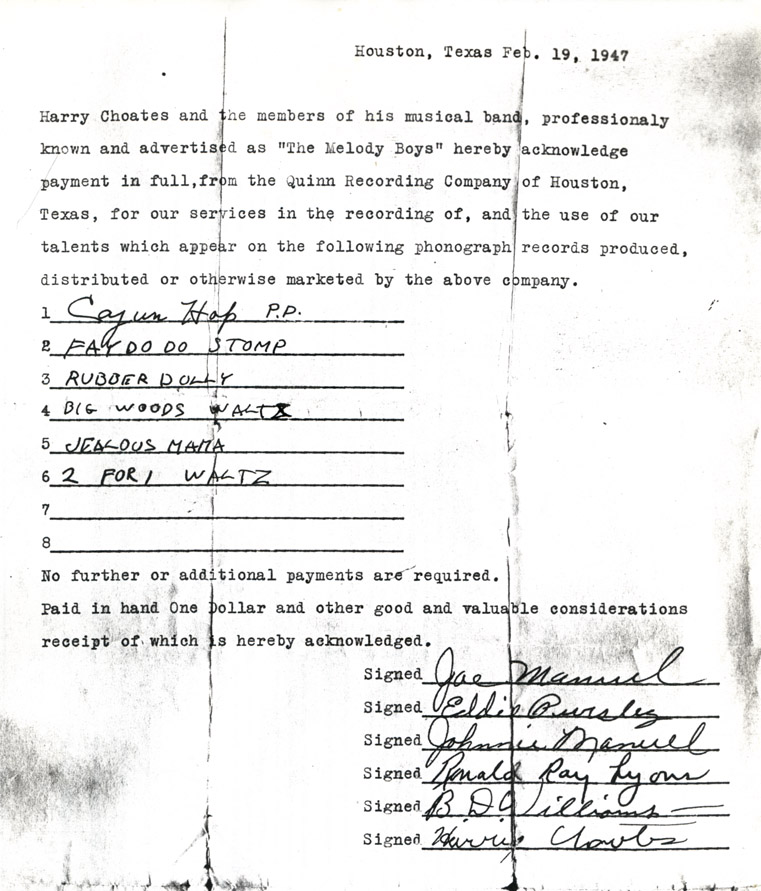
Gold Star session, 1947
Quinn's motivation was apparently to prove that he had paid the band for their services in case one of them tried to sue him later (as Jimmie Foster would do later that year for his non-credit on "Jole Blon"), though since he's only paying them $1.00 each, the contract is purely a formality. Either that, or the Melody Boys worked very cheap.  The song was the flip side of "Harry Choates Special" for Goldstar but the Bihari's released it on the other side of "Rubber Dolly".

Typically, though, his records show him as a Cajun Bob Wills, interspersing his singing and fiddling with cries of "eh,ha ha!".  It was a common phrase he used, especially when playing live, due to having a limited Cajun french vocabulary and constantly forgetting the lyrics mid-song.


Hey, little girl, you have left me to go away,
Naughty woman, I know, I don't deserve that,
Hey, dearie, pretty girl, pretty sweetheart,
What you've done, well, with me, (that's miserable).

Hey, hey, hey, hah, hah.
Hey, little girl, you're painful. 

Hey, dearie, pretty girl, pretty sweetheart,
Hey, well, I know I love (...),
Hey, little girl, hey, naughty ways,
I know, what you've done, you've not been good.


  1. Country Music Originals: The Legends and the Lost By Tony Russell
  2. http://wired-for-sound.blogspot.com/2010/08/harry-choates-on-gold-star-13261330.html
Release Info:
1326-A Cajun Hop | Gold Star 1326-A
1326-B Fa-De-Do Stomp | Gold Star 1326-B

1331 Rubber Dolly | Modern 20-528A
1326-A Cajun Hop | Modern 20-528B

Find:
Harry Choates ‎– The Fiddle King Of Cajun Swing (Arhoolie, 1982, 1993)
Devil In The Bayou - The Gold Star Recordings (Bear Family, 2002)

Monday, September 14, 2020

"Old Cow Blues" - Buddy Duhon & Harry Choates

Arthur James "Buddy" Duhon was a southern Louisiana blues vocalist vocalist from Broussard, Louisiana, but made a career in the region of east Texas as an American western swing guitarist. He got his start in 1935 with Vocalion records working alongside Don McCord where he recorded six songs in Dallas, Texas.  He had a short stint with the Bar-X Cowboys in 1940 and by 1941, he was working with Lucky Moeller, Moon Mulligan and worked as a solo artist for Bluebird Records.3  Duhon joined the Texas Wanderers and eventually became Cliff Bruner's right-hand man, acting as a bus driver, mechanic, cover-charge collector, and the bandleader's personal assistant.1   

By 1948, Gold Star's manager Bill Quinn picked up on Buddy's success and had him team up with his most popular local recording Cajun artist, Harry Choates.   Harry drew inspiration from Bruner's band, particularly the work of Bob Dunn, the Texas Wanderer's steel guitar player.    According to author Ryan Andre Brasseaux:


Duhon's smooth, unassuming pop vocal delivery made him a favorite in the corridor.  The Cajun singer was a Jimmie Rodgers devotee who ability to influence between styles and genres--such as pop compositions, blues country swing, and Cajun--boosted his stock as a professional musician in southeast Texas and southwest Louisiana.1  


Buddy Duhon
Together, they recorded two English tunes, including a blues song in which Harry filled the song with responses from Buddy's verses entitled "Old Cow Blues" (#1345).   It was a cover of a famous tune first recorded by Kokomo Arnold as "Milk Cow Blues", with themes found in songs by Sarah Martin, Son House and many others throughout the 1930s.   In the song, you can hear Harry call out steel guitarist Amos Hebert and piano accordionist Milton "Pee Wee" Calhoun.   Hebert, a Kaplan native, had only played with Harry for about nine months and claimed Harry was even more talented on the guitar.4  He recalled:
I only stayed nine months because I couldn’t stand to see Harry’s self destruction with alcohol. I considered him to be a such a good friend that I couldn’t take it.  I knew if I told Harry I was leaving because of his alcoholism, he would beg me to stay. He was such a good friend, I just couldn’t tell the man no. Instead, I never went back.7  

Pee Wee remembers joining the group in Lake Charles around the spring of 1948 and recalled that he simply telephoned Choates and asked for a job.
I went to work for Harry as an accordion player.  Popeye Broussard was the piano player.  One day, I sat down at the piano and played some things.  Old Popeye went and told Harry, "I thought he couldn't play piano".  So he quit, and I was back to piano playing.6    


(Aw, Mr. Calhoun)


Well, I woke up this morning, (What'd you do, boy?), look outdoors,
I can tell my old cow, I can tell by the way she loads,
If you see my old cow, whee, drive her on home, (Where's her home at, boy?)
Oh, all I had no milk and butter, whoo, since my cow's been gone (I hadn't had a decent meal either).

Well, you got to treat me right, day by day,
Get out your little prayer book, get out on your knees and pray,
Because you gunna need, you're gunna need my help some day, (Yeah, always.)
Yeah, you're going to be sorry, whoo, you treat me this a-way.

(Aw, Mr. Amos on that old steel guitar, yeah)

(Pee Wee on that accordion, now.)

Everything I get a hold of goes away like snow in June,
If I ever get a chance babe, I'm gunna sail up to the moon,
Well, my baby, I'm a ready for a change, now, (Whatcha talkin' about, boy, talkin' about?)
You got me feeling so low, baby, whooo Lord, underground, looking up and down. 


Taylor Daily Press
Mar 29, 1949

Quinn had Sue Romero on bass and Johnny Holland back up Buddy's vocals.  But just as Buddy's postwar success began, his life was taken in an accident.  Shortly after the recording session, the fledgling crooner died the following year in a fishing accident.  After a heavy rain storm, he and Beaumont-native M.F. Sterling were fishing in Jap Bayou near Fannett, TX when their trap lines got entangled on sections of their boat.  The strong current caused the light boat to capsize and Sterling saw Duhon fall into the raging waters and disappear.  After three days, his body was found by a fisherman, lodged in branches of a willow tree near HWY 124.5  He was only 36 years old and while there was never any lengthy investigation, some family claimed the drowning was no accident.  According to his son Jim Clifton Duhon, "Buddy was about to leave Cliff Brunner's Band and sign with Bob Wills."2  


  1. "Cajun Breakdown: The Emergence of an American-Made Music" by Ryan Andre Brasseaux
  2. http://mclemoregenealogy.org/getperson.php?personID=I1052&tree=McLemore
  3. The Encyclopedia of Country Music The Ultimate Guide to the Music
  4. https://www.panews.com/2017/01/20/port-arthur-musician-had-big-impact-on-cajun-music/
  5. Tyler Morning Telegraph (Tyler, Texas) 01 Apr 1949
  6. Devil In The Bayou by Andrew Brown.  Liner notes.
  7. https://archive.evangelinetoday.com/amos-hebert-and-his-steel-guitar-playing-days


Release Info:

1345A/ST-2303 Old Cow Blues | Gold Star 1345-A
1346B/ST-2304 Nobody Cares For Me | Gold Star 1345-B

Find:

Harry Choates: Five-Time Loser 1940-1951 (Krazy Kat, 1990)
Devil In The Bayou - The Gold Star Recordings (Bear Family, 2002)
Cajun Capers: Cajun Music 1928-1954 (Proper, 2005)

Sunday, May 17, 2020

"Port Arthur Waltz" - Harry Choates

Harry Choates was born in either Rayne or New Iberia, Louisiana, yet early on, he moved with his mother, Tave Manard, to Port Arthur, Texas, during the 1930s.  By the time he reached the age of twelve he had learned to play a fiddle and performed for tips in Port Arthur barbershops.  The Melody Boys, originally formed with Joe Manuel, Eddie Pursley, and local swing musicians around Lake Charles, were in desperate need of a fiddle player.   Harry was quickly added to the mix and eventually became the band's front man. 

Joe knew Harry and his talent from playing together in Leo Soileau's group in 1941 and by 1946, they teamed up for his famous "Jole Blon" recording.  The following recording session, Joe convinced Harry to have Johnnie play piano in the group. The group could become Harry first consistent band for many of the early Gold Star releases. 
Daily Advertiser
May 31, 1947


He, mignonne.

"I know I'm leaving Port Arthur", jolie fille, chérie,
Oh, chère, mais, moi j'connais, j'mérite pas ça.

He, petite, mais, moi j'connais, mignonne,
Oh, pourquoi t'as fais, moi j'connais, tu voir, t'es regret,

Eh, chérie, moi j'connais, mignonne,
Oh, il y a pas longtemps, mais, malheureuse, ça fait d'la peinne.

Ooh, petite, malheureuse, chere, cherie,
Eh, chère, mais, moi j'connais, t'as m'fais pitié. 


Harry Choates, Johnnie Ruth Manuel, Joe Manuel,
Eddie Pursley, B.D. Williams
Speedy's Broken Mirror, Sulphur, LA, 1947
Image by Tim Knight

With the runaway success of "Jole Blon" apparent by the fall of 1946, Quinn quickly brought Choates back to his studio for a follow-up release.  Suddenly Cajun music was commercial, and, for the time being, Quinn would insist that Harry exclusively record traditional material.   "Port Arthur Waltz" (#1319) may have been a traditional piece of material, although Choates claimed authorship.4  According to good friend Levan Meyers, he and Harry were returning from a gig in Sulpher, Louisiana.
Before leaving to return to Port Arthur, Harry purchased a fifth of Jack Daniel's whiskey and by the time they reached Orange Bridge, Harry had consumed the entire fifth, all the while singing what he called the "Port Arthur Waltz".  He was making up the entire song as they drove along.2  

Lake Charles American Press
Feb 27, 1947

The band consisted of Edmond Pursley on guitar, Abe Manuel on guitar, Joe Manuel on banjo, B.D.Williams on bass, Curzy "Porkchop" Roy on drums, and a honky-tonk pianist by the name of Johnnie Manuel.  According to author Tim Knight, his band recorded the "Port Arthur Waltz", which along with "Jole Blon" were hot sellers in the Port Arthur, Beaumont, and Orange County market.2  


Hey cutie.

I know I'm leaving Port Arthur, my pretty girl, dearie,
Oh, dear, well, I know, I don't deserve that,

Hey, little one, well, I know, cutie,
Oh, what you've done, I know, you'll see, you'll be sorry.

Hey, dearie, I know, cutie,
Oh, over there it won't be long, well, oh my , that's painful.

Oooh, little one, oh my, dear, dearie,
Hey, dear, well, I know, you've made me pitiful. 


Released on the flip-side of another traditional tune, "Allons A Lafayette", "Port Arthur Waltz" would not become the national hit that "Jole Blon" was.  In fact, neither Quinn nor Choates would ever had another one of those. But it did sell well in Louisiana and Texas, and that market was large enough to justify Quinn's continuing interest.4   After 1959, Starday purchased most of the rights to the Gold Star records, re-releasing some of Harry's tunes.


  1. https://tshaonline.org/handbook/online/articles/fch67
  2. Poor Hobo: The Tragic Life of Harry Choates, a Cajun Legend by Tim Knight
  3. Image by Museum of the Gulf Coast
  4. Devil In The Bayou by Andrew Brown.  Liner notes.


Release Info:
Allons A Lafayette | Gold Star 1319-A
Port Arthur Waltz | Gold Star 1319-B

ST 2318 Louisiana Boogie | Starday 224
ST 2296 Port Arthur Waltz | Starday 224

Find:
Harry Choates ‎– The Fiddle King Of Cajun Swing (Arhoolie, 1982, 1993)
Devil In The Bayou - The Gold Star Recordings (Bear Family, 2002)

Monday, December 30, 2019

"Te Petite" - Harry Choates

In the late 1940s, Jimmy Mercer of Paris, TX had created a new label called "Cajun Classic" in the hopes of getting Harry Choates to record for him.  By 1947, he made good on his promise and coaxed Harry to head there with his band and record several tunes, one of which was a traditional Cajun tune called "Tip-E-Te Tip-E-Ta Ameon" (#1006) for his Cajun Classics label.  The song known as "T'es Petite et T'es Mignonne" was an old Cajun tune, first recorded by the Fawvors in 1929.  Mercer and Harry had the song sung as a duet by his band members-- banjoist Joe Manuel and his guitarist Esmond "Eddie" Pursley.  The band rounded out with Ronald Ray "Pee Wee" Lyons on steel guitar, B.D. Williams on bass and Curzy "Porkchop" Roy on drums. 

Daily World
Aug 12, 1948


T’es petite et t’es mignonne,

Et galeuse, cherie, j’t’amie quand même,

Ah, mais ouais, la belle, chérie, se pas la belle, 

Ah, mais ouais, la belle, chérie, 

Vous allez et laver. 


T’es petite et t’es mignonne,

T'es trop galeuse, cherie, pour faire ma femme
Ah, mais ouais, la belle, chérie, se pas la belle, 
Ah, mais ouais, la belle, chérie, 
Vous allez et laver.

T’es petite et t’es mignonne,
Et galeuse, cherie, j’t’amie quand même,
Ah, mais ouais, la belle, chérie, se pas la belle, 
Ah, mais ouais, la belle, chérie, 
Vous allez et laver. 

T’es petite et t’es mignonne,
Et galeuse, cherie, j’t’amie quand même,
Ah, mais ouais, la belle, chérie, se pas la belle, 
Ah, mais ouais, la belle, chérie, 
Vous allez et laver.


After Gold Star's producer Bill Quinn accidentally found out about this session, the two producers settled on an arrangement.  Harry Choates had been playing with his Melody Boys for quite some time and the following year, in 1948, he and the Manuels were touring around east Texas and south Louisiana. That year, they re-recorded the tune "Te Petite" (#1343) for Gold Star records.   It featured a young pianist by the name of Johnnie Ruth Smyrle, sometimes listed as "Johnnie Mae", from San Angelo, Texas. 

This would be the last recording with his original group involving the Manuels. According to researcher Andrew Brown, rumor abound that Harry had an affection for Joe's wife Johnnie.  They had been touring through Texas and at some point, a band member caught the couple in the midst of "private relations".  This caused an immediate breakup of the band including, allegedly, the dissolving of Joe and Johnnie's marriage.  Many would never play with Harry again. 

Johnnie and Harry

To make matters worse, back in Louisiana, Choates’s wife was three months pregnant with their daughter, Linda. Despite the difficulties of his own making, in April 1947, Choates and Johnnie Manuel booked a month long engagement at Dessau Hall in Austin, Texas. By May or June, he had a show on KWBU in Corpus Christi. When Linda was born in September, Choates was still with Johnnie but it didn't last long.   According to bassist Grady "Tarzan" Mann, 
after a night of drinking, Choates grabbed the electric guitar and his dark side appeared:
One time we were playing at Dessau Hall.  [Choates] always liked for me to be right up there beside him with that upright bass.  Johnnie told him, "Are you gonna play for the people, or are you gonna play for Tarzan?"  And he turned around and knocked her clean off that piano stool!.1,2,5  

Choates turned to the crowd and stated, "That's all right, folks.  We just had to get some things straight around here."5  


You're small and you're cute,

And shabby, dearie, I like you anyways,

Ah, well yeah, pretty girl, dearie, she's not beautiful,

Ah, well yeah, pretty girl, dearie, 

You go and wash up.


You're small and you're cute,

You're too shabby, dearie, to be my wife,
Ah, well yeah, pretty girl, dearie, she's not beautiful,
Ah, well yeah, pretty girl, dearie, 
You go and wash up.

You're small and you're cute,
And shabby, dearie, I like you anyways,
Ah, well yeah, pretty girl, dearie, she's not beautiful,
Ah, well yeah, pretty girl, dearie, 
You go and wash up.

You're small and you're cute,
And shabby, dearie, I like you anyways,
Ah, well yeah, pretty girl, dearie, she's not beautiful,
Ah, well yeah, pretty girl, dearie, 
You go and wash up.


Harry Choates, Johnnie Ruth Smyrle Manual,
Joe Manuel

Other family members dispute the relationship rumors, stating Johnnie loved Harry like a brother and that they stayed friends until his death.   Choates didn’t worry too much about switching band members, as the Golden Triangle—the area of Texas just across the Sabine River from Louisiana where he spent most of his timewas jumping with musicians.   Eventually, he'd record with other groups and form other bands including one with tenor banjoist and Port Arthur resident Ivy Gaspard.   According to Gaspard,
This area was a hotbed of good musicians.  You had as many good musicians here as you had anywhere.4  

Often times when he found himself broke, Quinn would have him sit in for a session, regardless if he needed him or not.   Sadly, many of those impromptu session recordings never materialized. 


Te Petite (1947) - Gold Star


  1. http://www.amoeba.com/harry-choates/artist/64745/bio
  2. Devil In The Bayou - The Gold Star Recordings by Andrew Brown.  Liner notes.
  3. Image by Museum of the Gulf Coast
  4. http://www.offbeat.com/articles/harry-choates/
  5. All Over the Map: True Heroes of Texas Music By Michael Corcoran

Release Info:
Je Pasa Durvant Ta Port | Cajun Classics 1005
Tip-E-Te-Tip-E-Ta Ameon | Cajun Classics 1006

Find:
Harry Choates ‎– The Fiddle King Of Cajun Swing (Arhoolie, 1982, 1993)
Devil In The Bayou - The Gold Star Recordings (Bear Family, 2002)

Friday, August 23, 2019

"La Prison" - Virgil Bozman

John Hardin “Virgel” Bozman. He was a rustic singer/guitarist (born in Oklahoma) and part-time comedian who sometimes billed himself, with tongue-in-cheek, as “The Arkansas Sinatra“. He seemingly was also a house painter. He  had apparently been a staple on the San Antonio country and western music scene for some time.  Virgel Bozman was an eccentric Texas bandleader who became fascinated by Cajun music.1  

He had already recorded a Hillbilly record for Bill Quinn, "Griding For My Darling", which was virtually impossible to locate even when it was new. A 1945 contract for Bozman exists, so he may have had an unknown release on Quinn’s earlier Gulf label, or the sides could have become the later Gold Star release.1  However, once Quinn scored a huge success with Choates' "Jole Blon", Bozman couldn't help but take notice. 


Oklahoma Tornadoes, 1947
Floyd Leblanc, Iry Lejeune, Ben Oldeg,
Bennie Hess, Virgel Bozman

Bozman revamped up Bennie Hess' band as the Oklahoma Tornadoes in 1947 with new musicians of the caliber of Cajun fiddler Floyd LeBlanc. Together they came up with a viable French-English novelty "La Prison"(#1332). Somehow Quinn failed to see the potential of the song and buried it on the flip-side of "The Hokey Pokey" – a piece of pure corn by the Gold Star Trio. But the song still caught on as it was flipped over on the jukeboxes in several regions, and copies show up today with mint "A" sides and plowed "B" sides. With the right promotion, the record had the ingredients to become at least a regional hit in the hillbilly market. Bozman was not deterred and began to feature Cajun music more prominently, although he himself could not speak French outside the words that were scribbled on paper for "La Prison".1  Fiddler Wilson Granger stated:

He sang that "La Prison". He sung that in French, but what they did, it's just a few words, you see.  That's easy to say. But outside of that, he didn't speak French, no.2  


Well, I left for Louisiana about a year ago,
Started out through Texas while traveling with a show,
I landed in old Houston feeling mighty fine,
Until I met that woman and now I'm doing time.

Dans la prison, le "hell" avec ça,
Moi je m'en 'viens à la maison,
Dans la prison, le "hell" avec ça,
Moi je m'en 'viens dans vingt-quatre ans.
...

Corpus Christi Caller-Times
May 28, 1953

The significance of "La Prison" lies in understanding how Cajun music's impact on Texas musicians was starting to become apparent. After Texas-resident, Harry Choates, made "Jole Blon" so popular, people like Virgel and Floyd became aware of the music's marketability.   Cajun musicians didn't realize it but the genre was about to take off once more.  Recordings like this one sparked people like Virgel to pursue other Cajun artists to record and kicking off his interest to setup his own label.  So much so, that same year, he and Floyd convinced Bennie Hess to record Iry Lejeune's first session producing the monumental "Love Bridge Waltz" and eventually helped resurrect one man's career in 1949 by having him wax a well-known song on Virgel's fledgling O.T. record label:  Nathan Abshire and his "Pine Grove Blues".1    


In prison, to hell with that,

I'm going to return to my house,

In prison, to hell with that,

I'm going to return in twenty four years.


  1. http://www.bopping.org/blues-for-oklahoma-virgel-bozman-o-t-and-hot-rod-records-1949-1952/
  2. Wilson Granger interview. Andrew Brown. 2005.
  3. Cajun and Creole Music Makers By Barry Jean Ancelet
  4. Lyrics by Smith S


Find:

Louisiana Cajun Music Volume 4: From The 30s To The 50s (Old Timey, 1972)
Cajun Honky Tonk: The Khoury Recordings Vol. 2 (Arhoolie, 2013)

Friday, June 28, 2019

"Lawtell Waltz" - Harry Choates

One of the earliest independent labels to appear on the Texas and Louisiana music scene was Gold Star records.  Owner and producer Bill Quinn knew how to get talent: pay them well and they'll come to you.  He paid $100 and $200 per side and of course this was a great attraction for many a wandering minstrel.1   Harry Choates' band was no exception.  After recording successfully with Bill Quinn at his studio, he was invited again in 1947 with his band.  Although Harry got paid handsomely, his band members recall getting paid with a Mexican dinner.  With Reagan Parchman on steel guitar, possibly Junior Keelan on bass, Amos Comeaux on drums, and Johnnie Manuel on piano, they recorded the tune "Lawtell Waltz" (#1335), named after the small town of Lawtell, Louisiana. 

Oh malheurese, moi j'connais, mais, m'a soûler,

Oh, mais, chère 'tit fille, mérite pas ça, pour quoi, 'tit fille.


Oh, malheurese, tu connais, tu même-toi, chere,
Oh, mais, moi j'connais-z, (a) pauvre vieux nègre, a pas longtemps.
Amos Comeaux, Junior Keelan, 
Harry Choates, Johnnie Manuel, 
Ronald Ray "Pee Wee" Lyons, poss. W.M. Floyd
Bear Family Records

Like most small companies, Bill could not afford much publicity and promotion and all his shipments went out C.O.D. which explains the relatively poor distribution of the label.   It was a real "down home" operation, often even some of the acetate masters would not come out of the electroplating tank, something went wrong, and Bill explains many of the missing numbers in his catalog by this electro-chemical fail. 


Oh my, I know, well, I'm getting drunk,

Oh, well, dear little girl, don't deserve that, oh why, little girl?


Oh, my, you know, yourself, dear,
Oh, well, I know, (your) poor old man, not long ago.

The Shreveport Times
Aug 1, 1951

In later years, Bill would record other blues artists around the Texas area, but many were small-time musicians.  In the case of a record by a new artist, Bill would press maybe 100-300 copies and include a few with each shipment to distributors, but if there was not such of a response, he would never press any more.  Many specific Gold Star discs are almost impossible to find for this reason.1


  1. http://arhoolie.org/the-houston-record-men/


Release Info:
1335-A Bayou Pon Pon | Gold Star 1335-A
1335-B Lawtell Waltz | Gold Star 1335-B

Find:
Harry Choates ‎– The Fiddle King Of Cajun Swing (Arhoolie, 1982, 1993)
Devil In The Bayou - The Gold Star Recordings (Bear Family, 2002)

Sunday, March 3, 2019

"Rubber Dolly" - Harry Choates

Facts about Harry Choates' early life are lost to the sands of time, though it’s likely that he spent his early childhood in Rayne and New Iberia before his family moved to the booming oil town of Port Arthur, Texas in 1929. Beyond his birth certificate, the first concrete evidence of Choates’ existence came in the form of his first recorded appearance with Happy Fats’ Rayne-Bo Ramblers in 1940. Harry was now 17, and he emerged from childhood with two fully developed talents, the yin and yang that would define the highest and lowest moments of the rest of his life: the ability to drink most dedicated booze-hounds under the table and the musical genius to blow just about anybody off of the bandstand.1

Austin American
Oct 4, 1947


His 1947 instrumental, "Rubber Dolly" (#1331), for Gold Star records came to south Louisiana from the American hillbilly musicians of the Appalachian region. It became a marching song during WWI.  Quoted in the book “To the Last Ridge” by WH Downing, first published in 1920, he writes about hearing a wounded man out in no-man’s-land at Fromelles, singing it in his delirium.2,3,4  

Rumored to be the origins of an English nursery rhyme, it was later popularized by Woody Guthrie, Bill Parsons, Ella Fitzgerald and the Light Crust Doughboys.4  Earlier Cajun musicians such as Angelas Lejeune borrowed the melody for his popular "Bayou Pom Pom One Step".  Other derivatives of the melody found it's way into Joe Falcon's "Osson One Step", Adam Trahan's "Waltz Of Our Little Town" and Amede Ardoin's "Tortope d'Osrun".  Post-war Cajun versions can be found in Iry Lejeune's "Bayou Ponpon Special" and Austin Pitre's "High Point Two Step" and his "Janot Special".


Record producer, Bill Quinn, had such a large following of Harry Choates' music, he licensed out several songs from this session to Modern Records Hollywood of Los Angelas.  Listeners can hear Harry call out steel guitarist Ronald Ray "Pee Wee" Lyons. Among the other musicians were Joe Manuel on banjo, Eddie Pursley on guitar, B.D. Williams on bass, Johnnie Ruth Manuel on piano and Curzy "Pork Chop" Roy on drums.  Banjoist Chester "Pee Wee" Broussard, who played with Happy Fats at some of the same places Choates performed, related to Kevin Coffey:
[Harry Choates' Melody Boys] liked to drink, liked to smoke, and money just burned a hole in their pockets. We’d play a dance and get back to Rayne, and they’d go find a slot machine. Before we finished eating our breakfast, which was usually three in the morning, they were already broke and trying to borrow money from somebody else.1  


  1. http://www.offbeat.com/articles/harry-choates/
  2. http://www.mamalisa.com/?t=es&p=4030
  3. https://en.wikipedia.org/wiki/The_Clapping_Song
  4. https://www.mamalisa.com/blog/did-you-sing-the-rhyme-rubber-dolly/


Release Info:

1331 Rubber Dolly | Gold Star 1331
1326-B Fa-De-Do Stomp | Gold Star 1326-B

528A Rubber Dolly | Modern 20-528A
528B Cajun Hop | Modern 20-528B


Find:

Western Swing, Vol. 1 (Old Timey, 1966)
Harry Choates ‎– The Fiddle King Of Cajun Swing (Arhoolie, 1982, 1993)
Devil In The Bayou - The Gold Star Recordings (Bear Family, 2002)

Friday, October 5, 2018

"Devil In The Bayou" - Harry Choates

One of the stranger, spookier recordings that Cajun fiddler Harry Choates ever created was a haunting instrumental he laid down in Houston for Gold Star records.  Far from anything he had done before, one of Harry Choates’ most enduring compositions was the 1948 "Devil in the Bayou" (#1340).  Not a great hit in its day, the song somehow embodies the stereotype of sinister, supernatural Louisiana.  The manic violin coupled with a relentless piano backing and interspersed with demonic laughter, has a spooky appeal to modern listeners.  More than novelty, it demonstrates Choates’ extraordinary musical ability, achieving a huge range of sounds on the fiddle.3  

He was backed up by three of his original Melody Boys, Pee Wee Lyons on steel guitar, Johnnie Manuel on piano and Wilbur "Pee Wee" Maples on guitar, but replaced the other members with Grady Mann on bass and Amos Comeaux on drums.   The bizarre song is another one of Choates' original pieces. Played entirely in the key of A minor (virtually unheard of in hillbilly and Cajun music), author and researcher, Andrew Brown states:
"Devil" reminds one more of the soundtrack to an early horror movie than a country record, with Choate's sinister laughs accompanied by bassist Grady Mann's screams.5  

It had no commercial potential, but record producer Bill Quinn released it anyway.5    According to writer Thomas Townsley,
"Devil in the Bayou" continues to fascinate [Harry's] contemporaries and intrigue listeners. Demons are often a common topic in Cajun-Creole folklore. Among the most famous (and creepy) stories of haunted bayous is the account of feu follets.1  

According to the book, Swapping Stories: Folktales From Louisiana, feu follets  (known as will-o'-the-wisps in American culture) were reportedly unexplained glowing apparitions seen floating along the bayou at night. Many believed these glowing balls of light were demons that wandered the bayou, seeking to lead people astray into the dark. Choates in his song "Devil In the Bayou" brings to light the anxieties and terrors felt by the early superstitious Cajun peoples living along the bayou.1   

Harry himself succumbed to "demons" his whole life, mainly through the effects of his drinking. Legend has it that Harry never owned an instrument in his life; all his music was made on a $7.00 fiddle he borrowed from a friend and never bothered to return.2  He had the ability to drink most dedicated boozehounds under the table and the musical genius to blow just about anybody off of the bandstand.4  According to Brown,
There are a lot of musicians I talked to whose only remembrance of Harry is just this notorious alcoholic drunken bum guy. A lot of people don’t remember anything else but him just getting rip roaring drunk off his ass.4  
In 2002, Andrew Brown commemorated the recording by using it on his Harry Choates CD project, calling it "Devil In The Bayou".


  1. http://neworleansreligion.blogspot.com/2013/03/cajun-devil-folklore.html
  2. The Best of Country Music by John Morthland
  3. https://www.waveglobe.fm/harry-choates-fiddle-king-cajun-swing/
  4. http://www.offbeat.com/articles/harry-choates/
  5. Devil In The Bayou by Andrew Brown.  Liner notes.
Release Info:

1340-A Rye Whiskey | Gold Star 1340-A
1340-B Devil In The Bayou | Gold Star 1340-B

Find:
Harry Choates ‎– The Fiddle King Of Cajun Swing (Arhoolie, 1982, 1993) 
Devil In The Bayou - The Gold Star Recordings (Bear Family, 2002)