Showing posts with label Austin Pitre. Show all posts

Tuesday, December 7, 2021

"Prison Two Step" - Austin Pitre

Born in Ville Platte, Louisiana, Austin Pitre, he was surrounded by house parties and the emerging dance-hall scene.  All of the area's musicians had a profound influence on Austin's sound, just as his life of hard work added a unique rough edge to his style.  Austin's fiddle-playing father gave him an accordion in hopes that his six-year-old son would learn to accompany him at the local house dances.1  


"Prison Two Step" (#500) was Pitre's version of Amede Ardoin's "Les Blues De La Prison", originally recorded in 1934.   Austin was known to have several of Ardoin's original 78 RPM records and there's little doubt he learned the song from endless days of listening to them.  His group between 1954 and 1956 is possibly Cliff Fontenot on fiddle, Floyd Fontenot and Pee Wee McCoullough on guitar.  The session, recorded in Crowley, would be his last one with J.D. Miller.   From that point on, he would work almost exclusively with a new up-and-coming local record giant, Floyd Soileau. 

In 1956, Dr. Harry Oster recorded Austin again during a field session, this time calling the tune "Prison Song".  Later in life, Austin was invited to travel and play for the Library of Congress in 1973.   Guitarist Preston Manuel recalled,
A group I played with a long time ago was Austin Pitre.  Yes, we played many dances--me, and Austin, his son, Jimmy, [James Williams] "J.W." Pelsia, the steel player, and Roy Tate. We went to Washington, D.C. for nine days. We played in Arlington, Virginia, for that big fair.2  


  1. Austin Pitre "Opelousas Waltz".  Liner notes.
  2. Ye Yaille Chere by Raymond Francois


Release Info:
Prison Two Step | French Hits F-500
La Valse De Chagrin | French Hits F-500

Find:
Louisiana Cajun Music Volume 4: From The 30s To The 50s (Old Timey, 1972)
Acadian All Star Special - The Pioneering Cajun Recordings Of J.D. Miller (Bear, 2011)

Friday, August 28, 2020

"Jolie Jou Rose" - Austin Pitre

"My Pretty, Rosy Cheeks".  Cajun musician Austin Pitre was surrounded by house parties and the emerging dancehall scene growing up.  All of the area's musicians had a profound influence on Austin's sound.  Austin's fiddle-playing father gave him an accordion in hopes that his six-year-old son would learn to accompany him at the local house dances.  In his spare time he made himself a fiddle from a cigar box and at the age of ten, he won a real child size fiddle by selling flower and vegetable seeds from a catalog.1   


Malheureuse, chère joue rose, 
Fais pas ça, malheureuse, tu me fais du mal.

Chère joue rose, ça t'as fait (a)vec moi, malheureuse, 
Tu m'as pris de la maison, comme un pauvre orphelin,
...

Malheureuse, ça fait d'la peine de pour toi.
Parce que toi, ouais, changé, malheureuse, un grand vaurien.
...

Austin Pitre

During WWII, when the accordion popularity slacked off, he formed a string band to please the out-of-state soldiers who floodied the area's bars and dancehalls on the "leave" nights from Fort Polk.  By 1948, it is believed that Crowley record producer, J.D. Miller setup Austin with the a recording session.  That taped session may have been sent to Bill McCall in Los Angelas producing the record containing "Jolie Jou Rose" (#1341).    According to his wife Dorothy, his fiddle mentor, besides his father, was the brilliant Leo Soiileau of Ville Platte.  Austin kept a box of well-used 78RPM records of Amede Ardoin, Douglas Bellard, and Leo Soileau.1  Given his love for Leo's songs, it's no surprise that "Jolie Jou Rose" (referred to as "Chere Joues Rose") was just an adaptation of Leo's "Quand Je Suis Bleu".


Miserable woman, dear rosy cheeks,
Don't do that, miserable woman, you're hurting me.

Dear rosy cheeks, what you've done to me, miserable woman,
You took me away from home like a poor orphan,
...

Miserable woman, it's painful for you,
Because you, yeah, changed, miserable woman, into a big scoundrel. 
...

By the early 1950s,  Austin was forming a new band and asked a young insurance salesman and his brothers to come play with him.  That young man was Dewey Balfa.  According to Dorothy, Austin showed Dewey his style and Dewey learned "Chere Joues Rose" from Austin.1  It wouldn't be long before Dewey changed the lyrical theme based on Dennis McGee's "Les Blues Du Texas" and re-titled the melody as "La Valse Du Bambocheur".  in 1971, Austin re-recorded the song as "Cheres Joues Rose" with Alan Ardoin, Preston Manuel and James Pitre at Pitre's Garage. 


  1. Austin Pitre CD liner notes.  https://folkways-media.si.edu/liner_notes/arhoolie/ARH00452.pdf
  2. Lyrics by Stephane F

Release Info:

3196 Jolie Jou Rose | 4-Star 1341
3197 Gueydan Two Step | 4-Star 1341

Thursday, July 4, 2019

"Walfus Two Step" - Chuck Guillory & Milton Molitor

Chuck Guillory's group became the backup band for several Cajun musicians after the war.   Primarily a country string band, he helped headline Jimmy Newman, Al Terry, Papa Cairo, and Milton Molitor.  Recorded in Crowley at the J.D. Miller studio, Milton sang the tune "Walfus Two Step" for Miller's Feature label.  Wafus (misspelled Walfus) is named after the Wafus Club dance hall in Oakdale, Louisiana.
While the exact origins of the name "Wafus" is unknown, rumor states it's named after Walter Roy "Pete" Fuselier, a native of Kinder, LA in Allen Parish.  He grew up not far from the town of Oakdale--the town's name Chuck used on the flip-side of his recording and near the home of Molitor.  According to author Lyle Ferbrache:

Milton Molitor lived on a farm between Mamou and Oakdale and was close enough to have played at both clubs.1


Eh, chérie, depuis la première fois,

Eh, 'tit monde, j't'avais vu ma chère bébé.


Eh, bébé, depuis la première fois,
Eh, j't'ai vu, j'avais vu tes grands nœilnœils,
Eh, si capoté sur le bord, p’tit monde,
Eh, je m’ai rentourné à ma maison j’t’avait dit t’aurais eu.

Eh petite, je connaissait qu’y aurait eu,
Pour l’agrément, bébé, t’es partie pour s’en aller.
Opelousas Daily World
July 18, 1948

Milton's use of "grands nœilnœils" is unique since this is a phrase unusual to Louisiana French. It's similar to the word "canoeils" in Quebec.  A colloquial combination of the word "un œil", it's commonly used in France to refer to someone having "child-like eyes", generally in a cute way.    Afterwards, Milton would join up with Austin Pitre in 1957, giving these songs new life.  This one would later become the "Midway Two Step". 


Hey, dearie, since the very first time,

Hey, my little everything, I've seen my dear baby.


Hey, baby, since the very first time,
Hey, I saw you, I saw your big child-like eyes,
Hey, (I'm) so turned over the edge, my little everything,
Hey, I went back home, I already told you what you had.

Hey, little one, I knew what would would happen,
For fun, baby, you're leaving to go away.


Although the label reads 'Chuck Guillory featuring Milton Molitor on accordion, it's hard to believe that Chuck Guillory is on either side.1  It's quite possible that that the fiddle player is Austin Pitre instead.  Over time, the song title has been jokingly referred to as the "Waffle Two Step" as well as the "Pancake Two Step".2  


  1. "Acadian All Star Special" by Bear Records
  2. Ye Yaille Chere by Raymond Francois
  3. Lyrics by Stephane F and Jordy A
Release Info:
-A Oakdale Waltz | Feature F-1014-A
-B Walfus Two Step | Feature F-1014-B


Find:
Grand Texas (Arhoolie, 1998)
Acadian All Star Special - The Pioneering Cajun Recordings Of J.D. Miller (Bear, 2011)

Saturday, May 6, 2017

"Redell Waltz" - Austin Pitre

Austin Pitre (pronounced ‘Pete’) was a stellar musician, mainly because he was the stuff of legends. He drew capacity crowds at clubs, not only with exhilarating dance music but also with flamboyant showmanship. When he wanted his crowd to go bonkers, he played the squeezebox between his legs and behind his back and head, long before Jimi Hendrix ever thought about doing that with a guitar. He was also known to be the first accordionist to play standing up without using a strap, which requires great physical strength.  When it’s Pitre’s turn for a ride, he comes barreling in authoritatively with clean, precise playing.1,2

Hé, p‘tite fille, gardez-donc, que toi t’as fait, 

Ouais, malheureuse, tu connais pour toi-même, 

Quoi toi t’as fait, p‘tit monde, tu vas pleurer.


Hé, bébé, tu m’as cassé dedans mon cœur,
Ouais, malheureuse, par rapport à tes moyens, 
Ouais, que toi t'es tout le temps après rouler.

Hé, petite, rappelles-toi tous les bons temps, chérie, 
Ouais, moi je t’ai fait et les paroles, moi je t’avais dit,
Ouais, il a venu ce jour, tu m’as tourné ton dos. 

Hé, p‘tite fille, rappelles-toi la vérité,
Ouais, malheureuse, les misères tu m’as fait,
Ouais, les chagrins, que toi tu m’as mis dans.

Hé p‘tit monde, par rapport à tes moyens,
Ouais, je peux pas vivre, catin, sans prier,
Ouais, je peux pas dire, catin, tu me tournes ton dos.
Church Point News
May 15, 1951

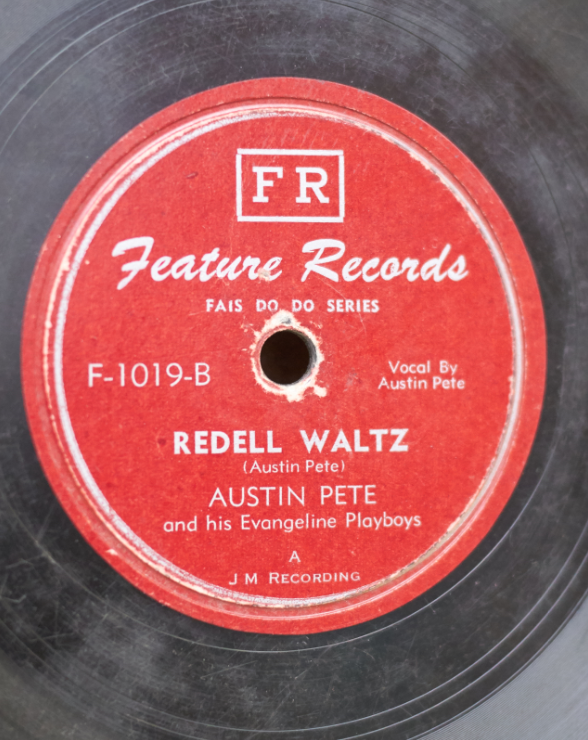
Austin played throughout south Louisiana, including the Green Lantern in Opelousas and around the small town of Redell, in which he used to title his "Redell Waltz" (#1019). Pitre and the Evangeline Playboys are exemplary on standards and signature originals alike, a few of which were strategically christened after dancehalls. 

Hey, little girl, look at what you've done,

Yeh, oh my, you know yourself,

What you did, my little world, you're going to cry.


Hey, baby you broke my heart,
Yeh, oh my, because of your ways,
Yeh, you're always running around.

Hey, little one, remember all the good times, dear,
Yeh, I have and the words, I've told you,
Yeh, this day will come, you'll turn your back on me.

Hey, little girl, remember the truth,
Yeh, oh my, you've made me miserable,
Yeh, the sorrows, which you have put me in.

Hey, my little everything, because of your ways, 
Yeh, I can not live, little doll, without praying,
Yeh, I can not say, little doll, you turned your back on me. 


Originally recorded by Joe Falcon in 1934 as "Le Valse De Mon Reve", the melody can found in Nathan Abshire's "Avalon Waltz".


  1. http://www.offbeat.com/music/austin-pitre-and-the-evangeline-playboys-essential-early-cajun-recordings-of-austin-pitre-the-evangeline-playboys-swallow/
  2. http://hollandtunneldive.blogspot.com/2017/02/ville-platte-louisiana.html
  3. Lyrics by Jordy A
Find:
Acadian All Star Special - The Pioneering Cajun Recordings Of J.D. Miller (Bear, 2011)

Friday, February 17, 2017

"Chatatinia Waltz" - Austin Pitre

Austin Pitre was one of the founding dancehall era accordionists during the 1950s.  His father, Joseph, played the fiddle, but it was an accordion he presented to Austin on his 6th birthday, looking ahead with hopes that someday his young son might join him at playing the popular house dances of that time.1,2 Austin had an enviably unspoiled style as a vocalist, accordionist, and violinist. Besides Leo Soileau, his major influence was Amadie Ardoin.3


Eh, chére tit fille,

Fais pas ça avec ton neg,

Malheurese tu vas pleurer

Ça t'as fait z'avec moi y'a pas longtemp.


Eh, mais, moi'j'suis là,

Dans les misère, mon tout seul,

Par rapport ma chére tit monde
Tu m'as fait des misère au si loin.

Malheureuse, prends courage,
T'en revenir, va faire encore
Malheurese, vas s'en aller
S'en aller pour 'venir, malheureuse

Austin Pitre


Chataignier (misspelled Chatatinia) is a small community in Evangeline Parish, Louisiana.  Austin's band worked up a tune called the "Chatatinia Waltz" (#1013) for J.D. Miller's new Feature label in 1950.   It was actually a melody by Doc Guidry called "Le Nuevo Te Maurice".   By this time, Miller seemed to drop his Fais Do Do label and use it as a subtitle on the records.

Hey, dear little girl,

Don't do that to you old man,

Oh my, you'll cry,

Did that with me there, not so long ago.


Hey, well, I am there,

In misery, all by myself,

Respectfully, my dear little everything,

You've made me miserable so far.

Oh my, take courage,
You'll return, you will do it again,
Oh my, going to go,
Going to go just to return, oh my.

Austin's first band, Evangeline Playboys, became one of the most sought after Cajun bands, drawing capacity crowds at all their dances.  The Chinaball Club's owner, in a last desperate effort to save his club, begged Austin to play his club....said he'd have to close up if he didn't come.  So, Austin and his band traveled to Bristol, Louisiana and they brought the crowds with them.  Austin and his band ended up playing there every weekend for six years.1,2


  1. Austin Pitre and the Evangeline Playboys.  Swallow 6041.   Liner notes.
  2. Acadian All Star Special.  Liner notes.
  3. South to Louisiana: The Music of the Cajun Bayous By John Broven
  4. Lyrics by Stephane F
Find:
Acadian All Star Special - The Pioneering Cajun Recordings Of J.D. Miller (Bear, 2011)

Tuesday, May 10, 2016

"Midway Two Step" - Austin Pitre & Milton Molitor

By 1957, 10 years had passed since the dance-hall revival of Cajun music after the war.   Khoury's Cajun recordings were on the decline, only occasionally recording Nathan Abshire from time to time.   J.D. Miller was still going, but both were leaning towards country, R&B and rock n roll artists; no longer interested in the dismal attention Cajun music was getting.  

Then came the first pressing by record-man Floyd Soileau.  Soileau's first label, Big Mamou, was formed in partnership with Ed Manuel, a Mamou, Louisiana, jukebox operator, nightclub owner, and regular customer of Floyd's Record Shop, who had the financial backing to assist the young entrepreneur. Manuel had also taped Cajun musicians Milton Molitor and Austin Pitre at a party where they performed "Midway Two Step"(#101) in 1957.  It was taken from Milton's early recording with Chuck Guillory known as "Walfus Two Step". 

Hé, chérie! qu'est ce qui t'as fais faire ça,

Hé, j'connais pas je mérite pas ça t'as fait.

Hé, aujourd'hui, tu plais z-à tout le monde,
Hé pointe au doigt, ça dit que c'est grand vaurien,
Hé, bébé, moi je mérite pas ça,
Hé, chérie, gardez donc que tous j'ai eu.

Hé, chérie, tu vas tuer(?) à mes parents, 
Hé, quand , moi,j'vas aller pour m'en aller,
Hé ,chérie, je connais pas (ce) qui arrive,
Hé, maman, t'espere moi je m'en vas.

Hé, chérie, j'pars, moi, la bas, 
Hé yéyaie, je connais pas tu vas revenir,
hé yéyaie, y' plus personne qui veut me voir,
Hé maman, j'espere donc pour je m'en vas.

Although these songs were recorded merely to advertise a couple of Manuel's nightclubs, Soileau shipped the masters to Don Pierce's Starday Records in Nashville. During his days at KVPI, Soileau had often run across promotional fliers from Starday, which read "If you've got a tape, we can press a record for you." The Big Mamou releases sold encouragingly and began to revive interest in Cajun music around Ville Platte.1  He said


Ed said, "We're gonna call this 'Manual Bar Waltz' and 'Midway Two Step'" because those were two nightclubs he had an interest in and he wanted some publicity. We put our first record out and started selling it.2
Austin Pitre, Lurlin Lejeune and Milton Molitor
In time-honored fashion, the artists were using the records to encourage dance bookings.  Soileau recalls his exposure to the music:
And then when word got out that somebody in Ville Platte was releasing French records again. . . . I say again because most—in fact, I think everybody had stopped, they weren't selling enough French records. . . . Country music had come through and sorta swept around here and there was nobody interested in doing Cajun records anymore. So we put that first record out. It sent the message that there was somebody releasing that kind of music again.1
Author John Broven jokingly refers to the name of the Midway Club as "midway between this community and that community!", referring to Breaux Bridge and Lafayette.4  

Hey honey! What makes you do this,

Hey, I don't know, I don't deserve what you've done.

Hey, now, everyone likes you,
Hey, pointing your finger, saying that here is a big scoundrel,
Hey, baby, I do not deserve this,
Hey, darling, look at everything I had.

Hey, honey, you're going to ruin my parents,
Hey, when I go, I've got to go,
Hey, honey, I don't know what happened,
Hey, mom, you expect me to leave.

Hey, darling, I'm leaving, I'm feeble,
Hey, oh my, I don't know if you're gunna come back,
Hey, oh my, over there, no one wants to see me,
Hey, mom, I expect I'll be leaving. 


  1. http://www.louisianafolklife.org/LT/Articles_Essays/miller_and_soileau.html
  2. South to Louisiana: The Music of the Cajun Bayous By John Broven
  3. http://louisianadancehalls.com/dance_hall/midway-club/
  4. Floyd's Early Cajun Singles.  John Broven.  Liner notes.
  5. Lyrics by Jerry M and Stephane F
Find:
Floyd's Early Cajun Singles (Ace, 1999)

Thursday, October 8, 2015

"La Valse De Chagrin" - Austin Pitre

Austin Pitre was the front man for "Austin Pitre & the Evangline Playboys" for many years and played dance halls around the South Louisiana area. His unique style of playing included standing up to play the accordion without the aid of a shoulder strap, as well as playing the accordion behind his head and between his legs. Besides being a talented musician, Pitre was also a highly regarded mechanic and had his own automotive repair shop near Ville Platte, Louisiana

Yeah, catin, comment j'vas faire,

Ton popa veut pas me voir chez toi, 

Ta moman, tu connais, elle est contre moi,

Quel espoir,moi j'peux avoir, aussi longtemps.
...
unknown, Claney Perron, Clifton Fontenot,
Austin Pitre, Floyd Fontenot, 

Pee Wee McCauley (sitting)
Shoe store in Ville Platte, LA
It's a rendition of Lawrence Walker's "Waltz of Sorrow".  Austin would later turn this song into "Jungle Club Waltz", named after a popular dance hall in New Iberia.  French "Hits" was a later J.D. Miller release.

Yeah, little doll, how I'm gonna do this?

Your poppa doesn't want to see me at his home,

Your momma, you know, she is against me,

What hope can I have, for so long?
...
Austin and his band toured the U.S. over the years and were recognized with several awards. In 1973, Austin was even invited to perform and entertain fans in Washington, D.C. at the Smithsonian Festival in American Folk Life. He returned for that same festival in 1976 for the bi-centennial celebration. In 1980, the Louisiana Freedom Festival in Elton, Louisiana, presented Austin an award in appreciation for 50 years of contribution to and promotion of Cajun music. 


  1. https://en.wikipedia.org/wiki/Austin_Pitre
  2. http://www.flattownmusic.com/Austin-Pitre.aspx
  3. Discussion with Neal P
  4. Lyrics by Stephane F
Find: 
Louisiana Cajun Music Volume 4: From The 30s To The 50s (Old Timey, 1972)
Acadian All Star Special - The Pioneering Cajun Recordings Of J.D. Miller (Bear, 2011)

Tuesday, April 21, 2015

"Janot Special" - Austin Pitre

In Austin Pitre's later recordings with J.D. Miller, he formed the LA. Rhythmaires and recorded a few tunes, one of them called the "Janot Special" on a vanity label called French "Hits" (#503). It contains elements of Aldus Roger's "Lafayette Two Step" melody and almost a direct copy of his High Point Two Step.  The melody has a vague similarity to the an older tune by Joe Falcon called "Osson Two Step" recorded in 1929 and Amede Ardoin's "Tortope d'Osrun".


Hé, comment ça s'fait, jolie,

Tu vien pas a ton neg',

Quand meme un fois avant d'mourir.
J't'aurai voulu bébé t'en r'venir, catin,
Quand même une fois avant d'mourir,
J'te pardonerrai pour tout ça tout m'as fait.
Z’au jour d’hui, bebe, je prend ça dur, malheureuse.
Johnny Janot
The song is possibly an ode to John Remie Janot (better known as Johnny Jano), a radio broadcast DJ at KEUN in Eunice, LA, then at KPAC in Port Arthur, TX and again at KPLC in Lake Charles, LA where he placed rockabilly music in south Louisiana. He worked with, and later married, Lee Parsley as a duo at KLOU. The couple were known as "Mr & Mrs Radio" and were popular around the 1950s and 1960s. 


Hey, how did that happen, pretty one,

You won't come to your man,

Even once before dying.

I would have wanted you to come back, pretty doll,
Even if one time before dying,
I would forgive you for all you did.
Today, baby, it's hard on me, unfortunately.
In the 1950s, he changed his name to Johnny Jano and became a rockabilly singer and performer. He also recorded for J. D. Miller in Crowley, LA, releasing his music on Excello Records, and with Eddie Shuler at Goldband Records in Lake Charles. In 1970, Johnny was in the pursuit of a new career as a Cajun/country music singer. In Beaumont, he teamed up with Cajun fiddler Manson Manuel and they formed a band and played the clubs and honky-tonks of southeast Texas. Johnny even opened his own club on Hwy 90, on Beaumont's west side. He performed at Gilley’s in Houston and made several appearances on Mickey Gilley's television show in Houston. He recorded songs such as "I'm Proud To Be A Cajun" and a french version of "A Closer Walk with Thee".
In 1978, he started the Sunday morning radio show called "Cajun Bandstand". With the powerful signal of KLVI Radio, Johnny Jano was a Sunday morning ritual through out bayous of South Louisiana, the plains of Southeast Texas and to piney woods near Lufkin. Johnny was being heard playing Cajun music and serving up "Dark Roast" Community Coffee to friends and listeners who would drop in to visit and chat. 


  1. Discussions with Milton Allen Graves 
  2. Lyrics by Jerry M and Bryan L

Find:
Acadian All Star Special - The Pioneering Cajun Recordings Of J.D. Miller (Bear, 2011)

Thursday, December 25, 2014

"Manual Bar Waltz" - Milton Molitor & Austin Pitre

One of the later independent Cajun music recording engineers was Floyd Soileau.  His early attempts at recording Cajun music started with two brief labels: VEE PEE and Big Mamou Records.  Soileau's first label, Big Mamou, was formed in partnership with Ed Manuel, a Mamou, Louisiana, jukebox operator, nightclub owner, and regular customer of Floyd's Record Shop, who had the financial backing to assist the young entrepreneur. Manuel had also taped Cajun musicians Milton Molitor and Austin Pitre at a party where they performed "Manuel Bar Waltz" (#101) in 1957.  By releasing the recording, it would become Floyd's entry into the music business.


Hey chère regarde donc quoi toi t'as fait,

Mais aujourd'hui avec moi ma criminelle.


Hey bébé tu pourrais plus.
Hey t'aurais eu le coeur aussi criminelle.
Hey semaine en semaine, jour en jour ici,
J'ai jongler à toi criminelle que t'as tout le temps été.

Hey bébé tous les soirs quand je me couche,
Hey tout le temps de la nuit, je me capote de bord dans mon lit.
Hey je peux pas dormir moi pour moi.
Hey c'est juste rapport a tout ce que toi tu m'as fait.
Manuel's Bar

The word "capote" is an old French marine term for saying "turned upside down" "overthrowing" and finally, "aground".  In Cajun French, the verb "jongler" is a mysterious, old French word and seems to translate as "to think" or "reminiscence".  Although these songs were recorded merely to advertise a couple of Manuel's nightclubs, Soileau shipped the masters to Don Pierce's Starday Records in Nashville. During his days at KVPI, Soileau had often run across promotional fliers from Starday, which read "If you've got a tape, we can press a record for you." The Big Mamou releases sold encouragingly and began to revive interest in Cajun music around Ville Platte.  He said


Ed said, "We're gonna call this 'Manual Bar Waltz' and 'Midway Two Step'" because those were two nightclubs he had an interest in and he wanted some publicity. We put our first record out and started selling it.


Austin Pitre, Lurlin Lejeune and Milton Molitor
Milton had his start early on with Chuck Guillory and his Rhythm Boys as the accordion player. Eventually, Molitor and Pitre recorded for Dr. Harry Oster and Chris Strachwitz in the 1960s.


Hey dear, just look what you've done to yourself,

However, now, you've done it with me, it's cruel.


Hey baby, you could do more.
Hey, you should have a heart, also cruel.
Hey, from week to week, day by day,
I remember you always have been cruel.

Hey baby, every night when I go to bed,
Hey, all hours of the night, I'm tossing and turning in my bed,
Hey, I, myself, can not sleep,
Hey, it's just everything that you've done to me.

After the records were released, Ed was no longer interested in the recording business.  He had obtained the publicity he needed for his clubs.  Floyd was on his own:


So I changed the label to VEE-PEE Records. I had seven hundred 45s and three hundred 78s done, and it started selling very well.  

Later that year, Floyd would record Lawrence Walker and Aldus Roger.  Soon afterwards, in 1958, he would continue his business with 45 vinyl releases on his Swallow label, using the English pronunciation of his last name.  Soileau recalled the name change:


"I knew damn well I couldn't put S-O-I-L-E-A-U on there," he says. "They wouldn't be able to pronounce it in most places out of here." "When my dad saw that, he said [with a thick Cajun accent] 'What's the matter! You 'shame of your name?' I said 'It's not gonna fit. . . . Besides, that's the bird, . . . it's not necessarily my name." And he had a hard time—I don't know if he ever bought that entirely"


  1. http://www.louisianafolklife.org/LT/Articles_Essays/miller_and_soileau.html
  2. South to Louisiana: The Music of the Cajun Bayous By John Broven
Find:
Floyd's Early Cajun Singles (Ace, 1999)

Friday, November 14, 2014

"High Point Two Step" - Austin Pitre

After WWII, other small Cajun labels popped up around south Louisiana. One of these was Fais Do Do records started by Jay Miller in 1946. A year later, he changed it to Feature Records that recorded many people such as Austin Pitre and Aldus Roger. In 1948, Austin would record his first record with Feature called "Evangeline Playboy Special" after the name of his band. 


Hey, mais malheureuse, toi 'tit monde, 
Quoi t'as fait, 'tit monde, avec ton nèg', 
Moi j'connais, c'est toi j'aime tant, tu vas aller,
Avec un autre, malheureuse, que t'aimes pas mieux. 
Hey gardé donc , quoi ta pres faire, 
Avec ton neg  t-monde toi te cannialle, 
Je tout l’temps ici, une jour avenir bébé,
Avant longtemp tu vas venir c’est cera  trops tard. 

Hey mais tout les soir ton vieux neg, 
Garde voir, t-monde tu ma fait mal,
Je tout l’temps dit, tu vas voir pour ton meme,
Tu vas payée pour tout  ça oui mon cher monde.

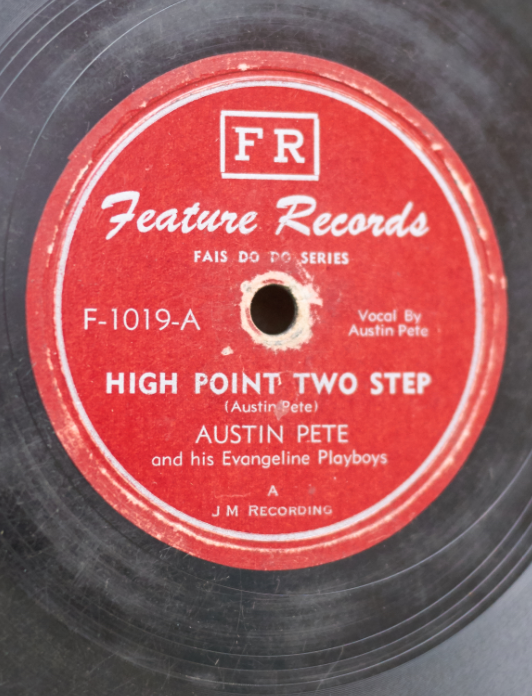
Pitre would kick off his career on this label with their best known song "Evangeline Playboys Special". On their second record in 1948, they recorded a song called "High Point Two Step" (#1019), named after a community in Evangeline Parish. It was the Cajun version of an old fiddle melody called "Rubber Dolly".  It would become well known after many musicians covered the tune including Mississippi John Hurt, Ray Price, Bill Parsons, and Woody Guthrie.   Other musicians around Louisiana would also cover the tune including a western swing version by Harry Choates in 1947 and a swamp pop version by Johnnie Allan in 1959.

Hey, oh my, my little everything, 

What did you do, my little everything, with your old man.


I know it's you that I love, you went away,

With another, oh my, who doesn't love you more. 


Hey, look at what you've done,

With your old man, little everything, you are mischievous,

I am always here, one day, (you'll) return to me, baby,

Before long, you are going to return, it'll be too late.

Hey, every night, old friend, 
Look here, my everything, you made me hurt,
I always told you, you will see for yourself,
You will pay for that, my dear everything.
Its a lively tune with a sad undercurrent. According to author Blair Kilpatrick, 


"The rhythm makes you want to dance however, the words if you let yourself feel them make you want to cry. A paradox you can't escape." 

Its about someone asking to see his love one more time before he dies.  The melody has a vague similarity to the an older tune by Joe Falcon called "Osson Two Step" recorded in 1929 and Amede Ardoin's "Tortope d'Osrun".   He would use the melody again in his "Janot Special".


  1. Accordion Dreams: A Journey Into Cajun and Creole Music By Blair Kilpatrick
  2. Lyrics by Marc C and Jerry M
Find:
Acadian All Star Special - The Pioneering Cajun Recordings Of J.D. Miller (Bear, 2011)

Friday, September 26, 2014

"Evangeline Playboys Special" - Austin Pitre

Many Cajun musicians were ready to bring the accordion back into the genre after WWII.   Throughout the 30s and 40s, much of the music had a strong western-swing feel dominated by the fiddle.  Unlike the bluesy sound of Nathan Abshire or the elegance of Lawrence Walker, Austin Pitre (also spelled "Pete") brought a raucous, loud, hard-edged voice with a powerful playing style.  Rumor has it, he was the first Cajun musician to play the accordion standing up as well as behind his head and between his legs. In his career, Austin would be most known for his recording of "Les Flammes d'Enfer".  

Pitre's major influence was Amede Ardoin and he was already well known by the time he recorded.  In 1948, Austin kicked-off his recording career in J.D. Miller's recording studio in Crowley for his Fais-Do-Do / Feature label.   One of those songs was "Evangeline Playboy Special" (#1013) named after his band and the parish he was from.  They played at many dancehalls throughout south Louisiana including the Chinaball Club.


Hey, 'tit monde, malheureuse chérie,

Tu vas jamais mais oublier

Les misères tu m'avais fait.


Hey, 'tit monde, rappelle toi tout les paroles

Toi tu m'dis y a pas longtemps,

Tu connais tu vas pleurer.

Hey, chérie, tu m'as dit pas c'est l'moment(?)
Si j'te vois(?) dans les misères
Par rapport à ces manières.

Hey, chérie, pas la peine tu te lamentes,
Pas la peine tu vas pleurer,
T'en revenir il sera trop tard.
Austin Pitre
The song has an eerie sound which may have been due to the combination of the condition of the accordion as well as the incorrect speed of the recording equipment.  Unlike much of Cajun music, the accordion sound resembles a concertina or carosel-style sound which seems too high in pitch for a standard diatonic of the era.   However, it is known that Austin had played many accordions throughout his career and this one could have been unique. 

Hey, it's a small world, sad honey, 

But you'll never forget

The misery you have given me.


Hey, it's a small world, remember your words,

You said it won't be long, 

You know you're gonna cry. 

Hey, honey, you said this isn't the time 
To see you in misery
Compared to your normal ways

Hey, honey, do not bother complaining, 
It's not worth you crying
When you come back, it will be too late.
Later, he would record with Miller again with the group Louisiana Rhythmaires led by Chuck Guillory on Miller's French "Hits" label.  Austin would go on to record for Swallow during the 1960s and 1970s.  He appeared at the 1973 and 1976 Smithsonian Festival of American Folk Life in Washington DC.  


  1. Blue Suede News, Volumes 37-45
  2. Ethnic and Border Music: A Regional Exploration by Norm Cohen
  3. South to Louisiana: The Music of the Cajun Bayous By John Broven
Find:
Louisiana Cajun Music Volume 4: From The 30s To The 50s (Old Timey, 1972)