Showing posts with label Ernest Fruge. Show all posts

Thursday, May 30, 2024

"La Danse Carre" - Dennis McGee & Ernest Fruge

Music associated with French and American dance forms influenced much of early Cajun social life in the 1920s.  From their Anglo-American neighbors, Cajun musicians learned jigs, hoedowns, and Virginia reels to enrich their growing repertoire which already included polkas, contredanses, varsoviennes and valses-à-deux-temps.5  Similar to the contredanse (counter-dance), the Cajun French square dance embraced a loosely structured call-out routine throughout the dance number.  These Cajun dances appeared in Acadie in the 17th century and flourished throughout.  According to musician and Acadian music researcher, Devon Léger, 

"Reel de la Rivière à la Truite" from New Brunswick.  It actually corresponds to a Cajun tune.  The first and third parts of "La Danse Carre" correspond pretty closely to two different old Acadian tunes from Eastern Canada! It's clear that French songs travelled from W. France to Canada to Louisiana with Acadians, but it's been super hard to demonstrate anything with the tunes.  Another Acadian tune, called "Rabastan à Avila Leblanc", from the Magdalen Islands. These islands from the coast of Quebec were one of the last strongholds of old style Acadian fiddling, so they have a lot of the old beautiful tunes.  The second part of "Rabastan" is exactly like the third part of "La Danse Carre", which is a really interesting correlation between old Acadian fiddling from Quebec, New Brunswick, Nova Scotia and Cajun fiddling.6  

When George Washington Cable toured through Louisiana in 1888, he commented on the Cajun dance: When a girl was old enough to "move into society"—that is, for marriage—she was "meant to join in the contra-dance.4  Cable continues: 
The fiddler's seat is mounted on a table in the corner.  The fiddler is in it.  Each beau has led a maiden into the floor.  The sets are made for the contra-dance.  The young men stand expectant, their partners wait with downcast eyes and mute lips as Acadian damsels should. The music strikes up, and away they go!4  

Dennis McGee

Although fiddler Dennis McGee spoke little but Cajun French, he was known nationally form appearances on such shows as "Prairie Home Companion" and from stops at colleges and festivals around the country.   McGee's career spanned most of the 20th century.  When Cajun music was first being recorded in the late 1920s, he played with such artists as Amede Ardoin, Joe Falcon and Amede Breaux.2  As a fiddler, McGee was keenly aware of the popularity of square dance styles.  He recalled:
I would love to be twenty years old again.  They danced contredanses throughout my courting days.  The contredanse wasn't difficult. You just had to turn around, making little steps while you turned.5  

During a recording session in 1929, he and Ernest Fruge recorded "La Dance Carre" (#512). Directly translated to "The Square Dance", you can hear Walter Coquille, a Cajun humorist who was present at the session, calling out dance instructions. McGee recalled playing this style at house dances every Saturday and Sunday from seven o'clock until midnight, where he'd received one dollar a night. 
We played all kinds of dances.  In a dance-hall in Ville Platte, we'd play first a "danse carrée", then a waltz, then a "two-step".  The "danse carrée" was very popular back then.  They danced by six or eight pairs.  Somebody would call out "Famille en ronde" and the girl would hold the arm of her partner.  Then they'd all make a big circle and return to place.  Then two pairs would cross together.  Then they'd form two lines, boys in one line and girls in the other.  They'd go in and meet and turn, then the pair would go down the line together.3    
Leleux Dancehall, 1938
Courtesy of LOC, Russell Lee Collection

Sometimes referred to as une contredanse francaise, it seemed to fade out of popularity towards the late 1930s, in particularly the regions of St. Landry parish and Evangeline parish.  Although McGee continued to play square dances afterwards, however, Fruge never recorded commercially for a major recording label ever again.  According to music producer Christopher King, he states: 
Their recording session features this hypnotic, driving, in-your-head twin fiddle breakdown. Two violins: one playing the lead, the other playing rhythm. "La Dance Carre" not only reminds me of the Carter Brothers but also the driving, hypnotic music we would also hear all over the world.1


  1. http://ngradio.gr/blog/chris-king/chris-travels-78-rpm-im-no-lyre-radio-show-no-4/.   Chris travels at 78 RPM: “I’m No Lyre” – Episode 4.   Radio show.
  2. "Cajun Fiddler Dead".  CPS. 1989.
  3. Dennis McGee ‎– The Complete Early Recordings.  Liner notes. 
  4. Bonaventure: A Prose of Acadian Louisiana By George Washington Cable
  5. Cajun and Creole Music Makers By Barry Jean Ancelet
  6. Discussions with Devon Léger, March 4, 2023.

Release Info:
NO-6713 La Rille Cajen | Brunswick 512
NO-6714 La Danse Carre | Brunswick 512 

Find:

The Early Recordings Of Dennis McGee: Featuring Sady Courville & Ernest Fruge (Morning Star, 1977)
Dennis McGee ‎– The Complete Early Recordings (Yazoo, 2006)

Tuesday, August 3, 2021

"Madame Donnez Moi Les" - Angelas Lejeune & Ernest Fruge

Petite Ou Gros!   The famous Creole melody that inspired so many covers, most notably "Les Flammes D'Enfer" in the later years of Cajun repertoire.   The original tune, "Adieu Rosa", would be covered in it's raw form by Dennis McGee.  Other musicians such as Joe Falcon, Leo Soileau, Moise Robin and Douglas Bellard all created their own renditions of this bye-gone song. It's about a love-interest begging a mother for either of her daughters' hands in marriage.  Either the skinny one or the large one—it doesn't matter. 


Ah, ye yaille, la malheureuse.

Aye, ye yaille. 

Madame donnez-moi les, ouais, 
La petite ou bien la grosse, 
La petite elle est mignonne, 
La grosse, elle est si belle.

Aye ye yaille, petite.

Madame donnez-moi les, ouais, 
La petite ou bien la grosse à cause, 
Si j'en ai une, 
C'est tout que moi je voudrais.

Quitte-moi, vous dire, 
Comment j'veux t'croire,
J'en aurais pas une,
Ni la petite ni bien la grosse,

Falloir dire, ouais madame, 
Moi j'vas voler la grosse, 
Vas pas la garde la belle,
Ça m'lesse tout seul.

Ah, ye yaille, la malheureuse.


Richard Voynow

Angelas' first session was produced by Brunswick's A&R representative Richard Voynow.   A jazz pianist and composer for The Wolverine Orchestra, Voynow dabbled in finding artists for the record label.  During a lengthy expedition into the south, he supervised Lejeune, Fruge and McGee's 1929 session with several area musicians from the Opelousas area.  By November of 1930, the label held their final session in New Orleans in which Angelas and Ernest were waxing another set of songs to disc.  For this recording, "Madame Donnez Moi Les" (#527), Angelas put down his accordion and let his vocals ride along Ernest's fiddle melody.  It's one of the few recordings that allow listeners to hear Fruge's fiddling talent dominate and it would be the duo's very last recording ever. 


Oh, ye yaille, miserable woman.

Oh, ye yaille.

Madam, give them to me, yeah, 
The little one or the big one,
The little one, she is cute,
The big one, she is so beautiful.

Oh, ye yaille, little one.

Madam, give them to me, yeah,
The little one or the big one because,
I have to have one, 
That's all I want.

Leave me, you said, 
How I wanted to believe you,
(Now), I won't get one,
Neither the small one nor the big one.

Have to say, yeah madam,
I'm going to steal the big one,
Don't protect the beauty,
It hurts me to be alone.

Oh, ye yaille, miserable woman.


The melody influenced many other pre-war Cajun tunes such as Joe Falcon's "Acadian One Step", Leo Soileau's "Demain C'Est Pas Dimanche" and Bixy Guidry's "Ella A Plurer Pour Revenir". Leo would rework the song in the 1930s as "Petit Ou Gros", made famous by Joe Bonsall in the 1960s.  


  1. Lyrics by Stephane F and Herman M
Release Info:
NO-6727 Valse A Aristil Creduer | Brunswick 577
NO-6728 Madame Donnez Moi Les | Brunswick 577

Find:
Let Me Play This For You: Rare Cajun Recordings (Tompkins, 2013)

Monday, May 24, 2021

"One Step Des McGee" - Dennis McGee & Ernest Fruge

Fiddler Dennis McGee was born in Bayou Marron to John McGee, of Irish descent, and Amelia Lafleur, of French and Seminole Indian ancestry.2  Dennis first began learning the fiddle from his father, his favorite tune being "Valse de Pop."  In his youth, he went to live with his grandmother, where he was surrounded by fiddle players. As with many other rural fiddlers, music was a family affair with Dennis--listening to the playing of his uncles, Ulysses and Joseph McGee, and a cousin, Oscar McGee.1   

Ler-der-de-de-da-da-ler-der-der,
De-ler-der-der-de-der-de-ler-der-der,
'Garde-le mourir, c'est trop dur, 
Eh, moi tout seul, eh, malheureuse la belle,
Eh, 'gardez-donc, oh, mais, ça t'as fais,
Moi, j'connais t'as fais, malheureuse.

Malheureuse, jolie 'tit cœur,
Regarde (ce que) t'as fais dés (que) tu passes la porte, 
T’étais là bas, c’est tout t’as fait,
Mais, malheureuse, mais, malheureuse.

Ler-der-de, 'garde-donc, r'garde belle,
Mais, 'tit galop pour aller (à) la maison,
Mais, cours toujours, mais, t'en aller,
Mais, nous tous seul, mais-là, gallop.


Theodore McGee

After working with a cousin, Ben Courville on his farm, he moved and began living with another cousin, Theodore McGee.   Theodore took him to Ville Platte to buy a fiddle and withing six months he was attracting the attention of neighbors who would come to hear him play.1  He received his first shiny red fiddle when he was 15 years old.4  According to Dennis, 
I stayed with Theodore McGee and one day he said, "Well Mac, I believe I'll buy a violin for you.  I'm going to Ville Platte."  No strings!  There was nothing on it. He bought some strings and the pegs. He knew how to play a little. He tuned it up and played "Tout Les Deux Pour La Meme".  He said, "Now, you're on your own."3  
He started out playing for square dances with eight or ten couples in country homes for the grand sum of $1 a night.4   By 1929, he scored a contract to record with Vocalion records with Sady Courville and later, with Amede Ardoin with Colombia records.  By 1930, he and fiddler Ernest Fruge teamed up and headed to New Orleans where they recorded "One Step Des McGee" (#590) for Brunswick records, in honor of his McGee musical family.  Similar to his "One Step De Chupic", Dennis introduces the verses with nonsensical phrasing.  This style of singing could be used to evoke emotions or even memories in listeners that couldn't be put into words or ones that weren't terribly specific. It allows the listener's mind to wander where it will, guided by the singer, but not forced into a specific narrative. 


Ler-der-de-de-da-da-ler-der-der,
De-ler-der-der-de-der-de-ler-der-der,
Look at him dying, it's too hard,
Hey, i'm all alone, hey, naughty beauty,
Hey, so look, oh, well, at that you've done,
I know what you've done, naughty woman.

Naughty woman, pretty little sweetheart,
Look what you did as soon as you walked through the door,
You were there, it's all due to you,
Well, naughty woman, well, naughty woman.

Ler-der-de, so look, look at that beauty,
Well, galloping to the house,
Well, always running, well, I'm going,
Well, we're all alone, well there, (let's) gallop.


  1. Louisiana Fiddlers By Ron Yule, Bill Burge
  2. https://64parishes.org/entry/dennis-mcgee
  3. Ye Yaille Chere by Raymond Francois
  4. The Daily Advertiser (Lafayette, Louisiana) 12 Sep 1982
  5. Lyrics by Stephane F and Herman M
Release Info:
NO-6731 La Valse De Rosalie | Brunswick 590
NO-6732 One Step Des McGee | Brunswick 590

Find:
Dennis McGee ‎– The Complete Early Recordings (Yazoo, 2006)

Saturday, September 19, 2020

"One Step Du Maraist Bouler" - Angelas Lejeune & Ernest Fruge

Cajun accordionist Angelas Lejeune and fiddler Ernest Fruge made their last recording session in 1930 alongside other artists such as Dennis McGee and Amede Ardoin.  The session was conducted by musician and artist scout Richard Voynow.   He had recently spent three months on the road recording artists in southern towns such ad Knoxville, Memphis and San Antonio.  He recalled that his entire session included the types of records known in the trade as the 'hillbilly, French-Cajan, race and popular.'1  Afterwards, Lejeune returned to his home community of Pointe Noire, located near the area of Marais Bouleur. 


Oh petite, chère,
Moi j'suis là, jolie,
Quoi faire tu m'fais ça?

Oh petite, chère,
Mais, toi t'es partie,
Tu m'laisses dans les misères.

Oh jolie,
Mam'zelle, j'aime pas
Tu m'parles comme tu m'parles.

Oh, j'connais pas quoi,
Petite, j'pourrais dire c'que j'suis aujourd'hui,
Oh j'suis condamné,
Pour tout(e) ma vie, à la misère.

Oh petite, chère,
Rappelle-toi quand j'ai parti pour m'en aller
Tu t'as mise à pleurer,
C'est là eyoù j'ai pris la parole,
Que j't'ai demandé, chère, fais donc pas ça.

Pour en revenir, (petite*),
Tu connais mon cœur est aussi gros qu'le tien,
Mais, donne moi une chose,
Que j'peux supporter et si vrai qu'le tien.

Add caption

"One Step Du Maraist Bouler" (#511) is a lively tune named after an area north of Scott, Louisiana where the low lying area retained water.  The name "Bouleur", however, has been a source of speculation.  According to reverend Donald Hebert, who was a pastor there, heard an old a story about how a horse named Bouleur liked to stay in a swampy area, the marais, where he could roll in the mud. According to the story, that’s how the place became Bouleur’s Marais and then Marais Bouleur. Hebert said he heard the same story from several people and it was the only consistent version of how the place got its name.2  Others had speculated that the name identified a bully of the swamp, as suggested by author Darrell Bourque in his "Plainsongs Of The Marais Bouleur" and Barry Jean Ancelet's "Rednecks, Roughnecs and the Bosco Stomp".  Aldus Roger's wife Bernice provides an alternative source of the name:
Marais Bouleur was just this side of Bosco.  When my grandmother, the Boullion generation, came from New Orleans, they settled there. A marais is like a swamp.  Wild ducks would come there.3  


Oh, little dearie,
I'm here, pretty one,
What are you doing to me?

Oh, little dearie,
Well, you left,
You left me in misery.

Oh, pretty one,
Mademoiselle, I don't like that,
You said what you said.

Oh, I don't know what,
Little one, I could say that I am today,
Oh, I am condemned,
For all my life, in misery.

Oh, little dearie,
Remember when I left to go,
You had started to cry,
This is where I had said the words,
That I asked you, dear, don't do that.

Coming back, little one,
You know my heart is as big as yours,
Well, give me one thing,
That I can carry and that it's truly yours. 

In 1967, Cajun accordionist Ambrose Thibodeaux, who was familiar with many of Angelas' tunes, re-recorded the song as the "Pointe Noir Two Step" as an ode to Lejeune's home town.


  1. A&R Pioneers by Huber
  2. https://archive.evangelinetoday.com/c%E2%80%99est-vrai-les-batailleurs-du-marais-bouleur
  3. Ye Yaille Chere by Raymond Francois
  4. Lyrics by Marc C and Stephane F


Release Info:
NO-6708 One Step Du Maraist Bouler | Brunswick 511
NO-6709 La Valse A Tidom Hanks | Brunswick 511

Find:
Let Me Play This For You: Rare Cajun Recordings (Tompkins, 2013)

Wednesday, June 17, 2020

"One Step De Chupic" - Dennis McGee

There are nonsense songs in Cajun music and some happy drinking songs in Cajun music though most of the songs are about tragedy and love lost. Dennis McGee along with Ernest Fruge performed a few numbers with happy lyrics like "Allons a Tassone" and "Adieu Rosa" but most of his tunes are sad and lonely.  The melodies sound happy and lilting but the words are quite depressing, like the "One Step de Chupic" (#15851).2  


La-la-la-lah-la-da-la-la-doh-la,

La-la-la-la-la-da-la-da-la-da,

'Gardez-donc, la belle, 
Elle est après s'en aller.

La-la-la-la, t'ai pas ave(c)'moi,
Va pas changer avec un autre qu'est loin,
Malheureuse, j'ai dit, mais, 'gardez-donc la belle.

La-la-la-la-la-da-doh-da-doh,
La-da-doh-da-doh-doh-loh-de-doh.

Doh-de-la-doh 'gardez-donc la belle,                    
Elle est après s'en aller avec un autre que moi,
Mais, malheureuse chérie, mais, fais pas donc, la belle,
'Garde-donc, chérie.

Aye yé yaille, comment j'vas faire,
Toujours mon t'seul comme une pauvre malheureuse,
Mais, chère que tout, mais, fais pas ça avec moi,
Malheureuse, la belle.


Recorded in New Orleans in the fall of 1929, Dennis put together a sorrowful story against a cheerful melody, interjected with lyric less chorus lines singing "la-la-la-la".   This style of singing could be used to evoke emotions or even memories in listeners that couldn't be put into words or ones that weren't terribly specific. It allows the listener's mind to wander where it will, guided by the singer, but not forced into a specific narrative.  In the lyrical portions, the lover tells his love interest to "Watch it!" because of the mistakes she's making.


Choupique fish

It's quite possible that this is a story of a lost lover from his home town of Choupique, Louisiana; a community named after local fish variety (the bow fin).     Dennis explains the name growing up in the community:
I was raised in Choupique. I lived there from the age of four until I was fourteen years old. When you go to Chataignier, you cross a little stream called La Coulee Choupique. There were many choupiques in that time. An some big ones! They were three feet long!  I caught many on my line when I was young.1  
Dennis McGee


La-la-la-lah-la-da-la-la-doh-la,

La-la-la-la-la-da-la-da-la-da,

So look, the beauty,
She's leaving.

La-la-la-la, you ain't with me,
Nothing will change with another that is far away,
Miserable one, I said, well, watch it, beautiful one.

La-la-la-la-la-da-doh-da-doh,
La-da-doh-da-doh-doh-loh-de-doh.

Doh-de-la-doh so look, the beauty,
She's leaving with someone other than me,
Well, miserable dearie, well, don't do it, beautiful one,
Watch it, dearie.

Aye yé yaille, how will I handle this,
I'm always alone, like a poor wretch,
Well, dear, all that, well, don't do that with me,
Miserable beauty.


  1. Ye Yaille Chere by Raymond Francois
  2. Dennis McGee ‎– The Complete Early Recordings.  Liner notes.
  3. Lyrics by Stephane F and Smith S


Release Info:

NO-236 Valse Du La Penitencier | Vocalion 15851
NO-237 One Step De Chupic | Vocalion 15851

Find:

Cajun Capers: Cajun Music 1928-1954 (Proper, 2005)
Dennis McGee ‎– The Complete Early Recordings (Yazoo, 2006)

Sunday, March 8, 2020

"La Rille Cajen" - Dennis McGee & Ernest Fruge

The Cajun Reel!  Dennis McGee's Scots-Irish roots truly come to form in his renditions of old Appalachian reels.  From their Anglo-American neighbors, Cajun musicians learned jigs, hoedowns, and Virginia reels to enrich their growing repertoire which already included polkas, contredanses, varsoviennes and valses-à-deux-temps.3  Learning from his father John McGee, uncles Ulysses McGee and Joseph McGee, and his cousins Oscar McGee and Theodore McGee, Dennis played—and joined in—on many contra and square dances in his courting days.


Every week they would pass on horseback and knock on every door to tell the people where the dance was.  And, chère, I believed I danced!  When I danced, everyone left the floor because I was the best.  They couldn't dance like I could.2   

Dennis McGee

But not all reels were danced to in south Louisiana.  One genre of traditional songs provided a link between the dance band and home songs: the "reels a bouche," similar to Celtic "mouth music." These were tunes that were sung—in particularly by women—to accompany round dances during Lent when instrumental performances were not allowed. The verses and meters of these pieces are generally simpler than those of the home music, but they are still a more private mode of expression than the dance hall numbers.4  

At the makeshift studio, the duo was introduced to Cajun humorist Walter Coquille.  Walter was attending the Brunswick session to kick off his series of spoken word recordings and decided to introduce McGee and Fruge's song to the listening public as "genuine Cajun breakdown music".  His 1930 New Orleans recordings of "La Rille Cajen" (#512) and "Dance Caree" were both tunes used in square dances.   The reel required more movement than other dancing styles such as the contredanse français.  Dennis recalled, 
The reel was a difficult dance and it took good legs.  You had to jump around quite a bit.3  

You can hear Coquille calling out dance instructions: "Avancez!", "Famille tout le tour!",  "Tourne la dame!"  Dennis spent many of his later years playing these same reels at places such as weddings. Dennis recalls:


I remember an old Indian woman we called Ma Carreau who sang at all the wedding dances. She had blue eyes and frizzy hair. She was a midwife.  She knew all the wedding songs. Her husband played the violin.  We would play the reels for fancy stepping, "pour fair des pas".2     

Leleux Dancehall, 1938
Courtesy of LOC, Russell Lee Collection

Recorded in 1930 in New Orleans during the depth of the Great Depression, the recordings suffered from poor record sales and were mostly forgotten.   Not long afterwards, the accordion became the dominant instrument throughout much of Cajun music.  Author Barry Ancelet explains:


Dennis McGee was around when what we now call Cajun music was invented, or was developing.  Because of how he learned and who he learned from, he was one of the last living links to our musical past.  He performed in a style that went back before the accordion had affected Cajun music as much as it has today.1  


  1. "Cajun Fiddler Dead".  CPS. 1989.
  2. Dennis McGee ‎– The Complete Early Recordings.  Liner notes. 
  3. Cajun and Creole Music Makers By Barry Jean Ancelet
  4. http://www.louisianafolklife.org/LT/Articles_Essays/creole_art_pub_priv_cajunm.html


Release Info:

NO-6713 La Rille Cajen | Brunswick 512
NO-6714 La Danse Carre | Brunswick 512 

Find:
The Early Recordings Of Dennis McGee: Featuring Sady Courville & Ernest Fruge (Morning Star, 1977)
Dennis McGee ‎– The Complete Early Recordings (Yazoo, 2006)

Tuesday, January 21, 2020

"La Valse Du Texas" - Angelas Lejeune & Ernest Fruge

Cajun accordion player Angelas Lejeune had learned to play at a young age.  By World War I, teenage Lejeune had become part of the region's musical network, collaborating and interacting with both Amede Ardoin and Dennis McGee.  LeJeune developed into a visible figure on southwest Louisiana's dance circuit, sometimes performing five nights a week at house dance in and around the rural Pointe Noire community.2  

Demand for French music also called the accordionist away to play lucrative gigs as far away as Texas.  After playing a dance in Lake Charles, Louisiana, McGee, Lejeune, and fiddler Ernest Fruge continued west to perform in Shiner, Texas.  Dennis recalled:
And over there, they tapped their feet. They jumped up, they cried out...they danced, danced, sweated, sweated.2  
Oct 1, 1929


Eh, chère, malheureuse, petite,

Criminelle, quoi faire tu fais ça avec ton nègre.


Oh, toi, quand j'ai parti pour aller,

Dans le Texas t'as parti, quoi mieux* 'tit monde, malheureuse.


Oh, éyou, (que) j'ai eu tout ma misère, 

C'est quand j'ai parti pour en revenir dans la Louisiane, qui est misérée.

Oh chère, si t'aurai voulu m’écouter, 
Tu serais pas dans les chemins aujourd'hui, mais, comme t'es,
Tu connais, chère, tu vas voir ton erreur, 
Tout ça là, pour tout ça tu m'as fait, malheureuse.

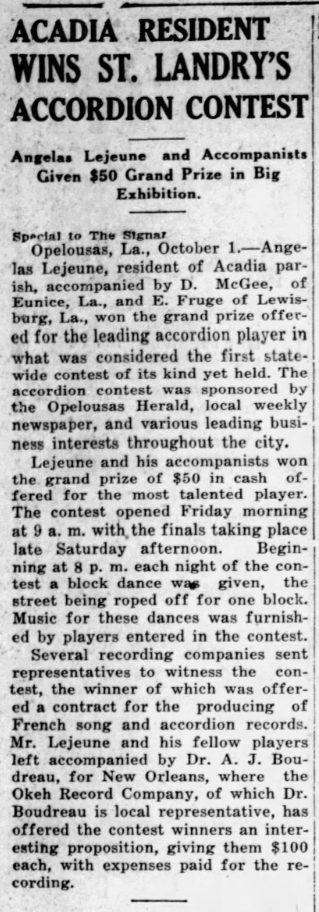
The receptive Texas audience paid the three musicians $80 for their appearance.   After winning an accordion contest back home, he and Ernest Fruge, along with many other Cajun musicians from the area descended on New Orleans in 1929 for a massive Vocalion/Brunswick recording session.   He would be called up the following year with Fruge and the duo would wax the tune "La Valse Du Texas" (#530). In 1934, Ardoin took the melody and stepped it up from a waltz to a two step, creating the "Le Midland Two Step".  McGee recalls playing with all of them:

I played with both accordion players. Angelas and Ernest and I played together as a trio.  When I played with Amede, we played just the two of us.1  

Angelas Lejeune (accordion)

Hey, dear, oh my, little one,
You're terrible, why have you done that to your man?

Oh, you, when I left to go,
To Texas, you left me, for the best*, little everything, oh my.

Oh, where are you, I've been in complete misery,
That's when I left to return to Louisiana, which has been miserable. 

Oh dear, if you had just wanted to listen to me,
You would not be wandering today, well, like you are,
You know, dear, you'll see your mistake,
All that over there, for all that you've done, oh my.
Angelas never continued his recording career and the song lost it's popularity until after World War II, when accordion player Belton Richard converted the tune into his more well-known 1967 "Cherokee Waltz".   Musician and native of Angelas' home town, J.C. Leger explains:

I love Angelas' playing so much. I find that all those accordion players born between 1890 and 1910 had a similar attack on the accordion, playing a discernible melody on a hard rhythm with space in the phrasing. It transcended race or region. I like to believe their playing to be the embodiment of the spirit of their culture at the time. They learned without the influence of recorded Cajun music.  It's pure and beautiful and alive.3  


  1. Cajun and Creole Music Makers By Barry Jean Ancelet
  2. Cajun Breakdown: The Emergence of an American-Made Music By Ryan Andre Brasseaux
  3. Discussions with J.C. Leger
  4. Lyrics by Stephane F
Release Info:
NO-6715 One Step A Cain | Brunswick 530
NO-6716 La Valse Du Texas | Brunswick 530

Find:

Let Me Play This For You: Rare Cajun Recordings (Tompkins, 2013)

Tuesday, October 15, 2019

"Valse des Vachers" - Dennis McGee & Ernest Fruge

Waltz of the Cowboys!  It was during this period, just after the turn of the century, that the stock repertoire of Cajun and Creole music took shape, based on a blend of influences from French, Acadian, Spanish, German, Native American, Scotch-Irish, Anglo-American, and Afro-Creole traditions.  "Valse des Vachers" (#15848), for example, recorded in 1929, is a bluesy description of the life of a cowboy sung in French to the tune of an Old World mazurka.2,3  According to record producer Christopher King:


This is essential since mazurkas, polkas, gallopades, varsoviannas,  and cotillions held a strong place in the early Cajun fiddle and dance repertoire but became less popular with the introduction of the diatonic accordion.1  


Malheurese, j'attrape-moi mon cable et mes éperons,

Pour moi aller voir à mes bêtes,

Mon cheval est selle, c'est malheureux de m'voir,
M'en aller moi tout seul ma chérie!

C'est malheureux de m'voir m'en aller au si loin,
Moi tout seul pour trouver que' chose que j'peux pas,
Perdu mais dans l'bois, malheureuse.

(Dit) 'bye-bye,' chérie, ma chérie, chère,
Dans les chemins, chère, moi tout seul, yaille,
Comment je va' faire, malheureuse, yaille?
Toujours, moi tout seul, malheureuse, chérie.

Ma chérie, viens-donc me r'join', chère!
Au si loin que moi j'sus de toi, belle!

Welsh, LA, 1915
Courtesy of 
Louisiana Sea Grant Digital Images Collection

Cajuns in the prairies had a strong relationship with cattle culture, specifically working alongside black Creole cowboys.  Creole cowboys helped manage thousands of cattle in pre-Louisiana Purchase days of southwest Louisiana and led cattle drives to keep New Orleans fed.  Cowboys found themselves moving their livestock from San Antonio and Dallas to Opelousas and further to New Orleans.   Following an ancient cattle trail along a highway known as the Old Spanish Trail, both Dennis McGee and Ernest Fruge recorded this song in New Orleans in 1929. Some musicians sing about going out to find their belle instead of bêtes.  


Oh my, catch me my rope and my spurs,

For I'm going to go see about my cattle.

My horse is saddled, it's sad to see me,
I'm going all alone, my dearie.

It's sad to see me going away so far,
I'm all alone to find something that I can't have,
Lost, well, in the woods, oh my.

Say "bye bye" dearie, my dearie, dear,
On the roads, dear, i'm all alone, yaille,
How will I handle this, oh my, yaille?
Always, I'm all alone, oh my, dearie.

My dear, so come rejoin me, dear,
So far that I've been from you, beautiful one.


Dennis, like many fiddlers of traditional American music, liked to retune his fiddle for certain sounds.  On "Valse des Vachers", he uses the ADAD tuning so he can basically play the same thing on the high and the low strings.4  By the 1930s, it's influence would span to Leo Soileau's group where they picked up the pace, converted into a bluesy two-step and re-titled it "Le Blues de Port Arthur".   Other related songs are "My Rope and Spurs" by Adam Hebert and "Valse Du Passe" by Shirley Bergeron. 


  1. https://oldtimeparty.wordpress.com/2014/06/18/himself/#more-10194
  2. Cajun Country By Barry Jean Ancelet, Jay Dearborn Edwards, Glen Pitre
  3. Cajun Music and Zydeco By Philip Gould
  4. Dennis McGee ‎– The Complete Early Recordings.  Liner notes.
  5. Lyrics by 'Hornisdas'

Release Info:

NO-248 Valse des Vachers | Vocalion 15848
NO-249 Jeunes Gens Campagnard | Vocalion 15848

Find:
The Early Recordings Of Dennis McGee: Featuring Sady Courville & Ernest Fruge (Morning Star, 1977)
Times Ain't Like They Used To Be: Early American Rural Music. Classic Recordings Of The 1920’s And 30's. Vol. 8 (Yazoo, 2003)
Dennis McGee ‎– The Complete Early Recordings (Yazoo, 2006)

Wednesday, August 28, 2019

"La Valse A Tidom Hanks" - Angelas Lejeune & Ernest Fruge

One the most impassioned stories in Cajun folklore that has been mostly lost to time is that of Adam "Tit 'Dom" Hanks and Alice Royer: The Cajun Romeo and Juliet.3  Angelas Lejeune and Ernest Fruge teamed up together to tell the legend of Hanks and Royer.  It involved a horse named Henri.2 According to columnist William Thibodeaux of Lafayette:
It's an Amercian love story, not unlike a lot of others. Adam "Tee Dom" Hanks and Alice Royer were sweethearts, but Alice's papa didn't approve of Tee Dom. Figured he wouldn't make a good son-in-law and so they disapproved of their engagement. They obeyed Alice's papa. Alice soon married someone else and left Tee Dom with a broken heart.1  


Oh, chère, malheureuse, chère, petite.


Oh, chère, criminelle, oh, quoi t'as fait z'ave(c) moi aujourd'hui.


Oh, Alice 'garde Adam, il est après venir,
Oui prépare toi moi j'veux voir il est apres venir, aujourd'hui.

Ça qui fait j'te dis ça, moi j'le vois il est après venir, (sur) le grand wrack* sur Henri,
Moi, j'le connais pas tu vu ton vieux nég'.

Oh chère, 'garde ton neg' qu'est après arriver, pour toi aujourd'hui.,
Quoi faire que tu m'fais tout ça, toi tu m'fais.

'Garde, tu m'fais plus d'mal à moi,
Dis (à) 'ton nég' que t’écoutes les conseils que les autres t'en mal.

Chère, tu connais si tu voudrais observer pour toi-même, 
Tu peux te sauver des misères à pas écouter les conseils.

Adam "Tee Dom" Hanks
Courtesy of Pierre Daigle

Researcher Pierre Daigle uncovered the true story in the early 1970s.  In the original tune, Tee Dom sang "Il a la jogg au plombeau, et le chapeau sur une coté". The reason for their disapproval was that Tee Dom loved to ride his horse Grand Henri while drinking from a whiskey jug.  He would ride with his chapeau (hat) cocked to one side, meaning, he didn't give a hoot about a thing.  The heartbreaking story of Tee Dom and Alice spread throughout the land, and a beautiful waltz was created.   Finally, Tee Dom relented an married Armena Thibodeaux, and together they raised seven children.  Years went by, but time didn't mend Tee Don's broken heart. He was still in love with Alice.  According to Pierre,  
Despite being married, whenever Tee Dom went to house dances he would sing and play his accordion to the melody of "La Valse a Tee Dom" as tears flowed down his cheeks.1,2  

Alice eventually married Edmond Miller and the family moved around the Scott/Judice area of Lafayette.  In 1930, Angelas was given permission by Tee Dom to use the lyrics of his song when he recorded "La Valse a Tidom Hanks" (#511) in New Orleans.  Pierre searched for Angelas Lejeune and he explained,
It's true.  The night before I went to cut the record, I talked to Tee Dom and asked him if I could use his words.  He said I could.2   
Angelas Lejeune


Oh, dear, oh my, dear little one.


Oh, dear, it's criminal, oh, what you've done with me today.


Oh, Alice, look at Adam, he's coming back,
Yeah, prepare yourself, I want to see, he's coming back, today.

That, which I've done told you that, I see he's coming back, on the big horse* Henri,
I don't know if you see your old man.

Oh, dear, look at your man who is arriving, for you, today,
What you've done to me, all of that, you've done to me.

Look, you've hurt me the most,
Tell your man that you listening to the advice of others has hurt you.

Dear, you know if you'd like to see for yourself,
You can save yourself from misery by not listening to advice.  

Alice Royer Miller
Courtesy of Pierre Daigle

When he arrived home, while playing a dance in Duson, a woman approached Angelas. Angelas explained,
A woman came to the bandstand.  "Are you Angelas Lejeune?" she asked. "Yes," I answered. "Are you the one that recorded 'La Valse a Tidom Hanks'?"  "Yes, I am".  "Would you play it and sing it as you did on the record?" she asked. So I played it.  And all that time that I played she stood behind me on the band stand.  When the song ended, she walked away.  She looked... well, moved.2  

Pierre eventually found Alice living in Judice.  She claims that one night at a dance near Bosco, Tee Dom told the late Lawrence Walker the words to the song.  The legend would carry on into Walker's "Chere Alice", referring to the sweet Alice Royer, a melody borrowed from his earlier "Country Waltz".  The melody can also be found earlier in Joe Falcon's "La Valse de Baldwin", Leo Soileau's "Valse de Josephine" and later in Austin Pitre's "Rainbow Waltz".  Alice eventually confessed to Pierre,
[Tee Dom] is the man I would have married had it not been for Papa.2  


  1. "The Legend of Tee Dom and Alice".  Discussions with William J. Thibodeaux.  The Daily Advertiser (Lafayette, Louisiana) 13 Nov 2011
  2. Tears, Love and Laughter by Pierre Daigle
  3. "Du Chicot": A Collection of Essays by Randy Whatley
  4. Lyrics by Stephane F
Release Info:
NO-6708 One Step Du Maraist Bouler | Brunswick 511
NO-6709 La Valse A Tidom Hanks | Brunswick 511

Find:
Let Me Play This For You: Rare Cajun Recordings (Tompkins, 2013)