Showing posts with label Julius "Papa Cairo" Lamperez. Show all posts

Thursday, July 22, 2021

"Chere Petite" - Jimmy Newman

Jimmy Yves "C" Newman was born in High Point, Louisiana, near Big Mamou, and raised in a bilingual family with parents who delighted in the cowboy sounds of Gene Autry and the country music of Jimmie Rodgers and The Carter Family. Mr. Newman's father died when he was a teenager, and he left school after six years of education, to work on a farm. During World War II, Mr. Newman worked in a defense plant as a welder's helper, and there he met an electrician and music aficionado named J.D. Miller.1,2  

Eh, chère petite, 
Moi j'm'en vas, moi tout seul,
Et pour ça, quoi t'as fait, 
Avec moi, il y a, pas longtemps,
Eh, mon cœur fait mal,
De te voir t'en aller,
Aussi loin avec un autre, 
Si j'connais je donne pas mieux.

Après ma mort, tu vas veiller,
Tu vas mendier pour tes mêmes choses,
Quoi t'as fait avec moi,
Il y a, pas longtemps, chère petite.


Jimmy "C" Newman

Jimmy first stint was with Murphy "Chuck" Guillory's billing in 1948.   The Bihari brothers of Modern records had previously helped release Harry Choates' Jole Blon two years earlier and they were scouting other Cajun music in Louisiana.  They had spotted Chuck's band playing Eunice and had them record the song, possibly in New Orleans.  Chuck and J.D. Miller kicked off Jimmy's musical career with his first vocal recording entitled "Chere Petite" (#20-612). The flip-side was "Gran Texas", sung by Julius "Papa Cairo" Lamperez, made famous later by Hank Williams.  However, Miller had struggled to gain commercial awareness.   Even Iry Lejeune in 1954 covered one of his tunes "I Made A Big Mistake", after Newman failed to garner success with it in 1953. His stint didn't last long with Chuck, leaving Chuck's group in 1950 to carry his on his own.


Hey, dear little one,
I'm going, all alone,
And for that, what you've done,
To me, over there, not long ago,
Hey, my heart is broken,
To see you go,
So far away with another,
I know, I won't get better.

After my death, you will watch over me,
You will cry about all the same things,
What have you done to me,
Over there, not long ago, dear little one.


"Chere Petite" featured fiddler Murphy "Chuck" Guillory, pianist Herman Durbin, drummer Curzy "Porkchop" Roy, steel guitarist Julius "Papa Cairo" Lamperez, and bassist Claude "Pete" Duhon.  It wouldn't be until Miller convinced Fred Rose to record Jimmy's "Cry, Cry, Darling" at Rose's Nashville home on Woodmont Ave that Newman became a fixture in the country music scene.  He climbed to the heights of country stardom but he never forgot his roots. He was a tremendous ambassador of our Cajun music and became the first performer on the Grand Ole Opry to sing Cajun French music.


  1. https://www.tennessean.com/story/entertainment/music/2014/06/22/jimmy-c-newman-obituary/11232265/
  2. https://www.usatoday.com/story/life/music/2014/06/22/jimmy-c-newman-opry/11237203/
  3. Lyrics by Stephane F

Release Info:
A Big Texas 20-612A Modern
B Chere Petite 20-612B Modern

Find:
Grand Texas (Arhoolie, 1998)
Jimmy C NEWMAN - The Original Cry, Cry, Darling (Jasmine, 2009)

Thursday, May 6, 2021

"La Valse De La Rosa" - Leo Soileau

Leo Soileau was one of the dominant Cajun musicians of the 1930s and early '40s. His more than 100 recordings included such influential tunes as "Hackberry Hop," "La Gran Mamou," La Valse De Gueydan," and his greatest hit, "Jolie Blonde." Taught the fiddle by influential Cajun fiddlers Dennis McGee and Sady Courville, Soileau made his recording debut, in 1928, when he joined with accordionist Mayeus Lafleur to record the second Cajun record ever, "He Mon." Following Lafleur's death, nine days later, he teamed with accordionist Moise Robin. He also recorded, in the late '20s, with the Soileau Couzens.2  


Oh chère, promets moi, mais, juste pour moi, jolie fille,
Jusqu'à jour de ta mort, bébé.

Oh chère, moi, j'connais, mais, toi pas venir jusqu'à moi,
Toi pas venir, mais, tu t'sauve* de ton nègre*, bébé.

Oh chère, promets moi de pas m'quitter jusqu'à la mort,
Jolie cœur, pour ton nègre, chère.

Oh chère, moi, j'connais, mais, moi, j'm'en va,
C'est pour te rejoindre, jolie cœur,
Pourquoi-donc tu veux pas d'moi, jolie?
Port Arthur News
Sep 20, 1946


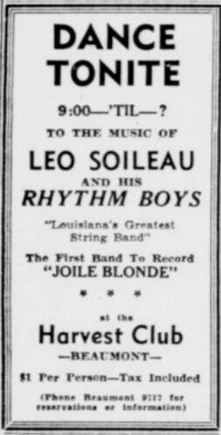
Forming his own band, the Three Aces, with rhythm guitarists Floyd Shreve or Dewey Landry and bassist/drummer Tony Gonzalez in the early '30s, Soileau expanded the group into a quartet, the Four Aces, in 1934. They later became the Rhythm Boys by 1937, backed by piano player Harold "Popeye" Broussard and steel guitarist Julius ‘Papa Cairo’ Lamperez.
2  In his last session with the Four Aces, Leo recorded a version of Joe Falcon's "Aimer Et Perdre" entitled "La Valse De La Rosa" (#17047), a melody he had reworked earlier in his career as "Ce Pas La Pienne Tu Pleur".   It would be his last recorded Cajun piece ever.  Although this marked the end of Leo's recording career, he claimed the reason was because of the onset of WWII.
When the war declared, that's when my contract expired with Decca.1   


Oh dear, promise me, well, (you're) just for me, pretty girl,
Until the day you die, baby.

Oh dear, I know, well, you didn't come to me,
You didn't come, well, you stayed away from your man, baby.

Oh dear, promise me not to leave me until death,
Pretty sweetheart, for your man, dear.

Oh dear, I know, well, I'm leaving,
It's to join you, pretty sweetheart,
So, why do you not want me, pretty girl?


The group continued to perform at the Silver Star Club in Lake Charles for eight years. Shifting to the Showboat Club in Orange, TX and other places like the Harvest Club, the band continued to play together for another two years. Although Soileau and the group appeared frequently on the radio, they never recorded again. In the late '40s, Soileau left music to work with his brothers in a general contracting firm in Ville Platte. He died in August 1980.2  


  1. http://arhoolie.org/leo-soileau-interview/
  2. https://www.pandora.com/artist/full-bio/leo-soileau/ARZbKjv4drvdfqc 
  3. Lyrics by Martin S

Release Info:
63070-A Chere Liza | Decca 17047 A
63070-A La Valse De La Rosa | Decca 17047 B

Find:
Leo Soileau: Louisiana Cajun Music Vol. 7 (Old Timey, 1982)
Cajun Country, Vol. 2, More Hits from the Swamp (JSP, 2005)

Tuesday, October 27, 2020

"Chere Poulette" - Papa Cairo

Adapting to the style of the Light Crust Doughboys and Jimmie Rodgers, Cajun steel-guitar pioneer Julius "Papa Cairo" Lamperez began playing guitar at the age of fourteen.  He eagerly built a guitar from a wooden box and a piece of lumber.   He dabbled in other instruments as well until he "got commercial" in 1935.  After getting a chance to watch Bob Dunn of the Texas Wanderers at a dance in Mermentau, Papa was immediately enamored by the steel-guitar and purchased one.6 He formed the band called the Daylight Creepers with Irby Thibodeaux, Leonard Campbell, and J.D. Miller.  But, after meeting Happy Fats and Doc Guidry, he found himself recording with other string bands such as the Rayne-Bo Ramblers, Harry Choates, and Joe Werner.6,7   Papa recalled, 
The first fiddle player we had around here who could really play [Cajun music] was Doc Guidry.  The second one was Harry Choates. He was a fine musician.6  
After the war, Papa joined up with Leo Soileau's band playing places like the Moulin Rouge Pleasure Club.  Leo remembered him as a serious player that didn't drink.   Having recorded previously with Chuck Guillory for the Bihari's Modern Records of Hollywood, Papa began eyeing different options on forming his own group.  However, not everyone was a fan of Papa's style, rather, they appreciated his determination and self-promotion.  According to Leo,
He'd play all night on two Coca-Colas.  No high ball, no nothing. That's one boy that didn't drink.1  
He decided to rig up a band.  He was selling though.   That's the reason I got him, he was selling.1   

Julius "Papa Cairo" (steel guitar),
Harry Choates (fiddle), Joe Manuel (banjo),
Eddie Pursley (guitar), Johnny Crain 
Poss. Hollywood Club, Rayne, Louisiana
Dec 1946
Courtesy of Arhoolie Foundation


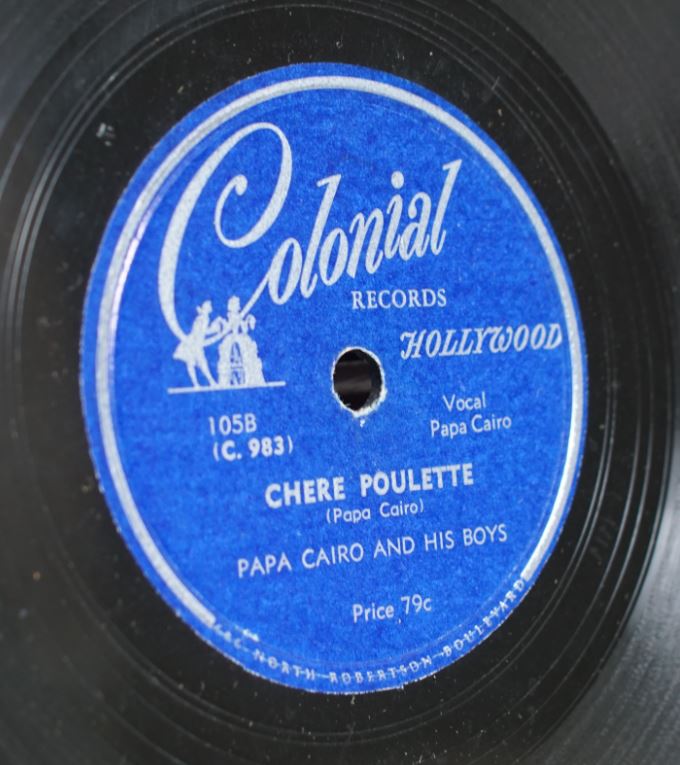
Riding high on the popularity of his previous recording of "Big Texas", he contacted Joe Bihari and together with Chuck Guillory's group, they recorded four more songs.  The first was an English language follow-up to his popular recording, entitled "Big Texas #2".  Then, he created two more songs, a rendition of his original French pre-war recording of "Alons Kooche Kooche" and a Western swing cover of the J.B. Fuselier tune "Chere Tout Tout" entitled "Chere Poulette" (#105).  Similarly, "Chere Poulette" was recorded as "The LeGrange Waltz" by Floyd Leblanc and "Tolan Waltz" by  Papa Cairo and his Boys consisted of Don Lane on xylophone, Murphy Smith on fiddle, Herman Durbin on piano, Albert Roy on guitar, possibly Pete Duhon on bass and Curly Mertz on percussion.   While terms of endearment such as "poulette" and "pou-lute" seem to have been lost to time, in turn-of-the-century France, cute women in Paris were referred to as "poupoule"; as noted in the late 19th century song "Viens Poupoule".  


Oh, mais, chere pou-lute,
'Gardez-donc, mais, quoi t'as fais?
Tu m'as quitte, pour t'en aller,
Pour t'en aller, à lac Arthur, mais, toi tout seul.

Oh, mais, chere 'tit poulette,
'Gardez-donc, mais, quoi t'as fais?
Tu m'as quitte, pour t'en aller,
Pour t'en aller, z-avec un autre, mais, loin de moi.

Oh, mais, chere pou-lute,
'Gardez-donc, mais, quoi t'as fais?
Tu m'as quitte, pour t'en aller,
Pour t'en aller, à lac Arthur, mais, toi tout seul.

Oh, mais, chere 'tit poulette,
'Gardez-donc, mais, quoi t'as fais?
Tu m'as quitte, pour t'en aller,
Pour t'en aller, z-avec 'tit poulette... 


The actual location of this recording session is a bit confusing.  When author Mike Leadbitter of Blues Unlimited caught up with Papa Cairo in 1968 and asked him about the Colonial recording, Papa claims "he was taken back to N.O (New Orleans) to record [Big Texas] under his own name."7  However, other researchers disagree with these details. Author John Broven spoke to Joe Bihari about the session.
I recorded at a radio station in Crowley, Louisiana, the Cajun hillbillies, the original ‘Jole Blon,’ the old French Cajuns. We knew we could sell the records there, purely to sell in Texas and Louisiana, some in Mississippi, too.  They recorded inside out. Their machines recorded from the inside of the disc and came to the outside, instead of the outside to the inside. That’s the way their equipment was set up. Not really a problem, all acetates.8  

Daily Advertiser
Oct 12, 1951

Although record producer JD Miller had a recording studio in Crowley and eventually worked with Papa Cairo and Chuck Guillory separately, the recording quality of these issues suggest that the band wasn't using studio quality equipment.  Author Nick Leigh goes on to affirm the notion, 
Surely these were not Miller tracks.  I don't think it was a case of JD recording Guillory/Cairo and then leasing out the tapes (or acetate) masters, but a Bihari operation during one of his many field trips to the south.5  

Broven thinks maybe the location could have been New Orleans, but not at a formal facility such as Cosimo Matassa's studio.

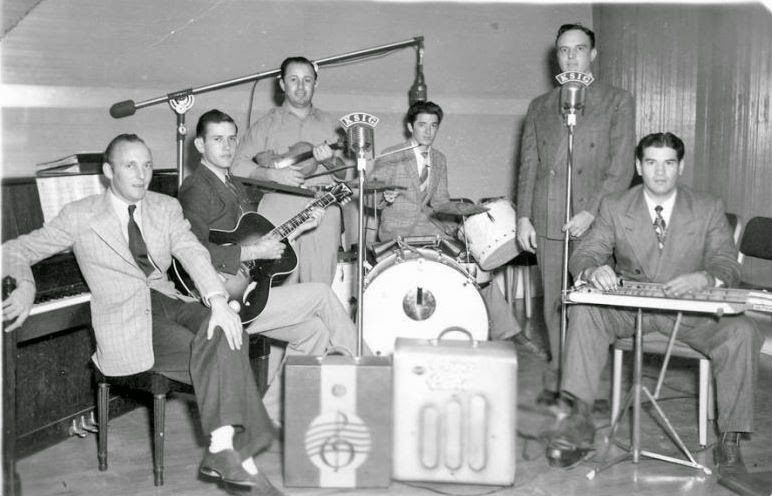
My feeling is that the Chuck Guillory session was cut at KSIG in Crowley in the summer of 1948. After the Modern recordings did fairly well, there were two Papa Cairo sessions in New Orleans in January and February 1949.  As there were still "inside start" acetates  being used, according to the Ace Records, London, database, I think we can assume the sessions were held at a New Orleans radio station.9  


Herman Durbin, Jimmy Newman,
Murphy "Chuck" Guillory, Kersey "Pork Chop" Roy,
R.R. Sagg (emcee), Julius "Papa Cairo" Lamperez
KSIG, Crowley, LA


Oh, well, dear little one,
So look, well, what have you done?
You left me, to go away,
To go away, to Lake Arthur, well, you're all alone.

Oh, well, dear little one,
So look, well, what have you done?
You left me, to go away,
To go away with another, well, far from me.

Oh, well, dear little one,
So look, well, what have you done?
You left me, to go away,
To go away, to Lake Arthur, well, you're all alone.

Oh, well, dear little one,
So look, well, what have you done?
You left me, to go away,
To go away with another... 


After the Biharis folded their Colonial operation and focused on their new label Flair, the following year, Papa teamed up with JD Miller to re-record both an English and French version of "Big Texas" on Miller's Feature label.  However, after Hank Williams released his 1952 hit "Jambalaya", Papa Cairo ceased recording ever again.  After his death, his family kept most of his memorabilia, including his signature steel guitar, with his name embossed on it.


Listen to sound clip sample: Chere Poulette

  1. http://arhoolie.org/leo-soileau-interview/
  2. South to Louisiana: The Music of the Cajun Bayous By John Broven
  3. Record Makers and Breakers: Voices of the Independent Rock 'n' Roll Pioneers By John Broven
  4. Discussions with John Broven
  5. Discussions with Nick Leigh
  6. "Crowley native newest member of CFMA Hall of Fame".  CPS 8-19-2018.  Wade Falcon
  7. 1968 Blues Unlimited - Papa Cairo.  Mike Leadbitter. 
  8. Joe Bihari interview.  John Broven.  2004.
  9. Discussions with John Broven.  10-22-2020
  10. Image courtesy of Brittany L
  11. Lyrics by Stephane F and Herman M

Release Info:
C 982 Kooche Kooche | Colonial 105A
C 983 Chere Poulette | Colonial 105B

Sunday, July 26, 2020

"Si Tu Voudroit Marriez Avec Moi (Marry Me)" - Joe's Acadians

Joe Werner, the Cajun harmonica player and entertainer rode the airwaves with his rendition of popular tunes and Cajun ballads.  One of Joe's earliest public performances was at a Houston radio station KTRH in 1930.  There he surprised listeners with his renditions of songs played on his harmonica.2  


Je te donnerais un bague en or
Si tu voudrais t'marier avec moi,
Si tu voudrais t'marier avec moi
Si tu voudrais t'marier avec moi, chère.

Allons  s'marier chere!

Je te donnerais un char neuf,
Et mon portrait de mon petit coeur,
Si tu voudrais t'marier avec moi,
Si tu voudrais t'marier avec moi, petite.

Je te donnerais la clef de mon coffre,
Et toute mon or et mon argent,
Si tu voudrais t'marier avec moi,
Si tu voudrais t'marier avec moi, chère.

Allons s'marier Jimmy

Je te donnerais un char neuf,
Et mon portrait de mon petit coeur,
Si tu voudrais t'marier avec moi,
Si tu voudrais t'marier avec moi, chère.

Je te donnerais la clef de mon coffre,
Et toute mon or et mon argent,
Si tu voudrais t'marier avec moi,
Si tu voudrais t'marier avec moi, chère.

Je te donnerais un bague en or
Si tu voudrais t'marier avec moi,
Si tu voudrais t'marier avec moi
Si tu voudrais t'marier avec moi, chère.


Rayne Tribune
Dec 5, 1936

Probably during the time he was courting his wife, he recorded "Si Tu Voudroit Marriez Avec Moi" (#2060) for Bluebird Records in New Orleans with Julius "Papa Cairo" Lamperez on guitar and possibly Wayne Perry on fiddle.  By 1936, he was engaged and married to Annie Thibodeaux of Crowley in a quiet ceremony with only immediate family.1   While living in Crowley, he attained much recognition as an outstanding musician and entertainer, being the first "live talent" to appear on KSIG.3  They remained in Crowley until the 1970s when they moved to Fort Worth, TX.


I would give you a gold ring,
If you'd marry me,
If you'd marry me,
If you'd marry me, dear.

Let's get married, dear.

I'll give you a new car, 
And my portrait of my sweetheart,
If you'd marry me,
If you'd marry me, little girl.

I'll give you the key to my chest,
And all my gold and my money,
If you'd marry me,
If you'd marry me, dear.

Let's get married, Jimmy.

I'll give you a new car, 
And my portrait of my sweetheart,
If you'd marry me,
If you'd marry me, little girl.

I'll give you the key to my chest,
And all my gold and my money,
If you'd marry me,
If you'd marry me, dear.

I would give you a gold ring,
If you'd marry me,
If you'd marry me,
If you'd marry me, dear.

In 2009, Linzay Young & Joel Savoy covered this obscure tune as "Si Tu Voudrais Marier".


  1. RT 4-10-1936
  2. "Local Boy Plays From Houston Radio Station" RT 12-05-1936
  3. The Rayne Acadian-Tribune (Rayne, Louisiana) 18 Jun 1978
  4. Lyrics by 'ericajun'

Release Info:

BS-027890-1 Si Tu Voudroit Marriez Avec Moi (Marry Me) | Bluebird B-2060-A
BS-027891-1 La Two Step A Chachin (Asa's Two Step) | Bluebird B-2060-B

Find: 
Raise Your Window: A Cajun Music Anthology 1928 - 1941 (The Historic Victor-Bluebird Sessions Vol. 2) (CMF, 1993)
Cajun Country, Vol. 2, More Hits from the Swamp (JSP, 2005)

Wednesday, December 4, 2019

"Personne M'aime Pas" - Leo Soileau

Leo Soileau was one of the pioneer fiddlers of recorded Cajun music. His recordings with the remarkable accordionist, Mayuse Lafleur, sold well locally, but some very traditional fiddle duets made with a cousin, Alius Soileau, did not sell as well. He also recorded a lot of blues and some jazzy numbers. As American pop music began making inroads into the prairies and along the bayous of Louisiana, Leo Soileau began recording songs in English, as well as country and pop songs translated into French! He was one of the first Cajun artists, along with the Hackberry Ramblers, to cross over and reach a wider English-speaking market, while keeping his young audience at home happy and dancing to the latest music.1  


Ouais, mais, personne pour m'aimer,
Moi, je connais, ouais, ça fait pas rien, ouais,
Oh, non, mais, personne m'aime pas,
Ouais, ça fait (rien), mon nègre, chère.

Moi j'suis orphelin, ni mère ni père,
P'us personne pour (m') soigner,
Hé oui, je prends ça dur, chère,
P'us personne, ouais, pour m'aimer.

Oui, oui, oui, mon nègre,
Oh, mais, 'garde-donc à moi-même, chère,
Oh, ouais, ça fait pitié, chère,
Oh, ouais, toujours, moi tout seul.

Leo Soileau and his Rhythm Boys, 1944.
George T-Chalk Duhon, Crawford Vincent,
Leo Soileau, D.W. Bollie Thibodeaux,
Desbra Fontenot

Courtesy of the
Johnnie Allan Collection
UL Lafayette Center of Louisiana Studies

Soileau's influences came from many different places. "Personne M'aime Pas" was a French take-off of the popular song "Nobody's Darling But Mine"  It must have been quite a sensation since Cleoma recorded the tune as "Pas La Belle De Personne Que Moi" that same year.  It was translated from the song by Jimmie Davis, "Nobody's Darlin' But Mine."  

His band consisted of Julius ‘Papa Cairo’ Lamperez on steel guitar, Floyd Shreve on guitar, Tony Gonzales on drums, and probably Harold ‘Popeye’ Broussard on piano. Together, they headed to Dallas, Texas in December of 1937 for one of his last recordings. 
Port Arthur News
Dec 3, 1944


Yeh well, nobody loves me,
I know, yeh, it doesn't matter, yeh,
Oh, non, well, nobody loves me,
Yeh, it doesn't matter, my friend, darling.

I am an orphan, neither a mother nor father,
No one, yeh, to look after me,
Hey yeh, I'm taking this hard, dear,
No one, yeah, to love me.

Yes, yes, yes my friend,
Oh well, look at myself, dear,
Oh yeah, it's pitiful, dear,
Oh yeh, always alone.


Soileau remained active in the early '40s, recording with Leo Soileau's Rhythm Boys. Dropped by Decca when the label decided to stop recording Cajun musicians at the beginning of World War II, the group continued to perform at the Silver Star Club in Lake Charles for eight years. Shifting to the Showboat Club in Orange, TX, the band continued to play together for another two years. Although Soileau and the group appeared frequently on the radio, they never recorded again. In the late '40s, Soileau left music to work with his brothers in a general contracting firm in Ville Platte. He died in August 1980.2 


  1. J'ai Ete Au Bal Vol. 1.  ARhoolie CD 331.  Liner notes.
  2. https://www.pandora.com/artist/full-bio/leo-soileau/ARZbKjv4drvdfqc 
  3. Lyrics by Jordy A


Release Info:

63069-A Personne N'Aime Pas | Decca 17042 A
63067-A Valse D'Amour | Decca 17042 B

Find:
Leo Soileau: Louisiana Cajun Music Vol. 7 (Old Timey, 1982)

Tuesday, November 12, 2019

"Chuck's Waltz" - Chuck Guillory

Murphy "Chuck" Guillory learned to play from his father, Mady Guillory. He first picked up the instrument at the age of seven in the 1930s.3  
I picked up his violin when I was 7 and I was too little to tune it. He tuned it for me, and I started playing with one finger--I learned to play it own my own.3  

Starting out small, like most Cajun musicians, he played in local establishments, country dances, and local musical contests.  According to Guillory,
I'd rather play music than eat.2  


Hé, p'tite fille, un jour à venir, mais, malheureuse, 
Moi, j'connais tu vas pleurer tu sera trop tard,
Hé, un jour à venir chérie, 
Moi, j'connais tu vas venir, mais, malheureuse.

Hé, mais, tu connais, chérie, 
Tu connais, t'es jamais dernière* pour ça t'as fait.

Herman Durbin, Jimmy Newman, Chuck Guillory,
Curzy "Pork Chop" Roy, R.R. Sagg (emcee),
Julius "Papa Cairo" Lamperez

After the breakup of Harry Choates' Melody Boys, Guillory attracted two of his biggest sidemen in the industry, fiddler Curzy "Porkchop" Roy and steel guitar player Julius "Papa Cairo" Lamperez.   Porkchop grew up learning from his father, in which he recalls "could play anything, accordion, fiddle, guitar, piano...".1   He explained his nickname from childhood,
When I was a kid, I chewed gum all the time. As soon as the flavor was gone, I'd spit the gum out and pop in another piece. So my father called me "cochon" (pig).1  

Daily World
May 2, 1950

At sixteen years old, Porkchop cut his teeth early on, playing the drums with Harry Choates and the Melody Boys and by the time Papa was filling in, the band, the two musicians found themselves in Eunice working alongside Guillory's group. Together, in 1950, they recorded a tune called "Chuck's Waltz" (#1015).   It's a song most likely introduced to Guillory by his early sideman, Preston Manuel. Preston, who played with Chuck shortly after the war, had helped popularize this tune in the 1930s as "Chere Tu Tu" with J.B. Fuselier.  Preston recalled playing with Guillory,
I had quite playing with J.B. for a few years, right after WWII, and we organized a band, me and Chuck, The Rhythm Boys.   My main man is Chuck .  I like to play with him and he's such a nice guy.  He's a good fiddler too!4   


Hey, little girl, one day will come, well, oh my,
I know you are going to cry, you'll be too late, 
Hey, one day will come, dearie, 
I know you're going to return, well, oh my.

Hey, well, you know, dearie,
You know, you'll never last*, for what you've done.


After working in the grocery business in Mamou for years, he brought back Preston and Porkchop for something he called a "re-comeback" in 1982, re-recording many of his old tunes including "Chuck's Waltz".   Porkchop reminisced a harrowing night with the band and Papa Cairo,
One night, we played a dance at Tee Maurice. Afterward, we went riding around Bosco with Papa Cairo...just looking around. The fella driving the car jumped a canal and we ended up in the water. I came up with my hair hanging all over my face. Papa Cairo was laughing at me, but he changed his tune when he saw his six string steel-guitar floating down the canal.  He started hollering for someone to grab it quick.   He didn't mind being in the canal near as much as losing that steel.1  


  1. "Cajun Musician Curzey Roy Recalls the Robust Rhythms".  Fannie Genin. DW. Sep 1984.
  2. "Guillory Nominated". Candace Riley. VPG. Mar 5, 1989
  3. "Fiddler Stands By Old Time Music". Robin Miller. TT Sep 26, 1993.
  4. "Ye Yaille Chere" by Raymond Francois 
  5. Lyrics by Stephane F

Release Info:
Chuck's Waltz | Feature F-1015-A
Teiyut Two Step | Feature F-1015-B

Find:

Grand Texas (Arhoolie, 1998)
Jimmy C NEWMAN - The Original Cry, Cry, Darling (Jasmine, 2009)

Wednesday, August 14, 2019

"Le Vieux Arbe De Pin (They Cut Down The Old Pine Tree)" - Louisiana Rounders

The Louisiana Rounders were formed from several Acadia Parish musicians, one being the popular entertainer Joe Werner.  After his big break with "Wondering" recorded with the Hackberry Ramblers, he went on to follow up with a mildly successful recording career.  In the early 1930s, country music from Texas began it's large scale influence on local Cajun music in Louisiana.  Several bands from west Louisiana and east Texas popped up using country music instruments and sang Cajun French lyrics. Joe Werner had alot of success with Happy Fat's early band and made a name for himself.  It wouldn't be long before Decca would ask him to travel to Dallas for a recording session where he invited Julius "Papa Cairo" Lamperez to come along and record with Wayne Perry as the Louisiana Rounders.


Ils ont coupé le vieux arbre de pin,
Ils l'ont halé loin au moulin,
Pour faire un cercueil de pin pour le cher cœur a moi,
Quand ils ont coupé le vieux arbre de pin.

Elle a pas une fleur* dans sa poche ce soir,
Où, là, mon cœur va toujours être,
Ils ont coupé mon cœur quand ils ont séparés,
Quand ils ont coupé le vieux arbre de pin.
Daily Advertiser
Aug 18, 1938

In 1937, Werner, fiddler Wayne Perry and steel guitar player Julius "Papa Cairo" Lamperez traveled to Dallas, TX and recorded the old tune "Le Vieux Arbe De Pin (They Cut Down The Old Pine Tree)" for Decca records (#17046).  The song was an old American folk tune, first recorded in 1929 by George Brown, Edward Eliscu, William Raskin and Albert Barbelle and then later by the Carson Robison Trio and Dick Robertson.  It would eventually become a staple of western music.  In his line, "elle a pas une fleur dans sa poche ce soir", he could be referencing the line "elle a pas seule dans sa tombe ce soir" which speaks of the love interest buried in the grave but never really alone.

Papa Cairo


They cut the old pine tree,
They hauled it away to the mill,
To make a pine coffin for my dear sweetheart of mine,
When they cut the old pine tree.

She is not alone in her grave tonight,
There, where my heart will always be,
They cut my heart when they separated it,
When they cut the old pine tree. 
Joe Werner and Papa Cairo continued to work together throughout their careers.  The song's popularity continued for decades, recorded by artists such as Sons of the Pioneers, Jimmy Driftwood and George Fisher, Gene Autry, Black & White, Buck Wilson & His Rangers, Dan Parker w/Orch, Dick Robertson w/Orch, Frank Luther, Frankie Marvin, Gene Carroll - Glen Rowell, Hart & Ogle, Joe Rines & His Orch, Paul Mason, Redd Evans & His Billy Boys, Rice Brothers Gang, Tennessee Moonbeams, Tommy & Willie, and the Tune Wranglers.


  1. Lyrics by Stephane F

Release Info:
63075 Le Vieux Arbe De Pin (They Cut Down The Old Pine Tree) | Decca 17046 A
63078 Vingt Et Un Ans (Twenty One Years) | Decca 17046 B

Find:
JOE WERNER Early Cajun Artist (BACM, 2016)

Friday, April 20, 2018

"Vingt Et Un Ans (Twenty One Years)" - Louisiana Rounders

Growing up, multi-talented musician and entertainer, Joe Werner, dazzled the local audiences in Crowley with his abilities to sing, whistle, play guitar, and the harmonica as a kid on stage.   Before long, his name as a local entertainer would reach neighboring cities. Throughout the 20s and 30s, he learned the popular tunes of the day and converted the lyrics to his native Cajun French language.  By 1936, Joe worked alongside the Hackberry Ramblers before forming a small group for his own recording session with Decca to record some popular American cover songs.  Still considered an amateur musician, he continued to perform in many talent contests, winning awards and garnering more fame. 
Rayne Tribune
May 8 1936


Le juge dit "Lève-toi debout garçon et sèche tes larmes,
T'es condamné a Nashville pour vingt et un ans",
Embrasse-moi bye-bye, chère, et dis tu seras pour moi,
Parce que vingt et un ans, chère, c'est bien longtemps.

Pas le loin du chemin d'fer, chère, aussi loin tu peux voir,
Et continue à m'faire bye-bye, chère, a "farewell" a moi,
Alors, embrasse-moi bye-bye, chère, et dis tu seras pour moi,
Parce que vingt et un ans, chère, c'est bien longtemps.

Daily Advertiser
Aug 18, 1938

Werner teamed up with Julius "Papa Cairo" Lamperez and Wayne Perry, who were both Crowley residents.   By the end of 1937, they were in Dallas, TX at the Adolphus Hotel for their first Decca session.  The trio covered a popular 1930 Bob Miller tune called "Vingt Et Un Ans (Twenty One Years)" (#17046) in a Cajun string band style.   Werner's harmonica mimic'd the accordion sound that had been so popular 10 years earlier.  
The judge said "Stand up boy and dry your tears,
You've been condemned to Nashville for twenty one years,"
Kiss me bye-bye, dear, and say you'll be mine,
Because twenty one years, dear, it's a very long time.

Not far from the railroad, dear, as far as you can see,
And continue waving bye-bye, dear, wishing farewell to me,
So, kiss me bye-bye, dear, and say you'll be mine,
Because twenty one years, dear, it's a very long time.
Bob Miller
Nashville Songwriters Hall of Fame


The original song writer, Bob Miller, was among the pioneering professional songwriters who specialized in what was then called hillbilly music. He worked for Irving Berlin Music, formed his own publishing company in 1933, and also worked as an A&R man and record producer for the Columbia and Okeh labels. His biggest early hit was the prison song "Twenty-One Years." During the Depression, this song was so popular and was sung by so many artists that Miller wrote a number of follow-up songs to it, including "Twenty-One Years, Part Two," "New Twenty-One Years," "Answer to Twenty-One Years," "Woman's Answer to Twenty-One Years," "After Twenty-One Years," "The End of Twenty-One Years" and "The Last of the Twenty-One Year Prisoner."1    


  1. http://nashvillesongwritersfoundation.com/Site/inductee?entry_id=2509
  2. Lyrics by Stephane F

Release Info:
L05 63075 Le Vieux Arbe De Pin (They Cut Down The Old Pine Tree) 17046 A Decca
L08 63078 Vingt Et Un Ans (Twenty One Years) 17046 B Decca

Saturday, February 25, 2017

"Ayou, Ayou, Mon Petite Chien Pour Edete (Where, Oh Where Has My Little Dog Gone)" - Louisiana Rounders

Joe Werner was a complete entertainer throughout the Cajun countryside.   He started his career in music and minstrel shows.  He recalled back when he was a barefooted kid, he told his father before Christmas that he waned Santa Claus to bring him a harmonica.  He got his harmonica an he started "fooling" with music.  Year after year, the Christmas request was the same, and year after year, Santa Claus came through with another harmonica. At the local high school auditorium in 1927, he entered a talent show, playing his harmonica and received "encore upon encore" for his version of the song "Casey Jones".6 By the early 1930s, he was dabbling both in music and in theater.  He participated in black face minstrel shows as a comedian for local theater groups.3  

Éyoù éyoù, mon petit chien peut d'être,

Éyoù éyoù, l'est peut d'être,

La queue coupée court(e), les oreilles sont larges,

Éyoù éyoù, l'est peut d'être.


Éyoù éyoù, mon petit chien peut d'être,
Éyoù éyoù, l'est peut d'être,
Y'a une tache dans le coté et ses cheveux est coupés courts,
Éyoù éyoù, l'est peut d'être.
Rayne Tribune
Dec 10, 1937

Throughout 1936, Joe's entertainment services would include playing music for special novelty programs at the Opera House, personifying Jimmie Rogers on stage.1   He even won a second place award during the finals in the Heymann Amateur Hour in Lafayette.    During the time allotted to him for his part of the program, Joe offered two English selections, "Cocktail For Two" and "She's Just That Kind Of A Girl". He accompanied both songs on the guitar and harmonica, also singing several choruses and whistling.2    

He shortly jumped into the band called the Hackberry Ramblers, recording for Bluebird Records.  The following year, Joe left their group and formed the Louisiana Ramblers with Wayne Perry on fiddle and Julius "Papa Cairo" Lamperez on steel guitar.   Together, they traveled to the Adolphus Hotel in Dallas, TX where they recorded the old traditional tune called "Ayou, Ayou, Mon Petite Chien Pour Edete (Where, Oh Where Has My Little Dog Gone)" in Cajun French (#17040). His title written as "ayou" or "éyoù" is a common Louisiana French phrasing of the words "où est".
Oh where, oh where can my little dog be,
Oh where, oh where can he be,
The tail is cut short, the ears are wide,
Oh where, oh where can he be.

Oh where, oh where can my little dog be,
Oh where, oh where can he be,
There's a spot on the side and his hair is cut short,
Oh where, oh where can he be.
Even stage shows that arrived in town would feature Joe Werner as the opening act.  Eventually, Joe would settle down, hosting a radio show on KSIG for years.4 


  1. "Winners Named For Premier".  RT 2-28-1936.
  2. "Werner Wins Amateur Award" RT 5-8-1936.
  3. "St. Joseph Fair Will Open On Saturday".  RT 10-18-1935.
  4. "Werner's Wondering Finds New Popularity".  H.I. Mitchell.  CDS. 1952.
  5. RT 12-10-1937
  6. "Large Crowd Attends Community Singing" RT 5-7-1927
  7. Lyrics by Stephane F

Find:

Cajun: Rare & Authentic (JSP, 2008)
The Very Best of Cajun: La Stomp Creole, Vol. 1 (Viper, 2016)

Saturday, September 17, 2016

"Tolan Waltz" - Chuck Guillory

Murphy "Chuck" Guillory, originally from Mamou, was a good hillbilly, Cajun-swing singer and fluent fiddle player who recorded J.D. Miller's Feature and Folk-Lyric labels. He regularly performed alongside his father, playing fiddle duets at a local bar each Saturday afternoon. After WWII, he recorded with Cajun musician Milton Molitor with his band the Rhythm Boys (featuring a young singer from Beaumont named George Jones).   Miller had heard about Modern Records recording Chuck's group in New Orleans featuring Jimmy Newman and Papa Cairo in 1948.  The sessions had been part of an extensive southern field trip by Modern. By 1949, it's believed Miller brought them to his studio to record Guillory's "Tolan Waltz" and released it on Colonial.

Moi, j'connais, chérie, un jour à venir, chérie. 

Tu vas revenir, tu seras trop tard. 
Chuck Guillory

Tolan McCauley was a popular blacksmith, rice mill operator and saloon owner in Eunice, not far from Mamou. Chuck Guillory and Jimmy Newman composed this song in his honor. The song features a lengthy sample of Red Fabacher's playing style on steel guitar; the key person from whom Papa Cairo had borrowed the melody for "Allons Kooche Kooche" and "Grand Texas".  Similarly, Tolan was recorded as "The LeGrange Waltz" by Floyd Leblanc and "Chere Poulette" by Papa Cairo.

I know, dear, one day eventually, dear,

You'll return, you will be too late.

Colonial, a subsidiary of the Bihari brother's Modern Records, was a label out of Hollywood, California that released recordings between 1947 and 1952.  Les Bihari handled the sales and the other two brothers, Joe and Jules, supervised the production and distribution.  It focused on hillbilly, race, and gospel "spiritual" genres.  Sometimes confusion occurs with other labels with the same name in Monterey Park, North Carolina, Nashville, Berkeley Springs, Boston, and NYC.  It's possible J.D. Miller had outsourced his recordings and had Modern/Colonial press even more than he could back home.  Despite the popularity of the song, the market was too localized for this ambitious concern or its fellow independents.  Chuck retired in 1958.


Opelousas Daily World
May 20, 1949


In 1982, having been re-discovered, he re-recorded the tune in a new recording session, this time with band members Michael Doucet, David Doucet and guitarist Preston Manuel taking most of the vocals. In the late '80s, Guillory re-formed the Rhythm Boys to play dances and record for the Arhoolie label, with his 1987 sessions for the company later collected on the 1998 release Grand Texas. Later, Tolan would be covered by Dennis McGee and Sady Courville.


Chuck Guillory - Tolan Waltz - 1949

Chuck Guillory - Tolan Waltz - 1982

Chuck Guillory - Tolan Waltz - 1987


  1. South to Louisiana: The Music of the Cajun Bayous By John Broven. p34.
  2. MADE IN LOUISIANA.  VRCD 325.  MARC SAVOY - Accordion. DEWEY BALFA - Fiddle. D. L. MENARD - Guitar.  Liner notes.
  3. Billboard Apr 23, 1949
  4. Chuck Guillory: Grand Texas.  Liner notes.
  5. http://www.allmusic.com/artist/chuck-guillory-mn0000099796/biography
  6. Lyrics by Stephane F
Find:
Chuck Guillory: Grand Texas (Arhoolie, 1998)
Jimmy C NEWMAN - The Original Cry, Cry, Darling (Jasmine, 2009)