A unique window into the world of Cajun music between 1928 and 1965. Compiled histories from websites, books, news articles, liner notes, and interviews. Most come from my personal 78 collection. Also covering Creole, Cajun-Country, and Cajun swing.
Showing posts with label John H. Bertrand. Show all posts
Showing posts with label John H. Bertrand. Show all posts
Before the arrival of the Acadians in 1764, Louisiana had a fair share of Frenchmen that arrived and resided along the Mississippi River as explorers, either from New France provinces near the Great Lakes or as French soldiers stationed along the river in places such as Natchez, Pointe Coupee, and New Orleans. Many of these Frenchmen would travel westward, away from the flooded watershed and find farming opportunities in the prairies of present-day St. Landry and Evangeline Parishes. They carried with them the songs of French European life. By the end of the Napoleonic Era, more Frenchman would settle in south Louisiana, bringing with them other European melodies alongside Appalachian tunes pouring into the region. Accordionist John H. Bertrand, of St. Landry parish, grew up exposed to these songs by his daughter who learned them from his mother, Nora Boone. In 1929, he had the rare opportunity to record these seminal songs on wax alongside guitar player Roy Gonzales and his fiddling son, Anthony.
Un jour en me promenant dessus le pont de Nantes,
J'ai rencontré la belle et j'ai voulu l'embrasser,
Hélas, le tribunal m'a rendu prisonnier.
Et quand ma belle a eu de mes nouvelles,
Elle s'était habillée dedans une grande robe noire,
Et droit dans la prison, la belle est bien allée.
...
Crowley Daily Signal Jul 5, 1929
Bertrand's songs like "Le Pond de Nante" (#12776) is a loose interpretation of a classic classic old world French song from Brittany called "Dans les prisons de Nantes". According to Wikipedia, it's a song featuring the story of the jailer 's daughter who helps a prisoner escape from a prison in Nantes. It can be found almost everywhere in the French-speaking world thanks to the sailors going up the Loire or to the exiles who arrived in New France. This particular story is of a lost love that dressed as a page, in a dark robe, pretending to be a man. She begs the prison guards to let her in to see her lover. Once in, she hands her lover the clothes, directs him to her horse, and instructs him to escape to freedom.1
John Bertrand may have been one of the more obscure artists during the early Cajun recording era, but his music seems to have had earlier origins than many of the Cajun folk songs of the time. His mother, Nora Boone, recalled and recited many French folk songs her family had passed down from Europe. Each one possessed a different theme and melody in which Bertrand translated into an accordion-led melody.
Bonsoir mes bonnes gens,
Si c'eût été possible,
De me loger ce soir,
Pour moi soyez sensibles,
Pour moi soyez sensibles.
Puisque ne pouvant pas,
Ici vous satisfaire,
Voyez notre maison,
N'est qu'un lieu si petit,
N'est qu'un lieu si petit.
Allez dans un village,
Vous trouverez un logis,
Allez dans un village,
Vous trouverez un logis.
Comment vous refusez,
À un soldat fatigué,
Qui devient moi-même,
Qui devient moi-même.
Et votre fils enfin,
Se trouverait dans ses bras,
Où vos dures satisfactions,
Vos maudites satisfactions.
À tout moment que je finis,
Vous m'arrachez les âmes,
Je vois bien qui les mange,
Dans les années souffrantes,
Dans les années souffrantes.
Reconnaissez-moi ma main,
Si je viens chez moi mince,
La mort ne parle pour moi,
Mais j'aime toujours la vie,
Mais j'aime toujours la vie.
Mais mon bras c'est une méthode,
Et toi ma chère amie,
Je vis toujours pour toi,
Avec un espoir immense,
Avec un espoir immense.
19th century French soldier Image by Alexandr Sidorov
Having teamed up with Acadia Parish guitarist and yodeler Roy Gonzales, John brought along his son Anthony and the trio headed to Chicago in the winter of 1929 where they recorded "Le Soldat Fatigue" (#12763). Songs like this may have come from French nursery rhymes similar to "Pauvre Soldat" commonly sung in France. In this piece, the song describes an old soldier looking for a place to sleep. He is refused a the first place and told to go to another town. Many of these Old World songs have their origins during the Napoleon Era.
Release Info: 21248-2 La Fille Du Jolier (The Jailor's Daughter) | Paramount 12763-A 21251-2 Le Soldat Fatigue (The Tired Soldier) | Paramount 12763-B Find: John Bertrand / Blind Uncle Gaspard / Delma Lachney Early American Cajun Music (Yazoo, 1999)
John Bertrand was born near Opelousas, more in the mainstream heart of the Cajun landscape, and the same can be said of his music, with its highly rhythmic accordion accompaniment. In terms of repertoire, though, the common factor is that several of his songs, many of which he appears to have learnt from his mother, would also seem to show Old World origins.1
Oh, ouais, partout que j’aime, ces lis donc me conviennent pas,
La seule que mon cœur aime, elle est si loin de moi,
Et si j’aurais des ailes, comme tous ces hirondelles,
Aupres de toi la belle, j’irais me reposer.
En te contant mes peines, et ensuite mes amities.
En te contant mes peines, et ensuite mes amities.
Apportez-moi une verre, que je boive à la santé,
Ina-t-une bouteille que j’aime, que je boive sans la nommer,
Il y’en à qui aime la blonde, et d’autre qui aime la brune,
Mais moi j’sus pas comme çà, j’aime bien mais tout les deux.
Comment tu veux je fais, pour aller bien tout les deux?
Comment tu veux je fais, pour aller bien tout les deux?
Crowley Daily Signal Mar 15, 1929
In 1929, Bertrand and his guitarist Milton Pitre traveled to Chicago and recorded "The Swallows" (#12730). But by the time the recordings had arrived on the shelves, Pitre had been shot and killed in a dispute over a woman. According to Ray Templton,
The Swallows, for all its English title, is surely an old traditional French song. Bertrand’s records all featured guitar accompaniment by one Milton Pitre. His playing is rather odd – he seems to be repetitively plucking single or double strings rather than playing chords. He doesn’t always hit the right harmony, but that may just have been recording session nerves, and most of the time it’s quite effective.1
John H. Bertrand
Oh, yeah, everywhere I like (to be), I don't find comfort in the beds,
The only one that I love in my heart, she is so far from me,
And if I had wings like all these swallows,
Beside you, beautiful one, I would go and rest.
Tell you my sorrows, and then my friendships,
Tell you my sorrows, and then my friendships.
Bring me a drink, that I'll drink to health,
There's a bottle that I like, that I'll drink without saying her name,
There are some who love blondes, and others who love brunettes,
Well, me, I'm not like that, I love, well, both of them.
How do you want me to go with both of them?
How do you want me to go with both of them?
Known as "Oh, Si J'aurais des Ailes", it was recorded in 1934 by Alan Lomax by Sansey Bonnet of Crowley. Later, in 1977, Loricia Guillory also recorded the song for Gerard Dole in Mamou.
Right before the Depression took hold, major recording labels wanted a piece of the action that Columbia had engaged in down in south Louisiana. By the beginning of 1929, other companies like RCA, ARC and Paramount were busy hunting down Cajun musicians in the prairies and sending them to their studios up north. Two of those musicians were John Homer Bertrand and Milton Pitre.
La plus vielle de la bande, mais, c'est la plus vaillant,
C'est la plus contente, elle a les yeux canailles,
Mais, dis pas à ta mom, mais, j'ai goutté ton bec,
Mais, dis pas à ton pop, mais, si j'ai pas la bonne tête,
C'est la mienne, mais, au péril de la vie,
Chère cousinne, mais, donne-moi, donc, celle-là
Mais, si c'est pas celle-là moi, j'en veux pas du tout,
Petit galop, mais, pour la Pointe au Pin.
John Bertrand
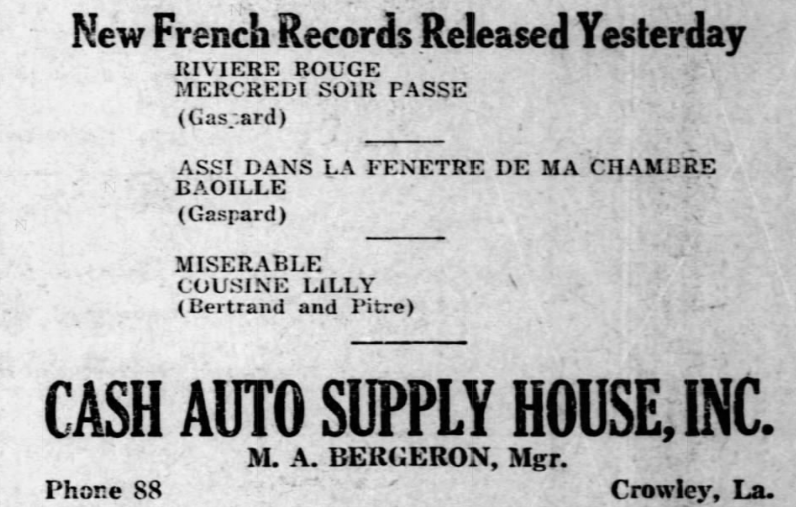
Bertrand was a blacksmith from the area around Opelousas known as Prairie Ronde. Together with Milton Pitre, they traveled to Chicago, IL and recorded "Cousinne Lilly" (#12725). It's most likely that John was singing about the courtship, and eventual marriage, of his brother Eddie to their second cousin, Lillian Joubert. In the song, he repeats the same verse, changing the placement of the line "petite galop" from the end to the middle. A "petite galop", or "small gallop", refers to the typical three-beat gait of a horse; also known as a canter.
The oldest of the group, well, is the most sociable,
She's very calm, she has mischievous eyes,
Well, don't tell your mom, well, I kissed your lips,
Well, don't tell your dad, well, unless you don't have a good mind,
She's mine, well, bet your life,
Dear cousin, well, give her to me, that one,
However, if that one's not mine, I don't want anything,
Let's canter, well, to Pine Point.
Given the lack of Paramount's Cajun releases found in Louisiana, it seems the company missed out on an opportunity. It's quite possible that Paramount failed to adequately distribute the bulk of this music in the south and struggled to improve sales. Nevertheless, "Cousinne Lilly" remained a popular tune throughout the Cajun prairies and by 1964, fiddler Adam Hebert scored one of his most well-known versions for Swallow records entitled "La Pointe Aux Pins".
Crowley Daily Signal Feb 22, 1929
Lyrics by Stephane F
Release Info: 21076-1 Cousinne Lilly | Paramount 12725-A 21075-2,-3 (La Valse De) Miserable | Paramount 12725-B Find: Early American Cajun Music (Yazoo, 1999) The Rise & Fall of Paramount Records: Volume Two, 1928-1932, CD G (Third Man, 2014)
Children's songs can be some of the most inspirational pieces of music passed on through generations. One of the most influential instrumentals floating around the Cajun prairies would be recorded by an almost obscure duo. Recorded by John H. Bertrand and Milton Pitre, it would influence one of the earliest versions of the melody which became Iry Lejeune's "J'ai Ete Z Au Bal" and be the sole influence for Lawrence Walker's "Johnny Can't Dance". The duo traveled to Chicago in 1929 when Paramount decided to bring more blues to their recording studio. The song, "The Rabbit Stole The Pumpkin" (#12730), was based on a children's tune that Lawrence Walker remembers hearing played as child.1 Later that same year, it was recorded separately as "J'vai Jouer Celea Pour Toi (I'll Play This For You)" by Bixy Guidry and during the mid 1930s as "Ne Buvez Plus Jamais" by Joe Falcon. While there are some similarities with Iry Lejeune's "I Went To The Dance"; covered by countless Cajun musicians, it would be Lawrence Walker's "Johnny Can't Dance" that would take the melody and popularize it for all time. Much later, Rick Michot would write lyrics to the song, calling it "Le Lapin a Volé Le Giraumon"2
Find: John Bertrand / Blind Uncle Gaspard / Delma Lachney Early American Cajun Music (Yazoo, 1999) The Rise & Fall of Paramount Records: Volume Two, 1928-1932, CD G (Third Man, 2014)
John H. Bertrand was born in Prairie Ronde, a small district near Opelousas, Louisiana. He worked primarily as a blacksmith and taught himself the accordion while in his teens. After a spell away from the Opelousas area he and his family returned in 1924 and settled in a small community, L’Anse Aux Pailles. The young Milton Pitre lived next door and he would back Bertrand at his first session for Paramount in what is thought to have been January 1929. He traveled to Chicago twice in 1929 to record for Paramount Records; first time with guitarist Milton Pitre and the second time with guitarist Roy Gonzales and fiddle player Anthony Bertrand. At the time, Pitre would have been around twenty. In a macabre echo of the murder of Mayeus La Fleur, just a few weeks after this recording debut, Pitre was shot dead in an argument over a woman. John and Milton are most known for the song "The Rabbit Stole The Pumpkin" which would influence two more well-known songs in years to come: Iry Lejeune's "I Went To The Dance" and Lawrence Walker's "Johnny Can't Dance".
Tout autour des "tanks" d'eau après attend' pour un train,
De mille miles de chez moi dans une place qu'est bien vilain.
J'ai monté de voir le conducteur, j'lui ai fait deux ou trois pas,
Il m'a dit si tu as d'l'argent, je vois que tu marches pas.
J'ai pas cinq sous dans ma poche, j'ai rien que j'peux montrer,
Tu peux descendre mon vieux bougre, il m'a fait me dépêcher.
(Yodel)
Ils m'ont fait descendre dans l'Texas, une Etat que j'aime bien,
J'ai r'gardé autour de moi, mais j'voyais pas le train.
Personne ne voulait pas y me donner un coup d'main,
Tu t'en sors (?) mon vieux hobo, dépêche prend ton ch'min.
En poche mon livre était bien vide et mon cœur était en peine,
J'suis mille miles de chez moi pour attendre toujours un train.
(Yodel)
John Bertrand
The recording is extremely rough and any translation is bound to be a guess at best. Bertrand's style represents an unusual byway of Cajun music that is softer and more introspective than most other styles. In March or April 1929 Bertrand was invited back for another Paramount session. With the death of Pitre, he appointed Roy Gonzales as back-up guitarist. Gonzales' unique yodeling style would imitate Jimmie Rogers which was popular during the era. It's one of the few Cajun recordings containing yodeling.
All around the water tanks, I'm waiting for a train,
A thousand miles from home in a place that is very shabby.
I came up to see the driver who was two or three steps away,
He said "If you got money, boy, I'll see that you don't walk",
I don't have five cents in my pocket, I have nothing to show,
"Get off old chap!" He made me leave quickly.
(Yodel)
They made me go down to Texas, a state that I like,
I looked around me, but I could not see the train,
Nobody wanted to give me a helping hand,
You go away, old hobo, hurry along,
In my book bag was empty and my heart was in pain,
I'm a thousand miles from my house forever waiting for a train.
(Yodel)
How the two came to work together is unclear but from the two numbers included here, the partnership appears to have worked well. During this second and final recording session, John and Roy record the song "Attendre Pour Un Train" for Paramount (#12762). The song is a Cajun french verison of Jimmie Rogers' "Waiting For A Train". Roy, a native of Crowley, Louisiana, was good friends with fiddler Leo Soileau. It's possible the fiddle player on this song is Leo however, it's still unknown. They would later team up, travelling together with Moise Robin to record for Paramount in Richmond, Indiana during the summer of 1929. During this session, Roy would re-record "Attendre Pour Un Train" (#12807), this time, by himself.