Showing posts with label Goldband Records. Show all posts

Friday, February 25, 2022

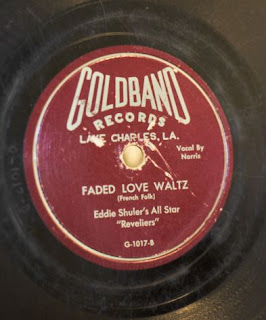
"Faded Love Waltz" - Eddie Shuler

Eddie Shuler spent much of the 1940s filling in western swing groups and Cajun string bands such as the Hackberry Ramblers.   By the end of WWII, he managed to assemble his own group called the Reveliers and decided a new record label was needed in order to promote his new group.  In doing so, he couldn't ignore the sudden increased demand for Cajun music.  Eddie was surrounded by Cajun people who wanted more of those records.   His band had to adapt to the music demand. He recalls:
Oh yes, I sold a lot of records to the jukebox operators; that was where you sold most of your records in those days.  There were not all that many record shops, and then the people didn't have all that much money to buy records, except the richer people.  That's where you sold most of those pop records.  But the jukebox operators had to have what they called race records and hillbilly records; they had to have that stuff and the Cajun records, too.  So we got into the Cajun thing.1

Oh, chère, mais, j'ai prié, mais, pour t'avoir,
J'ai pas vu,  joli 'tite monde, comment je vas faire.

Oh, chère, mais, quel espoir, mais, que tu connais,
Moi de mourir de plus t'avoir, joli 'tit monde.

Oh, chère, mais, pourquoi-donc, mais, (.........),
Tu vas voir que je mérite pas tout ça tu m'fais.


Liberty Vindicator
Dec 11, 1947

Shuler wanted to record his own songs and focus more on hillbilly music, like his main influence, Bob Wills. He explained:
Any country band was hillbilly. It didn't make no difference who you were, you were hillbillies. There wasn't no country music then. They hadn't even invented the word.2  

Between 1944 and 1945, Shuler cut the first record for the Reveliers, featuring Shuler's compositions "Broken Love" and "Room in Your Heart For Me Darling."   By 1946, Cajun music was ramping up among the population of south Louisiana and he brought in Norris Savoy to assist in singing some classic Cajun songs.  Along with Pee Wee Lyons on steel guitar and Johnny Babb on bass, they recorded the melody of the 1936 "Ma Valse Favori" by Cleoma Breaux in which he entitled it "Faded Love Waltz" (#1017).  The melody is the same as Lawrence Walker's 1929 recording of "La Vie Malheureuse" and Happy Fats' 1935 recording of "La Valse De L'Amour". Shuler called his new record label Goldband Records. 
It had something to do with my mentality. I said, 'This is going to be a goldmine, so I'll just call it Goldband.'2  


Oh, dear, well, I prayed, well, to have you,
I couldn't see, pretty little everything, how I'll do this.

Oh, dear, well, what hope, well, that you know,
I'm dying to have you anymore, pretty little everything.

Oh, dear, well, so why, well, (........),
You'll see that I don't deserve all that you've done. 


  1. Record Makers and Breakers: Voices of the Independent Rock 'n' Roll Pioneers By John Broven
  2. http://theind.com/article-168-the-record-man.html
  3. Lyrics by Stephane F
Release Info:
Hey Cushmall | Goldband G-1017-A
Faded Love Waltz | Goldband G-1017-B

Find:
Eddie Shuler & His All Star Reveliers: Grande Mamou (BACM, 2016)

Thursday, July 16, 2020

"Hey Cushmall" - Eddie Shuler

An immigrant from Texas, musician and record producer Eddie Shuler was operating a tiny music store when he started Goldband as a private label around 1945 to promote his western outfit, the All Star Reveliers.1  An excellent group that went toe-to-toe with Cliff Bruner, Leo Soileau, Harry Choates, the Hackberry Ramblers, and the other top Gulf Coast swing bands of the time.2  He recalls:
I had this eight-piece band and I had a packed house because I had a radio show down there on KPLC Radio.  That was a thirty-minute show in the afternoon.1


Eh, jolie, 

Moi j'm'en va, va à la maison,

C'est pour t'voir, mais, chère 'tite fille, 

Que si mignonne, mais, pour ton nèg.


Eh, couche mal, tu m'a dit, mais, tu m'aimais,

Oh, jolie, mais, aujourd'hui, t'après m'quitté. 


Eh, jolie, 
Moi j'm'en va, va à la maison,
Tout fais ça, mais, tu m'aimer, ça m'fait du mal, mais, aujourd'hui.


Sears in Lake Charles
Johnny Babb, Pee Wee Lyons, Johnny Reems,
Ronald Ardoin, possibly Johnny Porter,
unknown, Eddie Shuler

Many of Eddie's singles are solid western swing, Cajun, and country efforts comparable to anything else coming out in those genres at the time.2  Shuler cut his first records using the facilities of two Lake Charles radio stations, KPLC and KAOK, since the nearest dedicated recording studios were in distant New Orleans and Houston.  He said:

There wasn't no tape recorders back in those days.  You had to cut the thing on an acetate disc. So you'd go into the radio station and give the engineer ten dollars and a bottle of booze, and he'd make you an acetate.1  


Hey, pretty one,

I'm going, going home,

It's to see you, well, dear little girl,

That's so cute, well, for your man.


Hey, naughty one, you told me, well, you loved me,

Oh, pretty one, well, today, you're leaving me.


Hey, pretty one,
I'm going, going home,
All that's done, well, you loved me, that makes me sad, well, today.
Norris Savoie

During one of those sessions in 1948 or 1949, Eddie and Norris Savoy recorded the french tune "Hey Cushmall" (#1017) for his Goldband records.  The slang term "couche mal" was a Cajun nickname used to describe a "naughty person", which fell out of favor soon after the war.   It wasn't an overly impressive recording, sounding more like a country hillbilly band rather than a Cajun recording. Eddie was very much into English country tunes but Norris helped change that.

We was into the Bob Wills sound. Oh, we played French music ‘cause I had a French singer. I wasn’t crazy; I wanted that money too. I had a couple of [French singers], but the one who stayed the longest was Norris Savoie. He sang high, higher than a woman, and he played the fiddle.2  


  1. Record Makers and Breakers: Voices of the Independent Rock 'n' Roll Pioneers By John Broven
  2. http://wired-for-sound.blogspot.com/2011_11_24_archive.html


Release Info:

Hey Cushmall | Goldband G-1017-A
Faded Love Waltz | Goldband G-1017-B

Find:

Eddie Shuler & His All Star Reveliers: Grande Mamou (BACM, 2016)

Sunday, November 17, 2019

"La Valse Du Grande Chemin (The Waltz Of The Big Road)" - Iry Lejeune

By the late 1940s, almost all commercially recorded Cajun music was little more than Texas swing music sing in French.  But in 1948, Iry Lejeune recorded the "Love Bridge Waltz" and the pendulum began to swing back again. His cousin Angelas Lejeune, who had an accordion, recalled there was no money to buy Iry and accordion, so almost each day, Iry would come. Iry would play all morning while Angelas worked in his fields. His first accordion was a give from his uncle Stephen Lejuene.6   

During Eddie Shuler's first session at Iry Lejeune's home, Eddie picked up his guitar and with Milton Vanicor on fiddle, they belted out six tunes in a session that lasted into the night. One of those tunes was "La Valse Du Grande Chemin (Waltz Of The Big Road)" for Shuler's Goldband records in 1952 (#103).  The melody is essentially the same tune as "The Waltz That Carried Me To My Grave" recorded by Joe Falcon and Cleoma Breaux in 1928.


Oh, chère.

Dis "bye-bye" à ton pop,
Et ta mom, chère,
Pour t'en revenir à la maison,
Pour me rejoindre,
'Gardez-donc, quoi t'as fait,
Fait souffert, chère,
Un petit cœur qui t'aimaint,
Malheureuse.

Oh, bebe!

'Gardez-donc, chère 'tite fille,
Toi, t'es là, chère,
Après m'espérer,
Dans la porte de ma maison,
Moi, je croyais, chère 'tite fille,
Donc, jamais, chère, 
'Garde voir mon cercueil là, après m'espérer.

Oh yé yaie, chère c'est dur, c'est dur.

Asa Vanicor, Iry Lejeune, Milton Vanicor

The husband or lover who has been abandoned is a common figure in Cajun music, and he often uses the image of the empty house to refer to his unhappy state, complaining that he is left alone there, suffering, as he hopes for his wife's return. His request for reconciliation likewise takes the form of asking her to return to his house, as Iry LeJeune suggestion in "La Valse De Grande Chemin". According to Linus Bertrand,
Every Saturday morning, Iry would walk the half-mile from his house out to the gravel road with accordion in a sack.  From there, he would catch any ride he could, no matter where it was going., and go play his accordion for whomever would listen.  Often he would sit in with Alphee Bergeron and the Veteran Playboys during their dances at the popular Dixie Club in Eunice.6  

Milton was one of the Vanicor family members that played with Iry after his success with the Oklahoma Tornados.  During the late 1940s and early 1950s, Vanicor and his brothers, Ellis and Ivy, along with nephew Orsy Vanicor and brother-in-law Asa Lejeune and Iry Lejeune, performed as the Lacassine Playboys.  Vanicor recorded on many of Lejeune’s albums and hits, including "La Valse Du Grande Chemin". According to musician D.L. Menard: 
"[Milton's] music and the way he played, it was one-of-a-kind...he played his own style."


Oh, dear.

Say "bye bye" to your dad,
And your mom, dear,
You're coming home,
To join me,
So, look what you've done,
Suffered, dear,
A little sweetheart that love you,
Oh my.

Oh, baby!

So, look, dear little girl, 
You, you're there, dear,
Expecting me,
In the door of my home,
I couldn't believe it, dear little girl,
Never, dear,
See my coffin here, waiting for me.

Oh, ye yaille, dear, it's hard, it's hard.


Shuler re-issued the tune on 45RPM twice, once listed as G-1024 and then much later as G-1024-2 in which he labeled the pressing a "Collector's Item". The recording would become "Dis Bye Bye à Ton Pap" by Allie J. Young in 1975 for Gerard Dole.  Eddie, who produced almost every recording he ever made, never understood Iry's popularity.  He recalled,
He could go out-I've seen him do this-he'd go out there, get drunk, and start cussing all the people out in the club.  Of course, it would be late at night and they're all half-looped anyway. They'd all get mad, go home, and threaten that they're never gonna come to his dances again.  The next time they came to play, two weeks later, there they all were, right back in there. I didn't understand that at all. But that's the kind of following he had.  He was bigger after that than he was before.7  


  1. Iry Lejeune: Wailin the Blues Cajun Style by Ron Yule
  2. SENATE CONCURRENT RESOLUTION NO. 15.  2015 Regular Session.  Notes to commend Milton Vanicor for his passion, devotion, and his nearly eighty-year commitment to Cajun music.
  3. Image by Linda M
  4. http://www.louisianafolklife.org/lt/articles_essays/creole_art_oral_poetry_caj.html
  5. http://www.americanpress.com/Milton-Vanicor-dies
  6. The Daily Advertiser (Lafayette, Louisiana) 29 Dec 1998
  7. Louisiana Music by Lyle Ferbrache and Andrew Brown


Release Info:
Grande Nuit Especial (Big Night Special) | Goldband G-F103-A
La Valse Du Grande Chemin (The Waltz Of The Big Road) | Goldband G-F103-B

Find:
The Legendary Iry LeJeune (Goldband, 1991)
Iry Lejeune: Cajun's Greatest: The Definitive Collection (Ace, 2003)
Les Cajuns Best Of 2002 Les Triomphes De La Country Volume 12 (Habana, 2002)
J'ai Ete Au Bal - Vol. 1 (I Went To The Dance) (Arhoolie, 2011)

Friday, August 9, 2019

"My Jolie" - Eddie Shuler

Before Edward "Eddie" Wayne Shuler Jr entered into the record business, he had played and wrote many of his own songs.  He played guitar with The Hackberry Ramblers before forming his own band, The All-Star "Reveliers", which performed on the radio station KPLC.   

By 1945, he figured having his own label would allow him to promote his Reveliers band and so he created the Goldband record label.  Most of Shuler's pressings were done by Buster Williams' "Plastic Products" out of Memphis, TN.  Eddie Shuler recalls selling his records of himself:
I’d sell ‘em out of the back of my car. See, what I’d do, I’d take my records and put ‘em in the back of my car and go call on all the jukebox operators. And they didn’t know who I was, ‘cause I’d just tell ‘em “Goldband.” I didn’t want ‘em to know that I was the artist, ‘cause the jukebox operator’s not gonna buy a record from the artist, ‘cause they never are any good, according to them.1   


Viens t'en donc dans la maison, mais, chère Joline,

Pour toujours, mais, moi j'connais, tu vas pleurer, 'tite fille.


Tu m’as dit, mais, tu m'aimais, mais, chère jolie,
Aujourd'hui, t'es après m'quitter, pour ton bon à rien, chérie.

C'est rapport à ta vieille maman que tu me fais ça,
Moi j'connais tu vas pleurer, mais, pour l'avenir,
Plus personne, mais, pour m'aimer, comment j'vas faire?
Tu connais, mais, chère mignonne, ça me fait du mal.

Ton bon à rien, moi j'connais, mais, tu comme ça,
Viens me rejoindre, petite, m'voir, que je mérite pas, chérie.
KPLC Radio inside Majestic Hotel
Eddie Shuler, Glenn Croker, Venola Brunker,
Nookie Martin, Charles Broussard

Living in Lake Charles, he was exposed to quite a bit of Cajun music; something he referred to as "French Folk" music from the local area.  In 1948, he recorded "My Jolie" (#1018).  It featured Eddie on guitar and Norris Savoy on vocals and fiddle, however, it's possible Hector Stutes played fiddle for this recording. It was a slow country version of Papa Cairo's "Allons Kooche Kooche" and "Gran Texas", similar to the Breaux Brother's "La Valse du Bayou Plaquemine".

His music didn't garner near the attention he had hoped for. In 1955 the Reveliers disbanded. Eddie commented: 
"Not only was I tired of all the long nights and travel but also it was wreaking havoc on my marriage. You know how musicians always tend to attract the girls," he always said with a wink.2,3  


So, come to the house, well, dear Joline,

Forever, well, I know you're going to cry, little girl.


You have said, well, you loved me, well, dear pretty one,
Today, you are leaving, you good-for-nothing, dearie.

It's because of your old mom that you've done this to me,
I know you're going to cry, well, eventually,
No one, well, to love me, how am I going to handle this?
You know, well, dear cutie, it hurts me so.

You good-for-nothing, I know, well, you're like that,
Come join me, little one, to see me, that I don't deserve (this), dearie. 


  1. http://wired-for-sound.blogspot.com/2011_11_24_archive.html
  2. http://www.bluesart.at/NeueSeiten/2005EddieShuler.html
  3. http://www.bluesworld.com/EddieShuler.html


Release Info:

Friends Gather | Goldband G-1018-A
My Jolie | Goldband G-1018-B

Find:
Eddie Shuler & His All Star Reveliers: Grande Mamou (BACM, 2016)

Wednesday, July 10, 2019

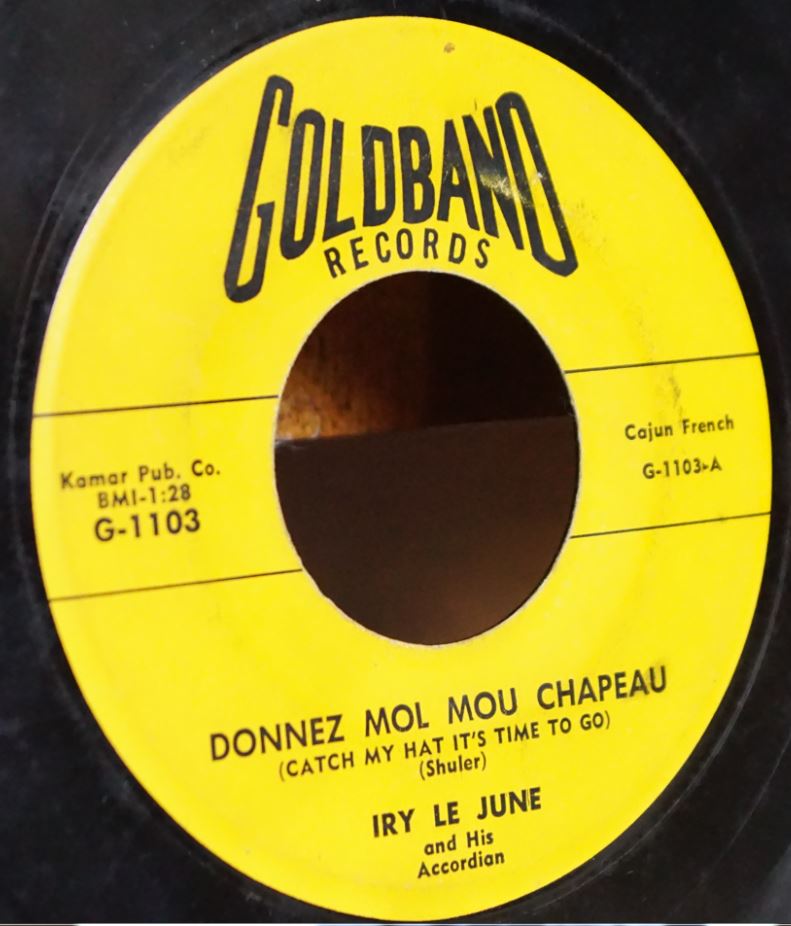
"Donnez-Moi Mon Chapeau" - Iry Lejeune


One of the most mysterious recordings of Cajun accordion player Iry Lejeune.  Nearly blind, Iry Lejeune spent his days in music and solitude.  The loneliness in his singing may have originated from his childhood.  He listened intently to the recordings of former greats, such as Amede Ardoin.  He was also greatly influenced by his relative Angelas Lejeune.2 

"Donnez-Moi Mon Chapeau" (#1102) was the same tune as "Give Me My Hat" or "Catch My Hat", made popular by the Hackberry Ramblers as the "Church Point Breakdown".  Originally, it was recorded by his older cousin Angelas Lejeune as "Petite Te Canaigh".   Leo Soileau's 1935 "Attrape-moi, Je Tombe" used the same melody. It can also be found spelled "Attrapez-moi Mon Chapeau."3 


Attrape-moi donc mon chapeau,
J'vois c'est l'heure, moi je m'en vas,
Écoutez-donc ton papa,
Mais, comme il est à peu près fâché,
Écoutez-donc ta maman,
Elle me ressemble contente,
Ton papa est sus la galerie,
Mais, moi, je l'entends après quereller fort.

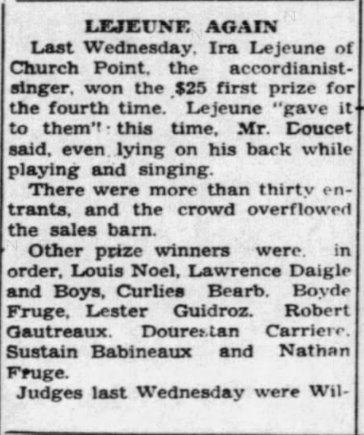
Lejeune performed regularly on Eddie Shuler's radio how on station KPLC in Lake Charles.  The station's manager objected to Iry's style, but disc jockey Shuler convinced him that Iry's accordion was riding on the wave of the future.2  Listeners demanded more of Iry and other traditional French music.  Iry's music on the radio had influences on other Louisiana music genre's, such as zydeco.  Zydeco musician Willis Prudhomme recalls:

My idols in Cajun music were Nathan Abshire and Iry LeJeune. White folks. They were playing their music on the radio, and I fell in love with it. I love French music. I listened to those guys singing, and I wanted to sing like them. Very few black people played Cajun music in them days. But I still play Cajun music. I like it a lot.1


Catch me my hat,

I see it's time, I'm going to go,

So, listen to your father,

Well, how he is a bit mad,
So, listen to your mom,
She seems to be happy,
Your father is on the porch,
Well, I hear him yelling loudly.

It is not known when or where this tune was recorded.  Iry's son Ervin thinks that "Chapeau" was a spliced-together engineering feat of Eddie Shuler since Ervin notes that Iry only sings one verse of this song. Drummer Robert Bertrand told him that Eddie--using "splicing technology"--added the subsequent sections which are a repeats of the first verse.4  Although pressed on Shuler's original yellow label, once Iry's music became popular again after his death, he re-issued the song as a "Collector's Item" on a red label.  It's one of the few pressings of Iry's music solely on 45 RPM and one of the earliest Cajun releases on this new format.  Shuler used two different publishing companies, with both issues containing misspelled titles.  Re-recorded around the same time by Amede Breaux as "Acadian Two Step", the tune has been covered by many artists such as Ambrose Thibodeaux, Sady Courville, Preston Manuel and Hadley Fontenot.


  1. https://www.theguardian.com/music/2004/mar/21/popandrock4
  2. "Iry Lejeune rescued traditional Cajun music" by Gene Thibodeaux. The Church Point News.  Oct 11, 2008.  
  3. Yé Yaille, Chère by Raymond Francois
  4. "Iry Lejeune: Wailin the Blues Cajun Style" by Ron Yule

Release Info:
Donnez-Moi Mon Chapeau | Goldband 1103
La Branche De Muriee | Goldband 1103

Find:
The Legendary Iry LeJeune (Goldband, 1991)
Iry Lejeune: Cajun's Greatest: The Definitive Collection (Ace, 2003)

Sunday, April 7, 2019

"La Fille La Vove (The Widow's Daughter)" - Iry Lejeune

One would be hard pressed today to find a Cajun band without an accordionist at its head.  But if it hadn't been for a nearly blind musician from Point Noire, the accordion would be only a museum piece in south Louisiana and Acadian music itself might be as extinct as the dinosaurs.  This style of music is still going strong years after Iry Lejuene made his recordings.1 

Eh, criminelle, 
Misérable, la malheureuse.

Oh, la fille de la veuve,
Cette-là là elle si belle et aussi aimable,
Avec toupet qui'tait aussi bien taillé,
Blâme-donc voir ta pauvre vieille maman avant ton negre

Oh, Tchic et Phine, 
T'en aller chez Madame Do Doon,
Voler les prunes dans les pruniers,
Et c'etait voir la chère fille de la veuve.


Iry Lejeune

"La Fille La Vove (The Widow's Daughter)", (#1219) followed the same traditional melody that once made "Jolie Blonde" a hit.   A cover of his cousin Angelas Lejeune's recording of "La Valse de La Veuve", it was recorded during a session with just Iry singing and playing alone.  With no band backing him up, one can hear his playing style uninhibited.  During an interview, Angelas was asked who the fille de la veuve (daughter of the widow) was.  He recalls:
She was the daughter of a man we called "Doo Doo" Matte.  She later became Mrs. Dave Ledoux (Emma Matte). But at the time the words were composed, she lived with her mother. Her father was dead. They lived in Pointe Noir.13   


Hey, it's criminal,

Miserable, terrible woman.

Oh, the widow's daughter,
That she's so beautiful and so kind,
With a forelock that was also cut well,
So, blame your poor old mother before your old man.

Oh, Tchic and Phine,
You're going to Madame Do Doon's house,
To steal the plums in the plum trees,
And that was in order to see the dear widow's daughter.


Daily Advertiser
Feb 26, 1950

After Iry's death, the interest in his music grew.   Eddie Shuler, Goldband producer, decided to start re-releasing his music on LPs throughout the 60s. However, Eddie felt necessary to modify the recordings.  He had Robert Bertrand overdub both fiddle and guitar on songs like "Vove" as well as other Goldband recordings.  Interestingly enough, if you listen carefully at around the 40s mark, you'll hear Robert Bertrand miss a note in which he startlingly exclaims "Bullshit!"

Chris Strachwitz, of Arhoolie records, regretted the day when he told Shuler that the Goldband recordings lacked "bottom" due to the primitive studio conditions.  Thereupon, Eddie proceeded to reissue many of his pristine 1950s recordings, sacrilegiously, with plodding bass guitar overdubs.2  The bass track overdubs were allegedly done by Jo-El Sonnier, and remained that way until Ace Records, re-released all of Iry's material using the original 78 RPM transfers.  According to Jo-El Sonnier,
I also played rhythm guitar and upright bass behind some Iry LeJeune recordings as well.  Again I thought I yelled loud over Iry playing and singing but I had no control to tell Eddie to [turn] my instrument's volume down as I was overdubbing over the pre-recorded tracks.  There was no bass guitar [on] the original recorded tracks but later I was asked to add my guitar rhythms and bass guitar [on] one take.4   


  1. "Iry Lejeune rescued traditional Cajun music" by Gene Thibodeaux. The Church Point News.  Oct 11, 2008.  
  2. Record Makers and Breakers: Voices of the Independent Rock 'n' Roll Pioneers By John Broven
  3. Tears, Love, and Laughter: The Story of the Acadians by Pierre Daigle
  4. Discussions with Jo-El Sonnier by Jeremy R.  
Release Info:
-1 La Fille La Vove | Goldband G-1219-1
-2 Convict Waltz | Goldband G-1219-2

Find:
Iry Lejeune: Cajun's Greatest: The Definitive Collection (Ace, 2003)

Friday, December 28, 2018

"Mes Cinquantes Sous (My Fifty Cents)" - Eddie Shuler

UPDATED! The Reveliers were a backup band for former Hackberry Ramblers guitarist and record producer, Eddie Shuler.  In the late 1940s, he had several fiddle players such as Johnny Porter, Norris Savoie, and Charlie Broussard.  Two other musicians that rounded out his group were steel guitarist Ronald Ray "Pee Wee" Lyons and bassist Johnny Babb.  For this session, Shuler's vocalist was Frankie "Tee Tee" Mailhes, a local musician in the Lake Charles area who had formerly recorded with his friends, the Alley Boys of Abbeville.  By the late 1940s, Shuler's first French music release was an attempt to capture the local Cajun music market.


Moi et ma belle on a été au bal,
C'était un samedi soir,
On en a revenu c’était lendemain,
Lendemain matin z- au jour,
J'ai demandé si elle avait pas faim pour quelqu'chose,
Elle m'a répondu (qu') elle avait pas faim,
Mais elle aurait mangé quand même.
Moi je pensais aller ordonner un lunch de quinze sous,
Elle a ordonné un poulet rôti, une demie douzaine de z"huitres,
Elle a ordonné un poulet rôti, une demie douzaine de z"huitres.

Moi, j"avais faim, mais j'avais pas le cœur de manger,
Et quand je pensais que j'avais juste cinquante sous dans ma poche,
Et quand je pensais que j'avais juste cinquante sous dans ma poche.
Et quand j'ai mis mon cinquante sous dessus le comptoir,
Il m'a foutu un coup de poing, il m'a tiré dans la fenêtre,
Il m'a foutu un coup de pied, il m'a tiré dans le chemin,
Écoutez ici, mes amis, ne vas jamais au restaurant,
Il faut jamais que tu vas dans le restaurant de cinquante sous dans ta poche.


Eddie Shuler's Reveliers
KPLC in Lake Charles
Eddie Shuler, unknown, possibly Eldrige "Coon" Guidry,
Amos Comeaux, Johnny Babb, Jimmy Webster, unknown

Recorded in mid 1946, "Mes Cinquantes Sous" (#1012) is a unique country-Cajun cover of the song "I Had But Fifty Cents", originally written as a poem in 1881 by Sam Devere and published in 1885.  It was later recorded by Riley Puckett in 1925 and the Binkley Brothers Dixie Clodhoppers in 1928.   Frankie had originally recorded the tune in 1939 as "Moi Et Ma Belle" with the Alley Boys and by 1946, brought the song to Shuler's group. It has been a well known song for years, even recorded by Ricky Skaggs, Jo-El Sonnier, and Beausoleil.


Me and my wife, we went to the ball,
It was a Saturday night,
We came back the next day,
Next morning, during the day,
I asked if she wasn't hungry for something,
She told me that she was not hungry,
But, she'd eat anyways.
I thought I was going to order a fifteen cent lunch,
I thought I was going to order a fifteen cent lunch,
She ordered a roast chicken, half a dozen oysters,
She ordered a roast chicken, half a dozen oysters.

I was hungry, but I did not have the heart to eat,
And when I realized I had just fifty cents in my pocket,
And when I put my fifty cents on top of the counter,
He punched me, he threw me into the window,
He kicked me, he pulled me into the road,
Listen here, my friends, never go to the restaurant,
You must never go to the restaurant (with only) fifty cents in your pocket.

During the early 1950s, Louis Spell and his French Serenaders would copy Shuler's recording and record "The Fifty Cent Song" for J.D. Miller in Crowley.  
By 1957, the Ethnic Folkways Library recorded the tune with Madame Marion Dugadet from Avery Island entitled "La Chanson De Cinquante Sous".


  1. Lyrics by Stephane F 
Release Info:
A Mes Cinquantes Sous (My Fifty Cents) | Goldband 1012
B Jolie Blonde (Pretty Blonde) | Goldband 1012

Tuesday, November 13, 2018

"Church Point Breakdown" - Iry Lejeune

By the end of Wold War II, Cajun music had basically devolved into western swing music sung in French.  Gone were the accordions of the 1920s, replaced by Texas-style string bands of the 1940s.  The isolation of the Acadian prairies gradually gave way and the music scene opened up to locals yearning of the good 'ole days.   After the war, many GIs wanted to hear the old music again and after Iry Lejeune recorded in 1948, a number of musicians from the old days dug out their dusty, neglected accordions form closets or attics or barns and began playing again across dance halls.1


Eh, ye yaille, malheureuse,
Tout les jours dans ma maison,
J'après, mais, t'espérer,
Eh, rappelle-toi, catin,
Ton papa et ta maman t'a toujours dit,
De pas faire ça avec ton nègre. 

Eh, ye yaille, tout les jours,
Après souffert dans ma maison,
Plus personne que vient me rejoindre,
Oh, ça me ressemble,
'Tite fille, tout les jours tu connais,
Pour venir puis voir,
Quoi faire que, moi, j'suis là?

Eh, bébé, tout les jours,
Moi, j'suis là sur ma galerie,
Après espérer, pour ton vieux nègre,
Oh, tu devrais jamais m'oublier,
Tant loin q'moi j'm'en vas te dire,
Donc, garde-donc, j'm'ennuie de toi. 


Crowley Daily Signal
Feb 9, 1950

"Church Point Breakdown" (#1096) was an ode to the town of Church Point, not far from where Iry grew up in Pointe Noire.  Iry's relative, Angelas Lejeune, was also a well-known accordionist from Pointe Noire and Iry converted his cousin's tune "Le Petite One Step" into his own.  Recorded in 1953 at Iry's home with Milton Vanicor on fiddle and Goldband producer Eddie Shuler on guitar, it's one of the few Iry releases that Eddie pressed solely on 45 RPM.  Shuler invited director Drew Ellender for this session.  His main function was to let Iry know when to start and stop and he stood behind Iry who was sitting on the floor.  Iry's son Ervin Lejeune pointed out that he was sitting on the floor, "probably because daddy had a bad habit of tapping his feet."3  


Daily World
Jan 30, 1949


Hey, ye yaille, oh my,
Everyday in my house,
Well, I'm waiting for you,
Hey, remember, little doll,
Your father and your mother have always told you,
Don't do that to your man.

Hey, ye yaille, everyday,
Suffering in my home,
No one comes to meet me,
Oh, looks to me that way,
Little girl, everyday you know,
What is that I'm doing here?

Hey, baby, everyday,
I am there, on my porch,
Waiting, your old man,
Oh, you should never forget me,
As far as I can tell you,
So, look, I am lonesome for you.


Daily World
Nov 27, 1959

It was Angelas who lent Iry his accordion to practice with while he plowed his fields and it was Iry's uncle Steven who gave the future star his first accordion.1
  But Angelas wasn't the only family influence on Iry.  Many of the Lejeunes from the area between Pointe Noire and Church Pointe were musicians.  Iry's father Agness played and Angelas' family were all musicians. When author Andrew Brown was asked to compare Iry's style against Lawrence Walker, he stated:
Iry could play rings around Lawrence Walker.  Lawrence could play some good waltzes, but when it comes to two-steps, he couldn't touch Iry Lejeune.2  


  1. "Iry Lejeune rescued traditional Cajun music" by Gene Thibodeaux. The Church Point News.  Oct 11, 2008.  
  2. Wilson Granger interview.   Andrew Brown.  2005.
  3. "Iry Lejeune: Wailin the Blues Cajun Style" by Ron Yule
Release Info:
-1 La Valse (Dalse) de Bayou Chene | Goldband G-1096-1
-2 Church Point Breakdown | Goldband G-1096-2

Find:
The Legendary Iry LeJeune (Goldband, 1991)
Iry Lejeune: Cajun's Greatest: The Definitive Collection (Ace, 2003)

Sunday, September 2, 2018

"La Valse De Bayou Chene" - Iry Lejeune

Iry Lejeune sang the story of his people, and made them remember who they were.1 The traditional Cajun music would resurface first in his recordings, a young accordion player and singer from the Pointe Noire area of Acadia Parish.  Iry Lejeune became a pivotal figure in a revival fueled by the return of homesick GIs seeking to soothe their soul.2

Iry, who drew heavily from the recorded repertoire of Creole musician, Amede Ardoin and who died at twenty-seven in a car crash in 1955, along with Ardoin is one of the most storied figures in Louisiana French music.3 One of many Ardoin recordings he resurrected was "Valse Des Opelousas" in which was retitled as "La Valse De Bayou Chene" named after a small bayou south of Welsh in Jeff Davis Parish.  After recording the tune for Eddie Shuler's Goldband records, it later became the "Duson Waltz" by Aldus Roger and much later, the "St. Landry Waltz" by Austin Pitre.


O, catin, comment tu veut que moi je m'en vais tout seul,
O, mon nèg, à pas être capable d'aller me rejoindre,
O, bébé, mon j'ai pris et je roulaillé,
Quo faire tit monde c'est dur comme ça d'être dans ma maison.


O, catin, tu m’avais dit que tu pouvais pas me marier,
O, d’autre que toi moi je va’s plaider à tes parents,
O, catin, t’as passé dimanche après-midi,
T’as passé pour me donner ta main, t’as parti en pleurant.


O, catin, c’est les dernières paroles que je veux dire,
Je savais c’est juste rapport à ta famille qui veut plus de moi,
Oh, ye yaille, c’est pas la peine que moi je reste comme ça,
Tout le temps dans les misères à pas être capable, être capable t’avoir.

At his home, he was accompanied by Milton Vanicor on fiddle and Eddie Shuler on guitar. Although venerated for his accordion skills, it is Lejeune's singing that draws the strongest superlatives from writers--that it can "bite and burn and blister the heart" and "encompassed all the pain, loneliness, and hardship of the isolated praire farmers".3  In 1955, leaving the Green Wing Club, he caught a ride home with Lake Charles fiddler J.B. Fuseilier.  As the two men were fixing a flat tire, another car plowed into them.  Fusilier lived but Iry was not so lucky.
Lake Charles American Press
Oct 9, 1955

If this young traditionalist had not appeared when he did, Cajun music would have drowned in the American melting pot of assimilation.1  The late Acadia Parish author Pierre Varmon Daigle wrote:


In [Iry's] music is all the cruel loneliness of our Cajun history.  Not only the loneliness at the time of our exile, but the later years of poverty...It's all there in the music of this almost blind man.  It's there like a dirge, as lonesome as the howl of a March wind around the house at night.  There is his greatness. The feeling , the heart of his music reaching like fingers to your heart.1


Oh, pretty doll, how do you want me to do this all alone?
Oh, my friend, you're not capable of going to join me,
Oh, baby, my I picked up and I roamed around,
What's done, my little everything, it's hard like that to be home.

Oh, pretty doll, you told me you could not marry me,
Oh, other than you, I'm going to plead with your parents,
Oh, pretty doll, you passed by Sunday afternoon, 
You passed by to give me your hand, you left crying.

Oh, pretty doll, this is the last words I want to say,
I knew it's just related to your family, who wants more from me,
Oh, oh my, it's not worth it, for me to stay like that,
Always in misery to not be able, to be able to have you.


  1. "Iry Lejeune rescued traditional Cajun music" by Gene Thibodeaux. The Church Point News.  Oct 11, 2008.  
  2. Cajun Music: Origins and Development by Barry Jean Ancelet
  3. Cajun and Zydeco Dance Music in Northern California: Modern Pleasures in a ... By Mark F. DeWitt
  4. Lyrics by Francis M


Find:
The Legendary Iry LeJeune (Goldband, 1991)
Iry Lejeune: Cajun's Greatest: The Definitive Collection (Ace, 2003)