Showing posts with label Milton Pitre. Show all posts

Monday, August 19, 2019

"The Swallows" - John Bertrand

John Bertrand was born near Opelousas, more in the mainstream heart of the Cajun landscape, and the same can be said of his music, with its highly rhythmic accordion accompaniment.  In terms of repertoire, though, the common factor is that several of his songs, many of which he appears to have learnt from his mother, would also seem to show Old World origins.1    


Oh, ouais, partout que j’aime, ces lis donc me conviennent pas,

La seule que mon cœur aime, elle est si loin de moi,

Et si j’aurais des ailes, comme tous ces hirondelles, 
Aupres de toi la belle, j’irais me reposer.

En te contant mes peines, et ensuite mes amities.

Apportez-moi une verre, que je boive à la santé,
Ina-t-une bouteille que j’aime, que je boive sans la nommer,
Il y’en à qui aime la blonde, et d’autre qui aime la brune,
Mais moi j’sus pas comme çà, j’aime bien mais tout les deux.

Comment tu veux je fais, pour aller bien tout les deux?

Crowley Daily Signal
Mar 15, 1929


In 1929, Bertrand and his guitarist Milton Pitre traveled to Chicago and recorded "The Swallows" (#12730).  But by the time the recordings had arrived on the shelves, Pitre had been shot and killed in a dispute over a woman.  According to Ray Templton,
The Swallows, for all its English title, is surely an old traditional French song.  Bertrand’s records all featured guitar accompaniment by one Milton Pitre.  His playing is rather odd – he seems to be repetitively plucking single or double strings rather than playing chords.  He doesn’t always hit the right harmony, but that may just have been recording session nerves, and most of the time it’s quite effective.1  
John H. Bertrand


Oh, yeah, everywhere I like (to be), I don't find comfort in the beds,

The only one that I love in my heart, she is so far from me,

And if I had wings like all these swallows,
Beside you, beautiful one, I would go and rest.

Tell you my sorrows, and then my friendships,
Tell you my sorrows, and then my friendships.

Bring me a drink, that I'll drink to health,
There's a bottle that I like, that I'll drink without saying her name,
There are some who love blondes, and others who love brunettes,
Well, me, I'm not like that, I love, well, both of them.

How do you want me to go with both of them?

Known as "Oh, Si J'aurais des Ailes", it was recorded in 1934 by Alan Lomax by Sansey Bonnet of Crowley.   Later, in 1977, Loricia Guillory also recorded the song for Gerard Dole in Mamou. 


  1. https://oldtimeparty.wordpress.com/2012/08/07/early-american-cajun-music/
  2. Lyrics by Smith S and Stephane F
Release Info:
21077-5 The Swallows | Paramount 12730-A
21074-1 The Rabbit Stole The Pumpkin | Paramount 12730-B

Find:
John Bertrand / Blind Uncle Gaspard / Delma Lachney Early American Cajun Music (Yazoo, 1999)

Wednesday, September 26, 2018

"Cousinne Lilly" - John Bertrand & Milton Pitre

Right before the Depression took hold, major recording labels wanted a piece of the action that Columbia had engaged in down in south Louisiana.  By the beginning of 1929, other companies like RCA, ARC and Paramount were busy hunting down Cajun musicians in the prairies and sending them to their studios up north.  Two of those musicians were John Homer Bertrand and Milton Pitre.  

La plus vielle de la bande, mais, c'est la plus vaillant,

C'est la plus contente, elle a les yeux canailles,

Mais, dis pas à ta mom, mais, j'ai goutté ton bec,

Mais, dis pas à ton pop, mais, si j'ai pas la bonne tête,

C'est la mienne, mais, au péril de la vie,

Chère cousinne, mais, donne-moi, donc, celle-là
Mais, si c'est pas celle-là moi, j'en veux pas du tout,
Petit galop, mais, pour la Pointe au Pin.


John Bertrand

Bertrand was a blacksmith from the area around Opelousas known as Prairie Ronde.  Together with Milton Pitre, they traveled to Chicago, IL and recorded "Cousinne Lilly" (#12725).   It's most likely that John was singing about the courtship, and eventual marriage, of his brother Eddie to their second cousin, Lillian Joubert.   In the song, he repeats the same verse, changing the placement of the line "petite galop" from the end to the middle.  A "petite galop", or "small gallop", refers to the typical three-beat gait of a horse; also known as a canter. 

The oldest of the group, well, is the most sociable,

She's very calm, she has mischievous eyes,

Well, don't tell your mom, well, I kissed your lips,

Well, don't tell your dad, well, unless you don't have a good mind,

She's mine, well, bet your life,

Dear cousin, well, give her to me, that one,
However, if that one's not mine, I don't want anything,
Let's canter, well, to Pine Point.

Given the lack of Paramount's Cajun releases found in Louisiana, it seems the company missed out on an opportunity.   It's quite possible that Paramount failed to adequately distribute the bulk of this music in the south and struggled to improve sales.  Nevertheless, "Cousinne Lilly" remained a popular tune throughout the Cajun prairies and by 1964, fiddler Adam Hebert scored one of his most well-known versions for Swallow records entitled "La Pointe Aux Pins".


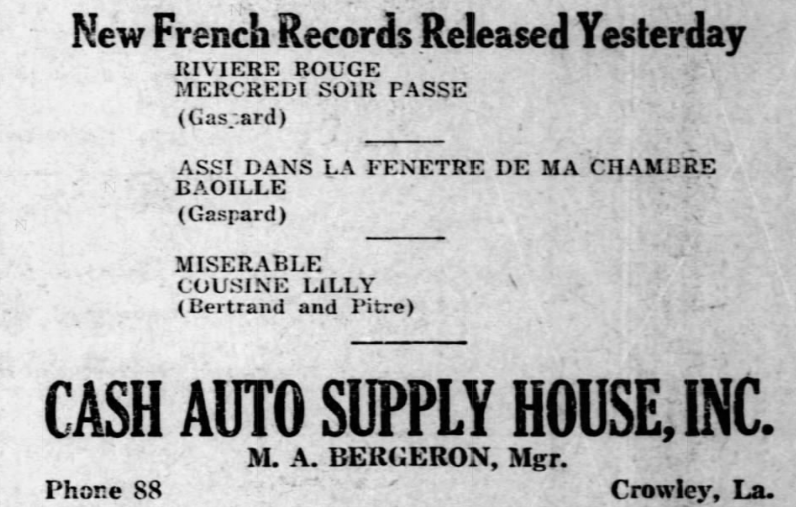
Crowley Daily Signal
Feb 22, 1929


  1. Lyrics by Stephane F

Release Info:
21076-1 Cousinne Lilly | Paramount 12725-A
21075-2,-3 (La Valse De) Miserable | Paramount 12725-B

Find:

Early American Cajun Music (Yazoo, 1999)
The Rise & Fall of Paramount Records: Volume Two, 1928-1932, CD G (Third Man, 2014)

Friday, October 2, 2015

"The Rabbit Stole The Pumpkin" - John Bertrand & Milton Pitre

Children's songs can be some of the most inspirational pieces of music passed on through generations.  One of the most influential instrumentals floating around the Cajun prairies would be recorded by an almost obscure duo.  Recorded by John H. Bertrand and Milton Pitre, it would influence one of the earliest versions of the melody which became Iry Lejeune's "J'ai Ete Z Au Bal" and be the sole influence for Lawrence Walker's "Johnny Can't Dance".   

The duo traveled to Chicago in 1929 when Paramount decided to bring more blues to their recording studio.   The song, "The Rabbit Stole The Pumpkin" (#12730), was based on a children's tune that Lawrence Walker remembers hearing played as child.1
Later that same year, it was recorded separately as "J'vai Jouer Celea Pour Toi (I'll Play This For You)" by Bixy Guidry and during the mid 1930s as "Ne Buvez Plus Jamais" by Joe Falcon.

While there are some similarities with Iry Lejeune's "I Went To The Dance"; covered by countless Cajun musicians, it would be Lawrence Walker's "Johnny Can't Dance" that would take the melody and popularize it for all time.  Much later, Rick Michot would write lyrics to the song, calling it "Le Lapin a Volé Le Giraumon"2


Crowley Daily Signal
Mar 15, 1929


  1. Ye Yaille Chere, Traditional Cajun Dance Music by Raymond E. Francois
  2. http://tcmichot.wix.com/lesfreresmichot#!liner-notes-from-cds/cqu0
Find:
John Bertrand / Blind Uncle Gaspard / Delma Lachney Early American Cajun Music (Yazoo, 1999)
The Rise & Fall of Paramount Records: Volume Two, 1928-1932, CD G (Third Man, 2014)