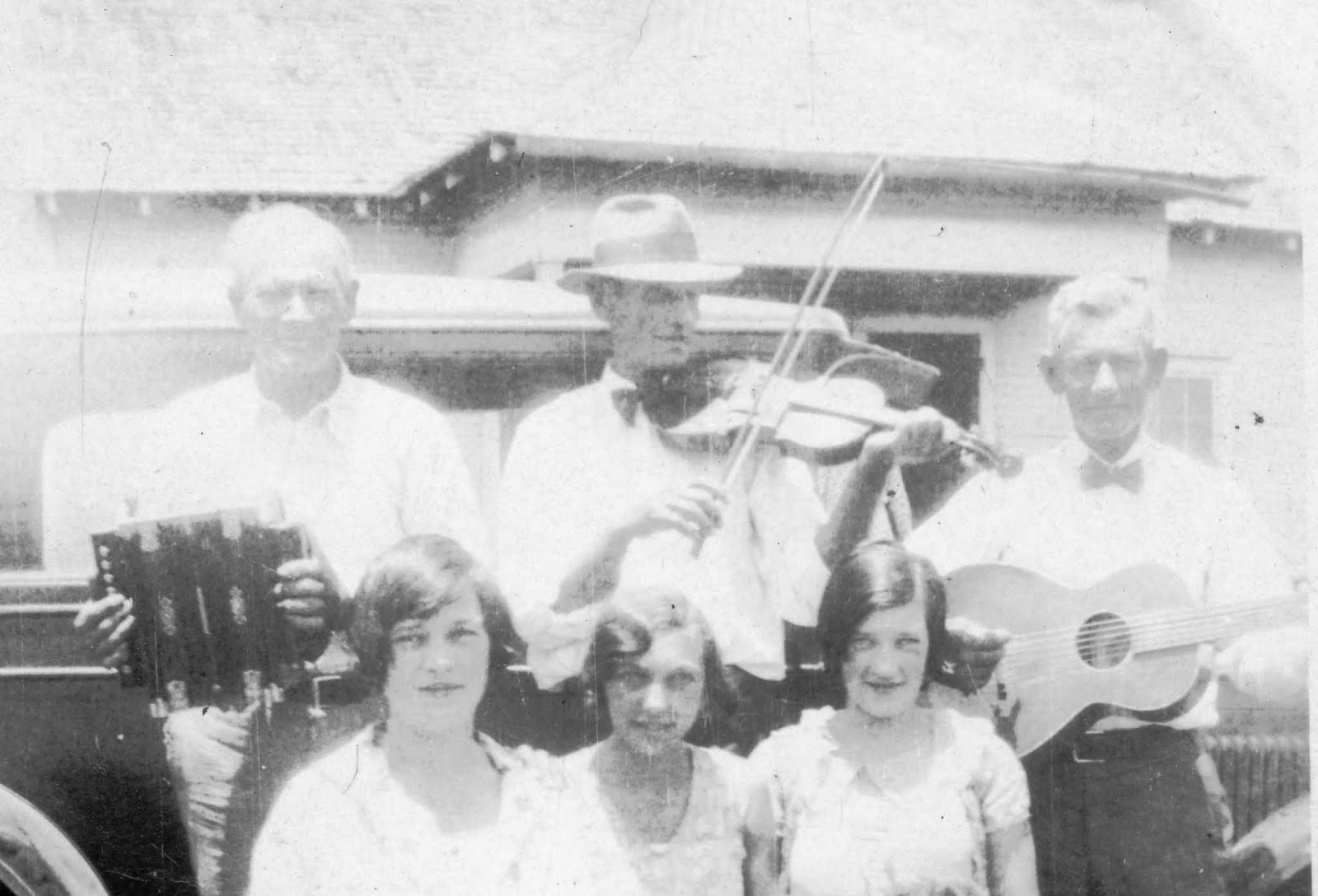
Showing posts with label Vocalion Records. Show all posts

Tuesday, January 19, 2021

"La Valse De Pecaniere" - Leo Soileau & Moise Robin

Evangeline Parish native Leo Soileau made his first recordings with Mayuse Lafleur for Victor records in 1928.  Shortly afterwards, Lafleur was killed.  After Leo lost his partner, he asked Maxine Ledoux to take over the accordion duties again at the dance-hall.5  Meanwhile, Leo tried to reinvent the sound he had forged with his childhood friend by hiring seventeen year old accordionist and LaFleur-admirer Moise Robin.  The two began playing once Robin could mimic the stylings of Lafleur.  Robin recalls:
I saw Mayuse play a house dance for the Richard family in Pecaniere.  It was Christmas day.  I was five years younger than he was and he inspired me.  He had a big red accordion and he would cry on that thing.2  

Malheureuse, je t’ai demandé pour tu veins mais avec moi, 
C’est finir tes bons jours avec ton negre,
Dit bye bye, chère, dit bye bye, mais chers amis, 
Mais pour t’en venir, pour venir, un bon jour, chère.

Chere tit fille, (donc, jamais tant par ce que)* pour t’en venir 
Avec ton neg, là-bas, là-bas à la maison, yé yaille. 

Oh, mom, malheureuse, oh.

Oh yé yaille, comment-donc, mais, moi j’vas faire, mais, moi tout seule?
J't'veux promenner-z-avec ton nèg, oh chérie.
Mais, écoute pas tes paroles pour tes amis, mais malheureuse, 
Ils vont pleurer s’ils les écouteraient, chère.

Silver Slipper
Courtesy of LouisianaDanceHalls.com

The 1929 New Orleans recording "La Valse De Pecaniere" (#15852) is an ode to the community of Pecaniere in St. Landry Parish.  Located between the towns of Port Barre and Arnaudville, Pecaniere was originally named Prairie Gros Chevreuil.  It was founded by one of Moise's earliest colonial French ancestors, Dr. Francois Robin, and was renamed after large pecan groves in the area.6  

Moise's melody found it's way into other songs that year such as Bartmon Montet & Joswell Dupuis's  "L'Abandonner (The Forsaken)" and  Amede Ardoin's "La Valse A Abe".  During the 1920s, Pecaniere was home to a popular dance-hall called the "Silver Slipper" owned by the Dupuis Brothers, Herman and Clayton.4  Moise recalls:
When I was young, Amede Ardoin was playing with Leo Soileau at my brother-in-law's Pecaniere dance hall and he would bring crowds that the people couldn't come in.1  
Clarion News
Oct 10, 1929


Poor woman, I begged you to come back, well, with me,
It's the end for your good days with your man,
Say "Bye bye", dear, say "Bye bye", well, dear friends,
Well, for you're coming back, coming back, it's a good day, dear.

Dear little girl, so, never believed that you'd come back,
With your man, over there, over there to the house, ye yaille.

Oh, ye yaille, so, how, well, will I handle this, well, all alone?
I want you to walk with your man, oh dearie.
Well, I won't listen to your words (you told) your friends, well, poor woman,
They would cry if they heard, dear.

Post-war zydeco musician Clifton Chenier, who grew up next to the Silver Slipper in Pecaniere, recalled the segregated "two-room dance club".  Chenier would perform on the white side of the club one week, and for the black side the next.3  


  1. http://arhoolie.org/moise-robin/
  2. Cajun Breakdown: The Emergence of an American-Made Music By Ryan Andre Brasseaux
  3. The Kingdom of Zydeco By Michael Tisserand
  4. Daily World (Opelousas, Louisiana) 09 Sep 1977
  5. The Ville Platte Gazette (Ville Platte, Louisiana) 21 Nov 1985
  6. Discussions with Fr. Jason Vidrine
  7. Lyrics by Smith S

Release Info:
NO263 La Valse De Pecaniere | Vocalion 15852
NO264 Le Cleuses De Negre Francaise | Vocalion 15852

Find:
The Early Recordings of Leo Soileau (Yazoo, 2006)

Wednesday, November 11, 2020

"Myself" - Dennis McGee & Sady Courville

Dennis McGee, regarded as the "Dean of Cajun fiddlers", kept the older Acadian fiddle sounds of the 1800s alive almost into the 1990s. He was one of the earliest Cajun fiddlers to be recorded.3  According to record producer Chris King:
Getting really obsessed with how the Cajun music can affect you so deeply, I got really curious on how McGee did it. Because, not only does he do it to me, but he does it to others.  And I was wondering 'What the hell he was doing?'1  


Dis, "Bye bye" à ton papa, ta maman, mais, t'en aller, malheureuse, 

Dis ,"Bye bye", t'(es) après t'en aller,

Avec mon bien aimé, pour toujours, mais, (chére*) Joline, malheureuse, 

Dis, "Bye bye", dis, 'Bye bye" à ta maman.


J'(suis) après m'en aller, m'en aller avec mon nég', malheureuse, 
Eh, dis "Bye bye" à ton pap et ta maman, 
Pour toujours nous en aller, s'en aller, mais, là joline, 
M'en aller avec mon bien aimé pour toujours et finir mes jours.


Eh, t'es jolie, t'es mignonne et t'es bien (ai)mable, malheureuse,
Eh, t'es jolie, t'es aimable joli cœur. 
Fais pas ça, ça fait moins cœur, ah oui, m'en aller,
Z-avec tous mes chagrins, malheureuse, dis "Bye bye".

(Re)gardez-donc, mais, joli cœur, comment-donc, mais, moi j'vas faire, 
Dis après me quitter par la faute à ta maman,
Oh, yéyaie, chérie, malheureuse, 
Mais, (re)gardez donc, j'vas m'ennuyer de toi.

Sady began playing music on the violin since the age of 16 when his father quit playing.  He played with Dennis for about eight years straight.6  Before the Dennis McGee and Sady Courville ever recorded, they were invited to play on KWKH in Shreveport in 1927 as part of a promotional campaign for Cajun music.  Courville recalled the Shreveport event:
Eunice News
Mar 22, 1929

There was an old man in the community who was always promoting different things. First of all, he got us to go to Shreveport to broadcast on the radio. "Old man Marks".  He was a sort of leader, you know.  He did a lot for the Boy Scouts and different things. So he asked Dennis and me to go to Shreveport. That was the closest broadcasting station around here outside of New Orleans.  So we went over there and broadcasted and we came back over here. That was about 1927.4 

In 1929, they were approached by Sady's employer, a local furniture store owner named Mattius "Mat" Fruge, to record in New Orleans.  Fruge had originally began as a door-to-door milkman as a boy.  After receiving education in Texas, he fought in WWI and returned to Eunice working in a cotton gin.  By 1924, he became manager, and later owner, of Teer Furniture Company where Sady worked as an assistant. It becomes Fruge's phonograph and record distribution connections to companies such as Okeh, Brunswick and Vocalion which provide Dennis and Sady's first recording opportunity.   Courville recalled carrying his fiddle to New Orleans in a flour sack.7  

Dennis McGee and Sady Courville


Say, "Bye bye" to your dad (and) your mom, well, you're going, oh my,

Say, "Bye bye", you're going to go,

With my beloved, forever, well, (dear*) Joline, oh my,

Say, "Bye bye", say "Bye bye" to your mom.


I am leaving, I'm going away with my man, oh my,
Hey, say "Bye bye" to your dad and your mom,
Always, we're going, going to go, well, over there, Joline,
I'm going away with my beloved forever and live out my days.

Hey, you're pretty, you're cute and you're sweet, oh my,
Hey, you're pretty, you're sweet, pretty sweetheart,
Don't do that, that's heartless, oh yeah, I'm going,
With all my sorrows, oh my, say, "Bye bye".

So look, well, pretty sweetheart, so how, well, will I handle this,
Told you I'm leaving because it's your mother's fault,
Oh, ye yaille, dearie, oh my,
Well, so look, I'll miss you.


Eunice News
Apr 14, 1927

McGee's tune "Myself" (#5348), with Sady Courville on second fiddle, represented the story of most of his recordings, a lover discussing leaving her mother to be wed.  Sady never recorded for a major label again however, he continued to be Fruge's top salesman throughout the 1930s.5  He played his last dance in Lacassine in September of 1929 and didn't pick up playing music again until 1968.6  Dennis McGee continued his commercial recording career, performing and recording with black accordionist Amede Ardoin in the late 1920s and early 1930s in the first racially mixed duo. Their music laid the groundwork for the style and repertoire of Cajun music as we know it today.3  In the 70s, the duo reunited for a series of field recordings as well as a studio session at Swallow records in Ville Platte. 

"Myself" is done in a different tuning, GDAG, which according to folklorist Will Spires was a popular tuning for old dances in the key of G. Both the fiddle and the vocal wail out on this number and Dennis displays his effortless high, piercing singing.8 It still resonates with musicologists today. According to record producer Chris King:
When you listen to this really closely, he's tuned wayyyyy low.  That's the thing about McGee that when he would go and record something, where as most people would keep their fiddle in standard or they might cross-tune, he re-tuned his fiddle for every piece he performed, because he realized, by changing the pitch this much, or increasing the pitch this much, it affected people in this particular way.1


  1. Vinyl Asides Episode 8 - Christopher King
  2. https://oldtimeparty.wordpress.com/2014/06/18/himself/#more-10194
  3. J'ai Ete Au Bal Vol. 1.  ARhoolie CD 331.  Liner notes.
  4. Ye Yaille Chere by Raymond Francois
  5. The Eunice News (Eunice, Louisiana) 14 Sep 1934
  6. The Eunice News (Eunice, Louisiana)12 Jun 1973
  7. The Ville Platte Gazette (Ville Platte, Louisiana) 07 Jan 1988
  8. Dennis McGee ‎– The Complete Early Recordings.  Liner notes.
  9. Lyrics by Stephane F

Release Info:
NO-110 Myself | Vocalion 5348
NO-111 Vous M'Avez Donne Votre Parole | Vocalion 5348 

Find:
Dennis McGee ‎– The Complete Early Recordings (Yazoo, 2006)

Friday, October 16, 2020

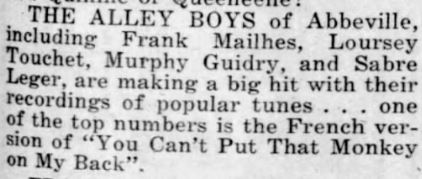
"Tu Peus Pas Me Faire Ce (You Can't Put That Monkey On My Back)" - Alley Boys of Abbeville

While traditional Cajun music began to take a backseat to western Texas swing and big band jazz orchestras, a handful of Cajun musicians from Abbeville landed a spot on KVOL performing some of their favorite jazz tunes as a string band group in 1938.  Lead by Sidney Guidry on vocals and guitar, he and fiddler Frankie Mailhes formed the group called the Alley Boys of Abbeville.  Named after the street in which they rehearsed frequently, it consisted of Murphy Guidry on guitar, Lourse Touchet on steel guitar and Maxie Touchet on drums. 


Tu peux pas me faire accroire que ca c'est tout vrai,
Tu peux pas me faire accroire la neige est noire,
Tu peux m'dire y'a un ouragan quand le soleil est bien chaud
Mais, tu peux pas m'mettre ce macaque sur mon dos.

Tu me quittes moi seul presque tous les jors,
Et tu vas ici et là-bas avec un et l'autre,
Après toi t'as été amuser, tu dis moi j'suis le seul,
Mais, tu peux pas m'mettre ce macaque sur mon dos.

J't'ai vue a un café avec un autre,
Et tu m'as dit t'avais été juste visiter,
Et c't'homme c'était ton cousin, mais, ton cousin il est mort,
Ca fait tu peux pas m'mettre ce macaque sur mon dos.

Tu m'as dit t'avais ete voir ta grand maman,
Mais, ta grand maman reste pas l'autre bord du ch'min d'fer,
Ecoute ici c'est une autre chose, je donne pas de bague en argent,
Ca fait tu peux pas m'mettre ce macaque sur mon dos.

Tu m'aimes quand j'ai un tas de l'argent,
Mais la l'argent est court les visites sont rares,
Tu m'as dit ca aurait ette vrai, mais, j'connais ca tu vas faire,
Ca fait tu peux pas m'mettre ce macaque sur mon dos.

J'ai dit mon dernier "Bonjour" et la j'men vas,
Mon vieux linge, mes souliers j'vas emporter,
Parce que tes cousins y rient c'est exu, ca après m'tuer,
Ca fait j'ai après tout m'mettre ce macaque sur mon dos.


Abbeville Meridional
Nov 18, 1939

Recorded at the Gayoso Hotel, Memphis, TN in 1939, the Alley Boys performed their Cajun rendition of the song "You Can't Put That Monkey On My Back" entitled "Tu Peus Pas Me Faire Ce" (#05058).  The song is a popular tune first recorded by the Shelton Brother the previous year in 1938 and then again in 1939 for Decca records.  The tune was composed by Marshall Walker and written by Hy Heath. It was also made popular by the jazz musician Frankie "Half Pint" Jaxon the same year. 

You can't make me believe that's all true,
You can't make me believe the snow is black,
You can tell me there's a hurricane when the sun is shining,
Well, you can't put that monkey on my back.

You leave me alone almost every day,
And you go here and there with one and another,
After you have your fun, you tell me I'm the only one,
Well, you can't put that monkey on my back.

I saw you at a cafe with another,
And you told me you were just visiting,
And this man was your cousin but your cousin, he died,
You can't put that monkey on my back.

You told me you had been to see your grandma,
But, your grandmother does not stay on the other side of the iron road,
Listen here, another thing, I'm not giving a silver ring,
You can't put that monkey on my back.

You love me when I have a bunch of money,
But the money is short, visits are rare,
You told me that would have been true, but, I know what you're going to do,
You can't put that monkey on my back.

I said my last "Good day" and I'm going,
My old laundry, my shoes, I'll take them, 
Because your cousins ​​laugh at them, it's over, it's killing me,
I did, after all, put this monkey on my back.


Later the recording would be covered by other musicians such as Riley Puckett and Hank Thompson.  
According to David Savoy, 
My grandfather played steel guitar on this classic track. But his name is misspelled above. It's actually Lourse Touchet (pronounced "Lauw-us" but everyone called him "Mockay" anyway). He was an awesome man and musician. The Alley Boys came to end due to WWII. A cannon fired in close vicinity to my grandfather during the war and he lost hearing in one ear. He gave up music from that point but I still remember that beautiful steel guitar always hanging in his closet.2  


  1. Lyrics by 'ericajun'
  2. Discussions with David Savoy

Release Info:
MEM-9-1 Tu Peus Pas Me Faire Ce (You Can't Put That Monkey On My Back) | Vocalion 05058
MEM-6-1 Se Toute Sain Cinne Moi Ma Saine (I Wonder If You Feel The Way I Do) | Vocalion 05058

Find:
Cajun Country, Vol. 2, More Hits from the Swamp (JSP, 2005)
Cajun Capers: Cajun Music 1928-1954 (Proper, 2005)
The Best Of Cajun & Zydeco (Not Now, 2010)
The Very Best of Cajun: La Stomp Creole, Vol. 1 (Viper, 2016)

Wednesday, June 17, 2020

"One Step De Chupic" - Dennis McGee

There are nonsense songs in Cajun music and some happy drinking songs in Cajun music though most of the songs are about tragedy and love lost. Dennis McGee along with Ernest Fruge performed a few numbers with happy lyrics like "Allons a Tassone" and "Adieu Rosa" but most of his tunes are sad and lonely.  The melodies sound happy and lilting but the words are quite depressing, like the "One Step de Chupic" (#15851).2  


La-la-la-lah-la-da-la-la-doh-la,

La-la-la-la-la-da-la-da-la-da,

'Gardez-donc, la belle, 
Elle est après s'en aller.

La-la-la-la, t'ai pas ave(c)'moi,
Va pas changer avec un autre qu'est loin,
Malheureuse, j'ai dit, mais, 'gardez-donc la belle.

La-la-la-la-la-da-doh-da-doh,
La-da-doh-da-doh-doh-loh-de-doh.

Doh-de-la-doh 'gardez-donc la belle,                    
Elle est après s'en aller avec un autre que moi,
Mais, malheureuse chérie, mais, fais pas donc, la belle,
'Garde-donc, chérie.

Aye yé yaille, comment j'vas faire,
Toujours mon t'seul comme une pauvre malheureuse,
Mais, chère que tout, mais, fais pas ça avec moi,
Malheureuse, la belle.


Recorded in New Orleans in the fall of 1929, Dennis put together a sorrowful story against a cheerful melody, interjected with lyric less chorus lines singing "la-la-la-la".   This style of singing could be used to evoke emotions or even memories in listeners that couldn't be put into words or ones that weren't terribly specific. It allows the listener's mind to wander where it will, guided by the singer, but not forced into a specific narrative.  In the lyrical portions, the lover tells his love interest to "Watch it!" because of the mistakes she's making.


Choupique fish

It's quite possible that this is a story of a lost lover from his home town of Choupique, Louisiana; a community named after local fish variety (the bow fin).     Dennis explains the name growing up in the community:
I was raised in Choupique. I lived there from the age of four until I was fourteen years old. When you go to Chataignier, you cross a little stream called La Coulee Choupique. There were many choupiques in that time. An some big ones! They were three feet long!  I caught many on my line when I was young.1  
Dennis McGee


La-la-la-lah-la-da-la-la-doh-la,

La-la-la-la-la-da-la-da-la-da,

So look, the beauty,
She's leaving.

La-la-la-la, you ain't with me,
Nothing will change with another that is far away,
Miserable one, I said, well, watch it, beautiful one.

La-la-la-la-la-da-doh-da-doh,
La-da-doh-da-doh-doh-loh-de-doh.

Doh-de-la-doh so look, the beauty,
She's leaving with someone other than me,
Well, miserable dearie, well, don't do it, beautiful one,
Watch it, dearie.

Aye yé yaille, how will I handle this,
I'm always alone, like a poor wretch,
Well, dear, all that, well, don't do that with me,
Miserable beauty.


  1. Ye Yaille Chere by Raymond Francois
  2. Dennis McGee ‎– The Complete Early Recordings.  Liner notes.
  3. Lyrics by Stephane F and Smith S


Release Info:

NO-236 Valse Du La Penitencier | Vocalion 15851
NO-237 One Step De Chupic | Vocalion 15851

Find:

Cajun Capers: Cajun Music 1928-1954 (Proper, 2005)
Dennis McGee ‎– The Complete Early Recordings (Yazoo, 2006)

Monday, March 16, 2020

"La Valse Du Mariage" - Guidry Brothers


When early Cajun music artists are discussed, rarely does the location of St. Martin parish come to mind.  However, it would take an obscure group from the Anse La Butte area to record one of the more amiable marriage songs in the Cajun bayou.  Shelton Devillier, grandson of Dosete Guidry, remembered asking his grandfather the name of their band. Dosete replied, “Guidry Brothers!”  All of the brothers in the Guidry band played multiple instruments. Shelton, stated, 
Dosete loved the violin. That was his favorite. He played the accordion. He played the mandolin.1 


C'est dans un petit village, j'ai rencontré une jolie brune,
J'ai commencé lui faire l'amour, elle m'a montré ses amitiés,
J'ai aussi parlé du mariage, elle m'a donné-z un contentements,
Cela m'a mis beaucoup content et remplit mon cœur de joie.

(yodel)

Chere amie, si t'es pareille, on va aller dedans l’église,
Se présenter devant l'autel et le prêtre nous mariera,
Le contrat sera passé, et le billet se signera,
Et ton cœur sera pour moi et mon cœur sera pour toi.

(yodel)

Arthur Guidry, Dosete Guidry, Isidore Guidry

Something wonderfully unique is their recording of "La Valse du Mariage" (#15864), an alternate take on a Cajun wedding march. Different from the more popular "La Marche de Mariés", it speaks of the joy of meeting a pretty girl and wishing to get married at the altar.  Unlike many Cajun songs that discuss the fears of leaving behind the single life, the Guidrys sing of a lover excited to marry his longtime love interest.  According to record producer Christopher King,
I like the marriage waltz. If I could travel back to the 1880s in southwest Louisiana, I could imagine having heard this at a common plantation wedding.1   


In a little village, I met a pretty brunette,
I started flirting, she shared with me her friendship,
I also talked about marriage, she gave me a commitment,
It made me very happy and filled my heart with joy.

(yodel)

Dear friend, if you'd like, we'll go inside the church,
Go to the altar and the priest will marry us,
The contract will be passed (around), and the record will be signed,
And your heart will be for me and my heart will be for you.

(yodel)


  1. "Breaux Bridge At Center of 90-Year-Old Cajun Music Mystery".  Wade Falcon.  Teche News.  2019. 
  2. Lyrics by Stephane F and Jordy A

Release Info:
NO-242 Le Garcon Chez Son Pere | Vocalion 15854
NO-243 La Valse Du Mariage | Vocalion 15854

Find:
Cajun Country, Vol. 2, More Hits from the Swamp (JSP, 2005)

Tuesday, October 15, 2019

"Valse des Vachers" - Dennis McGee & Ernest Fruge

Waltz of the Cowboys!  It was during this period, just after the turn of the century, that the stock repertoire of Cajun and Creole music took shape, based on a blend of influences from French, Acadian, Spanish, German, Native American, Scotch-Irish, Anglo-American, and Afro-Creole traditions.  "Valse des Vachers" (#15848), for example, recorded in 1929, is a bluesy description of the life of a cowboy sung in French to the tune of an Old World mazurka.2,3  According to record producer Christopher King:


This is essential since mazurkas, polkas, gallopades, varsoviannas,  and cotillions held a strong place in the early Cajun fiddle and dance repertoire but became less popular with the introduction of the diatonic accordion.1  


Malheurese, j'attrape-moi mon cable et mes éperons,

Pour moi aller voir à mes bêtes,

Mon cheval est selle, c'est malheureux de m'voir,
M'en aller moi tout seul ma chérie!

C'est malheureux de m'voir m'en aller au si loin,
Moi tout seul pour trouver que' chose que j'peux pas,
Perdu mais dans l'bois, malheureuse.

(Dit) 'bye-bye,' chérie, ma chérie, chère,
Dans les chemins, chère, moi tout seul, yaille,
Comment je va' faire, malheureuse, yaille?
Toujours, moi tout seul, malheureuse, chérie.

Ma chérie, viens-donc me r'join', chère!
Au si loin que moi j'sus de toi, belle!

Welsh, LA, 1915
Courtesy of 
Louisiana Sea Grant Digital Images Collection

Cajuns in the prairies had a strong relationship with cattle culture, specifically working alongside black Creole cowboys.  Creole cowboys helped manage thousands of cattle in pre-Louisiana Purchase days of southwest Louisiana and led cattle drives to keep New Orleans fed.  Cowboys found themselves moving their livestock from San Antonio and Dallas to Opelousas and further to New Orleans.   Following an ancient cattle trail along a highway known as the Old Spanish Trail, both Dennis McGee and Ernest Fruge recorded this song in New Orleans in 1929. Some musicians sing about going out to find their belle instead of bêtes.  


Oh my, catch me my rope and my spurs,

For I'm going to go see about my cattle.

My horse is saddled, it's sad to see me,
I'm going all alone, my dearie.

It's sad to see me going away so far,
I'm all alone to find something that I can't have,
Lost, well, in the woods, oh my.

Say "bye bye" dearie, my dearie, dear,
On the roads, dear, i'm all alone, yaille,
How will I handle this, oh my, yaille?
Always, I'm all alone, oh my, dearie.

My dear, so come rejoin me, dear,
So far that I've been from you, beautiful one.


Dennis, like many fiddlers of traditional American music, liked to retune his fiddle for certain sounds.  On "Valse des Vachers", he uses the ADAD tuning so he can basically play the same thing on the high and the low strings.4  By the 1930s, it's influence would span to Leo Soileau's group where they picked up the pace, converted into a bluesy two-step and re-titled it "Le Blues de Port Arthur".   Other related songs are "My Rope and Spurs" by Adam Hebert and "Valse Du Passe" by Shirley Bergeron. 


  1. https://oldtimeparty.wordpress.com/2014/06/18/himself/#more-10194
  2. Cajun Country By Barry Jean Ancelet, Jay Dearborn Edwards, Glen Pitre
  3. Cajun Music and Zydeco By Philip Gould
  4. Dennis McGee ‎– The Complete Early Recordings.  Liner notes.
  5. Lyrics by 'Hornisdas'

Release Info:

NO-248 Valse des Vachers | Vocalion 15848
NO-249 Jeunes Gens Campagnard | Vocalion 15848

Find:
The Early Recordings Of Dennis McGee: Featuring Sady Courville & Ernest Fruge (Morning Star, 1977)
Times Ain't Like They Used To Be: Early American Rural Music. Classic Recordings Of The 1920’s And 30's. Vol. 8 (Yazoo, 2003)
Dennis McGee ‎– The Complete Early Recordings (Yazoo, 2006)

Thursday, September 12, 2019

"La Valse A Moreau" - Moise Robin & Leo Soileau

The late twenties was a pivotal time for Cajun music recordings. In 1928, Joe Falcon and Cleoma Breaux waxed the first Cajun record with 'Allons a Lafayette.' Shortly thereafter, Amédé Ardoin, the Breaux Brothers, Douglas Bellard, Angelas LeJeune, Dennis McGee and others joined the ranks as 'recording stars.' In 1928, so did fiddler Leo Soileau, who is considered one of Cajun music's great innovators.1

Allons, donc, chez Moreau, malheureuse, chère,

S’en aller chez Moreau, nous-autres tout seul, mom.


Ça me revient comme un rêve, malheureuse, chère,

Moi, je t’avais dans mes bras hier au soir, chère.


Ton cœur était barré dedans l’armoire, chère,

Et la clé a été perdue dans ma cour, mom.


Allons, donc, s’en aller, nous-autres tout seul, mom,
C’est pour rejoindre grand Moreau, malheureuse, chère.

Oh, malheureuse, gardez-donc tous les jours,
Tous les soirs, je suis moi tout seul dans mon lit, mom.

Pourquoi-donc, tu viens pas me rejoindre, chère, yaille,
Gardez-donc comment c’est mal, malheureuse, chère.
Clarion News
Oct 10, 1929
Moise Robin

Leo lost his first accordion player, Mayuse Lafleur, in a baroom fight.  After Lefleur's death, Soileau hooked up with Moise Robin, a younger accordionist but stylistically very similar. After a recording sessions with Paramount and RCA Victor, the two men moved to Opelousas and with the aid of their new manager, Sheriff "Cat" Doucet's brother Elton, they continued to play dances. According to Robin,
W'ed play every night. On Monday was a special dance for colored people. Light colored people, mulattoes. Whitney Cropper had a store in Mallet where we'd play. We played dances every night.2 

Most of Soileau's early recorded output was done with Robin, who was known for his passionate, yet complicated, unpredictable playing. As vocalists, the two are similar, with Lafleur having an edgier tension about his singing compared to Robin.1  While in New Orleans for a Vocalion recording session, the duo covered a familar Cajun melody that inspired other tunes such as the Segura Brother's "My Sweetheart Run Away".  Robin's rendition was entitled "La Valse A Moreau" (#15845), although exactly who "Moreau" is has been lost to time.


Leo Soileau


Come on, to Moreau's house, oh my, dear,

Let's go to Moreau's, we're all alone, mom.


It came back to me like a dream, oh my, dear,

I had you in my arms last night, dear.


Your heart was locked in the cupboard, dear,

And the key was thrown in the yard, mom.


Come on, let's go, we're all alone, mom,
To meet at Big Moreau, oh my, dear.

Oh, oh my, looking at that every day,
Every night, I'm all alone in my bed, mom.

Why, then, don't you come to join me, dear, ye yaille,
Look at that how it hurts, oh my, dear.

In the 30s, as the accordion dropped out of favor, Soileau became an innovator of the string band craze. It's an intriguing examination of Soileau's early career that reveals his ingenuity and ability to record in a spectrum of styles.1  It wouldn't be until the 1960s in which Joe Bonsall would give the title new life as "Hack A Moreau".


  1. http://www.rootsworld.com/rw/feature/cajun1.html.  Dan Willging
  2. The Early Recordings of Leo Soileau.  Yazoo 2006.  Liner notes.
  3. Lyrics by Jordy A

Release Info:
NO261 La Valse A Moreau | Vocalion 15845
NO262 Demain C'est Pas Dimanche | Vocalion 15845

Find:
The Early Recordings of Leo Soileau (Yazoo, 2006)

Monday, June 17, 2019

"Abbeville Breakdown" - Alley Boys of Abbeville

One of the last Cajun string bands to record before the war was the Alley Boys of Abbeville.  Their band leader, Sidney Guidry, started playing music at eight years of age and became a self-taught rhythm guitarist, vocalist and songwriter. By the age of 13 he was a professional musician. During the 1930’s he worked with the Alley Boys in Abbeville, LA and later played with Doc Guidry and the Sons of the Acadians. 

The Alley Boys of Abbeville, an accordion-less group of youngsters who recorded once for Vocalion, composed of Frankie "Tee Tee" Mailhes on fiddle and vocals, Sidney Guidry on guitar, Lourse "Mockay" Touchet on guitar,  and Murphy "Mule" Guidry on guitar. Together, the group recorded a self-entitled instrumental, based on the small town of Abbeville, Louisiana, called "Abbeville Breakdown" (#05168) in 1939. 
Sidney Guidry

It was a rendition of a 1934 Joe Falcon tune entitled "Au Revoir Cherie" and resembled J.B. Fuselier's 1938 "Redell Breakdown" even closer.   It would later become one of Iry Lejeune's most iconic songs--the 1948 recording of "Evangeline Special".

Always pushing the envelope, Sidney developed a rudimentary sound system in 1939 powered by an automobile battery. Also in 1939 Sidney Guidry had a weekly radio show on KVOL in Lafayette, Louisiana, a larger city north of Abbeville. After serving in the Marine Corps during World War II, Sidney returned to full-time performing for a couple of years after the war.


Release Info:
MEM-12-1 Abbeville Breakdown | Vocalion 05168
MEM-15-1 Je Vous T'Aime Lessair Pleurer (I'll Never Let You Cry) | Vocalion 05168

Find:
Cajun Vol. 1 Abbeville Breakdown 1929-1939 (Columbia, 1990)
American Roots - A History Of American Folk Music (Disky, 1999)
Les Triomphes De La Country Music (Habana, 2002)
Cajun Country, Vol. 2, More Hits from the Swamp (JSP, 2005)
Music Inspired By Oh! Brother, Where Art Thou? (Not Now, 2007)

Friday, April 26, 2019

"Homme Abondonne" - Guidry Brothers


In 1929, the sound of south Louisiana was taking shape. Cajun music was getting a foothold in the recording industry; getting discovered outside of south Louisiana for the very first time. By October, three brothers arrived in New Orleans for a recording session alongside some of the more well-known Cajun musicians of the time. Composed of an accordion player, fiddler and guitarist, the family trio waxed six songs for the major recording label Vocalion Records. Some of their melodies, the first to be found on commercial recordings, can be recognized as familiar tunes we hear today. But as quickly as they were discovered, they faded away.1

They were known as the Guidry Brothers of St. Martin Parish and for most people, their music and identities were almost lost to time.  The three musicians – Arthur, Isidore and Jean Dosete Guidry – were natives of Breaux Bridge. Sons of Alcide Guidry and Marie Louise Hebert, they lived a simple life as tenant farmers.1   

Tous les tracas moi j'ai eu dans ma vie,
C’était te faire venir, toi malheureuse,
Et aujourd'hui, mais, tu veux me pousser,
Un jour à venir, tu vas voir ton erreur.

Ouais, toi, mignonne, observe bien ça t'as fait,
Et tu vas voir, moi, je méritais pas ça,
Si loin de moi comme toi tu peux dire,
Toi, toujours content pour aller te joindre.

Moi connais bien t'as eu de conseiller,
C'est bien tu n'fais, moi je peux pas t'oublier.
T'aurais pas du écouter les conseils.

Si tu m'abandonnes, toi, malheureuse,
J'vas m'en aller où jamais tu vas me voir,
Tu dis toi même la mort c’est bien triste,
Mais, j'aime mieux de mourir, que autre qu'être m'abandonnes.
Arthur Guidry (accordion),
Dosete Guidry (fiddle), Isidore Guidry (guitar)

Arriving in New Orleans, and sponsored by Boudreaux's Music Shop, the trio recorded "Homme Abondonne" (#15849).   According to Dosete's grandson, Patrick Thibodeaux, 
Papa Dosete started putting this song together while working in the field. Got home and grabbed his fiddle, put the words to music... Jolie Blonde!1  

Although Amede Breaux holds the title to the original 1929 Jolie Blonde recording, the Guidrys’ take on the instrumentation was unique. Instead of singling out a “pretty blond,” Arthur attached his own lyrics to the popular melody, talking about a man abandoned by his lover.1  


Daily Advertiser
Oct 3, 1929

All the trouble I've had in my life,
It was to make you return, you bad woman,
And today, well, you want to drive me (crazy),
One day you'll return, you will see your mistake.

Yeah, you cutie, look at what you've done,
And you'll see, I did not deserve all of that,
So far from me as you are, you could say,
You, I'm always ready to go join you.

I know well, you've had advice,
It's good (that) you didn't, I cannot forget you,
You should not have listened to the advice.

If you abandon me, you bad woman,
I'm going to go where you're never going to see me,
You said yourself (that) death is very sad,
But, I'd rather die, other than to be abandoned.


  1. "Breaux Bridge At Center of 90-Year-Old Cajun Music Mystery". Wade Falcon. Teche News.  St. Martinville, La. - Wednesday, April 24, 2019.
  2. Lyrics by Stephane F
Release Info:
NO-244 Le Garcon Negligent | Vocalion 15849
NO-245 Homme Abondonne | Vocalion 15849

Find:
CAJUN-Rare & Authentic (JSP, 2008)