Showing posts with label Johnny Babb. Show all posts

Friday, February 25, 2022

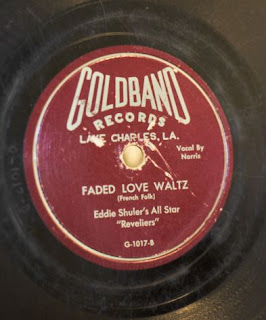
"Faded Love Waltz" - Eddie Shuler

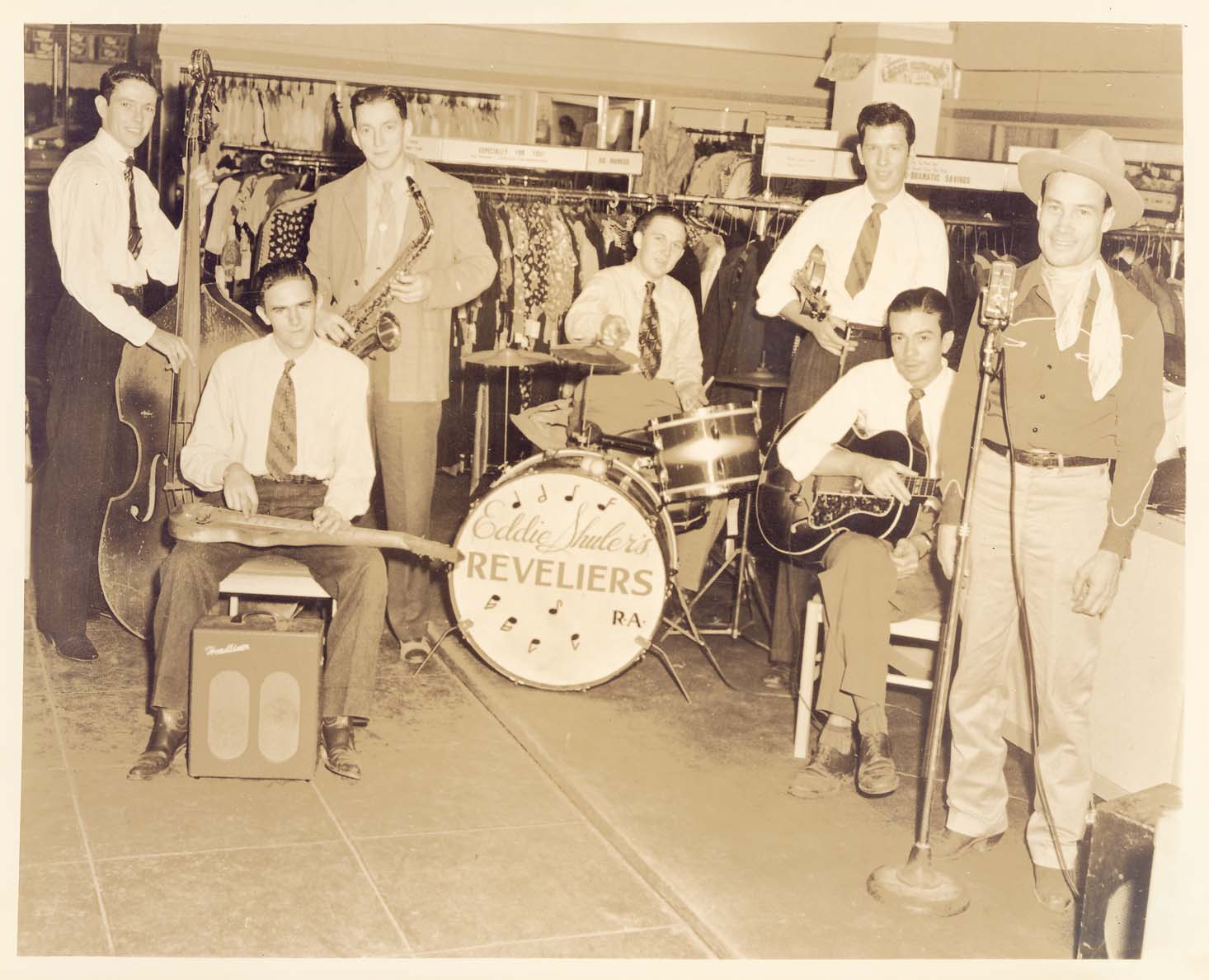
Eddie Shuler spent much of the 1940s filling in western swing groups and Cajun string bands such as the Hackberry Ramblers.   By the end of WWII, he managed to assemble his own group called the Reveliers and decided a new record label was needed in order to promote his new group.  In doing so, he couldn't ignore the sudden increased demand for Cajun music.  Eddie was surrounded by Cajun people who wanted more of those records.   His band had to adapt to the music demand. He recalls:
Oh yes, I sold a lot of records to the jukebox operators; that was where you sold most of your records in those days.  There were not all that many record shops, and then the people didn't have all that much money to buy records, except the richer people.  That's where you sold most of those pop records.  But the jukebox operators had to have what they called race records and hillbilly records; they had to have that stuff and the Cajun records, too.  So we got into the Cajun thing.1

Oh, chère, mais, j'ai prié, mais, pour t'avoir,
J'ai pas vu,  joli 'tite monde, comment je vas faire.

Oh, chère, mais, quel espoir, mais, que tu connais,
Moi de mourir de plus t'avoir, joli 'tit monde.

Oh, chère, mais, pourquoi-donc, mais, (.........),
Tu vas voir que je mérite pas tout ça tu m'fais.


Liberty Vindicator
Dec 11, 1947

Shuler wanted to record his own songs and focus more on hillbilly music, like his main influence, Bob Wills. He explained:
Any country band was hillbilly. It didn't make no difference who you were, you were hillbillies. There wasn't no country music then. They hadn't even invented the word.2  

Between 1944 and 1945, Shuler cut the first record for the Reveliers, featuring Shuler's compositions "Broken Love" and "Room in Your Heart For Me Darling."   By 1946, Cajun music was ramping up among the population of south Louisiana and he brought in Norris Savoy to assist in singing some classic Cajun songs.  Along with Pee Wee Lyons on steel guitar and Johnny Babb on bass, they recorded the melody of the 1936 "Ma Valse Favori" by Cleoma Breaux in which he entitled it "Faded Love Waltz" (#1017).  The melody is the same as Lawrence Walker's 1929 recording of "La Vie Malheureuse" and Happy Fats' 1935 recording of "La Valse De L'Amour". Shuler called his new record label Goldband Records. 
It had something to do with my mentality. I said, 'This is going to be a goldmine, so I'll just call it Goldband.'2  


Oh, dear, well, I prayed, well, to have you,
I couldn't see, pretty little everything, how I'll do this.

Oh, dear, well, what hope, well, that you know,
I'm dying to have you anymore, pretty little everything.

Oh, dear, well, so why, well, (........),
You'll see that I don't deserve all that you've done. 


  1. Record Makers and Breakers: Voices of the Independent Rock 'n' Roll Pioneers By John Broven
  2. http://theind.com/article-168-the-record-man.html
  3. Lyrics by Stephane F
Release Info:
Hey Cushmall | Goldband G-1017-A
Faded Love Waltz | Goldband G-1017-B

Find:
Eddie Shuler & His All Star Reveliers: Grande Mamou (BACM, 2016)

Friday, December 28, 2018

"Mes Cinquantes Sous (My Fifty Cents)" - Eddie Shuler

UPDATED! The Reveliers were a backup band for former Hackberry Ramblers guitarist and record producer, Eddie Shuler.  In the late 1940s, he had several fiddle players such as Johnny Porter, Norris Savoie, and Charlie Broussard.  Two other musicians that rounded out his group were steel guitarist Ronald Ray "Pee Wee" Lyons and bassist Johnny Babb.  For this session, Shuler's vocalist was Frankie "Tee Tee" Mailhes, a local musician in the Lake Charles area who had formerly recorded with his friends, the Alley Boys of Abbeville.  By the late 1940s, Shuler's first French music release was an attempt to capture the local Cajun music market.


Moi et ma belle on a été au bal,
C'était un samedi soir,
On en a revenu c’était lendemain,
Lendemain matin z- au jour,
J'ai demandé si elle avait pas faim pour quelqu'chose,
Elle m'a répondu (qu') elle avait pas faim,
Mais elle aurait mangé quand même.
Moi je pensais aller ordonner un lunch de quinze sous,
Elle a ordonné un poulet rôti, une demie douzaine de z"huitres,
Elle a ordonné un poulet rôti, une demie douzaine de z"huitres.

Moi, j"avais faim, mais j'avais pas le cœur de manger,
Et quand je pensais que j'avais juste cinquante sous dans ma poche,
Et quand je pensais que j'avais juste cinquante sous dans ma poche.
Et quand j'ai mis mon cinquante sous dessus le comptoir,
Il m'a foutu un coup de poing, il m'a tiré dans la fenêtre,
Il m'a foutu un coup de pied, il m'a tiré dans le chemin,
Écoutez ici, mes amis, ne vas jamais au restaurant,
Il faut jamais que tu vas dans le restaurant de cinquante sous dans ta poche.


Eddie Shuler's Reveliers
KPLC in Lake Charles
Eddie Shuler, unknown, possibly Eldrige "Coon" Guidry,
Amos Comeaux, Johnny Babb, Jimmy Webster, unknown

Recorded in mid 1946, "Mes Cinquantes Sous" (#1012) is a unique country-Cajun cover of the song "I Had But Fifty Cents", originally written as a poem in 1881 by Sam Devere and published in 1885.  It was later recorded by Riley Puckett in 1925 and the Binkley Brothers Dixie Clodhoppers in 1928.   Frankie had originally recorded the tune in 1939 as "Moi Et Ma Belle" with the Alley Boys and by 1946, brought the song to Shuler's group. It has been a well known song for years, even recorded by Ricky Skaggs, Jo-El Sonnier, and Beausoleil.


Me and my wife, we went to the ball,
It was a Saturday night,
We came back the next day,
Next morning, during the day,
I asked if she wasn't hungry for something,
She told me that she was not hungry,
But, she'd eat anyways.
I thought I was going to order a fifteen cent lunch,
I thought I was going to order a fifteen cent lunch,
She ordered a roast chicken, half a dozen oysters,
She ordered a roast chicken, half a dozen oysters.

I was hungry, but I did not have the heart to eat,
And when I realized I had just fifty cents in my pocket,
And when I put my fifty cents on top of the counter,
He punched me, he threw me into the window,
He kicked me, he pulled me into the road,
Listen here, my friends, never go to the restaurant,
You must never go to the restaurant (with only) fifty cents in your pocket.

During the early 1950s, Louis Spell and his French Serenaders would copy Shuler's recording and record "The Fifty Cent Song" for J.D. Miller in Crowley.  
By 1957, the Ethnic Folkways Library recorded the tune with Madame Marion Dugadet from Avery Island entitled "La Chanson De Cinquante Sous".


  1. Lyrics by Stephane F 
Release Info:
A Mes Cinquantes Sous (My Fifty Cents) | Goldband 1012
B Jolie Blonde (Pretty Blonde) | Goldband 1012

Monday, July 9, 2018

"La Valse De Meche" - Eddie Shuler

Goldband Records founder Eddie Shuler made immeasurable contributions to Louisiana music before his death.  Behind his folksy, down-to-earth demeanor, Shuler was a shrewd businessman and the driving force behind Goldband Records. Without him, Louisiana's musical heritage wouldn't be what it is today.  Shuler was born in Texas and grew up on a farm. By the mid 1940s, he had moved to Lake Charles and opened up business.  According to Shuler
My first store was in a trailer house. I started about June of 1944. I didn't have too much of a business because I didn't have too much stock.  I had no pianos and no sheet music.  Yeh, I sold records in the store too, the pop music.  And we were fixing radios, too, on the side.   That's back in the radio days.1 
I went to work as an insurance company salesman, and, of course, I was already a musician by that time, because I had been playing with the Hackberry Ramblers before all this stuff come about.  Then I decided I wanted to make records, so I found an ad in Billboard magazine, a place in New York, because I had written to all the record companies and nobody even answered my letter.  I said "Well, that's not going to work; I'm going to to it anyway [myself]".1 


Ooh, chérie, mais, moi, j'm'en vas, mignonne, 
Mais, c’est pour voir ma jolie petite fille

Ooh, chérie, mais, quel espoir, mignonne, 
Que, moi, je peux avoir, c’est de te voir t’en aller 

Ooh, chérie, mais tu m’as dit, mignonne, 
Que tu m'aimais, mais aujourd'hui, t’après m'quitter 

Ooh, chérie, mais quel espoir, mignonne, 
C'est de te voir t'en aller avec un autre
Sears in Lake Charles
Johnny Babb, Ronald Ray "Pee Wee" Lyons, 

Johnny Reems,
Ronald Ardoin, possibly Johnny Porter,
unknown, Eddie Shuler

Eddie took his band and using his own methods cut the song "La Valse De Meche" (#1015) in 1946 (although some sources say 1947), playing the guitar, while Norris Savoy accompanied on fiddle and vocals.  Similar to the Walker Brothers' tune "La Valse de Louisiane".  It's possible that Ronald Ray "Pee Wee" Lyons filled in on steel guitar and Johnny Babb backed them up on bass.
The first Cajun record was "La Valse De Meche" by Eddie Shuler and his Reveliers with Norris Savoy doing the vocal in French, and we cut that in KLOE radio down on Clarence St in the middle of the studio.1  


Oh, dearie, well, I'm going, cutie,
Well, it's to see you, my pretty little girl.

Oh, dearie, well, what hope (is there), cutie,
That I can have, seeing you go away.

Oh, dearie, well, you said, cutie,
That you loved me, well, today, then you left me.

Oh, dearie, well, what hope (is there), cutie
Seeing you, you went away with another. 


His first pressing batch in the 40s lacked the name of his band, and above all, Eddie's name.  He fixed this by having all the issues stamped with "Eddie Shuler" in gold and silver lettering.  Later, in 1955, he would open up a new studio in a white frame building along Church Street in Lake Charles, which was once home to an Assembly of God church before Shuler purchased it.  It's at this time, he re-released the tune on the flipside of Hackberry Rambler's "The Misery Of A Broken Heart", keeping the same catalog number #1015.   Over the years, others would record the song including Sidney Brown, Nathan Abshire, the Balfa Brothers, Maurice Barzas, Nolan Cormier, Rufus Thibodeaux and Octa Clark.


  1. Record Makers and Breakers: Voices of the Independent Rock 'n' Roll Pioneers By John Broven
  2. http://theind.com/article-168-the-record-man.html
  3. Lyrics by Jordy A

Find:
Eddie Shuler & His All Star Reveliers: Grande Mamou (BACM, 2016)