A unique window into the world of Cajun music between 1928 and 1965. Compiled histories from websites, books, news articles, liner notes, and interviews. Most come from my personal 78 collection. Also covering Creole, Cajun-Country, and Cajun swing.
Showing posts with label Joseph Elton Walker. Show all posts
Showing posts with label Joseph Elton Walker. Show all posts
The pre-war Cajun recording era had a surprising set of artists that many rarely consider today. Accordionist Lawrence Walker, more known for his honky-tonk post-war career, had formed a small group in the late 1920s to bring his mixture of American blues and French music to the surrounding parishes. As a teenager he formed the Walker Brothers group with his brother Elton. Featuring accordion, fiddle and guitar, the band played both Cajun and hillbilly music. Soon, they were invited to record for both Brunswick and RCA. In 1935, Walker waxed a pair of bluesy English compositions at RCA Bluebird's mobile recording facility in New Orleans.2
With guitarists Junior and Aldus "Popeye" Broussard added to the group, their professional sound has been preserved on Bluebird recordings like "What's The Matter Now" (#2199). The droning guitar strum with simple accordion riffs gave the traditional Cajun sound an added dimension.1 It arrived on the heels of similar recordings of the era, such as the Breaux Brothers' "Le Blues De Petit Chien".
In 1928, Leo Soileau had helped RCA Victor Records make a huge impact on their southern music sales across Cajun prairies with his accordion-led recordings with Mayuse Lafleur. By 1935, the company spun off their subsidiary company Bluebird Records and began offering recording sessions to many Cajun string-band musicians such as the Hackberry Ramblers, the Rayne-Bo Ramblers, J.B. Fuselier and others. The first of these string-bands to be invited by Bluebird were the Walker Brothers and Soileau's Three Aces. Accordion player Lawrence Walker, who had recorded earlier in Dallas in 1929, was familiar with the music scene of the area. How these musicians were discovered by RCA scouts has been forgotten but each one of these groups received invitations during the year. As long as they could make it to New Orleans, they packed up their instruments and joined A&R Eli Oberstein for sessions at the field studio.
Jeunes filles de la campagne,
Mariez-vous autres jamais
'Gardez comme moi j'ai fait,
J'ai mis dans la misère.
Tu vu (de) ton vieux nég,
Rejoindre ton pauv' vieux nég,
Qui c'est, mais, pour toi-même,
Qui c'est boo-boo t'aimes ça.
Eh, petite!
Quand j’étais jeune z-enfant,
J’étais un bambocheur,
Et asteure que j'suis marié,
Ça va tout le temps pareil.
Petite, t'es trop mignonne,
Pour faire la criminelle,
Pour faire, moi, m'en aller
Tu vas voir, mais, pour toi-même,
Je mérite pas tout ça,
Tout ça, mais, t'es après faire.
Petite, tu me fais quitter,
Quitter, ouais, toi tout(e) seul.
Dallas Centennial, 1936
Walker, his brother Elton and Junior covered the old Cajun song "Jeunes Gens De La Campagne" as "Jamais Marriez" (#2195). First recorded by Dennis McGee in 1929, it would be popularized later by Iry Lejeune in 1954 as "Don't Get Married". Instead of addressing a young gentleman, Lawrence and Elton sung of the concerns of a young woman getting married too soon.
The recordings made Walker a local known name among musicians and led to him playing ever more frequently in the dance-halls. However, it was in Dallas during the great Texas Centennial the following year that the versatile French accordion player played to more Texans than he had ever dreamed. In 1936, he entered a French accordion music contest in Rayne, competing with three other men. To his surprise, he had won an all-expenses paid trip to the Centennial. He was accompanied by folklorist and columnist Lauren Post, professor at Louisiana State University and head of the Louisiana Delegation for the event.
Marksville Weekly News Jul 4, 1936
Young girls in the countryside,
Never get married to anyone,
Look at what I did,
I've placed myself in misery.
You saw your old man,
Come back to your poor old man,
Who is the one, well, for you,
Who is the boo-boo that you love.
Hey, little one.
When I was a young child,
I was a reckless one,
And now that I'm married,
It's the same thing, all the time.
Little one, you're too cute,
To be this bad,
You're making me go away,
You'll see, well, for yourself,
I do not deserve all that,
All that, well, you're doing,
Little one, you making me leave,
Leaving, yeah, all alone.
In addition to playing for the largest crowd he had ever experienced, he was scheduled to play on five different programs, including on KRLD, Dallas' Columbia radio broadcast. Lawrence recalled:
I played the old French tunes like "Jolie Blonde", "Chere Tout Tout", and "Bye Bye La Belle", going from bandstand to bandstand over the Centennial grounds. I'll never forget how amazed I was when Lauren Post checked the clocking device and told me I was playing to over 36,000 people.1
Introducing Louisiana-based Cajun music to outsiders was a risky endeavor. It could have gotten you boo-ed off stage or worse. Texas-influenced string band music was all the rage in Louisiana and not much cultural exposure was headed the other way. This didn't stop Lawrence Walker from trying. By 1935 he was recording Cajun tunes like "La Valse De Louisiane" (#2198) for Bluebird records in New Orleans and quite often playing Texas hillbilly music in Dallas. While Walker enjoyed entertaining his Texas audiences with hillbilly music, he was determined to try to introduce Cajun music. He recalls his discussions with his father:
One night as we were packing our instruments to go play for a dance, I told daddy, "You know something. I want to bring my French accordion and play some old French music for those Texans." But daddy was doubtful. "They'll laugh at you" he told me. But I said "Let them laugh".1
Lawrence Walker, 1936
Songs like "La Valse de Louisiane", a simple instrumental of the Cajun favorite "Jolie Blonde", was ideal for Lawrence and his brother Elton Walker to introduce Texans to Cajun music. Backed by his brother, it's possible guitarists Junior Broussard and Norris Mire were at the session. His early stage performance in Texas must have gone over fairly well. He continues:
During Intermission, I announced that at the next dance I would have a "surprise" for them. A big crowd turned out that night and at 10 sharp, I strapped on my accordion and announced "I am going to play a French instrument and if you like it --applaud, and if you don't, I'll just change right back to my fiddle. No hard feelings". Well, they all clapped and clapped and hollered, too. And from then on I played straight French accordion.1
Interview by Mona Mel Mouton. Jan 18, 1968
Release Info:
BS-87612-1 La Valse De Louisiane | Bluebird B-2198-A
BS-87613-1 Pourquois Vous Etes Si Cannai | Bluebird B-2198-B
While Lawrence Walker garnered local fame in south Louisiana during the 1950s, very few recall his early career playing music both in Louisiana and in Texas. In 1929, he was invited to record in a studio for the very first time. Lawrence Walker was a man who "played" for a living ever since he was a child. It was near the Texas border, in the little Louisiana town of Adgerly that Walker played for his first dance. He recalls:
I remember the chair was so high my father had to put a box under my feet and the accordion so big, it hid my face. My father did not want me to play before because I was too young. It's a strain on the chest.3
Daily Advertiser May 17, 1947
Tite fille, tu m'fais pitié de t'avoir après pleurer,
De t'voir après pleurer comme un pauve malheureuse, chère,
C'est moi, c'est moi la cause si ton cœur est si cassé,
Tite fille, prend-donc courage, prend pas donc ça si dur.
Tite fille, prend-donc courage puis vien toi avec moi,
Tite fille, mais, j'va t'soigner jusqua à l'jour de ta mort, chère,
Comment tu veux je fais, j'su'assez mais moi tour seul?
Tit fille, prend-donc courage, prend pas donc ça si dur.
Texas Centennial, 1936
Lawrence would always have an affection for the Texas people. By 1929, Lawrence and his brother Elton headed to Dallas, TX for their very first session with Brunswick records. There, they waxed "La Breakdown La Louisianne" (#381).
Admiring the music of Texas, good friend and cultural folklorist, Dr. Lauren Post, became chairman of the Louisiana section of the National Folk Festival in Dallas.4 In 1936, it was the Texas Centennial celebration and the western swing craze of the 30s drew many Cajun musicians away from their own music and toward more Anglicized forms.2 That year, Lauren was called to create a group, which he called the "Little Acadian Band", to perform at the festival on multiple stages and at several key events.4 Walker said:
The little band was so different and proficient in its folk playing that it was popular wherever it played at the festival.1
Little girl, you made me pitiful when I saw you crying,
Saw you crying like a poor unfortunate one, dear,
It's me, it's my fault if your heart is broken,
Little girl, have courage, don't take it so hard.
Little girl, have courage then come with me,
Little girl, well, I'll take care of you until your dying day, dear,
How will I handle this, I am sorry but I'm alone?
Little girl, have courage, don't take it so hard.
In 1949, Nathan Abshire recorded the song as the "Iota Two Step". As time when on, Walker played his accordion night after night, year after year. The strain of the accordion was such a burden, he had to wear a tight band over his chest for relief.3 Yet, he continued playing and recording until the 1960s.
NOTE: Cajun Early Recordings (JSP, 2004) has both Brunswick 381 sides reversed.
Release Info: DAL-545 La Breakdown La Louisianne | Brunswick 381 DAL-546 La Vie Malheureuse | Brunswick 381 DAL-545 La Breakdown La Louisianne | Brunswick 80084
DAL-546 La Vie Malheureuse | Brunswick 80084 Find:
Louisiana Cajun Music Volume 1: First Recordings - The 1920's (Old Timey, 1970) Cajun Early Recordings (JSP, 2004)
By 1935, small acoustic accordion-based ensembles began to give way to more substantial string-based orchestras. Lawrence Walker and Nathan Abshire, a pair of experimental accordionists who would become two of the leading proponents of the pot-WWII dancehall sound, recorded the clearest example of the shift to Cajun swing on the Bluebird record label.3 In 1935, Lawrence recorded his version of the song "Corina, Corina", in English, entitled "Alberta" (#2199) in honor of his daughter Alberta. Originally a Leadbelly song called "Roberta", it was also covered by the Mississippi Sheiks. Lawrence joined his brother Elton Walker on violin, with probably Junior Broussard on guitar, and possibly Aldus Broussard or Norris Mire on guitar. According to producer Chris Strachwitz:
It is well known among jazz musicians in New Orleans. I think it is a jazz tune with a Cajun accent. This belongs to both black and white tradition in the South and was first popularized on record by the Mississippi Sheiks in the late 1920s. Perhaps it was a popular tune long before then. The accordion on this performance seems to show strong [Creole] Cajun influence and I think Lawrence Walker probably learned it from a [Creole] Cajun performer.1
Lawrence Walker, Lena Mae Menard Walker, Alberta Walker, unknown
"Corina" was a "blues with a touch of jazz and a flavor of hillbilly" that by the 1930s was widely popular among blues and hillbilly artists, who also recorded the arrangement under the titles "Alberta" and "Roberta". The tune later became a fixture in the Western swing repertoire largely through the popularity of Bob Wills.3 Author Ryan Brasseaux writes:
In essence, "Alberta" can be equated with the Breaux family composition "Ma Blonde Est Parti" because both tunes describe an inconsolable man lamenting about the impenetrable boundaries that separate the protagonist from his belle.3
Alberta, Alberta, where have you been so long,
Alberta, Alberta, where have you been so long,
I ain't had no lovin', since you've been gone.
I met Alberta, way across the pond,
I met Alberta, way across the pond,
Didn't write me no letters, you didn't care for me.
Alberta, Alberta, tell the world "Adieu",
Alberta, Alberta, tell the world "Adieu",
Just a little bit of lovin', let your heart be true.
Alberta, Alberta, where have you been so long,
Alberta, Alberta, where have you been so long,
I ain't had no lovin', since you've been gone.
Lawrence Walker transformed the Cajun accordion style by adding strong elements of swing to his playing. This transformation is revealed in this Bluebird recording. Even so much that James Hancock (a Joe Davis pseudonym) had taken out a copyright to what he called Lawrence's "Alberta Blues".2
Louisiana Cajun Music Volume 2 The Early 30s. Chris Strachwitz. Liner notes.
The Melody Man: Joe Davis and the New York Music Scene, 1916-1978 By Bruce Bastin
Find: Louisiana Cajun Music Vol. 2: The Early 30s (Old Timey/Arhoolie, 1971) Cajun Louisiane 1928-1939 (Fremeaux, 2003) I Saw The Light (Blues People 1934 -1935) (Blues Classics, 2015)
Cajun accordionist Lawrence Walker became well known in the 1930s both in Louisiana and in Texas, specifically Dallas. Walker's first encounter with travelling to Dallas would be for Brunswick records in 1929. There, he and his brother, Joseph Elton, recorded two sides, one being "La Vie Malheureuse" (#381). It contained similarities with Joe Falcon's recording "Poche Town". However, the music after 1930 began to change to the string sound. Contemporaries of Lawrence used the melody in their string band recordings, such as Happy Fats' 1935 recording of "La Valse De L'Amour" and Cleoma Falcon's 1936 recording of "Mon Favori". Even Walker's accordion finally succumbed to the flood of string bands during the late 1930s and early 40s.
Oh, pourquoi donc tu fais ça.
Tu connais j'mérite pas ça,
Ça t'as fait, joli cœur.
Oh, j'ai prié, j'ai pleuré,
Pour t'avoir plus personne,
Pourquoi donc tu viens pas?.
Oh, tous les soirs tu rouler,
Pour t'avoir plus personne,
Pour quoi donc ton tout seul.
Stephen Castille, Norris Mire, Aldus "Popeye" Broussard 1936 Texas Centennial Tryouts North Rayne Elementary 1,7
Folklorist Lauren Post gathered Lawrence for a Cajun music ensemble to be featured in that city. Though Lawrence was not a "full-bred" Cajun, he spoke Cajun French well and put together a group to travel back to Dallas.4 In 1936, he was featured at the National Folk Festival in Dallas, Texas, accompanied by the Broussard Family Band.1,6 His band won rave reviews and came in first place. It featured Aldus "Popeye" Broussard on fiddle, Sidney Broussard on fiddle, Junior Broussard on guitar, Norris Mire on accordion, and Evelyn Broussard on triangle and vocals. Joining them was Elemore Sonnier, a solo vocalist from Scott. These were the first appearances that brought Cajun music to the public's attention on a national level.1,3
Rayne Tribune June 26, 1936
Over the years there were many other contests where he was challenged by the various other accordion players. During these showdowns, the crowds were usually the judges. Lawrence always won. He was known far and wide as “King of the Accordion Players” at that time. He was also quite well known for his great showmanship with his instrument. It is said that he could completely captivate his audience in a way few accordion players ever have.5
Oh, why have you done that,
You know I don't deserve that,
That you've done, pretty sweetheart.
Oh, I've prayed, I've cried,
For you have no one,
So, why don't you return?
Oh, every night, you roam around,
For you have no one,
That's why you're all alone.
Despite his notoriety as a musician, Walker made the bulk of his living as a rice farmer until after World War II, when he returned to Louisiana and played in clubs throughout southern Texas with his band the Wandering Aces.2 Nathan Abshire used it in his "Iota Two Step" in 1949. Not to be outdone, Lawrence re-recorded the song as "Waltz of Regret" in 1955. By the early 1960s, Aldus Roger stepped into the J.D. Miller studio and took Walker's "La Vie Malheureuse" and renamed it "La Valse De Misere.
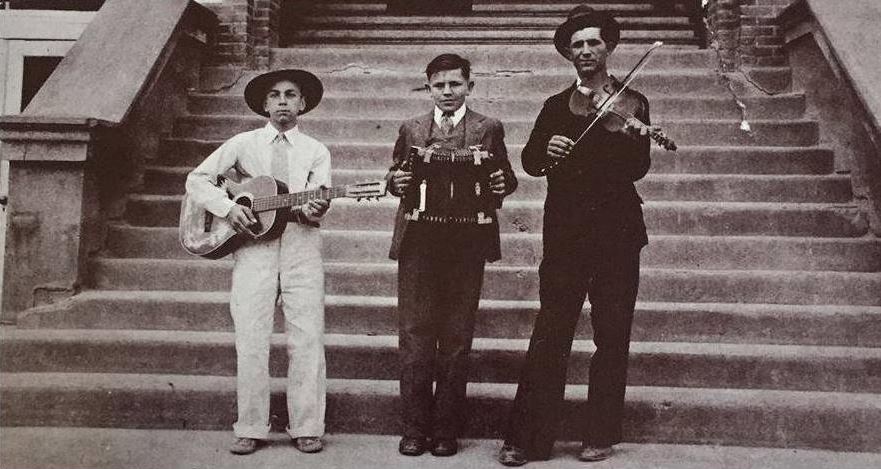
NOTE: The photo shown in this article has been historically mistaken as a photo of the Breaux brothers. This photo has been officially corrected in this blog.
NOTE: Cajun Early Recordings (JSP, 2004) has both Brunswick 381 sides reversed.
Release Info: DAL-545 La Breakdown La Louisianne | Brunswick 381 DAL-546 La Vie Malheureuse | Brunswick 381 DAL-545 La Breakdown La Louisianne | Brunswick 80084 DAL-546 La Vie Malheureuse | Brunswick 80084 Find:
Louisiana Cajun Music Volume 1: First Recordings - The 1920's (Old Timey, 1970) Cajun Early Recordings (JSP, 2004)