Showing posts with label Columbia Records. Show all posts

Tuesday, September 2, 2025

"I Woke Up One Morning In May" - Didier Hebert

Didier Hébert (pronounced DEE-djay AY-bear) was a blind guitarist from Louisiana who accompanied the accordion player Dewey Segura on one Columbia recording session on December 10, 1929. The two men recorded three French numbers together and Hébert (misspelled as Herbertrecorded one solo song, "I Woke Up One Morning in May" (#40511), a Cajun French lament of a woman that married a gambling and drinking man who abandon her and their children.[1]  


Je me suis levé matin dans Mai,
Mais, bien de bon matin,
C’était pour passer,
Mais, un beau jour dans ma vie.

Oh j’ai trouvé mon père en train de pleurer,
Ma mère qui pleurait dans ses bras,
C’est adieu pour longtemps,
Je me donnes à un jeune garçon.

Oh moi je l’aimais beaucoup,
Beaucoup plus que ma vie,
Il m’avait fait une promesse,
Et cette promesse c’est d’être sa femme

Oh j’ons ferait des enfants,
Il m’a quitté d’un abandon,
Moi bien malade dans mon lit,
Et mes enfants là crèvent de faim

Et mon mari à la table après gambler,
Et moi je ne souhaît que la mort,
C’est tous ces jeunes bébés, grand Dieu,
Dans les jambes de moi

Oh mettez-vous tous vous autres à méfier
De tous ces jeunes garçons,
Ça, ça conte autant de menteries,
Qu’en a d’étoiles dans le ciel.

Oh depuis dans l’âge de quatorze ans
J’après misèré avec toi,
Et dès de jour en jour,
Mais moi je m’en vas dans l’abandon.

Oh moi je connais je m’en vas dans ces grands chemins,
Misereux moi toute seule,
Et dès je suis une délaissée,
Mais que personne en veut de moi.


Didier Hébert represent an older tradition of Cajun musicians that sang old songs and ballads, so rarely heard on recordings.  His music was authentic enough that John and Alan Lomax chose to record Didier in June of 1934 performing "C'est Bien Le Mois D'Avril".  Growing up, Didier went blind due to a gun accident when he was eight years old but it never prevented him from learning the guitar.      Although the melody of the song is unique in Cajun music, the theme of Hebert's tune is common in other genres.  According to Alexander M. Stern, 

The detail of the husband spending his time in a tavern rather than with his wife and family recalls the story of the female suicide in Buell Kazee's 'The Butcher's Boy.' The warning to other young girls to avoid the same fate also recalls 'The House of the Rising Sun,' famously recorded by Dave Van Ronk, Bob Dylan, and the Animals.[2]  


I got up early in the morning in May
Well, very early in the morning,
It was to pass the time,
Well, a beautiful day in my life.

Oh, I found my father crying,
My mother crying in his arms,
It's goodbye for a long time,
I gave myself to a young boy.

Oh, I loved him very much,
Much more than my life,
He made me a promise,
And that promise was to be his wife.

Oh, I had children,
He left me with abandonment,
I was very sick in my bed,
And my children there are dying of hunger.

And my husband at the table, gambling,
And I wish only death,
It's all these young babies, good God,
At my feet.

Oh, all of you, start being wary,
Of all these young boys,
That tells as many lies,
As there are stars in the sky.

Oh, since I was fourteen,
I've been miserable with you,
And, from day to day,
But, I'm leaving, abandoned.

Oh, I know, I'm going away on these highways,
A mistress all alone,
And now I'm abandoned,
Well, no one wants me.


Allen Hebert, Didier's son, felt his father was embarrassed by the recording.   Didier claimed he was sick that day and it didn't turn out well.  He married in 1930 and gave up having a recording career.  However, the haunting nature of the recording has been appreciated by many over the years.  In 1952, it famously made the cut on the acclaimed Harry Smith's Anthology of American Folk Music LP in which guitarist and archivist John Fahey described his feelings about the song: "Love it, Wonderfully out of tune."[3]    According to Matt Ryan's Strange Currencies Music,

Hébert’s lone solo recording expresses a profound sadness, even before one attempts to translate its lyrics. Among the eighty-four songs on the Anthology, “I Woke Up One Morning” has one of the hardest codes to crack, but when it hits you, it becomes a clear favorite.[4]  


  1. https://oldweirdamerica.wordpress.com/2012/01/10/60-i-woke-up-one-morning-in-may-by-didier-hebert/
  2. https://theanthologyofamericanfolkmusic.blogspot.com/2010/05/i-woke-up-one-morning-in-may-didier.html
  3. https://folkways-media.si.edu/docs/folkways/artwork/SFW40090.pdf
  4. http://strangecurrenciesmusic.com/harry-smiths-america-part-3-songs/

Release Info:
W111390-1 I Woke Up One Morning In May | Columbia 40517-F | Okeh 90017
W111391-2 Far Away From Home Blues | Columbia 40517-F | Okeh 90017

Find: 
ANTHOLOGY OF AMERICAN FOLK MUSIC – VOLUME THREE (Folkways, 1966)
Les Cajuns Best Of 2002 Les Triomphes De La Country Volume 12 (Habana, 2002)
Cajun Country 2: More Hits From The Swamp (JSP, 2005)

Wednesday, November 3, 2021

"Confession D'Amour (Confessions Of Love)" - Sydney Landry

Sydney Landry was one of the last Cajun recording artists of the pre-Depression era.    Better known as "Syd", the Landry's grew up in the small community of Henry, Louisiana outside of Erath.  He started in music when he was nine years old as a drummer, like his dad Louis Landry, who played for local dances. Sydney often entertained friends singing with his guitar.


Mais, il est temps pour moi j'avance, moi faire sans toi,

Tout ça que š'apprendre pour* moi et toi,

Tous les langueurs, j'ai passé pour essayer de faire m'aimer,

Faudra s'assoir, tous les jours, oublier, t'as jamais voulu m'aimer. 

[yodel]


J'ai pris mon pistolet, un jour, et j'ai parti pour me tirer,

Quand j'ai pensé à ma promesse, je m'ai donc dû bouger.

[yodel]


J'ai tout mon linge dedans ma malle, avec mon cœur qui me fait bien mal, 

Avec l'idée juste à partir, mais, m'en aller bien loin dedans le noir.

[yodel]


Sydney Joseph Landry

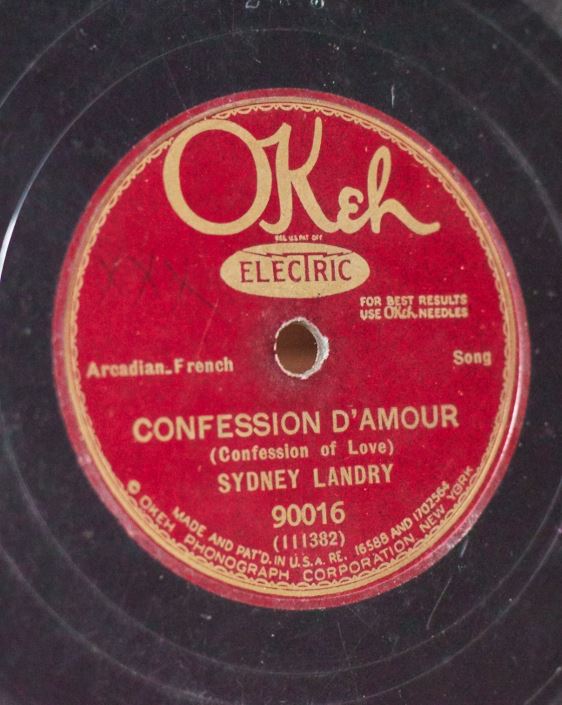
Sydney's family moved westward to Ged, Louisiana in Calcaseiu parish. There, he worked alongside Lawrence Walker's band.  By 1929, Columbia records offered him a chance to record two songs in New Orleans, one which was a Jimmie Rodgers-style recording entitled "Confession D'Amour" (#40516), later co-pressed by Okeh. He arrived in early December along with Amede Ardoin, the Segura Brothers, and Didier Hebert. 


Well, it is time for me to move on, without you,

All of that I learned about* me and you,

All the languor I have spent trying to make you love me,

Have to sit, every day, forgetting (that) you never wanted to love me.

[yodel]


I took my pistol, one day, and I left to go shoot myself,

But, when I though about my promise, I had to move on,

[yodel]


I have all of my clothes in my trunk, with my heart that aches,

With the idea of just leaving, well, to go far into the darkness.

[yodel]


Sydney moved to Texas, living in different areas of southeast part of the state, until finally retiring in Columbus, Texas.   Sydney's recordings remained obscure and his music career never materialized.  According to his son Grady,

"He had a very bad automobile accident in the 30's. He lost his voice and ended up breaking all his records."1  


  1. Discussions with Grady L
  2. Lyrics by Stephane F
Release Info:
111382-2 Confession D'Amour (Confessions Of Love) | Columbia 40516-F |  Okeh 90016
111383-2 La Blouse Francaise (French Blues) | Columbia 40516-F |  Okeh 90016

Find: 
CAJUN-Rare & Authentic (JSP, 2008)

Tuesday, December 1, 2020

"Every Time I Pass Your Door" - Link Davis

American singer, fiddler, saxophonist, and songwriter, also known as Papa Link Davis, was born in Sunset, Texas.  He was involved in recordings of western swing, hillbilly, Cajun music, rockabilly, rock n' roll and blues, either as the main artist or a session musician.  One of eight children, he formed a trio with two of his brothers during the late '20s, playing local dances. A natural musician, Davis started out playing the fiddle and later took up the saxophone. He gravitated toward Western swing music when he turned professional and one of his earliest known steady gigs was as a member of the Crystal Springs Ramblers, a Fort Worth-based outfit with which he cut his first record in 1937.1  


Every time I pass your door,
I get a feeling in my heart,
That's when the tear drops start,
Every time I pass your door.

J'ai passe devant ta porte,
J’ai crie, “By-bye la belle.”
Y a personne qu’a pas repondu,
O ye yaille, mon coeur fait mal.

I know my love has died,
And she's gone gone forever more,
But the tears come down inside,
Every time I pass your door.

Link Davis

His 1954 recording of "Every Time I Pass Your Door" (#21431) for Columbia records was a country-western version of Cleoma Breaux's "Mon Coeur T'Appelle (My Heart Aches For You)".  Like many of Link Davis' country renditions of Cajun songs, he sung both in English and French.   Recorded at the ACA Studio in Houston, TX, Link Davis & His Bayou Billies consisted of Cameron Hill on guitar, Herb Remington on steel guitar, Buck Henson on bass and Doug Hudson on piano. 


Every time I pass your door,
I get a feeling in my heart,
That's when the tear drops start,
Every time I pass your door.

I passed in front of your door,
I cried, "Goodbye, my beautiful girl."
Yet no one responded,
Oh, how my heart aches.

I know my love has died,
And she's gone gone forever more,
But the tears come down inside,
Every time I pass your door.


Even into the 1960s, he occasionally made a foray into rock & roll with songs like "Rice and Gravy," but he failed to make a lasting impression in the field. He continued to be a top session musician and cut records in Western swing, Cajun, and blues style throughout the decade for different labels, mostly based in Houston, TX, until he was sidelined by a stroke late in the decade.1  


  1. https://www.allmusic.com/artist/link-davis-mn0000289593

Release Info:
CO 52833/ACA-3017 Every Time I Pass Your Door | Columbia 4-21431
CO 52834/ACA-3018 Cajun Love | Columbia 4-21431

Find:
The Very Best Of Link Davis (Emusic/Goldenlane, 2009)

Wednesday, March 25, 2020

"The Waltz Of Our Little Town" - Adam Trahan

Joe Falcon's breakthrough recording of "Lafayette" for Columbia records in 1928 spawned other players to take up the challenge.  By the time Joe arrived back from his second session, Cow Island native Adam Trahan had challenged Joe Falcon to an accordion contest, convinced he, himself, was a better player.  His denouncement of Joe's abilities at best garnered him the attention of a local furniture store owner and the Columbia executives.  At 19 years old, Adam received a telegram from Columbia Record Company representative, F. Mackey.  It directed him to "hop on the next train to New Orleans" where he would meet with the Columbia record contacts.1

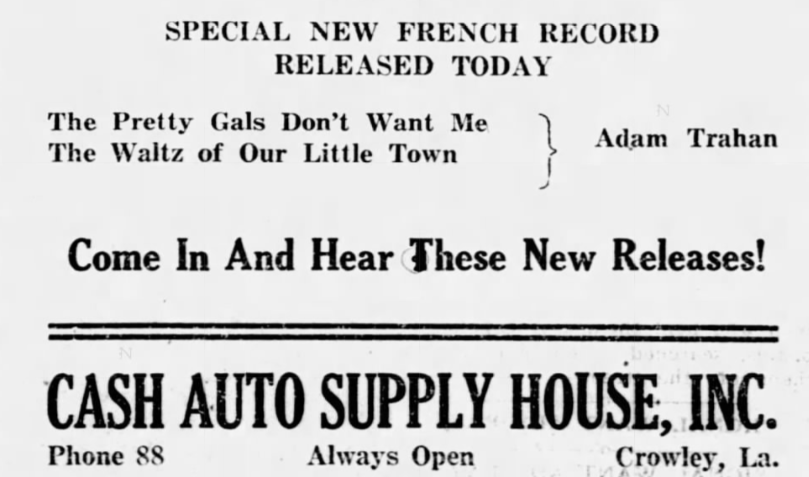
He arrived in New Orleans in December of 1928 where he waxed the song "The Waltz Of Our Little Town" (#40501). The accordion melody has some similarity with Angelas Lejeune's 1929 recording of "Bayou Pon Pon", played as a waltz instead of a one-step, however, the lyrical melody resembles Joe Falcon's 1928 recording of "Osson".  It borrowed some similarities from an old fiddle melody called "Rubber Dolly". By 1934, Amede Ardoin traveled to NYC and recorded the song for Decca with many similarities, giving it the title "Tortope d'Osrun".   After the war, Austin Pitre sped up the tempo and created his "High Point Two Step" and "Janot Special". 


Si 't'avais écouter ton papa et ta maman, 

Aujourd'hui toi tu serais avec moi à la maison, 

J'ai courtaillé, j'ai roulayé, pour essayer, 
De t'avoir, malheureuse, j'ai pas pu.

Tu m'as pris de la maison comme un pauvre orphelin,
Tu m'as promis de t'soigner jusqu'à le jour de ma mort.


Abbeville Meridional
Dec 15, 1928

Sadly, Adam's guitarist and Milton native Edney Broussard, improvised all the chord changes, causing his session to sound terribly dissonant.   Columbia Records invited Trahan back for a second recording session, but he declined, having already sold his accordion.1  But his reputation as an excellent accordion player lingered in the community.  According to the Abbeville Meridional in 1929,
Adam Trahan has made a few records for the Columbia Phonograph Company, and is considered a wicked key snapper.  His ability to coax seductive melodies from the ol' wind box borders on the marvelous.  With the first strains from Adam's accordion the puritanical toe shakes off its solemnity--acquires a new cunning and swings into line with the dictates of nature.2  


If you'd listened to your dad and your mom,

Today, you'd be with me at home,

I had courted, I had ran around, trying,
To have you, miserable one, I just couldn't.

You took me from the house like a poor orphan,
You promised to take care of me until the day I die. 


Crowley Daily Signal
Apr 18, 1929


  1. Accordions, fiddles, two step & swing: a Cajun music reader by Ryan A. Brasseaux, Kevin S. Fontenot
  2. Abbeville Meridional (Abbeville, Louisiana) 24 Aug 1929
  3. Lyrics by Stephane F


Release Info:

W147634-2 The Waltz Of Our Little Town | Columbia 40501-F
W147635-2 The Pretty Girls Don't Want Me | Columbia 40501-F

Find:
Cajun: Rare & Authentic (JSP, 2008)

Sunday, September 8, 2019

"La Valse De St. Marie" - Vin Bruce

Cajun music titan Ervin "Vin" Bruce was born in Cut Off, Louisiana. His father, Levy played fiddle at local dances; usually in someone's front room. Vin learned to play guitar at an early age, at 14 he began playing and singing in a local band, performing once a week on the radio in New Orleans. At the age of seventeen Vin was brought to the attention of Don Law, legendary producer/A&R man for Colombia Records. Vin signed a contract with Colombia and became the first Cajun artist on a major label since the 1930's. He was also the first to record Cajun music with such Nashville professionals as Chet Atkins, Grady Martin, Tommy Jackson, Jack Shook, and Harold and Owen Bradley.1  


C'est pas la peine tu dis que "non",

Faudra bien qu'tu t'maries,

Faudra bien qu'tu t'maries,
À l'eglise Sainte-Marie.

Tous les deux pour la même,
Ni une ni l'autre tu l'auras,
Tout le soleil pour la brune,
Et pis y'as rien pour la blonde.

Les habits son achetes,
Mais, ton idée est changer,
Les consentements 'mendait,
Les alliances sont achetés.

C'est pas la peine tu dis que "non",
Faudra bien qu'tu t'maries,
À l'eglise Sainte-Marie.

Que c'est la cause de tout ça,
C'est ces grands conseilleurs,
Mais, ces grands conseilleurs,
Et pas le grand un payeur.

C'est pas la peine tu dis que "non",
Faudra bien qu'tu t'maries,
À l'eglise Sainte-Marie.

Tous les deux pour la même,
Ni une ni l'autre tu l'auras,
Tout le soleil pour la brune,
Pis y'as rien pour la blonde.

C'est pas la peine tu dis que "non",
Faudra bien qu'tu t'maries,
À l'eglise Sainte-Marie.

Vin Bruce


A direct interpretation of the old traditional tune "Tous Les Deux Pour La Même", a song made famous by Lawrence Walker years earlier, Vin sung of a darling named Marie and re-titled the tune as "La Valse De St. Marie" (#21189) for Columbia Records in 1953.   Working alongside Nashville producer Don Law, at the Tulane Hotel he was backed by Grady Martin and Jack Shook on guitars, Bob Foster on steel guitar, Ernie Newton on bass, Tommy Jackson on fiddle, and Papa John Gordy on piano.


It's not worth you saying no,

You have to get married,

You have to get married,

At St. Mary's Church.


Either of them, it's all the same,
Neither me nor you will have them,
All the sunshine for the brunette,
And then there's nothing for the blonde.

The clothes are purchased,
But, your mind is changing,
The consents (papers) are requested,
The wedding rings are bought.

It's not worth you saying no,
You have to get married,
At St. Mary's Church.

What's the cause of all of this?
It's these folks giving advice
Well, it's these folks giving advice,
And not the ones paying (for everything). 

It's not worth you saying no,
You have to get married,
At St. Mary's Church.

Either of them, it's all the same,
Neither me nor you will have them,
All the sunshine for the brunette,
And then there's nothing for the blonde.

It's not worth you saying no,
You have to get married,
At St. Mary's Church.


In 1973, he was honored with "Vin Bruce Day" by his hometown and in 1978 he was Lafourche Parish's "Citizen of the Year" and has been inducted into several Country and Cajun Music Halls of Fame.1  


  1. http://www.ponderosastomp.com/music_more.php/259/Vin+Bruce
  2. Lyrics by Martn Cortez, Smith S, Stephane F and Jerry M


Release Info:

CO 49042/NASH 1630 La Valse De St. Marie | Columbia 4-21189
CO 49043/NASH 1631 Oh Ma Belle | Columbia 4-21189

Find:

Vin Bruce: King of Cajun Music: Dans la Louisianne (Bear Family, 2011)
Vin Bruce: Vintage Cajun Classics of the 1950's (Vintage Masters, 2012)

Monday, June 24, 2019

"You're Small And Sweet" - Segura Brothers

One of the earliest Cajun musical families was the Segura family of Delcambre where two brothers, Dewey and Edier, learned to play some of the earliest Cajun melodies.   During the 1920s, Dewey's parents raised their children near a bayou known as the Petite Anse Canal, not far from the local dance-halls.   Dewey's mother not only played the accordion, but also knew the secret of making moonshine in the cornfield.  To accommodate their income, she would sell the liquor at the local dance halls, keeping a wary eye out for the "revenues". She taught Dewey how to play the accordion as well as make liquor.1  

Toi, petite, t’es mignonne,
Si aimable, t’es trop canaille, malheureuse.

Quoi j’ai fait à ton papa,
Pour être puni aussi longtemps,
Lord, Lord, c’est dans la maison,
Je peux p’us revenir icitte.

En demander à ton papa et ta maman,
Pour t’amener avec ton vieux nègre, malheureuse,
Papa dit "non", chère, maman veut pas,
Parce que ma robe est pas jolie,
(J’après mourir)*, quoi moi, je vas faire, mais, d’être toute seule?

Ta maman, mérite etre content,
'Vec une corde là, oh, la corde au cou,
Tu connais, chère, la corde au cou, c’est dur pour moi,
Que toi tu est dis t'abandonner, c'est mieux d’avoir la corde au cou.
Dewey and Edier Segura

He, his brother Eddie and a local guitarist named Didier Hebert traveled to New Orleans at the end of 1929 to catch a Columbia recording session where other Cajun musicians such as Dennis McGee and the Amede Ardoin were lined up.  The Seguras recorded an old Cajun tune about a lover commenting on a love interest's desperation entitled "You're Small And Sweet" (#40512).  Not to be confused with the 1928 Fawvor Brothers's title  "T'Est Petite a Ete T'Est Meon (You Are Little and You Are Cute)", a different tune that would become the standard for future generations. Attributed to "E. Segura", it's believed the company mistakenly left off Dewey's name.  In the song, he refers to "la corde au cou", or "rope around the neck", however, the phrase signifies extreme frustration, more closely aligned to a person being "at the end of his rope."

You're small, you're cute,
Even though friendly, you're too mischievous, oh my.

What did I do to your dad,
To be punished for so long?
(Lord, Lord, in that house,
I can't come back here.)

Ask your dad and your mom,
To bring you to your old man, oh my,
(Your) dad says "no", dear, (your) mom doesn't want to,
Because my clothes aren't nice,
(I'm dying), well, what am I going to do, but to be all alone?

Your mom, deserves to be happy,
With a rope there, oh the rope around my neck,
You know, dear, the rope around my neck, it's hard for me,
That you have said you've abandoned me, it's better to have the rope around my neck. 

In 1949, Cajun music was back in demand.  Dewey started a full-time band, The Delcambre Playboys, where they group played around Vermilion Parish dance-halls such as The Blue Moon in New Iberia, the Grand Terasse near St. Martinville and the Rock-A-Bye Club in Forked Island.  Dewey always insisted his family come see him play.  He stated: 
If my family don't come, nobody else is going to come.  They'll think I'm not good.1  


  1. Discussions with Lorraine S D
  2. Lyrics by Stephane F and Jordy A


Release Info:
W111392-2 Rosalia | Columbia 40512-F
W111393-2 Your Small And Sweet | Columbia 40512-F

W111392-2 Rosalia | Okeh 90012
W111393-2 Your Small And Sweet | Okeh 90012


Find:

Cajun Dance Party: Fais Do-Do (Legacy/Columbia, 1994)
Les Cajuns Best Of 2002 Les Triomphes De La Country Volume 12 (Habana, 2002)
Cajun Country, Vol. 2, More Hits from the Swamp (JSP, 2005)

Wednesday, May 15, 2019

"Vieux Airs (Old Tunes)" - Joe Falcon

"Your Kiss Is Sweet".   This vieux air, or "old tune", was one of many Cajun instrumentals passed down to the later generations of Cajun musicians.   Like the recording's flip-side, the song had it's origins in 19th century Cajun folk life. Musicians like Joe Falcon practiced their instruments using these songs during their early years. In fact, Joe recalls his very first paid opportunity:
I had just took my accordion when I left with my sister with the horse and buggy to go to the dance.  And when I got there, [Oneziphore Guidy’s] band didn’t show up. So he asked me, ‘How about you coming in and playing my dance? I’ll pay you. I said, ‘Oh, no. I just play like that, for fun.’  He said, ‘Come on. I ain’t go no music’. So I got up on the band stand and I started playing, and I played until twelve o’clock, and at twelve o’clock he come there and he paid me four dollars. Boy, I mean, I was glad with them four dollars.1  

Cleoma Breaux and Joe Falcon

By the summer of 1928, his recording "Lafayette" was on area record store shelves when he and Cleoma Breaux were requested to hop on a train to New York City where they recorded "Vieux Airs (Old Tunes)" for Columbia Records  (#15325).  Like many of the recordings Joe made, the titles were lost to time.  Columbia recording engineers insisted the songs have names.  Many times, Joe had to create a name on the spot, hence, "Vieux Airs".  In some cases, he was encouraged to name the song after a location he was familiar with back home.  During a later recording session, he explains he had to create his own lyrics to these melodies,

The number was there but I had to make up the words.  Like "Osson", it was the name of a little town, but you just have to find a name to put on the record.  It's an old two-step.2  

By the time they got back, the buzz about his recordings had reached fever pitch and he no longer needed to work in the fields.  The dance halls were now prime places to make a living and their music career had officially kicked off. The song didn't gain much traction between the 30s and 50s, until Joe Bonsall recorded it as "Ton Bec est Doux" in the 1960s.   Later recording artists have resurrected the song, but the added lyrics are more recent. 


  1. Lauren Chester Post Papers, Mss. 2854, Louisiana and Lower Mississippi. Valley Collections
  2. http://arhoolie.org/joe-falcon-interview/

Release Info:
W146906-1 Vieux Airs (Old Tunes) | Columbia 15325-D
W146909-2 La Marche De La Noce (Wedding Marche) | Columbia 15325-D

Find:
CAJUN-Rare & Authentic (JSP, 2008)

Sunday, October 21, 2018

"Elle M'a Oublie (She Has Forgotten Me)" - Joe Falcon

Early 20th century Cajun music, and the industry that surrounded it, was dominated by men.  Much of this had to do with the reputation the music had among others in the community.  Generally, the music was played in places known for drinking, fighting and decadence; places where a urban lady typically wouldn't be found.  When Cleoma Breaux followed her brother's lead and joined up with Joe Falcon to become a professional musician, she challenged the industry's mentality of the time.   This heightened the group’s drawing power among men, although some women were reportedly resentful – even more so, perhaps, because Cleoma was a sharp dresser whose wardrobe reflected the latest national fashion trends. Atypically, the Falcons were able to make a living playing music alone, with no need for day jobs.

Ville Platte Gazette
Dec 14, 1929


Eh, chère, rapelle-toi j’ai promete,

Et j'étais d’accord, quoi tu m’as fait?

Chère, moi, je peux plus,

T’endurer, jolie cœur.
Toi, tu m’as promis, chère,
De plus faire ça et regarde-donc,
Quoi t'après faire aujourd’hui, chère,
Ça c’est dur, oui, pour moi t’endurer.

Quand même tu veux pas, chère,
T’as pas promis il y a pas longtemps, jolie fille,
Tu rappelle-toi quoi t’as fair, jolie cœur?
Oui, c’est de me voir, chère,
Si loin de toi après jongler sans savoir, jolie fille,
Chère, si jamais tu vas d’etre à la traîne.

Petite, tu devrais, chère,
Viens observer il y a si longtemps quoi t’as fais avec moi,
Chère, si tu jongle à moi,
Tu vas voir pour toi-même.
Petite, si tu voudrais, chère,
Donc, me prendre, tu saurais quoi moi je ferais pour toi-même,
Chère, tu te regretterais-donc jamais toute ta vie.
Cleoma and Joe Falcon
Courtesy of Alain Chenneviere

At this time, the role of women in Cajun music was relegated to the home, and a repertoire that primarily consisted of ballads, lullabies, and other a capella music not conceived for dancing. This mindset made it all the more remarkable when Columbia signed Cleoma, along with her partner Joe, to their own recording contract in 1929.1  The duo brought along her brothers Amede and Ophy to Atlanta as accompaniment. Together, the group recorded a song called "Elle M'a Oublie" (#40508) about a lover's broken promise.   

Hey, dear, remember, I promised,

And I agreed, what did you do to me?

Dear, I can not,

Endure you, pretty sweetheart,
You promised me, dear,
Never to do that, and so look,
What you are doing today, dear,
That's hard, yeah, for me to endure you.

Even if you do not want to, dear,
You didn't promise all that long ago, pretty girl,
Do you remember what you did, pretty sweetheart?
Yeah, it's to see me, dear,
So far from you after reminiscing yet not knowing, pretty girl,
Dear, if you're ever going to lag behind.

Little one, you should, dear,
Come and see how long ago, what you've done with me,
Dear, if you reminisce with me,
You'll see for yourself,
Little one, if you like, dear,
So, take me, you would know what I would do, for yourself,
Dear, you'll never regret this for the rest of your life.
Lake Charles American Press
Dec 14, 1951


  1. http://musicrising.tulane.edu/discover/people/452/Breaux-Cleoma
  2. Lyrics by Stephane F and Francis M

Release Info:
W110551-1 C'est Si Triste San Lui (It Is So Blue Without Him) | Columbia 40508-F OKeh 90008
W110554-2 Elle M'a Oublie (She Has Forgotten Me) | Columbia 40508-F OKeh 90008


Find:
Cajun Early Recordings (JSP, 2004)

Tuesday, August 14, 2018

"Madame Atchen" - Amede Ardoin

Another iconic duo of Cajun music was Amede Ardoin and Dennis McGee.  The duo cut their first recordings together in 1929 at a joint Columbia/Okeh field session in New Orleans under the direction of the Okeh A&R man and talent scout Polk C. Brockman.  All of these sides, credited on the record labels only to Ardoin, were released in both Columbia's and Okeh's small special series of Acadian French, or Cajun, records.3  

It’s hard to say what stands out more in his music, his singing or playing. The former is his real audio signature, a pleading tone, almost the edge of a cry that emerges from the accordion-fiddle flurry and grips the ears right from the the waltz "Madame Atchen" (#40515).  Torn between anguish, threat, plea and regret he queries his “chere ‘tite femme” in Creole French: “I’m going away, oh little woman / But what did you do with your little heart?” Confused, desperate, ultimately defeated—it’s heartbreaking whether you understand the words or not.2  Recorded at the end of 1929 for Columbia records in New Orleans, the alleged origins of Mrs. Atchen are explained by the Savoy family:
A pure old Cajun waltz written about the daughter of Marc's great grandfather's French yardman. She would wear a striped dress and was very tall, so at the dance a song was written about her, Grande Barree (Tall Woman in Stripes) Amede Ardoin later recorded it and called it Madame Atchen as a tribute to Marc's grandmother's housekeeper of this name.4  

The song would later become "Ta Robe Barre" by Bois Sec Ardoin and the Carriere Brothers


Malheureuse, quoi t'a fait. Ouis, avec moi?

Ca me fais du mal chaque fois je tu regarde, ouais malheureuse.

Quoi t'as fait? Chere Jouline, ca me fait du mal,

Quoi faire t'as fait mais tout ca, t'as fait si long (temps) avec moi?

Je vas m'en aller, je vas m'en aller, a la maison,

Je vas me'en aller, ouais, a la maison, sans tu Jouline.


Malheureuse, quoi t'as fait a ton petite coeur,
Moi j'ai pas pu juger ton histore rapport a tu,
Ta bonne histoire est aussi bonne que tesparoles,
Ca tu m'as dit, ma belle Jouline, ca m'a fait du mal,
Je suis pas sur d'etre capable de m'en aller,
Mon coeur fait mat juste assez, chere pour moi pleurer.
Amede Ardoin

"Madame Atchen" was covered by Leo Soileau as "Embrace Moi Encore" Milton Vanicor recalled playing with Amede Ardoin in his earlier years.  On certain occasions, they would host a dance.  In fact, Milton points out they had built a big living room in the house, in part, so they could host dances.  Probably the first consideration would be to get the right musicians for the dance.  Only the best accordion player would be right for the job.  In the Vanicor's case, that musicians was Amede Ardoin.  According to Milton's interview with Ron Yule, Amede always brought a big crowd.  Amede's presence would mean a successful dance.  Other accordionists played at the Vanicors off and on, but Amede was the favorite.1


Oh my, why did you do this, yes, with me?

It makes me feel bad every time I look at you, yeah, oh my,

What did you do, dear Joline? It makes me sad,

What you've done, well, all of that, you've done for a longtime with me,

I am going to go, I'm going to go, to my house,

I am going to go, yeah, to my home, without you Joline.


Oh my, what you did to your little sweetheart,
I have not been able to judge based on your information,
Your good story is as good as your words,
That you told me, my beautiful Joline, it hurt me,
I'm not sure I'll be able to go,
My heart hearts just enough, dear, to make me cry.


  1. When The Fiddle Was King by Ron Yule
  2. https://www.offbeat.com/music/amede-ardoin-mama-i%E2%80%99ll-be-long-gone-the-complete-recordings-of-amede-ardoin-tompkins-square-records/
  3. Hidden in the Mix: The African American Presence in Country Music edited by Diane Pecknold
  4. The Savoy Family Band - Turn Loose But Don't Let Go.  Liner notes.

Release Info:
W111386 -2 Madam Atchen | Columbia 40515-F | Okeh 40515
W111387 -1 Two Step De La Prairie Soileau | Columbia 40515-F | Okeh 40515

Find:

Cajun Dance Party: Fais Do-Do (Legacy/Columbia, 1994)
Cajun Origins (Catfish, 2001)
Cajun Country, Vol. 2, More Hits from the Swamp (JSP, 2005)
J'ai Ete Au Bal - Vol. 1 (I Went To The Dance) (Arhoolie, 2011)

Wednesday, June 20, 2018

"Fille De La Ville" - Vin Bruce

Ervin "Vin" Bruce was a South Louisiana treasure of unparalleled significance. His signing to Columbia Records in the early fifties was positively historical in more ways than one. The first Cajun artist to be marketed to the widespread record buying public by a major record company, his first 1952 single, "Dans La Louisianne", backed with, "Fille De La Ville", was sung purely in French, but, like Harry Choates' "Jole Blon" before it, that didn't keep it from becoming a country music sensation.1 

Après chercher pour cette fille, cette fille de village,
Après chercher pour cette fille qu'aurais pas du s'en aller,
Après chercher pour cette fille, cette fille de village.

Quand tu m'vois après pleurer chere,
Après pleurer pour cette fille qui s'en a été hier,
Elle est la plus belle femme dans l'village,
Mais, j'connais j'va la r'voir une journée.
Vin Bruce
by Jack Vartoogian

Hailing from Bayou Lafourche, below New Orleans, Vin and his peers Leroy Martin, Gene Rodrigue and Dudley Bernard developed their own stripe of Cajun music; an accordion-less string band style that was as much hillbilly as it was French. Vin, along with Tommy Jackson on fiddle, Owen Bradley on piano, Bob Foster on steel guitar, Grady Martin on mandolin, and possibly Ernie Newton on bass, recorded "Fille De La Ville"(#20923) in Nashville in 1952.  Vin's Columbia sides brought that sound to the jukeboxes, airwaves and the Grand Ole Opry. Hank Williams was so endeared to Bruce's music that he invited him to play his public wedding ceremony at New Orleans' Municipal Auditorium.1  

Searching for this girl, this girl of the village,
Searching for this girl, that shouldn't have left,
Searching for this girl, this girl of the village.

When you see me crying dear,
Crying for this girl who was here yesterday,
She is the most beautiful woman in the village,
Well, I know I'll see her again one day.

Vin would continue to record with labels such as Swallow and perform throughout Louisiana. 


  1. Vin Bruce - Dans La Louisianne BCD 16895 AH.  Liner notes.

Release Info:
CO 47686 Fille de la ville | Columbia 20923

CO 47687 Dans la Louisianne | Columbia 20923

Find:
Vin Bruce: King of Cajun Music: Dans la Louisianne (Bear Family, 2011)
Vin Bruce: Vintage Cajun Classics of the 1950's (Vintage Masters, 2012)