Showing posts with label Floyd Shreve. Show all posts

Tuesday, December 30, 2025

"Alons A Ville Platte" - Leo Soileau

As the Depression began to subside, RCA used their new Bluebird label to coax earlier Cajun musicians back into the studio.  In the winter of 1935, they reached back out to fiddler Leo Soileau and offered him to kick off a session in New Orleans.  It would be the first time Soileau stepped foot back in a studio and this time things would be different.  No longer did he front an accordion-led duo.   He was now the lead vocalist and fiddler in a four piece group called Leo Soileau And His Three Aces.  Originally a family ensemble lead by guitarists Floyd Shreve, Danny Shreve and their father, Olaf "O.P." Shreve, as their manager, they convinced Soileau with his RCA connections to lead the group. 


Allons à la Ville Platte,
Mais, jolie, jolie fille,
J'(ai) envie de s'en aller,
Là bas-à la Ville Platte.

Jolie, mais, jolie fille,
Jolie, mais jolie cœur,
Allons donc s'en aller,
Là bas à la Ville Platte.

[Mais], de la Ville Platte,
Ça dit que ça m'aime plus,
Moi, j'connais bien tout ça,
Jolie, mais, jolie fille. 

Oh, joli cœur,
Tu crois t'es très jolie,
Comment moi tu rejoindre toi,
Jolie, jolie fille.

Tu voudrais t'en revenir,
Avec, mais, ton vieux nègre?
Jolie, jolie fille.

Jolie, mais, jolie fille,
Après j'aimerais mon chère,
Tout ça juste faire pour toi,
Tout ça, je mérite encore.

Jolie, mais, jolie fille,
Pourquoi, mais, t'as fait ça,
Avec, ouais, ton vieux nègre?
Jolie, mais jolie cœur.

Jolie, 'tite fille,
Pourquoi, t'as fait ça,
Avec ton vieux nègre,
Jolie, mais, jolie cœur.


Soileau, a master of "French music" understood the importance of the Texas-style string band phase that was sweeping the area.  In a first for the genre, Soileau and the Shreves incorporated a jazz drummer, Tony Gonzales, in the group and invited Bill "Dewey" Landry on guitar.  
The Daily Advertiser
Aug 09, 1935
Down here, me and the Hackberry Ramblers were the only bands.  I noticed by the rhythm that the people were dancing.  When I was playing with accordion, we'd notice the "English" (style) was a bit more popular. I began to understand that's what they wanted. They wanted that guitar.  They wanted that rhythm. So, I started with two guitars, a standard and a straight rhythm guitar.... and a drum.  I sold that like hot cakes.1 

Riding on the influences of the popular Cajun tunes of the day, he took his drum-backed group to New Orleans in 1935 and they kicked off the entire session with a reworked version of Joe Falcon's 1928 "Lafayette" into "Alons A Ville Platte" (#2196), an ode to his home town.


Let's go to Ville Platte,
Well, pretty, pretty girl
I want to go away,
Over there to Ville Platte.

Pretty one, well, pretty girl,
Pretty one, well, pretty sweetheart,
Let's go away then,
Over there to Ville Platte.

Well, in Ville Platte,
She says that she doesn't love me anymore,
I know all of that well,
Pretty one, well, pretty girl.

Oh, pretty sweetheart,
You think you're very pretty,
How can I get back with you?
Pretty one, pretty girl.

You want to come back, 
Well, with your old man,
Pretty one, pretty girl.

Pretty one, well, pretty girl,
Well, why have you done that,
Yeah, with your old man?
Pretty one, well, pretty sweetheart.

Pretty one, pretty girl,
Why did you do that,
With your old man?
Pretty one, well, pretty sweetheart. 


References
  1. http://arhoolie.org/leo-soileau-interview/
  2. Lyrics by Stephane F

Wednesday, March 30, 2022

"A Ute" - Leo Soileau

Cajun fiddler Leo Soileau made a name for himself after waxing four sides for Victor Records in 1928.  He became the second Cajun recording artist after the Falcons and was the first fiddler to record for a major label.  After his partner Mayuse Lafleur died in a senseless tragedy, he continued to record until the Great Depression took hold.


Eh, bébé, éyoù toi t'es?
Pourquoi-donc toi t'es fais,
Jolie fille, avec moi,
Jolie fille, pour ton vieux nègre?

Eh, bébé, pourquoi-donc,
T'as fait ça à ton vieux nègre,
Jolie 'tite fille, faudra que tu viens,
Pour faire t'as fait avant longtemps.

Eh, chère, comment ç(a) se fait,
Ma jolie, t'as jamais vu,
J'vu jaimais, jolie fille, 
Pourquoi-donc tu t'en reviens pas?

Oh, chère, éyoù toi t'es,
Jolie 'tite fille, ton vieux nègre,
Cher tit monde, pour trop tard,
Tu viens pas t'en revoir ton nègre.

Ah, mon nègre, moi j'm'en va,
Oui, là-bas, z'à grand Crowley,
Oh, mon nègre, pour te rejoindre,
Pourquoi-donc tu fais tout ça?


Crowley Post Signal
Dec 9, 1935
By 1935, RCA's new Bluebird recording division contacted Leo about recording again and this time he assembled a string band group.  By 1936, Leo had been switched over from Bluebird to Decca Records where he used the opportunity to re-record two of his original Victor pieces, one entitled "A Ute (Where Are You)" (#17017).   A clear mis-spelling of the phrase éyoù toi, the song was a string band version of the classic Mayuse Lafleur song "Mama Where You At?".

Leo was backed by fellow guitarists Bill Landry, Floyd Shreve and probably drummer Tony Gonzales, all billed as the Four Aces of Crowley. The melody remained in the popular Cajun repertoire among area musicians until after WWII, when the song became more commonly known as "Hey Mom". 


Hey, baby, where are you at?
So, what have you done,
Pretty girl, with me,
Pretty girl, with your old man?

Hey, baby, so what,
You'd done that to your old man,
Pretty little girl, you have to return,
To do what you've done before long.

Hey, dear, how that feels,
My pretty one, you'll never see,
I'll never see, pretty girl,
So why don't you return.

Oh, dear, where are you at?
Pretty little girl, you old man,
Dearest everything, it's too late,
You won't return to see your man.

Ah, my friend, I'm leaving to ,
Yea, over there, to big Crowley,
Oh, my friend, you'll come back,
So why have you done all that?


  1. Lyrics by Stephane F

Release Info:
NO-60795 A Ute (Where Are You) | Decca 17017 A
NO-60792 Je M'Ennui Ce Soir (I'm Lonesome Tonight) | Decca 17017 B

Thursday, May 6, 2021

"La Valse De La Rosa" - Leo Soileau

Leo Soileau was one of the dominant Cajun musicians of the 1930s and early '40s. His more than 100 recordings included such influential tunes as "Hackberry Hop," "La Gran Mamou," La Valse De Gueydan," and his greatest hit, "Jolie Blonde." Taught the fiddle by influential Cajun fiddlers Dennis McGee and Sady Courville, Soileau made his recording debut, in 1928, when he joined with accordionist Mayeus Lafleur to record the second Cajun record ever, "He Mon." Following Lafleur's death, nine days later, he teamed with accordionist Moise Robin. He also recorded, in the late '20s, with the Soileau Couzens.2  


Oh chère, promets moi, mais, juste pour moi, jolie fille,
Jusqu'à jour de ta mort, bébé.

Oh chère, moi, j'connais, mais, toi pas venir jusqu'à moi,
Toi pas venir, mais, tu t'sauve* de ton nègre*, bébé.

Oh chère, promets moi de pas m'quitter jusqu'à la mort,
Jolie cœur, pour ton nègre, chère.

Oh chère, moi, j'connais, mais, moi, j'm'en va,
C'est pour te rejoindre, jolie cœur,
Pourquoi-donc tu veux pas d'moi, jolie?
Port Arthur News
Sep 20, 1946


Forming his own band, the Three Aces, with rhythm guitarists Floyd Shreve or Dewey Landry and bassist/drummer Tony Gonzalez in the early '30s, Soileau expanded the group into a quartet, the Four Aces, in 1934. They later became the Rhythm Boys by 1937, backed by piano player Harold "Popeye" Broussard and steel guitarist Julius ‘Papa Cairo’ Lamperez.
2  In his last session with the Four Aces, Leo recorded a version of Joe Falcon's "Aimer Et Perdre" entitled "La Valse De La Rosa" (#17047), a melody he had reworked earlier in his career as "Ce Pas La Pienne Tu Pleur".   It would be his last recorded Cajun piece ever.  Although this marked the end of Leo's recording career, he claimed the reason was because of the onset of WWII.
When the war declared, that's when my contract expired with Decca.1   


Oh dear, promise me, well, (you're) just for me, pretty girl,
Until the day you die, baby.

Oh dear, I know, well, you didn't come to me,
You didn't come, well, you stayed away from your man, baby.

Oh dear, promise me not to leave me until death,
Pretty sweetheart, for your man, dear.

Oh dear, I know, well, I'm leaving,
It's to join you, pretty sweetheart,
So, why do you not want me, pretty girl?


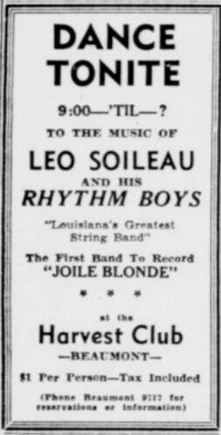
The group continued to perform at the Silver Star Club in Lake Charles for eight years. Shifting to the Showboat Club in Orange, TX and other places like the Harvest Club, the band continued to play together for another two years. Although Soileau and the group appeared frequently on the radio, they never recorded again. In the late '40s, Soileau left music to work with his brothers in a general contracting firm in Ville Platte. He died in August 1980.2  


  1. http://arhoolie.org/leo-soileau-interview/
  2. https://www.pandora.com/artist/full-bio/leo-soileau/ARZbKjv4drvdfqc 
  3. Lyrics by Martin S

Release Info:
63070-A Chere Liza | Decca 17047 A
63070-A La Valse De La Rosa | Decca 17047 B

Find:
Leo Soileau: Louisiana Cajun Music Vol. 7 (Old Timey, 1982)
Cajun Country, Vol. 2, More Hits from the Swamp (JSP, 2005)

Friday, July 31, 2020

"Darbone's Creole Stomp" - Hackberry Ramblers

The Hackberry Ramblers were one of the first Cajun string bands in the rnid-1930s to imitate the swing sounds from Texas (such as Bob Wills, Milton Brown and the Light Crust Doughboys), but they also played the latest jazz tunes of the time, such as "High Society", re-titled after a local town, called "Vinton's High Society", and "Careless Love". The Hackberry Ramblers were one of the first Cajun groups to use amplification in dance halls and they were the first band to record a string band arrangement of "Jolie Blonde" that is still heard today.1 

Radio waves emanating from Texas, Shreveport, and New Orleans ignored south Louisiana's cultural boundaries as they crisscrossed Cajun Country and spilled Western swing, hillbilly music, and jazz across the region.2  Influenced by music across the boarder, the original members got their big break when they were invited to play on the radio. Darbonne stated:
There were no radio stations in southwest Louisiana.  Not until the Lafayette's KVOL and Lake Charles KPLC came on air in 1935.2 

(top) Lennis Sonnier, Claude "Pete" Duhon,
(bottom) Luderin Darbonne, possibly Floyd Shreve
By 1937, several members changed out and landed in New Orleans recording for RCA's Bluebird Records at the St. Charles Hotel.   There, they recorded a rendition of the 1929 Harrington, Landry & Stewart instrumental "La Stomp Creole", re-titled as "Darbone's Creole Stomp"  (#2025).  Along with "Darbone's Breakdown", this is one of two songs which were odes to the band's founder, Luderin Darbone.  The recording featured Darbone on fiddle, Lennis Sonnier and Floyd Shreve on guitars, and Claude "Pete" Duhon on bass.  After the war, musicians such as Nathan Abshire re-titled the melody again as the "Hathaway Two Step". 


  1. J'ai Ete Au Bal Vol. 1.  ARhoolie CD 331.  Liner notes.
  2. Cajun Breakdown: The Emergence of an American-Made Music By Ryan Andre Brasseaux
Release Info:
BS 14004-1 Church Point Breakdown | Bluebird B-2025-A
BS 14003-1 Darbone's Creole Stomp | Bluebird B-2025-B

Find:
Cajun Country, Vol. 2, More Hits from the Swamp (JSP, 2005)
Cajun Capers: Cajun Music 1928-1954 (Proper, 2005)

Monday, April 20, 2020

"Quitter La Maison (Leaving Home Blues)" - Hackberry Ramblers

In 1933, when Luderin Darbone was 19, he joined Edwin Duhon to form a two-member band and named it the Hackberry Ramblers.  However, There was a change even before the band got its first job.  Duhon, accomplished on both the accordion and guitar, had planned to play the accordion to accompany Darbone’s fiddle. But the accordion was battered and wheezy. A new one would cost $20 — more than either young man had.1  By the time the Ramblers were hitting their stride and Eli Oberstein contacted them to record, the accordion was no longer the popular instrument in Cajun bands. 


Et là, heir au soir,

Mais, t'as été dans l'amour,
Elle m'avait dit elle voulait pas m'voir,
Mais ça, ça m'fait du mal.

J'ai quitté la maison,
Pour m'en aller dans le Texas,
J'ai quitté ma vieille mère,
Parce que mon cœur était cassé,
Eh, chère.

J'aimerais être avec toi,
Mais, je connais tu veux pas m'voir,
Je vas rester à Houston,
Parce que je connais tu me veux.
By 1935, according to Luderin, "no band had an accordion". Duhon put down his ailing instrument and picked up his guitar.  However, Darbone and Duhon did have a radio. They tuned to every station they could find that played country and western music. The Hackberry Ramblers started with a fiddle and guitar.1 


(top) Lennis Sonnier, Claude "Pete" Duhon,
(bottom) Luderin Darbonne, possibly Floyd Shreve
Luderin Darbone recalls the first recordings:
The first accordion record was released about in 28 or 29. At this period, when we moved to Crowley, it was about 1935. Then RCA Victor got this fellow, Leo Soileau, to come in and make some of these Acadian records and they went over pretty big. Then the next time they came down, or before they came down, I wrote to them and told them that we could play that type music too.  Then we started practicing up on these.2 
By 1937, the group consisted of Lennis Sonnier on vocals and guitar, Floyd Shreve on guitar, Claude "Pete" Duhon on bass and Luderin Darbonne on fiddle.  At the St. Charles Hotel in New Orleans, the ensemble recorded "Quitter La Maison" (#2021).  


And there, last night, 

Well, you were in love,
She told me she didn't want to see me,
Well that, that's terrible.

I left home,
To go away to Texas,
I went to my old mother's place,
Because my heart was broken,
Oh, dear.

I'd like to be with you,
But I know you don't want to see me,
I'm going to stay in Houston,
Because I know you want me to.


  1. "Hackberry Ramblers Making music since 1933". DON KINGERY. American Press, Friday, September 24, 2004
  2. http://arhoolie.org/hackberry-ramblers/
  3. Lyrics by Stephane F

Release Info:
BS 14000-1 Quitter La Maison (Leaving Home Blues) | Bluebird B-2021-A
BS 14007-1 Pas Aller Vite (Step It Fast) | Bluebird B-2021-B

Find:
Louisiana Cajun Music Vol. 3: The String Bands Of The 1930s (Old Timey/Arhoolie, 1971)
Cajun Early Recordings (JSP, 2004)

Wednesday, December 4, 2019

"Personne M'aime Pas" - Leo Soileau

Leo Soileau was one of the pioneer fiddlers of recorded Cajun music. His recordings with the remarkable accordionist, Mayuse Lafleur, sold well locally, but some very traditional fiddle duets made with a cousin, Alius Soileau, did not sell as well. He also recorded a lot of blues and some jazzy numbers. As American pop music began making inroads into the prairies and along the bayous of Louisiana, Leo Soileau began recording songs in English, as well as country and pop songs translated into French! He was one of the first Cajun artists, along with the Hackberry Ramblers, to cross over and reach a wider English-speaking market, while keeping his young audience at home happy and dancing to the latest music.1  


Ouais, mais, personne pour m'aimer,
Moi, je connais, ouais, ça fait pas rien, ouais,
Oh, non, mais, personne m'aime pas,
Ouais, ça fait (rien), mon nègre, chère.

Moi j'suis orphelin, ni mère ni père,
P'us personne pour (m') soigner,
Hé oui, je prends ça dur, chère,
P'us personne, ouais, pour m'aimer.

Oui, oui, oui, mon nègre,
Oh, mais, 'garde-donc à moi-même, chère,
Oh, ouais, ça fait pitié, chère,
Oh, ouais, toujours, moi tout seul.

Leo Soileau and his Rhythm Boys, 1944.
George T-Chalk Duhon, Crawford Vincent,
Leo Soileau, D.W. Bollie Thibodeaux,
Desbra Fontenot

Courtesy of the
Johnnie Allan Collection
UL Lafayette Center of Louisiana Studies

Soileau's influences came from many different places. "Personne M'aime Pas" was a French take-off of the popular song "Nobody's Darling But Mine"  It must have been quite a sensation since Cleoma recorded the tune as "Pas La Belle De Personne Que Moi" that same year.  It was translated from the song by Jimmie Davis, "Nobody's Darlin' But Mine."  

His band consisted of Julius ‘Papa Cairo’ Lamperez on steel guitar, Floyd Shreve on guitar, Tony Gonzales on drums, and probably Harold ‘Popeye’ Broussard on piano. Together, they headed to Dallas, Texas in December of 1937 for one of his last recordings. 
Port Arthur News
Dec 3, 1944


Yeh well, nobody loves me,
I know, yeh, it doesn't matter, yeh,
Oh, non, well, nobody loves me,
Yeh, it doesn't matter, my friend, darling.

I am an orphan, neither a mother nor father,
No one, yeh, to look after me,
Hey yeh, I'm taking this hard, dear,
No one, yeah, to love me.

Yes, yes, yes my friend,
Oh well, look at myself, dear,
Oh yeah, it's pitiful, dear,
Oh yeh, always alone.


Soileau remained active in the early '40s, recording with Leo Soileau's Rhythm Boys. Dropped by Decca when the label decided to stop recording Cajun musicians at the beginning of World War II, the group continued to perform at the Silver Star Club in Lake Charles for eight years. Shifting to the Showboat Club in Orange, TX, the band continued to play together for another two years. Although Soileau and the group appeared frequently on the radio, they never recorded again. In the late '40s, Soileau left music to work with his brothers in a general contracting firm in Ville Platte. He died in August 1980.2 


  1. J'ai Ete Au Bal Vol. 1.  ARhoolie CD 331.  Liner notes.
  2. https://www.pandora.com/artist/full-bio/leo-soileau/ARZbKjv4drvdfqc 
  3. Lyrics by Jordy A


Release Info:

63069-A Personne N'Aime Pas | Decca 17042 A
63067-A Valse D'Amour | Decca 17042 B

Find:
Leo Soileau: Louisiana Cajun Music Vol. 7 (Old Timey, 1982)

Tuesday, February 20, 2018

"Paroi Acadia Breakdown" - Leo Soileau

Leo Soileau was one of the giant figures in Cajun music history. His early recordings from the late 1920s are both powerful and emotive, and rank among the all-time classics of Cajun music. Great contributions to his music were made by legendary Cajun musicians and singers Mayeus LaFleur and Moise Robin.2  The bandleader prided himself on his diverse repertoire that catered to the ethnically diverse audience between southwest Louisiana and east Texas.1 Acknowledging the difference between country and Cajun:


It's more music to it--to me. You can play in different keys. That French music, it's just the one...just like that rock n roll.1


In the 1935 recording was done in Chicago, IL as his Four Aces Leo with Bill ‘Dewey’ Landry on guitar, Floyd Shreve on guitar, and possibly O.P. Shreve and Johnny Roberts on either drums, bass, or rhythm guitar.  The instrumental is a slower version of the Breaux recording of "Vas Y Carrement", better known "Step It Fast". 

For unknown reasons, Decca chose to market this for the French speaking market as well as the English speakers as well.   On their original release, the song is listed as "Pario Acadia Breakdown" (a mixture of French-English title referring to Acadia Parish) and on the re-issue, they gave it a new catalog number, renaming it to "Arcadia County Breakdown".  Oddly enough, the word parish is replaced with county and Acadia is misspelled. The same was done with the records flip-side recording: "Les Blues De La Louisiane" or "Louisiana Blues" respectively. 


Rayne Tribune
Oct 29, 1937


  1. Cajun Breakdown: The Emergence of an American-Made Music By Ryan Andre Brasseaux
  2. Leo Soileau - The Early Recordings of Leo Soileau CD.  Liner notes.
Release Info:
C-9975-A Les Blues De La Louisiane - Decca 17009 A Montgomery Ward M-4485
C-9988-A Paroi Acadia Breakdown - Decca 17009 B Montgomery Ward M-4485

C-9975-A Louisiana Blues - Decca 5116 A Montgomery Ward M-4485
C-9988-A Arcadia Country Breakdown - Decca 5116 B Montgomery Ward M-4485

Find:
Leo Soileau & The Four Aces (BACM, 2020)

Wednesday, February 14, 2018

"La Valse De Gueydan" - Leo Soileau

Old melodies such as "Jolie Blonde" were popular tunes that Cajuns picked up and learned during the turn of the century.   Melodies such as this one found it's way into pockets of isolated populations where unique names were given to the songs.  Leo Soileau's group took the original Breaux recording of "Ma Blonde Est Partie" and changed it slightly, giving it a new name, "Le Valse De Gueydan" (#2086). After the Hackberry Ramblers recorded the same tune in the same swing style as "Jolie Blonde", many musicians would later simply refer to Leo's version as "Jolie Blonde" as well.

In 1935 in New Orleans, Leo Soileau had his Three Aces group record the tune on Bluebird records under the watchful eye of Eli Oberstein.  The song was an ode to the small Cajun town of Gueydan.  While his Three Aces were fairly constant, occasionally Leo had other members record with him as well.   According to Happy Fats, Tony Gonzales was on drums and Bill Landry or Floyd Shreve was on guitar.  However, Preston Manuel recalls Sam Baker on drums and Jerry Baker on guitar.

Eh, jolie, moi je m'en vas dans grand Gueydan,

C'est pour voir, ma jolie petite fille,

Jolie cœur, je peux pas venir.


Eh, jolie, pourqoui-donc, mais, tu fait ça,

Avec ton vieux nègre, jolie petite fille,

Pourquoi-donc mais tu fais ça avec ton nègre?

Tu m’as laissée dans les misères,
Mais, jolie fille, pourquoi-donc,
Tu fait ça avec ton vieux nègre,
Et jamais j'avais cru quoi j'ai vu.

Tu ma dit, jolie fille.
Leo Soileau and the Three Aces
Floyd Shreve, Tony Gonzales, Leo Soileau, and Dewey Landry 5

Not to be confused with John Bertrand and Milton Pitre's recording of "Valse de Gueydan" or Amede Ardoin's "La Valse de Gueydan", it's the version of the melody in which most believe influenced Harry's famous 1946 recording of "Jole Blon".  After his father's death, around the late 30s, Choates joined Soileau's group on guitar and second fiddle for Leo's Aces with Joe and Abe Manuel, and Francis “Red” Fabacher. A great innovator in Cajun music, Soileau mentored Choates, who learned many of Soileau's stage tricks.   During Harry's time with Soileau's group, he was exposed to their song "La Valse De Gueydan".  


According to Happy Fats:
Harry had first performed the tune in Soileau's band but on his Gold Star recording he stepped up the key from G to A.  

Eh, pretty, I am going to big Gueydan,

It's to see my pretty little girl,

Pretty sweetheart, I can't return.


Eh, pretty, why have you done that,

To your old man, pretty little girl,

Why have you done that to your man?

You left me in misery,
Well, pretty girl, why have,
You done this to your old man,
And I never thought I'd see that.

You told me, pretty girl. 
The Three Aces' efforts were well received in the Cajun community.  Their version of the popular waltz was an instant success that prompted Bluebird to issue the record twice in their 2000 Cajun series.4


  1. South to Louisiana: The Music of the Cajun Bayous By John Broven
  2. Encyclopedia of Great Popular Song Recordings, Volume 2 By Steve Sullivan
  3. Label scan by University of Louisiana at Lafayette Cajun and Creole Music Collection - Special Collections
  4. Cajun Breakdown: The Emergence of an American-Made Music By Ryan Andre Brasseaux
  5. Country Music Originals : The Legends and the Lost: The Legends and the Lost By Tony Russell
  6. Lyrics by Smith S
Find:
Louisiana Cajun Music Vol. 3: The String Bands Of The 1930s (Old Timey/Arhoolie, 1971)
Jole Blon - 23 Artists One Theme (Bear, 2002)
Cajun Louisiane 1928-1939 (Fremeaux, 2003)
Cajun Capers: Cajun Music 1928-1954 (Proper, 2005)
The Beginner's Guide to Cajun Music (Proper/Primo, 2008)

Sunday, February 4, 2018

"La Breakdown A Pete" - Hackberry Ramblers

The Hackberry Ramblers were a western-swing group that employed Cajun French lyrics in many of their tunes.  The group, named after the town of Hackberry, Louisiana, started with Luderin Darbonne and Edwin Duhon.  Later in 1933, as their popularity spread, new musicians were added. The Ramblers began regular radio broadcasts, driving from Hackberry to radio station KFDM in the old Majestic Hotel in Lake Charles to make early morning broadcasts.1

According to the recollection of Crawford Vincent, the first drummer to be employed by a Cajun band, the Ramblers played their first club dance in the Blue Andrus Dance Hall in late 1933. They were applauded.  In 1935, the Ramblers moved to Crowley, which was centrally located to the spots across south Louisiana and east Texas where they were being booked.1
Pete Duhon, working as electrician

By 1937, the group had changed and added Claude "Pete" Duhon Sr. to the band's mix.   In 1938, the lineup changed.  Lennis Sonnier got married and was replaced by Floyd Shreve.  Luderin hired Floyd's brother, Danny Shreve shortly afterwards.  Crawford Vincent notes that the Shreve Boys had played with Leo Soileau previously and were good musicians.  Both were local boys who joined by the Ramblers first bassist, Claude "Pete" Duhon, a Crowley native.2  They entitled the instrumental song "La Breakdown A Pete", likely as an ode to their bass player.   


Hackberry Ramblers
Minus Broussard, Crawford Vincent,
Luderin Darbone, Jack Theriot

Pete had come to Luderin, wanting to learn an instrument and begin playing in the band.  So Luderin helped him after he had bought a bass fiddle for $15.00 from a local black man.2  Pete played with the group while working as an electrician in Vermilion parish.  However, this session would be their last before WWII, and the last recordings of Pete completely.   Luderin got married and moved back to Hackberry, and suddenly, their recording career would cease.  

Luderin speculated on why Bluebird Records never called them back:
I suppose they couldn't find me.2 


  1. "Hackberry Ramblers Making music since 1933". DON KINGERY. American Press, Friday, September 24, 2004
  2. Discussions with Ron Yule
Find:
The Cajuns: Songs, Waltzes, & Two-Steps (Folkways, 1971)

Tuesday, November 14, 2017

"Si Vous Moi Voudrez Ame (If You'd Only Love Me)" - Leo Soileau

Leo Soileau was one of the first Cajuns to incorporate elements of commercial country music into Cajun music.2  Formed in 1934, Leo Soileau's Three Aces--although there were never less than four musicians--soon shot to the forefront of this embryo "Cajun country" movement.  Apart from the Cajun tradition, their major inspiration came from western swing, a cheerful, spirited amalgam of swing, blues, ragtime, and fiddle music that originated in Texas.1  

Tu m’as dit, jolie fille, tu p’us, mais chère,

Tu pouvais pas p’us m’aimer, chère,

Pourquoi donc, mais tu fais ça à ton vieux neg, chérie?

Tu vas me faire (mourir??), jolie.

Tu m’as dit jolie fille, tu pouvais p’us m’aimer,
Toi, maman, quoi faire t’as fait ça, chérie?

Tu m’as dit, jolie fille, pourquoi-donc, chérie,
Tu fais ça avec ton neg, chérie,
Tu m’as dit, joli cœur, que tu peux p’us m’aimer, chère.

Ohh, toi, ‘tit monde, jolie fille, criminelle,
Haa, toi ‘tite fille, ohhh, bébé.
Rayne Tribune
Dec 10, 1937

He learned to play fiddle from his father at around the age of 12 and was inspired by other local Cajun musicians such as Dennis McGee.3   
I'd steal his fiddle from under the bed and when I'd break a string, I'd get a whipping.  That's for sure!3

In early 1935, Soileau's string band, without an accordionist, but with the first drummer to play on Cajun sessions, made popular recordings such as "Si Vous Moi Voudrez Ame (If You'd Only Love Me)" (#4880 & #2194) which Bluebird co-issued on Montgomery Ward's label.  His Three Aces were composed of Floyd Shreve on guitar, Bill (Dewey) Landry on guitar, and Tony Gonzales on drums.  The smooth, rhythmic music was in sharp contrast to the raw folk sound of Joseph Falcon's performances.   However, "Voudrez" was eclipsed by the more popular tune on the flipside, "Le Gran Mamou". 


You told me, pretty girl, you could, well dear,

You couldn't love me anymore, dear,

Why then, well, did you do that to your old man, darling?

You are going to make me an old man, dear.

You told me pretty girl, you could love me,
You, little momma, why did you do that, darling?

You told me, pretty girl, why so, darling?
You did that to your man, darling,
You tole me, pretty sweetheart, that you could love me, dear.

Oh, you little everything, pretty girl, it's terrible,
Ha, you little girl, oh baby.
Leo Soileau and the Three Aces
Floyd Shreve, Tony Gonzales, 
Leo Soileau, and Dewey Landry

By  late 1935, he renamed his band to the Four Aces and signed with Decca, which had already signed Joseph Falcon and Amade Ardoin.  Working with a completely different company, many unaware of his previous recordings, he used the opportunity with Deccas to re-record the song in 1937.   His swinging tune became more well known as "La Blues de Port Arthur".  


  1. South to Louisiana: The Music of the Cajun Bayous By John Broven
  2. The Encyclopedia of Country Music
  3. http://arhoolie.org/leo-soileau-interview/
  4. Lyrics by Jordy A
Find:
Raise Your Window: A Cajun Music Anthology 1928 - 1941 (The Historic Victor-Bluebird Sessions Vol. 2) (CMF, 1993)
Cajun Early Recordings (JSP, 2004)

Saturday, August 26, 2017

"La Valse De La Prison" - Hackberry Ramblers

The Hackberry Ramblers were the first band in southern Louisiana to bring electronic amplification to area dancehalls. Many of these venues still did not have electricity, and the Ramblers powered their primitive Sears-Roebuck “P. A. system” from the battery of Darbone’s idling Model-T Ford. The advent of amplification profoundly changed the local music scene. Until then only the accordion could cut through the noise of a crowd. Stringed instruments such as fiddle and guitar were barely audible and thus relegated to simple accompanying roles playing rhythm parts. Once they could be heard clearly, however, musicians who played these instruments were inspired to take solos and generally improve their technique, thus elevating the prevailing standards of musicianship.1


Dans la prison, chérie, assis sur mon lit,
Comment, donc, je vas faire, chérie, sans ma ‘tite fille?
Sans ma ‘tite fille, chérie, avec les yeux bleus,
Comment, donc, je vas faire, chérie, depuis tu m’aime p’us?
Depuis tu m’aime p’us, chérie, je vas m’en aller,
Je vas m’en aller, chérie, dans le paradis.
Crowley Daily Signal
Dec 30, 1940


The 1938 session that produced "La Valse De La Prison" (#2066) would be the band's last Cajun recording stint before the war.  Floyd and Danny Shreve backed Luderin up on guitar, with Floyd belting out the French vocals.  Claude Duhon filled in on bass.  In 1939, they disbanded briefly when Luderin quit playing after the death of his father in an oil-field accident. Luderin formed a new group in the 1940s, teaming with Crawford Vincent and Jack Theriot. The new band kept the old name — Hackberry Ramblers.  However, the Ramblers broke up again when some musicians were drafted for World War II. Darbone reorganized, bringing back Edwin Duhon and adding Eddie Shuler.2


In prison, dear, sitting on my bed,
How, then, will I go on, dear, without my daughter?
Without my daughter, dear, with blue yes,
How, then, will I go on, dear, since you love me?
Since you love me, darling, I'm gonna go,
I'm gonna go, dear, to paradise.


  1. https://www.knowlouisiana.org/entry/hackberry-ramblers/
  2. "Hackberry Ramblers Making music since 1933". DON KINGERY. American Press, Friday, September 24, 2004
Find:
Gran Prairie: Cajun Music Anthology, Vol. 3: The Historic Victor Bluebird Sessions (Country Music, 1994)
Cajun Louisiane 1928-1939 (Fremeaux, 2003)