Showing posts with label Cleoma Breaux. Show all posts

Wednesday, May 1, 2024

"La Fille A Oncle Elair" - Joe Falcon & Cleoma Breaux

The early surge of musical creativity carried over into a new period as Cajun performers throughout the 1930s, adapted tunes they heard on the radio. Joe and Cleoma were both known to have taken popular tunes of the day and recorded them in Cajun French.  

After the Great Depression, Joe and Cleoma were approached by RCA to travel to their makeshift studio in San Antonio for a recording session.  Together, the duo recorded four sings in 1934, one of them known as "La Fille A Oncle Elair" (#2191).  The song's popular was easily eclipsed by the record's popular flipside recording of "Ils Volet Mon Trancas", better known as "Hippy Ti Yo".  


Ah yéyaie les filles à n'onc Hilaire, 
C'est toutes des chères belles filles, 
Y'a une 'tite brune, y'a une 'tite blonde, 
Un qui est trop noire pour moi z'aimer, 
Mais, ça me fait du mal à moi.

Ah yéyaie les filles à n'onc Hilaire, 
C'est toutes des chères belles filles, 
Y'a une 'tite brune, une 'tite blonde, 
Un qui est pas de mon goût du tout, 
Mais, ça me fait du mal.

Ai yé yaille, les filles à Nonc’ Hilaire,
C'est toutes des chères ‘tites filles,
Tout ce qui me dégoute de porter des petits souliers numéro 9,
C’est trop de l’argent pour moi dépenser,
Fait pas ça avec moi.

Je me rappelle quand moi je passais,
Devant la porte de ta maman, 
N'en n’a pas un qui voulait me voir,
J'ai eu de la chance, mais-aujourd’hui,
De m' faire de l’argent,
Mais, ils m'ont tous dit d’aller me voir,
Elle voulait me voir avant de mourir.

Nonc Helaire Trahan
and Anita Babineaux Trahan


The song is a story of Nonc Helaire's daughters, each of whom had different colored hair.  The dark haired one was tough to love as a little girl since she seemed to desire expensive things such as "little size 9 shoes".   The author is clearly broke and only when he acquires enough money to make them happy, then he can visit their dying mother at her home.   In real life, "Nonc Helaire" was Helaire Trahan Sr, who came from such a large family that everyone knew him as "nonc".  A native of nearby Osson, Louisiana, he had three daughters, Nell, Verna and Joycelyn—the three filles referenced in Joe's song.1  


Aye ye yaille, the girls of uncle Helaire, 
They are all dear beautiful girls,
There's a brunnette, there's a blonde,
One who is too dark haired for me to love,
But, that hurts me so much.

Aye ye yaille, the girls of uncle Helaire, 
They are all dear beautiful girls,
There's a brunnette, there's a blonde,
One who is not my taste at all, 
But, that hurts me so much.

Aye ye yaille, the girls of uncle Helaire,  
They are all dear beautiful girls,
Everything disgusts me about them wearing little size nine shoes,
It's too much money for me to spend,
Don't do that to me.

I remember when I passed,
In front of your mother's door,
Not one of them wanted to see me,
I was lucky, today, to have money,
Well, they all told me to come see,
She wanted to see me before she died. 


Since then, the song has been recorded by many, including Beausoleil and the Basin Brothers, even taken on a caricature with Revon Reed as the famed "Nonc Helaire".  In 1996, Helaire's grandson, Horace Trahan, reworked the song in the studio and released it on his Swallow Records CD "Osson Blues".  


  1. Discussions with Anita H
  2. Lyrics by Marc C and Stephane F
Release Info:
BS-83852-1 La Fille A Oncle Elair (Uncle Elair's Daughter) | Bluebird 2191
BS-83853-1 Ils La Volet Mon Trancas | Bluebird 2191

Find:
Cajun Early Recordings (Important Swamp Hits Remastered) (JSP, 2004)

Thursday, June 16, 2022

"Pauvre Garcon" - Falcon Trio

By 1936, it had been over a year since Joe and Cleoma Falcon had stepped foot in a studio before they had scored another contract with RCA.  Eli Oberstein and other recording executives had arrived the week before Mardi Gras and began loading their equipment into the second floor of the building.   There, they planned a three-day session where bands such as Bo Carter and the Arthur Smith Trio were waiting for their turn.1    

Feeling the need for a fiddle player, Joe convinced Crowley native and musician, Moise “Mose” Morgan join their duo.  Mose had learned to play the fiddle as a young child and grew up learning popular tunes.  The trio recorded a song Joe called "Pauvre Garçon (Poor Boy)" (#2185).  In typical form, Joe often held the verses beyond the standard meter, allowing the chord changes to match the lyrical changes. 


Comment tu crois, mais, que moi j’peux faire, chère?

Mais, avant hier soir, mais, t’après faire avec moi,

Moi j’vois pas quoi moi j’va faire, moi seul.


Garde-donc toi, ‘tite fille qui crois bien pourquoi toi t’as dit, toi chère,

Il y a pas, mais, si longtemps tu m’as donc promis de jamais oublier,

Mais, ‘garde-donc toi t’après faire avec moi,

Tu devrais donc, chère, user ta tête, ouais, tu vois les promesses,

J’mérite, mais, oui, pas tout la misère que toi t’après me faire avec moi.


Au jour d’aujourd’hui, mais, moi j’connais, chère,

Tu vas r’venir, oui, mais, donc me r’joindre, oui chère,

Mais, pour des bonnes excuses à moi avant longtemps.


Tu connais, ‘tite fille, mais j’mérite pas, mais, donc tout ça, toi chère,

Le seul Bon Dieu va m’mettre la main, ça c’est moi, oui, pour toi, oui chère,

Mais, malheureuse, ‘garde moi donc, moi j’va faire, oui, tout seul.


Joe Falcon
Courtesy of Squalor Illustrations
squalorillustrations.bigcartel.com

Other bands such as the Hackberry Ramblers and the Dixie Ramblers were on the docket that day, awaiting their turn to record as well.  To avoid possible conflicts with any earlier contract that Joe and Cleoma may have signed with the Kapps at Decca, Oberstein got creative and renamed the group, The Falcon Trio. When RCA Bluebird pressings arrived in stores, eager buyers discovered Falcon Trio songs stamped on the flip-side of some Hackberry Ramblers recordings as well as on the flip-side of some Dixie Ramblers pressings.1  


How do you think, well, that I'll be able to do this, dear?

Well, before last night, well, what you've done to me,

I don't see what I'm going to do, I'm alone.


So look, little girl, who really believed what you said, my dear,

It wasn't, well, so long ago (that) you promised to never forget me,

Well, so, look at what you've done to me,

So, dear, you should use your head, yeah, you'll see the promises (made),

I don't deserve, well yeah, all of the misery that you've done to me.


As of today, well, I know, dear,

You have returned, yeah, well, so join me, yeah dear,

Well, apologies to me before long.


You know, little girl, well, I don't deserve, well, all of that, you dear,

Only the Good Lord will hold my hand, mine, yes, for you, yes dear,

Well, oh my, so look at me, i'm doing (this), yeah, all alone. 


  1. "Allons A Lafayette: The First Families of Commercial Cajun Music" by Wade Falcon
  2. Lyrics by Marc C

Release Info:
BS-99227-1 Mon Vieux D'Autrefois (My Old Used To Be) 
| Bluebird 2185
BS-99228-1 Pauvre Garcon (Poor Boy) | Bluebird 2185

Find:
Raise Your Window: A Cajun Music Anthology 1928 - 1941 (The Historic Victor-Bluebird Sessions Vol. 2) (CMF, 1993)
Cajun Early Recordings (JSP, 2004)

Friday, August 13, 2021

"Blues Negres" - Cleoma Falcon

This article may contain potentially offensive language, including obscenities and ethnic or racial slurs. In the interest of making this material fully available to scholars, we have chosen not to censor this material.

In the 1920s and 1930s, Cajun musicians could not avoid the influence of the blues sound heard throughout the south.   So much so, many of them recorded at least one tune with some blues influence.   A great example is the tune by Cleoma Breaux Falcon entitled "Blues Negres (Niggar Blues)" on Decca (#17004).   According to Dr. Barry Ancelet, it would be the influence of Afro-Creole and Native American sounds that makes Cajun music sound so different than the Acadian music of Nova Scotia.  

Oh, pour tu m'aimer,
Tu connais j'mérite pas donc tout ça, toi t'après faire,
C’est pitié a la maison, moi tout seul, j'ai p'us personne, mais, p'us m'aimer,
Moi j'm'en va, moi tout seul, comme un pauvre malheureuse.

Écoute-moi tout les conseils de les autres,
Tu connais moi j't'aime, bon Dieu sait, chère 'tite fille,
Tu connais j'mérite pas tout ça toi t'après faire.
Moi j'm'en va, moi tout seul, à la maison, j'ai p'us personne, mais, p'us m'aimer,
Pourquoi moi j'ai des regrets quoi toi t'après faire?


Recorded in 1934 in New York City, "Blues Negres", i
t shares similarities with a song called "Bull Doze Blues" by Henry Thomas in 1928 for Vocalion.  It's loosely related to the old minstrel song, composed in 1912 by Leroy “Lasses” White entitled "Nigger Blues", which was one of the first blues songs published.  In addition to the importance of the "Nigger Blues" for being one of the first published blues songs and written by one of the first composers of twelve-bar blues, it was the first whose lyrics were in what would become the standard blues form used by the 1920s vaudeville performers and found in the folk blues songs collected and recorded in the 1930s.3  


Whoa, how you loved me,
You know, so I don't deserve all that you've done,
It's pitiful at home, I'm all alone, I have no one, well, no one to love me,
I'm going, all alone, like a poor miserable woman.

Listening to all the advice of others,
You know I love you, the good Lord knows, dear little girl,
You know I don't deserve all that you've done,
I am going, all alone, to the house, I have no one, well, no one to love me,
Why do i have such regret for what you are doing?


Blues arrangements and one-steps acted as a cultural weather vane indicating the direction of commercial Cajun music.  Cleoma would go on to record other bluesy tunes such as "Ouvrez Grand Ma Fenetre" and "En Route Chez Moi". 


  1. Against the Tide, the story of the Cajun people of Louisiana by Zachary Richard
  2. Cajun Breakdown : The Emergence of an American-Made Music By Ryan Andre Brasseaux
  3. https://en.wikipedia.org/wiki/Nigger_Blues
  4. Lyrics by Herman M
Release Info:
39208-A Soucis Quand J'Etais Gamin (Troubles When I Was A Boy) | Decca 17004 A
39207-A Blues Negres (Nigger Blues) | Decca 17004 B

Find:
Presents Hot Women Singers (Kein & Aber, 2003)

Monday, January 4, 2021

"Le Valse De Mon Rêve (Waltz Of My Dream)" - Joe and Cleoma Falcon

Joe Falcon and his wife Cleoma Falcon had been the star Cajun musicians throughout the Cajun countryside from 1928 to 1929.  However, as the Depression took hold, their recording career went on hiatus.  It wouldn't be until 1934 when a different set of record scouts arrived in south Louisiana looking for the tried and true Cajun artists of the 20s.  Eli Oberstein, a field scout with RCA's new Bluebird division, attempted to do just that when the Falcons were invited to San Antonio.  Joe's "Le Valse De Mon Rêve (Waltz Of My Dream)" (#2188) backed by his wife Cleoma on guitar, expressed a lover's desire to see his love interest once more—this time, through the viewpoint of a dreamer. 

Tu connais, malheureuse, ça t'as fait, mais, z-avec moi,
Oui, chère catin, ça c'est dur pour moi endurer,
Moi j'connais j'ai pas bien fait, mais, j'aime quand même, jolie fille,
Eh, catin, donne-moi une chance avant de mourir.

Tu voudrais, jolie fille, t'en revenir avec moi-même,
Oui, malheureuse, tu voirais pour toi-même,
Moi me cru dans tout ça que le bon dieu me permettrai,
Oui, malheureuse, pour essayer de faire (ai)mer toi.

Moi j'me tarde de me voir, m'en revenir a la maison,
Oui, malheureuse, de plus trouver personne pour moi,
Moi j'vois pas quoi j'vas faire sur la terre, malheureuse, 
Oui, chère catin, ça c'est dur, ça pour moi.

"Les Falcons"
Cleoma and Joe Falcon

Courtesy of Bob Tooke

Oberstein worked with many other ethnic artists during his stint with RCA including Lydia Mendoza and King Nawahi's Hawaiians.  Accompanying the Falcons that day was black Creole accordionist Amede Ardoin and white Creole fiddler Dennis McGee at San Antonio's Texas Hotel. The city of San Antonio was virtually a world away, both culturally and geographically, for most Cajuns. The music filling the dance halls and streets of San Antonio during the 1930s sounded different in style and in language.  For recording companies, Texas seemed to provide as much talent to record executives up north as did Tennessee, Georgia and Louisiana.  During the decade, both Dallas and San Antonio would become Meccas for Cajuns looking for outlets to record.1       

Daily Advertiser
Sep 14, 1934


You know, miserable one, what you've done, well, with me,
Yes, dear doll, it's hard for me to endure,
I know I haven't been doing well, however, I love you nevertheless, pretty girl,
Hey, pretty doll, give me another chance before I die.

You would like, pretty girl, to come back with me,
Yes, miserable one, you'll see for yourself,
I believe in all of that, which the good Lord will allow me,
Yes, miserable one, to try to make you love (me).

I'm too late to see, returning home,
Yes, miserable one, to never find anyone for me,
I do not see what I'll do on earth, miserable one,
Yes, dear doll, it's hard for me.
Although not a major hit among the Cajun music buying audience, the melody did however influence other post-war recordings such as Austin Pitre's "Redell Waltz" and Nathan's "Avalon Waltz".  Either concerned about appealing to a male-dominated Cajun market or misunderstanding her importance, RCA failed to mention Cleoma’s name on the session notes.  Each of the record sides gave credit to “Joseph Falcon”, leaving Cleoma’s legacy as nothing more than the following footnote: “Singing with accordion and guitar by Mrs. Falcon”.1   


  1. "Allons A Lafayette: The First Families of Commercial Cajun Music" by Wade Falcon
  2. Lyrics by Stephane F

Release Info:

BS-83850-1 Le Valse De Mon Rêve (Waltz Of My Dream) | Bluebird B-2188-A
BS-83851-1 Vous Etes Si Dous (You Are So Sweet) | Bluebird B-2188-B

Monday, April 27, 2020

"Catahoula Stomp" - Falcon Trio

The mid-1930s saw a dramatic change for Cajun musicians, one that had the largest effect on traditional accordion players.  The old-fashioned sound of the 20s was gone and American pop songs, mainly driven by string bands, were all the rage.  Slowly, groups like Leo Soileau and the Falcons had to adapt to these growing changes to meet the demand in the dance-halls of the South. 

One of Joe and Cleoma Falcon's favorite places to play was at Catahoula Lake near the Atchafalaya Basin in St. Martin Parish.   The "lake" is actually a wide section of water at the junction of Bayou Mersier and Bayou Berard Canal.  The town of Catahoula was established here and by 1928, dance-halls popped up such as the large Catahoula Inn and Noe Lasseigne's dance-hall.  The Catahoula Inn boasted a large gathering room for 2500 dancers and became a popular spot for area musicians to perform.  
Cleoma Breaux Falcon


Once I loved a darling seaman,

Oh, and he thought this world of me,

Until another girl persuaded,

And now he cares no more for me.

I don't want your greenback dollar,
I don't want your watch and chain,
Yes, all I want is your heart, darling,
Won't you take me back again?

Oh, many a strolls we took together,
Oh, down beside the deep blue sea,
But in your heart, you love another,
But in my grave I'd rather be.

I don't want your greenback dollar,
Oh, I don't want your watch and chain,
Yes, all I want is your 22-20,
Just to shoot out your dirty brain.

Papa says we cannot marry,
Oh mama says it'll never do,
But if you ever learn to love me,
I will run away with you.


Catahoula Inn, 1928
In 1936, fiddler Moise Morgan tagged along with Joe and Cleoma to create their own unique string band sound.  In New Orleans, the trio covered their rendition of the old traditional "I Don't Want Your Greenback Dollar" which is slightly based on a song called "East Virginia Blues".  Leo Soileau used a similar melody in his English hillbilly recording of "Little Darling Pal of Mine". Maybe fearing royalty conflicts or legal action by other labels, RCA had the trio change the title.  Being a frequent performer at Lasseigne's dance-hall hot spot along the lake, the song became the "Catahoula Stomp" (#2186).  To increase sales in the Cajun market, the record company pressed the song on the flip-side of a Hackberry Ramblers tune.  This cover of a beloved English radio tune foreshadowed the style which the Falcons soon found themselves accustomed.  


  1. Lyrics by Jimmy Walker

Release Info:
BS-99231-1 Catahoula Stomp | Bluebird B-2186-A
BS 99213-1 Leave Me If You Wish (Hackberry Ramblers) | Bluebird B-2186-B

Wednesday, May 15, 2019

"Vieux Airs (Old Tunes)" - Joe Falcon

"Your Kiss Is Sweet".   This vieux air, or "old tune", was one of many Cajun instrumentals passed down to the later generations of Cajun musicians.   Like the recording's flip-side, the song had it's origins in 19th century Cajun folk life. Musicians like Joe Falcon practiced their instruments using these songs during their early years. In fact, Joe recalls his very first paid opportunity:
I had just took my accordion when I left with my sister with the horse and buggy to go to the dance.  And when I got there, [Oneziphore Guidy’s] band didn’t show up. So he asked me, ‘How about you coming in and playing my dance? I’ll pay you. I said, ‘Oh, no. I just play like that, for fun.’  He said, ‘Come on. I ain’t go no music’. So I got up on the band stand and I started playing, and I played until twelve o’clock, and at twelve o’clock he come there and he paid me four dollars. Boy, I mean, I was glad with them four dollars.1  

Cleoma Breaux and Joe Falcon

By the summer of 1928, his recording "Lafayette" was on area record store shelves when he and Cleoma Breaux were requested to hop on a train to New York City where they recorded "Vieux Airs (Old Tunes)" for Columbia Records  (#15325).  Like many of the recordings Joe made, the titles were lost to time.  Columbia recording engineers insisted the songs have names.  Many times, Joe had to create a name on the spot, hence, "Vieux Airs".  In some cases, he was encouraged to name the song after a location he was familiar with back home.  During a later recording session, he explains he had to create his own lyrics to these melodies,

The number was there but I had to make up the words.  Like "Osson", it was the name of a little town, but you just have to find a name to put on the record.  It's an old two-step.2  

By the time they got back, the buzz about his recordings had reached fever pitch and he no longer needed to work in the fields.  The dance halls were now prime places to make a living and their music career had officially kicked off. The song didn't gain much traction between the 30s and 50s, until Joe Bonsall recorded it as "Ton Bec est Doux" in the 1960s.   Later recording artists have resurrected the song, but the added lyrics are more recent. 


  1. Lauren Chester Post Papers, Mss. 2854, Louisiana and Lower Mississippi. Valley Collections
  2. http://arhoolie.org/joe-falcon-interview/

Release Info:
W146906-1 Vieux Airs (Old Tunes) | Columbia 15325-D
W146909-2 La Marche De La Noce (Wedding Marche) | Columbia 15325-D

Find:
CAJUN-Rare & Authentic (JSP, 2008)

Sunday, October 21, 2018

"Elle M'a Oublie (She Has Forgotten Me)" - Joe Falcon

Early 20th century Cajun music, and the industry that surrounded it, was dominated by men.  Much of this had to do with the reputation the music had among others in the community.  Generally, the music was played in places known for drinking, fighting and decadence; places where a urban lady typically wouldn't be found.  When Cleoma Breaux followed her brother's lead and joined up with Joe Falcon to become a professional musician, she challenged the industry's mentality of the time.   This heightened the group’s drawing power among men, although some women were reportedly resentful – even more so, perhaps, because Cleoma was a sharp dresser whose wardrobe reflected the latest national fashion trends. Atypically, the Falcons were able to make a living playing music alone, with no need for day jobs.

Ville Platte Gazette
Dec 14, 1929


Eh, chère, rapelle-toi j’ai promete,

Et j'étais d’accord, quoi tu m’as fait?

Chère, moi, je peux plus,

T’endurer, jolie cœur.
Toi, tu m’as promis, chère,
De plus faire ça et regarde-donc,
Quoi t'après faire aujourd’hui, chère,
Ça c’est dur, oui, pour moi t’endurer.

Quand même tu veux pas, chère,
T’as pas promis il y a pas longtemps, jolie fille,
Tu rappelle-toi quoi t’as fair, jolie cœur?
Oui, c’est de me voir, chère,
Si loin de toi après jongler sans savoir, jolie fille,
Chère, si jamais tu vas d’etre à la traîne.

Petite, tu devrais, chère,
Viens observer il y a si longtemps quoi t’as fais avec moi,
Chère, si tu jongle à moi,
Tu vas voir pour toi-même.
Petite, si tu voudrais, chère,
Donc, me prendre, tu saurais quoi moi je ferais pour toi-même,
Chère, tu te regretterais-donc jamais toute ta vie.
Cleoma and Joe Falcon
Courtesy of Alain Chenneviere

At this time, the role of women in Cajun music was relegated to the home, and a repertoire that primarily consisted of ballads, lullabies, and other a capella music not conceived for dancing. This mindset made it all the more remarkable when Columbia signed Cleoma, along with her partner Joe, to their own recording contract in 1929.1  The duo brought along her brothers Amede and Ophy to Atlanta as accompaniment. Together, the group recorded a song called "Elle M'a Oublie" (#40508) about a lover's broken promise.   

Hey, dear, remember, I promised,

And I agreed, what did you do to me?

Dear, I can not,

Endure you, pretty sweetheart,
You promised me, dear,
Never to do that, and so look,
What you are doing today, dear,
That's hard, yeah, for me to endure you.

Even if you do not want to, dear,
You didn't promise all that long ago, pretty girl,
Do you remember what you did, pretty sweetheart?
Yeah, it's to see me, dear,
So far from you after reminiscing yet not knowing, pretty girl,
Dear, if you're ever going to lag behind.

Little one, you should, dear,
Come and see how long ago, what you've done with me,
Dear, if you reminisce with me,
You'll see for yourself,
Little one, if you like, dear,
So, take me, you would know what I would do, for yourself,
Dear, you'll never regret this for the rest of your life.
Lake Charles American Press
Dec 14, 1951


  1. http://musicrising.tulane.edu/discover/people/452/Breaux-Cleoma
  2. Lyrics by Stephane F and Francis M

Release Info:
W110551-1 C'est Si Triste San Lui (It Is So Blue Without Him) | Columbia 40508-F OKeh 90008
W110554-2 Elle M'a Oublie (She Has Forgotten Me) | Columbia 40508-F OKeh 90008


Find:
Cajun Early Recordings (JSP, 2004)

Thursday, August 9, 2018

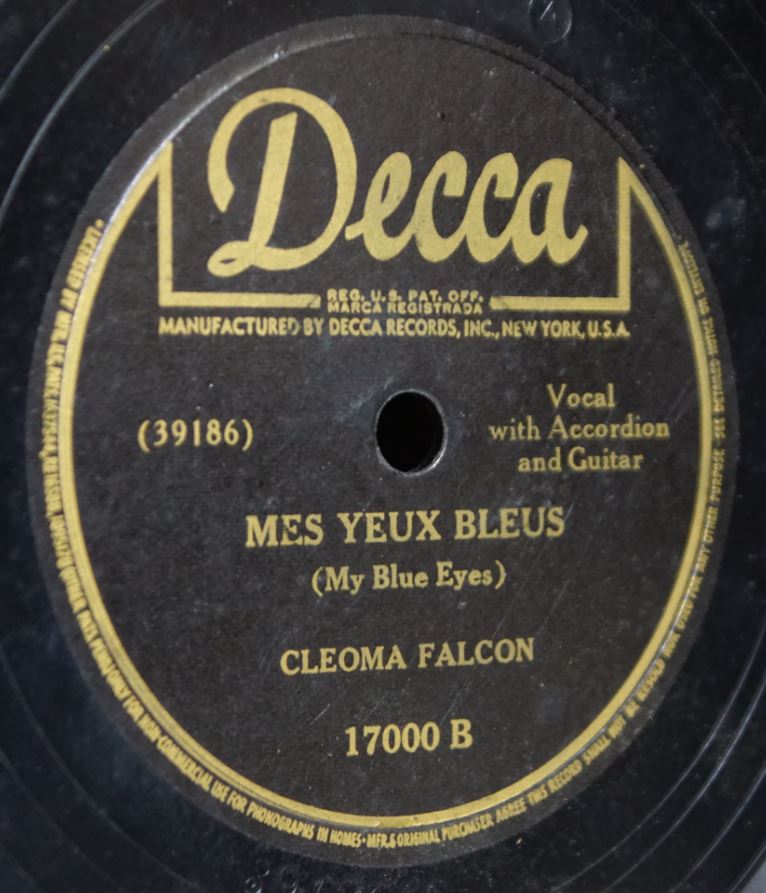
"Mes Yeux Bleus" - Cleoma Breaux Falcon

By 1934, the Great Depression forced major recording companies, such as Paramount and Columbia, to rethink their efforts in "French Arcadian" music.  No longer were scouts from these companies looking for regional music in the south.  It would be left to only three major companies, one of them known as Decca Records. That year, they would invite the Falcons, Joe and Cleoma, to record "Mes Yeux Bleus" (#17000) on their fledgling American label.  


J'ai jonglé, ouais, à toi, à mon yeux bleus,
J'va après, ouais, au dessus de la mer,
Moi j'suis après, ouais, jonglé a lui tout seul,
Et moi je jongle si jamais i(l) pense à moi. 
C'aurait été beaucoup mieux quand j'aurais jamais rejoint,
Dans ce pays, oui, si triste que aujourd’hui,
Pour le plaisir on à tant passé z-ensemble, 
Moi je suis sûr l'amitié (va) jamais oublié.

Il m'a dit, ouais, cher, que tu m'aimais, 
Et asteur, après t'en aller là bas,
Il y a une maille dans la chaine qu'as été cassée,
En me laissant avec une peine dans mon cœur.
Quelle espoir croire à toi, mais, toujours à moi, 
Est ce que tu viendrais pas, mais, avec une larme,
Et dire à les étrangers, ouais, tout autour de toi,
Que mon cœur z'avait cassé l'année passée.


Cleoma Breaux Falcon
Courtesy of Kelly Schafer
www.ampedartstudio.com

Former stockbroker Edward Lewis formed The Decca Record Company Limited in the United Kingdom in 1929. The company started releasing records under the Decca trademark.   A US branch, Decca Records, Inc., was launched in 1934. By persuading RCA and Columbia artists to jump ship onto their label, it was Decca's first attempt at releasing Cajun music.2  

"Mes Yeux Bleus" is a Cajun rendition of the Carter family's "I'm Thinking Tonight Of My Blue Eyes".  Cleoma was known to be a huge fan of the their music, later covering their single "Bonnie Blue Eyes" and primping her hair in similar fashion as Sara Carter had done.  Unlike Columbia, who payed for train travel to New York, Decca provided round trip bus fare. 
Daily Advertiser
May 17, 1947


I am reminiscing, yeah, about you, about my blue eyes,
I am going, yeah, out to sea,
I'm, yeah, reminiscing all alone,
And I'm thinking if you ever think of me,
It would have been alot better if I'd never joined you,
In the country, yeah, so sad today,
For the pleasure, we spent so much time together,
I am sure the frienship will never be forgotten.

You told me, yeah, dear, that you loved me,
And now, you're going over there,
There is a stitch in the chain that has broken,
Leaving me with pain in my heart.
What hope to have believed you, well, would always be with me,
Did you not come back, well, with a tear?
And tell the strangers, yeah, all around you,
That my heart had broken last year.


"Mes Yeux Bleus" was one of Cleoma's first attempts at covering American hillbilly music in the early 30s.  The Falcons would have a long career with Decca, fulfilling recording contracts until 1937.  This Decca branch was sold off during World War II, but the UK & US companies continued to release each other’s recordings in their respective territories.


  1. http://www.knowla.org/audio-file/90/&view=summary
  2. http://www.bigboppa.co.uk/45-sleeves/DE/decca/decc-de.htm
  3. Lyrics by Stephane F
  4. Illustration by Kelly Schafer

Release Info:

39185-A La Valse De Madam Sosten | Decca 17000 A
39186-A Mes Yeux Blues | Decca 17000 B

Find:
Cajun Country, Vol. 2, More Hits from the Swamp (JSP, 2005)

Friday, June 15, 2018

"Poche Town" - Joe Falcon

Joe Falcon, dubbed “The Accordion King,” helped push the instrument to the peak of its prewar popularity. Although button accordions were available in Louisiana as early as the 1880s, the instrument wasn’t popular until 1925, when the Monarch and Sterling boxes arrived on the scene. Set in C and D, they could be played alongside the open-tuned Cajun fiddle and, with their prodigious volume, they quickly came to dominate the dance music of the fais do do.1    

Oh, promets-moi, joli cœur,

Tu vas jamais m’oublier comme t'as pris, oui, ton cœur,

Tu m'as pris de la maison, jolie fille,
En promettant de me soigner, garde-donc ça tu fais, chère

Oh, observe-moi bien, joli cœur,
Tu vas avoir, ouais, pitié, moi tout seul dans la misère,
Tu m'as pris de la maison, jolie fille,
Tes bons parents qui m'a fait donc quitter de la maison.

Oh, j'ai p'us d'espoir, chère,
J'ai d'espoir t'en aller en virant le dos pour la vie,
Tu m'as dit, chère, tu voulais la promesse,
De bien te soigner tous les deux, bonne ‘tite fille, jusqu'à la mort.


Many of Joe's tunes had no titles by the time he entered the studio.  Executives persuaded him to make up names on the spot, either after family or towns he was familiar with.   Entitled "Poche Town" (#40506) in 1929, it was an old Cajun melody. Today, the area referred to as Poche Town (pronounced "poh-shay") is a rural section, north of the railroad tracks in Sulphur, Louisiana.  The area is named after George Simeon Portie, Sr.son of Oscar and Corrina Elender Portie, who moved here in 1902 from Hackberry, Louisiana.2

Adolph "Bixy" Guidry in 1929 did the same with his tune "Waltz Of The Long Wood" with Percy Babineaux for Bluebird Records.  Several of Joe's songs influenced Leo Soileau, including this one entitled "Promise Me".  The song also has some similarities to the Chuck Guillory's "Tolan Waltz", "La Valse De Grand Bois", Shirley Bergeron's "La Valse De La Belle", Blackie Forestier's "Crying Waltz" and The Veteran Playboys' "La Valse De La Belle".  


Oh, promise me, pretty sweetheart,

You will never forget me when you took, yes, your heart (away),
You took me away from home, pretty girl,
Promising to take care of me, so look what you've done, dear.

Oh, pay attention well, pretty sweetheart,
You'll have, yeah, pity, I'm all alone in misery,
You took me away from home, pretty girl, 
Your good parents who made me leave home. 

Oh, I'm hoping, dear,
I have hoped you'll go turn back forever,
You told me, dear, you wanted the promise,
Of taking good care of both of us, good girl, until you die.

The accordion-fiddle combination reigned at dances and on phonograph records until about 1935, when the slicker sounds of the hillbilly string bands and, soon, Western swing came rushing into the French-speaking parishes.   


  1. https://roothogordie.wordpress.com/2013/10/06/let-me-play-this-for-you/
  2. http://www.sulphurdailynews.com/article/20120226/NEWS/302269997
  3. Lyrics by Stephane F and Jordy A

Release Info:
W110552-2 Poche Town | Columbia 40506-F Okeh 90006
W110553-2 Osson | Columbia 40506-F Okeh 90006

Find:
Louisiana Cajun Music Volume 1: First Recordings - The 1920's (Old Timey, 1970)
Cajun, Vol. 1: Abbeville Breakdown 1929-1939 (Sony/Columbia, 1990)
Cajun Origins (Catfish, 2001)
Baby, How Can It Be? (Songs of Love, Lust and Contempt from the 1920s and ‘30s) (Dust To Digital, 2010)
The Perfect Roots & Blues Collection (Sony, 2015)

Friday, February 9, 2018

"Marie Buller" - Cleoma Breaux

Recorded in the summer of 1928 in New York, Cleoma Breaux's singing and guitar work took center stage once again during her performance of the driving valse à deux temps "Marie Buller" (#40502).  Her nasal vocal delivery, though at an uncomfortably low key for the singer, represented the first session to feature prominently a female Cajun vocalist.2 The melody has a slight similarity to her brother's recording of "Ma Blonde Est Partie" a year later.

The song is named after what was once a notoriously violent oil-field community, north of what now is called Mire/Bristol area, called Marais Bouleur.1,5   It lays about a mile from Lafayette Parish and across the road from the Acadia Parish line.  It was already a tough area when the discovery of oil compounded the problem by attracting Anglo-American drillers and roughnecks from Texas and Oklahoma.3  Breaux and Falcon frequented dancehalls in the area which were rough places to play. 

Tu m’as pris dans les bras d’ mon papa, 

D’ ma maman, tu m’as promis,

Je te soignais comme l’enfant de la maison,

Et c’est toi t’as pris, m’quitter moi toute seule.


Mon dieu sait y a pas eu qu’toi dans l’pays,

Mais y a eu qu’toi qu’mon petit cœur désirait d’avoir,

Pourquoi-donc j’ai écouté les conseils, tous les conseils de les autres,

Bon dieu sait j’lui dis toi,

Mais tout ça, ça t'après faire.


Tu voudrais t’en venir avec moi,
J’t’attendrai pour qu’tu sois qui m’appelle,
Bon dieu sait y a pas eu qu’toi dans le pays,
Mais y a eu qu’toi qu’mon petit cœur désirait d’avoir,
Ecoute pas tous les conseils,
C’est juste toi qu’moi je voudrais avec moi.

According to Rev. Donald Hebert, the name Marais Bouleur stems from a story about a horse name "Bouleur" who liked to roll in the mud of the swampy wetlands.  The swampy area, or "marais", remains wet most of the year.4  However, according to author Mary Alice Fontenot:
Some years ago, George Buller, at that time president of the St. Landry Police Jury, told me that his family name was once spelled "Buhler".  One of his ancestors, he said, owned a large tract of marshy land near Rayne, hence the name Marais Buhler, or Buller.  This sounds like a logical explanation, since the name Buller (or Buhler) would be pronounced "Bou-leur" by the Acadians.
Cleoma Breaux and Joe Falcon

An abundance of ruffians in the nearby Marais Bouleur made it virtually impossible to keep a dance hall open for any length of time (despite the best efforts of club owner Sully Babineaux and others), so folks from that area frequently came to Esta Hebert's hall in nearby Ossun and to Gérald Forrestier's hall in Vatican.  Referred to as "no-man's land", lawmen such as Martin Weber and Joe Hanks became famous for their unwavering maintenance of order in the dance halls around Marais Bouleur.3  

According to author Chere Dastugue Coen:
Weber had a habit of announcing his rules once at the beginning of the dance: No fighting, drinking, smoking, spitting, cussin, or wearing of hats in the hall.  If anyone had to fight, drink, smoke, spit, cuss, or wear a hat, he should go outside.  Mr. Weber did not repeat his rules.  He had a hardwood stick and used it liberally to break up fights and take off hats.3


Even some of the bad local men would make their presence known:
Supposedly some of these Marais Bouleur guys would do was wear a red handkerchief... the bandanna, such that when they would walk in a place, you'd say "Uh oh!".6  

You took me from the arms of my dad,

From my mom, you promised me,

I was treating you (well), like a child of the house,

And you took me, then left me all alone.


Good God knows there's no one other than you in the countryside,

Well, you were the only thing my little heart desired to have,

So why did I listen to the advice, all the advice of others,

Good God knows I told you,

Well, all that, that you've done.


You want to come with me,
I will wait for you, for you are calling me,
Good God knows there's no one other than you in the countryside,
Well, you were the only thing my little heart desired to have,
Don't listen to the advice of others,
It's just (that) I'd like you to be with me.
It wouldn't be until the 1940s before the first dance hall, Chez Petit Maurice, was able to remain open in the area.3  As far as the song is concerned, the reasoning behind Cleoma's title is unknown, however, it seems it has very little to do with the reputation of the area.  She sings about a common Cajun theme of being left alone, begging for the lover's return.  Over time, the Cajun term to refer to people that caused problems, kidnapping, and stealing, were called  "Marais Bouleurs".


  1. "Louisiana Women: Their Lives and Times" By by Janet Allured and Judith F. Gentry
  2. "Cajun Breakdown: The Emergence of an American-Made Music" by Ryan Andre Brasseaux
  3. "Cajun Country (Folklife in the South Series)" By Barry Jean Ancelet
  4. Haunted Lafayette, Louisiana By Chere Dastugue Coen
  5. Discussions with Jerry M
  6. "Looking For Trouble". David Brasseaux.  (https://vimeo.com/69744513)
  7. Lyrics by Stéphanie D

Find:
Louisiana Cajun Music Volume 1: First Recordings - The 1920's (Old Timey, 1970)
Cajun Origins (Catfish, 2001)
Cajun Early Recordings (JSP, 2004)
Cajun Dance Party: Fais Do-Do (Legacy/Columbia, 1994)