Showing posts with label Ivy Vanicor. Show all posts

Monday, May 14, 2018

"Teche Special" - Iry Lejeune

The legendary Iry Lejeune ranks as one of the truly great blind musician/performers.  Iry got his second chance at the recording world in 1947 when he heard about Eddie Shuler's radio show on KPLC in Lake Charles, La. Shuler provided a 15- minute segment daily during which any amateur musician could walk in and play on the air. Iry pitched his French accordion into a flour sack and showed up on Eddie Shuler's doorstep. The young accordion player was a smash hit with the listeners. Unfortunately, the station owner was not a fan of Cajun accordion music and ordered Shuler not to bring Lejeune back on his show.1 Shuler explains:
[Iry] came in and performed on my show, two songs.  When we were walking out of the station after the show was over, the head man of the station, his name was Mr. Wilson, he came out of that back room.  He had a voice like a bellowing bull.  He weighed about 290 pounds.  He said "Eddie Shuler, you S.O.B, what in the hell was that you had on my radio station?" I said "Mr. Wilson, that man said that was Cajun music. I don't know, I have to go along with him. I have never heard anything like it". He said, "If you ever do that again I'm going to throw you right out the front door.  I'm not going to tell you you're through, just kick your effed up self out the front door". I said, "Yes sir".3  


Eh, 'tit monde, comment tu crois, moi, je vas faire,
Tout le temps après, mais, jongler à toi,
Tu devrais quand même chez toi, t'en venir, oui, 'tite monde,
J'aimerais te dire quelque chose, que j'aimerais entendre.

Eh, je devrais, mais, pas oublier tout ça, toi,
Tout ça que, toi, t'etais apres me faire,
Juste par rapport à ta famille, 
Moi, je connais, tite monde, t'es apres me faire du mal.

Moi j'connais, catin, mais, viens donc me rejoindre,
Moi, je voudrais te dire quelque chose, que je peux pas te dire,
Moi, je peux pas t'envoyer te dire, mais, cher 'tit monde, pas jusqu'à, toi,
Tu reviens, oui, me rejoindre, que je te dis toi-même.


R.C. Vanicor, Ernest Fruge, Iry Lejeune,
Alfred "Duckhead" Cormier, Earl Demary,
Ernest's son


Not looking to loose his radio business, he dropped the act.  In the meantime, Shuler had formed a small record company, Goldband Records. He and Lejeune quickly reached a gentleman's agreement that they would record four sides in the middle of the night in the KPLC studios when they were not being used for station purposes. The agreement stated that Shuler would use all of his contacts with other disk jockeys and radio stations throughout Louisiana and Texas to promote and distribute the records produced, and that only if positive financial results could be produced within six months from the initial recording sessions would future recording sessions result.1  During one of those sessions, in 1949, Iry recorded the "Teche Special" (#101) alongside Ellis Vanicor on fiddle, Ivy Vanicor on rhythm guitar, and Orsy "R.C" Vanicor on steel guitar.  

Hey, my little everything, how do you think I'll deal with this,
Always, well, thinking of you,
You should still come home, yeah, my little everything,
I would like to tell you something, that I'd like (you) to hear.

Hey, I shouldn't, well, forget all that you (did),
All that which you did to me,
Just because of your family,
I know, my little everything, you made me sad.

I know, pretty doll, well, come and join me,
I would like to tell you something, that I can't say to you,
I can't send (someone) to tell you, well, dear little everything, not until you,
You come back, yeh, to join me, which I'll tell you, yourself.

Although this song was recorded in 1948, Iry was playing this song as early as 1944.3  His group under this agreement, Iry Lejeune cut 26 sides for Goldband Records and his subsidiary Folk-Star between 1948 and his tragic death in 1955.  Record sales rarely went beyond the local Cajun audience due mainly to the language barrier and the fierce down-home nature of the music.  Eddie considered one of these early copies a "big hit": selling a mere 3500 copies!2


  1. http://www.zydecocajunbyway.com/iry.html
  2. Cajun Honky Tonk. The Khoury Recordings.  John Broven. Liner notes.
  3. http://arhoolie.org/eddie-shuler-goldband-records/
  4. Ye Yaille Chere by Raymond Francois
Release Info:
-A Teche Special | Goldband F-101-A
-B Te Mone | Goldband F-101-B

Find:
The Legendary Iry LeJeune (Goldband, 1991)
Iry Lejeune: Cajun's Greatest: The Definitive Collection (Ace, 2003)

Wednesday, June 28, 2017

"Jolie Catin" - Iry Lejeune

In the small community of Pointe Noire near Church Point, a young man named Iry Lejeune was learning to play his cousin's accordion and listening to old recordings, especially records of Amédé Ardoin. This in turn led him to record "The Love Bridge Waltz" and "The Evangeline Special" for a Houston record label in 1947. After scoring a big regional hit with the record, LeJeune began to record for Eddie Shuler's Goldband Records in Lake Charles, bringing back the traditional sound of Cajun music from earlier in the century and through his own musical genius giving his songs an immediacy and direct emotional appeal lacking in Americanized music.5 

His rough accordion sound was a fresh change from the earlier country swing material by the Hackberry Ramblers and Happy Fats. A huge fan of Amédé Ardoin, Lejeune exploded with power as a Cajun accordionist, playing so loud that he often drowned out a full electrified band in his recordings. Many of the Vanicors played behind Iry during this session including Milton and Ellis on fiddle and Ivy on guitar.  


Billboard Magazine, mistakenly listing
"Steve Fruge" and Iry Lejeune

Even though producer Eddie Shuler created the Folk-star label specifically for Iry, he moved him onto his more widely sold Goldband label.
I had Folk-Star and Goldband.  Then, later, after two or three records, I put him on Goldband because he was selling a lot of records. I said "Hell, I don't give a damn about Folk-Star, I want Goldband". I put him on Goldband then.3


Eh, yé yaille, chère jolie,


Toi, catin, 'gardez donc,

Moi, j'suis là dans les misères.

Jolie, je peux pas t'avoir.
Moi, je n'peux plus dormir le soir,
Avec tour mes jonglements,
Et mon chagrin que j'ai pour toi.
Catin, oublie pas ça.

Eh, yé yaille, tu connais,
T'après sentir ton mal,
Parce que, toi, t'as toujors fait,
Tout le temps mal avec moi.
Tu m'as toujours maltraité,
Fait quelque chose que je méritais pas.
Mais, peut-être, que tu t'aperçois,
Toutes tes grosses erreurs.

Eh, yé yaille, tes chers 'tits yeux,
Qu,est aussi canaille ça me ressemble,
Que t'as quelque chose,
Que tu veux me dire,
Mais tu te sens pas cpable.
Moi, je voudrais que tu me redis,
Pour toi-même voir quo'faire que toi,
Tu m'as mis dans autant de chagrin,
Que moi je suis toujours dedans.

During this second session at KPLC in 1950 (or possibly 1952), Eddie Shuler had gotten the Vanicors and Iry together, laying down four sides, one of them being a fast paced two-step known as "Jolie Catin" (#102).  The crude, yet direct, translation to "pretty whore" doesn't capture the deeper meaning in Cajun culture.  It became a term of endearment, roughly translated to "pretty little doll", which had no negative connotation attached.  It's Iry's version of the Amede Ardoin song "Eunice Two Step" and allegedly, the song was inspired by his cousin Geraldine Lejeune Morain.  Doug Kershaw recalls playing with Iry:
I would set in with Iry & Nathan both.  Iry had so much heart & feeling when he sang & played his accordion.  I took that memory and applied it to myself when I grew up.
Crowley Daily Signal
Feb 9, 1950
Soon after, some band member changes had been made. Orsy had left to join Lawrence Walker as his rhythm guitarist and previous recordings had be on a "D" accordion but by this time, Iry traded it in for a "C" Monarch accordion.  According to Mike Leadbitter, on these recordings done at KPLC, Iry removed his shoes due to the fact that while playing, he would stomp his feet... causing the needle to jump on the disc!
Eh, oh my, dear pretty one,
You, little doll, look at this,
I am here in misery.
Pretty one, I can't have you.
I can no longer sleep at night,
With all I am thinking,
And my sadness I have for you.
Little doll, don't forget that.

Eh, oh my, you know,
You are feeling pain,
Because you always did,
Always did wrong by me.
You've always mistreated me,
Did things that I didn't deserve.
Well, maybe you realize,
All your big mistakes.

Eh, oh my, your dear little eyes,
That are so mischievous, it seems to me,
That you have something,
You want to tell me,
But, you don't feel like you are able.
I'd want you to tell me again,
For yourself why you,
Have placed me in all this grief,
That I am still in.
Much later, Nathan Abshire would re-record the tune into his "Basile Breakdown".


  1. Iry Lejeune: Wailin the Blues Cajun Style by Ron Yule
  2. http://www.hearthmusic.com/blog/a-hearth-music-visit-with-94-year-old-cajun-fiddler-milton-vanicor.html
  3. http://arhoolie.org/eddie-shuler-goldband-records/
  4. Billboard Magazine, 1951
  5. http://andrethierry.com/zydeco/
Find:
The Legendary Iry LeJeune (Goldband, 1991)
Cajun's Greatest: The Definitive Collection (Ace, 2004)

Thursday, August 18, 2016

"La Valse De Cajin" - Iry Lejeune

Known for his soulful music, many consider Iry LeJeune to be the greatest Cajun accordion player and recording artist of all time.  Produced by Eddie Shuler and Folk-Star, a subsidiary of Goldband Records out of Lake Charles, Louisiana, Iry’s recordings of "Calcasieu Waltz," "Jolie Catin," "Evangeline Special," and many more were big hits.  Believed to be recorded in 1950 at the KLPC radio station, "La Valse De Cajin" (#GF102) included Milton Vanicor on fiddle, Ellis Vanicor on fiddle, and Ivy Vanicor on rhythm guitar.  It was a slight take on his uncle Angelas' recording of "La Valse De La Louisianne".   Orsy Vanicor did not appear because he had left the Lacassine Playboys. It was a rendition of Bixy Guidry and Percy Babineaux's "Qu'est Que J'ai Fait Pour Etre Peuni Si Longtemps".

Around 1954, the Vanicors were playing with other bands or had quit.  Iry regrouped with a new set of band members around the Calcasieu area including Duckhead Cormier and Wilson Granger.  By mid 1955, fiddler J.B. Fusilier moved to Lake Charles around the same time Iry's fiddler Wilson Granger quit the group.  After playing with Iry at the Blue Moon, guitar player Alfred "Duckhead" Cormier told Iry:
I think we're gonna keep that man on the violin.  He's as good as you ever did have.2

Eh, yé yaille, chere tit monde,

Quo'faire t'es comme ça,

Autant dans les misères?

Eh, yé yaille, je te fais pas arien,

Je veux que toi tu sois,

Comme toi, chère, t'es après faire. 


Eh, yé yaille, tout cette peine,

Tu devrais écouter,
Ton vieux nègre une fois,
Quand, moi, je te dis quelque chose,
Tite fille, rappelle-toi,
Jongle voir quand ton papa,
T'as déjà aussi maltraitée.

Eh, moi, je voudrais que tu reviens,
Me rejoindre, cher tit monde,
Coucher ta chère tite tête,
Dessus mon épaule,
Quitter tes chères tites larmes,
Couler pour te pardonner tout ça t'as fait.


Church Point News
Oct 11, 1955

Sadly, Iry LeJeune died at age 26 when he and J.B. stopped to change a flat tire on his car late one night on their way home from a performance at the Green Wing club (believed to be located between Mamou and Eunice, Louisiana) along Hwy 90. Unfortunately, widening the highway for extra lanes meant the pair had no shoulder on which to pull the car. Both men were on the side of the road when Luther Holt of Houston, TX slammed into both men.  Fuselier, who was driving, survived the accident with numerous broken bones and a head injury, but LeJeune, unable to see well, had no warning and died instantly.  


Eh, ye yaille, dear little everything,
Why are you like that,
In so much misery,
Eh, ye yaille, I didn't do anything to you,
I want you to return to,
Your old self, dear, after all of this.

Eh, ye yaille, all of this pain,
You should listen,
To your old man one more time,
When I tel you something,
Little girl, you'll remember,
Think of how your papa,
Has already mistreated you so much.

Eh, I'd want your to come back,
To meet me, dear little everything,
To rest your dear little head,
Upon my shoulder.
Let your dear little tears,
Fall to pardon you for all you've done.

Church Point News
Oct 11, 1955

He left behind a young family of five children, dozens of recordings, and a Cajun music legacy.  Luther was jailed and charged with "negligent homicide".   

According to author Ron Yule:
I think Iry's impact was enhanced by his early death, but his unique accordion style and bluesy, earthy voice as presented in his recordings would have continued to be recognized. This great talent would have lived on, and he would have impacted other musicians just as it continues to do today.1


B.O. Sparkle, Bridge City, TX, 1954
Robert Bertrand, Wilson Granger,
Iry Lejeune, Alfred Cormier


  1. http://theind.com/article-16337-l'effet-papillon.html
  2. Louisiana Fiddlers By Ron Yule, Bill Burge
Find:
The Legendary Iry LeJeune (Goldband, 1991)
Cajun's Greatest: The Definitive Collection (Ace, 2004)

Monday, August 3, 2015

"Te Mone" - Iry Lejeune

Almost blind, Iry Lejeune devoted himself to the accordion, developing a style based on the singing and playing of Creole musician Amede Ardoin.  His emotional, heart wrenching singing full of blues notes and slurs is emulated by most Cajun singers.  Eddie Shuler, owner of Folk-star, created the label specifically to record Iry Lejeune and his Lacassine Playboys. From there, he recorded a slew of what he considered "folk" music with artists such as Sidney Brown, Joe Manuel, Gene Rodrigue, Popeye Broussard and Phil Menard.  The Folk-star recording of "Te Mone" (#101) was the second pressing Eddie Shuler released of the group, recorded at the KPLC radio studio in Lake Charles.   It featured the Vanicor family musicians, Ellis on fiddle, Ivy on guitar, and Orsy on steel.  In fact, this song features the only steel guitar ride in all of Iry's recordings.   
Eh, quo'faire, toi, tu crois,
Moi, j'suis là tout le temps,
Après t'espérer, chère.
Tu devrais mais pas m'oublier, yé yaille,
Tant loin que, moim
Je m'éloigne de toi.

Eh, quo'faire t'es comme ça,
Après espérer juste pour moi mais jour et nuit,
Juste pour me faire des misères,
'Tit monde,
Des misères que je mérite pas.
Iry Lejeune

The song was heavily influenced by Amede Ardoin's 1934 San Antonio recording of "Oberlin".  While the phrase "tit monde" directly translates to "little world", it's meaning isn't apparent here.  The phrase of endearment in this case is similar to "chere tout tout", referring to a loved one, usually a young girl or daughter.  While "chere tout tout" has the meaning of "you're my all in all", similarly, "tit monde" has a deeper meaning, more along the lines of "you're my whole world" or better yet, "you're my everything".    According to producer Eddie:
The song Te Mone and the song Duralde Waltz we did that when they came out with the little cheap tape recorders. A little cheap one track tape recorder, I think , was the name of the thing was Echo or something like that.  Some little thing cost $278 and I was in hog heaven because I had a way to make records and didn't have to go give that guy a fifth of whiskey.4 
Eh, why do you think,

I am here alwayss,

Waiting for you, dear.

You shouldn't forget me, yé yaille,

So far that,

I distance myself from you.


Eh, why are you like that,

Waiting just for me day and night,

Just to make me miserable,
Little one,
Misery that I don't deserve.
Eddie Shuler

Milton Vanicor did not record on this project since he felt they had enough musicians and did not need him.  It's the only session in which Iry recorded with a steel guitar.  According to Milton Vanicor:
When Iry came to my house, he was hitch-hiking. He’d play maybe for a dollar at a restaurant in some town, he’d hitch-hike to go elsewhere and stop maybe at a bar. If you’d tell him, "Play, I’ll give you a dollar," he’d play. If you’d tell him, "I’ll give you 2 dollars," he’d play. It didn’t make any difference to him... He came to my house dirty, dirty clothes, poor thing. He said, "I’ve come to ask you if I could stay with you." And I told him, I said, "You’ve got to ask your cousin, my wife." She put her head down and she said, "I guess so, Iry."  She was a good person. So, we got him some clean clothes and he stayed at my house and that’s when we started The Lacassine Playboys and we had a band. Me, and my brother and R.C. (R.C. Vanicor) and my nephew. It was all family, my brothers. There were 3 brothers and then, my brother-in-law and Iry. The Lacassine Playboys. It was a good band... I went over there and recorded with them.... We’d play almost for nothin’. We’d go and get maybe $6 a man. It was kind of a lot of money in them days, but at the most I had, the big dances, maybe $12.


  1. Iry Lejeune: Wailin the Blues Cajun Style by Ron Yule
  2. Encyclopedia of the Blues: K-Z, index By Edward M. Komara 
  3. http://www.hearthmusic.com/blog/a-hearth-music-visit-with-94-year-old-cajun-fiddler-milton-vanicor.html
  4. http://arhoolie.org/eddie-shuler-goldband-records/
Release Info:
-A Teche Special | Goldband F-101-A

-B Te Mone | Goldband F-101-B

Find:
The Legendary Iry LeJeune (Goldband, 1991)
Cajun's Greatest: The Definitive Collection (Ace, 2004)

Tuesday, March 3, 2015

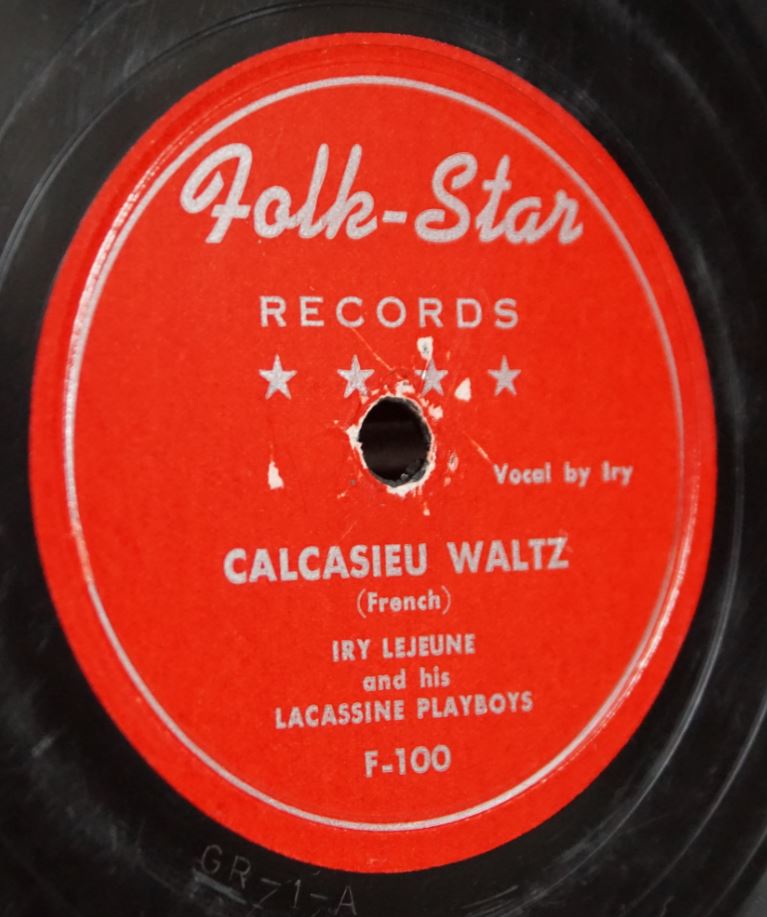
"Calcasieu Waltz" - Iry Lejeune

Iry Lejeune's sound would be copied from a Creole accordion player named Amade Ardoin.  When Iry reintroduced the accordion into Cajun music in the 1950s, he was inspired by many hours spent listening to his Uncle Angelas' old 78s of Ardoin.  In fact, the celebrated return of the accordion into contemporary Cajun music was largely due to Lejeune's versions of Ardoin tunes. 


Hé, gardez donc, moi je connais tu voudrais,
Hé, t'en revnir à la maison pour rejoindre ton nèg.
Hé, catin, moi je voudrais que toi tu reviens, quand-même,
ouias, une fois, mais, oui, une fois avant de mourir.

Oh, jolie, comment moi je vas faire?
Comment toi tu crois j'sus là tout te le temps pour toi?
Hé, 'tite fille, tout le temps après jongler
Autant dans les chagrins pas être capable jamais de t'avoir.

Hé, 'tite fille, pourtant rappelle-toi donc,
Que tu vas toujours écouter un autre que moi.
Hé, c'est pas la peine que moi je te dis quelque chose.
Toi, tu me ressembles pas jamais être contente.

Between 1949 and 1950, Shuler produced Iry's first Folk-Star 78 record, "Calcasieu Waltz" (#100).  It was a version of Ardoin's "La Valse de Amitié" recorded back in 1934 in San Antonio for Bluebird.  Similarly, Lee Sonnier composed his "War Widow Waltz" using the same melody roughly around the same time.  Shuler mentioned:


“I bribed the engineer at the radio station to cut the disc for us.  It was easy; just a fifth of Old Crow.”
"His first recording had a fiddle, a guitar, and a steel guitar. Them were all his wife’s brothers. That was “Lacassine Special” and “Calcasieu Waltz,” that was his first recording (on Folk-Star)."

The recording was done during Iry's second session at KPLC in Lake Charles. It included Milton Vanicor on fiddle, Ellis Vanicor on second fiddle and Ivy Vanicor on guitar.  Calcasieu is an Attakapas word that means "crying eagle" named after an Attakapas Indian chief who gave a peculiar cry like an eagle as he went into battle.   Eventually a parish was named after him; with the song taking the name from the parish.  
Doug Kershaw and Iry Lejeune
Avalon Club


Hey, look, I know that you'd like,

Hey, to come back home to join your lover.

Hey, doll, I'd like for you to come back, even if,

yes, one time before dying.


Oh, pretty girl, what am I going to do?

How can you believe I am always there for you?

Hey, little girl, I am always thinking in sorrow about because I'm can't ever have you.


Hey, pretty girl, remember well!

You will always listen to another besides me.

He, there's no use for me to tell you anything.

It seems you can never be happy.

Eventually, Lee Sonnier, along with Laura Broussard on vocals, would record a slower version of the melody and call it "War Widow's Waltz".  


  1. The Kingdom of Zydeco By Michael Tisserand
  2. Iry Lejeune: Wailin The Blues Cajun Style by Ron Yule
  3. http://www.wendyrodrigue.com/2011/04/iry-lejeune-cajun-accordion-player.html
Find:
The Legendary Iry LeJune (Goldband/Swallow, 1991)
The Legendary Iry LeJune Vol. 1 (Goldband/Swallow)
The Legendary Iry LeJune Vol. 2 (Goldband/Swallow)
Iry Lejeune: Cajun's Greatest; The Definitive Collection (Ace, 2013)

Sunday, August 31, 2014

"Lacassine Special" - Iry Lejeune

This artist could easily be considered the most influencial Cajun musician after WWII. Iry Lejeune was a virtually blind accordionist from around Church Point, Louisiana who brought back the same bluesy, soulful playing that Amede Ardoin brought to the culture 20 years before. Many of Iry's songs have the same melodies that Amede used, including being influenced by his cousin's music, Angelus Lejeune.

He was among a handful of recording artists who returned the accordion to prominence in commercially recorded Cajun music and dance hall performances. The return of the accordion contrasted with the popular Cajun recorded output of the late 1930s and 1940s, a time during which fiddles and Western Swing sounds from Texas were influencing Cajun music. At the conclusion of World War II, LeJeune moved west to Lacassine, Louisiana (near Lake Charles) where there were many more venues in which to play music.

Nearly blind, music provided happiness for LeJeune, and as he grew older. Unable to work in the fields because of his poor eyesight, as a youth, LeJeune entertained the local sharecroppers. By the time he reached his teens, LeJeune was making a few dollars on weekends playing dances. Luckily, in 1948 LeJeune met fiddler Floyd LeBlanc. Together they traveled to Houston, Texas where they recorded "Love Bridge Waltz" and "Evangeline Special" on Leblanc's Opera label with Virgil Bozman's Oklahoma Tornadoes supporting.  Bozman's band backed up many artists who had songs to record. 

Upon returning to Lacassine, LeJeune went to radio station KPLC in Lake Charles and asked to perform on the air. The station manager wasn't keen on hearing the primitive, wailing accordion, but disc jockey Eddie Shuler liked what he heard and featured him on several broadcasts. 
Iry Lejeune

"I felt sorry for the kid," admitted Shuler. "He was nearly blind and he had no other way to make money."
 "He said 'Eddie, I want to make records and I want you to make them,'" said Shuler. "I didn't know anything about making French records. Finally I agreed though because there was nobody around here making French records. Nobody was interested in making them because there was no money in French records. But as it turned out, I had the market to myself."
LeJeune knew Shuler was making his own records on Goldband and asked whtat her record him. It costs $200 to press copies at about 9 cents a copy.  Shuler struck a deal.  They would record one record, and if it made any money, they'd continue working together. If not, they would part ways. Bribing the engineer at KAOK with a bottle of Old Crow, in 1950, Shuler had LeJeune record "Lacassine Special" and "Calcasieu Waltz" on a disc cutter at the radio station used to record commercials and jingles. He sent the metal masters to Houston where several hundred 78s were pressed on the Folk Star label.   Backed by Iry's group consisting of Milton Vanicor on fiddle, Ellis Vanicor on fiddle and Ivy Vanicor on rhythm guitar, the record made a profit of $72.
"I was in high cotton", Shuler says. "By that time, I was hung up in this record business, and I didn't want to play anymore.  I just wanted to make records.  That's how I got into the record business."
"Lacassine Special" was based on an older set of tunes.  It's about a husband threatening his wife with an end to their marriage by telling her that "tu peux voir le chemin et t'en aller" (but you can see the road and go"). In 1937, the melody appears in J.B. Fusilier along with Miller's Merrymakers song "Elton Two Step", recorded for Bluebird records, and Joe Falcon's "Step On It", recorded for Decca records.  The same melody appears even earlier in Amede Ardoin's 1929 recording "Two Step de Mama". (In Tisserand's book, he mistakely states it's based on Ardoin's "Tante Aline" however, that song would become Iry's "Viens me Chercher".) 

Hé, comment mais toi tu crois
Que moi mais moi je va's faire
Tout le temps dans les misères
Tout le temps après souffert
Juste rapport à tes paroles
À tes paroles que toi,
Catin tu m'avais dit
Hé, ta chère vilaine manière,
Que toi t’as tout le temps eu
I1 faudra t’oublies tout ça.
Si toi tu veux rester
avec ton cher vieux nèg’
Mais ’garde toi tu peux voir
Le chemin et t’en aller.
Hé, toi, chère,
il faut toi tu t’en reviens
Mon, j’suis tout le temps là
après jongler à toi
Après jongler à toi, catin,
c’est juste rapport
A tous mais ces jonglements
Que toi tu m’as mis dedans.

Keep in mind, "neg" and "negresse" are corrupted forms of the word "negre" which in Cajun french has an endearing meaning such as "hey, my man" or "hey, honey", completely void of racial tones. Author Stivale covers this topic quite well.  The same can be said for "catin", which loosely translates to "little doll".  At times, the words are not described at all, but are simply blamed for the man's misery, as when the singer says that he has suffered misery because of "tes paroles, que toi, catin, tu m'avais dit" ("Just because of your words, of your words that you, catin, you said to me"). Milton Vanicor remembers playing the song with Iry:
Iry complained that no one could see him because he was sitting too low. Iry said he'd like to be the same height as everyone else but he couldn't play standing up. They came upon the idea of stacking "Coke" flats high enough that he'd appear taller. They stacked them and put his chair in the middle of the two stacks. The legs of the chair were placed in the holes where the cokes fit.
He was now the same height as the others and he was happy. Milton told him, "Now that you're up there, play the 'Lacassine Special'. Man, he got on that thing. Everybody that was dancing stopped, you know, they came to the bandstand to hear." Milton said when Iry's hair flopped down in front of his eyes; it meant he was really getting into the music. He began rocking back and forth and before long the boxes started moving and opening up. All of a sudden on one backward sway he kept going and wound up on the floor. "Ellis always said he didn't stop, but he did. He did stop a little while. He fell on his back, and boy, he got on that 'Lacassine Special' layin' down. We had fun."
After his tragic death, his music carried on.


  1. Angola to Zydeco: Louisiana Lives By R. Reese Fuller
  2. http://www.louisianavibe.com/artists/lejeune-iry/
  3. Iry Lejeune: Wailin The Blues Cajun style by Ron Yule
  4. http://www.louisianafolklife.org/LT/Articles_Essays/creole_art_oral_poetry_caj.html
  5. Disenchanting Les Bons Temps: Identity and Authenticity in Cajun Music and Dance By Charles J. Stivale
Find:
The Legendary Iry LeJeune (Goldband, 1991)
Cajun's Greatest: The Definitive Collection (Goldband, 1993)
As Good As It Gets: Cajun (Disky, 2000)
Cajun Capers: Cajun Music 1928-1954 (Proper, 2005)
The Beginner's Guide to Cajun Music (Proper/Primo, 2008)
Musique de La Louisiane (Intense, 2008)
The Best Of Cajun & Zydeco (Not Now, 2010)