Showing posts with label Khoury's Recordings. Show all posts

Saturday, September 20, 2025

"Point De Lou" - Nathan Abshire

Nathan Abshire was born in the small town of Gueydan and his father, mother and uncle all played insturments.  Although his father was an accordionist, Abshire claimed nobody taught him, he just picked it up himself.  Abshire spoke little English.  He was unable to sign his own name, yet he composed many wonderful Cajun songs, and was right at the top of the tree as a singer, accordionist and bandleader.1   

J’étais à là, z-au bal, j'ai fait le serment de p(l)us te voir, 

Courtiser les veuves, j'connais ça fait du bien,
Dans la courtise* cousins, 'tit monde, mais, je suis comme ça, 
Toi, qui veux m'aimer, j'connais ça me fait du mal.

J’étais à là, z-au bal, mais, j'suis-z-habillé encore, 
J'vais seulement pas te voir pour courtiser les veuves,
Toujour courtise*, j'suis comme ça pas, toi tu veux me rejoindre,
Mais, ça fait du mal, j'connais ça peut pas durer.


Nathan Abshire


The song was likely an ode to a small community in Acadia Parish named Pointe Aux Loups, between Iota and Eunice.  It translated to Wolf Point because of all the wild wolves that roamed the area.   Recorded between 1953 and 1954, "Point De Lou" (#645) was influenced by one of the earliest versions of the melody, Iry Lejeune's "J'ai Ete Z Au Bal". It's based off of a children's tune known as ""The Rabbit Stole The Pumpkin" by John Bertrand & Milton Pitre in 1929, with words added by Joe Falcon in his 1934 recording of "Ne Buvez Plus Jamais (Never Drink No More)".   


I was there, at the dance, I swore I'd see you some more,

Courting all the single ladies, I know that it's good,
Courting your cousin*, my little everything, well, I'm like that,
You, who wants me to love you, I know it feels bad.

I was there, at the dance, well, all dressed up again,
I'm not only there to see you, but, to court the single ladies,
Always courting*, I am not like that, you want to join me,
Well, it hurts, I know that it cannot last.


Nathan changed the name from the Musical Five and his band became the Rhythm Five after several of his band members left.  He had to put together a rag tag team of musicians and friends in order to keep playing, mostly due to the Kegleys leaving the group.  Because of the nature of Nathan's lineup changing, it's quite difficult to pin down the musicians during this period.  The session possibly had Cleveland Deshotel on fiddle, Atlas Fruge on steel guitar, Ernest Thibodeaux on guitar, possibly Jim Baker on bass and Shelton Manuel on drums.  Yet, to this day, the vocalist of this wild and raucous recording is unknown.  


  1. Boppin' By The Bayou - Rock Me Mama.  Liner Notes.
  2. Lyrics by Stephane F
Release Info:
2258 Texas Waltz | Khoury KH-645-A
2259 Point De Lou | Khoury KH-645-B

Find:
Nathan Abshire & the Pine Grove Boys - French Blues (Arhoolie, 1993)

Wednesday, November 2, 2022

"Old Time Waltz" - Texas Melody Boys

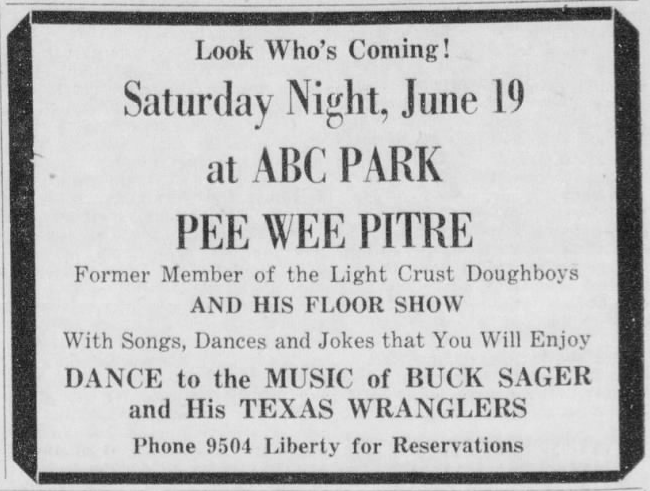
Robert William "Pee Wee" Pitre was one of the single session Cajun recording artist of the early 1950s.  A native of Kinder, Louisiana, he was a radio entertainer and accordion player in Eunice.  He moved to Texas at some point after WWII and formed a group he referred to as the Texas Melody Boys. 

During his early years, Pitre worked along side Eddie Shuler's band and performed on his radio show.   Eventually, Shuler hosted a stage show where Pitre showed up as a one-man-band, dressed in blackface minstrel.2    


Oh, mignone, moi j'connais, tu va vieux nègre,
Tu va vieux nègre, mais, ça t'as fais dedans vieux nègre.

Eh, mignone, moi j'connais, tu va vieux nègre,
T'es misère, mais, mon tout seule à la maison,
Eh, catin, t'oublie faire, mais, ça t'as fais,
T'oublie faire, mais, ça t'as fais, dedans vieux nègre.


Liberty Vindicator
Jun 17th, 1954
Pee Wee moved to Texas where he worked alongside fiddler Ralph Richardson.  Ralph, originally from Lake Charles, heard Pee Wee playing on KPLC.  According to researcher Lyle Ferbrache,
He was happy go-lucky and was a very smooth dancer, drawing his friends to follow him from club to club. Pee Wee also had a record on his own Pee Wee label with fiddle player Ralph Richardson.1  

Pitre's reputation as a solo entertainer made the newspapers during a halftime football show on the field.  
"The second quarter saw Private Peewee Pitre, who was recently awarded a Hollywood contract which he plans to take up after the duration, amaze the crowd with songs, dances, and snappy patter. He scored heavily with musical imitations without instruments and tap danced his way to a touchdown as the half ended, with a glass of water balanced on his head."3  -Lake Charles American Press

Oh, cutie, I know you left, your old man,
You left your old man, well, what you've done to your old man.

Hey, cutie, I know you left your old man,
You are in misery, well, I'm all alone at home,
Hey, pretty doll, you've forgotten, well, what you've done,
You've forgotten, well, what you've done to your old man.

Pee Wee Pitre
"Old Time Waltz" (#500) turned out to be his rendition of the classic "Jolie Blonde", first recorded by the Amede Breaux.  Pitre's repertoire of accordion songs were quite limited according to the Vanicor family.  After Ellis and Orsy Vanicor agreed to accompany Pitre at a performance, he played the same songs over and over, forcing the dance feel long and tiresome.  Fiddler Wilson Granger shared the same experience with Pitre and his antics.

Pee Wee Pitre was slick. When we’d play, like at the Shamrock Club. He’d come there about 10, 11 o’clock. He’d say (motioning toward a distant table),  “A bunch of people over there asked me to play ‘Jolie Blonde’ for them.” He was lying, but we’d let him play it.4   

I went there one night to play music with him. Bill Mott was playing accordion with Pitre that night. He wouldn’t give us a chance to tune our music. He’d make us play whether we were ready or not. He was slick. He could talk himself into anything.4 


  1. Post War Cajun 78 RPM Nuggets - Blues & Rhythm. Lyle Ferbrache. 2014. 
  2. The Eunice News Eunice, Louisiana · Friday, November 29, 1946
  3. "Cajun Dancehall Heyday" by Ron Yule
  4. Interview with Wilson Granger. Andrew Brown. 2005.
Release Info:
Ain’t No More | Khoury's 500 A
Old Time Waltz | Khoury's 500 B

Find:
Cajun Honky Tonk: The Khoury Recordings, Volume 1 (Arhoolie, 1995)

Friday, April 30, 2021

"Ain't No More" - Texas Melody Boys

Robert William "Pee Wee" Pitre was one of the single session Cajun recording artist of the early 1950s.  A native of Kinder, Louisiana, he was a radio entertainer and accordion player in Eunice.  He moved to Texas at some point after WWII and formed a group he referred to as the Texas Melody Boys. 

His "group" recorded a popular Amede Breaux tune called "Vas Y Carrement", more commonly referred to as "Step It Fast".   In 1949, Nathan Abshire tied lyrics to the song which Pitre borrowed for his title "Ain't No More" (#500).  It's about The recording is quite fast paced and a bit confusing aurally.  While some hear multiple musicians, researcher and author Lyle Ferbrache believes we're hearing the sounds of a one-man-band.  He explains:
It seems the Texas Melody Boys were just Pee Wee singing and playing the accordion and a drum! I love the record and play it often and that’s all I hear.1  

Eunice News
Nov 29, 1946

Sadly, not much is known about Pee Wee.  He moved to Pasadena Texas in 1954 shortly after the recording and died in 1960. 


  1. Post War Cajun 78 RPM Nuggets - Blues & Rhythm. 2014

Release Info:
Ain’t No More | Khoury's 500 A
Old Time Waltz | Khoury's 500 B

Find:
Cajun Honky Tonk: The Khoury Recordings, Volume 1 (Arhoolie, 1995)

Monday, April 5, 2021

"Casa Blanca Waltz" - Nathan Abshire

Nathan Abshire made his first recording debut in 1935 alongside Happy Fats' string band.   He resurrected his recording career in 1949 with his famed "Pine Grove Blues" recording which carried him through the 1950s.  As Nathan Abshire's recording career with Lake Charles record salesman George Khoury was winding down, so was George's interest in Cajun music.   By 1956, the band continued to market itself as the Pine Grove Boys and found themselves covering popular tunes to keep the crowds coming.  Named after the small Casa Blanca Bar in Westlake, Louisiana, "Casa Blanca Waltz" (#647) was an ode to this short lived place that Nathan and his band frequented.  


Eh, 'tite monde, tu m'a quitté, 
Tu m'a quitté, pour t'en aller avec un autre,
Eh, chère, ça m'fais du mal,
Je parti mon aller sur les lames.

Eh, 'tite monde, c'est pas la peine,
Si jamais quoi te reviens pour m'rejoindre,
Mon je vu peux jamais, tous t'es voir, catin,
Les paroles tu m'a dis sont trop dur.

Eh, 'tite monde, tu m'a dis,
Pouvez p'us jamais veux, mais, te m'rejoindre,
Eh, catin, j'ai pris ça,
J'ai pris ça c'est dur que j'ai parti.

Eh, 'tite monde, j'ai parti,
Moi aller, sur le lames dans les misères,
Aujourd'hui, 'tite monde, tu voudrais mon cœur,
T'es trop tard, mon je veux plus jamais tu voir.


His band in 1956 consisted of possibly Jake Miere on steel guitar, Ernest Thibodeaux on guitar, Cleveland Deshotel on bass, and Shelton Manuel on drums.  Fiddler and vocalist Dewey Balfa, relatively unknown at this time, helped the band recreate the old classic melody entitled "Over The Waves".  It had entered the Cajun dance-hall repertoire eight years prior with Oklahoma Tornadoes fiddler, Floyd Leblanc.  It's popularity peaked in south Louisiana in the 1960s as Joe Bonsall's closing song each night. 

Nathan Abshire with the Balfas


Hey, my little world, you left me,
You left me, to go away with another,
Hey, dear, that makes me feel bad,
I left to go over the waves.

Hey, my little world, it's not worth it,
If you ever come back to join me,
I'll never ever see you, pretty doll,
The words you told me are too harsh. 

Hey, my little world, you told me,
You could never want, well, to join me,
Hey, little doll, I took it,
I took it hard, therefore, I left.

Hey, my little world, I left,
I'm going over the waves into misery,
Today, my little world, you would like my heart,
You're too late, I never want to see you again.


Eunice News
June 22, 1961


The dance-hall era of Cajun music began to fade in the late 1950s.  To keep the music going, Nathan purchased a nightclub in 1960 with Dorselee Deshotel called the Rainbow Club in Basile, Louisiana.  With the arrival of rock and roll, Cajun music as a whole had little chance of being heard much beyond Louisiana until 1964, when fiddler Dewey Balfa very reluctantly agreed to appear at the Newport Folk Festival. To his great surprise, he received not scorn but adulation from the huge audience, and he returned home convinced that Cajun music was not something just for the old folks back home, but potentially had great international appeal.  Nathan would go on to record more tunes with the Balfa Brothers for several years afterwards.


  1. http://louisianadancehalls.com/dance_hall/casa-blanca-club/
  2. http://www.fiddlingaround.co.uk/cajun/
  3. Lyrics by Herman M

Release Info:
647-A Lu Lu Boogie | Khoury's KH-647-A
647-B Casa Blanca Waltz | Khoury's KH-647-B

Tuesday, July 21, 2020

"Lu Lu Boogie" - Nathan Abshire

By the mid-1950s, the country found itself absorbed in rock n roll and Cajun accordion players adapted to the new sound in various ways.  In early 1955, Nathan Abshire and his Rhythm Five recorded a jumping, jiving instrumental in which he called the "Lu Lu Boogie" (#647).  His "Five" at the time consisted of Nathan on accordion, possibly Dewey Balfa on fiddle, possibly Jake Miere on lead guitar, possibly Ernest Thibodeaux on rhythm guitar, and possibly Shelton Manuel on drums.  Believed to be named after Leleux's Dance-hall near Estherwood, the club was owned by locally-known fiddle luthier Lionel Leleux's grandfather, Ernest Leleux.   His dance-hall was located in the community of the family's namesake.  

Leleux's Dance-hall, 1938
Russell Lee Collection, LOC

When young Lionel Leleux began playing music in 1927, he teamed up with the young Nathan Abshire.  They rotated between playing at Leleux's Dance-hall and the Martinez Dance Hall in Morse.  Neither had transportation, so one week, Lionel walked the 12 miles to Morse; the following week, Nathan hiked it to the community of Leleux.2   According to a 1941 Louisiana brochure by the Work Projects Administration, "Leleux is little more than a post office, general store, and combination saloon and dance-hall, where fais-dodos, or Cajun “breakdown” dances, are held each Wednesday evening."1   
  
Ernest Leleux, 1938
Russell Lee Collection, LOC

Ernest's dance-hall featured the likes of Dennis McGee and Sady Courville in the earliest days and was the chosen location for U.S. Farm Security Administration's photographer Russell Lee.   In 1938, he took some of the most iconic photos of post-Depression life in the Cajun prairies, including dancers dancing to the popular string band: the Alley Boys of Abbeville.    His photos taken in Leleux's Dance-hall are located today in the Library of Congress. 

Another possible origin for the name could have bee Lulu's Dancehall, located southwest of Gueydan, not far from where Nathan lived.  Lastly, it could have been a reference to local man named Lester "Lu Lu" Faulk that lived in the southwest area of Vermilion Parish; an area which contains the road named Lu Lu Rd. 


  1. Louisiana; a guide to the state, compiled by workers of the Writers' Program of the Work Projects Administration in the State of Louisiana ... sponsored by the Louisiana Library Commission at Baton Rouge.
  2. The Daily Advertiser (Lafayette, Louisiana) 26 Jul 2009


Release Info:
Casa Blanca Waltz | Khoury's KH-647-A
Lu Lu Boogie | Khoury's KH-647-B

Find:
French Blues (Arhoolie, 1993)

Monday, June 22, 2020

"Belle Isle Waltz" - Jimmy Choates

Fiddler Jimmie (Jimmy) Choate was born in Bancker, Louisiana, not far from Abbeville.  He grew up playing music at an early age, similar to many of his siblings.  Quick to latch on to the success of famed Texas fiddler Harry Choates, Jimmie and his brother Pete decided to make a music career.  Jimmy's Melody Boys accommodated Ronald Ray "Pee Wee" Lyons on steel guitar, possibly Blackie Dartez on guitar, and Charles ‘Pete’ Choate on bass guitar.


Hé, petite, mais, moi j'm'en vas à Belle Isle,
Oh, chérie, mais, moi j'connais j'mérite pas ça.

Hé, petite, mais, moi j'connais, jolie fille,
Hé, chérie, mais, moi j'connais tu vas brailler.

Hé, petite, mais, moi j'connais, mais, moi j'm'en vas,
Au Belle Isle pour t'en aller, t'en aller, mais, loin d'ici.

Daily Advertiser
May 20, 1949

In 1950, Jimmy and his Melody boys recorded the "Belle Isle Waltz" (#608) in Lake Charles; a story of a lover going to Belle Isle.   It's a region of open fields located in the marsh lands, along the Gulf Coast, far away from most of the Cajun prairies.  On the highland areas, cattle ranching was the way of life in the 1930s for most residents, including families such as the Sagreras and Broussards.  Ernest Broussard recalled there were no roads at all in Belle Isle.  "It was open prairie, just a trail to go to [Abbeville]."1  


Hey, little one, well, i'm going to Belle Isle,
Oh, dearie, well, I'm know I don't deserve that.

Hey, little one, well, I know, pretty girl,
Oh, dearie, well, I know you're going to wail.

Hey, little one, well, I know, well, I'm going,
At Belle Isle you left, you left to go, well, far from here.


  1. http://www.louisianafolklife.org/LT/Articles_Essays/creole_art_ranching_trad.html
  2. Lyrics by Stephane F

Release Info:
Lonesome For You | Khoury's KH 608-A
Belle Isle Waltz | Khoury's KH 608-B

Find:

Cajun Honky Tonk: The Khoury Recordings Vol. 2 (Arhoolie, 2013)

Sunday, May 24, 2020

"Bosco Stomp" - Lawrence Walker

Oh, c'est ça fait du mal!  It's one of the most recognized tunes in all of Lawrence Walker's discography: the Bosco Stomp.  Transcending both Cajun and Zydeco music, musicians since the 1950s have been playing and recording this tune.  Named after the community of Bosco, which in turn was named after a store owner, Fernest "Bosco" Prejean, it was located between Lafayette and Church Point.  The melody was originally recorded by Delin T. Guillory and Lewis Lafleur as the song "Quelqun est Jalous" ( or "Quelqu'un est Jaloux") for Victor in 1929.   According to writer Neal Pomea:

Bosco Stomp, a remake of Delin T. Guillory and Lewis Lafleur's "Quelq'un est Jaloux", is a well-loved standard showpiece, common to the repertoire of Walker's contemporary and rival, Octa Clark.2   


Crowley Daily Signal, Oct 1949


Ça, ça m'fait du mal.

Oh, bébé, ça m'fait du mal.

Oh, haha!

(Il) y a des 'tites blondes,
(il) y en a des 'tites brunes.
Il y en qu'est assez noires que moi j'peux pas aimer,
I(ls) vont t'faire des accroires,
I(ls) vont faire des promesses,
I(ls) vont t'faire ouais t'aimer et là ça te tourne le dos.


Ah, U.J., yeah, alright.
Ah yeah, oh, come on baby.

Ça, ça m'fait du mal.

Petite, rappelle-toi,
Tous les misères tu m'as fait,
Tu mens tout ce qui peux,
Que moi je peux p(l)us t'aimer.

Uray Jules "U.J." Meaux

Working with Lake Charles record producer, George Khoury, Lawrence gathered up his band Valmont "Jr." Benoit on steel guitar, Demus Comeaux on rhythm guitar, Lawrence Trahan on drums, and Uray Jules "U.J" Meaux on fiddle.  Together, they recorded "Bosco Stomp" (#616) in 1951.    A lively piece, you can clearly hear Lawrence call out "U.J." midway through the song.  A popular tune with his contemporary Aldus Roger, store owner Bosco Prejean was Aldus' wife's step-grandfather.  The entire family grew up in the area and recalled the drunken brawls and bloody fights that locals encountered in the rough and tumble Marais Bouleur side of Bosco. 


What's done is terrible.

Oh, baby, what's done is terrible.

Oh, haha.

There are little blondes,
There are little brunettes,
There are some dark haired ones, that I don't like,
They're going to make you believe falsely,
They will make promises,
They will make you, yeah, love them, and like that, turn on your back.

Ah, U.J. yeah, alright.
Ah yeah, oh, come on baby.

What's done is terrible.

Little one, remember,
All the miserable things you've done to me,
You lie all that you can,
Therefore, I can't love you anymore. 


As WWII wound down, Walker was one of the first accordionists to return the instrument to prominence--but not in the old style. His band, the Wandering Aces, fused the string band format with a heavy steel guitar sound with the drive of the accordion.  The result was a brash new sound that came to be labeled "dance-hall".2,3   Once Walker's recording his the jukeboxes, the popularity took off.  For decades, Cajun and zydeco bands found ways to incorporate the song into their repertoire in order to keep the audience dancing.  In 1963, Doug Kershaw reworked the melody into the "Cajun Stripper".  


  1. Francois (Yé Yaille Chère!), 1990; pgs. 346-347
  2. Discussion with Neal P
  3. "Accordions, Fiddles, Two Step & Swing: A Cajun Music Reader" by Ron Brown, Ryan A. Brasseaux, and Kevin S. Fontenot 
  4. Lyrics by Stephane F


Release Info:
Waltz Of Sorrow | Khoury's KH 616-A
Bosco Stomp | Khoury's KH 616-B

Find:
Cajun Honky Tonk: The Khoury Recordings, Volume 1 (Arhoolie, 1995)
Cajun Champs (Arhoolie, 2005)

Thursday, February 20, 2020

"Country Waltz" - Lawrence Walker

By the 1950s, it had been 15 years since Lawrence Walker had stepped into a recording studio.  No longer where the major recording labels, such as RCA and ARC, interested in his music.  It was during this time he got wind of an independent recording producer in Lake Charles who had made a name for himself recording the Cajun accordion music of Nathan Abshire.  It would be his first recording session since the 1930s and afterwards, his legacy would never be forgotten. 

Lawrence's path mimic'd the same one that Nathan had gone down.  Both were picked up briefly by RCA in the 1930s and both were dropped once the accordion was no longer in favor.  Since Lawrence was no longer playing with his brother as a duo, he formed a new group with Mitch David on fiddle, Valmont "Junior" Benoit on steel guitar and Simon Schexneider on drums.  Even Houston Fruge played with the band.  Together, they recorded the "Country Waltz" (#601), the tale of two estranged lovers, Adam "Tit 'Dom" Hanks and Alice Royer. 


Oh, Alice, vas-donc mettre ta 'tite robe de grandes barrées,

'Garde-donc quoi-ce-qui vient à travers du clos sur Grand Henri,
Tu m'as promis d'espérer et 'garde-donc voir quoi t’après faire aujourd'hui,
Petite, tu demandes une chance avant de mourir.

Oh, Alice, blâmes-donc pas les paroles dis, viens-moi Alice, tite monde,
Petite, tu connais surement la cause de tout ça,
Tu connais je prends ça dur mais de devoir t'en aller aussi loin de toi,
Oui, chère Alice, donnes-moi une chance avant de mourir.

Lawrence Walker

The well-known story of Alice, Adam, and his horse Henri was popular among those around Acadia Parish.  The story was first recorded by Pointe Noir native Angelas Lejeune in his locally popular tune "La Valse A Tidom Hanks".  Over time, the story made it's way into Lawrence Walker's repertoire and he used it to accompany his "Country Waltz".  Johnnie Allan, steel guitarist in Lawrence's later years, recalls the places where he and Lawrence used to play in the country:


We performed at clubs like the OST in Rayne, the Welcome Club in Crowley, the Jolly Rogers in Forked Island, the River Club in Mermentau, the Bon Ton Rouley in Lafayette, and the Blue Moon in Lake Charles.  None of the clubs was air conditioned and the cost was usually fifty cents per person. The audience varied in age from about fifteen years old to some in their seventies.1 


Oh, Alice, go put on your little striped dress,

So look, what's that who's coming across, riding on Big Henri,
You promised me hope and to keep watching what you're doing today,
Little one, you asked for one more chance before I die.

Oh, Alice, don't blame the words that were said, come to me Alice, my little everything,
Little one, you surely know the cause of all  of this,
You know I've taken it hard, well, having to go so far away from you,
Yes, dear Alice, give me another chance before I die. 


Rayne Tribune
Dec 2, 1954

Both Lawrence and Aldus Roger had popular bands that packed the same clubs, sometimes night after night.  Allan remembers:

Generally we played from nine to one o'clock with no intermission.  The band members pitched in to set up and tear down musical equipment, there were no roadies in those days!.1

By 1962, Walker re-recorded his tune for Swallow Records as "Chere Alice". 


  1. South to Louisiana: The Music of the Cajun Bayous By John Broven
  2. Lyrics by Stephane F

Release Info:
Country Waltz | Khoury's 601 A
Mamou Two Step | Khoury's 601 B

Find:
A Legend At Last (Swallow, 1983)
Cajun Honky Tonk: The Khoury Recordings, Volume 1 (Arhoolie, 1995)
A Tribute to the Late, Great Lawrence Walker (La Louisianne, 1995, 2000)
Essential Collection of Lawrence Walker (Swallow, 2010)

Saturday, February 15, 2020

"Musical Five Special" - Nathan Abshire

Nathan Abshire was a Cajun accordionist who made his home in Basile, Louisiana.  A self-taught musician, he was in great demand as a performer, first at house dances, then at local dancehalls, and eventually at music festivals all over the country.  In the 1930s, he played with Creole musician Amede Ardoin, who had a great influence on Abshire's music. In 1949, Nathan, backed by Earl DeMary's Musical Aces, recorded the acclaimed "Pine Grove Blues" in Lake Charles. It was an attempt by bar owner Quincy Davis to get new found attention on his struggling dancehall, the Pine Grove Club.


By 1953, Quincy Davis had gotten the publicity he wanted and Nathan was left on his own.  According to Bernella Fruge, she believes that's when Davis insisted on exclusive rights to use the Pine Grove Boys name in relation to the Avalon Club.  Looking for an alternate and influenced by DeMary's band, Nathan renamed his group the Musical Five.   Together, they recorded the "Musical Five Special" (#631), an instrumental cover of the Joe Falcon song "Fe Fe Ponchaux". While Cleveland "Cat" Deshotel had begun playing with Nathan around the same time, it's believed to be Will Kegley on fiddle.  Will would end up playing with Nathan during those early years before the band picked up Atlas Fruge and Jim Baker and Shelton Manuel.  According to Will's grandson, Chad Crochet, he had heard stories of younger Will building and selling fiddles in exchange for whiskey.  

After a notorious fight between Will and Nathan's steel guitarist Atlas Fruge, which left Altas with a stab wound, Will was sentenced to 18 months in prison, but only ended up serving a few months.  When he returned, Atlas had left the band and Will picked up right where he had left off.   However, it wouldn't be long before he found more trouble.  Kegley eventually moved from Lake Charles to the other side of the Sabine, playing in Orangefield and Port Neches, Texas.  He decided to leave after tangling with Davis, a man who had done prison time and supposedly had connections to the mob.4  


Will Kegley and Nathan Abshire

Stories about Kegley's pension to fight Davis after drunken sprees at the Avalon are notorious, however, many only remember his fine fiddling skills.3  When famed fiddler Doug Kershaw formed his group and the Continental Playboys played bars and dances around the Lake Arthur area, they wound up as regulars on radio station KPLC. He recalled Will Kegley as the founding influence in his earliest years:
We learned songs from local musicians like the fiddler Will Kegley.2,5

Cajun accordionist Ray Abshire recalled Will backing him up.
Kegley was the master at 'basing' behind the accordion.  When playing with Will, I sometimes turned to make sure he was still playing.  He was so good he just blended perfect with the accordion.4  

Today, Will's fiddle can be found in the Nashville Hall of Fame museum.


  1. Discussions with Chad Ray Crochet
  2. http://www.fiddle.com/Articles.page?Index=27&ArticleID=18818
  3. Louisiana Music by Lyle Ferbrache
  4. https://therecordlive.com/2009/08/13/the-lost-waltz/
  5. "Cajun Breakdown: The Emergence of an American-Made Music" by Ryan Andre Brasseaux
Release Info:
Musical Five Special | Khoury's KH-631-A
Avalon Waltz | Khoury's KH-631-B

Find:
Nathan Abshire & the Pine Grove Boys - French Blues (Arhoolie, 1993)

Friday, January 31, 2020

"La Cote Farouche De La Vie" - Marie Falcon & Clopha "Shuk" Richard

What many people aren't aware of is that acclaimed Cajun accordionist Joe Falcon had a large musical family, which included his niece Marie Solange Falcon.   Marie, backed by Clopha "Shuk" Richard's band, had a short lived recording career in 1952.   An admirer of her aunt Cleoma Breaux Falcon, she had no problem jumping into the music business.   She had played with many musicians and lived in Cajun dance-halls playing music for years.  George Khoury had her record a very popular country song that year, in French, called "Le Côte Farouche De La Vie" (#621).  The song is fitting for the wild and boisterous female guitarist and vocalist.


Vous serait pas lire mes lettres, se j'ai écrit les 

Tu me demandes de pas ta appelez de sur "phone", 
Il y a quelque chose de vous dit, oui, asteur chere, 
Je l'ai écrit dans les mots dans c'ette chanson. 

Savais pas bon dieu a fait des anges "honky-tonk", 
J'aurais tu connu que m'a jamais faites une femme, 
T'as quitte, oui, le seul l'amour qui t'aimé, chere, 
T'en aller sur la borde la vie farouche. 

Les lumière du le place du soir t'a attiré,
A la place éyoù vin et whisky flux,
Bien, êtes-vous d'être le bébé d'un autre de Pointe d'Eglise,
Oublier l'amour des yeux que t'as jamais connais. 

Savais pas bon dieu a fait des anges "honky-tonk", 
J'aurais tu connu que m'a jamais faites une femme, 
T'as quitte, oui, le seul l'amour qui t'aimé, chere, 
T'en aller sur la borde la vie farouche. 

Eddie Richard, Jay Dartez,
Clopha "Shugg" Richard on accordion,
Marie Solange Falcon on guitar,
Jack Brock (MC)

It is a Cajun rendition of Hank Thompson's 1952 "The Wild Side Of Life". It carries one of the most distinctive melodies of early country music, used in "Thrills That I Can't Forget" recorded by Welby Toomey and Edgar Boaz in 1925.2  The song's roots go back to when William Warren was a boy and A.P Carter of the Carter Family was collecting old traditional folk songs for the Carter Family to record.  One of those songs was "I'm Thinking Tonight of My Blue Eyes," which was a hit for the Carter Family in 1929.  In 1934, Marie's aunt, Cleoma Breaux, was a huge fan of the Carters and had used the melody for her "Mes Yeux Bleu". Influenced by her aunt, Marie sung the song in Lake Charles backed up by Shuk Richard on accordion, Will Kegley on fiddle and Crawford Vincent on drums.    


You would not read my letters, if I wrote them,

You asked me not to call your phone,
This is something you said, yes, right now, dear,
I wrote the words in this song.

Didn't know the good Lord made honky-tonk angels,
I should have known that you never made a woman,
You're leaving, yeah, the one that loved you, dear,
You're going to the wild side of life.

The lights of the night have lured you,
At a place where the wine and whiskey flows,
Well, you are the baby of another from Church Point,
Forget the lovely eyes you've ever known.

Didn't know the good Lord made honky-tonk angels,
I should have known that you never made a woman,
You're leaving, yeah, the one that loved you, dear,
You're going to the wild side of life.


J.D. Miller, showing his #1 hit
"It Wasn't God Who Made Honky Tonk Angels"

Roy Acuff heard the same tune but with different lyrics from a band called The Black Shirts. Acuff recorded the song as "The Great Speckled Bird," a song inspired by the 12th chapter and 9th verse of the Book of Jeremiah. In 1952, Jimmy Heap and his band the Melody Masters first recorded the song on the Imperial label. The band's piano player, Arlie Carter, is credited as the song's co-writer.  Heap said in a 1971 interview with Ray Campi that the Melody Masters' version sold about 10,000 copies before Hank Thompson picked it up as the "B" side of his single "Crying In The Deep Blue Sea."

Louisiana recording producer and songwriter J.D. Miller heard Hank's song on his car radio and immediately wrote lyrics for a female response to the song. He submitted his lyrics to Decca Records, which contacted Kitty Wells about recording it. Ms. Wells, semi-retired at the time, was not all that interested in the song, but her husband convinced her to record it anyway since she would be paid a session fee for stepping into the studio. Her song "It Wasn't God Who Made Honky Tonk Angels," became a number one hit in 1952, and stayed there for six weeks.1


  1. http://www.texasescapes.com/ClayCoppedge/A-Classic-Walk-on-The-Wild-Side.htm
  2. https://en.wikipedia.org/wiki/The_Wild_Side_of_Life
  3. Lyrics by Jerry M
Release Info:
La Cote Farouche De La Vic | Khoury's KH-621-A
Jole Brun | Khoury's KH-621-B

Find:
Cajun Honky Tonk: The Khoury Recordings, Volume 1 (Arhoolie, 1995)
Bayou Two-Step - Cajun Hits From Louisiana 1929-1962 (Jasmine, 2015)

Tuesday, January 14, 2020

"J'ai Passe Devant Ta Porte" - Eddie Shuler

Behind his folksy, down-to-earth demeanor, producer Eddie Shuler was a shrewd businessman and the driving force behind Goldband Records.  Shuler was born in Wrightsboro, Texas, the oldest of three children. His parents separated when he was still a child, and the young Shuler worked odd jobs, picking cotton, corn and pecans and loading cottonseeds into boxcars. 
"I was one of those that had to grow up on my own," he says. "I started working when I was 9 years old. All I was trying to do was make a living. I didn't have that much of an education.".3  

Once Shuler became older, he soon found out that there were fringe benefits to being a musician.  He recalls one particular gig in Creole. 
Boy, there were some pretty little gals. I'm telling you, them were good looking little gals, and I hadn't never even seen a Cajun until I come over here. All them little Cajun gals was ganged around me like flies around flypaper. So the second time we went out there to play, they carried my guitar for me and all my songs and everything. I said, 'To hell with that damn drag line! I'm going to be a musician.'"3    


J’ai passe devant ta porte,
J’ai crie, “By-bye la belle.”
Y a personne qu’a pas repondu,
O ye yaille, mon coeur fait mal.

Moi, je mis (à) bien observer,
Moi, je vu le lumiere allumé,
Y quelque chose qui me disait j'aurais pleuré,
O ye yaille, mon coeur fait mal.

Quand j’ai ete cogner a la porte,
Quand ont (r)ouvert la porte de la maison,
Moi, j’ai vu des chandelles allumees
Tout autour de ton cercueil.


Eddie Shuler's Reveliers
KPLC in Lake Charles
Eddie Shuler, unknown, possibly Eldrige "Coon" Guidry, 
Amos Comeaux, Johnny Babb, Jimmy Webster, unknown

Courtesy of Chris Strachwitz

So, Eddie joined up with the Hackberry Ramblers in the 1940s, but it was short lived.  Shuler wanted to record his own songs and focus more on hillbilly music, like his main influence, Bob Wills. He left the Ramblers and started his own outfit: Eddie Shuler and the All Star Reveliers.3     Shuler recalls:
Then I decided I wanted to make records, so I found an ad in Billboard magazine, a place in New York.  So I saved my money, and with this outfit in New York, I made my first record on Goldband.  Why Goldband?  I was one of those true optimists, I believed, and I had to find me a name.  I sad "Goldband!"  I could visualize a gold band, a gold mine.  Then I had to come up with the logo.  I had an artist to draw the logo for me, which we sent to the guy in New York.1


Recorded in either late 1954 or early 1955, Shuler's orchestra consisted of twin fiddles, possibly by Charlie Broussard and Norris Savoie, and together they recorded the original Cleoma Breaux classic song entitled "J'ai Passe Devant Ta Porte" (#700).  The vocals seem to point to Frankie Mailhes as lead singer but it remains unknown.   It was pressed on both his black and blue labels. 


I passed in front of your door
I cried, "Goodbye, my beautiful girl."
Yet no one responded.
Oh, how my heart aches!

I took a closer look,
I saw the lights lit,
And something told me I was going to cry,
Oh, how my heart aches!

When I knocked at the door,
When they they opened the door of the house,
I saw the (devotional) candles lit,
All around your coffin.


Strangely enough, his subtitled the song "The For Me, For Me Song" for reasons unknown on the blue label.  Yet, he misspells the title as "Je Vous Passe La Porte" on the black label, only referencing the band as "Shuler's All Star Reveliers".  Although this was probably recorded much earlier, the pressing of this song was a late one for the Reveliers.  Later, in an interview, he mistakenly believes this was pressed on Bob Tanner's TNT label but clearly done under the management of his contemporary down the street, George Khoury.  When asked about Khoury,
Oh yeah, none of the people that's here are competition to me.  We're friends.2   


  1. Record Makers and Breakers: Voices of the Independent Rock 'n' Roll Pioneers By John Broven
  2. https://arhoolie.org/eddie-shuler-goldband-records/
  3. http://theind.com/article-168-the-record-man.html

Release Info:
J’ai Passé Devant Ta Porte | Khoury's 700-A
Louisiana Stomp | Khoury's 700-B

Find:
Eddie Shuler & His All Star Reveliers: Grande Mamou (BACM, 2016)
Hillbilly Researcher # 27 - Khoury`s & Lyric (Hillbilly Researcher, 2018)