Showing posts with label Milton Vanicor. Show all posts

Sunday, November 17, 2019

"La Valse Du Grande Chemin (The Waltz Of The Big Road)" - Iry Lejeune

By the late 1940s, almost all commercially recorded Cajun music was little more than Texas swing music sing in French.  But in 1948, Iry Lejeune recorded the "Love Bridge Waltz" and the pendulum began to swing back again. His cousin Angelas Lejeune, who had an accordion, recalled there was no money to buy Iry and accordion, so almost each day, Iry would come. Iry would play all morning while Angelas worked in his fields. His first accordion was a give from his uncle Stephen Lejuene.6   

During Eddie Shuler's first session at Iry Lejeune's home, Eddie picked up his guitar and with Milton Vanicor on fiddle, they belted out six tunes in a session that lasted into the night. One of those tunes was "La Valse Du Grande Chemin (Waltz Of The Big Road)" for Shuler's Goldband records in 1952 (#103).  The melody is essentially the same tune as "The Waltz That Carried Me To My Grave" recorded by Joe Falcon and Cleoma Breaux in 1928.


Oh, chère.

Dis "bye-bye" à ton pop,
Et ta mom, chère,
Pour t'en revenir à la maison,
Pour me rejoindre,
'Gardez-donc, quoi t'as fait,
Fait souffert, chère,
Un petit cœur qui t'aimaint,
Malheureuse.

Oh, bebe!

'Gardez-donc, chère 'tite fille,
Toi, t'es là, chère,
Après m'espérer,
Dans la porte de ma maison,
Moi, je croyais, chère 'tite fille,
Donc, jamais, chère, 
'Garde voir mon cercueil là, après m'espérer.

Oh yé yaie, chère c'est dur, c'est dur.

Asa Vanicor, Iry Lejeune, Milton Vanicor

The husband or lover who has been abandoned is a common figure in Cajun music, and he often uses the image of the empty house to refer to his unhappy state, complaining that he is left alone there, suffering, as he hopes for his wife's return. His request for reconciliation likewise takes the form of asking her to return to his house, as Iry LeJeune suggestion in "La Valse De Grande Chemin". According to Linus Bertrand,
Every Saturday morning, Iry would walk the half-mile from his house out to the gravel road with accordion in a sack.  From there, he would catch any ride he could, no matter where it was going., and go play his accordion for whomever would listen.  Often he would sit in with Alphee Bergeron and the Veteran Playboys during their dances at the popular Dixie Club in Eunice.6  

Milton was one of the Vanicor family members that played with Iry after his success with the Oklahoma Tornados.  During the late 1940s and early 1950s, Vanicor and his brothers, Ellis and Ivy, along with nephew Orsy Vanicor and brother-in-law Asa Lejeune and Iry Lejeune, performed as the Lacassine Playboys.  Vanicor recorded on many of Lejeune’s albums and hits, including "La Valse Du Grande Chemin". According to musician D.L. Menard: 
"[Milton's] music and the way he played, it was one-of-a-kind...he played his own style."


Oh, dear.

Say "bye bye" to your dad,
And your mom, dear,
You're coming home,
To join me,
So, look what you've done,
Suffered, dear,
A little sweetheart that love you,
Oh my.

Oh, baby!

So, look, dear little girl, 
You, you're there, dear,
Expecting me,
In the door of my home,
I couldn't believe it, dear little girl,
Never, dear,
See my coffin here, waiting for me.

Oh, ye yaille, dear, it's hard, it's hard.


Shuler re-issued the tune on 45RPM twice, once listed as G-1024 and then much later as G-1024-2 in which he labeled the pressing a "Collector's Item". The recording would become "Dis Bye Bye à Ton Pap" by Allie J. Young in 1975 for Gerard Dole.  Eddie, who produced almost every recording he ever made, never understood Iry's popularity.  He recalled,
He could go out-I've seen him do this-he'd go out there, get drunk, and start cussing all the people out in the club.  Of course, it would be late at night and they're all half-looped anyway. They'd all get mad, go home, and threaten that they're never gonna come to his dances again.  The next time they came to play, two weeks later, there they all were, right back in there. I didn't understand that at all. But that's the kind of following he had.  He was bigger after that than he was before.7  


  1. Iry Lejeune: Wailin the Blues Cajun Style by Ron Yule
  2. SENATE CONCURRENT RESOLUTION NO. 15.  2015 Regular Session.  Notes to commend Milton Vanicor for his passion, devotion, and his nearly eighty-year commitment to Cajun music.
  3. Image by Linda M
  4. http://www.louisianafolklife.org/lt/articles_essays/creole_art_oral_poetry_caj.html
  5. http://www.americanpress.com/Milton-Vanicor-dies
  6. The Daily Advertiser (Lafayette, Louisiana) 29 Dec 1998
  7. Louisiana Music by Lyle Ferbrache and Andrew Brown


Release Info:
Grande Nuit Especial (Big Night Special) | Goldband G-F103-A
La Valse Du Grande Chemin (The Waltz Of The Big Road) | Goldband G-F103-B

Find:
The Legendary Iry LeJeune (Goldband, 1991)
Iry Lejeune: Cajun's Greatest: The Definitive Collection (Ace, 2003)
Les Cajuns Best Of 2002 Les Triomphes De La Country Volume 12 (Habana, 2002)
J'ai Ete Au Bal - Vol. 1 (I Went To The Dance) (Arhoolie, 2011)

Tuesday, November 13, 2018

"Church Point Breakdown" - Iry Lejeune

By the end of Wold War II, Cajun music had basically devolved into western swing music sung in French.  Gone were the accordions of the 1920s, replaced by Texas-style string bands of the 1940s.  The isolation of the Acadian prairies gradually gave way and the music scene opened up to locals yearning of the good 'ole days.   After the war, many GIs wanted to hear the old music again and after Iry Lejeune recorded in 1948, a number of musicians from the old days dug out their dusty, neglected accordions form closets or attics or barns and began playing again across dance halls.1


Eh, ye yaille, malheureuse,
Tout les jours dans ma maison,
J'après, mais, t'espérer,
Eh, rappelle-toi, catin,
Ton papa et ta maman t'a toujours dit,
De pas faire ça avec ton nègre. 

Eh, ye yaille, tout les jours,
Après souffert dans ma maison,
Plus personne que vient me rejoindre,
Oh, ça me ressemble,
'Tite fille, tout les jours tu connais,
Pour venir puis voir,
Quoi faire que, moi, j'suis là?

Eh, bébé, tout les jours,
Moi, j'suis là sur ma galerie,
Après espérer, pour ton vieux nègre,
Oh, tu devrais jamais m'oublier,
Tant loin q'moi j'm'en vas te dire,
Donc, garde-donc, j'm'ennuie de toi. 


Crowley Daily Signal
Feb 9, 1950

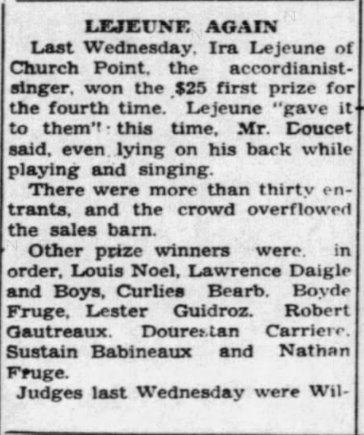
"Church Point Breakdown" (#1096) was an ode to the town of Church Point, not far from where Iry grew up in Pointe Noire.  Iry's relative, Angelas Lejeune, was also a well-known accordionist from Pointe Noire and Iry converted his cousin's tune "Le Petite One Step" into his own.  Recorded in 1953 at Iry's home with Milton Vanicor on fiddle and Goldband producer Eddie Shuler on guitar, it's one of the few Iry releases that Eddie pressed solely on 45 RPM.  Shuler invited director Drew Ellender for this session.  His main function was to let Iry know when to start and stop and he stood behind Iry who was sitting on the floor.  Iry's son Ervin Lejeune pointed out that he was sitting on the floor, "probably because daddy had a bad habit of tapping his feet."3  


Daily World
Jan 30, 1949


Hey, ye yaille, oh my,
Everyday in my house,
Well, I'm waiting for you,
Hey, remember, little doll,
Your father and your mother have always told you,
Don't do that to your man.

Hey, ye yaille, everyday,
Suffering in my home,
No one comes to meet me,
Oh, looks to me that way,
Little girl, everyday you know,
What is that I'm doing here?

Hey, baby, everyday,
I am there, on my porch,
Waiting, your old man,
Oh, you should never forget me,
As far as I can tell you,
So, look, I am lonesome for you.


Daily World
Nov 27, 1959

It was Angelas who lent Iry his accordion to practice with while he plowed his fields and it was Iry's uncle Steven who gave the future star his first accordion.1
  But Angelas wasn't the only family influence on Iry.  Many of the Lejeunes from the area between Pointe Noire and Church Pointe were musicians.  Iry's father Agness played and Angelas' family were all musicians. When author Andrew Brown was asked to compare Iry's style against Lawrence Walker, he stated:
Iry could play rings around Lawrence Walker.  Lawrence could play some good waltzes, but when it comes to two-steps, he couldn't touch Iry Lejeune.2  


  1. "Iry Lejeune rescued traditional Cajun music" by Gene Thibodeaux. The Church Point News.  Oct 11, 2008.  
  2. Wilson Granger interview.   Andrew Brown.  2005.
  3. "Iry Lejeune: Wailin the Blues Cajun Style" by Ron Yule
Release Info:
-1 La Valse (Dalse) de Bayou Chene | Goldband G-1096-1
-2 Church Point Breakdown | Goldband G-1096-2

Find:
The Legendary Iry LeJeune (Goldband, 1991)
Iry Lejeune: Cajun's Greatest: The Definitive Collection (Ace, 2003)

Sunday, September 2, 2018

"La Valse De Bayou Chene" - Iry Lejeune

Iry Lejeune sang the story of his people, and made them remember who they were.1 The traditional Cajun music would resurface first in his recordings, a young accordion player and singer from the Pointe Noire area of Acadia Parish.  Iry Lejeune became a pivotal figure in a revival fueled by the return of homesick GIs seeking to soothe their soul.2

Iry, who drew heavily from the recorded repertoire of Creole musician, Amede Ardoin and who died at twenty-seven in a car crash in 1955, along with Ardoin is one of the most storied figures in Louisiana French music.3 One of many Ardoin recordings he resurrected was "Valse Des Opelousas" in which was retitled as "La Valse De Bayou Chene" named after a small bayou south of Welsh in Jeff Davis Parish.  After recording the tune for Eddie Shuler's Goldband records, it later became the "Duson Waltz" by Aldus Roger and much later, the "St. Landry Waltz" by Austin Pitre.


O, catin, comment tu veut que moi je m'en vais tout seul,
O, mon nèg, à pas être capable d'aller me rejoindre,
O, bébé, mon j'ai pris et je roulaillé,
Quo faire tit monde c'est dur comme ça d'être dans ma maison.


O, catin, tu m’avais dit que tu pouvais pas me marier,
O, d’autre que toi moi je va’s plaider à tes parents,
O, catin, t’as passé dimanche après-midi,
T’as passé pour me donner ta main, t’as parti en pleurant.


O, catin, c’est les dernières paroles que je veux dire,
Je savais c’est juste rapport à ta famille qui veut plus de moi,
Oh, ye yaille, c’est pas la peine que moi je reste comme ça,
Tout le temps dans les misères à pas être capable, être capable t’avoir.

At his home, he was accompanied by Milton Vanicor on fiddle and Eddie Shuler on guitar. Although venerated for his accordion skills, it is Lejeune's singing that draws the strongest superlatives from writers--that it can "bite and burn and blister the heart" and "encompassed all the pain, loneliness, and hardship of the isolated praire farmers".3  In 1955, leaving the Green Wing Club, he caught a ride home with Lake Charles fiddler J.B. Fuseilier.  As the two men were fixing a flat tire, another car plowed into them.  Fusilier lived but Iry was not so lucky.
Lake Charles American Press
Oct 9, 1955

If this young traditionalist had not appeared when he did, Cajun music would have drowned in the American melting pot of assimilation.1  The late Acadia Parish author Pierre Varmon Daigle wrote:


In [Iry's] music is all the cruel loneliness of our Cajun history.  Not only the loneliness at the time of our exile, but the later years of poverty...It's all there in the music of this almost blind man.  It's there like a dirge, as lonesome as the howl of a March wind around the house at night.  There is his greatness. The feeling , the heart of his music reaching like fingers to your heart.1


Oh, pretty doll, how do you want me to do this all alone?
Oh, my friend, you're not capable of going to join me,
Oh, baby, my I picked up and I roamed around,
What's done, my little everything, it's hard like that to be home.

Oh, pretty doll, you told me you could not marry me,
Oh, other than you, I'm going to plead with your parents,
Oh, pretty doll, you passed by Sunday afternoon, 
You passed by to give me your hand, you left crying.

Oh, pretty doll, this is the last words I want to say,
I knew it's just related to your family, who wants more from me,
Oh, oh my, it's not worth it, for me to stay like that,
Always in misery to not be able, to be able to have you.


  1. "Iry Lejeune rescued traditional Cajun music" by Gene Thibodeaux. The Church Point News.  Oct 11, 2008.  
  2. Cajun Music: Origins and Development by Barry Jean Ancelet
  3. Cajun and Zydeco Dance Music in Northern California: Modern Pleasures in a ... By Mark F. DeWitt
  4. Lyrics by Francis M


Find:
The Legendary Iry LeJeune (Goldband, 1991)
Iry Lejeune: Cajun's Greatest: The Definitive Collection (Ace, 2003)

Wednesday, June 28, 2017

"Jolie Catin" - Iry Lejeune

In the small community of Pointe Noire near Church Point, a young man named Iry Lejeune was learning to play his cousin's accordion and listening to old recordings, especially records of Amédé Ardoin. This in turn led him to record "The Love Bridge Waltz" and "The Evangeline Special" for a Houston record label in 1947. After scoring a big regional hit with the record, LeJeune began to record for Eddie Shuler's Goldband Records in Lake Charles, bringing back the traditional sound of Cajun music from earlier in the century and through his own musical genius giving his songs an immediacy and direct emotional appeal lacking in Americanized music.5 

His rough accordion sound was a fresh change from the earlier country swing material by the Hackberry Ramblers and Happy Fats. A huge fan of Amédé Ardoin, Lejeune exploded with power as a Cajun accordionist, playing so loud that he often drowned out a full electrified band in his recordings. Many of the Vanicors played behind Iry during this session including Milton and Ellis on fiddle and Ivy on guitar.  


Billboard Magazine, mistakenly listing
"Steve Fruge" and Iry Lejeune

Even though producer Eddie Shuler created the Folk-star label specifically for Iry, he moved him onto his more widely sold Goldband label.
I had Folk-Star and Goldband.  Then, later, after two or three records, I put him on Goldband because he was selling a lot of records. I said "Hell, I don't give a damn about Folk-Star, I want Goldband". I put him on Goldband then.3


Eh, yé yaille, chère jolie,


Toi, catin, 'gardez donc,

Moi, j'suis là dans les misères.

Jolie, je peux pas t'avoir.
Moi, je n'peux plus dormir le soir,
Avec tour mes jonglements,
Et mon chagrin que j'ai pour toi.
Catin, oublie pas ça.

Eh, yé yaille, tu connais,
T'après sentir ton mal,
Parce que, toi, t'as toujors fait,
Tout le temps mal avec moi.
Tu m'as toujours maltraité,
Fait quelque chose que je méritais pas.
Mais, peut-être, que tu t'aperçois,
Toutes tes grosses erreurs.

Eh, yé yaille, tes chers 'tits yeux,
Qu,est aussi canaille ça me ressemble,
Que t'as quelque chose,
Que tu veux me dire,
Mais tu te sens pas cpable.
Moi, je voudrais que tu me redis,
Pour toi-même voir quo'faire que toi,
Tu m'as mis dans autant de chagrin,
Que moi je suis toujours dedans.

During this second session at KPLC in 1950 (or possibly 1952), Eddie Shuler had gotten the Vanicors and Iry together, laying down four sides, one of them being a fast paced two-step known as "Jolie Catin" (#102).  The crude, yet direct, translation to "pretty whore" doesn't capture the deeper meaning in Cajun culture.  It became a term of endearment, roughly translated to "pretty little doll", which had no negative connotation attached.  It's Iry's version of the Amede Ardoin song "Eunice Two Step" and allegedly, the song was inspired by his cousin Geraldine Lejeune Morain.  Doug Kershaw recalls playing with Iry:
I would set in with Iry & Nathan both.  Iry had so much heart & feeling when he sang & played his accordion.  I took that memory and applied it to myself when I grew up.
Crowley Daily Signal
Feb 9, 1950
Soon after, some band member changes had been made. Orsy had left to join Lawrence Walker as his rhythm guitarist and previous recordings had be on a "D" accordion but by this time, Iry traded it in for a "C" Monarch accordion.  According to Mike Leadbitter, on these recordings done at KPLC, Iry removed his shoes due to the fact that while playing, he would stomp his feet... causing the needle to jump on the disc!
Eh, oh my, dear pretty one,
You, little doll, look at this,
I am here in misery.
Pretty one, I can't have you.
I can no longer sleep at night,
With all I am thinking,
And my sadness I have for you.
Little doll, don't forget that.

Eh, oh my, you know,
You are feeling pain,
Because you always did,
Always did wrong by me.
You've always mistreated me,
Did things that I didn't deserve.
Well, maybe you realize,
All your big mistakes.

Eh, oh my, your dear little eyes,
That are so mischievous, it seems to me,
That you have something,
You want to tell me,
But, you don't feel like you are able.
I'd want you to tell me again,
For yourself why you,
Have placed me in all this grief,
That I am still in.
Much later, Nathan Abshire would re-record the tune into his "Basile Breakdown".


  1. Iry Lejeune: Wailin the Blues Cajun Style by Ron Yule
  2. http://www.hearthmusic.com/blog/a-hearth-music-visit-with-94-year-old-cajun-fiddler-milton-vanicor.html
  3. http://arhoolie.org/eddie-shuler-goldband-records/
  4. Billboard Magazine, 1951
  5. http://andrethierry.com/zydeco/
Find:
The Legendary Iry LeJeune (Goldband, 1991)
Cajun's Greatest: The Definitive Collection (Ace, 2004)

Saturday, December 31, 2016

"Grande Nuit Especial (Big Night Special)" - Iry Lejeune

Iry Lejeune, one of the greatest that ever lived in the Cajun French music field, was acclaimed by all for the way he could deliver the songs, singing and playing the accordion.  He never made a record that was not a big hit, and these many years after his untimely death, his records continue to sell like new releases.  One of the recordings was the "Grande Nuit Especial", also known as Saturday Night Special, for Ed Shuler's Goldband label in in Lake Charles around November of 1952.  Like many of Iry's tunes, he used a melody similar to an Amede Ardoin song.  In this case, it was "Si Dur D'etre Seul" originally recorded in 1934. Eddie Shuler, producer of Goldband records recalled trying to get Iry's music out in stores.   Not everyone was interested in doing so:
At one time I thought I would get me a distributor.  So I talked to the guy in New Orleans that was distributing for Mercury Records.  He said "Send me some samples; I'll let my salesman take them out on the road".  I waited about a month and a half and I never got any orders.5
Eddie managed to track down the salesman for the New Orleans distributors, William B. Allen Supply Co. at a record shop in Opelousas.
So I met him at the car and I said, "Do you have any Cajun records?"  He said "I got one of them lousy things in my car.  I can't stand that stuff. Man, that's the most horriblest thing I ever heard in my life.  I'm not gonna play that thing; I can't stand it."  So I called his boss. I said "Hey, just forget about this distributing thing, we got somebody else".  So I went back to work.5
From that point on, Eddie controlled his own distribution.
Oh ye yaille, chère ‘tit bébé,
Moi je connais, moi je m’ennuie de toi quand même.
Hey ‘tit coeur tu devrais pas oublier,
Tout ça toi tu m’avais parlé avant de t’en v’nir.

Oh tit coeur ça c'est dur à croire,
Ton pap et ta mam t’avaient dit j’étais pas bon.
Oh catin asteur toi t’as du regret,
C’est trop tard c'est pas la peine que tu t’lamentes à moi.

Hey ye yaille, aujourd'hui tu t’lamentes,
Oh bébé, j’peux pas comprendre le bien qu’ça t’fait.
Oh ma chère, tu fais des misères, ça ressemble mais qu’tu mérites,
J’ai du regret, tu mérites pas ça.
High Mount Club, 1954
Robert Bertrand, Wilson Granger
Iry Lejeune, Alfred Cormier

The word "asteur" is the corrupted form of a very old 16th-17th French phrase still used in Quebec, spelled "à cette heure", which translates to "now".  According to Milton Vanicor, he and Eddie Shuler are playing in the background at Iry's home.  According to Ron Yule's interviews with Milton, Eddie had used a session director in order to tell Iry when to start and stop, probably because he sat on the floor due to having a bad habit of tapping his feet. 


Oh ye yaille, dear little baby,
I know, I'll miss you anyway,
Hey little heart, you should not forget,
All that you told me before you came.

Oh little heart, that's hard to believe,
Your dad and your mom told you I was no good,
Oh you little doll, now you regret this,
It's too late, it's not worth you lamenting over me.

Hey ye yaille, today you lament,
Oh baby, I can not understand how you do it,
Oh dear, you're miserable, but it looks like you deserve it,
I regret that, you do not deserve this.

In an interview Eddie recalled the clash he had with the station manager of KPLC when he in 1948 invited a precocious twenty-year-old accordionist from Lacassine, LA, Iry LeJune, to play during his time slot. 


"When he first came to town he was like a hobo, real raggedy, and wearing this big floppy hat. He had his squeeze box in a flour sack under his arm," he said. But after the station was swamped with requests for an encore performance, the program director finally relented. "Iry was a persistent feller all right. But I always believed in giving a man a chance; otherwise, how would you discover what he could do?"6
Towards the end of the original recording, Shuler's tape machine began to inject an obnoxious "whistle" sound, which he later had removed on some pressings.  Shuler re-issued the tune on 45RPM twice, once listed as G-1024 and then much later as G-1024-2 in which he labeled the pressing a "Collector's Item".  In 1958, Lawrence Walker would take the fast paced two-step and create a waltz from it, calling it "Midnight's Waltz". 


  1. Iry Lejeune: Wailin the Blues Cajun Style by Ron Yule
  2. Biography.  The Greatest.  Iry Le June.  GBLP7741.
  3. http://www.bluesworld.com/EddieShuler.html
  4. SENATE CONCURRENT RESOLUTION NO. 15.  2015 Regular Session.  Notes to commend Milton Vanicor for his passion, devotion, and his nearly eighty-year commitment to Cajun music.
  5. Record Makers and Breakers: Voices of the Independent Rock 'n' Roll Pioneers By John Broven
  6. http://www.bluesart.at/NeueSeiten/2005EddieShuler.html
  7. NOTE:  Early 78 RPM pressings (GF 103 A in deadwax) contains the full recording with tape "whistle". (Jeremy R)  Later 78 RPM pressings (G 103 A in deadwax) contains the song cut early without the tape "whistle"
Release Info:
Grande Nuit Especial (Big Night Special) | Goldband G-F103-A G-1024
La Valse Du Grande Chemin (The Waltz Of The Big Road) | Goldband G-F103-B G-1024

Find:
The Legendary Iry LeJeune (Goldband, 1991)
Cajun's Greatest: The Definitive Collection (Goldband, 1992)
Cajun's Greatest: The Definitive Collection (Ace, 2004)

Saturday, October 29, 2016

"Bayou Ponpon Special" - Iry Lejeune

Iry Lejeune's musical mentor was his uncle Angelas Lejeune, one of the most popular muscians at fais-do-dos and house dances in Acadiana during the twenties.  Because Iry's parents had no money to buy an accordion, he used to visit Angelas' house almost every day to practice on his uncle's accordion while Angelas worked in the fields. By the early 50s, Iry Lejeune had worked quite a bit with Eddie Shuler and was gaining popularity locally with his recordings.  Shuler brought him into the studio around 1953 and they recorded "Bayou Ponpon Special" and released it on Bob Tanner's TNT label (#105).   It was a rendition of his cousin Angelus Lejeune's recording of the "Bayou Pom Pom One Step" in 1929 for Brunswick and even recorded earlier by Joe Falcon called "Osson". 
Oh, c'est malheureux chère

c'est malheureux te voir, autant dans les douleurs.

Oh, c'est tout le temps dur à ton pop,

ta mom t'a donnée là, je vas jamais oublier ça.


Oh, rapelle-toi, donc, de la fois

J'étais t'amener sur le pont,

Sur le pont du Bayou Pon Pon

"Oh toi t'es la seule, maman,"

Ça dit à toi, catin

Ça me fait du mal à moi.


Oh, c'est misérable aujourd'hui

Si t'es à la traîne comme ça,

Dans les chemins, toi, toute seule,

Oh, savoir qui c'est l'auteur

Oh, si t'es comme ça aujourd'hui,

C'est pas la peine tu me blàmes.
"Red River" Dave Mcenery,
Bob Tanner (holding a record),
Ray Campi, Ray Liberto

Bayou Pon Pon (spelled either "Pon Pon" or "Pom Pom") is a mythical town, somewhere in Lafourche Parish, in which comedian Walter Coquille would use as the basis for his 1929 satirical recordings. In Iry's 1953 version of the song, he spoke of the sorrow of a loved one he remembers at the Bayou Pon Pon bridge.   Other men want her stating, "Oh toi t'es la seule, maman", but he's convinced she'll be alone if he can't have her.  According to Ron Yule's interview with Milton and Odile Vanicor, the song revolves around Adeline Blanchard's visits with Iry, sitting a bridge, in which she asked him to write a song about a bridge. 
Iry Lejeune

Iry had his crack band called the Lacassine Playboys that featured fiddle player Milton Vanicor.  For this session though, Eddie brought his tape recorder to Iry's home, grabbed his guitar, and the trio recorded into the night.  For some reason, Ed didn't release this on the Goldband or Folk-Star label.  Eddie Shuler recalls working with Bob Tanner, owner and founder of the TNT label:
Well, I went to San Antonio because Bob Tanner had a pressing plant. So, I drove over there, and took a couple of my acetates with me. And I told him I’d like to make a deal for him to press my records. So, he decided he’d press ‘em himself and put ‘em on his label. And I said, "Well, okay, let’s try that." I hadn’t tried that.

Oh, it's sad, dear,

It is sad to see you in pain,

Oh, its always so hard for your pop.  

Your mom gave you away there, 

I'll never forget that.


Oh, reminds me of that time,

I took you to the bridge,

Oh, the Bayou Pon Pon bridge.

"Oh you're the only one, little mama,"

That's what they said, my doll,

It hurt me.


Oh, today is miserable,

If you're running down,

Along the road, all alone,
Oh, to know who is at fault,
Oh, if you're still like that today,
It's no use to blame me.

Although Bob's primary goal was to record and press more Tex-Mex music eventually including rockabilly, country, blues, jazz, and polka, he had pressed only three Cajun records and didn't seem to have had any sort of guiding vision like Pappy Daily or other independent labels in Texas. It was short lived.


  1. Iry Lejeune: Wailin the Blues Cajun Style by Ron Yule
  2. South to Louisiana: The Music of the Cajun Bayous By John Broven
  3. http://wired-for-sound.blogspot.com/2011_11_24_archive.html
  4. http://wired-for-sound.blogspot.com/2010/06/jerry-dove-on-tnt-122.html
  5. SENATE CONCURRENT RESOLUTION NO. 15.  2015 Regular Session.  Notes to commend Milton Vanicor for his passion, devotion, and his nearly eighty-year commitment to Cajun music.

Find:
Louisiana Cajun Music Volume 4: From The 30s To The 50s (Old Timey, 1972)
The Legendary Iry LeJeune (Goldband, 1991)
Cajun's Greatest: The Definitive Collection (Ace, 2004)

Thursday, August 18, 2016

"La Valse De Cajin" - Iry Lejeune

Known for his soulful music, many consider Iry LeJeune to be the greatest Cajun accordion player and recording artist of all time.  Produced by Eddie Shuler and Folk-Star, a subsidiary of Goldband Records out of Lake Charles, Louisiana, Iry’s recordings of "Calcasieu Waltz," "Jolie Catin," "Evangeline Special," and many more were big hits.  Believed to be recorded in 1950 at the KLPC radio station, "La Valse De Cajin" (#GF102) included Milton Vanicor on fiddle, Ellis Vanicor on fiddle, and Ivy Vanicor on rhythm guitar.  It was a slight take on his uncle Angelas' recording of "La Valse De La Louisianne".   Orsy Vanicor did not appear because he had left the Lacassine Playboys. It was a rendition of Bixy Guidry and Percy Babineaux's "Qu'est Que J'ai Fait Pour Etre Peuni Si Longtemps".

Around 1954, the Vanicors were playing with other bands or had quit.  Iry regrouped with a new set of band members around the Calcasieu area including Duckhead Cormier and Wilson Granger.  By mid 1955, fiddler J.B. Fusilier moved to Lake Charles around the same time Iry's fiddler Wilson Granger quit the group.  After playing with Iry at the Blue Moon, guitar player Alfred "Duckhead" Cormier told Iry:
I think we're gonna keep that man on the violin.  He's as good as you ever did have.2

Eh, yé yaille, chere tit monde,

Quo'faire t'es comme ça,

Autant dans les misères?

Eh, yé yaille, je te fais pas arien,

Je veux que toi tu sois,

Comme toi, chère, t'es après faire. 


Eh, yé yaille, tout cette peine,

Tu devrais écouter,
Ton vieux nègre une fois,
Quand, moi, je te dis quelque chose,
Tite fille, rappelle-toi,
Jongle voir quand ton papa,
T'as déjà aussi maltraitée.

Eh, moi, je voudrais que tu reviens,
Me rejoindre, cher tit monde,
Coucher ta chère tite tête,
Dessus mon épaule,
Quitter tes chères tites larmes,
Couler pour te pardonner tout ça t'as fait.


Church Point News
Oct 11, 1955

Sadly, Iry LeJeune died at age 26 when he and J.B. stopped to change a flat tire on his car late one night on their way home from a performance at the Green Wing club (believed to be located between Mamou and Eunice, Louisiana) along Hwy 90. Unfortunately, widening the highway for extra lanes meant the pair had no shoulder on which to pull the car. Both men were on the side of the road when Luther Holt of Houston, TX slammed into both men.  Fuselier, who was driving, survived the accident with numerous broken bones and a head injury, but LeJeune, unable to see well, had no warning and died instantly.  


Eh, ye yaille, dear little everything,
Why are you like that,
In so much misery,
Eh, ye yaille, I didn't do anything to you,
I want you to return to,
Your old self, dear, after all of this.

Eh, ye yaille, all of this pain,
You should listen,
To your old man one more time,
When I tel you something,
Little girl, you'll remember,
Think of how your papa,
Has already mistreated you so much.

Eh, I'd want your to come back,
To meet me, dear little everything,
To rest your dear little head,
Upon my shoulder.
Let your dear little tears,
Fall to pardon you for all you've done.

Church Point News
Oct 11, 1955

He left behind a young family of five children, dozens of recordings, and a Cajun music legacy.  Luther was jailed and charged with "negligent homicide".   

According to author Ron Yule:
I think Iry's impact was enhanced by his early death, but his unique accordion style and bluesy, earthy voice as presented in his recordings would have continued to be recognized. This great talent would have lived on, and he would have impacted other musicians just as it continues to do today.1


B.O. Sparkle, Bridge City, TX, 1954
Robert Bertrand, Wilson Granger,
Iry Lejeune, Alfred Cormier


  1. http://theind.com/article-16337-l'effet-papillon.html
  2. Louisiana Fiddlers By Ron Yule, Bill Burge
Find:
The Legendary Iry LeJeune (Goldband, 1991)
Cajun's Greatest: The Definitive Collection (Ace, 2004)