Showing posts with label Orville "Bennie" Hess. Show all posts

Monday, February 22, 2016

"Evangeline Special" - Iry Lejeune

Born near Church Point, Louisiana to a farming family, Iry LeJeune, near blind from birth, turned to music as a young child.  It was his cousin, Angeles LeJeune, who first introduced him to the accordion.  But it was the records of Amedee Ardoin that most inspired him, influencing both his Cajun-French style and his recording future.   After a watching Bennie Hess and the Oklahoma Tornadoes one night, he convinced their fiddle player, Floyd Leblanc, to join them on their way to Houston.  There, Iry would get a chance to record for the very first time. 


O' toi ti monde, moi j'connais hier au soir,

Tout partout y'où moi j'étais, pour te 'joindre ma jolie cœur,

Hé-y-yaille, la promesse tu m'avais fait,

Elle a mieux aimé m'tourner l'dos, s'en aller en rejoindre un autre.


O' 'tite fille, rappelle toi tout partout,
Ton papa y'après s'en venir, viens me 'joindre à la maison,
Hé-y-yaille, Lui l'à venu, m'voulu cher,
pour m'demander d'me dire pardons, il connais il avait mal.

Hey 'tite fille, rappelle toi moi j'connais,
Moi j'après te dire asteure, la parole j'voulais pas t'dire,
Hé-y-yaille, si tu m'aime mais blâme moi pas,
Si les autres t'après donner, les conseils écoute les pas!

LeJeune eventually relocated to the Lake Charles region, where he found a thriving music scene among the many dance halls.  He met fiddler Floyd Leblanc, who convinced the young accordionist to accompany him to Houston Texas.4  In 1948, riding on a current stirred by songs like Harry Choates' "Jole Blon," string music flooded the dance-halls and airwaves of South Louisiana. Then, with one song, Iry Lejeune threw a life preserver to the accordion. After his "Love Bridge Waltz," the fiddle fell out of Cajun music favor and the accordion crested.  According to an article penned for Britain's Old Time Music by Mike Leadbitter, the song broke a 10-year dry spell for accordion music on South Louisiana jukeboxes.2  On the flip side, he recorded the "Evangeline Special" (#105) on Bennie Hess' Opera label along with Hess' band called the Oklahoma Tornadoes.  They consisted of Floyd Leblanc on fiddle, Virgil Bozman on guitar, Orville "Bennie" Hess on guitar, and Ben Oldeg on bass.
Iry Lejeune
By George Rodrigue

Based loosely on Joe Falcon's "Au Revoir Cherie", the tune helped propel the accordion forever into Cajun music after the war.  He titled the song after a small dance-hall in Ville Platte, Louisiana known as the Evangeline Club.5  

A gifted singer and a master of the accordion, and able to craft deeply personal songs, Lejeune had it all and potential for even more. Lejeune developed a crying singing voice, both melodic and pleasant yet shrill enough to cut through the clangor of a noisy dance-hall, an asset before amplification. Plus, his band could play complicated songs. 2
Oh, you little one, I know that last night,
Everywhere that I went, to meet you, pretty heart.
Eh, ye yaille, the promise you made me,
Turned your back on me, to go meet another.

Oh, little girl, remember that everywhere,
Your papa, I saw him coming,
Yes, to meet me at my house.
Eh, ye yaille, he had wanted, dear,
To ask for forgiveness, he knew he'd done wrong.

Oh, little girl, remember that I know,
I'm telling you now, the words I couldn't say,
Eh, ye yaille, if it's hard, don't blame me,
If the others had given you advice,
Don't listen to them.


According to the Library of Congress:
The post-World War II revival of traditional Cajun music began with accordionist Iry LeJeune’s first single, his influential recordings of “Evangeline Special” and “Love Bridge Waltz.” Le Jeune’s emotional and deeply personal style was immensely popular with Louisiana Cajuns returning home from the war, eager to hear their own music again. His recordings marked a distinct move away from the style influenced by Western Swing that had dominated commercial Cajun recordings for over a decade and a return to the older sound of Cajun music. This sound featured the accordion, prominently and unrestrained, and a blues-influenced singing in French. LeJeune is regarded as one of the best Cajun accordionists and singers of all time.3
Afterwards, Iry teamed up with Eddie Shuler of Lake Charles.  According to Eddie:
Iry went to Houston, Texas and he came up on this outfit called, I think it was Opera Records.  Anyway, he cut a record over there and they put it out but nobody could buy the record. They couldn't find the record and the people were going crazy. That's the time that he approached me as he came back from Houston. What he wanted was records so that he could go out and play his dances.7 

In 2009, the both songs, "Evangeline Special" and "Love Bridge Waltz, were inducted into the Library of Congress' National Recording Registry, honoring the work to be "culturally, historically, or aesthetically significant".6


  1. http://www.wendyrodrigue.com/2011_04_01_archive.html
  2. http://theind.com/article-16337-l'effet-papillon.html
  3. https://www.loc.gov/today/pr/2010/10-116.html
  4. http://www.knowla.org/entry/1093/
  5. Francois (Yé Yaille Chère!), 1990; pp. 373
  6. https://www.loc.gov/programs/national-recording-preservation-board/recording-registry/registry-by-induction-years/2009/
  7. http://arhoolie.org/eddie-shuler-goldband-records/
Find:
The Legendary Iry LeJeune (Goldband, 1991)
Iry Lejeune: Cajun's Greatest: The Definitive Collection (Ace, 2004)

Friday, February 12, 2016

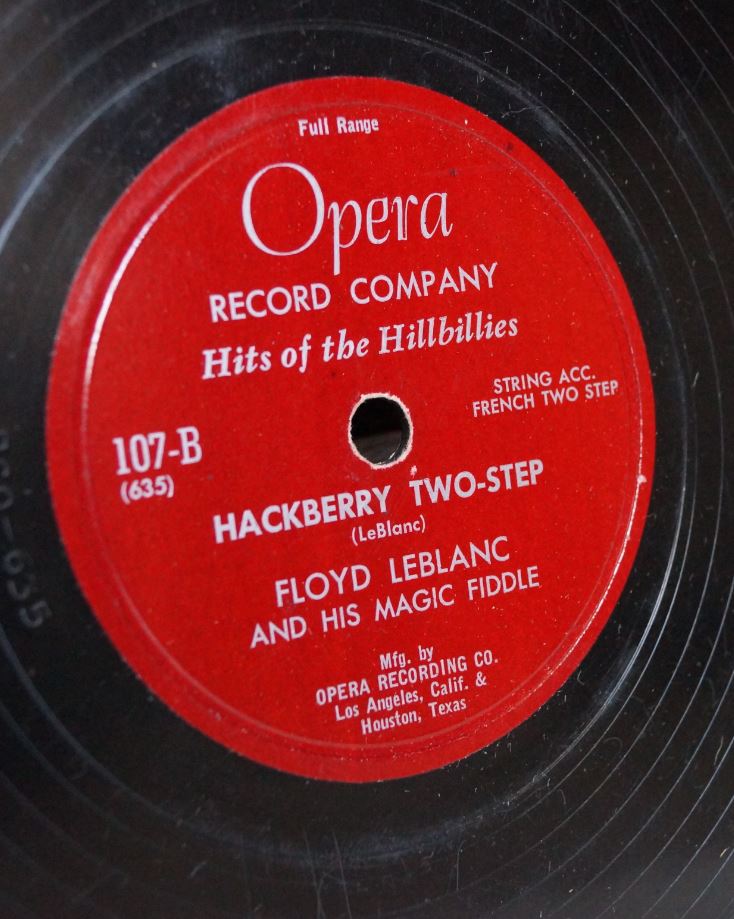
"Hackberry Two Step" - Floyd Leblanc

Similar to Harry Choates, Floyd Leblanc was an outstanding fiddler from Mermentau, Louisiana during the post-war Cajun swing era. Bennie Hess, song writer and guitarist, had begun the Opera label for his own band. It's one of several issues Bennie Hess released on his small label, this time headlining his fiddler Floyd Leblanc.  Originally, he had worked with Bill Quinn at Gold Star in Houston but never recorded as a solo artist until he worked with Hess' label.  The song "Hackberry Two Step" (#107) was an ode to the town in which he played often. 
Hey jolie coeur,
Mais, viens donc me voir ‘tite monde,
Pour ça ta fait, jolie coeur,
Mais, moi je connais ça sera pitié.

Hey jolie fille,
Mais, rappelle toi ‘tite monde,
Pour ça t’as fait, jolie coeur,
Mais, moi je connais mais te voudras.

Hey, jolie blonde,
Mais, moi je connais, jolie fille,
Mais, ça t’as fait, ‘tite monde,
Mais moi je connais ça sera trop tard.
Floyd Leblanc

Floyd injected a Cajun sensibility into the Tornadoes' sound.1 Backed by Virgel Bozman’s Oklahoma Tornadoes band, Floyd's releases never got the same attention on Opera as Iry Lejeune's release. Outside of music, Floyd built several shrimp boats as a hobby and sold them upon completion. He was part owner and operator of LeBlanc's Net Shop until the time of his death.
Hey, pretty sweetheart,
Well, come see me, little everything,
Because of that, pretty sweetheart,
Well, I know it'll be pitiful.

Hey, pretty girl,
Well, I remember you, my little everything,
Why did you do this, pretty sweetheart,
Well, I know, but you wish you knew.

Hey, pretty blonde,
Well, I know this, pretty girl,
Well, it's what you did, my little everything,
Well, I know it's going to be too late.


  1. Cajun Breakdown : The Emergence of an American-Made Music by Ryan Andre Brasseaux
  2. Image by Jeanne L

Monday, April 27, 2015

"Love Bridge Waltz" - Iry Lejeune

"La Valse Du Pont d'Amour"! This tune would be Iry Lejeune's first recording and propel the accordion into Cajun music for good after WWII. Although history follows Iry's adventures and career with Eddie Shuler, his music didn't start with Shuler's label.  His first recording would not be for Shuler but for a group of Texans, recording his first tune entitled "Love Bridge Waltz" (#105).  Recorded for the Opera label in 1948 but probably released in 1949, it was based on a melody by Delin Guilory and fiddler Lewis Lafleur entitled "Alone At Home" recorded in 1929 for Victor but released in 1940.  Benny Hess' recording of the Iry LeJeune’s “Love Bridge Waltz” resulted in the first good selling Cajun accordion record since the latter days of the 20s. 

It all began with Bennie Hess and Bill Quinn.  Orville "Bennie" Hess had first started in the record business as one of Bill Quinn’s partners in the Gulf label in late 1944 or early 1945 before Quinn went out to greater success with his own Gold Star label. Some evidence exists that Hess may have been in partnership with engineer/producer Bill Quinn in launching it however it's not clear who helped him.   According to Andrew Brown, Frank Sanborn and Hess were the original partners.  However, he suggests W.Kendall Baker may have been involved rather than Hess.  According to musicologist Paul Oliver, Vernon Woodworth, known as Woody Vernon, was his only business partner at the time.   


Bennie Hess
Quinn's Gulf label issued records artists such as Woody Vernon (which may also be listed as Tex Moon), Jerry Irby, and Jesse Lockett and his Orchestra.  The label only lasted a year.   He struggled to get artists since Quinn had no pressing equipment.  Quinn started his new Gold Star label and Hess parted ways.

Around this time period, however, Hess was apparently playing on KRLP radio’s Cornbread Matinee in Dallas. In 1947 he traveled to California and signed a contract with the Black & White label. His release, “Someday You’ll Know”/“You Just Won’t Do,” apparently earned him roles as a singing cowboy in some B-movie Westerns.  

The union recording ban took effect in 1948, forcing many labels to close down. However unconcerned by the union, Hess recorded a string of releases during this year ending up becoming his busiest period. The 1948 recording ban actually benefited him as did the resurgence of interest in French Cajun Music in the area of South Louisiana.  


Hess, along with James Bryant, formed Opera and put out a series of fine fiddle Cajun records by Floyd LeBlanc and Charlie Broussard and achieved the distribution to get the records out there to Cajun homes and juke boxes.  Probably because he was still under contract to Black & White Records, Hess released his first record on Opera under the name of Georgie Harrison with the Nation's Play Boys in 1948.   Floyd, along with Bennie Hess, at some point formed a band called the Oklahoma Tornadoes with friend Virgil Bozman.

The next influencial people to make an impact on this recording was Floyd Leblanc and Virgel Bozman.  John Harvey "Virgel" Bozman was a rustic singer/guitarist and part-time comedian who sometimes billed himself, with tongue-in-cheek, as "The Arkansas Sinatra".  He had apparently been a staple on the San Antonio music scene for some time and he awas in Houston recording for Bill Quinn by the end of 1945.  While stationed at a San Antonio military base near the end of WWII, Floyd Leblanc befriended Bozman. 


Iry with the Oklahoma Tornadoes
Floyd Leblanc, Iry Lejeune, Ben Oldeg,
Bennie Hess and Virgil Bozman
Iry happened to meet Virgil Bozman and Floyd Leblanc who played with the Oklahoma Tornadoes after that band's performance in Evangeline.  The band was playing an engagement at the Pine Grove Club when Lejeune showed up unannounced to st in with his buddies.  The Tornadoes were about to travel to Houston to record for Hess' Opera label and Iry asked Floyd to let him come along.   Floyd, in return, asked Hess and Bryant if Iry could join them.   Both label producers had witnessed first hand at the success of Choates' "Jole Blon" and recognized Lejeune's talent on the accordion in order to tap the lucrative Cajun music market.  That year, in 1948, Iry would join them in the studio to make his first recording, and change his life forever.
He, 'tite fille, moi, je me vois, après, oui,   
Partir mais m'en aller donc, si loin,
Oh, chere 'tite fille, quand-même tu voudrais t'en rev'nir  ,
'Tit monde, 'garde donc, je veux plus de toi.


He, tu m'as dit, 'tite fille, criminelle, 
'Tite tete noire, tu voulais plus m'aimer, malheureuse,
Tu connais, 'tite fille, que moi, j'ai pris ca dur,
Pris ca z-assez dur que moi j'ai pris le grands chemins.


Oublie, voir pas les conseils que t'as ecoutes,
C'est la que tu m'as dit que moi je pouvais plus aller te voir. 
Oh, mon 'tit monde, moi je peux pas oublier ,
Les paroles tu m'as dit, et moi, je connais tu vas brailler.

Mike Leadbitter recalls:
His recording of Love Bridge Waltz was the turning point in his life and in French music.  It was a strong seller at a time when accordion driven music had fallen out of style in favor of the fiddle. and for the first time in 10 years the accordion wailed from jukeboxes in Cajun country. 
Iry Lejeune
It's a simple medium tempo number, one of the first accordion records in the era's dancehall style, made special by the desperately earnest quality in a voice steeped in loneliness and the squeezebox evoking generations of Acadian tradition. Author Kevin Fontenot explains the "dancehall" sound:


[It consists of] a driving, swinging accordion, accompanied by the fiddle, drums, guitar, and a "crying" steel guitar.  The music was amplified to cut through the noise of the dancehall.


He, lil girl, afterwards I saw myself,
Leaving to go far away,
Oh, dear lil girl, anyway you want to come back,
Look, my all in all, I want more of you.

Hey, you told me, lil girl, criminal,
Lil brunette, you wanted to love me, unhappy,
You know, lil girl, I'm driving,
Taking this hard, I'm driving the big roads.

I've not forgotten the advice you've told me,
That's where you told me that I should not go to see you,
Oh, my all in all, I can not forget,
The words you said to me, and I know you'll scream.

"Love Bridge Waltz" has been dated to 1948 in most writings, however, surviving paperwork from the Opera label challenges this date.  An artist's contract with Floyd Leblanc survives, dated May 3, 1947.  Leblanc plays fiddle on Lejeune's record and Leblanc's debut release was just two numbers after 105.   Another Opera artist, Charlie Broussard, is dated March 15, 1947.  Therefore, it's most probable, Iry's song was recorded in the summer of 1947.

Iry didn't stay with Opera for long.  In a sense a victim of his own success, Virgel Bozman had by 1949 signed up Floyd LeBlanc for his new OT label while Eddie Shuler at the same time created a Folk Star label for the express purpose of recording Iry LeJeune. Shuler, owner of GoldBand and Folk-Star stated:


[Iry] had recorded one record for Opera and nobody could get the records. Him and a fiddle player, Floyd Leblanc, jumped in the car and decided to go to Houston and make a record. And Iry had all these people wanting his record, and nobody could ... buy it, because Opera didn't have any money or something.  I don't know what their problem was but, you couldn't get the records.
Iry and I had a radio show on KPLC radio and Iry wanted to make another recording. I said "Well, I tell you what. I'll make one record, and if it's a success, me and you are in business, and if it doesn't, we are out!" And we shook hands.

According to Ron Yule, Lejeune's recordings on the Opera label in Houston and those at Goldband Studios in Lake Charles remain a source of study for accordion students today.  Opera made no apparent effort to develop new artists, instead becoming purely an outlet for Bennie’s own releases, which become increasingly scarce after his Mercury firing. There was one exception with fiddler C. F. Pevoto at # 1021 before the label ended with its final Hess release.


  1. Encyclopedia of Great Popular Song Recordings, Volume 2 By Steve Sullivan
  2. Cajun Breakdown: The Emergence of an American-Made Music By Ryan Andre Brasseaux
  3. Louisiana Fiddlers By Ron Yule
  4. Record Makers and Breakers: Voices of the Independent Rock 'n' Roll Pioneers By John Broven
  5. Ethnic and Border Music
  6. http://www.kplctv.com/story/23783301/musical-tribute-to-cajun-music-legend-iry-lejeune-set-saturday
  7. House of Hits: The Story of Houston's Gold Star/SugarHill Recording Studios By Andy Bradley
  8. Louisiana Music, Vol. 1 by Lyle Ferb
  9. https://tshaonline.org/handbook/online/articles/fhe89
  10. http://www.rockabilly.nl/references/messages/bennie_hess.htm
  11. Discussions with Neal P
Find:
The Legendary Iry LeJune Vol. 2 (Goldband/Swallow)
The Legendary Iry LeJune (Goldband, 1991)

Cajun Gold (Goldband, 2000)
Iry Lejeune: Cajun's Greatest: The Definitive Collection (Ace, 2004)
Laissez le Bon Temps Rouler! Authentic Cajun (Mbop Global, 2006)
Cajun Classics (X5 Music, 2010)