Showing posts with label Francis "Red" Fabacher. Show all posts

Thursday, April 22, 2021

"Cata Houla Breakdown" - Jolly Boys of Lafayette

Joe Fabacher was a talented accordion player that hailed from Acadia Parish. He began his band in 1935, modeled after other successful area groups such as the Hackberry Ramblers, the Dixie Ramblers, and the Rayne-Bo Ramblers, and Leo Soileau's Aces.  He kicked off his recording career with his very first recording done in Dallas, Texas.

Decca's A&R man, David Kapp, made pilgrimages through the south in areas such as Memphis, New Orleans, Dallas, San Antonio and Charlotte. He stated 
"In Dallas we got a lot of Cajuns coming in. I've seen some of those artists drive 500 miles in tumble-down cars to get an audition".1  

Joseph Fabacher,
Leon "Crip" Credeur

By 1937, Decca invited the group, composed of Leon "Crip" Credeur on fiddle and vocals, Joseph Fabacher on accordion and Francis "Red" Fabacher on guitar, to Dallas where they performed the "Cata Houla Breakdown" (#17029) in the Adolphus Hotel.  Named after a small town east of Lafayette called Catahoula, it featured the rarely heard accordion talent of Joseph Fabacher.   It was a rendition of the Breaux Brother's "Le One Step A Martin".  When he wasn't playing music, he was busy managing venues such as Rene Guilbeau's Dance Hall in Carencro.  His brother Francis played guitar and during much of the late 1930s, the two had similar bands that performed in the same dance-hall circles.   


The Jolly Boys continued to play in places such as A. Romaire's Hall, Voorhies Roof Garden, Dixie Bar Dance Hall in Iota, Welcome Club in Crowley, Lucky Star Dance Hall, and the Armory Hall.   Songs like "Cata Houla Breakdown" became better known as Aldus Roger's "Crowley Two Step". 


Daily Advertiser
July 14, 1939


  1. Billboard Magazine. Hotel Room Recording Studios. Apr 3, 1971.

Release Info:
61912-A Cata Houla Breakdown | Decca 17029-A
61919-A La Valse De Lafayette | Decca 17029-B

Find: 
CAJUN-Rare & Authentic (JSP, 2008)

Tuesday, May 7, 2019

"Fais Do Do Two Step" - Jimmy Durbin

Some of the earliest Cajun string band music were still being recorded in the early 1950s.   Bands like Chuck Guillory and Jimmy Newman were latching onto the style, sometimes landing large recording contracts with MGM, Decca, and Columbia.   Around this same time, one would gather that a certain Jimmy Durbin lead a group of Cajun musicians backed by Chuck Guillory's band members and recorded "Fais Do Do Two Step" (#1008) for J.D. Miller's Fais Do Do label.  It was a version of Amede Ardoin's "One Step de Chameaux".   

Misspelled "fias", it was an ode to the common Cajun house dance event known as a "fais do-do".   Literally meaning "make sleep", the word "do" became a shorted form of the French word "domir" (to sleep).   In the same manner a mother was tell a child "beddie-bye" in English, legend has it that mothers who attended these dances with their children, tried to quickly get their babies to sleep in the back room, less their husbands be caught dancing with someone else!


Oh, ma jolie fille, 'tit fille, m'fais pas ça,

Cherie, ma jolie cœur, 'tit fille m'fais pitié,

Oh, ma malheureuse, tit fille, m'fais du mal, 
Eh, ma ça ta fais ton nègre, il y a pas longtemps.

Chérie, mais, j'vas mourir, 'tite fille, mais, ça me va pas,
Tite fille, auprès de toi, chérie, mais, que j'vas voir,
Eh, mais, malheureuse, m'j'connais te m'fais pitié,
Chérie, t'es, joli cœur, tite fille, tu me fais du mal.


Jimmy Newman, Curzy Porkchop Roy,
unknown, Papa Cairo, unknown,
Herman Durbin

Image courtesy of Johnnie Allan Collection, 
Center for Louisiana Studies, 
University of Louisiana at Lafayette


It would seem that Chuck's band had this recording led by a man named Jimmy Durbin.  Except, there's one problem: there was no such person as Jimmy Durbin!  In a strange identity crisis, no one has been able to determine who this person was, leading to several theories. The name is most likely Miller's attempt at listing Jimmy Newman and his regular piano-playing sidekick, Herman Durbin, together.  Instead of Benny Fruge on piano, it could very well be Herman with Miller attempting to list them as "Jimmy & Durbin". 

Author and producer of the Acadian All-Star box set, Lyle Ferbrache explains:


For some reason when JD released the record, he put the name "Jimmy Durbin" on the record.  Shelton Manuel had no idea why.  As far as I can tell there us no Jimmy Durbin.  J.D. did things that sometimes made no sense.1


Oh, my pretty girl, little girl, don't do that to me,

Dearie, my pretty sweetheart, little girl, make me pitiful,

Oh, my unfortunate little girl, that hurts me,
Hey, that was done to your man, over there not long ago.

Dearie, well, I'll die, little girl, well, I'm not going,
Little girl, with you, dearie, that I can see,
Hey, well, oh my, I know you made me pitiful,
Dearie, you are a pretty sweetheart, little girl, you've hurt me.
Regardless, the band was most of Chuck Guillory's backup group with Jimmy Newman on guitar, Shelton Manuel on vocals and fiddle, Francis "Red" Fabacher on steel guitar, Howard Thibodeaux on bass, Curzey "Pork Chop" Roy on drums, and either Herman Durbin or Benny Fruge on piano.   The record was recorded on a tape machine that J.D. had just started using and wanted to see if he could make a remote recording.  So, Miller and the band recorded the session at Benny's Fruge Piano House in Eunice about 1949.  It was recorded around the same time Nathan Abshire used the melody for his "Lake Charles Two Step".   Later, Chuck Guillory would record it as "One Step De Chameaux".   Generally, both songs are known as the same tune.  


  1. Discussions with Lyle F
  2. Lyrics by Stephane F
Release Info:
-A Drunkard Waltz | Fais-Do-Do F1008-A
-B Fais Do Do Two Step | Fais-Do-Do F1008-B

Find:
Acadian All Star Special - The Pioneering Cajun Recordings Of J.D. Miller (Bear, 2011)

Thursday, April 11, 2019

"J'Vas Continue A' T'Aime (I'll Keep On Loving You)" - Sons Of Acadians

Sons of Acadians were formed by a team of Lafayette area musicians in 1939 to capture the sounds of the popular music emenating from the radio.  Made up of cousins, Oran "Doc" Guidry on fiddle, Nason Guidry on upright bass, and Sidney Guidry as guitarist and vocalist, they teamed up with either steel-guitarist Roscoe Whitlow or steel-guitarist Francis "Red" Fabacher and began playing night clubs in Rayne.


Si l’univers continue à tourner, comment on connait ça va faire, 
Là, j'vas continuer à t'aimer. 
Si le jour se casserait demain, comment on connait ça va faire, 
Là, j'vas continuer à t'aimer. 

Mais, si des choses tombent, le ciel tomberait, 
Le jour viendrait pas, l'univers s’arrêterait, 
Ça ferait pas rien, pas toi t'oublie,
Ça ferait pas rien à rien du tout,
Si les étoiles restent dans le ciel et la lune reste dans le bleu, 
Moi, j'vas continuer à t'aimer.


Clarion News
Jul 31, 1947

Together, the band recorded "J'Vas Continue A' T'Aime (I'll Keep On Loving You)" at the Rice Hotel in Houston, Texas.  Written by Floyd Tillman in 1939 and later recorded as "I'll Keep On Loving You".  It was later recorded in the 1950s by Ray Price and even later by Johnny Gimble. 

After the session, Doc left his day job working at a local drug store and headed to Baton Rouge.  With an offer from Gov. Jimmie Davis, he took a job working for the public safety department.  Nason Guidry took over the Sons of Acadians, playing alongside the likes of Al Terry, Uncle Ambrose Thibodeaux, and Stansbury's Colored Band at community center square dances and company picnics.


If the universe continues to turn, how do we know it will do it?
There, I will continue to love you,
If the day breaks tomorrow, how do we know it will do it?
There, I will continue to love you.

Well, if those things fall, the sky will fall,
The day wouldn't come, the universe would stop,
It wouldn't matter, don't you yourself forget,
It wouldn't matter to nothing at all,
If the stars stay in the sky and the moon stays blue,
I will continue to love you.


  1. Lyrics by Stephane F

Release Info:
66403 Aux Belle Chez Te Maurice | Decca 17054 A
66414 J'Vas Continue A' T'Aime (I'll Keep On Loving You) | Decca 17054 B

Friday, March 8, 2019

"Tant Que Tu Est Avec Moi" - Jolly Boys of Lafayette

The Jolly Boys got their start in 1937 with their only recording session with Decca.  Joe Fabacher led his group during the late 1930s through the 1950s. It included his brother Red and Leon "Crip" Credeur".  Francis "Red" Fabacher was a brilliant guitar player.  By 1940, Red was playing radio shows on KVOL along with Nason Guidry and the Sons Of Acadians.  However, soon after, he was drafted into WWII.

(Moi) tout seul dans la peine,

Moi tout seul, chère 'tit monde,

Mérite pas ça, ça t'as fais, 
Mais, ça t'as fais, jolie.

Quand ton nègre est avec toi,
C'est "chère" ici et "chère" là bas,
Mais, quand ton nègre est-z-à-coté,
T'as bien prié ton pauvre vieux nègre.
Crowley Daily Signal
Sept 7, 1950

The song was their version of Amede Ardoin's "Eunice Two Step".  It spawned other post-war versions such as Virgil Bozman's "Tell Me If You Love Me" and Lee Sonnier's "Chere Ici Et Chere La-Ba". The phrase chère ici et chère là bas eludes to a lover's quarrel, where in the love interest acts differently when her man is at her side versus when he's away.

(I'm) all alone in pain,

I'm all alone, dear little everything,

Don't deserve that, that you've done,
Well, that you've done, pretty.

When your man is with you,
It's "dearie" here and "dearie" there,
Well, when your man alone by your side,
You had better pray for your poor old man.

While Red got his start playing Cajun swing music, he also was adept to playing country and rock in the later years. By the time he got out of the service, he had joined Harry Choates band, playing full rhythm guitar and occasionally filling in for Happy Fats.


  1. Lyrics by Stephane F


Release Info:
61914-A Tant Que Tu Est Avec Moi (As Long As You're With Me) | Decca 17036 A
61915-A High Society | Decca 17036 B

Find: 
Cajun: Rare & Authentic (JSP, 2008)

Wednesday, April 11, 2018

"Drunkard Waltz" - Jimmy Durbin

Chuck Guillory's band was a very successful Cajun string group in the early 1950s.  Having a slew of musicians in his band, many went off to create their own solo careers, with Jimmy Newman becoming the most successful.   At some point, in 1949, Jimmy decided to leave the group, possibly due to Chuck's drinking but also because of his passion to have his own recording career.   Either way, Newman gathered some of Chuck's members in recording one of his earliest vocal performances, the "Drunkard's Waltz" (#1008).

The band was most of Chuck Guillory's backup band with Jimmy Newman on vocals and guitar, Shelton Manuel on fiddle, Francis "Red" Fabacher on steel, possibly Howard Thibodeaux on bass, Curzey "Pork Chop" Roy on drums, and Farrel "Benny" Fruge on piano.   The band recorded the session at Benny's Fruge Piano House in Eunice about 1949 after Miller decided to try out his new tape recorder for a remote session.  Author and producer of the Acadian All-Star box set, Lyle Ferbrache explains:  
The name could be a combination of Newman's first name and the amp he might have been using at the time, which was a Durbin brand.1


Eh, malheureuse, toi t'après m'quitté,

Eh, chère 'tit monde, quoi tu vas brailler?

Quoi tu m'a dis, tu voulais plus m'aimer,

Eh, malheureuse, mon j'suis parti m'soûler.  

Eh, jolie monde, toi jolie coeur,
Eh, malheurse, toi te m'fais du mal.
Quoi tu m'a dis, tu voulais plus m'aimer?
Eh, malheureuse, mon j'suis parti m'soûler.


Herman Durbin, Jimmy Newman,
Murphy "Chuck" Guillory


Another theory could be that Chuck's former piano player, Herman Durbin, could have influenced the name.  Maybe it was a combination of Jimmy Newman and Herman together?   Maybe Durbin is actually on the recording and was nicknamed "Jimmy"?  The source remains unknown.   It's most likely Miller's attempt to label the group as "Jimmy & Durbin". 


Hey, it's terrible, you have left me,

Hey, dear little everything, why are you crying?

Why didn't you say, you didn't love me anymore,

Hey, it's terrible, I left to get drunk.

Hey, pretty everything, you pretty sweetheart,
Hey, it's terrible, you made me sad,
Why didn't you say, you didn't love me anymore,
Hey, it's terrible, I left to get drunk.


Not to be confused with the Balfa's "Drunkard's Waltz" or Louis Cormier's "Drunkards Blues", it would find it's way into Belton Richard's version of "Drunkard's Waltz" around 1967.


  1. Discussions with Lyle F
  2. Lyrics by Jerry M and Jesse L
Release Info:

-A Drunkard Waltz F1008-A Fais Do Do

-B Fais Do Do Two Step F1008-B Fais Do Do

Find:
Jimmy C NEWMAN - The Original Cry, Cry, Darling (Jasmine, 2009)
Acadian All Star Special - The Pioneering Cajun Recordings Of J.D. Miller (Bear, 2011)

Sunday, December 10, 2017

"Jolie (Brunette)" - Jolly Boys of Lafayette

Attesting to the endurance of Jolie Blonde as a true Cajun song, it's melody can be found in numerous recordings, both before the war and afterwards.  As the Hackberry Ramblers were reveling in their recent release of "Jolie Blonde" for Bluebird records in late 1936, Decca had the Jolly Boys of Lafayette covered the same tune in early 1937 at a session in Dallas, Texas, but with a different title called "Jolie Brunette" (#17032).   The melody came from the first recording of "Ma Blonde Est Partie" by the Breaux family. 


Jolie brune, ouais, tu connais,

J’ai mérité pas, ça t’après m'faire,

Et moi, je connais tu vas pleurer,

Avant longtemps d’avoir fait ça tu m’as fait.

Joli cœur, moi je connais,
T'auras du regret de pas bienfait, 
Mais, ça t’as fait il y pas longtemps,
Fais pas ça à ton pauvre vieux negre, malheureuse.


The Jolly Boys of Lafayette consisted of the Fabacher brothers, Francis "Red" on guitar and Joseph accompanying, along with Leon "Crip" Credeur on vocals and fiddle.   As shown in an early test pressing, Decca had originally attempted to call it "Jole Le Blon" however, for unknown reasons, the title was changed.   It was most likely an attempt to capitalize on the popularity of the melody and Decca made sure the name wouldn't cause any issues.  The melody was used twice during the session, changing up the lyrics for their tune "La Valse De Lafayette".  
Daily Advertiser
Mar 1, 1947


Pretty brunette, yeah you know,

I do not deserve this you've done to me,

And me, I know you have cried,

Before long, what's been done to me.


Pretty sweetheart, I know,
You will regret when you're not doing so well,
Well, you did that not long ago,
Do not do this to your poor old man, oh my.


Courtesy of Katherine Prater
from Lake Charles
While the group wasn't well known, their short recording session added to the Cajun music repertoire of the late 1930s.  By 1946, Harry Choates would propel the song into the American culture.  By 1947, Decca re-issued the song, entitled "Jolie Blon" quite possibly to capture a new audience. 


  1. Lyrics by Jordy A


Find: 

Cajun: Rare & Authentic (JSP, 2008)

Tuesday, December 5, 2017

"Cajun Boogie" - Leroy "Happy Fats" Leblanc

Having worked on a radio station show, Leroy "Happy Fats" Leblanc was intimately keen on the changes of the music in the region.  During the mid 1940s, after the war, blues-influenced rockabilly became more prominent and he would have been on of the first to be exposed to it.   Here, this is one of the earliest bluesy rock tunes to come from the south Louisiana prairies.  It's clearly influenced by the sounds coming out of neighboring New Orleans and radio stations throughout the country.  

Listening carefully, one can enjoy the smooth rockabilly playing by Francis "Red Fabacher on lead guitar and a upbeat fiddle ride by Andrus "Uncle Ambrose" Thibodeaux.  The band rounded out with Jimmy Gardiner on rhythm guitar, Giles ‘Candy Man” Castillo on steel guitar and Buel Hoffpauir on drums.   Released in 1947, Billboard magazine writer stated:
It's all hot fiddling and guit'box picking in country style that Happy Fats provides for a fast-spinning Cajun Boogie.  Cajun Boogie will attract attention at the dances in those deep South corners.1 
Happy Fats, Bradley Stutes, Papa Cairo,
Andrus "Uncle Ambrose" Thibodeaux, 

Joseph "Pee Wee" Broussard

1946 seemed to be the end of an era and beginning of a new one.  "Cajun Boogie" (#20-2200) on Victor was one of the last Cajun string band recordings by a major record label.  Not long afterwards, RCA Victor would abandon all things related to Cajun music, probably due to lack of sales nation wide.    Independent labels were taking off.  Happy would have to look at other outlets, which he did, with J.D. Miller's new independent label called "Fais Do Do" records.
Rayne Tribune
Mar 7, 1947

By December of 1947, King records released Moon Mullican's "Jole Blon Is Gone, Amen", closing an end to the era.  The only exceptions were 2 moderately sized labels. DeLuxe Records of New Jersey arrived in Sulphur around 1949 and briefly recorded a slew of songs by Happy Fats, the Hackberry Ramblers, Joe Manuel and Johnny Billiot.  Modern Records of California had latched onto Chuck Guillory and Papa Cairo around the same time.  Cajun music releases were firmly in the hands of the indie labels. 
Billboard
Apr 5 1947


It didn't seemed that any major national label gave any attention to the resurgence of Cajun-inspired music until suddenly, in 1952, Columbia Records released Vin Bruce's "Dans La Louisianne".  That year, a wave of Cajun-country influenced songs flooded the airwaves including Okeh's release of Link Davis' "Big Mamou" and MGM's release of Hank Williams' "Jambalaya".


  1. Billboard Magazine. May 17, 1947


Find:
HAPPY FATS & His Rayne-Bo Ramblers (BACM, 2009)
Leroy Happy Fats LeBlanc: & His Rayne-Bo Ramblers (Master Classics, 2013)

Thursday, July 14, 2016

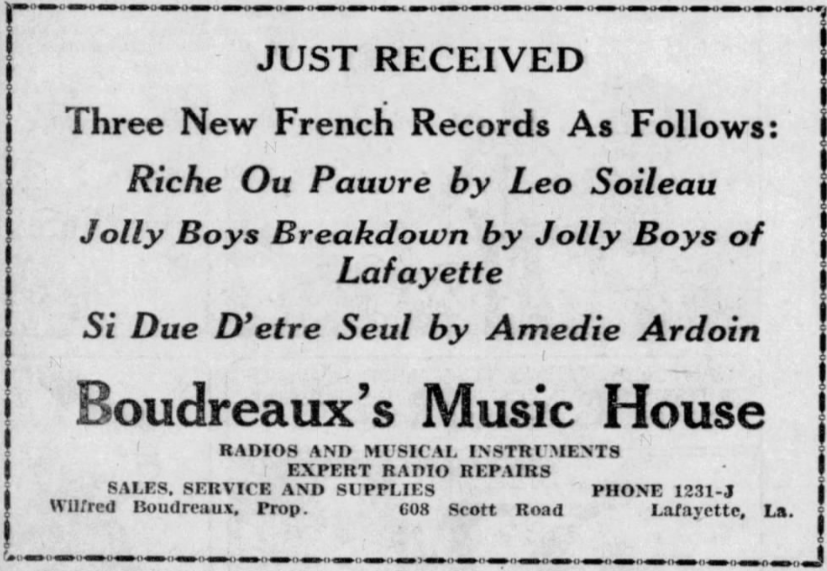
"Jolly Boys Breakdown" - Jolly Boys of Lafayette

By the late 1930s, old-time string bands were being replaced by brother acts like the Delmores and the Sheltons.  There were also new sounds of the Western swing groups to attract the public's ear.  Cajun music on record also changed.   Out went the accordion and in came the western string bands.1   The Jolly Boys of Lafayette were just one of many that landed a recording session with Decca in 1937. 
Francis "Red"
Fabacher

The song was a cover of the Angelas Lejeune recording "Perrodin Two Step" originally recorded in 1929.  The song is most notably known as The Perrodin, allegedly named after two brothers who often requested it at dances.2  Here, the band named it after themselves, calling it the "Jolly Boys Breakdown" (#17032).  The Jolly Boys were Francis "Red" Fabacher and Leon "Crip" Credeur. 


The same melody would be used by Miller's Merrymakers called "Round Up Hop" in 1937.    Some refer to it as "Mamou Breakdown" as recorded by Wallace "Cheese" Read. By 1947, Decca re-issued the song on their black "script" label. 


Daily Advertiser
Sep 20, 1937


Courtesy of Katherine Prater
from Lake Charles


  1. Cajun Country 2.  Pat Harrison.  Liner Notes.
  2. MADE IN LOUISIANA.  VRCD 325.  MARC SAVOY - Accordion. DEWEY BALFA - Fiddle. D. L. MENARD - Guitar.  Liner notes.
Find:
Cajun Louisiane 1928-1939 (Fremeaux, 2003)
Cajun Country, Vol. 2, More Hits from the Swamp (JSP, 2005)
The Best Of Cajun & Zydeco (Not Now, 2010)

Tuesday, June 16, 2015

"Dragging The Bow" - Harry Choates

One of Harry Choates' best demonstrations of his talent was ability to show off his solo fiddle rides on certain tunes.   Here, in early 1948, he takes the opportunity with his band to record for Bill Quinn's Houston-based Gold Star label one of his more well known instrumentals called "Dragging The Bow" (#1343).

His band had shifted some players and by 1948, the group consisted of Wilbur "Pee Wee" Maples on guitar, Red Fabacher on steel guitar, Junior Keelan on bass, Amos Comeaux on drums, and Johnnie Ruth Manuel on piano.  Throughout the song, you could hear him shift the attention to his friend Francis "Red" Fabacher by calling out his name.   Red had earlier worked with his brother Joseph in the group called Jolly Boys of Lafayette. He met Harry around the time both were helping Happy Fats during the early 1940s.


Red Fabacher, Ronald Ray "Pee Wee" Lyons,
Johnnie Ruth Smyrl, Harry Choates,
Amos Comeaux, Curly Maples
Originally recorded by Henry Hartley and the Travelers as "Raggin' The Fiddle", it's a cover of the famous western swing player Curt "Dott" Massey's 1935 Vocalion recording called "Draggin’ the Bow".  Most likely, Harry picked up the tune while playing with Shelley Lee Alley & his Alley Cats, given they recorded the tune in 1938 as "Alley Cat Stomp".  Harry had previously recorded it with Happy Fat's Rayne-Bo Ramblers in 1940 for Bluebird and their subsidiary Montgomery Ward label, calling it "Lake Charles Shuffle". The song title refers to the action of a smooth fiddle player.  While the phrase has mysterious origins, it most likely refers to a player's ability to keep the bow constantly on the strings, while moving from string to string, in one sweeping fashion. 


Goldstar would end up selling the masters to Pappy Daily's "D" records which re-released the song (#1024), sometimes changing the name slightly, such as "Draggin The Fiddle" (Starday #273, D 1023)  and "Drag That Fiddle" (Starday #258).

Harry's lifestyle was erratic.  According to Red:

I drank when I was on the bandstand, but [Harry] drank all day long.


Daily Advertiser
Feb 19, 1941


  1. Country Music Originals: The Legends and the Lost By Tony Russell
  2. http://www.vithefiddler.com/draggin-the-bow-fiddle-tune-a-day-day-110/
Find:
Fiddlin' country style (Melodisc, 1961)
Harry Choates ‎– The Fiddle King Of Cajun Swing (Arhoolie, 1982, 1993)
Harry Choates - Jole blon: The Original Cajun Fiddle of Harry Choates CD (D, 1999)
Cajun Fiddle King (AIM, 1999)
Devil In The Bayou - The Gold Star Recordings (Bear Family, 2002)

Sunday, November 30, 2014

"Abbeville" - Jolly Boys of Lafayette

After 1933, Decca began looking to record more southern American music including hillbilly and Cajun music. Their A&R man, David Kapp, made pilgrimages through the south in areas such as Memphis, New Orleans, Dallas, San Antonio and Charlotte. He stated 
"In Dallas we got a lot of Cajuns coming in. I've seen some of those artists drive 500 miles in tumble-down cars to get an audition". 
One of those many Cajun bands was the Jolly Boys of Lafayette. Lafayette is a city in the heart of Cajun country. Composed of Leon "Crip" Credeur on fiddle and vocals, Joseph Fabacher on accordion and Francis "Red" Fabacher on guitar, they would travel to Dallas in 1937 and record 10 songs. Allegedly, Oran Doc Guidry claimed he and the band recorded earlier for Decca in 1934, however, there is no record of this in the Decca archives. 


S'en aller là bas à Abbeville

C'est pour voir ma chère mignonne petite veuve

Quelques jours passés, je lui ai envoyer une lettre

Elle m'a jamais renvoyé de ses nouvelles


Petit coeur tu connais t'auras du regret

D'avoir eu fait tous les misères que t'es après me faire

Mais oh y aïe moi j'connais tu vas pleurer

Tu vas pleurer, c'est pour ça que t'es après faire
Francis Fabacher

The Fabacher brothers descend from a Bavarian family that settled in the region during the 1870s. Joseph's German accordion would have been very familiar to the families older generation. One of the songs recorded included the country influenced entitled "Abbeville" (#17026), named after a town south of Lafayette. The tune is typical of the country-hillbilly sound which influenced Cajun music in the late 1930s. An old country-western tune called "Lonesome Pine", which Cleoma Breaux covered as "Pin Solitaire" in 1936, most likely was the influence.  The first recording of this melody as a Cajun tune was by the Guidry Brothers called "Le Garcon Negligent" in 1929.  The melody was previously recorded by her brothers the year before as "La Valse Du Bayou Plaquemine".  The melody would later influence "Alons Kooche Kooche" and "Grand Texastunes by Papa Cairo.  All of these tunes would lead to Hank Williams' "Jambalaya".


Going away to there Abbeville,
It's for my cute dear little widow,
Past few days, I've been sending letters,
She never sent me anything new.

Small heart, you know you'll regret this,
Having made me miserable after all of this,
But oh yaille, I know you're going to cry,
You're going to cry, it's what will happen.
Daily Advertiser
Apr 12, 1937
In the same fashion, the group would also record the song "Jolie Brunette", a different take on the famous "Jole Blon" melody. The group didn't last and disbanded. Francis would later end up playing guitar with Happy Fats and both steel guitar and electric guitar with Harry Choates. Leon would later work with Leroy Broussard of the Happy-Go-Lucky Band.  Joe is believed to have played with Pee Wee Broussard and the Melody Boys.


  1. Louisiana Fiddlers By Ron Yule
  2. Billboard Magazine. Hotel Room Recording Studios. Apr 3, 1971.
  3. Lyrics by 'ericajun'
Find:
Cajun: Rare & Authentic (JSP, 2008)