Showing posts with label Fais Do Do Records. Show all posts

Thursday, October 20, 2022

"Chinaball Special" - Veteran Playboys

Hailing form the same Pointe Noire area west of Church Point that produced the remarkable Lejeune clan of singers and musicians, Alphée Bergeron had played before the war (including alongside Amede Ardoin and Mayuse Lafleur), but like many of his contemporaries, he had put aside his accordion for two reasons: first, because he felt he should tend to the serious business of raising his family and second, because accordion driven Cajun music had faded from the scene.  In the years following WWII, many were growing uncomfortable with the widespread loss of ethnic identity caused by social stigmatization.  Legendary Cajun musicians such as Iry Lejeune, Lawrence Walker, Austin Pitre and Aldus Roger launched a renaissance of Cajun music culture.  Another of these pioneers was Alphée Bergeron.2 

Hé, jolie petite blonde, j'aimais tant, 
Oh, petite mignonne pour moi, 
Hé, pour faire donc toi t'as eu pour me quitter moi comme ça.

Hé, 'tite fille, mais gardez donc de ma maison, 
Hé, mignonne,(je) m'ennuie de toi, 
Hé, pour faire donc je pourrai pas te revoir une fois encore.

Hé, petite, moi j'voudrais, mais, te demander, 
Oh, c'est bien éyou t'as été?, 
Ouais, parce que moi je suis misérable quand je vais à Duralde asteure.  


Shirley Bergeron, Bill Matte, Adam Hebert,
Raymond Lafleur, Alphee Bergeron,
Wallace Lafleur
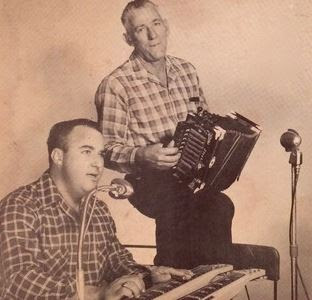
In 1947, the musical climate had changed. He dusted off his instrument and formed his aplty-named Veteran Playboys.  He teamed up with fiddler Adam Hebert, a veteran himself, in 1948 in which they recorded the "Chinaball Special" (#1012), named after a dance-hall they frequented called the Chinaball Club in Bristol, Louisiana.  It featured a melody commonly associated with the song "B.O. Sparkle" by Leroy Broussard.  According to author and collector, Lyle Ferbrache,
This is truly one of the great post-war records. It was the first super group of Cajun music.  Adam Hebert sings and plays fiddle with  Alphée Bergeron playing accordion.  Alphée's son, Shirley Bergeron, Bill Matte and Raymond Lafleur played in this great band as well.  In time, all the members went on to their own successes.1   


Alphee Bergeron

Hey, pretty little blond, I loved so much,
Oh, little cutie for me,
Hey, so what's done, you had to leave me like that.

Hey, little girl, well, so look, I'm home,
Hey, cutie, I miss you.
Hey, so what's done, I won't be able to see you again.

Hey, little one, I would like, well, to ask you,
Oh, it's good wherever you are?
Yeah, because I am miserable when I go to Duralde, right now. 


Alphée gave up farming after Hurricane Audrey wiped out his crops in 1957.  However, he was still able to make a living as a musician and continued to play music alongside Adam Hebert and Bill Matte.  

Adam Hebert
Hebert was a gifted song writer whose music is at the center of traditional Cajun repertoire.  Adam constructed his first fiddle as a child out of a chocolate box and screen wire, later progressing to one his brother made out of a cigar box and horse hair. When his father overheard him playing for his sister and her beau in the parlor, he realized Adam's talent and ordered a real violin out of the Montgomery Ward catalog.  Adam, then began playing hose dances at age 13 and later recalled how he approached singing,


Some musicians just count from their mouth when they sing, they just speak. I approach my music not from my mouth, it comes straight from my heart.3  

Alphée continued to play in bands until the the 1970s and quit when he got sick.  His son Shirley, who was also an accomplished musician, stated,
Daddy was a very comical fellow and very serious at his work as a farmer. He was a hard working accordion player at the dance jobs. He played until he got physically unable to keep up But his music lives on through the records.  His music is still popular.4  


  1. Post War Cajun 78 RPM Nuggets – Lyle Ferbrache
  2. Barry J. Ancelet.  The Daily Advertiser (Lafayette, Louisiana) 17 Sep 1997
  3. Adam Hebert.  The Daily Advertiser (Lafayette, Louisiana) 12 Oct 2010
  4. Daily World (Opelousas, Louisiana ) 12 Apr 1991
  5. Lyrics by Stephane F

Release Info:
Eunice Waltz | Fais-Do-Do F1012
Chinaball Special| Fais-Do-Do F1012


Find:
Acadian All Star Special - The Pioneering Cajun Recordings Of J.D. Miller (Bear, 2011)

Monday, October 18, 2021

"Chere Catan" - Lee Sonnier

Accordionist Lee Sonnier and his contemporaries were attuned to, and profoundly affected by, the ever-changing musical landscape that sustained their art.  They were not only products of their environment, but also cultural actors who intervened by adapting the diatonic accordion into a Cajun swing framework, a context they knew intimately well.1 But it would take his son-in-law JD Miller to bring him into the studio to shine.

Before Miller married into the Sonnier family, he had been a musician himself.  When Miller was 11 years of age, he played in the grade school band and his interest in music was born.  At the age of 15 Miller joined the Crowley High School band as a drummer. He recalled,
That band was the only formal music training I ever got, and I didn't pay any attention to the instructor even then.  I just played!3  

J.D. Miller, 1954

Oh, bébé, malheuruse, catin,
'Tite monde, quoi moi j'va faire, chère,
Ouais, quand mon j'vu là, 'tite fille,
(Pour toi m'écoute), malheuruse.
...


During his high school days, he began writing songs.  Though this period, he wrote 95 songs, but being convinced that they were not good, he destroyed them all and temporarily put the thought of a musical career behind him.2  However, by the 1930s, Miller was invited by steel guitarist Papa Cairo, and fiddler Irby Thibodeaux to form the band called Daylight Creepers.  J.D. Miller states:

You think the names of bands are strange now.  We used to play at night and it seemed that almost every time the old car we used broke down.  We'd have to push that car back home during the day and that's how we came up with the name.1

Lee Sonnier

Oh, baby, oh my, pretty doll,
Little everything, what you've done, dearie,
Yeah, when I saw you there, little girl,
You were listening (to me), naughty woman. 
...


By 1946, he was no longer in a band.  Instead, Miller gathered Sonnier's group into his new recording studio at M&S Electrical shop around 1948 and using a tape recorder, listened to Lee's band record a traditional tune called "Chere Catan" (#1002) with Calvin Holloway as vocalist, Lawrence "Blackie" Fruge on fiddle, Eula Mae Fruge on guitar, and Happy Fats on bass.  Sadly, Miller struggled with balancing the instruments and Calvin's vocals are hardly heard over the volume of Lee's accordion.


  1. Cajun Breakdown : The Emergence of an American-Made Music by Ryan Andre Brasseaux
  2. JD Interview.  RT.  1953
  3. JD Interview  DA.  1954
Release Info:
Dans Les Grand Meche | Fais Do Do F-1002-A
Chere Catan | Fais Do Do F-1002-B

Find:
Fais Do Do Breakdown - Volume One - The Late 1940's (Flyright, 1986)
Acadian All Star Special - The Pioneering Cajun Recordings Of J.D. Miller (Bear, 2011)

Monday, May 17, 2021

"Eunice Waltz" - Veteran Playboys

When the Second World War finally came to a close, the returning veterans of southwest Louisiana wanted to hear the music of their youth.  One of the leading bands of that era was Alphée Bergeron and the Original Veteran Playboys.  They played traditional Cajun music every night of the week for three years straight.  Alphée was a sharecropper by day and accordion player by night. He was from the community of Pointe Noir, near Church Point in Acadia Parish.1  


Moi j'm'en va d'la maison, 
J’suis parti en larme, mais, tu vas voir encore,
Toi, 'tite fille, toi, tes ma pardonné, 
C'est de la peine que j'ai (pour) toi pour toujours.

J’suis parti en larme, mais, tu vas voir encore,
J'suis condamné par les paroles de ma catin
Te condamné pour quatre-vingt-dix neuf ans,
Dans les bals*, chere-là, m'joindre pas jamais.

T'as jonglé tout mes parents,
(Je) pense à toi, c'est des mauvaises paroles, catin,
Faudra je prends mes chagrin pour mourir,
Toi, tite fille, t’es peut remercier ton papa et ta maman.


Shirley and Alphee Bergeron
At the age of eight he, he started playing the accordion and at the age of twelve, he was playing house dances.  He played his first house dance with Joe Cormier in the Tasso community.  He was a close neighbor with accordion player Angelas Lejeune.4 

Alphée son, Shirley, was a quick study and soon joined his father’s band while still in school.  Shirley was eager to learn and soon began singing in his father’s band.  He also learned to play the electric steel guitar—his favorite instrument.  The typical week would start Tuesday nights with a short performance at KSLO radio, then to the Deuce Club in Lewisburg.  Shirley recalled,
"The second night, Wednesday, was the Rose Garden Club in Nuba. Thursday night, we'd perform at the Side Inn in Church Point.  Friday night's performance was at Jake's Place in Church Point, and on Saturday night....man, there's so many places. I was going through high school at the time. Man it was rough. "2  
In 1948, Alphée and fiddler/vocalist Adam Hebert formed a band called the Veteran Playboys because of two of the group members were veterans.3  They recorded one pressing on J.D. Miller's Fais Do Do label including song "Eunice Waltz" (#1012), a version of Amede Ardoin's 1929 recording "La Valse Ah Abe".  The rest of band included Raymond Lafleur on guitar, Wallace Lafleur on guitar, Bill Matt on drums and possibly Willard Matt.

Daily World
Mar 23, 1951


I'm going back home,
I left in tears, well, you will eventually see,
You, little girl, you've forgiven me,
It's because of the pain that you've given me forever.

I left in tears, well, you will eventually see,
I'm condemned by the words you said, pretty doll?
You've condemned me for ninety-nine years,
Good riddance, dearest, never join me again.

I'm reminiscing about all my parents,
Thinking of you, because of the terrible words, my pretty doll,
I have to keep my sorrows until I die,
You, little girl, you can thank your father and your mother. 


Shirley Ray Bergeron became one of the best singer-songwriters of Cajun Music.  Adam Hebert would continue on, forming a group called the Country Playboys. 


  1.  J’AI FAIT MON IDEE (I MADE-UP MY MIND) By William Thibodeaux 11/12/2013
  2. Daily World (Opelousas, Louisiana )12 Apr 1991
  3. The Ville Platte Gazette (Ville Platte, Louisiana) 10 Jun 1993
  4. https://www.cajunfrenchmusic.org/documents/8AlpheeBergeron.pdf
  5. Lyrics by Herman M and Stephane F
Release Info:
Eunice Waltz | Fais Do Do F-1012-A
Chinaball Special | Fais Do Do F-1012-B

Find:
Acadian All Star Special - The Pioneering Cajun Recordings Of J.D. Miller (Bear, 2011)

Monday, February 8, 2021

"Petite Negress" - Jimmy Choates

Fiddler Jimmie (Jimmy) Choate was born in Bancker, Louisiana, not far from Abbeville.  He grew up playing music at an early age, similar to many of his siblings.  Quick to latch on to the success of famed Texas fiddler Harry Choates, Jimmie and his brother Pete decided to make a music career.  Record producer J.D. Miller of Fais Do Do records saw the opportunity as well, and in 1951, he had Jimmie's band record two songs. 


Moi j'aime cousin et moi j'aime cousine mais j'aime mieux ma 'tite negress,
Samedi, ce soir, moi j'etais au bal, je m'ai saoulé comme un 'tit cochon,
Dimanche matin, c'est tout manière malade,
Passez-moi le verre à limonade.

L'hiver arrive, l'hiver arrive, mon p'tit nég a pas de couverte,
Demain ce soir, il t'etais au bal, il saoulé comme un 'tit cochon,
Lundi matin, il était tout manière malade, 
Passez-lui le verre à limonade.

L'hiver arrive, l'hiver arrive, mon p'tit nég a pas de couverte,
Demain ce soir, il t'etais au bal, il saoulé comme un 'tit cochon,
Lundi matin, il était tout manière malade, 
Passez-lui le verre à limonade.

Moi je bois du vin et moi je mange des dattes, et tout ça, ça me coute pas rien,
Demain ce soir, moi j'etais au bal, je m'ai saoulé comme un 'tit cochon,
Lundi matin, c'est tout manière malade, 
Passez-moi le verre de Hadacol.


Blackie Dartez

Apr 19, 1951

Jimmie's Melody Boys included Ronald Ray "Pee Wee" Lyons on steel guitar and Charles ‘Pete’ Choate on bass guitar, however, Miller had the Melody Boys back up his star studio vocalist and guitarist Blackie Dartez.  Leodis "Blackie" Dartez was a guitarist from Cut Off, Louisiana and made his way to Crowley during the 1940s.  He played alongside Joe Falcon and his Silver String Band and later with Leroy Broussard and his French Serenaders.  There, he taught the accordion player his version of of a 1929 Columbus Fruge recording "Point Clear Blues" and entitled it "Petite Negress" (#1009).   


I appreciate my cousin, appreciate my cousin, but I prefer my woman,
Saturday night, I went to the dance, I got drunk like a big pig,
Sunday morning, I wasn't feeling well,
Pass me a glass of lemonade.

Winter comes, winter comes, my good friend was homeless,
The next night, he was at the dance, he was drunk like a pig,
Monday morning, he was very sick,
Pass him a drink of limonade.

Winter comes, winter comes, my good friend was homeless,
The next night, he was at the dance, he was drunk like a pig,
Monday morning, he was very sick,
Pass him a drink of limonade.


I drank wine and ate dates, and all that, it didn't cost me anything,
Saturday night, I went to the dance, I got drunk like a big pig,
Sunday morning, I wasn't feeling well,
Pass me a glass of Hadacol.


Teche News
Feb 10, 1950

Blackie changed up the lyrics, including the last line as an ode to the popular elixir Hadacol, invented by famed Lafayette salesman Dudley Leblanc.  It was a popular drink in 1949 that was sold by the thousands across the country.  By the time Leroy made his way into the Goldband recording studio in 1956, he re-recorded the song as "Lemonade Song" and it remained that title ever since. 


Release Info:
Chere Meon | Fais-Do-Do F-1009-A
Petite Negress | Fais-Do-Do F-1009-B

Find:
Acadian All Star Special - The Pioneering Cajun Recordings Of J.D. Miller (Bear, 2011)

Monday, December 14, 2020

"Chere Eci Et Cher Laba" - Lee Sonnier

"Sweetie Here And Sweetie There".  J.D. Miller had recently left a recording session at Cosimo Matassa's studio in New Orleans and decided to build his own around 1948.  Logically, perhaps, the first person to be recorded at the new studio was Miller's father-in-law, a highly respected accordionist, Lee Sonnier.  Born near Rayne, he had no musical training but was from a musical family.  Lee was a welder by trade working up to an through WWII in defense plants.  After the war he opened his own welding business.  J.D. Miller married the youngest of this three daughters.1 


Quand ton nègre avec toi,
C'est "chère ici, chère là bas",
Quand ton nègre n'il ya à coté,
Toi tu fais trop la canaille,
...


'Gardez-donc, malheureuse,
Pour pas bien ton vieux nègre,
Tu vas voir pour toi même,
Petite, tu vas faire pitié,
...


Criminelle, petite,
Pour faire bien, malheureuse,
Tu vas voir, mignonne,
Ah, je mérite pas ça,
...
Daily Advertiser
Apr 25, 1952


In  J.D Miller's new studio in Crowley, they recorded an old traditional melody, first recorded Amede Ardoin as "Eunice Two Step" in 1929 and later in 1934 by Joe Falcon as "Vous Etes Si Doux".  Joe and Lee played together in the same dance-halls after the war, giving way to Lee's version which he called "Chere Eci Et Cher Laba" (#1010).   Miller brought in fiddler and vocalist Aldus "Popeye" Broussard to sing the tune.  Aldus was already well known fiddler who previously played with Norris Mire and Happy Fats throughout the 30s and 40s. The phrase "c'est un chere ici, cher la-bas" has an underlying meaning.  It's a Cajun idiom used to describe a couple who make a show of affection in public, but who fight frequently in private.  


When your man's with you,
It's "dearie here, dearie there",
When your man's not around,
You act too mischievous,
...

So look, miserable one,
It's hasn't been good for your old man,
You will see for yourself,
Little girl, you'll be pitiful,
...


Naughty, little girl,
It's been good, miserable one,
You will see, cutie, 
Ah, I don't deserve all of this,
...
Lee Sonnier


The labels showed the difficulty of getting Cajun spellings printed accurately away from home.  "Chere Eci Et Cher Laba" reflect it no less obviously than the artist credits to Lee "Snownier".1  Sonnier's lyrics would have little to do with "Eunice Two Step", a melody in which he borrowed from black Creole accordionist Amede Ardoin.   Later, Iry Lejeune would also take it and turn it into his "Jolie Catin". Lee carried on playing in south Louisiana clubs in to the 1950s.1  


  1. Fais Do Do Breakdown - Volume One - The Late 1940's (Flyright, 1986).   Liner notes.
  2. Lyrics by Stephane F

Release Info:
La Blues De Cajin | Fais Do Do F-1010-A
Chere Eci Et Chere Laba | Fais Do Do F-1010-B


Find:
Fais Do Do Breakdown - Volume One - The Late 1940's (Flyright, 1986)
Acadian All Star Special - The Pioneering Cajun Recordings Of J.D. Miller (Bear, 2011)

Sunday, November 1, 2020

"Bayou Lafourche" - Happy, Doc And The Boys

Throughout the 1930s, Leroy "Happy Fats" Leblanc and his Rayne-Bo Ramblers became the first Cajun band from south Louisiana to play on a radio show broadcast nationally over the CBS network.  However, the outbreak of WWII caused his band to go into hiatus.  Once the war was over, he filled in as a backup musician for country star Tex Ritter in Hollywood.  By the time he arrived back home, the Louisiana Hayride show in Shreveport was looking for new talent.  According to Happy, he recalled playing in the same lineup with Hank Williams on the Hayride radio show.  It was a half-hour show where the rules dictated "no repeats!"  Happy explains to author Ryan Brasseaux:
So, we played "Jole Blonde" there was a tremendous crowd that night.  Hank Williams was there playing.  We got on and we played "Jole Blonde" and when we got through playing it they started clapping.  Horace Logan, the station manager, was there so I though he wanted us to quit.  "No", he said, "play it again!"  "Well, you said no repeats".  We had to repeat on that network three times!2

Bon heures tous les matins,
J'peux voir mon vieux papa,
Partir à la pêche dessus la mer,
C'est su' le Bayou Lafourche,
Il vient toutes les dimanches,
À l'église du bon dieu pour prier.

Y'en a pas qu'est si riche,
Y'en a pas qu'est si pauvre,
Juste les bons Acadiens, apprise faire une vie,
Et c'est là  j'sus parti,
Pour la balance d'ma vie,
Sur le côté du beau Bayou Lafourche.


Lake Charles American Press
Oct 29, 1952


After his last contract recording with RCA in 1946, he quickly reformed a group called Happy, Doc And The Boys.  "Bayou Lafourche" (#1011), recorded in Crowley, Louisiana at J.D. Miller's studio between 1947 and 1949, marked Happy's attempt at converting his popular pre-war hit "Les Veuves de la Coulee" into a waltz-tempo ballad.  The bayou translated to "Fork Bayou") is one of the major navigable tributaries of the Mississippi River and flows through lands once owned by displaced colonial French Acadian and Spanish Isleno settlers.  Along with Oran "Doc" Guidry on fiddle, Bradley "Sleepy" Stutes on steel guitar, and possibly the Redlich brothers , Happy's ultimate goal was to break into the Nashville scene and become the next big country music star, similar to Hank Williams.   According to Happy:

Hank Williams had a lot of influence down here.  He was on the Louisiana Hayride.  It covered about a quarter of the nation, it was a 50,000 watt station.  And Hank, you've got to give him that, he was good, he was really good.  He was on, like I was, for Johnny Fair's Syrup.  He left to go to the Grand Ole Opry.  He gave me the job, the Old Syrup Sopper. 
Rayne Tribune
Oct 24, 1952


Early every morning,
I can see my old papa,
To go fish near the waters,
It's on the Bayou Lafourche,
He comes every Sunday,
To the church for the Good Lord to pray.

There isn't anyone too rich,
There isn't anyone too poor,
Just good Acadians, trying to make a living,
And that's where I'm leaving to go,
In order to set my life straight,
To the shores of the beautiful Bayou Lafourche.


The Drifting Cowboy and Happy Fats reunited in 1952 when Williams invited the Cajun guitarist to tour around the US.2


  1. Rayne's People and Places By Tony Olinger
  2. Cajun Breakdown: The Emergence of an American-Made Music By Ryan Andre Brasseaux
  3. Image by Mark P
  4. Lyrics by Stephane F, Francis M, Jerry M and Herman M
Release Info:
Bayou LaFourche | Fais Do Do F-1011-A
Sothe Fermon | Fais Do Do F-1011-B

Find:
Acadian All Star Special - The Pioneering Cajun Recordings Of J.D. Miller (Bear, 2011)
Friday, April 10, 2020

"Setre Chandelle" - Happy, Doc and the Boys

"Seven Candles".  In the late 1940s, Leroy "Happy Fats" Leblanc and Oran "Doc" Guidry teamed up together with Louis Noel and Jack Leblanc and headed to New Orleans to record at Cosimo Matassa's J&M Studio.  Fais Do Do Records producer J.D. Miller had heard about Matassa's studio and grabbed the musicians for his very first recording session.  Miller recalls the trip down old Highway 90 to New Orleans and their time there:
Doc had a friend who was a custodian of a private school in New Orleans.  He and his family lived on the top floor of the school and we were invited to stay overnight.  With this recording session being what we thought to be one of the highlights of our lives we did a little celebrating, Cajun style.  There was plenty of food, plenty of drink, and plenty of music (which) lasted nearly all night--at least as long as the participants were able to celebrate.  The next day is when the records were cut.1

Cosimo Matassa


T’as parti un an passé,

J’espérais, belle coeur, cassé,

La grande rêve, t’as plus, chérie,
C’a cassé mon cœur en deux.

La bataille t’avais clamée,
Sur la table t'as sont vidée*,
Les paroles, les derniers dit,
Ramenez-moi dan mon pays.

Poussez-moi près de mom et pop,
Pour toujours et près d’elle,
Sept chandelles étaient petite peu,
Pour montrer mon aime était.

Tout ma vie j’ai coursaillé,
J’ai roulé et j’ai traîné,
Là, asteure, j’après mourir,
Un jeune homme de vingt année.

Dans pays j’après mourir,
Prends entend ça, je serai préservé*,
Rêve pas pour moi, j’sus satisfié,
Dans le ciel j’apres t’espérer.

Doc Guidry

Miller traveled to New Orleans between 1946 and 1948 with Happy, Doc Guidry and Jack Leblanc. The three musicians each cut a record at the Cosimo Matassa recording studio, the only one then in the state.  In typical Cajun fashion, they put down the excellent pairing to be heard, "Setre Chandelle" and "Allons Dance Colinda", with no evidence of the previous night's partying.  "Setre Chandelle" (#1001) was Happy's rendition of the famous Cleoma Breaux song "Mon Coeur T'Appelle (My Heart Aches For You)" more popularly known as "J'ai Passe Devant Ta Porte".  The song discusses the loneliness of losing a loved one who is laying in a coffin, surrounded by "sept chandelles".  It's one of the finest recordings of Doc's smooth fiddle solos.  
According to Miller:
Each guy cut two sides of a 78. We didn't have 45s yet. The records had to be sent to the West Coast to be pressed. They weren't the best records, but they sold.1
Teche News
Jun 8, 1951


You've left a year ago,

I was hoping, my beautiful heart, broken,

The big dream, you no longer have, dearie,
It broke my heart in two.

The fight had claimed you,
On the table feeling empty*,
The words, the last ones spoken,
Take me back to my countryside.

Gather me close to mom and pop,
Forever and close to her,
Seven candles were too little,
To show my love.

All my life I've been chasing around,
I had rolled around and dragged around,
Here, right now, I'm dying,
A young man of twenty years.

In the countryside, I'm dying,
Understand that, I'll be remembered*,
Don't dream of me, I'll be fine,
Up in the sky, I'm begging you.


Miller then decided to produce his own records of local musicians.  He went to the Gates Record Company in Houston and purchased a portable recorder, a microphone, an amplifier and a speaker for about $3000. The Jay Miller Studio was founded.2


  1. Fais Do Do Breakdown - Volume One - The Late 1940's.  Liner notes.
  2. Interview with J.D. Miller. By Stacey Courville. Crowley Post Signal. 1983.
  3. Lyrics by Smith S

Release Info:

Setre Chandelle | Fais Do Do F-1001-A
Allons Dancer Colinda | Fais Do Do F-1001-B
Find:

Fais Do Do Breakdown - Volume One - The Late 1940's (Flyright, 1986)
Acadian All Star Special - The Pioneering Cajun Recordings Of J.D. Miller (Bear, 2011)

Friday, December 20, 2019

"Gabriel Waltz" - Happy, Doc And The Boys

From 1946 to 1959, J.D. Miller released all forms of French language records, from the beautiful fiddle and guitar records of Oran 'Doc' Guidry and Leroy 'Happy Fats' Leblanc to the raucous recordings of Robert Bertrand and the Lake Charles Playboys.  It was between 1946 and 1948, when Miller decided to work with Happy Fats and record some of the first Cajun-country music after WWII.  Miller recalls:
We founded the M&S Electric company and we were doing industrial work on the rice mills.  All of it was heavier-type work, industrial and commercial.  I rented a building to house our company, but it was such a large building it looked bare with what we had invested.  There was so much room, I took an idea to put a little music and record shop in it.3 
So we bought a few records and a guitar or two...strings.  We put in a few records and the jukebox owners started buying records from my store.  Many of the customers, because they were predominantly Cajun at the time, wanted Cajun records.  They had a couple of Harry Choates records on the market and few other things, but apart from that, try as hard as I could, I couldn't obtain any.  So I got the idea I'm gonna make some, and I didn't know where to turn to go to a studio. Then I found they had a studio in New Orleans, the only studio in Louisiana: Cosimo Matassa's.3
J.D. Miller

Miller went to Cosimo Matassa's fledgling J&M Recording studio in New Orleans between 1946 and 1947 and recorded singer Happy Fats with fiddler Doc Guidry and singer Louis Noel.  Happy told radio interviewer Dave Booth:
We did a French thing and a country thing.1 


Gabriel avais de mon parrain,

Madeleine, c’était ma marraine,

Gabriel, il était pas beau,

Madeleine, elle valait pas mieux.


Gabriel avait de beau chapeau,
Madeleine avait (z)un beaux souliers,
Gabriel avait de beau chapeau,
C’est dommage il avait pas de calotte.

Gabriel avait de beaux souliers,
Madeleine avait (z)un beau chapeau,
C’est dommage il avait pas de calotte.

Gabriel avait de belle calotte,
Madeleine avait (z)un beau chaussette,
Madeleine avait (z)un belle chaussette,
C’est dommage il était déchiré.

Gabriel avait de beaux souliers,
Madeleine avait (z)un beau chapeau,
Madeleine avait (z)un beaux souliers,
C’est dommage c’était des "tennis shoes".

Louis Noel

It turns out they recorded six songs total, one of them being "Gabriel Waltz" (#1000).  It was an old French folk ballad, associated with children's nursery rhyme.  The 1947 melody has origins in Leo Soileau's 1937 "Valse D'Amour", with the smooth fiddle rides by Oran "Doc" Guidry.  In addition was Happy Fats on guitar, Jack Leblanc on guitar and Dalton Delcambre on steel guitar.  To round out the group, Happy picked up a budding guitarist from St. Landry parish known as Louis Noel.   Louis' daughter recalled: 
Louis decided to give up farming and try his luck as a musician.  He landed a spot at KSLO in Opelousas.  He did some "hand me down" songs like "La Cravat" and "Gabriel Waltz".4

Miller's early releases had the letter 'F' in the catalog number to signify a French recording, specifically Cajun French, while the letter 'E' signified and English recording, specifically a country song.   Therefore, Miller's early pressings contain multiple uses of numbers.


Crowley Daily Signal
Oct 13, 1949


Gabriel was my godfather,

Madeleine, she was my godmother,

Gabriel, he was not handsome,

Madeleine, she was no better.


Gabriel had a nice hat,
Madeleine had nice shoes,
Gabriel had a nice hat,
It's a shame, he had no overshoes.

Gabriel had beautiful shoes,
Madeleine had a nice hat,
It's a shame, he had no overshoes.

Gabriel had a nice cap,
Madeleine had nice socks,
It's a shame, they were torn.

Gabriel had beautiful shoes,
Madeleine had a nice hat,
Madeleine had nice shoes,
It's a shame, it was tennis shoes.

In 1957, Bobby Bourke from Avery Island would record the tune during a field session for the Ethnic Folkways Library's I. Bonstein.   Later, Austin Pitre's "Valse d'Amour" would re-issue the melody and Nathan Abshire would rework the tune as "Gabriel Waltz" later.


  1. Slim Harpo: Blues King Bee of Baton Rouge By Martin Hawkins
  2. Yé Yaille Chère! by Raymond Francois
  3. Record Makers and Breakers: Voices of the Independent Rock 'n' Roll Pioneers By John Broven
  4. Discussions with Karl W
  5. Lyrics by Marc C
Release Info:
La Cravat | Fais Do Do F-1000-A
Gabriel Waltz | Fais Do Do F-1000-B

Find:
Acadian All Star Special - The Pioneering Cajun Recordings Of J.D. Miller (Bear, 2011)

Friday, October 25, 2019

"Dans La Platin" - Happy, Doc and the Boys

After the wartime sojourn with Leo Soileau and Harry Choates in Lake Charles, Leroy "Happy Fats" Leblanc had been invited to tour with top singing cowboy star Tex Ritter, playing Mississippi, Arkansas, Florida, Georgia, and even Hollywood. When he returned home, jobs were hard to find, until he teamed up with Doc Guidry for broadcasting and recording. He recalls:
It got kinda tough playing dances and playing the guitar.  Doc Guidry was a very good violin player, very good fiddle player, I thought he would add a little to it so I got Doc.1


Tu fais pitié, mignonne, de quoi t'as fait, chérie,

Un partir, catin mais, au si loin, jolie,

Tu viens pas, mais, dans le platin, mais, pour asteur.


(Tu) m'fais de la peine, chérie, il y a pas longtemps, jolie,

Tu m'a laissé, catin, tu fais pitié, jolie, 

De partir, mais, au si loin avec un autre.


Toi vieille femme, chérie mais, t'en vas pas, chère mignonne, 
M'a laissé, catin, pour z-un autre, chérie,
Tu m'a laissé pour t'en aller dedans le platin.

Fais de la peine, chérie, de quoi pleurer, mignonne,
(Tu) m'a laissé, chérie, moi tout seul, catin,
Pour t'en aller avec un autre, mais, malheureuse.
Johnny Redlich

In 1947, Happy would record the tune as simply "Dans La Platin" (#1005) on J.D. Miller's Feature records at Miller's brand new studio in Crowley, Louisiana.  While some today use the word "platin" to refer to a low lying area, at the turn of the century, Cajuns referred to a "platin" as a small circular pond, of which there were thousands on the prairies.3  It was similar to either a "marrais" or "meche". 

The melody evolved from the popular Dennis McGee song "Ma Chere Bebe Creole" recorded in 1929.   Joe Falcon would later record it as "La Nuit De Samedi".  It featured Johnny Redlich on vocals, brother of Hanks and "Dago" Redlich, the latter better known for having originally owned the Viking and Chamo label in the 1960s.  Bradley "Sleepy" Stutes, who had joined Happy's group years earlier, can be heard on steel guitar.  Quite possibly it's not Doc Guidry on fiddle for this song but Johnny's brother Hank Redlich on fiddle.  While many know Hank from his guitar playing years, Hank's name is called out during the song for his fiddle solo.   In fact, his family recalls some of his great talented playing:
Hank Redlich


Around 1948, Hank came in 2nd place in a fiddle contest with Harry Choates.  They judges called both of them at least six different times.  They couldn't decide who was the winner.2  


It's pitiful, cutie, what you've done, dear,

Leaving, little doll, well, so far away, my pretty,

You're going to go, well, to the lowlands, well, now.


(You) made me feel sorry, dear, over there not long ago, my pretty,

You left me, little doll, feeling pitiful, my pretty,

Leaving, well, far away with another.


You, old woman, dear, well, I'm not going, dear cutie,
Left me, little doll, for another, dear,
You left me to go away to the big lowlands.

Felling sorry, dear, I have cried, cutie,
(You) left me, dear, all alone, little doll,
For you went away with another, well, oh my.


In 1949, Virgil Bozman and members of Bennie Hess' Oklahoma Tornadoes covered the tune as "The Cameron Waltz" with Floyd Leblanc on fiddle.   Cheese Reed calls it "'Tit Canard Mulet" on his Arhoolie album. The Balfa Brother do it on Cajun Music from the Southwest Prairies on Rounder, field recordings around 1964 for Ralph Rinzler and Newport.  


  1. South to Louisiana: The Music of the Cajun Bayous By John Broven
  2. Discussions with Donnie R
  3. Cajun Sketches From The Prairies Of Southwest Louisiana by Lauren Post
Release Info:
New Jolie Blond | Fais Do Do F 1005-A
Dans La Platin | Fais Do Do F 1005-B

Find:
Acadian All Star Special - The Pioneering Cajun Recordings Of J.D. Miller (Bear, 2011)