A unique window into the world of Cajun music between 1928 and 1965. Compiled histories from websites, books, news articles, liner notes, and interviews. Most come from my personal 78 collection. Also covering Creole, Cajun-Country, and Cajun swing.
Many musicians are familiar with Cajun accordionists Nathan Abshire's "Hathaway Two Step", but many aren't aware of the melody's original release by two musicians, Harrington and Landry. Although their names have been lost to time, it's remotely possible the two musicians were Lloyd Harrington and Bob Landry of Kaplan. Lloyd played the harmonica and the two often traveled to St. Martin Parish for dances. This also happened to be the same place where W.J. Lemoine signed Patrick "Dak" Pellerin for the same Okeh session in which they all performed. Given that Mina Stubbs was there, it's also possible her friend Mrs. W.T. Stewart, a renown music director in the region, could have been supervising the session.
Record store owner and sewing machine seller Winter Lemoine hand selected the musicians for the late 1929 recording in which they waxed "La Stompe Clreole" (#45411), a clear misspelling of the word "creole". Like the late Pellerin sides, the Harrington-Landry pressings were meant to offer a unique mixture of local music to the community. The results of this venture ranged from from Harrington and Landry's traditional Cajun material to Pellerin & Stubb's operatic French Creole selections. The melody lends itself to dancing, in particular, a shuffle style dance. According to writer and musician Ben Sandmel,
When I was with the Hackberry Ramblers, if we played this around Eunice, Lake Charles, Jennings, etc., people would line-dance to it, although nobody ever line-danced to any other song that we played.1
Oscar "Slim" Doucet was a native of Opelousas who assembled a group of musicians known as the Accordion Playboys. For years, he ran Slim Doucet's Garage during the day, working as a mechanic and played music for barn dance parties at night. After meeting local town representative, Dr. Boudreaux, he jumped on an opportunity to bring his accordion to a 1929 Okeh session in Atlanta. Alongside some contemporary musicians where he and guitarist Chester Hawkins recorded two songs, one which was the "Waxia Special" (#45333). "Waxia", is the name of a bayou near Opelousas, Louisiana, Hawkins home town. Referred to on maps as "Bayou Wauksha", it's most likely the corrupted spelling of the Indian name "Ouachita" (not to be confused with the larger "Ouachita River" in northern Louisiana). Another source explains that a Alabamas tribe had settled there in the early 19th century from the region of Waxahatchee. The word, meaning "crest of hair", may possibly be a Siouan word from the Catawba tribe, which spoke a Catawban dialect.1
Daily World Jun 21, 1945
The bayou was home to the Waxia community not far from the historic town of Washington, LA. The waterway flowed into the more well known Bayou Teche river which inspired many Cajun tunes. In recent times, Creole people of the Waxia area were studied by Dr. Jay Edwards of LSU for their unique usage of the French language.2
Native American Placenames of the United States By William Bright
Je Suis Pas Si Canaille! In June 1929, the New Drug Store in Opelousas, Louisiana booked a full-page ad in the Clarion News to advertise the recordings of "Acadian Records" by Okeh. The manager of the store, who took the group of six musicians to Atlanta, used the rhetoric explicitly based on the Evangeline myth. Although Okeh was interested in Cajun music, Dr. A.J. Boudreaux sent along an Opelousas-born jazz crooner to fill in the session. The few Cajuns that tried to incorporate pop tunes of the day into their repertoire did so with the results achieving cultural success or marketing failure.
Though it's a fickle age,
With flirting all the rage,
Here is one bird with self-control,
Happy inside my cage,
I know who I love best,
Thumbs down on all the rest,
My love was given heart and soul,
So it can stand the test.
Personne peut parler avec,
Je suis tout seul,
Personne avec qui marcher avec,
Mais je suis content sûr l'étagère,
Je fais pas cannaille,
Je garde mon amour pour toi.
Je connais pour sûr,
Que quand moi j'aime,
J'ai jamais courtiser dessus toi qu(i) a les cheveux foncés,
Je garde mon amour,
Je garde mon amour pour toi.
On raconte que,
Dans le p'tit coin,
Va pas nulle part,
Pas faire différence avec,
Tes baisers qu'on attend de toi, crois donc moi,
Ne reste pas en retard,
Ne pas aller,
Chez moi à huit heures, juste moi et mon radio,
Je fais pas cannaille,
Je garde mon amour pour toi.
On raconte que,
Dans le p'tit coin,
Va pas nulle part,
Pas faire différence avec,
Tes baisers qu'on attend de toi, crois donc moi,
Ne reste pas en retard,
Ne pas aller,
Chez moi à huit heures, juste moi et mon radio,
Je fais pas cannaille,
Je garde mon amour pour toi.
"Acadian Musicians Sing for Records" Dr. A.J. Boudreaux, Oscar "Slim" Doucet, Christine Mufzar, Jeanne LeBlanc, S. Hawkins and Patrick Pellerin Traveled to Atlanta to record for Okeh, 1929. Center for Louisiana Studies, UL Lafayette
Patrick “Dak” Pellerin's banjo was the Cajun embodiment of America's waning minstrelsy traditions and the escalating jazz fervor sweeping the nation during the roaring twenties. Consequently, Pellerin's musical performance was absolutely cutting edge.1 Accompanied by pianist Mina Stubbs, the banjo player performed a English-French interpretation of Fats Waller and Andy Razaf's showstopper "Ain't Misbehavin" made famous by Broadway's all African-American musical revue "Connie’s Hot Chocolates". Okeh records entitled it "Je Jais Pos C Cannye (Ain't Misbehavin')" (#45410). That year, "Ain’t Misbehavin'" became one of the most successful songs of its day. Ted Gioia states that more than 20 artists recorded the song in 1929 alone, including Louis Armstrong, Waller (an instrumental version) and Bill Bojangles with Irving Mills & his Hotzy Totsy Gang. One of the unique versions to come out from that year was one by Ruth Etting who introduced a unique set of verses in the introduction. It seems it's this version in which Pellerin chose to sing; starting in English and finishing in French.
Ruth Etting
No one to talk with,
I'm all by myself,
No one to walk with,
But I'm happy on the shelf,
I'm not being mischievous,
I'm keeping my love for you.
I know for sure
That when I love,
I'll never woo on the one that has dark hair,
I'm keeping my love,
I'm keeping my love for you.
It is said that,
In the little corner,
Don't go anywhere,
Doesn't make a difference,
Your kisses, which I look forward to, believe me,
I don't stay late,
I don't care to go,
At home at eight o'clock, just me and my radio,
I'm not being mischievous,
I'm keeping my love for you.
It is said that,
In the little corner,
Don't go anywhere,
Doesn't make a difference,
Your kisses, which I look forward to, believe me,
I don't stay late,
I don't care to go,
At home at eight o'clock, just me and my radio,
I'm not being mischievous,
I'm keeping my love for you.
Patrick is presented as a "student at Southwest Louisiana College" with his education validating the authenticity and the weight of his selections and promoting Acadian social status.1 The fact that Okeh marketed this jazz piano rendition as part of their "French Acadian" series highlights the lack of cultural understanding that major labels had regarding the nature of Cajun music. It's no doubt that Pellerin's influence came less from Cajun Creole origins and more from French-converted contemporary radio tunes of the day. As far as A&R executives were concerned, as long as it was in French and stemmed from Louisiana, it must be Cajun music.
Early 20th century Cajun music, and the industry that surrounded it, was dominated by men. Much of this had to do with the reputation the music had among others in the community. Generally, the music was played in places known for drinking, fighting and decadence; places where a urban lady typically wouldn't be found. When Cleoma Breaux followed her brother's lead and joined up with Joe Falcon to become a professional musician, she challenged the industry's mentality of the time. This heightened the group’s drawing power among men, although some women were reportedly resentful – even more so, perhaps, because Cleoma was a sharp dresser whose wardrobe reflected the latest national fashion trends. Atypically, the Falcons were able to make a living playing music alone, with no need for day jobs.
Ville Platte Gazette Dec 14, 1929
Eh, chère, rapelle-toi j’ai promete,
Et j'étais d’accord, quoi tu m’as fait?
Chère, moi, je peux plus,
T’endurer, jolie cœur.
Toi, tu m’as promis, chère,
De plus faire ça et regarde-donc,
Quoi t'après faire aujourd’hui, chère,
Ça c’est dur, oui, pour moi t’endurer.
Quand même tu veux pas, chère,
T’as pas promis il y a pas longtemps, jolie fille,
Tu rappelle-toi quoi t’as fair, jolie cœur?
Oui, c’est de me voir, chère,
Si loin de toi après jongler sans savoir, jolie fille,
Chère, si jamais tu vas d’etre à la traîne.
Petite, tu devrais, chère,
Viens observer il y a si longtemps quoi t’as fais avec moi,
Chère, si tu jongle à moi,
Tu vas voir pour toi-même.
Petite, si tu voudrais, chère,
Donc, me prendre, tu saurais quoi moi je ferais pour toi-même,
Chère, tu te regretterais-donc jamais toute ta vie.
Cleoma and Joe Falcon Courtesy of Alain Chenneviere
At this time, the role of women in Cajun music was relegated to the home, and a repertoire that primarily consisted of ballads, lullabies, and other a capella music not conceived for dancing. This mindset made it all the more remarkable when Columbia signed Cleoma, along with her partner Joe, to their own recording contract in 1929.1The duo brought along her brothers Amede and Ophy to Atlanta as accompaniment. Together, the group recorded a song called "Elle M'a Oublie" (#40508) about a lover's broken promise.
Hey, dear, remember, I promised,
And I agreed, what did you do to me?
Dear, I can not,
Endure you, pretty sweetheart,
You promised me, dear,
Never to do that, and so look,
What you are doing today, dear,
That's hard, yeah, for me to endure you.
Even if you do not want to, dear,
You didn't promise all that long ago, pretty girl,
Do you remember what you did, pretty sweetheart?
Yeah, it's to see me, dear,
So far from you after reminiscing yet not knowing, pretty girl,
Dear, if you're ever going to lag behind.
Little one, you should, dear,
Come and see how long ago, what you've done with me,
Dear, if you reminisce with me,
You'll see for yourself,
Little one, if you like, dear,
So, take me, you would know what I would do, for yourself,
Dear, you'll never regret this for the rest of your life.
Release Info: W110551-1 C'est Si Triste San Lui (It Is So Blue Without Him) | Columbia 40508-F OKeh 90008 W110554-2 Elle M'a Oublie (She Has Forgotten Me) | Columbia 40508-F OKeh 90008
Joe Falcon, dubbed “The Accordion King,” helped push the instrument to the peak of its prewar popularity. Although button accordions were available in Louisiana as early as the 1880s, the instrument wasn’t popular until 1925, when the Monarch and Sterling boxes arrived on the scene. Set in C and D, they could be played alongside the open-tuned Cajun fiddle and, with their prodigious volume, they quickly came to dominate the dance music of the fais do do.1
Oh, promets-moi, joli cœur,
Tu vas jamais m’oublier comme t'as pris, oui, ton cœur,
Tu m'as pris de la maison, jolie fille,
En promettant de me soigner, garde-donc ça tu fais, chère
Oh, observe-moi bien, joli cœur,
Tu vas avoir, ouais, pitié, moi tout seul dans la misère,
Tu m'as pris de la maison, jolie fille,
Tes bons parents qui m'a fait donc quitter de la maison.
Oh, j'ai p'us d'espoir, chère,
J'ai d'espoir t'en aller en virant le dos pour la vie,
Tu m'as dit, chère, tu voulais la promesse,
De bien te soigner tous les deux, bonne ‘tite fille, jusqu'à la mort.
Many of Joe's tunes had no titles by the time he entered the studio. Executives persuaded him to make up names on the spot, either after family or towns he was familiar with. Entitled "Poche Town" (#40506) in 1929, it was an old Cajun melody. Today, the area referred to as Poche Town (pronounced "poh-shay") is a rural section, north of the railroad tracks in Sulphur, Louisiana. The area is named after George Simeon Portie, Sr., son of Oscar and Corrina Elender Portie, who moved here in 1902 from Hackberry, Louisiana.2 Adolph "Bixy" Guidry in 1929 did the same with his tune "Waltz Of The Long Wood" with Percy Babineaux for Bluebird Records. Several of Joe's songs influenced Leo Soileau, including this one entitled "Promise Me". The song also has some similarities to the Chuck Guillory's "Tolan Waltz", "La Valse De Grand Bois", Shirley Bergeron's "La Valse De La Belle", Blackie Forestier's "Crying Waltz" and The Veteran Playboys' "La Valse De La Belle".
Oh, promise me, pretty sweetheart,
You will never forget me when you took, yes, your heart (away),
You took me away from home, pretty girl,
Promising to take care of me, so look what you've done, dear.
Oh, pay attention well, pretty sweetheart,
You'll have, yeah, pity, I'm all alone in misery,
You took me away from home, pretty girl,
Your good parents who made me leave home.
Oh, I'm hoping, dear,
I have hoped you'll go turn back forever,
You told me, dear, you wanted the promise,
Of taking good care of both of us, good girl, until you die.
The accordion-fiddle combination reigned at dances and on phonograph records until about 1935, when the slicker sounds of the hillbilly string bands and, soon, Western swing came rushing into the French-speaking parishes.
Release Info: W110552-2 Poche Town | Columbia 40506-F Okeh 90006 W110553-2 Osson | Columbia 40506-F Okeh 90006 Find: Louisiana Cajun Music Volume 1: First Recordings - The 1920's (Old Timey, 1970) Cajun, Vol. 1: Abbeville Breakdown 1929-1939 (Sony/Columbia, 1990) Cajun Origins (Catfish, 2001) Baby, How Can It Be? (Songs of Love, Lust and Contempt from the 1920s and ‘30s) (Dust To Digital, 2010) The Perfect Roots & Blues Collection (Sony, 2015)
Columbia records rounded out the end of 1928 with a final call by advertising in the papers for Cajun musicians to bring their instruments to New Orleans for one last session. In December, the Segura Brothers accepted the invitation. It would be these recordings that would gain them the notoriety of Alan Lomax in 1934 and later, other folklorists at the Library of Congress. As Lomax lamented:
The Segura Brothers and their band at White Oak near New Iberia, Louisiana, played this beautiful music.2,3
Les maringouins, a tout mange ma belle,
Ils ont quitté de ses gros orteils,
Pour me faire des bouchons de liège,
Pour toucher les demi-bouteilles,
Et ton papa ressemble à un éléphant,
Et ta maman ressemble à une automobile,
Ton petit frère ressemble à un ouaouaron,
Ta petite soeur ressemble à un coin de banquette.
Given that this song seems to be a children's tune, the Seguras seem to borrow more Acadian traditional melodies compared to the African Creole influences in other melodies of the period. Like other comparable tunes such as "Saute Crapaud", Cajun children had a fascination with songs involving animals and insects. According to his daughter Lorraine:
I asked him, "Why did you make that?" He said, "Just for fun." Everyone would laugh their heads off when he'd play it.4
Dewey and Eddie Segura
Keep in mind, these lyrics can't be taken literally. Cajuns found interesting and unique ways to describe someone's appearance. In this case, the mosquitoes caused such bodily havoc, that the subject's family look deformed. Even in Cajun French, the term "coin de banquette" is commonly used to refer to someone who is ugly. A "demi-bouteille" is more of a small whiskey bottle, similar to a flask. "Maringouins" and "ouaouaron" are both Native American words that Cajuns adopted from the Huron/Iriqouis and South American natives respectively.5 The following year, Artelus Mistric recorded the melody as "You Belong To Me". It's quite possible it may have been influential in Leo Soileau's 1937 "Valse D'Amour".
The mosquitoes ate my beauty,
They have left her big toes,
Seem as if they are plugging corks,
To use on half-bottles,
And your dad looks like an elephant,
And your mom looks like a car,
Your little brother looks like a bullfrog,
Your little sister looks like a bench seat.
In 1957, the tune was recorded during a field session for the Ethnic Folkways Library by Bobby Bourke from Avery Island entitled "Les Marigouins Ont Mange Ma Belle". Nathan Abshire was a huge fan of the Segura's music. He had borrowed their tune "My Sweetheart Run Away" for his "Valse de Bayou Teche". In 1949, "Mosquito" became popularly known as Nathan Abshire's "La Valse de Hollybeach". In 1987, right before his death, Dewey told his daughters that he wanted the Cajun French music heritage, which he had worked his lifetime to promote, to remain alive. In keeping with those wishes, he gave his 78 RPM recordings to them stating, "I know you'll do something with them".1 In 1998, his recordings, along with other artifacts, were put on display at the Acadian Museum of Erath near his hometown. He told his daughter Lorraine that "Mosquito" was his favorite song.
Traditional Music in Coastal Louisiana: The 1934 Lomax Recordings By Joshua Clegg Caffery
Discussions with Lorraine S D
Ye Yaille Chere by Raymond Francois
Lyrics by Stephanie D
Release Info: W147656-1 A Mosquito Ate Up My Sweetheart 40507-F Columbia 90007 Okeh W147657-1 New Iberia Polka 40507-F Columbia 90007 Okeh Find: Louisiana Cajun Music Volume 1: First Recordings - The 1920's (Old Timey, 1970) Cajun Louisiane 1928-1939 (Fremeaux, 2003) Cajun Capers: Cajun Music 1928-1954 (Proper, 2005) Cajun Country, Vol. 2, More Hits from the Swamp (JSP, 2005)
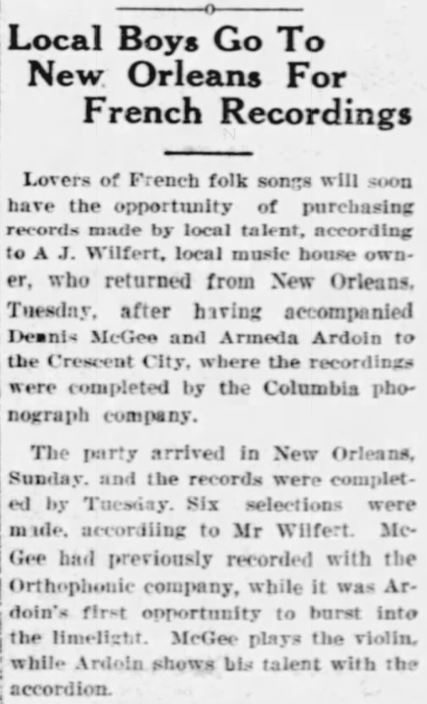
In the 1920s and '30s, Amédé Ardoin was the zipper of Cajun and Creole music. While he was performing, the two genres - though distinct - came together in a groove that shared his repertoire and style. Breaking Jim Crow era barriers, he routinely played with Cajun musicians.6 After witnessing his friend Douglas Bellard record in New Orleans, Amede Ardoin got an opportunity to pursue his first recording session with Columbia that same year. Along with Dennis McGee as his accompanying fiddle player, the song would be the first listing of an Ardoin recording for Columbia known as "Taunt Aline" (#40514). The duo cut their first recordings together in 1929 at a joint Columbia/Okeh field session in New Orleans. The song is believed to be an ode to his aunt Oline Ardoin Poulard, wife of Alcee Poulard, who is mentioned in the title of another Ardoin song called "La Valse A Alcee Poulard".
Eunice News Dec 13, 1929
Born in 1898, Ardoin lost his father in an accident when he was nine months old. His mother and seven brothers eked out a living as sharecroppers in Eunice in St. Landry Parish. As a teenager, Ardoin acquired an accordion and taught himself to play it. Illiterate, he also “wrote” songs that seemed to vary with every rendition.1 Poet Darrell Bourque states:
He never sang a song the same way twice. He’d change the lyrics. He made up the songs. It’s all in the oral tradition.1
He, chère catin, malheureuse,
Tu connais moi j't'aime avec tout mon coeur, malheureuse,
Tu devrais, mais, pas fair ce ça, mais, t'après faire, mais, malheureuse,
C'est pour ça, chèr 'tit monde, tu fais du mal à mon coeur.
Malheureuse, tu connais, chère 'tit fille, tu vas pleurer,
Pour ça tou t'es après faire, tu m'as dit, chère 'tit fille, mais criminelle,
Malheureuse, tu connais tu vas pleurer, mais, malheureuse.
This song is something the Cajuns call a 'valse à deux temps', or a 'two-step waltz', as it has two dotted quarter notes per measure for rhythm guitar.2 Sometimes referred to as a 'waltz in two beats', the pattern was made popular in France during the 1840s and involved the gentleman beginning with his left foot and the lady with her right, and together they'd take one step forward and then one step back.3 Joshua Caffery makes note of songs with this particular rhythm.
A 'valse à deux temps' originally referred to a dance step rather than a song type. Although the notion of a "two-step waltz" seems counterintuitive, as waltzes and two-steps are generally considered two discrete, even opposite, steps, particularly in Louisiana and Texas, the 'valse à deux temps' is simply another style of dancing to a triple meter.5
Amede Ardoin
According to Dr. Barry Ancelet, it was a style already familiar to Cajuns before Americans had migrated into the area.
From their Anglo-American neighbors, [Cajuns] learned jigs, hoedowns, and Virginia reels to enrich their growing repertoire which already included polkas and contredanses, varsoviennes and valses à deux temps.4
Hey, dear little doll, oh my,
You know I love you with all my heart oh my,
You shouldn't, well, do what you're doing, well, on my,
That's why, dear little one, you hurt my heart.
Oh my, you know, dear little girl, you'll cry,
For what you're doing, you told me dear little girl, well, it's criminal,
Oh my, you know you'll cry, well, oh my.
Soon Ardoin was in great demand to play and sing—in a voice that has been described as haunting and unearthly—at house parties and little country honky-tonks. Ardoin reworked his "La Valse A Austin Ardoin" into this more well known song, "Taunt Aline". It would later become Iry Lejeune's 1954 recording "Viens me Chercher" and the Balfa's 1974 recording "J'Sus Orphelin".
Hidden in the Mix: The African American Presence in Country Music edited by Diane Pecknold
Photo by Jeremy S
Release Info: W111384-2 Taunt Aline Columbia 40514-F, OKeh 90014 W111385-2 Two Step De Mama Columbia 40514-F, OKeh 90014 Find: Amadé Ardoin – Louisiana Cajun Music Vol. 6 : Amadé Ardoin – The First Black Zydeco Recording Artist (1928–1938) (Old Timey) Cajun Early Recordings (JSP, 2004) Prends Donc Courage - Early Black & White Cajun (Swamp Music Vol. VI) (Trikont, 2005) Cajun Dance Party: Fais Do-Do (Legacy/Columbia, 1994) The Best Of Cajun & Zydeco (Not Now, 2010) Mama, I'll Be Long Gone : The Complete Recordings of Amede Ardoin, 1929-1934 (Tompkins Square, 2011)
"Two Step De Mama" (#40514), recorded for Columbia records, was amongst the first recordings in the career of musician Amede Ardoin. During his very first session, he laid down six tunes in New Orleans. It isn't clear, however, just how Amede came to make a record. Dennis McGee recalls that it was after he had won an accordion contest. In September of 1929, three months before the pair went to New Orleans, there was indeed a contest in the town of Opelousas. The sheriff and local doctor, both Cajuns, built a platform in the center of town and the weekend-long event attracted an estimated crowd of two thousand, including representatives from at least four record companies.3
Eunice News Dec 13, 1929
The subject matter of many of his songs revolve around his "sweet Joline", a woman he longed to court but who's mother always seemed to send him away from their home. Much of his music dealt with lost of this loved one or his own mortality. In the song, Ardoin seems to be acknowledging the reality of his own death. In translation, one representative passage goes: "I'm going away from you, Joline, so far away / I did say, oh yes, I'm so lonesome for you / There is so much sadness in me — How will I go on, little heart? / I don't know if I'll ever find you again."1
Pardonne-moi, donc chère, ma Joline,
J’vas m’en aller, ouais, à la maison,
Mais, comment ça se fait, oh ouais ils vont me retourner,
Mais, ça m’fait trop d’la peine, mais ouais, te r’voir,
Oh ouais, revoir quand toi tu m’as mal fait,
J’connais ça me fait du mal pour moi pleurer.
Ma Joline, bonsoir jolie Joline,
Bonsoir catin, bonsoir, mais ouais, je m’en vas,
Tu connais (y a) personne jamais qui va me rejoindre,
Jamais encore après ça que tu m’as fait,
Ça me fait si dur de quitter de ta maman,
Je veux pas de voir des autrements que toi.
Comment je vas faire, bye bye, oh ouais, catin,
Donc c’est mignonne, c’est toi, ouais ‘tite tête noire,
**Mais garde-donc toi**? je te voulais, jolie mignonne,
Mais ouais pas de te r’voir, ta chère maman m’a fait,
La cause à toi, catin, je pourrais pleurer,
Ouais, donc ouais, pleurer, je crois pas ça me fait du bien.
Amede Ardoin
As for what occurred in Opelousas, it's a bit of a mystery. The reported winner of the grand prize was a Cajun accordionist named Angelas Lejeune, with McGee accompanying, yet the local papers also noted that fifteen winners were chosen in all. It is likely that Ardoin attracted some attention that weekend.3
So, forgive me, dear, my Joline,
I'm going to leave, yeh, to the house,
Well, that's how it feels, oh yeh, to return,
Well, it hurts me too much, well yeh, to see you again.
Oh yeh, seeing you again when you've done me wrong,
I know it hurts for me to cry.
My Joline, good night sweet Joline,
Goodnight pretty doll, goodnight, well yeh, I'm going,
You know there's nobody who will join me ever,
Never again after what you've done,
It's so hard to leave your mom's place,
I do not want to see anything other than you.
How will I handle this? Bye, bye, oh yeh, little doll,
So, it's my cutie, it's you, yeh, little dark headed girl,
Well, look at you, I wanted you, pretty cutie,
Well yeh, I'm not able to see you again, your dear mother did this to me,
All because of you, little doll, I could cry,
Yeh, so yeh, this crying, I do not think this is doing any good.
Thankfully, his sessions proved powerful enough to have him record for Bluebird, Brunswick and Decca records between 1930 and 1934. His recording was placed in an advertisement in the Phonograph Monthly Review in March of 1930. Without this his career in Cajun music, we wouldn't have a slew of songs inspired by his artistic creations. According to musician Mike Doucet:
Without him we would not have the dozen or so songs Iry Lejeune interpreted and recorded in the 1950s that helped to bring about a resurgence of Cajun French pride. We would not have Austin Pitre’s soulful interpretation of “Opelousas 2-Step” nor his version of Amédé’s emotional “Le blues de la prison.” How can we dismiss Dewey Balfa’s version of “Je suis orphelin” or his brother Will’s haunting “Les blues du cadien”?2
And with Ardoin's "Mama", Iry Lejeune took this song and made it into his "Lacassine Special" in the late 1940s.
Find: Amadé Ardoin – Louisiana Cajun Music Vol. 6 : Amadé Ardoin – The First Black Zydeco Recording Artist (1928–1938) (Old Timey) Cajun Dance Party: Fais Do-Do (Legacy/Columbia, 1994) Aimer Et Perdre: To Love & To Lose Songs, 1917-1934 (Tompkins Square, 2012)