Showing posts with label Mayuse LaFleur. Show all posts

Thursday, January 31, 2019

"Your Father Put Me Out (Ton Pere A Mit d'Eor)" - Leo Soileau and Mayuse Lafleur

Cajun music began to be recorded in order to target one more ethnic group and Ralph Peer, predictably, was in the middle of it all.  The very first Cajun music on record was a pair of accordion sides by Joseph Falcon on Columbia.  Victor rushed to respond with a session in Atlanta when Mayuse Lafleur and Leo Soileau traveled there.  This recording took place during precisely the same week of Atlanta recording sessions in which Jimmie Rodgers was laying down songs. In 1928, St. Landry Parish Sherriff "Cat" Doucet and jewelry store owner Frank Dietlein escorted the team to the big city.
I loaned Mayuse one of my suits. We went first class. Stayed at one of the biggest hotels in Atlanta.  I had told those people we didn't want to be put up at no joint. And we went on the train and had sleepers.2  
Jimmie Rodgers

In face, record producer Ralph Peer had the groundbreaking Cajun pair and Rodgers holed up in the same place.1 According to Soileau:
We stayed at the same hotel as the great Jimmie Rodgers, the old Blue Yodeler and it was really a thrill for us to meet him.  He was there for a recording session, too.1,2  


Oh toi, ‘tit monde, ton papa m’a jeté dehors,

Il m’a jeté dehors de ma maison, de ma maison, moi-même chérie.


Vieille mom! Je suis malheureux, il savait pas, là, il fait erreur,
Ton papa, il a fait erreur quand il m’avait jeté dehors.

Oh, ye yaille, comment ça se fait il a fait ça?
Je connais pas, je méritais pas tout ça il a fait avec moi.

C’est malheureux, il s’aperçoit il a fait erreur, mais, il est trop tard,
C’est pas la peine qu’il se lamente, c’est pas la peine, il va pleurer.


Mayuse Lafleur

With his wife abandoning him and fleeing back her parents home, "Your Father Put Me Out (Ton Pere A Mit d'Eor)" (#21770) spoke direcly to LaFleur's marital problems.   His problems affected the recording session.  The record executives concluded that the duo needed to remedy their edginess and secured a pint of 190 proof "prescription liquor" at a nearby pharmacy.2   Alcohol seemed easy to get.  Maybe lost in rumors, Soileau also mentioned:
Jimmie knew where to secure a supply of moonshine of such high quality and refinement, ...[we] chatted and drank the night away.1,2
Ville Platte Gazette
Dec 22, 1928

However, Dietlein recalled the story differently.
When we arrived at the recording place, Leo told me that Mayuse could not sing.  For his muse to awaken he needed a drink.  When I told the Victor representative Ralph Peer of this predicament, he handed me a twenty dollar bill and asked me to get a taxi cab and try to find a drink Mayuse.  I soon was back with a bottle of white lightning. Mayuse took a healthy swing of the white liquid. I can see Mayuse now.  After a drink or two, his foot began moving and tapping the floor in rhythm.  Pretty soon, I heard him tell Leo, "Laisser aller!"  They started playing and the extemporaneous words came from Mayuse.  His first song was about his girlfriend's father who had kicked him from his house.  "Ton Papa Ma Jete Dehors".3  
Even "Cat" Doucet claims to have been involved in obtaining the liquor.
That was when I took them two boys to Atlanta. They gave us each $100. And our expenses.  Those boys wouldn't go without me. You know them Cajuns wouldn't go to no big city like Atlanta by their selves. I loaned Mayuse one of my suits. The man from RCA--I believe it was RCA--that record company that had the sign with the little dog listening to the big horn--he came and talked to me, and we arranged that I would go over there with Mayuse and Leo.4    

We had a problem with the boys. They were used to having a drink or too before they would play, some of that good bootleg stuff people around here used to make.  Well, they didn't have nothing like that in Georgia. It was a dry state.   Those boys just couldn't get going. Leo played the violin and Mayuse played the accordion and he would sing. They couldn't get started.  So I went to a drug store and go some alcohol, 190 proof, and I made them put something in it--strawberry syrup or something like that. After two-three pops of that, they cranked off!4  

Jimmie would eventually have a deep influence on Leo's music, inspiring Leo to cover tunes such as Jimmie's "Frankie and Johnny".   The melody stayed with Leo, using it for his "Il Ta Prie De Moi" in 1936.  By 1948, hillbilly artists Abe and Joe Manuel covered the tune as "Your Papa Threw Me Out" and later in 1950, Lawrence Walker recorded it as his "Ton Papa Ta Mama Ma Sta Da All". Harry Choates recorded the same tune as "Tondelay".

Oh, you, my little everything, your daddy threw me out,

He threw me out of my house, from my house, by myself, dearie.


Old mom! I'm unhappy, he did not know, over there, he made a mistake,
Your dad, he made a mistake when he threw me out.

Oh, ye yaille, how come he did that?
I do not know, I did not deserve all that he did to me.

It's unfortunate, he realizes he's wrong, but, it's too late,
It' not worth lamenting about it, it's not worth it, he's going to cry.


When Mayuse arrived back home, nine days later, he was found dead from a gunshot wound from a bar fight.    As far as Mayuse's father-in-law, the protagonist of the song, he grew angry at Mayuse's bitter blame  For years after his death, he broke any Mayuse LaFleur record he encountered in the community...regardless of who owned it!2  


  1. Meeting Jimmie Rodgers: How America's Original Roots Music Hero Changed the ... By Barry Mazor
  2. Cajun Breakdown: The Emergence of an American-Made Music By Ryan Andre Brasseaux
  3. Daily World (Opelousas, Louisiana) 07 May 1974, Tue Page 4
  4. Daily World (Opelousas, Louisiana) 02 Feb 1971, Tue Page 2
  5. Lyrics by Stephane F and Jordy A
Release Info:
BVE-47203-2 The Criminal Waltz | RCA Victor 21770-A
BVE-47204-1 Your Father Put Me Out (Ton Pere A Mit d'Eor) | RCA Victor 21770-B

Find:

Cajun Capers: Cajun Music 1928-1954 (Proper, 2005)
The Early Recordings of Leo Soileau (Yazoo, 2006)
The Beginner's Guide to Cajun Music (Primo, 2008)
The Best Of Cajun & Zydeco (Not Now, 2010)
The Very Best of Cajun: La Stomp Creole, Vol. 1 (Viper, 2016)

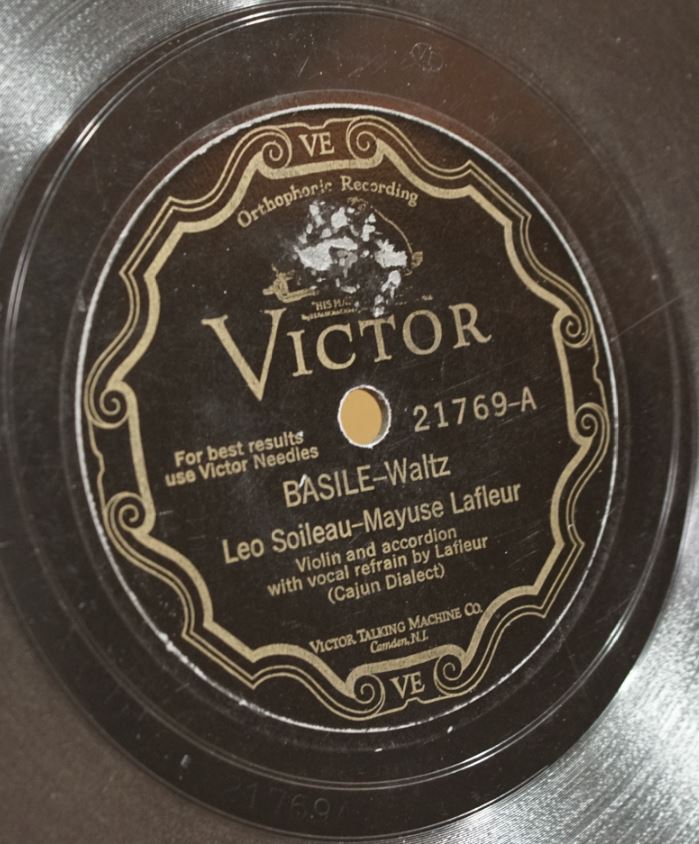
Thursday, August 31, 2017

"Basile Waltz" - Leo Soileau and Mayuse Lafleur

One of most popular Cajun waltzes of all time, it still has a place in modern day recordings and live dance halls.   Created by Leo Soileau and Mayuse Lafleur, other musicians would take the tune and change it's name and it's lyrics; recording it for years to come.  The "Basile Waltz" (#21769) comes in at the top of the list for one of the most covered and recorded tunes throughout Cajun music history. It's the common Cajun lament about asking a lover to leave and go away with him, this time, to the small south Louisiana town of Basile.

The original was done in Atlanta, GA as the flip side to Soileau and Lafleur's famous "Mama Where You At?" recording in October 1928 for Victor.   Before the war, others recorded the melody as well.  Joe and Cleoma borrowed from the melody for their song "Aimer Et Perdre (To Love and Lose)".  After the Depression in 1934, Decca invited Joe and Cleoma Falcon to record in New Orleans in which she used the melody in her song "Ma Valse Preferé".  Even Leo would re-use the melody in his later recording of "La Bonne Valse".   Their sponsor, Frank Dietlein recalled the session:
[Mayuse] sang a song about his mother, "Mama, Where You At" and it was at this recording session when eh sang his version of "Grand Basile".  I soon found out that the Cajun songs were extemporaneous and invariably fitted the mood the singer was in.7  

Oh, allons s'en aller dans grand Basile,

Oui, jolie petite fille.


Hé, toi malheureuse qu'est t'as fais,

Oh, moi je t'ai jamais fais rien pour toi faire ça 

Toi tite fille, t'auras du regret avant longtemps ça t'as fait.


Toi, jolie petit monde ça t'as fait,

Moi je connais tu vas pleurer, malheureuse, ye yaille,
Toi tite fille tu connais j'mérite pas ça toi t'as fait.

Oh, jolie fille, malheureuse, 
Si t'aurais voulu m’écouter chérie, 
Tu serais dans le grand Basile avec aujourd'hui, chère.

Oh, toi 'tite fille chérie,
Moi je connais c'est ça, j'm'en vas dans grand Basile,
Mais toi 'tite fille, tu peux pas venir me rejoindre, 
Et même si tu veux, malheureuse, je veux pas te voir.
Abbeville Meridional
Dec 15, 1928

Lafleur was an excellent singer and an expressive accordionist. The two men quickly reached simpatico in their playing.  It took five hours for the engineers to perfect the vocal levels for the session however, Lafleur's playing was brighter and more enthusiastic than Falcon's more traditional style.  The Victor session became infamous after the death of Mayuse nine days later.    By 1935, Soileau teamed up with Floyd Shreve, Bill Landry, and Tony Gonzales as the Three Aces.  Together, they traveled to New Orleans and re-recorded the tune in a string-band style as "Le Grand Mamou" on both the Bluebird label (#2194) and the Montgomery Ward label (#4880).   According to Arheon Vidrine who was interviewed in 1953,
"La Valse de Grand Mamou" was very popular 45 years ago when Edwin Landreneau played it on his fiddle at fais do-dos and sang it with much pathos and feeling. An old Frenchman taught him the song so we tend to believe that it goes further back still.  The late Mayuse Lafleur gave it new life in the late twenties.6  


Mayuse Lafleur
It wouldn't be until 1948 when Harry Choates used "Basile" as "Gra Mamou" (#124) for the Macy's label in Houston, even following up with "Answer to Gra Mamou" which was never released.  At some point, he recorded an alternate take pressed at the Humming Bird studio called "Big Mamou" (#1012) in 1951.  During Nathan Abshire's first session recording with Will Kegley and Atlas Fruge in 1950, they laid down the song "Grand Mamou" for Virgel Bozman's O.T. label (#106) however, due to a poor recording sound, his version never sold well and was almost lost to history.  Even record producer Eddie Shuler found favor in recording the song with his own group entitled "Grande Mamou".  However, it would be Link Davis' English version of "Big Mamou" in 1952 which solidified it's national popularity.
Oh, go, let's go to big Basile,
Yes, pretty little girl.

Hey, you're so unhappy, how you feel,
Oh, I never did anything for you to do that,
You little girl, you'll regret this before too long, all you've done.

You, pretty little world of mine, what you've done,
I know you're going to cry, oh my, ye yaille,
You little girl, you know I don't deserve what you've done.

Oh pretty girl, oh my,
If you wanted to listen to me, dear,
You'd be in big Basile with me today, dear.

Oh, you little girl, dear,
I know that's it, I'm going to big Basile,
Well, you little girl, you can not come with me,
And even if you want to, oh my, I don't want to see you.
Cajun music mural
Basile, LA

Since then, many musicians have taken this melody and have put their own spin providing countless recordings since the 50s such as Harry Choates, Ambrose Thibodeaux, Link Davis, Eddie Shuler, Pete Hanley, Ella Mae Morse, Dolores Gray, Jimmy Newman, Everly Brothers, Waylon Jennings, Rod Bernard, and Clifton Chenier.  

Over time the song would be interchangeably known as both "Basile" and "Grand Mamou" in the Cajun music circles.   Today, however, most of the world knows the tune as "Big Mamou".


  1. Cajun Breakdown: The Emergence of an American-Made Music By Ryan Andre Brasseaux
  2. Louisiana Fiddlers By Ron Yule
  3. http://jopiepopie.blogspot.com/2014/01/basile-waltz-1928-gran-mamou-1935-big.html
  4. Label scan by University of Louisiana at Lafayette Cajun and Creole Music Collection - Special Collections
  5. Louisiana Music: A Journey From R&b To Zydeco, Jazz To Country, Blues To Gospel, Cajun Music To Swamp Pop To Carnival Music And Beyond by Rick Koster
  6. VPG. Apr 23, 1953
  7. Daily World (Opelousas, Louisiana) 07 May 1974, Tue Page 4
  8. Lyrics by Stephane F
Find:
Le Gran Mamou: A Cajun Music Anthology -- The Historic Victor-Bluebird Sessions, 1928-1941 (Country Music Foundation, 1990)
The Early Recordings of Leo Soileau (Yazoo, 1999)
Cajun Origins (Catfish, 2001)
The Early Recordings of Leo Soileau (Yazoo, 2006)
The Return Of The Stuff That Dreams Are Made Of (Yazoo, 2012)
The Missing Country & Blues Album (Magic Gold, 2014)
Down Home Blues (Goldenlane, 2014)

Wednesday, May 25, 2016

"The Criminal Waltz (La Valse Criminale)" - Leo Soileau and Mayuse Lafleur

A Cajun fiddle master, Leo Soileau was one of the giant figures in Cajun music history.  His early recordings from the late 20s are both powerful and emotive, and rank among the all-time classics of Cajun music. His greatest contribution to the music could be his earliest recordings with Mayuse Lafleur.  In October 1928, the duo headed to Atlanta and recorded several tunes including "The Criminal Waltz (La Valse Criminale" (#21770) for Victor.
The Shreveport Times
Oct 30, 1928


Toi 'tit monde, yaille, fais pas ça, malheureuse,

Toi 'tite fille, jongle à moi avant d'faire ça.


Toi 'tit monde faut pas te jongles à ton papa et avec ta maman.

Mais écoute pas avec ton papa et avec ta maman.


Malheureuse, si t'écoutes ton papa et après ta maman,

Tu s'ras jamais heureuse.


Ah, ye yaille, qui j'ai fait à ton papa, après ta maman,
Pour m'haïr autant qu'ça .

Moi j'connais j'ai pas fait rien ton papa, chère,
Toi 'tite fille, faut' qu'tu jongles à tout ça.

Toi 'tite fille, moi j'crois pas t'as le cœur
Aussi criminel que ça, malheureuse.

Rappelle-toi, petite fille, chère,
J't'avais dit tu vas jamais faire ça.

'Garde donc qui t'as fait avec mon y a pas si longtemps ?
Malheureuse t'aurais pas dû faire tout ça.

Toi 'tite fille, j'suis parti m'en aller, yaille,
M'en aller à la maison avant longtemps.
Mayuse Lafleur

Mayuse had allegedly told Victor A&R representative Ralph Peer that he couldn't sing without having something to drink.  According to their sponsor, Frank Dieltein:
It was during Prohibition and of course, we did not know where to find anything to drink.  Finally, Peer found a taxicab driver who was willing to get a bottle of what he called 'mountain dew' for $5.  Taking the bottle to Mayuse, he handed it to him saying, "This is all we could get."5  

I'll never forget how Mayuse looked at the bottle and took a deep drink.  For about 15 minutes the musician kept taking drinks from the bottle.  Finally, I noticed that his right foot began to tap on the floor in rhythm as if he were humming to himself.  At last, he looked at his partner, smiled, and raised his accordion and squeezed a chord as a signal that hew was ready.  The two musicians struck up several more chords and then told the Victor recording engineer that they were ready to start making the record.5  

Nine days later, the two played a house dance in Basile.  On the way home, they stopped at a "blind tiger" (illegal drinking establishment) run by Alexander Bellon.  A violent fight broke out between gamblers shortly after the duo arrived and Lafleur was killed in the melee.  Soileau cradled his dying friend's head on the blood soaked bar floor.  It haunted him the rest of his life.

You, my everything, oh, don't do that, oh my,

You, little girl, remember me before doing this.


You, little girl, should not reminiscence about your papa and your mama,

However, listen! Not with your dad and with your mom.


Oh so sad, if you listen to your dad and also your mom,

You'll never be happy.


Ah, oh, what did I do to your father, also, your mother,
For them to hate me that much. 

I know I have not done anything to your father, dear.
You, little girl, you must remember all of that.

You, little girl, I don't reckon you have the heart,
To be criminal as that, oh my.

The Shreveport Times
Oct 30, 1928
Remember, dear little girl,
I told you to never do that.

Just look at what you did with me, not so long ago?
Oh my, you'd not have done all that.

You, little girl, I'm gone, oh!
I'll be going home before long.


Although LaFleur's style of playing was different from Anglelas and Iry LeJeune's music, there is some of the quality of loneliness in those two men's recordings.   LaFleur cut the only two records he made in 1928, the year he died. In fact according to Leo Soileau who accompanied him on the fiddle, he never heard his records.4  It must have made some sort of impression on other musicians since the following year, Artelus Mistric used the melody for his Victor recording of "Belle Of Point Clare".  By 1936, Leo and the Shreves formed the Four Aces and re-recorded the song as a string band tune entitled "Je M'Ennui Ce Soir".  By 1951, Amede Breaux covered the tune for J.D. Miller of Crowley as the "Criminal Waltz".  


  1. Louisiana Fiddlers By Ron Yule
  2. Early American Cajun Music: The Early Recordings Of Leo Soileau. Liner notes.
  3. Lyrics by Marc C and Herman M
  4. Discussions with Pete B
  5. Daily World (Opelousas, Louisiana) 17 Dec 1967, Sun Page 4

Find:

Early American Cajun Music: The Early Recordings of Leo Soileau (Yazoo, 1999)
The Early Recordings of Leo Soileau (Yazoo, 2006)
Cajun: Essential Guide (Union Square, 2007)

Friday, October 10, 2014

"Mama Where You At?" - Leo Soileau & Mayuse LaFleur

This story is about one of the saddest moments in Cajun music history.   Leo Soileau was a proficient musician which i discussed previously.  He would play with many musicians throughout the 1930s and 1940s, however, his first stint at music was with his close friend Meus (also spelled "Mayeuse" or "Mayuse").

Mayuse Lafleur was born August 14, 1906 and six months later in February 1907, his mother abandoned her husband and infant son.  According to historian Par Pascal, Mayuse’ father brought his infant son to live with Mayuse’ grandmother, who was a widow and living near Ville Platte.

Leo Soileau was a childhood friend of Mayuse and a distant relative, who also played the violin. Mayuse played the accordion and sang. While growing up, together they played in a number of house dances and dance halls.  After he got married, Mayuse’ in-laws didn’t approve of his long absences playing music in dance halls and fais-do-dos and being away from their daughter and grandson. They finally told Mayuse to leave, causing hardship and his wife's separation. 


Dietlein Jewelry Store, 1920s
 Carola Lillie Hartley Historic Photo Collection

In 1928, Lafleur and Soileau traveled to Atlanta Georgia and recorded four songs for Victor Records. According to author Tony Russell, Leo was introduced to a Victor agent, Ralph Peer, by Frank Dietlein, an jewelry store owner from Opelousas, Louisiana who also sold records on the side.  They were not the first Cajun musicians to record their music; they were second. The honor of being first went to Joe Falcon from Rayne, who earlier in the same year recorded “Allons A Lafayette” (Let’s Go to Lafayette) for Columbia Records.
Leo Soileau

On October 17th, they arrived in Atlanta and the following morning, Soileau and LaFleur were escorted to an improvised studio that doubled as a Ku Klux Klan meeting room.   Peer had Jimmie Rodgers recording in the same building that day.  The four sides waxed during this historic session represented Leo Soileau and Mayuse LaFleur's first recordings.   Seated underneath Victor's dangling microphone, LaFleur performed for the first time publicly "Mama, Where You At?" (#21769).   Also known as "Chere Mam" or "Hey Mom", the tune expresses LaFleur's wish to see his mother one more time before he dies, inasmuch as LaFleur's mother had abandoned him when he was an infant.  On the first take Mayuse started singing, then broke down sobbing. A few minutes later, on the second take Mayuse was able to control his emotions and that was the version used.2  According to Dietlein, 
They began playing the old tune and about half way through the tune, Mayuse began singing in French.  When the song was finished, the engineer asked me for the name. I asked Mayuse for the name of the song. After a moment or two, he translated into English this title, "Mama, Where You At?"  That was the name under which the Victor company released the recording.  Later I found out that these French songs were spontaneous. While the old tunes remained the same, the lyrics invariably reflected the mood of the singer.11  

According to musician Mickey Soileau, 
That song, "Mama, Where You At" might have different words altogether the next time Mayuse sang it.  It all depended how he felt. If he felt sad, he'd sing a sad song, but if he felt happy the song would be a happy one.  That is true in many cases of Cajun singers and musicians.11  

Oh Mam, éyoù toi t'es,

Chère Mam, comment ça se fait

Que jamais je te voir encore,

Chère Mam, éyoù toi t'es ?


Hey Mam, comment ç'fait

J'ai jamais eu des nouvelles,

De toi, chère maman,

J'voudrais t'voir, ye ya yaille.


Hey yaille, Maman,

J'voudrais t'voir quand même,

Une fois avant d'mourir,

Chère Mam, oh ye yaille.


Hey Mam, moi j'prend ça dur,

D'pas t'avoir jamais vue

Ye yaille, chère Maman,

Laisse-moi te r'voir une fois.


Hey, ye yaille,

Ya yaille , chère maman,

Comment ç'fait, 

Que moi j'su comme ça ?


Hey yaille, chéri,
Viens vite mon……..,
Me voir ma chère Maman,
La première fois moi j'va la voir.

Oh Mam, prépare-toi,
Ton nèg' est passé t'voir,
Oh m'mam, 'gardez donc,
Viens voir quoi c'est y a eu.

Mayuse LaFleur and Leo Soileau also recorded “Grand Basile,” “La Valse Criminelle,” (The Criminal Waltz) which was composed by Meus. “Ton Papa Ma Jeter Dehors,” (Your Father threw me out) obviously singing about how his ex-father-in-law threw Meus off the property, which he had given to him and his wife. And “Mom, Et ou Toi T’est?” (“Mom, where are you?”).  Mayuse and Leo were each paid $25 for every song recorded. Mayuse told Leo he would use the $100 to find his mother.

Unbeknownst to anyone, Mayuse dealt with a broken heart and wondered why his mother gives him up? When he sang “Chere Mam”, was it a premonition? Mayuse was shot and killed on October 28, 1928, just nine days after recording “Chere Mam.” Mayuse was only twenty-two years old.  

Mayuse and Leo were playing at a honky-tonk in Basile, Louisiana, which was owned by Mayuse’ friend Alex Bellon when Kossuth Manual pulled a gun and shot Bellon several times. Bellon escaped outside and hid under a truck where he later died. Mayuse immediately ran to his friend’s side. Kossuth shot Mayuse, instantly killing him. Kossuth also shot at Leo Soileau, but missed because Leo quickly ducked back inside the honky-tonk bar.


Mayuse Lafleur
By Rob Jones
The reason for the fight is found in rumors.  Lawmen tried with varying degrees of effort and success to control the fights at dancehalls, but they usually winked at the Saturday night high-jinx — unless it really got out of hand. The first is that a man backed his truck into the front porch of the place where LaFleur was playing, causing about $10 in damage. The owner demanded the money to fix the porch. The driver said he didn’t have it. Both were pretty drunk. One thing led to another, especially after a friend of the driver got involved to make matters worse.  The other is that it was in a fight over some moonshine.  There may be an element of each of those stories in how the brawl started, but it ended with six shots fired from a .38-caliber pistol.

Two months after the death of Mayuse, near Christmas 1928 Victor Records shipped several hundred records to local dealers for distributions.  Mayuse’ nineteen-year-old estranged wife, Hazel, opened all the doors and windows in her house and continuously played Mayuse’ records at top volume for her parents to hear and fully appreciate the consequences of his actions. 


Ville Platte Gazette
Nov 24, 1928


Oh mom, where are you,

Dear mom, why is it

That I never see you anymore,

Dear mom, where are you?


Hey mom, how come

I never heard from, 

You, dear mother, 

I would like to see you, ya yaille


Ya yaille, mom, 

I'd like to still see you

Once more before I die 

Dear mom, oh, ye yaille. 


Hey mom, I'm taking it hard, 

Not seeing you

Ye yaille, dear mother, 

Let me one more time. 


Hey, ye yaille, 

Ya yaille, dear mother, 

How come 

You knew I'd be this way


Ye yaille, honey, 
Come quickly
I want to see my dear mother, 
For the first time I've seen her

Oh Mom, get ready, 
Your little boy has come to see you
Mom oh, look at this,
Come see how I've gotten.

"Yaille" is a word that doesn't translate well or at all.  It's possible origin is from the Spanish phrase "ah ya yaille" loosely meaning "Oh! Wow!"  Sometimes it comes out as an exuberant yell.  Other times, it conveyed a mixture of surprise, reproach, and resignation.  In this context, it's definitely a cry of sorrow.  

Leo continued to play dances and picked up an occasional accordionist for recordings, however, he would eventually take a break until 1934 when he picked up music again.   By 1936, he and the Shreves formed the Four Aces and re-recorded the song as a string band tune entitled "A Ute", a misspelled transcription of the Cajun French idiom éyoù (where are you?).   Amedie Breaux and his band would record for J.D. Miller's Feature label the song called "Hey Mom" in 1953.  

According to the publication "The New Era" in Eunice, Lousiana:
"The voice of a dead man pierced the gloomy atmosphere of Second Street last Saturday morning, when a song recorded by Meus [sic] LaFleur, before his untimely death, thrilled hundreds of those who yet speak and understand the Acadian French. ... Tho those who had learned of his alleged murder, the song seemed to grasp their very heart strings, and some even wiped away tears which forced their way to the eyes of those sympathetic listeners, while others not so well informed were happy again for having heard a folk song of their nationality which had never been written but handed down from generation to generation.”


  1. South to Louisiana: The Music of the Cajun Bayous By John Broven
  2. Cajun Breakdown : The Emergence of an American-Made Music By Ryan Andre Brasseaux
  3. Louisiana Music: A Journey From R&b To Zydeco, Jazz To Country, Blues To ... By Rick Koster
  4. Discussions with historical columnist William J Thibodeaux
  5. The Encyclopedia of Country Music
  6. BRAWL TOOK LIFE OF CAJUN MUSICIAN. By Jim Bradshaw. 04/20/2009
  7. Ralph Peer and the Making of Popular Roots Music By Barry Mazor
  8. Meeting Jimmie Rodgers: How America’s Original Roots Music Hero Changed the Pop Sounds of a Century by Barry Mazor
  9. http://popdenial.blogspot.com/2011/04/mama-where-you-at-mayeus-lafleur-2011.html
  10. Photo courtesy of Carola Lillie Hartley Historic Photo Collection
  11. Daily World (Opelousas, Louisiana) 17 Dec 1967, Sun Page 4
Find:
Louisiana Cajun Music Vol. 2: The Early 30s (Old Timey/Arhoolie, 1971)
Raise Your Window: A Cajun Music Anthology 1928 - 1941 (The Historic Victor-Bluebird Sessions Vol. 2) (CMF, 1993)
Cajun Origins (Catfish, 2001)
Cajun Louisiane 1928-1939 (Fremeaux, 2003)
The Early Recordings of Leo Soileau (Yazoo, 2006)