Showing posts with label Horace Andrus "Uncle Ambros" Thibodeaux. Show all posts

Tuesday, September 11, 2018

"Coosh Mal" - Leroy "Happy Fats" Leblanc

Happy Fats ran several radio shows during the 40s and 50s.  It created more demand for his music.   But by the 1950s, he was running his own TV show.   KADN and KLFY both aired his shows during the 1960s, including his popular show "Mariné".  According to Adam "Jack" Landry's son Morgan, both he and his father played with Happy on the show.
He played bass when I played with him at the dance hall. I know that he spoke very good French.  He always had something good to say. I never heard him say anything bad.  He loved to joke around.3  

Before his TV show however, his recording career was phenomenal.  His contracts with RCA Victor seemed to be never ending.  In 1946 he recorded "Coosh Mal" (#2034) with Francis “Red” Fabacher on lead guitar, Jimmy Gardiner on rhythm guitar, Giles ‘Candy Man” Castillo on steel guitar, Buel Hoffpauir on drums, and a fiddle player named Andrus "Uncle Ambros" Thibodeaux in New Orleans.   His song sings of a drunkard from Port Barre that flirts with all the women, but never amounts to much in life. 
Hé Couchemal, qui vient du Port Barré,
Oh Couchemal, il est tout le temps parlé, 
Hé Couchemal, il coursaille toutes les femmes,
Oh Couchemal, toutes les femmes lui regarde pas.

Hé Couchemal, il aime bien sa bouteille,
Oh Couchemal, il pard par sa bouteille,
Hé Couchemal, il fait jamais à rien,
Oh Couchemal, il regarde pas trop demain.

Hé Couchemal, qui vient du Port Barré,
Oh Couchemal, il est tout le temps parlé,
Hé Couchemal, il coursaille toutes les femmes,
Oh Couchemal, toutes les femmes lui regardaient pas.
Teche News
Apr 11, 1947

It's possible that the title is an ode to rhythm guitarist Jimmy Gardiner that joined the band that year.  Sung by Francis "Daddy Red" Fabacher, he refers to man with mischievous ways, usually in a bad way.  Possibly related to the mythical creature, le cauchemar (bad sleep), the nickname was used when Happy's stage show performances included more novelty acts as well as music, such as comedic entertainment. 
Hey Couchemal, who's coming from Port Barré,

Oh Couchemal, he's always talking (flirting), 

Hey Couchemal, he's courting all the women, 

Oh Couchemal, all the women don't notice him. 


Hey Couchemal, he likes his bottle,

Oh Couchemal, he does not lose his bottle,

Hey Couchemal, he never does anything,
Oh Couchemal, he never looks to tomorrow.

Hey Couchemal, who's coming from Port Barré,
Oh Couchemal, he's always talking (flirting), 
Hey Couchemal, he's courting all the women, 
Oh Couchemal, all the women don't notice him.

But by 1947, Victor called it quits and he teamed up with a new group of musicians but kept Ambrose as his fiddle player.  Morgan recalls the TV show:
[The show was] very professional. Me and my dad drove to Lafayette, it was actually a bit on the outskirts from what I remember. I also remember standing on the side of the set watching the show as it took place while waiting for me and my dad to go up. There was a background set up, some bales of hay if i remember correctly, then there were the microphones, the cameras were set up some 30 feet, pretty close to it if not, from the band. The lights were not too bad from what I recollect. If memory serves me correctly, the fiddle player was Uncle Ambrose and he kicked of the show with the rooster call.3
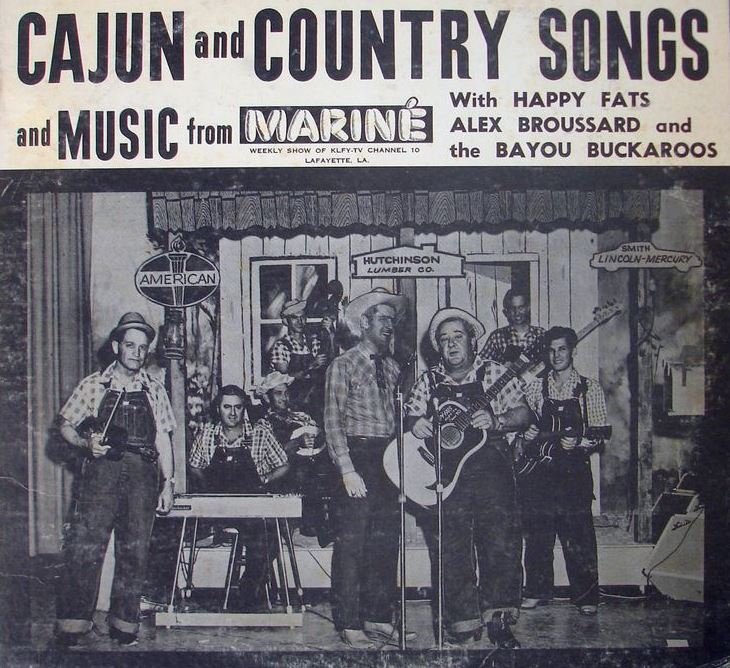
Happy would travel to different towns around Lafayette, promoting not only his band but his TV show as well.   He would advertise his "Mariné" show on the side of a van.   He even released a self-entitled LP on Swallow Records in 1964 with the lead song being the "Mariné Theme".


  1. http://bayoutechedispatches.blogspot.com/2013/02/a-glimpse-from-1968-historic-films.html
  2. http://www.katc.com/story/36721057/medical-explanation-for-cajun-folklore-known-as-kooshma
  3. Discussions with Morgan L
  4. Lyrics by Jordy A

Release Notes:

D6VB 2985 Coosh Mal | Victor 20-2034-A
D6VB 2986 La Valse De Bosco | Victor 20-2034-B

Find:
Happy Fats & His Rayne-Bo Ramblers (BACM, 2009)
His Rayne-Bo Ramblers 1938-1949 (Master Classics, 2011)

Tuesday, December 5, 2017

"Cajun Boogie" - Leroy "Happy Fats" Leblanc

Having worked on a radio station show, Leroy "Happy Fats" Leblanc was intimately keen on the changes of the music in the region.  During the mid 1940s, after the war, blues-influenced rockabilly became more prominent and he would have been on of the first to be exposed to it.   Here, this is one of the earliest bluesy rock tunes to come from the south Louisiana prairies.  It's clearly influenced by the sounds coming out of neighboring New Orleans and radio stations throughout the country.  

Listening carefully, one can enjoy the smooth rockabilly playing by Francis "Red Fabacher on lead guitar and a upbeat fiddle ride by Andrus "Uncle Ambrose" Thibodeaux.  The band rounded out with Jimmy Gardiner on rhythm guitar, Giles ‘Candy Man” Castillo on steel guitar and Buel Hoffpauir on drums.   Released in 1947, Billboard magazine writer stated:
It's all hot fiddling and guit'box picking in country style that Happy Fats provides for a fast-spinning Cajun Boogie.  Cajun Boogie will attract attention at the dances in those deep South corners.1 
Happy Fats, Bradley Stutes, Papa Cairo,
Andrus "Uncle Ambrose" Thibodeaux, 

Joseph "Pee Wee" Broussard

1946 seemed to be the end of an era and beginning of a new one.  "Cajun Boogie" (#20-2200) on Victor was one of the last Cajun string band recordings by a major record label.  Not long afterwards, RCA Victor would abandon all things related to Cajun music, probably due to lack of sales nation wide.    Independent labels were taking off.  Happy would have to look at other outlets, which he did, with J.D. Miller's new independent label called "Fais Do Do" records.
Rayne Tribune
Mar 7, 1947

By December of 1947, King records released Moon Mullican's "Jole Blon Is Gone, Amen", closing an end to the era.  The only exceptions were 2 moderately sized labels. DeLuxe Records of New Jersey arrived in Sulphur around 1949 and briefly recorded a slew of songs by Happy Fats, the Hackberry Ramblers, Joe Manuel and Johnny Billiot.  Modern Records of California had latched onto Chuck Guillory and Papa Cairo around the same time.  Cajun music releases were firmly in the hands of the indie labels. 
Billboard
Apr 5 1947


It didn't seemed that any major national label gave any attention to the resurgence of Cajun-inspired music until suddenly, in 1952, Columbia Records released Vin Bruce's "Dans La Louisianne".  That year, a wave of Cajun-country influenced songs flooded the airwaves including Okeh's release of Link Davis' "Big Mamou" and MGM's release of Hank Williams' "Jambalaya".


  1. Billboard Magazine. May 17, 1947


Find:
HAPPY FATS & His Rayne-Bo Ramblers (BACM, 2009)
Leroy Happy Fats LeBlanc: & His Rayne-Bo Ramblers (Master Classics, 2013)

Saturday, October 31, 2015

"Cajun Jitter Bug" - Leroy "Happy Fats" Leblanc

It's an early rockabilly influenced tune that seems very little to do with Cajun music, but more with the fact that rock n roll was beginning to have it's influence on the culture.  It was recorded as "Cajun Jitter Bug" (#20-2321) on RCA Victor in 1946 by a group called Happy Fats and his Rayne-Bo Ramblers, named after the town near his home.   

Early uses of the word "jitterbug" may have been associated with social drinking in the mid 1930s. However, by the mid 1940s, the "jitterbug" is a kind of dance associated with various types of swing dances such as the Lindy Hop, jive, and East Coast Swing. Time magazine reported that American troops stationed in France in 1945 jitterbugged, and by 1946, jitterbug had become a craze in England. It was already a competition dance in Australia.  


Jitterbug Dancing, 1939
The instrumental features a boogie woogie guitar piece by Francis “Red” Fabacher on lead guitar and a rhythmic strum by Jimmy Gardiner. Red, along with his brother Joseph, were well known from their days with the Jolly Boys of Lafayette, would occasionally sit in Harry Choates group as well. In the background you can hear Giles "Candy Man" Castillo on steel guitar and Andrus (Ambros) Thibodeaux on fiddle.   


Cajun Jitterbug Dancing
Today, Cajun Jitterbug is a relatively new style of Cajun dancing with two variations. The main style is a classic two-step form of a six-count East Coast Swing, which is differentiated from the one-step Cajun Jig. The other is considered a cowboy-style of Jitterbug or swing dance, also referred to as the Lake Charles Slide, the Cowboy Jitterbug and the Whiskey River Jitterbug.

The sound of this tune foreshadowed what was to come of a lot of music in the south. As rock n roll took over, many of the venues Cajun musicians had to play began a transition away from accordion led bands.  By 1958, many groups either converted over as well, such as the musicians in Lawrence Walker's band, or simply quit playing all together.


Find:

HAPPY FATS & His Rayne-Bo Ramblers (BACM, 2009)
Leroy Happy Fats LeBlanc: & His Rayne-Bo Ramblers (Master Classics, 2013)