The first fiddle player we had around here who could really play [Cajun music] was Doc Guidry. The second one was Harry Choates. He was a fine musician.6After the war, Papa joined up with Leo Soileau's band playing places like the Moulin Rouge Pleasure Club. Leo remembered him as a serious player that didn't drink. Having recorded previously with Chuck Guillory for the Bihari's Modern Records of Hollywood, Papa began eyeing different options on forming his own group. However, not everyone was a fan of Papa's style, rather, they appreciated his determination and self-promotion. According to Leo,
He'd play all night on two Coca-Colas. No high ball, no nothing. That's one boy that didn't drink.1
He decided to rig up a band. He was selling though. That's the reason I got him, he was selling.1
 |
| Julius "Papa Cairo" (steel guitar), Harry Choates (fiddle), Joe Manuel (banjo), Eddie Pursley (guitar), Johnny Crain Poss. Hollywood Club, Rayne, Louisiana Dec 1946 Courtesy of Arhoolie Foundation |
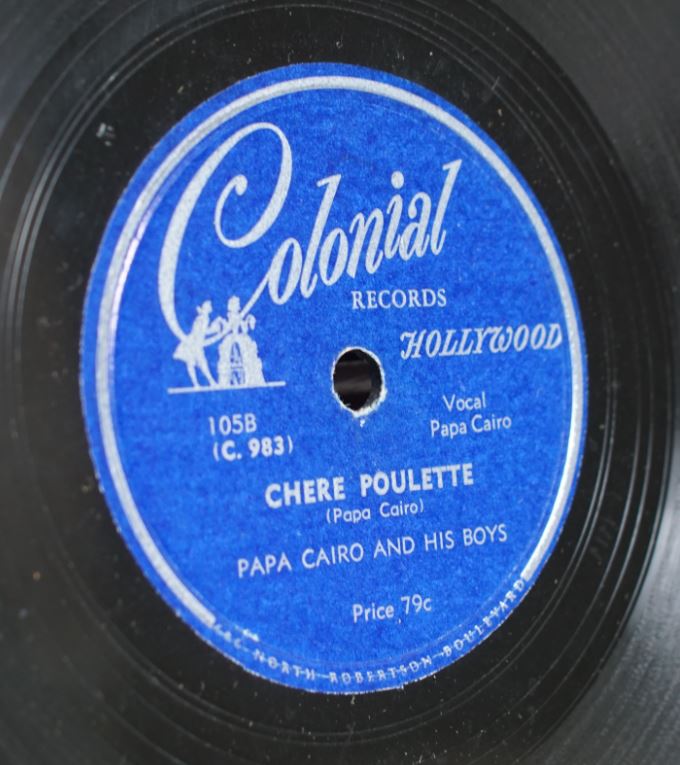
Riding high on the popularity of his previous recording of "Big Texas", he contacted Joe Bihari and together with Chuck Guillory's group, they recorded four more songs. The first was an English language follow-up to his popular recording, entitled "Big Texas #2". Then, he created two more songs, a rendition of his original French pre-war recording of "Alons Kooche Kooche" and a Western swing cover of the J.B. Fuselier tune "Chere Tout Tout" entitled "Chere Poulette" (#105). Similarly, "Chere Poulette" was recorded as "The LeGrange Waltz" by Floyd Leblanc and "Tolan Waltz" by Papa Cairo and his Boys consisted of Don Lane on xylophone, Murphy Smith on fiddle, Herman Durbin on piano, Albert Roy on guitar, possibly Pete Duhon on bass and Curly Mertz on percussion. While terms of endearment such as "poulette" and "pou-lute" seem to have been lost to time, in turn-of-the-century France, cute women in Paris were referred to as "poupoule"; as noted in the late 19th century song "Viens Poupoule".
Oh, mais, chere pou-lute,'Gardez-donc, mais, quoi t'as fais?Tu m'as quitte, pour t'en aller,Pour t'en aller, à lac Arthur, mais, toi tout seul.Oh, mais, chere 'tit poulette,'Gardez-donc, mais, quoi t'as fais?Tu m'as quitte, pour t'en aller,Pour t'en aller, z-avec un autre, mais, loin de moi.Oh, mais, chere pou-lute,'Gardez-donc, mais, quoi t'as fais?Tu m'as quitte, pour t'en aller,Pour t'en aller, à lac Arthur, mais, toi tout seul.Oh, mais, chere 'tit poulette,'Gardez-donc, mais, quoi t'as fais?Tu m'as quitte, pour t'en aller,Pour t'en aller, z-avec 'tit poulette...
The actual location of this recording session is a bit confusing. When author Mike Leadbitter of Blues Unlimited caught up with Papa Cairo in 1968 and asked him about the Colonial recording, Papa claims "he was taken back to N.O (New Orleans) to record [Big Texas] under his own name."7 However, other researchers disagree with these details. Author John Broven spoke to Joe Bihari about the session.
I recorded at a radio station in Crowley, Louisiana, the Cajun hillbillies, the original ‘Jole Blon,’ the old French Cajuns. We knew we could sell the records there, purely to sell in Texas and Louisiana, some in Mississippi, too. They recorded inside out. Their machines recorded from the inside of the disc and came to the outside, instead of the outside to the inside. That’s the way their equipment was set up. Not really a problem, all acetates.8
 |
| Daily Advertiser Oct 12, 1951 |
Although record producer JD Miller had a recording studio in Crowley and eventually worked with Papa Cairo and Chuck Guillory separately, the recording quality of these issues suggest that the band wasn't using studio quality equipment. Author Nick Leigh goes on to affirm the notion,
Surely these were not Miller tracks. I don't think it was a case of JD recording Guillory/Cairo and then leasing out the tapes (or acetate) masters, but a Bihari operation during one of his many field trips to the south.5
Broven thinks maybe the location could have been New Orleans, but not at a formal facility such as Cosimo Matassa's studio.
My feeling is that the Chuck Guillory session was cut at KSIG in Crowley in the summer of 1948. After the Modern recordings did fairly well, there were two Papa Cairo sessions in New Orleans in January and February 1949. As there were still "inside start" acetates being used, according to the Ace Records, London, database, I think we can assume the sessions were held at a New Orleans radio station.9
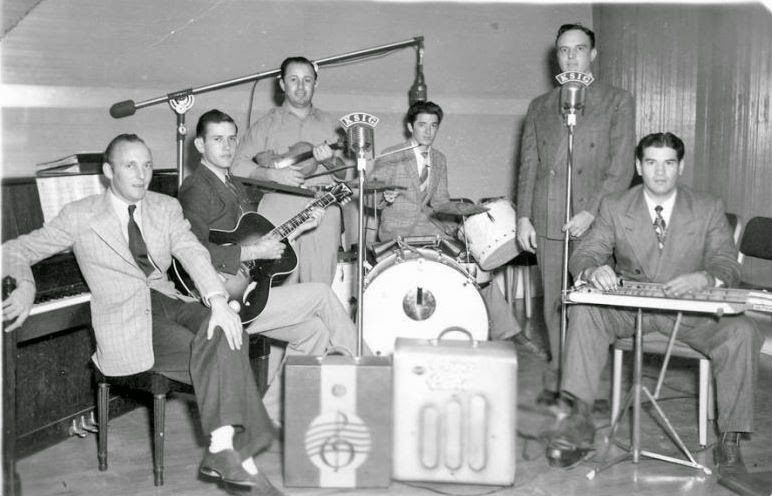 |
| Herman Durbin, Jimmy Newman, Murphy "Chuck" Guillory, Kersey "Pork Chop" Roy, R.R. Sagg (emcee), Julius "Papa Cairo" Lamperez KSIG, Crowley, LA |
Oh, well, dear little one,So look, well, what have you done?You left me, to go away,To go away, to Lake Arthur, well, you're all alone.Oh, well, dear little one,So look, well, what have you done?You left me, to go away,To go away with another, well, far from me.Oh, well, dear little one,So look, well, what have you done?You left me, to go away,To go away, to Lake Arthur, well, you're all alone.Oh, well, dear little one,So look, well, what have you done?You left me, to go away,To go away with another...

After the Biharis folded their Colonial operation and focused on their new label Flair, the following year, Papa teamed up with JD Miller to re-record both an English and French version of "Big Texas" on Miller's Feature label. However, after Hank Williams released his 1952 hit "Jambalaya", Papa Cairo ceased recording ever again. After his death, his family kept most of his memorabilia, including his signature steel guitar, with his name embossed on it.
Listen to sound clip sample: Chere Poulette
- http://arhoolie.org/leo-soileau-interview/
- South to Louisiana: The Music of the Cajun Bayous By John Broven
- Record Makers and Breakers: Voices of the Independent Rock 'n' Roll Pioneers By John Broven
- Discussions with John Broven
- Discussions with Nick Leigh
- "Crowley native newest member of CFMA Hall of Fame". CPS 8-19-2018. Wade Falcon
- 1968 Blues Unlimited - Papa Cairo. Mike Leadbitter.
- Joe Bihari interview. John Broven. 2004.
- Discussions with John Broven. 10-22-2020
- Image courtesy of Brittany L
- Lyrics by Stephane F and Herman M
Release Info:
C 982 Kooche Kooche | Colonial 105A
C 983 Chere Poulette | Colonial 105B


