Showing posts with label Victor Records. Show all posts

Monday, April 7, 2025

"Jack Lafiance On De Crawfish" - Joseph Pierre Landry

Joseph Pierre Landry was born July 9, 1877 in Bayou Goula, Iberville Parish.  His father, Volney, was a veteran of the Civil War and his mother Harriet was a home maker. At the turn of the century, Joseph worked as a store salesman near White Castle and it was during this period of his life that Joseph spent time crafting his talent as a stage and voice actor.  

After moving to Beaumont, he married Anna Eileen Cunningham, an Irish woman and native of Illinois, and the couple started a family.   During the 1920s, he worked as a "commercial trucker" however, he began traveling to various towns between Texas and Louisiana, entertaining audiences with a number of "humorous stories and charming sketches that fairly brought down the house." Often these monologues were in conjunction with other musical acts that performed either before or after his stage shows. 

Either possibly discovered on one of his many performances in Louisiana or possibly connected to the Wilferts of Opelousas, the Victor Recording Company invited the humorist in November of 1929 to record two of his most popular monologues, "Jack LaFiance At The Telephone" and "Jack LaFiance On De Crawfish".(#22212).   While in New Orleans, other Cajun musicians that awaiting their turn in front of the microphone were Artelus Mistric, Columbus "Boy" Fruge and Moise Robin of Arnaudville, Alius Soileau & Leo Soileau of Ville Platte, Berthmost Montet & Joswell Dupuis of Henderson, Delin Guillory & Lewis Lafleur of Eunice, and Bixy Guidry & Percy Babineaux of Carencro. According to record collector/dealer Malcolm Vidrine, 

"The A-side is even done completely in French. B-side is in English and Jack LaFiance makes a decent case on replacing the Louisiana Pelican with a Crawfish (and put him on the dollar as well!)."  

LaFiance was a caricature figure, popularized in late 19th century New Orleans literature, and represented in literary newspaper columns by James J. McLaughlin, who told of fictional stories of creole courtship in New Orleans.   

After the Great Depression, Landry's career stalled.  Victor released his recordings in February of 1930, during the depths of the Depression, killing any chance of success Landry may have expected.  His recording seems to have been mostly forgotten and the distribution of the monologue, only 804 copies, succumbed to the effects of the economic situation.   

Outside of his day job in real estate sales, Joseph spent much of his time acting and impersonating in various talent shows and social events both in Beaumont and in Houston.  He would often demonstrate "great versatility as an imitator of various dialects," performing for the Kiwanis Club and Knights of Columbus; an organization in which he had deep involvement.

He became president of a real estate company after WWII and lived the rest of his life in Beaumont.  Joseph passed away April 24, 1957.


References

  1. The Houston Post Houston, Texas · Wednesday, December 24, 1919
  2. https://www.findagrave.com/memorial/167722299/joseph-pierre-landry
  3. Discussions with Malcolm V

Release Info:
Jack Lafiance At The Telephone | Victor 22212
Jack Lafiance On De Crawfish | Victor 22212

Monday, March 22, 2021

"Vien A La Maison Avec Moi" - Percy Babineaux & Bixy Guidry

"You'll Come Home With Me!" Adolph "Bixy" Guidry was born in the rural area around Cankton, Louisiana.  He showed a strong affinity for music from an early age. According to music researcher Ron Brown, "one day he nailed a strap to each end of a board for his thumb and fingers respectively and hammered nails along the middle portion to simulate accordion notes."  A few years later he mother bought him his own accordion which he quickly mastered and by his late teens, Bixy was playing house dances. Before long, he teamed up with Carencro musician Percy Babineaux.1   


(Moi) j'connais pas tu mérite,
Ça t'as fait avec mon chère,
Moi j'connais, t'prends ça dur,
Chère 'tite fille, chère, t'as fait (ça).

Moi, j'connais,
Tu mérite pas, d'être (........)
Mais, tu, tu ne plus tu va venir,
Avec ton nègre à la maison.

Tu jamais,
D'être malheureuse,
C'est pas la peine que tu veins,
Tu pleures quand t'ai ton nègre, 
Chère 'tite fille, rappelle-toi les misères,
Tu m'a fait, j'mon aller.


Adolph "Bixy" Guidry

The waltz, "Vien A La Maison Avec Moi (You'll Come Home With Me)", was recorded during a RCA Victor session in New Orleans in 1929 (#22210).  Adolph "Bixy" Guidry and Percy Babineaux, an accordion-fiddle duo, cut eight sides in one session for the Victor company.  In some listings, he's known as "Dixie" Guidry. 


I don't know you deserve,
All that you've done to your dear sweetheart,
I know, you take it hard,
Dear little girl, dearie, you have done that.

I, myself, know,
You don't deserve to be miserable
Well, you, you won't return again,
To your man at the house.

You (should) never,
Be miserable,
It's not worth it that you return,
You cry when you have your man,
Dear little girl, remember all the miseries,
You did to me, I'm going.


Recordings such as this are based on much older melodies that inspired other songs, such as Angelas Lejeune's "Valse De Pointe Noire", Fawvor Brother's "La Valse De Creole", and Amede Ardoin's "La Valse Du Ballard".  Several post-war recordings contain the melody such as Floyd Leblanc's "Brow Bridge Waltz", Abe Manuel's "Ville Platte Waltz" and most notably Nathan Abshire's "Kaplan Waltz".


  1. Let Me Play This For You : Rare Cajun Recordings.  Ron Brown.  Liner notes.
  2. Lyrics by Herman M

Release Info:
BVE-56494-2 Vien A La Maison Avec Moi (You'll Come Home With Me) | Victor 22210
BVE-56495-2 J'vai Jouer Celea Pour Toi (I'll Play This For You) | Victor 22210

Find: 
Let Me Play This For You: Rare Cajun Recordings (Tompkins, 2013)

Thursday, July 2, 2020

"Belle Of Point Clare" - Arteleus Mistric

One of the more unique recordings during the pinnacle year of early traditional Cajun music is the harmonica-led recordings by Artelus Mistric.  A native of Leonville, he sings about a beautiful lover living in the small community that straddles Leonville and Arnaudville, known as Pointe Claire.  It was a low lying area named after the bayou of the same name. 


T'es petite et t'es mignonne,
C'est pour moi, malheureuse,
Ça t’fais tout, moi j’ai,
Pas fait ça.

Ton vieux negre, 'garde-donc, chère,
Mais, roulait, mais, les chemins,
C'est pour toi malheureuse,
Mais, donc, pour aller.*

Moi j’croyais pas, toi, 
T’avais le cœur, malheureuse,
Si criminelle que ça,
Chère 'tite fille.

Artelus Mistric

Similar to neighboring musician Moise Robin who was inspired by Mayuse Lafleur, Artelus seems to be take the popular melody of Lafleur's The Criminal Waltz (La Valse Criminale) and turn it into what he called "Belle Of Point Clare" (#22108).  Most likely sponsored by Frank Dietlein or some other local store owner, several St. Landry Parish and St. Martin Parish musicians were on hand for this 1929 recording session in New Orleans including Oscar Doucet, Berthmost Montet, Joswell Dupuis, Adolph "Bixy" Guidry, Percy Babineaux, and the Soileau Couzens, Leo and Alius Soileau.


You are small and you're sweet,
It's because of me, you poor woman,
All that you've done,
I didn't do that.

Your old man, look, dear,
Well, roaming, well, the roads,
It's because of you, you poor woman,
Well, so, (he's) going.

I can't believe, you,
(That) you'd have a heart, you poor woman,
So mean like that,
Dear little girl. 


The lover in the story is clearly blaming himself first, then begins to blame his love interest because he left.  The Victor recordings list his instrument as the "French harp" and included Opelousas-native Eldon Gill. It's quite possible that Eldon, an "expressman" and auto mechanic, helped Artelus craft the song lyrics. 


  1. Lyrics by Smith S
Release Info:
BVE-56507 Tu Ma Partient (You Belong To Me) | Victor 22208-A
BVE-56506 Belle of Point Clare | Victor 22208-B

Find:
Le Gran Mamou: A Cajun Music Anthology (CMF, 1990)
Cajun Capers: Cajun Music 1928-1954 (Proper, 2005)
Cajun Country, Vol. 2, More Hits from the Swamp (JSP, 2005)

Wednesday, February 5, 2020

"Je Veux Marier (I Want To Get Married)" - Moise Robin & Leo Soileau

After Leo Soileau and Mayuse Lafleur recorded in Atlanta in 1928, Leo found himself having to replace his fellow accordionist the following year.  Lafleur was killed shortly after he had made the recordings and his records were released posthumously.  In fact they came out about the time of the trial of his slayer.3  A young Moise Robin took up the accompanying duties of the late Lafleur.  Moise had learned by watching Amede Breaux:

He would play, I was anxious too. I was young, you see. I would watch him and so that's how I learned that with him.2 


Leo invited Moise to join him. By July of 1929, the musicians arrived at the Starr Piano Company Building in Richmond, IN for a Paramount session and then later, in September of 1929, they arrived at the Claridge Hotel in Memphis, TN for a Victor session.  Moise remembered both of these sessions:


We met in Richmond, Indiana and made two records there. And a while after, we was called to Memphis, Tennessee, me and Leo, and made again two records there.2  

Clarion News
Oct 3, 1929


J'voudrais m'marier, j'voudrais m'marier
J'voudrais m'marier, mais, la belle veux pas.

Oh, la belle veux, la belle veux,
La belle veux, mais, les vieux veux pas.

La belle veux, la belle veux,
La belle veux, mais, les vieux veux pas.

Oh, les vieux veux, les vieux veux,
Les vieux veux, mais, j'ai pas d'argent.

J'ai pas d'argent, j'ai pas d'argent,
J'ai pas d'argent, mais, les poules pond pas, ye yaille.

J'voudrais m'marier, j'voudrais m'marier, 
J'voudrais m'marier, mais, les vieux veux pas, chère.

Oh, les vieux veux, les vieux veux, 
Les vieux veux, mais, j'ai pas d'argent, chère.

J'ai pas d'argent, j'ai pas d'argent, 
J'ai pas d'argent, les poules pond pas, yaille. 


Crowley Daily Signal
Nov 23, 1929

Roy Fuselier, an accordion player around the area of Ville Platte remembered the old tune as an instrumental when he was learning to play as a young boy.
I was ten years old when I started playing the accordion.  A man called Sosthene Saucier was a neighbor.  He played some little dances in the country. I watched his fingers move!  After a while, he pulled out a Bull Durham sack and rolled himself a cigarette.  He put the accordion down between him and me.  I caught the accordion and played the tune that was very popular during those times, "Je Veux Marier".  It was Leo Soileau who had made this tune.  I like it very much but I had heard it before, before the record was out.  I had heard it from Mr. Sosthene. He played it, but he didn't sing it.4  


Although Leo is credited as singing the song, according to their sponsor Frank Dietlein, it was fellow accordionist Columbus Fruge who helped Leo write the lyrics.   Columbus had tagged along for the recording session and together with Leo and Mayuse, they recorded "Je Veux Marier". (#22183)  According to Dietlein, 
The 'Cajun' singers and musicians used the old tunes that were handed down by their French ancestors, but their lyrics were extemporaneous.  They improvised the words to suit their moods.  I recall one singer, Columbus Fruge, coming up with these lyrics. "Je veux m'marier, Je veux m'marier, Je veux m'marier... La poule pas d'ouef" and the next line went this way, "Je veux m'marier, je veux m'marier... La belle veux pas".  He later said that he was a bachelor and was thinking of getting married.3  


I would like to get married, I'd would like to get married,
I'd like to get married, but, you don't want to.

Oh, the beautiful girl wants to, the beautiful girl wants to, 
The beautiful girl wants to, but, the old ones don't want us to.

The beautiful girl wants to, the beautiful girl wants to, 
the beautiful girl wants to, but, the old ones don't want us to.

Oh, the old ones want us to, the old ones want us to, 
The old ones want us to, but now, I don't have money.

I don't have money, I don't have money,
I don't have money, well, the hens don't lay eggs, ye yaille.

I would like to get married, I'd would like to get married,
I'd like to get married, but, you don't want to, dear.

Oh, the old ones want us to, the old ones want us to, 
The old ones want us to, but now, I don't have money, dear.

I don't have money, I don't have money,
I don't have money, well, the hens don't lay eggs, ye yaille.
In 1957, Nathan Abshire used the melody for his "Cannon Ball Special".  The reference to "eggs" seem to be an musical curiosity that related more to him than just in song.  Robin explains,
It was during this time, when I was growing up, that I was learning to play the accordion and sing.  I didn't have a good voice, it was too low and I never had a good voice up to this day. One of my friends advised me to drink raw eggs and that would cause me to have a beautiful voice.  So, I started watching the chicken house and looking for eggs.4  


  1. Photo by Chris Strachwitz
  2. http://arhoolie.org/moise-robin/
  3. Daily World (Opelousas, Louisiana) 28 Nov 1958
  4. Ye Yaille Chere by Raymond Francois

Release Info:
BVE-55534-2 Penitentiary Waltz | Victor 22183-A
BVE-55535-2 Je Veux Marier (I Want To Get Married) | Victor 22183-B

BVE-55534-2 Penitentiary Waltz | Bluebird B-2184-A
BVE-55535-2 Je Veux Marier (I Want To Get Married) | Bluebird B-2184-B


Find:
Louisiana Cajun Music Volume 1: First Recordings - The 1920's (Old Timey, 1970)
The Early Recordings of Leo Soileau (Yazoo, 2006)
Aimer Et Perdre: To Love & To Lose Songs, 1917-1934 (Tompkins Square, 2012)

Wednesday, October 9, 2019

"Trois Jours Apres Ma Mort" - Soileau Couzens

Just as fiddler Leo Soileau was hitting his stride with accordionist Moise Robin in 1929, the partnership faded away.   Leo returned to his roots, establishing a contract with RCA Victor and convincing his talented cousin Alius Soileau to join him for a recording session in New Orleans.   Together, they were billed as the Soileau Couzens.   It was his first attempt at performing commercially as a fiddle duet.

Eh, toi, 'tite fille, 

Viens me rejoindre là bas à la maison.


Hé, dans trois jours après ma mort, 
Tu vas venir à la maison te lamenter de moi.

Hé, 'gardez donc, 'tit monde, 
Fais pas ça, ta maman va pleurer.

Hé, viens 'vec moi là bas, 
T'en vas dire à ta maman c’est pas rien.

Hé, toi, 'tite fille, 
Moi, je connais, tu ferais mieux pas de faire ça, yaie.


Leo Soileau

"Trois Jours Apres Ma Mort" (#22578), recorded by Leo and his cousin Alius on vocals, seemed to be a waltz-style version of the melody known as "Bayou Pom Pom".  Roy Fuselier remembered Alius' playing style,

When my brother got married, he stopped playing completely.  I got myself another player, one named Alius Soileau, a good violin player known in the territory, Leo Soileau's cousin.  He's an old violin player raised at Durald, near me.  Hey, he's a man who gives a good sound on the violin. Prettier than Leo.2   

Fiddler Canray Fontenot remembered both of them,
Alius Soileau, he could play the fiddle good, yeah. He was Leo's first cousin.  But, he just liked to play when he wanted to play. He'd come to the house, in the back of Basile.1   

Hey you, little girl, 
Come join me over there at the house.

Hey, in three days, after my death,
You will come to my house and you'll lament about me.

Hey, so look here, my little everything,
Don't do that, your mom will cry.

Hey, come back with me over there,
You are going to tell your mom it's nothing.

Hey, you little girl,
I know, you better not do that, oh my.


  1. http://arhoolie.org/canray-fontenot-interview/
  2. Ye Yaille Chere by Raymond Francois
  3. Lyrics by Stephane F
Release Info:
BVE-56502-1 Quand J'Ete Seul Hier | Victor 22578-A
BVE-56504-1 Trois Jours Apris Ma Mort | Victor 22578-B

Find:
Le Gran Mamou: A Cajun Music Anthology (CMF, 1990)
Cajun Early Recordings (JSP, 2004)

Friday, June 7, 2019

"Point Clear Blues" - Columbus Fruge

In 1928, Victor successfully tried their hand at marketing and recording Cajun music to the country. With the success of selling these recordings to eager buyers in south Louisiana, they turned again in 1929 to Leo Soileau to bring in a new batch of old songs along with a few new accompanying musicians such as young St. Landry accordionists Moise Robin and Columbus "Boy" Fruge.  The trio, along with their sponsor and Opelousas jewelry store owner Frank Dietlein, left for Memphis, TN in 1929 by train and together they recorded several songs for Victor's Ralph Peer A&R representative. According to Deitlein*,
In the grand ballroom in the Claridge Hotel, where the Victor company did their recording, the four of us entered and were greeted by a fellow by the name of Ralph Peer. I believe that he was president of the Southern Music Publishing Co., which specialized in recording Southern folk songs.  When we walked in, we were introduced to the late Jimmy Rodgers, whose records at the time were selling by the thousands.  Blue Steel, a noted orchestra leader at the time, was leading his band while recording the favorite tune of the day, "Girl of My Dreams."*1  
Claridge Hotel
Memphis, TN

The group couldn't contain their excitement and memories of their shenanigans in the hotel remained with Robin:
Leo Soileau and "Boy" Columbus Fruge were the others on the trip. I'll never forget while we were in the hotel in Memphis, [Frank] told me that there was a long distance call for me from Mr. John Speyrer in Leonville. Latter, I found out that it was Leo Soileau in the next room who had disguised his voice by speaking with a towel over the phone mouth piece.4   


Mais, chère 'tite fille, mais, chère 'tite fille, comment ton nègre va faire,
L'hiver est là, l'hiver est là, ton nègre a pas de couverte.

Moi l'aime les filles, moi l'aime les femmes et moi l'aime les plus belles veuves.

Moi l'aime cousin, moi l'aime cousine et moi l'aime la bonne cuisine,
Moi mange des dattes, moi boire 'tit verre, tout ça, ça coute (pas) rien,
Moi, tout le monde, lundi matin, moi tout manière malade,
Va prendre le verre, mais, pauvre 'tit monde, l(u)i verse d'la limonade.

Ton nég(re) est malade!


Columbus "Boy" Fruge

Pointe Claire is a small community in St. Landry parish along HWY 347, between Leonville and Arnaudville, not far from where Fruge and Robin lived.  However, when Peer and the other Victor engineers heard the name of the song, they wrote down "Point Clear Blues" (#22206), sometimes known as "Chanson de Limonade" or "Mon Cher Cousin".  On his second attempt at recording the song, the three recording engineers got out some cotton which they put in their ears.  They, apparently thought that the stomping and the accordion music was too loud.2  By the 1940s, it became other tunes such as Jimmy Choates' "Petite Negress" and Leroy Broussard's "Lemonade Song".  For years, Leroy claimed he wrote the tune, however, Moise Robin, who was there during Fruge's session, knew better.
I went to Lafayette one night and met Leroy Broussard at a saloon while at the bar drinking a few beers. He came over and introduced himself. I was glad and we started a good conversation. He said, "you made some records?"  "Yes," I answered, "and you too?" Leroy said, "Yes, I made Passe Moi Le Verre De Lionade."  "Aw, " I said, "It's not you who made that; it's [Columbus] 'Boy' Fruge who made that in 1929."  But Leroy said, "I tell you it's me who made the record."  I told him, "You're wrong!"  He got angry.  I said, "Okay, but someday I might find 'Boy' Fruge's record , and even if I have to go to your home, I'll find out where you live and I will show you that it's not you who made that record.3  
Clarion News
Sep 12, 1929

Well, dear little girl, well, dear little girl, how will your man do this,
Winter is here, winter is here, your man doesn't have a blanket.

I like the girls, I like the women and I like the most beautiful widows.

I like my cousin, I like my other cousin and I like good food,
I eat dates (nuts), I drink a little glass, all that, it costs nothing,
I, with everyone, Monday morning, I'm sick all the way,
Go take the glass, well, poor little fellow, he'll pour the lemonade.

Your man is sick!


  1. Daily World (Opelousas, Louisiana) 28 Oct 1965, Thu Page 4
  2. Daily World (Opelousas, Louisiana) 13 May 1971
  3. "Ye Yaille Chere, Traditional Cajun Dance Music" by Raymond E. Francois.
  4. Daily World (Opelousas, Louisiana) 08 Nov 1967, Wed Page 4
  5. Lyrics by Stephane F and 'Hormisdas'
*NOTE: Although Frank Dietlein's recollection of event details are conflicting with Victor recording session documentation, a decision was made to leave the interview quote in the article without corrections.

Release Info:
BVE-55541-2 Pleur Plus' (Don't Cry) | Victor 22206-A
BVE-55543-2 Point Clear Blues | Victor 22206-B

Thursday, January 31, 2019

"Your Father Put Me Out (Ton Pere A Mit d'Eor)" - Leo Soileau and Mayuse Lafleur

Cajun music began to be recorded in order to target one more ethnic group and Ralph Peer, predictably, was in the middle of it all.  The very first Cajun music on record was a pair of accordion sides by Joseph Falcon on Columbia.  Victor rushed to respond with a session in Atlanta when Mayuse Lafleur and Leo Soileau traveled there.  This recording took place during precisely the same week of Atlanta recording sessions in which Jimmie Rodgers was laying down songs. In 1928, St. Landry Parish Sherriff "Cat" Doucet and jewelry store owner Frank Dietlein escorted the team to the big city.
I loaned Mayuse one of my suits. We went first class. Stayed at one of the biggest hotels in Atlanta.  I had told those people we didn't want to be put up at no joint. And we went on the train and had sleepers.2  
Jimmie Rodgers

In face, record producer Ralph Peer had the groundbreaking Cajun pair and Rodgers holed up in the same place.1 According to Soileau:
We stayed at the same hotel as the great Jimmie Rodgers, the old Blue Yodeler and it was really a thrill for us to meet him.  He was there for a recording session, too.1,2  


Oh toi, ‘tit monde, ton papa m’a jeté dehors,

Il m’a jeté dehors de ma maison, de ma maison, moi-même chérie.


Vieille mom! Je suis malheureux, il savait pas, là, il fait erreur,
Ton papa, il a fait erreur quand il m’avait jeté dehors.

Oh, ye yaille, comment ça se fait il a fait ça?
Je connais pas, je méritais pas tout ça il a fait avec moi.

C’est malheureux, il s’aperçoit il a fait erreur, mais, il est trop tard,
C’est pas la peine qu’il se lamente, c’est pas la peine, il va pleurer.


Mayuse Lafleur

With his wife abandoning him and fleeing back her parents home, "Your Father Put Me Out (Ton Pere A Mit d'Eor)" (#21770) spoke direcly to LaFleur's marital problems.   His problems affected the recording session.  The record executives concluded that the duo needed to remedy their edginess and secured a pint of 190 proof "prescription liquor" at a nearby pharmacy.2   Alcohol seemed easy to get.  Maybe lost in rumors, Soileau also mentioned:
Jimmie knew where to secure a supply of moonshine of such high quality and refinement, ...[we] chatted and drank the night away.1,2
Ville Platte Gazette
Dec 22, 1928

However, Dietlein recalled the story differently.
When we arrived at the recording place, Leo told me that Mayuse could not sing.  For his muse to awaken he needed a drink.  When I told the Victor representative Ralph Peer of this predicament, he handed me a twenty dollar bill and asked me to get a taxi cab and try to find a drink Mayuse.  I soon was back with a bottle of white lightning. Mayuse took a healthy swing of the white liquid. I can see Mayuse now.  After a drink or two, his foot began moving and tapping the floor in rhythm.  Pretty soon, I heard him tell Leo, "Laisser aller!"  They started playing and the extemporaneous words came from Mayuse.  His first song was about his girlfriend's father who had kicked him from his house.  "Ton Papa Ma Jete Dehors".3  
Even "Cat" Doucet claims to have been involved in obtaining the liquor.
That was when I took them two boys to Atlanta. They gave us each $100. And our expenses.  Those boys wouldn't go without me. You know them Cajuns wouldn't go to no big city like Atlanta by their selves. I loaned Mayuse one of my suits. The man from RCA--I believe it was RCA--that record company that had the sign with the little dog listening to the big horn--he came and talked to me, and we arranged that I would go over there with Mayuse and Leo.4    

We had a problem with the boys. They were used to having a drink or too before they would play, some of that good bootleg stuff people around here used to make.  Well, they didn't have nothing like that in Georgia. It was a dry state.   Those boys just couldn't get going. Leo played the violin and Mayuse played the accordion and he would sing. They couldn't get started.  So I went to a drug store and go some alcohol, 190 proof, and I made them put something in it--strawberry syrup or something like that. After two-three pops of that, they cranked off!4  

Jimmie would eventually have a deep influence on Leo's music, inspiring Leo to cover tunes such as Jimmie's "Frankie and Johnny".   The melody stayed with Leo, using it for his "Il Ta Prie De Moi" in 1936.  By 1948, hillbilly artists Abe and Joe Manuel covered the tune as "Your Papa Threw Me Out" and later in 1950, Lawrence Walker recorded it as his "Ton Papa Ta Mama Ma Sta Da All". Harry Choates recorded the same tune as "Tondelay".

Oh, you, my little everything, your daddy threw me out,

He threw me out of my house, from my house, by myself, dearie.


Old mom! I'm unhappy, he did not know, over there, he made a mistake,
Your dad, he made a mistake when he threw me out.

Oh, ye yaille, how come he did that?
I do not know, I did not deserve all that he did to me.

It's unfortunate, he realizes he's wrong, but, it's too late,
It' not worth lamenting about it, it's not worth it, he's going to cry.


When Mayuse arrived back home, nine days later, he was found dead from a gunshot wound from a bar fight.    As far as Mayuse's father-in-law, the protagonist of the song, he grew angry at Mayuse's bitter blame  For years after his death, he broke any Mayuse LaFleur record he encountered in the community...regardless of who owned it!2  


  1. Meeting Jimmie Rodgers: How America's Original Roots Music Hero Changed the ... By Barry Mazor
  2. Cajun Breakdown: The Emergence of an American-Made Music By Ryan Andre Brasseaux
  3. Daily World (Opelousas, Louisiana) 07 May 1974, Tue Page 4
  4. Daily World (Opelousas, Louisiana) 02 Feb 1971, Tue Page 2
  5. Lyrics by Stephane F and Jordy A
Release Info:
BVE-47203-2 The Criminal Waltz | RCA Victor 21770-A
BVE-47204-1 Your Father Put Me Out (Ton Pere A Mit d'Eor) | RCA Victor 21770-B

Find:

Cajun Capers: Cajun Music 1928-1954 (Proper, 2005)
The Early Recordings of Leo Soileau (Yazoo, 2006)
The Beginner's Guide to Cajun Music (Primo, 2008)
The Best Of Cajun & Zydeco (Not Now, 2010)
The Very Best of Cajun: La Stomp Creole, Vol. 1 (Viper, 2016)

Tuesday, September 11, 2018

"Coosh Mal" - Leroy "Happy Fats" Leblanc

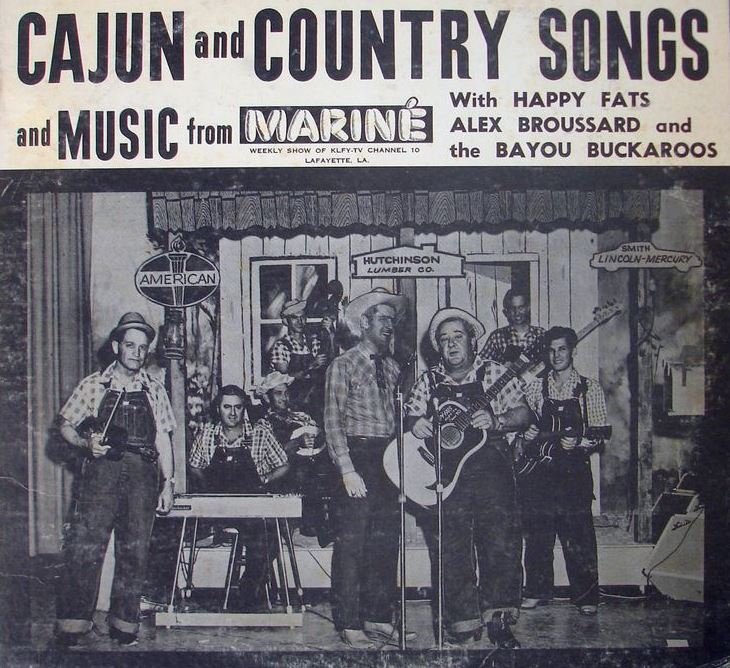
Happy Fats ran several radio shows during the 40s and 50s.  It created more demand for his music.   But by the 1950s, he was running his own TV show.   KADN and KLFY both aired his shows during the 1960s, including his popular show "Mariné".  According to Adam "Jack" Landry's son Morgan, both he and his father played with Happy on the show.
He played bass when I played with him at the dance hall. I know that he spoke very good French.  He always had something good to say. I never heard him say anything bad.  He loved to joke around.3  

Before his TV show however, his recording career was phenomenal.  His contracts with RCA Victor seemed to be never ending.  In 1946 he recorded "Coosh Mal" (#2034) with Francis “Red” Fabacher on lead guitar, Jimmy Gardiner on rhythm guitar, Giles ‘Candy Man” Castillo on steel guitar, Buel Hoffpauir on drums, and a fiddle player named Andrus "Uncle Ambros" Thibodeaux in New Orleans.   His song sings of a drunkard from Port Barre that flirts with all the women, but never amounts to much in life. 
Hé Couchemal, qui vient du Port Barré,
Oh Couchemal, il est tout le temps parlé, 
Hé Couchemal, il coursaille toutes les femmes,
Oh Couchemal, toutes les femmes lui regarde pas.

Hé Couchemal, il aime bien sa bouteille,
Oh Couchemal, il pard par sa bouteille,
Hé Couchemal, il fait jamais à rien,
Oh Couchemal, il regarde pas trop demain.

Hé Couchemal, qui vient du Port Barré,
Oh Couchemal, il est tout le temps parlé,
Hé Couchemal, il coursaille toutes les femmes,
Oh Couchemal, toutes les femmes lui regardaient pas.
Teche News
Apr 11, 1947

It's possible that the title is an ode to rhythm guitarist Jimmy Gardiner that joined the band that year.  Sung by Francis "Daddy Red" Fabacher, he refers to man with mischievous ways, usually in a bad way.  Possibly related to the mythical creature, le cauchemar (bad sleep), the nickname was used when Happy's stage show performances included more novelty acts as well as music, such as comedic entertainment. 
Hey Couchemal, who's coming from Port Barré,

Oh Couchemal, he's always talking (flirting), 

Hey Couchemal, he's courting all the women, 

Oh Couchemal, all the women don't notice him. 


Hey Couchemal, he likes his bottle,

Oh Couchemal, he does not lose his bottle,

Hey Couchemal, he never does anything,
Oh Couchemal, he never looks to tomorrow.

Hey Couchemal, who's coming from Port Barré,
Oh Couchemal, he's always talking (flirting), 
Hey Couchemal, he's courting all the women, 
Oh Couchemal, all the women don't notice him.

But by 1947, Victor called it quits and he teamed up with a new group of musicians but kept Ambrose as his fiddle player.  Morgan recalls the TV show:
[The show was] very professional. Me and my dad drove to Lafayette, it was actually a bit on the outskirts from what I remember. I also remember standing on the side of the set watching the show as it took place while waiting for me and my dad to go up. There was a background set up, some bales of hay if i remember correctly, then there were the microphones, the cameras were set up some 30 feet, pretty close to it if not, from the band. The lights were not too bad from what I recollect. If memory serves me correctly, the fiddle player was Uncle Ambrose and he kicked of the show with the rooster call.3

Happy would travel to different towns around Lafayette, promoting not only his band but his TV show as well.   He would advertise his "Mariné" show on the side of a van.   He even released a self-entitled LP on Swallow Records in 1964 with the lead song being the "Mariné Theme".


  1. http://bayoutechedispatches.blogspot.com/2013/02/a-glimpse-from-1968-historic-films.html
  2. http://www.katc.com/story/36721057/medical-explanation-for-cajun-folklore-known-as-kooshma
  3. Discussions with Morgan L
  4. Lyrics by Jordy A

Release Notes:

D6VB 2985 Coosh Mal | Victor 20-2034-A
D6VB 2986 La Valse De Bosco | Victor 20-2034-B

Find:
Happy Fats & His Rayne-Bo Ramblers (BACM, 2009)
His Rayne-Bo Ramblers 1938-1949 (Master Classics, 2011)

Tuesday, December 5, 2017

"Cajun Boogie" - Leroy "Happy Fats" Leblanc

Having worked on a radio station show, Leroy "Happy Fats" Leblanc was intimately keen on the changes of the music in the region.  During the mid 1940s, after the war, blues-influenced rockabilly became more prominent and he would have been on of the first to be exposed to it.   Here, this is one of the earliest bluesy rock tunes to come from the south Louisiana prairies.  It's clearly influenced by the sounds coming out of neighboring New Orleans and radio stations throughout the country.  

Listening carefully, one can enjoy the smooth rockabilly playing by Francis "Red Fabacher on lead guitar and a upbeat fiddle ride by Andrus "Uncle Ambrose" Thibodeaux.  The band rounded out with Jimmy Gardiner on rhythm guitar, Giles ‘Candy Man” Castillo on steel guitar and Buel Hoffpauir on drums.   Released in 1947, Billboard magazine writer stated:
It's all hot fiddling and guit'box picking in country style that Happy Fats provides for a fast-spinning Cajun Boogie.  Cajun Boogie will attract attention at the dances in those deep South corners.1 
Happy Fats, Bradley Stutes, Papa Cairo,
Andrus "Uncle Ambrose" Thibodeaux, 

Joseph "Pee Wee" Broussard

1946 seemed to be the end of an era and beginning of a new one.  "Cajun Boogie" (#20-2200) on Victor was one of the last Cajun string band recordings by a major record label.  Not long afterwards, RCA Victor would abandon all things related to Cajun music, probably due to lack of sales nation wide.    Independent labels were taking off.  Happy would have to look at other outlets, which he did, with J.D. Miller's new independent label called "Fais Do Do" records.
Rayne Tribune
Mar 7, 1947

By December of 1947, King records released Moon Mullican's "Jole Blon Is Gone, Amen", closing an end to the era.  The only exceptions were 2 moderately sized labels. DeLuxe Records of New Jersey arrived in Sulphur around 1949 and briefly recorded a slew of songs by Happy Fats, the Hackberry Ramblers, Joe Manuel and Johnny Billiot.  Modern Records of California had latched onto Chuck Guillory and Papa Cairo around the same time.  Cajun music releases were firmly in the hands of the indie labels. 
Billboard
Apr 5 1947


It didn't seemed that any major national label gave any attention to the resurgence of Cajun-inspired music until suddenly, in 1952, Columbia Records released Vin Bruce's "Dans La Louisianne".  That year, a wave of Cajun-country influenced songs flooded the airwaves including Okeh's release of Link Davis' "Big Mamou" and MGM's release of Hank Williams' "Jambalaya".


  1. Billboard Magazine. May 17, 1947


Find:
HAPPY FATS & His Rayne-Bo Ramblers (BACM, 2009)
Leroy Happy Fats LeBlanc: & His Rayne-Bo Ramblers (Master Classics, 2013)