Showing posts with label Lyric Records. Show all posts

Tuesday, February 23, 2021

"Chere Ami Waltz" - Musical Four Plus One

For over ten years, the band Musical Four Plus One enjoyed a period of great popularity.  Their recording is among the most obscure post-war releases in early Cajun music and appears on George Khoury's Lyric label.  The record immediately catches the ear with a fine electric guitar lead which participates throughout, making it unique among any Cajun record of that or probably any period.1  

The original version of the band cut this elusive record, containing "Chere Ami Waltz" (#609), a take on the old Cajun melody "Chere Tout Tout", in late 1950 or very early 1951.  That year, the group consisted of Ellias Thibodeaux on accordion, Eddie Duhon on vocals and fiddle, Cleadis Mott on electric guitar, Charles Delaney on rhythm guitar, Eldridge ‘Coon’ Guidry on bass, and Clifton Newman on drums.  According to Dave Sax, 

Eldridge "Coon" Guidry

Eddie Shuler handled the recording in a makeshift studio in Lake Charles and brought the reliable bassist Eldridge "Coon" Guidry along to augment the band.  The bass lends an unusual flavor here as it weaves with the accordion and Mott's wonderfully supple guitar work and reinforces the brisk tempo that basically takes "Chere Ami Waltz" out of the waltz category altogether.1  

Eh, criminelle, 'tit monde, 
Voir j'va pas, moi j'va faire avec maman
Te m'a quitter, pour t'en aller, chere,
T'en aller dans l'pays, si loin de moi,

Hey, te ma dire, 'tit monde,
Il y a pas longtemps, te peux revenir pour même,
Aujourd'hui mon j'peux voir, 'tit monde,
Mon j'peux voir t'apres partir, pour moi aller.


Musical Four Plus One
Cliff Newman, Eddie Duhon,
Cleadis Mott, Charles Delaney

Courtesy of Lyle Ferbrache

At the beginning they secured a residency at the Blue Moon Club in Lake Charles, which initially sponsored Saturday afternoon appearances for them on KWSL.  With a band name chosen to mimic Nathan Abshire's Musical Five, their versatility and comedy skits helped to endear them to the audience.    Although the label was sold under Khoury's Lyric catalog, on this session, we actually hear Shuler 'producing' here.  Sax explains,
Cleadis began to close the song and Eddie waved his hands above his head for them to continue playing because the record was not long enough.  As a result Cleadis' guitar began to end the piece and then picked it up again!1  
Lake Charles American Press
Jan 19, 1955


Hey, it's terrible, my little everything, 
See, I won't, I won't do that to my mom,
You're leaving me, to go away, dear,
You're going into the countryside, so far away from me,

Hey, you told me, my little everything,
Over there, not long ago, you'll return the same,
Today, I can see, my little everything,
I can see you're leaving, for I'm going now.


William Charles Delaney

They later enjoyed a nine year stint at the Clover Club, 
becoming a string band when Sidney Brown left. Other places they played were the Club 90 in Iowa, the Reno Club in Kaplan, Buddy Little's in Carlyss, and the B.O. Sparkle in Bridge City, TX.2  Cleadis Matt later played for twenty years with the Tune Toppers, recording for both Jin and J.D. Miller's Ringo label.1  Families recalled,

When they played at Lavergne's in Poche Town, they would play one week and a young George Jones would play the next.  The bar was about 100 ft from the hall with a window to allow people to get drinks from the outside. There were only benches in the hall with an elevated bandstand.  It also had a bullpen that was enclosed with chicken wire for the dancers. You could stand and watch from outside the pen but if you wanted to dance, you had to buy a ticket.2  


  1. Cajun Honky Tonk: The Khoury Recordings, Volume 1.  David Sax.  Liner notes.
  2. "Musical Four Plus One: Tran La Ezy" by Lyle Ferbrache. 
  3. Lyrics by Herman M, Stephane F, Jesse L
Release Info:
Chere Ami Waltz (Dear Friend Waltz) | Khoury’s/Lyric KH-609-A
Tran La Ezy (Drag it easy) | Khoury’s/Lyric KH-609-B

Find:
Cajun Honky Tonk: The Khoury Recordings Vol. 2 (Arhoolie, 2013)

Friday, June 12, 2020

"Lawtell Two Step" - Vincent & Cagley

"Vincent & Cagley" was the duo title for guitarist Crawford Vincent and Will Kegley. Together, they recorded two songs for Khoury's subsidiary Lyric label in 1952, one being the old Cajun string band tune "Two Step de Lawtell".  It's record producer George Khoury's only brand label with the red color and gold Lyric logo.   Khoury's Lyric label and later, his self entitled label, was one of the earliest post-war recording labels in south Louisiana and one of the few that gave Cajun musicians their recording "break". Vincent recalls,
Mr. George started out a lot of Cajun bands, I mean like Lawrence Walker, Nathan Abshire, even Jimmy 'C.' Newman.  I recorded for him two songs, I never did do well, they didn't make no hit.  But I was still proud I made 'em, because, you know, it's a souvenir for my grandchildren.  But Mr. Khoury he started a whole bunch of guys.  You see he's had Marie Falcon, Shuk Richard, he's had Will Kegley--that song we made, me and Will Kegley, he put that out.5  


Hé jolie ‘tite fille,

Pourquoi mais j’sus comme ça?
Oh, ‘tit cœur,
N’importe à ton "bon-à-rien". 

Hé jolie ‘tite fille,
Pour toi, comment ça s’fait?*
Tout le temp, ‘tit monde,
Mais oui, dans les misères.

Leo Soileau and Crawford Vincent

Crawford, who had played for years under different groups, mainly with Leo Soileau, teamed up with Nathan Abshire's old fiddle player, Will Kegley for the classic song, "Lawtell Two Step" (#605).  Crawford's earliest memories were learning to play music:
My sister gave me a fiddle when I was nine, and I got an ol' barber down there on the Mermentau River to tune it. I played fiddle the first time when I was nine---well, harmonica when I was eight. You could pack that in the cotton field. You just play 'em, and then when they get kind of dirty you boil 'em in hot water. Anybody can play a harmonica, but they don't master it. I played it pretty well, but I never did play it in a band. I played guitar, fiddle, and drums with the western-swing band.4   


Hey, pretty little girl,

Why, well, am I like that?
Oh, little sweetheart,
Doesn't matter to your "good-for-nothing".

Hey, pretty little girl,
For you, how do you do this?
All the time, my little everything,
Well, yeah, in misery. 


Benny Fruge

By 1951, Crawford employed pianist Cecil Farrell "Benny" Fruge.  Benny learned to play piano from his father Hubert who was known a locally known piano tuner.  Benny picked up the craft at the age of five and began memorizing what he played.  This helped him to develop a keen ear for music.   He began playing with small bands such as Papa Cairo, Jimmy Newman, Chuck Guillory and Happy Fats, while he was still a high school student.  Accommodating teachers arranged his senior high school classes for the afternoon to enable him to continue his musical activities.2,3   


Benny occasionally toured with Lefty Frizzell and played in the Rampart Street Six jazz band until 1954.2  By the late 50s, Fruge had moved to Baton Rouge working at Werleins music store, tuning pianos and teaching piano.  In 1980, he opened his own piano store, Fruge’s Piano Company.1  


  1. https://rabenhorst.com/obituary/c-farrellbennyfruge/
  2. Daily World (Opelousas, Louisiana) 16 Nov 1967
  3. Basile Weekly (Basile, Louisiana) 17 May 1990
  4. They Called It the War Effort: Oral Histories from World War II Orange, Texas By Louis Fairchild
  5. Cajun Honky Tonk: The Khoury Recordings, Volume 1 (Arhoolie, 1995).  Liner notes.
  6. Lyrics by Stephane F and Smith S
Release Info:
A Chere Petite Blun | Khoury's/Lyric 605-A
B Lawtell Two Step | Khoury's/Lyric 605-B

Find:
Cajun Honky Tonk: The Khoury Recordings, Volume 1 (Arhoolie, 1995)

Sunday, December 15, 2019

"Tran La Ezy (Drag It Easy)" - Musical Four Plus One

Traîne-la Aisée!  Musical Four Plus One had been one of many Cajun music groups around the mid 1950s to play and record around the Lake Charles area. Their recording of "Tran La Ezy" (#609) was a cover of Leo Soileau and Moise Robin melody popularly known as "Easy Rider Blues" recorded in 1929.   Leo recalls the song,
That was, that was popular down here, boy.  Very, very good.1 


Eh, chère, mais, quoi t'as fais avec moi hier au soir, 
Eh, 'tite fille, mais, quoi t'as fais avec moi hier au soir, 
Tu m'as quitté pour un autre, c'est pas la peine tu viens, je veux plus te voir,
C'est pas le peine jamais tu viens, je veux plus te voir, ah négresse.

Eh, chère, mais, rappelle-toi d'ton pauvre vieux nègre,
Eh, 'tite fille, mais, rappelle-toi d'ton pauvre vieux nègre,
Tu t'en vas avec un autre, cher bébé, c'est pas la peine, je p(l)us te voir,
C'est pas la peine, je p(l)us te voir, yaille.

Musical Four Plus One
Sidney Brown, Mickey Peshoff, Eddie Duhon
Crawford Vincent, and Cleadis Mott

By 1951, the group consisted of Ellias Thibodeaux on accordino, Eddie Duhon on vocals and fiddle, Cleadis Mott on electric guitar, Charles Delaney on rhythm guitar, Eldridge ‘Coon’ Guidry on bass, and Clifton Newman on drums.  Some bigger names went through the band including Sidney Brown and Crawford Vincent, who replaced Thibodeaux and Newman respectively.2   


Hey, dear, well, why did you do that to me, last night,
Hey, little girl, well, why did you do that to me, last night,
You left me for another, it's not worth you returning, I don't want to see you anymore,
It's not worth you returning, I don't want to see you anymore, ah naughty woman.

Hey, dear, well, remember your poor old man,
Hey, little girl, well, remember your poor old man,
You're going away with another, dear baby, it's not worth it, I'll never see you, 
It's not worth it, I'll never see you, yaille.


Cleadis Mott, Charlie Delaney

The misspelled title of the French saying "traîne-la aisée" can be directly translated to "drag along easily" but leans more with the meaning of "take it easy",  "ride easy", or to "casually ride along", hinting at the connection to the original melody.   Although, Eddie Duhon, the vocalist, changed the lyrics considerably, his fiddle rides followed the exact pattern Leo had laid down back in 1928.  


  1. Leo Soileau interview with Chris Strachwitz
  2. Cajun Honky Tonk: The Khoury Recordings, Volume 1.  David Sax.  Liner notes.
  3. Lyrics by Stephane F

Release Info:
Chere Ami Waltz | Khoury's 609-A
Tran La Ezy | Khoury's 609-B

Chere Ami Waltz | Lyric 609-A
Tran La Ezy | Lyric 609-B


Find:
Cajun Honky Tonk: The Khoury Recordings, Volume 1 (Arhoolie, 1995)

Monday, January 7, 2019

"Chere Petite Blun" - Vincent & Cagley

Fiddle player and Cajun drummer, Crawford Vincent, came from a musical family.  His grandfather, Theozime Vincent, who had come from France, was known to play dances in the Gueydan area as early as the 1870s.   Crawford not only learned from his grandfather, but also from a local fiddler named J.B. Fuselier.  However, Crawford's biggest influence came from listening to and playing with the Hackberry Ramblers.1

Will Kegley grew up in a sharecropper family where he and the Clement family grew up together. Accordion player Terry Clement believes this is where Will learned how to play the fiddle.   By the late 1930s, Will and a guitar player from Jennnings named Ernest Thibodeaux.    Will Kegley's biggest connection to the music was when he helped find Nathan Abshire to lead the Pine Grove Boys.   
Crawford Vincent


Oh 'tit monde, tout ça, mais, t'es après faire, 
Si loin, 'tite fille, de moi de toi,
Oh, tout le temps, après 'garder, ouais, pour toi, 
Ça on appelle ma chère,  jolie petite brune.

Oh tout le temps, de t'voir, mais, aussi loin, 
Avec un autre, 'tite fille qui m'aimait pas. 
Oh, de t'voir, avec un autre, avec un monde,
(Je te) promets, 'tit monde, ça fait de la peine.

Crawford and Will were popular musicians that played often together in other groups such as in Shuk Richard's Louisiana Aces.1  They duo came together in 1952 to recording for George Khoury's new record lable Lyric where they waxed "Chere Petite Blun" (#605), adding Cecil Farrell "Benny" Fruge on piano.  Sadly, the rest of the musicians during the session is unknown. Khoury's lack of attention to detail produced a title with the word "brun" misspelled along side Kegley's name written as "Cagley".
Will Kegley


Oh, my everything, all that, well, you've done,
So far away, little girl, I am from you,
Oh, all the time, looking, yeah, for you, 
We call my dear, pretty little brunette.

Oh, all the time, seeing you, well, so far away,
With another, little girl, who doesn't like me,
Oh, seeing you with another, everywhere,
(I) promise you, little everything, it hurts.

However, in tragic turn of events, Will's reputation would be cemented as a rough musician. In June of 1954, while playing with the Pine Grove Boys, he stabbed steel guitar player Atlas Fruge in a fit of rage over the jealously surrounding his wife Oziet.   He was sentenced to Angola for 18 months but only served a year.   Afterwards, he filled in with other bands such as Andrew Cormier's Rambling Aces.1  


  1. Cajun Dancehall Heyday by Ron Yule
  2. Lyrics by Stephane F
Release Info:
A Chere Petite Blun | Khoury's/Lyric 605-A
B Lawtell Two Step | Khoury's/Lyric 605-B

Find:
Cajun Honky Tonk: The Khoury Recordings Vol. 2 (Arhoolie, 2013)

Wednesday, November 22, 2017

"Choupique Two Step" - Nathan Abshire

Nathan Abshire was the first in the family of six children.  His parents, also musicians, played accordion, and two of his brothers, known to have been top-notch accordion players, gave it up when still young.3  Abshire was especially taken with the spirited playing and singing of Creole accordionist and singer Amede Ardoin, and Ardoin often invited Abshire to play with him.2  
“Every Saturday we used to go to John Foreman’s saloon. I’d see Amédé Ardoin coming down the way. He’d say, ‘Abshire, you’ve got to help me tonight.’ I’d say. ‘Amédé, I can’t help you.’ ‘Oh yeah,’ he’d say, ‘We’re both going to play. I’ll play for awhile, you play for awhile.’ I’d say, ‘I don’t feel much like going Amédé.’ But I’d go and we’d sure make some music. As far as that goes, we made some great music.”2


Oh, jolie parti, c'es partie à Choupique,

C'es parti, jolie catin, 

Pour voir des belles 'tit blondes.


Aye! C'es Choupique!


Oh, jolie catin, jolie sa m'fais du mal.

Oui, ces drole qui tu m’a dit,

Jolie, sa m'fais du mal.


Oh, jolie catin, jolie tu m'fais du mal,

M'fais du mal, catin du mal,

J'vas pleurer pour toi.


Nathan Abshire
by Todd Kruse
http://pictify.saatchigallery.com/user/tjkruse

The choupique (pronounced "shoe pick") is a trash fish, known outside Louisiana as the bowfin, which isn't eaten much but can be found plentiful around Evangeline Parish, Louisiana. Choupique is also the name of a rural community north of Eunice, Louisiana, not far from a small stream called "La Coulée Choupique".

George Khoury, the owner of Lyric label, recorded Nathan's "Choupique Two Step" (#610) in 1951 but chose not to co-release it on his Khoury's label until years later when he re-released many of these pressings on 45 RPM.  The band consisted of his typical lineup of Nathan on accordion and vocals, Will Kegley on fiddle, Atlas Fruge on steel guitar, Ernest Thibodeaux on guitar, Jim Baker on bass, Ozide Kegley on drums. It could very well be a version of Happy Fats' "Les Fille De St. Martin" that Nathan had remembered from their first session together 16 years earlier.   All of these are based on Amede Ardoin's "Amede Two Step".
Church Point News
Dec 12, 1961


Oh, my pretty went away, went away to Choupique,

She left me, my pretty doll,

Going to go see the pretty little blondes.


Aye! Choupique!


Oh, my pretty doll, pretty, you hurt me,

Yes, it's odd what you said,

Pretty, you hurt me.


Oh, my pretty doll, pretty, you hurt me,

You hurt me, my doll, it hurts,

I'm going to cry over you.


  1. Louisiana Music, Vol. 1 by Lyle Ferbrache
  2. http://www.offbeat.com/articles/masters-of-louisiana-music-nathan-abshire/
  3. Pine Grove Blues: Swallow LP 6014. Liner notes.
  4. Lyrics by Jerry M
Find:
Nathan Abshire & the Pine Grove Boys - French Blues (Arhoolie, 1993)

Sunday, April 9, 2017

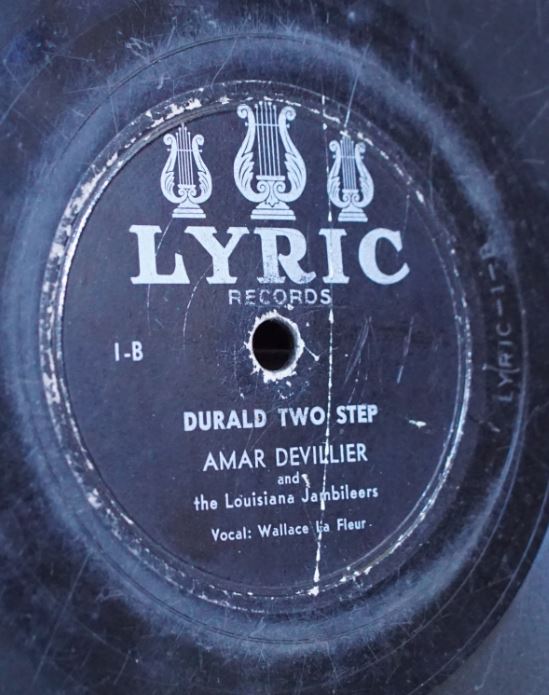
"Durald Two Step" - Amar Devillier

Amar "Ti-Frère" DeVillier.  Amar first learned to play the accordion in his late teens from his brother-in-law Angelas Manuel and also with a young teenage prodigy, Alphonse"Bois Sec"Ardion, a family acquaintance from the nearby community of  Duralde, who helped hone his skills. Occasionally on weekends, Amar would hitch up the horse and buggy and ride the family to their neighbor, Cheese Reed's house and "passe la veille" (play music and visit).1,2  

Devillier recorded some of the earliest known Cajun music with harmonica, similar to the recordings of Joe Werner. The Louisiana Jambileers gathered at the KEUN Radio studios in Eunice and laid down two songs, one which was the Duralde Two Step (#1).  It  featured the vocalist Wallace Lafleur and was named after the rural community known as Duralde in South Louisiana.  Recorded in 1952 on George Khoury's Lyric label, it would be the only record in his catalog identified with a single digit.  
Amar Devillier


Moi aller, chere tite fille, 

Oh, là-bas à Duralde,

Eh, ye yaille, moi je connait,

Chere tit fille, t'es mien, je t'aime.

Chere tit monde, mon aller,

Oui, là-bas au si loin, 

Mon aller, chere tit fille, 

Mon aller là-bas à Duralde.


Chere tit fille, moi'je connait,
Moi'je connait, c'est pas la peine, 
Moi te faire tout de ça,
Tout ça m'a fait mal.
Ah, chere tit monde, 
Moi aller là-bas à Duralde,
Moi aller mon tout seul,
Moi aller là-bas à Duralde.
Angelas Manuel and Amar Devillier
Courtesy of Neal Granger

Amar began playing in dance halls in the 1930's and 1940's and therefore was able to greatly supplement his income during the Great Depression.   He played many bals de maison in the early years and considered by local music buffs as one of the original French musicians from the area. Musicians had to play loud to be heard thus were hard on their instruments.  Because of his rough playing and due to no amplification at the time, he would wear-out a set of bellows often on his accordion.  

Later on, Lafleur was supposed to be the key musician at the Newport Folk Festival in 1964, but his wife wouldn't have it.  At the last minute, before the band left, he dropped out.  Instead, the mostly unknown Dewey Balfa took his place, creating one of the most important events in Cajun music history: the Cajun music "renaissance".   After Balfa's return, he helped create what is known as Festival Acadiens. 


I'm going, dear little girl,

Oh, over there to Duralde,

Hey, ye yaille, I know,

Dear little girl, you're mine, I love you.

Dear little everything, I'm going,

Yes, over there as of now,

I'm going, dear little girl,

I'm going over there to Duralde. 


Dear little girl, I know,
I know, it's not worth it,
You've done to me, all of that,
All that, I'm miserable.
I'm going over there to Duralde,
I'm going all alone,
I'm going over there to Duralde.

Amar and Cajun fiddler, Dennis McGee, were known to have co-written some songs together, most notably "La Valse de Lanse Meg", also known as "La Valse de Devillier".1,2   By 1960, Wallace would end up playing with Shirley Bergeron and his group while Terry Clement would take the melody and use it in his song "Diggy Liggy Lo". 


  1. https://pngran.blogspot.com/2019/06/la-valse-de-devillier-amars-waltz.html
  2. Discussions with Neal G
  3. Lyrics by Jerry M
Find:
Cajun Music - The Early 50s (Arhoolie, 1969)
Cajun Honky Tonk: The Khoury Recordings Vol. 2 (Arhoolie, 2013)
Bayou Two-Step - Cajun Hits From Louisiana 1929-1962 (Jasmine, 2015)

Monday, October 20, 2014

"La Waltz a Belezere" - Nathan Abshire

Following Iry Lejeune's lead, previously popular Cajun musicians, such as Nathan Abshire, dusted off their accordions and began providing music for a generation interested in preserving and reviving its fading heritage.    Nathan had recorded for Virgil Bozeman's O.T. records and record producer George Khoury had financed the label.  Khoury owned a record shop and while servicing jukeboxes, he realized customers were asking for more Cajun music.   Noticing Nathan's popularity with "Pine Grove Blues", he convinced Nathan to leave O.T. and record for his two new labels, "Khoury's" and "Lyric", which he created in 1950.  The reason for creating two different labels is unknown. Between 1950 and 1953, Nathan recorded for Khoury several songs including this tune called "La Waltz a Belezere" (#610) in Lake Charles, Louisiana.  His Musical Five included Will Kegley on fiddle, Ernest Thibodeaux on guitar, Atlas Fruge on steel guitar, Jim Baker on bass, and Ozide Kegley on drums. Also known as Belisaire Waltz, it is based on the tune "A Precious Jewel" by Roy Acuff recorded about 1941. 
Nathan Abshire


Ouais, s'en aller, là bas chez Belisaire
Ouais, c'est pour voir les belle 'tite filles que moi j'aime tant
Ouais, c'est nous autres, ouais, qu'est si joyeux
Ouais, pour rencont(r)er notre bons amis qui viennent nous voir

Ouais, pour un dimanche, mais, ouais, après-midi
Ouais, se rassembler pour aller chez Belisaire
Ouais, rencontrer, oh, ouais, notre bons "friends"
Ouais, c'est danser ses belle vielle valse chez Belisaire
Will Kegley

"Belezere" was a small dance-hall right outside of Kaplan owned by Belizaire Herpin, a native of nearby Gueydan.  Belizaire's Dancehall was located on the highway north of Kaplan headed to Crowley.  Mixing English into otherwise French tunes would not be uncommon among Cajun recordings, however, one has to wonder about his use of "friends" in such a manner. The song seems to be influenced by an old-timey tune called "Farther Along". Abshire released at least 10 records for Khoury over the next 8 years.  The Clement Brothers would also record a song called "Belisaire" around the same time.  According to Neal Pomea, the brothers were writing alot of songs at this point and were good friends with Nathan who used to play down the road from their house.  

Two of the band members, however, would be known for an infamous event. According to Ernest Thibodeaux, Will and Atlas had never gotten along, One night, Kegley attacked Atlas after the two had words over whether Kegley had been inappropriate with Atlas’ wife, Bernella Fruge.  Several versions exist  Bernella Fruge said Kegley was going around the bandstand at the Town and Country Club in Riceville, La., trying to play a different instrument on each number. When he got to her and the drum set, he touched her leg. She slapped him across the hand with a drumstick and Atlas noticed.  Bernella claimed the stabbing was premeditated. In that version, Kegley went to the bar to buy Atlas a soft drink to smooth things over. When he returned, he took out a pocket knife and attacked Atlas in the back. Kegley was eventually sentenced to 18 months, but served a shorter term since he had spent three months in jail awaiting trial.  
Atlas Fruge


Yeah, go over there to Belisaire's

Yeah, it's nice to see the lil girls that I love so much

Yeah, that's us, yeah, it's so fun

Yeah, to meet our good friends who've come with us 


Yeah, on Sunday, but yeah, after lunch

Yeah, we'll get together to go to Belisaire's

Yeah, we'll meet, oh yeah, our good "friends"

Yeah, it's a beautiful old waltz at Belisaire's


Nathan would go on to record this song for Swallow in 1966, referred to as "Phil's Waltz" with a different set of lyrics.  There's no record of who "Phil" is, however, it's possible he was Phil Ancelet, an owner of a club called "Shamrock Club" in Lake Charles that Nathan played at.  In 1979, the Mamou Cajun Band with Roy Fuselier and Aubrey Deville would record a live version of the tune for KEUN on a LP entitled "This is Mamou Cajun Radio" for Sonet Records.


  1. Cajun Country By Barry Jean Ancelet
  2. Cajun Breakdown : The Emergence of an American-Made Music By Ryan Andre Brasseaux
  3. South to Louisiana: The Music of the Cajun Bayous By John Broven
  4. Discussions with Neal Pomea
  5. Interview with Beverly Spell of Orange, daughter of the late fiddle player Will Kegley
  6. http://therecordlive.com/2010/05/20/la-music-mag-has-orange-edge/
  7. Lyrics by Marc Chauveau
Find:
French Blues (Arhoolie, 1993)