Showing posts with label Amede Ardoin. Show all posts

Tuesday, April 23, 2024

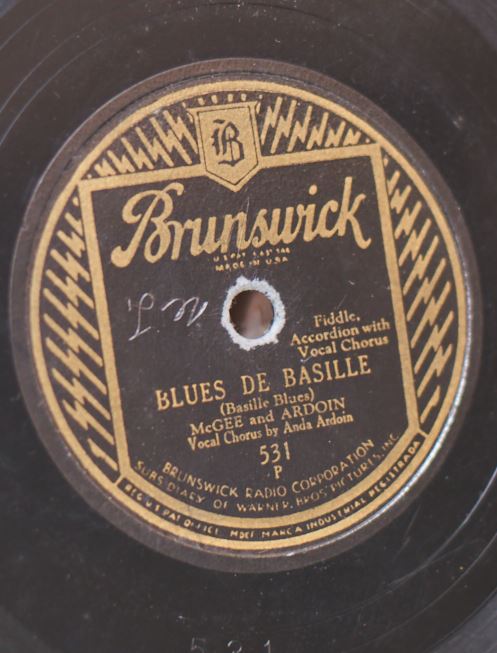
"Blues de Basille" - Amede Ardoin & Dennis McGee

With songs like "Two Step de Eunice" and "Blues De Basille," (#531) accordionist Amede Ardoin, helped by his fiddle player and traveling companion Dennis McGee, became one of the first musicians to record Louisiana's Cajun music. Ardoin was an accordion virtuoso who, by all accounts, had an uncanny knack for improvising French lyrics with his strange high voice.1  Named after the town of Basile, Ardoin was no stranger to the "blues" that this town offered him,
One time they had a dance hall in Basile, and what saved him was some white guy who was learning how to play the guitar.  Somebody threw a big ol' rock--whoever done it wanted to hurt him bad--and the rock went through the guitar.4  

Oh comment je vas faire, catin,
Mais, ouais, ’tite fille je m’en vas à la maison tout seul,
Comment tu veux, dis, ouais, je peux faire, ’tite fille,
Si tes parents veulent pas, je te demanderais pas,
Dis, ouais, c’est toi, éou c’est tu veux je peux aller,
Mais, ouais, mon nèg, chaque fois que je vas pas c’ez toi.

Oh, mais, oui, catin; comment,
Si vous-autres peuvent faire m’en aller de toi, ’tite fille,
Moi, je te vois pas, c’est beaucoup rarement,
Je serais contente te rejoindre, te rejoindre, ’tite fille.

Oh, comment je vas faire, catin,
Dis ouais, je vas tout seul éoù c’est je vas aller,
Que tes parents veulent pas, comment je vas faire, tite fille.
Daily Advertiser
May 1, 1931

It's unlikely we'll ever know for certain what became of Ardoin. By some accounts, he wound up in a mental institution in Pineville, Louisiana. The only concrete evidence of this, however, is a death certificate issued May 30, 1941 from Pineville for a person named "Amelie Ardoin." And the certificate lists Ardoin as being 20 years older than he actually was at the time. Others say Ardoin eventually left Pineville and headed home.1  Music writer Tom Schnabel compares the song to his life and death,
Listening to it, I was reminded of a much more famous singer, the blues great Robert Johnson, who himself died of mysterious circumstances at age 27.  There is a great deal of myth surrounding Johnson’s life, as it’s been rumored that he was poisoned by a jealous girlfriend. Others say that he sold his soul to the devil in a faustian deal to become the greatest blues singer of all time. The latter story involved Johnson taking his guitar to Dockery Plantation at midnight to seal the deal, which turned out to be a meeting at the crossroads. The music of Ardoin and Johnson has a certain edge that captures the energy of their youth. Songs like Ardoin’s “Blues de Basile,” parallel the same piercing, exhortatory urgency of Johnson’s “Preaching Blues.”2  


Oh, how will I do this, pretty doll,

Well, yeah, little girl, I'm going to go home all alone,
What do you want, tell me, yeah, I can do this, little girl,
If your parents don't want, I won't demand,
Tell me, yeah, it's you, wherever you want, I can go,
Well, yeah, my friend, every time that I'm not going to you.

Oh, well, yes, pretty doll, how?
If you all can make me leave you, little girl,
I don't see you, it's very rarely,
I'll be happy to join you, to join you, little girl.

Oh, how will I do this, pretty doll,
Say yeah, I will go all by myself, where ever can I go,
That your parents do not want me, how will I do this, little girl.


Amede Ardoin

The common, accepted story is: While playing his accordion at a local farmhouse in Eunice, Louisiana, in the late 1930s, Creole musician Amede Ardoin wiped his brow with a handkerchief given to him by a white woman. Two white men angered by the exchange between Ardoin and the woman followed him outside, where they beat him, backed over him with a Ford Model A truck and threw him in a ditch. He woke up crippled, with permanent brain damage.1  Fellow musician Canray Fontenot remembers how that night changed his friend:


After that, "he didn't know whether he was hungry or not.... He was plumb crazy."1
In 2014, "Blues de Basille" crossed over, making it's appearance into the mainstream when it was recorded by jazz violinist Regina Carter on her album "Southern Comfort".3   


  1. http://www.motherjones.com/mixed-media/2011/03/amede-ardoin-cajun-zydeco-mardi-gras
  2. https://www.kcrw.com/music/articles/the-zydeco-legend-of-amede-ardoin
  3. https://www.newsounds.org/story/regina-carter-in-studio/
  4. The Kingdom of Zydeco By Michael Tisserand
Release Info:
NO-6719 Blues De Basille | Brunswick 531
NO-6720 La Valse A Thomas Ardoin | Brunswick 531

Find:
Pioneers of the Cajun Accordion (Arhoolie, 1989)
I'm Never Comin' Back: The Roots of Zydeco (Arhoolie, 1995)
Cajun Country, Vol. 2, More Hits from the Swamp (JSP, 2005)
Mama, I'll Be Long Gone : The Complete Recordings of Amede Ardoin, 1929-1934 (Tompkins Square, 2011)

Tuesday, August 23, 2022

"Oberlin" - Amede Ardoin & Dennis McGee

Cajun accordionist Amede Ardoin himself was a sought-after dance musician who played both white Cajun gatherings and black la-la dances and was known for his ability to improvise lyrics about those in attendance; a practice which sometimes got him in trouble. It might seems strange that a black Creole musician who left little more of a trace on the world than 34 scratchy recordings would come to be known as the father of a musical style rooted in the culture of French-Canadian exiles. In this sense, the record stands as a testament to the musical creativity happening in Louisiana during the first half of the 20th Century. Around the same time Ardoin was mastering his accordion, musicians like Jelly Roll Morton and Buddy Bolden were in nearby Storyville, New Orleans, shaping ragtime music into jazz.3 According to journalist Ed McKeon:

He played in a rhythm-heavy syncopated style and sang with a passion unmatched even to this day in Cajun and Creole song.1  


Oh, 'coute mes paroles, ye yaille,

Comment, mon je vas faire, mon j'm'en vas,

J'vas faire, j'vas faire, mon j'm'en vas, catin,

Où c'est t'as prender*, malheureuse?


Oh, quoi faire, t'as m'fais ca, maman,

Comment mon je vas faire, mon j'm'en vas,

Mon j'm'en vas, m'en vas à la maison, maman,

Mon cœur fais si mal qu'à jongler.


Oh chère!


Mon j'm'en vas, mes parents, mon j'm'en vas,

Oh, c'est tous les dimanches au soir,

Mais, les samedis, tous les samedis au soir,

Maman, j'après aller pour mon t'voir. 


Oh, oh, ye yaille, ye yaille,

J'suis loin d'la maison,

J'connais pas equand je vas m'retourner, ye yaille,

J'm'en vas, mon tout seul, mais, 'tit cœur,

Mes parents veulent pas je reste jamais avec toi,

Quique* (chose), va rester, j'ai pas d'argent.


Eli Oberstein
Along the outskirts of San Antonio in 1934, a small group of recording engineers, alongside producer Eli Oberstein, gathered various folk performers, including Amédé Ardoin, in two rooms of the Texas Hotel to make some records. Despite his stylistic affinity with the white French music of rural Louisiana, the six tunes Ardoin documented that day (for the Bluebird/Victor company) included some distinct differences foreshadowing the future of black Creole music.2  According to music producer, Christopher King, the combination white and black musicians during this time period was quite unique,

It was one of the first instances of that actually occurring in Cajun music. And it actually is a rare occurrence in pre-war music taken as a whole. But as you can hear from the recordings, they're so perfectly integrated and relaxed with each other.


Oh, listen to my words, ye yaille,

How will I do this, i'm going,

I'm doing this, I'm doing this, I'm going, pretty doll,

Where are you going to go, naughty woman?


Oh, why do you do that to me, little mama,

How will I do this, I'm going,

I'm going, I'm going home, little mama,

Oh, my heart aches thinking about this.


Oh, dear!


I'm leaving my family, i'm leaving,

Oh, it's every Sunday night,

But, the Saturdays, the Saturday evenings,

Little mama, I'm leaving to go to see you.


Oh, oh, ye yaille, ye yaille,

I am so far away at home,

I don't know when I will return, ye yaille,

I'm leaving, all alone, well, little sweetheart,

My parents never wanted me to stay with you,

Whatever, I'm staying, I have no money.


He and fiddle player Dennis McGee recorded "Oberlin", an ode to the small town in Louisiana.  Not to be confused with his "One Step de Oberlin", the Texas Hotel session marks another significant development. Although Ardoin had generally established a reputation for playing in a syncopated style more consistent with his Creole legacy than with straight Cajun music, none of his catalog of thirty-four recordings included any percussion instrument accompaniment.2 

Portions of the tune resemble Cleoma Breaux's classic recording of "Mon Coeur T'appelle".   The greatest legacy of the song would be it's usage as Iry Lejeune's "Te Mone" in the 1950s.  According to accordionist Cory McCauley,

In Oberlin, Amédée and Dennis played at a dancehall called The Golden Gate, which was located just south of town. I think this was the last stop on a circuit they would play that would bring them from Châtaignier, Eunice, Basile, Duralde, L'Anse Chaumont, Soileau and Oberlin. I've heard stories of them buying moonshine and sleeping under a tree, staying gone for two weeks at a time. Playing a dance every night. La vie de musicien!5  


  1. http://www.downhomemusic.com/product/amede-ardoin-im-never-comin-back/
  2. Southeast Texas: Hot House of Zydeco by R. Wood.
  3. http://www.motherjones.com/mixed-media/2011/03/amede-ardoin-cajun-zydeco-mardi-gras
  4. https://www.npr.org/templates/transcript/transcript.php?storyId=135638265
  5. Discussions with Cory M - 6-8-2024
  6. Lyrics by Stephane F

Release Info:
BS-83856-1 | Les Blues De Crowley (Crowley Blues) | Bluebird B-2190-A
BS-83857-1 | Oberlin | Bluebird B-2190-B


Find:
I'm Never Comin' Back: The Roots of Zydeco (Arhoolie, 1995)
Cajun Country, Vol. 2, More Hits from the Swamp (JSP, 2005)
Cajun Capers: Cajun Music 1928-1954 (Proper, 2005)
Mama, I'll Be Long Gone : The Complete Recordings of Amede Ardoin, 1929-1934 (Tompkins Square, 2011)

Monday, May 16, 2022

"Amadie Two Step" - Amede Ardoin & Dennis McGee

Before there was zydeco music, early French-speaking musicians in Southwest Louisiana were creating French-Creole music. And, one of the earliest recording artists of this style was accordion player Amede Ardoin, whose life on the Creole music trail went from stardom to tragedy. Ardoin was a virtuoso on the accordion, and he wrote and recorded a series of songs from 1929 to 1934.  According to author Darrell Bourque:

He was kind of like a rock star of his own day and time.  The most repeated a line in his songs, other than wanting a girl to pay attention to him, ... this thing about not having a home, you know, being exiled.1


Oh, bonsoir, catin, ouais, je m'en va, jolie,

Moi, je m'en va, donc, moi tout seul, droite à la maison,

Moi, je voudrais si vous-autres peuvent faire,

Ouais, pour toi, qu'es aussi mal,

Tu t'en va à ta maison, toi, tu me quittes derrière.


Oh, bonsoir, catin, quoi tu veux (que) je peux faire?

Moi, je te vois, mais, t'en aller, ouais, ça me fait du mal,

Si tu vas, comment je peux faire quand je jongle à toi?

Toi, peut-être j’aurais le courage, ouais, de m’en aller.


Oh, bonsoir, catin, peur tout le temps fait ça,

C’est pour faire plaisir, catin, pourqoui à tes parents,

Quand ton neg’ radotte sur moi, je crois, toi, tu me fais ça,

Tu me fais du mal, c’est toi, catin, (qu'es) assez pour moi pleurer.


Daily Advertiser
Aug 13, 1931
It had been almost a year since Dennis Mcgee and Amede Ardoin had made their ground-breaking recordings for Columbia, which were co-pressed on Okeh. The Great Depression had taken a toll on the recording industry. November of 1930 was quite late into the Depression for recording labels to attempt marketing new Cajun music, but Brunswick decided to try one last time.  They gathered Dennis and Ardoin together and recorded a song that reflected the pain in which Ardoin was so familiar with... the loss of a lover.  While he attempts to blame her parents, he also passes blame on her as well.  Unlike Columbia and Okeh, Brunswick did not employ a special numberical series for its Cajun records.  Instead, the firm released all of these titles, which consisted of waltzes, one-steps, two-steps and blues, under the bill of McGee and Ardoin in its "Songs from Dixie" series.3  He continued to play with McGee and his black Creole neighbor Douglas Bellard into the early 1930s. 


Oh, goodnight my pretty doll, yeah, I'm leaving, my pretty,

I'm leaving, so, all alone, straight to the house,

I'd like it if you could do this,

Yeah, for you, who's also sad,

You have gone to your house, you've left me behind.


Oh, goodnight my pretty doll, what do you want (that) I can do?

I see you, well, you're going, yeah, it makes me feel sad,

If you're going, how will I handle this when I'm thinking about you?

You, maybe I'll have the courage, yeah, to go away.


Oh, goodnight my pretty doll, always scared to do that,

Trying to please, pretty doll, your parents,

When your father rambles on about me, I believe you've done that to me,

You've made me sad, it's you, pretty doll, (who did) enough to make me cry. 

The popularity of the song gave way to Happy Fats' 1935 "Les Fille De St. Martin" and Nathan Abshire's 1950 "Choupique Two Step" and his 1960 "Jolie Catin".  In the 1980s, Marc Savoy recorded a different melody giving it the same name. Because of the confusion it caused, he explains:

In the 1980s the Savoy-Doucet Cajun Band recorded Arhoolie CD #316 entitled "Two-Step Amédé." Initially, the title song, which I had composed out of love and admiration of Amédé Ardoin's music, was supposed to be called "Tribute to Amédé Ardoin." Even though the submitted track list clearly described the title correctly, the producer went to press having changed it to "Two-Step Amédé" not realizing that there was already a completely different song entitled "Amédé Two-Step" by Amédé Ardoin recorded in the 1930s. My recording of "Two-Step Amédé" was never meant to be a version of Amédé's wonderful song. Instead it was my feeble attempt to compose a tune to honor his contribution to Cajun/Creole Music.2 


  1. http://www.fox8live.com/story/37771315/heart-of-louisiana-the-story-of-amede-ardoin
  2. https://folkways.si.edu/arhoolie 
  3. Hidden in the Mix: The African American Presence in Country Music edited by Diane Pecknold

Release Info:
NO-6717-A Amadie Two Step | Brunswick 576 

NO-6718-A La Valse A Austin Ardoin | Brunswick 576

NO-6717-A Amadie Two Step | Melotone M18050
NO-6718-A La Valse A Austin Ardoin | Melotone M18050

Find:
I'm Never Comin' Back: The Roots of Zydeco (Arhoolie, 1995)
Cajun Country, Vol. 2, More Hits from the Swamp (JSP, 2005)
Mama, I'll Be Long Gone : The Complete Recordings of Amede Ardoin, 1929-1934 (Tompkins Square, 2011)

Friday, June 4, 2021

"Tortope D'Osrun (Tortope of Osrun)" - Amede Ardoin

Cajun and Zydeco music would not be what it is today without Amédé Ardoin and his musical recordings of the late 1920s and early 30s. His fortés include his uniquely eloquent lyrics his resonating voice and his driving accordion virtuosity. The equanimity in which this slight black French-speaker composed performed and recorded his songs attests to the high regard held by those who knew him. Amédé lived the blues and injected his spirit into our music.2 


Oh, oh, quoi faire, je m'en va,
Tu m'abandonnes, yé yaille, tu m'abandonnes,
Ayoù je vas aller, chére, n'importe quel bord qu'il va,
T'es pas là, yé yaille, ça me fait de la peine.

Oh, yé yaille, ça me fait de la peine à mon,
Ayoù je vas aller, pour être capable te voir,
Quand tu me passes, toi, tu reviens jamais,
Avant samedi au soir, après midi.

Oh, yé yaille, comment je vas faire?
Comment je vas faire, yé yaille?
J'suis après partir, tous les samedis au soir,
Ta mom veut pas,
Que mon je t'emmene en nulle part,
Comment je vas faire?

Amede Ardoin


Based on a Joe Falcon recording entitled "Osson", Ardoin's 1934 "Tortope D'Osrun" (#17007) was an ode to the small community of Osson and contained the same lyrical theme he used in much of his other recordings.  Left to his own devices, Ardoin's solo work for Decca Records in New York City that December became the last creative pieces he ever recorded.  Melodies such as the one borrowed from the American standard "Rubber Dolly", which inspired other Cajun songs such as Adam Trahan's "The Waltz Of Our Little Town", Angelas Lejeune's "Bayou Pon Pon" and Austin Pitre's "High Point Two Step".  Musician Moise Robin recalls meeting Amede Ardoin,

When I was young, Amédé Ardoin was playing with Leo Soileau at my brother-in-law dance hall and he would bring crowds that the people couldn't come in.  He was a good singer. And that's what the people were [there] for.1


Oh, oh, what's been done, i'm going,
You abandoned me, ye yaille, you abandoned me,
Where am I going to go, dear, no matter which side that I go,
You aren't there, ye yaille, that hurts me.

Oh, ye yaille, that makes it painful to me,
Where am I going to go, in order to be able to see you,
When you passed by me, you never returned,
Before Saturday evening, that afternoon.

Oh, ye yaille, how will I handle this?
How will I handle this, ye yaille?
I am leaving, every Saturday night,
You mom doesn't want,
That I bring you anywhere,
How will I do this?


  1. http://arhoolie.org/moise-robin/
  2. http://www.downhomemusic.com/product/amede-ardoin-im-never-comin-back/
Release Info:
39198-A Valse Brunette (Brunette Waltz) | Decca 17007 A
39199-A Tortope D'Osrun (Tortope of Osrun) | Decca 17007 B

Find:
Amadé Ardoin – Louisiana Cajun Music Vol. 6 : Amadé Ardoin – The First Black Zydeco Recording Artist (1928–1938) (Old Timey)
I'm Never Comin' Back: The Roots of Zydeco (Arhoolie, 1995)
CAJUN-Rare & Authentic (JSP, 2008)
Mama, I'll Be Long Gone : The Complete Recordings of Amede Ardoin, 1929-1934 (Tompkins Square, 2011)

Monday, December 7, 2020

"La Valse A Thomas Ardoin" - Amede Ardoin & Dennis McGee

Amede Ardoin became the most influential Creole singer and accordionist, whose music provided roots for modern Cajun and Zydeco music.  In his earliest years his family played a large part of the influence.  According to Amede's nephew Milton Ardoin,
My daddy [Beaudoin Ardoin] bought an accordion to start.  He was not able to learn. Amede, you know, he was the baby one, and he gave the accordion to him.  When Amede started to play, he was on a chair and he was so small his foot was not touching to the floor.  But he learned that over and over and over, until he caught it.2  

Ardoin couldn't read and write and spoke no English.  Amede's parents, Thomas and Aurelia, were brought up during Reconstruction and became one of many land holding former slaves in south Louisiana.  Thomas Ardoin's mother, Marie Tom, was a slave, and Thomas was also born into slavery. Yet, by the time Amede was born, Thomas had acquired 157 acres of land on Bayou Nezpique.2   However, Milton recalled the tragedy that struck him as a child, 
St. Landry Clarion
Feb 4, 1899


My grandfather [Thomas Ardoin] got killed when Amede was small.  He was on the road. They reached a bridge, and they had some beef to haul.  It was old wood, and it broke, and my grandfather had his neck broken.2  


Oh, ye yaie, moi, j'ai pas de femme,

Oui, ses parents ça veut pas je se vois, malheureuse.


Oh, ye yaie, mes parents, eou je vas aller?
Moi, j'suis tout seul, mon j'ai pas de place d'aller,
Oh, ye yaie, mon j'ai pas d'argent, moi, j'ai pas de maison,
Mes parents veulent pas me voir.

Oh, 'tite fille, mais, eou toi, tu vas,
Toi, t'es pas la seule qui est contraire à ta maman,
Oh, catin, ton coeur fait du mal,
Mon, je m'ai aperçu pour Ia maniere tu fais avec moi.
Daily Advertiser
May 1, 1931

In 1930, alongside fiddler Dennis McGee, Ardoin recorded the tune "La Valse A Thomas Ardoin" (#531) in New Orleans as an ode to his late father. According to author and poet laureate Darrell Bourque,

One of the things I find fascinating is the variety of stories that circulate about Amédé, and the way they reflect the culture of the time. So when I began to run across all this information, that was exactly the kind of story that I wanted to tell, because I didn’t want to tell a story that was an interesting pocket of information, but one that connected in many ways with what we continue to have to deal with in terms of race, migration and the meaning of home.1  


Oh, ye yaille, I don't have a wife,

Yes, her parents don't want to see me, oh my.


Oh, ye yaille, my parents, where can I go?
I'm all alone, I don't have a place to go,
Oh, ye yaille, I don't have money, I don't have a home,
My parents don't want to see me.

Oh, little girl, well, where are you, you went away,
You're not the only one who is contrary to your mother,
Oh, pretty doll, your heart hurts,
I noticed that by the way you've done (treated) me.

In 1957, accordion player Lawrence Walker re-worked Ardoin's tune into the "Midnite Waltz" for Swallow Records. 


  1. https://kreolmagazine.com/culture/features/amede-ardoin-and-his-legacy-a-discussion-with-darrell-bourque/#.XH_u-8BKhhE
  2. The Kingdom of Zydeco By Michael Tisserand
  3. NOTE: Cajun Country, Vol. 2 has song mis-titled

Release Info:
NO-6719 Blues De Basile | Brunswick 531
NO-6720 La Valse A Thomas Ardoin | Brunswick 531

Find:
I'm Never Comin' Back: The Roots of Zydeco (Arhoolie, 1995)
Cajun Country, Vol. 2, More Hits from the Swamp (JSP, 2005)
Mama, I'll Be Long Gone : The Complete Recordings of Amede Ardoin, 1929-1934 (Tompkins Square, 2011)

Wednesday, August 5, 2020

"Valse A Alcee Poulard" - Amede Ardoin & Dennis McGee

Although Creole accordion player Amede Ardoin played with many fiddlers in his lifetime, including the incomparable Douglas Bellard, his most enduring creative partnership was with Dennis McGee, an orphaned white sharecropper from Eunice, Louisiana, who is credited on twenty of Ardoin’s thirty-four sides. Such interracial alliances weren’t unprecedented, but it’s likely the relationship was socially fraught. McGee probably recommended Ardoin to Columbia Records, which would make him ultimately responsible for Ardoin existing outside of his time and place.2 


Oh, ye yaille, je m'en vas.

Moi, je me'en vas, malheureuse, moi, je m'en vas, catin,
Je m'en vas, mon tout seul à la maison.

Comment je vas faire, toi, 'tite fille, ayou je vas aller, jolie?
Pour moi être capable t'rejoindre, ouais, encore,
Moi, je connais tes parent, ça veut pas, catin,
Ayou, moi je vas aller pour t'rejoindre?

Toi, jolie, fait pas ça, ye yaille,
Comment moi je vas faire? C'est si dur.


Amede Ardoin

The Columbia session was short lived and the label closed the doors to any more Cajun sessions due to The Depression.  The only name in the Cajun recording game at the time was Brunswick Records of Chicago.  In late November of 1930, the recording team made one last trip to Louisiana where they recorded Dennis and Amede; kicking off with the performance of "Valse A Alcee Poulard" (#495); a melody more familiar as "Quel Étoile".  Alcee Poulard is believed to be the husband of Amede's aunt, Oline Ardoin Poulard, who is mentioned in the title of another Ardoin song called "Taunte Aline".  McGee's backing of Ardoin's tune provided unique support that seems to be noticed to musicologist Jared Snyder.
Only "Valse a Alcee Poulard," in the cross key of A, needs the fiddle to state the chord progression while the other waltzes, played in D, barely need McGee's contribution to work.3   


Oh, ye yaille, I'm leaving.

I'm leaving, naughty woman, I'm leaving, little doll,
I'm leaving, I'm all alone at home.

How will I do this, you little girl, where am I going to go, pretty girl,
In order for me to meet you, yeah, again?
I know your parents, don't want me to, little doll,
Where am I going to meet you?

You, pretty girl, don't do that, ye yaille,
How will I do this?  It's so hard.


Although the recording didn't hit the market until over a year, the duo continued to play house dances across south Louisiana. According to record producer Christopher King,
You would primarily go to a bal de maison, or a house party, where essentially, the owner of the plantation would go out and collect the musicians in a horse and carriage and bring them to the house. And then the whole community would show up, and they would roll up the carpets and hang the chairs up on the wall.

And then Dennis McGee and Amede Ardoin would take what would be a stage, which is a little platform, and just play from, say, 7 o'clock in the evening until the next morning, essentially. Back then, they were essentially sharecroppers, but they were valued by the plantation owner not for their work-work but for their ability to entertain and to keep the morale up of all the other workers.1   


  1. https://www.npr.org/templates/transcript/transcript.php?storyId=135638265
  2. https://www.oxfordamerican.org/magazine/item/244-amede-ardoin-accordion-virtuoso
  3. "I'm Never Com in' Back" Amede Ardoin.  Liner notes.

Release Info:
NO-6735 Valse A Alcee Poulard | Brunswick 495
NO-6736 One Step D'Oberlin | Brunswick 495

Find:
I'm Never Comin' Back: The Roots of Zydeco (Arhoolie, 1995)
Cajun Country, Vol. 2, More Hits from the Swamp (JSP, 2005)
Mama, I'll Be Long Gone : The Complete Recordings of Amede Ardoin, 1929-1934 (Tompkins Square, 2011)

Sunday, April 5, 2020

"Tout Que Reste C'est Mon Linge" - Amede Ardoin & Dennis McGee

"All That Remains Is What I Have On".  In the 1920s and '30s, Amédé Ardoin was the zipper of Cajun and Creole music. While he was performing, the two genres - though distinct - came together in a groove that shared his repertoire and style. After his death, they wandered apart, further and further as the two went along. Ardoin's influence on both genres is so formidable that he appears on both Cajun and zydeco compilations and is sometimes incorrectly listed as a Cajun. Breaking Jim Crow era barriers, he routinely played with Cajun musicians.1


Oh, oh Joline, (pour) moi d’être croyable avec tes parents,
Oh, petite, oh, j’ai passé à la porte, 
Oh, mais, moi, je t’ai pas vue.

Oh, catin, tu devrais pas faire ça,
T’auras jamais bonheur, éyoù tu vas aller?
Oh catin, t’as écouté ta maman et ton papa, je vas partir.

Moi, je m’en vas, oh petite,
Oh, tous les dimanches et les samedis,
Au soir pour aller au bal*,
J'connais pas ça, éyoù j'vas te 'joindre,
J'jongle à toi, pour moi être capable aller 'vec toi.

Oh, moi, j'm'en vas, moi tout seul,
Oh, Joline, moi, je m’en va, oh, moi tout seul.

Oh, petite, c’est la manière, toi, t’as,
Toi comme ça, je peux pas t’empêcher,
T’auras pas bonheur pour tout ça t’après faire à moi Joline.
Daily Advertiser
Aug 27, 1931

Ardoin along with his accompanying fiddler, Dennis McGee, left in 1934 to San Antonio and recorded "Tout Que Reste C'est Mon Linge" (#2192) at the Texas Hotel. Not only did Ardoin's life greatly influence Cajun and zydeco music, so did his death. The details surrounding Ardoin's death are the stuff of legend in every sense of the word. Accounts differ. It's almost too much to believe. Some versions only agree that he is dead.1 Author Ryan Brasseaux compares his death to Robert Johnson and Jimi Hendrix but speculates Ardoin would have made a comeback during the 1960s' folk revival:
I imagine Amédé's career following the same trajectory as, say, Mississippi John Hurt. I imagine that he would have faded into obscurity as musical tastes changed.1


Oh, oh Joline, to gain credibility with your parents,
Oh, little one, oh, I passed by your door,
Oh, well, I didn't see you.

Oh, pretty doll, you shouldn't have done that,
You will never have happiness, where will you go?
Oh, pretty doll, you heard your mom and your dad, I'm going.

I am leaving, oh, little one,
Oh, every Sunday and Saturday,
At night, going to the ball,
I don't know, all alone, I'm going to join you,
Reminiscing of you, of me being able to go with you.

Oh, I'm going away, I'm all alone,
Oh, Joline, I'm leaving, oh, I'm all alone.

Oh, little one, it's the way you, you are,
You're like that, I can't stop you,
You will not be happy because of all of this you're doing to me, Joline.


Author Nate Knaebel states it in a different way:
Cajun music never made it too far out of the swamps of Louisiana and certainly never touched the world like the blues. And even if the sounds that Ardoin recorded failed to capture the imaginations of a bunch of white British guys decades later, his career poses some interesting parallels to Robert Johnson’s. Neither man was the very first to play their respective genre of music, yet they provided primary texts to be studied by anyone wishing to play them going forward.2

In 2009, author Ryan Brasseaux used the record for the cover of his book "Cajun Breakdown: The Emergence of an American-Made Music". 


  1. http://theind.com/article-16337-l'effet-papillon.html
  2. http://www.dustedmagazine.com/reviews/6308
  3. Lyrics by Jordy A

Release Info:
BS-83858-1 Sunset | Bluebird B-2192-A
BS-83859-1 Tout Que Reste C'est Mon Linge | Bluebird B-2192-B

Find:
Cajun: Rare & Authentic (JSP, 2008)
Mama, I'll Be Long Gone : The Complete Recordings of Amede Ardoin, 1929-1934 (Tompkins Square, 2011)

Wednesday, December 25, 2019

"La Valse A Austin Ardoin" - Amede Ardoin & Dennis McGee

A distinctive accordion player, an emotional singer and a legendary songwriter, Amede Ardoin is one of the most important progenitors of both Cajun and Creole music. His family were huge influences on his music.  His cousin Bois Sec Ardoin's first music lesson was playing triangle behind Amede--the whole time watching his cousin and learning his tunes, telling him, "It won't be long before I catch up with you."  It was this close knit family, and the loss of his loved ones, that stirred the emotions of this creative musician later in his life. Author and poet laureate Darrell Bourque explains: 
When Amédé was nine months old, his father was killed in an accident. The story goes that his father and mother owned a very successful farm at the time and had earned enough to buy land. Supposedly, they had a 120-acre plot of land, with his father often hauling meat to various places. Apparently, as he was hauling meat across a wooden bridge, his wagon fell into the bayou, and he was killed.1  


Donc, bye-bye, je m'en vas mes parents,

Moi, je m'en vas, c'est rapport à la catin,

Donc, jamais j'aurais crû fallait je m'en vas,

Moi, tout seul et la quitter derrière,

'Gardez-donc, aussi loin, crois vous-même, moi, je suis après aller,

Moi, je la quitte, jamais encore je vas la rejoindre.


Donc, bonsoir, bonsoir, mes parents,
Je suis orphelin, il y a, beaucoup des années,
Mais, il faut je prends mes misères comme ça vient,
Mes parents, il y en a pas un qui veut me voir,
Quand je suis malade, il faut je vas chez les étrangers,
Ça pris eux-autres pour me soigner dans ma souffrance.

O, yé yaie, toi, petite fille,
Je serais curieux te rejoindre, quand même, une autre fois,
Pour moi être capable te dire comment dur ça c'est être orphelin,
"Tite fille, marie-toi, quand toi tu seras capable.


Daily Advertiser
Aug 26, 1932

By the time Amédé was a teenager, he was beginning to play music. The loss of his father and the care his elderly mother required was too much to handle, according to his cousin "Bois Sec" Ardoin,
Amede's mother was poor and old, too.  He tried to help a little bit after he was big enough, but after somebody found an accordion for him, he'd go and play. He didn't help his mama no more.  He stayed with the white people.2  
After his mother passed away in the 1920s, Amede moved into the home of his brother Austin.  For the rest of his days he would sing of his life as an orphan.2  By 1930, he traveled with fiddler Dennis McGee, recorded a song about his troubles, and named it "La Valse A Austin Ardoin" (#576).  The recording contains an eerie sound that wasn't present to listeners until modern times.  According to producer to Christopher King and author Amanda Petrusich,
Listen very carefully to "La Valse A Austin Ardoin".  When the accordion break occurs between the vocals, you can hear him humming--like a Glenn Gould--type sound.  Amédé Ardoin is giddily humming along with himself, doubling the melody, goading it forward.4  
Austin Ardoin


So, bye-bye, I'm leaving my family,

I'm going to go, it's because of the pretty doll,

So, I never thought I'd have to leave,

I'm all alone and leaving her behind,

So look here, (going) so far away, believe it yourself, I'm going, 

I'm leaving her, never again to rejoin her.


So, good evening, good evening, my family,

I've been an orphan, over there, for many years,

Well, I must handle my miseries as they come,

(Of) my family, there is no one who wants to see me,

When I'm sick, I have to go to strangers,

It takes them to heal me in my suffering.


Oh, ye yaille, you little girl,
I would be curious to join you, in any way, one more time,
For me to be able to tell you how hard it is to be an orphan,
Little girl, get married, when you, yourself, are ready.


 Daily Advertiser
Jul 30, 1931

He and McGee quickly became known and respected not only by the Creole community, but by the white Cajun community. Amédé had three recording sessions, in 1929, 1930, and 1934.  His catalog is probably about 34 or 35 songs, which undoubtedly represents a very, very small volume of the overall repertoire that he had.1  


  1. https://kreolmagazine.com/culture/features/amede-ardoin-and-his-legacy-a-discussion-with-darrell-bourque/#.XH_u-8BKhhE
  2. The Kingdom of Zydeco By Michael Tisserand
  3. Mardi Gras, Gumbo, and Zydeco: Readings in Louisiana Culture edited by Marcia G. Gaudet, James C. McDonald
  4. https://www.oxfordamerican.org/magazine/item/244-amede-ardoin-accordion-virtuoso

Release Info:
NO-6718-A La Valse A Austin Ardoin | Brunswick 576 Melotone M18050
NO-6717-A Amadie Two Step | Brunswick 576 Melotone M18050

Find:
I'm Never Comin' Back: The Roots of Zydeco (Arhoolie, 1995)
Cajun Country, Vol. 2, More Hits from the Swamp (JSP, 2005)
Mama, I'll Be Long Gone : The Complete Recordings of Amede Ardoin, 1929-1934 (Tompkins Square, 2011)