Friday, November 14, 2014

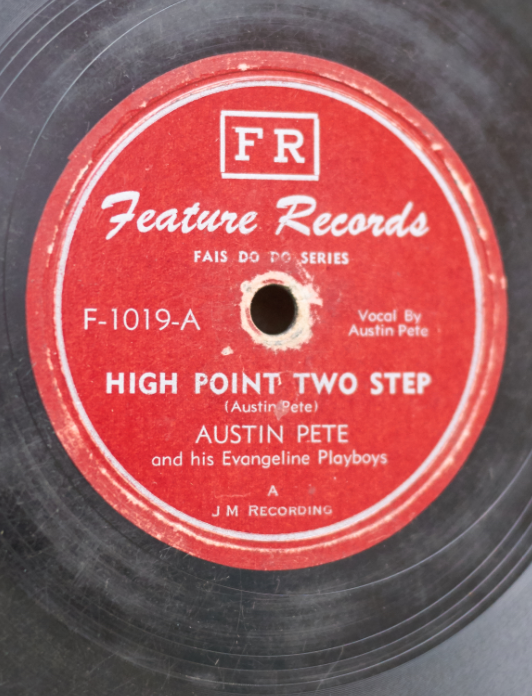
"High Point Two Step" - Austin Pitre

After WWII, other small Cajun labels popped up around south Louisiana. One of these was Fais Do Do records started by Jay Miller in 1946. A year later, he changed it to Feature Records that recorded many people such as Austin Pitre and Aldus Roger. In 1948, Austin would record his first record with Feature called "Evangeline Playboy Special" after the name of his band. 


Hey, mais malheureuse, toi 'tit monde, 
Quoi t'as fait, 'tit monde, avec ton nèg', 
Moi j'connais, c'est toi j'aime tant, tu vas aller,
Avec un autre, malheureuse, que t'aimes pas mieux. 
Hey gardé donc , quoi ta pres faire, 
Avec ton neg  t-monde toi te cannialle, 
Je tout l’temps ici, une jour avenir bébé,
Avant longtemp tu vas venir c’est cera  trops tard. 

Hey mais tout les soir ton vieux neg, 
Garde voir, t-monde tu ma fait mal,
Je tout l’temps dit, tu vas voir pour ton meme,
Tu vas payée pour tout  ça oui mon cher monde.

Pitre would kick off his career on this label with their best known song "Evangeline Playboys Special". On their second record in 1948, they recorded a song called "High Point Two Step" (#1019), named after a community in Evangeline Parish. It was the Cajun version of an old fiddle melody called "Rubber Dolly".  It would become well known after many musicians covered the tune including Mississippi John Hurt, Ray Price, Bill Parsons, and Woody Guthrie.   Other musicians around Louisiana would also cover the tune including a western swing version by Harry Choates in 1947 and a swamp pop version by Johnnie Allan in 1959.

Hey, oh my, my little everything, 

What did you do, my little everything, with your old man.


I know it's you that I love, you went away,

With another, oh my, who doesn't love you more. 


Hey, look at what you've done,

With your old man, little everything, you are mischievous,

I am always here, one day, (you'll) return to me, baby,

Before long, you are going to return, it'll be too late.

Hey, every night, old friend, 
Look here, my everything, you made me hurt,
I always told you, you will see for yourself,
You will pay for that, my dear everything.
Its a lively tune with a sad undercurrent. According to author Blair Kilpatrick, 


"The rhythm makes you want to dance however, the words if you let yourself feel them make you want to cry. A paradox you can't escape." 

Its about someone asking to see his love one more time before he dies.  The melody has a vague similarity to the an older tune by Joe Falcon called "Osson Two Step" recorded in 1929 and Amede Ardoin's "Tortope d'Osrun".   He would use the melody again in his "Janot Special".


  1. Accordion Dreams: A Journey Into Cajun and Creole Music By Blair Kilpatrick
  2. Lyrics by Marc C and Jerry M
Find:
Acadian All Star Special - The Pioneering Cajun Recordings Of J.D. Miller (Bear, 2011)

Wednesday, November 12, 2014

"Pine Grove Blues" - Nathan Abshire

Nathan Abshire had a brief recording stint with Happy Fats before he entered WWII training. However, he would make a much stronger impression on the Cajun music scene after the war, creating his signature song in the process.

In 1948, Clobule and Ernest Thibodeaux asked him to join the Pine Grove Boys, house-band of the Pine Grove Inn.  One day, the club owner, Telesphore Esthay, asked Thibodeaux to find an accordion player for the group. Partly due to Iry LeJeune’s success, the accordion was again popular in Louisiana. Esthay felt the addition of an accordion would be good for business.  According to Jerry Esthay,
The Pine Grove Inn was in Acadia Parish on the way to Evangeline it was across Hwy. 97 from the Evangeline Refinery. My dad, Claude Esthay and grandfather Telesphore Esthay owned it. My dad is the one who went to get Nathan to play. My dad would drive them to other club's to play. They had a little house behind the Pine Grove Inn that the band would stay in.9  

 Upon Thibodeaux’s father’s recommendation—who played fiddle with Amédé Ardoin briefly—he approached Abshire. Abshire said he’d love to start playing music again, but unfortunately he didn’t have an accordion, and he couldn’t afford to buy one. The Pine Grove Boys went into their own pockets and bought a broken single row Sterling accordion for $75. No one locally could repair it, so they drove to Houston (possibly to Mrnustik's shop), where the repairs cost them another $150.7  The group played six out of seven days, alternating between both Quincy Davis’ clubs in Lake Charles, the Crystal Grill and the Broken Mirror in the evening, and on KPLC radio for a daily broadcast in the daytime.  

Eddie Shuler, who worked for the station, but was too busy with the promotion of Iry LeJeune, put them in touch with businessman Virgil Bozman.  Virgil, based in Westlake, Louisiana, signed them on his rising O.T. label, partially funded by George Khoury. Oklahoma Tornadoes was the name of the group formed by Virgil as the studio band for the Opera label run by James Bryant and Bennie Hess, based in Houston, Texas. Their fiddler being Floyd LeBlanc, of Mermentau with whom Nathan had played earlier on, probably put Nathan in touch with Bozman.  


Earl DeMary, Wilson Granger,
Eldrige Guidry, unknown on drums,
Nathan Abshire, and Ernest Thibodeaux
The Pine Grove Boys were playing constantly at the Avalon Club. However, due to disputes between club owner, Quincy Davis, and some of the band members, the band was fired and Davis had replaced them with Earl DeMary's Musical Aces.  Wilson Granger, who was already playing with Earl, recalled:
Quincy Davis fired the whole bunch that was playing with Nathan.  He hired us, because they'd get drunk and want to fight.  So, Quincy Davis, on Saturday nights, he'd give us a quart of whiskey. It was on the house. But then, they'd start wanting to fight.  He said, "From now on, you pay for your whiskey if you want to drink some."8  

It would be DeMary's band in which Nathan would record his signature tune. In May of 1949, Virgel gathered them in KPLC studio, located inside the Majestic Hotel in Lake Charles, to cut 8 tracks; the first of which was the legendary "Pine Grove Blues" for the O.T. label (#102).  His Pine Grove Boys band included Roy Broussard and Ernest Thibodeaux on vocals, Earl DeMary or Ernest Thibodeaux on guitar, Atlas Fruge on lap steel, Jim Baker on bass guitar, Oziet Kegley on drums, and either Will Kegley or Wilson Granger on fiddle.  Based on It would be Nathan's defining song in which he would re-record for several different labels and documentaries throughout the 50s, 60s, and 70s. 

Hé, négresse!

ayoù toi t'as été hier au soir, ma négresse?

("J'ai été au bal, neg")


Hé, négresse!

ayoù toi t'as été hier au soir, ma négresse?

("J'ai été au bal, neg")


T'arriva à c'matin.

Soleil étais après s'lever, ma négresse.


Hé, négresse!

ayoù toi t'as passé hier au soir, ma négresse?
("par la barrière, neg")

Hé, négresse!
ayoù toi t'as passé hier au soir, ma négresse?
("passé la barrière")

T'arriva à c'matin.
Ta robe était toute déchiré. 
("J'ai passé la barrière")
KPLC, located inside the Majestic Hotel

The singer is taking his girlfriend to task for being out all night... inferring that it's with someone else!   The melody was inspired by Amédée Breaux's "Blues du 'Tit Chien" recorded for Vocalion Records in 1934.  (Author John Broven mistakenly states the song was inspired by Columbus Frugé’s "Tite négresse"; a song Fruge never recorded.)  Nathan's 1935 recording "One Step de Lacassine" clearly anticipates the melody. Author Shane Bernard notices lyrical similarities with a much older Creole tune called "Anons au bal Colinda".  There are some similarities with Bob Wills' "Milk Cow Blues" recorded in 1946 and even a loose similarity with "In The Pines", which some have credited as Nathan's source.  The phrases were shouted more than sung by Nathan, cheered by the interjections Ernest Thibodeaux, the same type of calls to his musicians used by Bob Wills in western swing. The accordion is hypnotic – not that it puts you to sleep, of course – and bewitching, relieved by a weft of fiddle and rhythmic guitar, the whole propelled by a powerful double bass.  According to Eddie Shuler, Bozman’ recording methods were very strange.  He recalls:


He kept the pot boiling by selling cowhorns (the famous Longhorns) and it is how he landed in Lake Charles one day. He discovered fast how I managed to get artists recorded by a third person and he decided to follow my steps. He arrived at the station studio, gave a bottle of booze to the sound engineer, asked him to cut an acetate, left with it and got it pressed somewhere else.

Virgel Bozman
Since most Cajun 78s usually reached a pressing figure of 500, it was a big hit, pressing around 3,200 copies of the single on several labels.  Nathan and his Pine Grove Boys were called everywhere to entertain at dances with their two-steps and waltzes. A happy period of his life, which is reflected in his recordings, exuberant voice, tonic accordion and lively band.

Hey, honey!
Where did you go last night, my honey? 
(I went to the dance, my honey)

Hey, honey!
Where did you go last night, my honey?
(I went to the dance, my honey)

When you came back this morning.
The sun was coming up.

Hey, honey!
Where did pass by last night, my honey?
(I passed by the fence, honey)

Hey, honey!
Where did pass by last night, my honey?
(I passed by the fence)

You came back this morning.
Your robe was all torn. 

George noticing Nathan's popularity, persuaded him to move from O.T. to his new label, Lyric, in which he recorded his songs throughout the 1950s.  In 1951, he tried to recreate his success with the recording "Pine Grove Blues #2" on Khoury's label (#611) to no avail.  Abshire never financially benefited from his song's success.  Floyd Soileau recalls: 


Khoury never registered the song but Nathan had recorded it as "Pine Grove Blues" for J.D. Miller. He registered it at BMI, but wasn’t paying Nathan royalties. I told Nathan that if he signed a publishing contract with me, I get him his writer’s royalties. I took him to a notary and he put his X on a contract. I cleared the song with BMI. J. D. contested it, but I had a contract. J.D. claimed his got burned in fire. But Dewey Balfa, who played on the Miller sessions, said nobody signed anything with J. D.”7

The song appears in 1967 for Swallow, in 1970 for a field recording in New York, in 1972 and in 1978 for LaLouisiane.  In 1979, Swallow released an album with the name "Pine Grove Blues". 


  1. South to Louisiana by John Broven
  2. Cajun Breakdown : The Emergence of an American-Made Music By Ryan Andre Brasseaux
  3. All Music Guide to Country: The Definitive Guide to Country Music edited by Vladimir Bogdanov
  4. Swamp Pop: Cajun and Creole Rhythm and Blues By Shane K. Bernard
  5. Encyclopedia of Music in the 20th Century edited by Lol Henderson
  6. http://www.bopping.org/nathan-abshire-pope-of-cajun-accordion/
  7. http://www.offbeat.com/2003/10/01/masters-of-louisiana-music-nathan-abshire/
  8. Wilson Granger interview.  Andrew Brown.  2005.
  9. Discussions with Jerry Esthay.  2019.
  10. Lyrics by 'Ericajun'
Find:
Boppin' Hillbilly 26 (White Label/Collector Records)
Nathan Abshire & the Pine Grove Boys - French Blues (Arhoolie, 1993)
Les Cajuns Best Of 2002 Les Triomphes De La Country Volume 12 (Habana, 2002)
The Beginner's Guide to Cajun Music (Proper/Primo, 2008)
Bayou Two-Step - Cajun Hits From Louisiana 1929-1962 (Jasmine, 2015)

"Mardi Gras Dance" - Aldus Roger

"Lache aller!". Every Mardi Gras in the rural areas of south Louisiana, communities would gather around and chant "La Vielle Chanson de Mardi Gras".  During the event known as the "courir", some of the participants will dance around to the playing of a Cajun accordion, simply known as the Mardi Gras dance. 

Eventually, around 1954, Aldus Roger would record an instrumental version of the song entitled "Mardi Gras Dance" (#2004) for J.D. Miller's Feature Records recorded in Miller's studio in Crowley, Louisiana.  The label focused on recording Cajun music in the region.   Roger's version would be would be a quick tempo, full-sounding instrumental with solos throughout the song.  Unlike the early traditional chant, the "dance" would have a bluesy chord progression with room for different musicians to take lead.  Roger's version of the deeply traditional Mardi Gras Dance went even further, being pepped up to a frenzy by rock'n'roll drumming.
Aldus Roger
Courtesy of Emile Waagenaar
www.emilecajun.com

Known as the "King of the Accordion Players", Aldus would be known for his band The Lafayette Playboys and his Saturday afternoon music broadcast show on KLFY.  His band consisted of a well talented group of musicians including Doc Guidry, Phillip Alleman, Johnny Credeaur, Tunice Abshire, and Fernice Abshire.  He would also record for Quinn's Folkstar label out of Houston and Bob Tanner's T.N.T. label, recorded by Eddie Shuler in Lake Charles.

Rumor has it, it became the unofficial "official" song for the Tit Mamou Mardi Gras run.  Also known as the "Mardi Gras Jig", the melody would find it's way into the 1971 popularized two-step by Nolan Cormier known as the "Hee Haw Breakdown", which would find it's way into a British telecom commercial.  In it, the instrumental and vocal yells refer to the mardi gras participants attempting to hold back the jackasses along the trail... to no avail.


  1. http://www.theguardian.com/news/1999/jun/02/guardianobituaries2
  2. Discussions with Bryan L
Find:
Acadian All Star Special: The Pioneering Cajun Recordings of J.D. Miller (Bear Family, 2011)


Monday, November 10, 2014

"Sundown Playboys Special" - Lionel Cormier

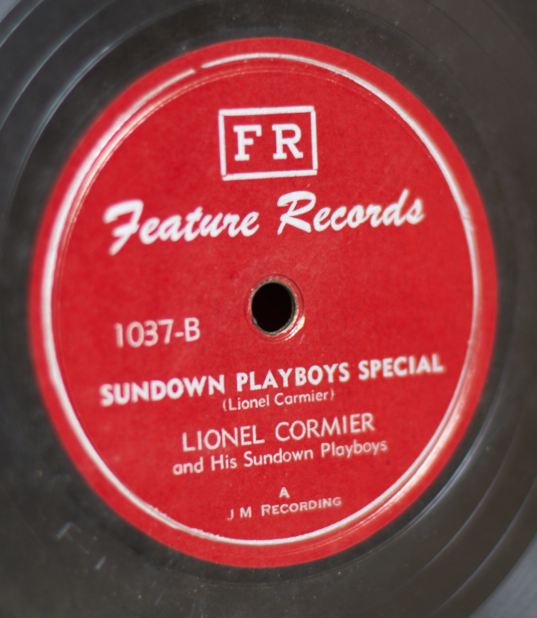
Cajun accordionist Lionel Cormier was one of the founding members of the Sundown Playboys in 1947. Originally called the Elton Playboys after the Louisiana town where Cormier and his family lived at the time, the group recorded for the first time in 1952. The result was a 78 rpm that featured "Sundown Playboys Special" for J.D. Miller's Feature Records (#1037).   Cormier and his bandmates, including Percy Fuselier and Emory LaPoint, went on to record a number of other songs.  The song is an instrumental two-step, named after the band.

He began to join in as an accordionist at house dances and informal family get-togethers when he was 12 years old and moving to Elton, he took work in a sawmill. 
Lionel Cormier

Lionel would also record for Ed Shuler's Goldband Records.  On June 5, 1971, after finishing the song "Church Point Two-Step", Cormier died of a heart attack unexpectedly with his boots on – onstage during a benefit dance at Lake Charles’ Bamboo Club, while taking a break as the emcee made announcements between songs. 


Accordion player Pat Savant eventually joined the band and briefly knew Lionel; having met him only twenty minutes before the veteran played his last Church Point Two-Step. Pat would be known for recording "Saturday Night Special", released by either George Harrison or Ringo Starr of the Beatles on their lablel Apple Records.


  1. South to Louisiana: The Music of the Cajun Bayous By John Broven
  2. Meet The Sundown Playboys By Leslie Berman
  3. http://www.npr.org/templates/story/story.php?storyId=130836815
  4. http://www.allmusic.com/artist/lionel-cormier-and-the-sundown-playboys-mn0001577968/biography
  5. http://library.mcneese.edu/depts/archive/SWLAMusicians/encycloaj.htm
  6. http://www.hechicero.com/louisiana/sundownplayboys.html

Saturday, November 8, 2014

"La Vie De Campagne" - The Arcadians

The Arcadians would be another Cajun-influenced country band recorded on an obscure label called Arcadia Records (not to be confused with Richard Raichelson's label with the same name).  The label focused on country, Cajun, blues, jazz and rockabilly around the New Orleans area and only ran for a short time between 1956 and 1959.  However, in that time frame, they would record Joe Gaines, Earl Williams, and a "story telling Cajun" named Louis Marion Marcotte, Jr. 

Born in Moreauville, Louisiana, Marcotte lived in Gretna, outside New Orleans.  He wrote his first song at 14 and bought his first guitar with money he earned picking cotton.  Marion, along with Art Petivan, wrote the song "La Vie De Compagne (Country Life)" (#112) and sung it with the group Gilroy Jesselin and his Arcadians. 
Raoul avait dit y aura ….. du manger
Et quand il est rev'nu il m'a dit,
Essayons vite donner,
Une brosse à dents, une paire d'caleçons
Et un paquet d’gomme,
Une livre de café vert avec un corset pour sa femme, 
Et des boucles d'oreilles, hey, et une charrue,
Un rat de bois maigre, hey, et du the cru.

Il a dit aille à sa femme, mais, qu’elle aille (a)trap(er) des coton de maïs, 
"Va m’attisoner le feu et faire un gross pain maïs."
Elle a coul(é) une grègue du café fève qu’elle a mis dans les braises. 
Il se roulé un Durham et se l’a accrochée derrière l’oreille. 
He would later end up having a career as a French-language storyteller and comedian, spinning tales about country life on radio stations. One of his characters was "Cousin Pogoyo", delivering a sales pitch for his miraculous new tonic and cough syrup.  He went on to write more than 300 songs and record more than 40 records, some for Swallow and JIN records. He also wrote campaign songs for political candidates and a jingle for "Whataburger."  According to musician Allen Fontenot:
Marion Marcotte


Mr. Marcotte had a following across south Louisiana and was known for his homespun comic style. He was always the life of the party, telling jokes.  A typical Marcotte joke was about a mother-in-law making coffee "so weak, even the pot fainted." 
Information on the label is non-existent however, there lies a curiosity about the name of the band and the name of label being identical.  We do know that it was one of many labels pressed by Monarch Records out of Los Angeles, California. They did a lot of business with small, independent labels but they also did large quantities for the major labels when they had a hot 45 and needed extra copies.
Raoul had said he will want to eat,
And when he returned, he told me that,
Let us quickly get him
A toothbrush, a pair of shorts,
And a pack of gum, 
One pound of unroasted coffee with a corset for his wife, 
And earrings and a plow,
A lean possum and some raw tea.

He said to his wife, well, that she go grab some corncobs,
"Go stir up the fire for me and made a big cornbread loaf",
She brewed up a pot of coffee that she put on the hot coals,
He rolled himself a Durham and hooked it behind his ear.
Also originating from Avoyelles Parish, Bruce Daigrepont in 1987 would use a similar melody for his song "Le Two-Step De Marksville", talking about country life around the town of Marksville, Louisiana; not far from where Marion was from.


  1. South to Louisiana: The Music of the Cajun Bayous By John Broven
  2. http://www.rockabilly.nl/references/messages/hawks.htm
  3. http://home.earthlink.net/~v1tiger/Mostly%20forgotten-1.html
  4. Biography of Louis Marcotte, Jr., Jefferson, Louisiana, Submitted by N.O.V.A. July 2005
  5. http://www.acadianmuseum.com/legends.php?viewID=139
  6. Lyrics by John C, Marc C, Bryan L, and Jerry M

Thursday, November 6, 2014

"Waltz of the Mulberry Limb" - Iry Lejeune

After WWII, small independent labels began popping up all over Texas and Louisiana including one created by Robert E Tanner and his wife Dorris.  Bob originally teamed up with Virgil Bozman after his O.T. label dried up and together, they created the very short lived Hot Rod label in San Antonio, Texas.   After that failed, in 1947, Bob and his wife built a record pressing plant in San Antonio, Texas due to the increasing amount of chicano music in the area. By 1953, they created  T.N.T. ("Tanner 'N' Texas").   

Their primary goal was to record and press more Tex-Mex music eventually including rockabilly, country, blues, jazz, and polka.   In 1953, Ed Shuler used the pressing plant to outsource the production his Iry Lejeune recording of "Waltz of the Mulberry Limb" (#105), better known as "La Branche Du Murier" done in Lake Charles.  The song is a staple of Cajun music. 


Gardez donc, chère 'tite fille,

Tous les dimanches après-midi,

Moi, j'sus là dans ma maison,

Après souffert et m'ennuyer.


Passé dans un tas de chagrin,

Misères que, toi, tu jongle,

Par toi-même que moi j'pourrais,

Passer rapport à toi.


Gardez donc quoi t'as fait,

Coupé la branche de mon mûrier,

Pour te voir passer devant,

Devant la porte chez ton papa.


Garde donc, chère 'tite fille,

Comme moi et ces 'tits enfants

Sont après s'ennuyer de toi

Dans un tas de chagrin.

Tu veux pas revenir...

Allegedly, the song was written by much earlier by Dennis McGee, known as "L'Anse de Belair".8  The story goes that a young girl cut a branch off of a mulberry tree so she could see her fiancé's brother ride by. It was this brother whom she really loved.  Author Ron Yule states that Milton Vanicor and Eddie Shuler both recorded with Iry on the tune.   Erwin Lejeune claims that Iry noticed a mulberry tree out the corner of his eye and decided to make a song about it.    
Joseph Gonzalez, Lillie G.,
 Joe Jr., Bob Tanner


So look, dear lil girl 

Every Sunday afternoon, 

I'm here in my house, 

Miserable and bored. 


Went through a lot of grief, 

What miseries, i've been thinking,

Things about yourself that I could,

Get over you.


Look at what you've done, 

I cut the branch of my mulberry,

To see you pass, 

In front of the door with your dad. 


So look, dear lil girl,

Me and the little children,

Are missing you,

They're in alot of grief.

You do not want to come back ...


During the record labels existence, only two Cajun records were produced there; Iry's by Shuler and Aldus Roger by J.D. Miller.   Even at some point in 1951, Bob used the KCOR radio station to record two of Shuler's Harry Choates records for another label called Allied.

The label also produced religious and children's music.  By 1972, Bob ended up having health problems after having a stroke and his wife managed the business for a while until a studio equipment salesman, Tom Albright, purchased the pressing plant around 1973.  He expanded it to handle all the Tex-Mex music being recorded in San Antonio and surrounding areas.  Many of his artists went on to record for major labels. 

One of the outtakes Shuler had kept of that session would later make it onto a 45RPM as "La Branche Du Murier" (#1103), both on the maroon label and yellow label. As far as Iry is concerned, it wouldn't be the only time Iry would record this tune.  Before his death in 1955, he purchased a recorder so he could record his own tunes.  He was apparently so dissatisfied with his dealing with Eddie Shuler that he decided to make his own recordings, hoping to gain control over production. Although several of these discs were made, this is the only to survive.  It contained four recordings: "Gran Mamou", Perrodin Two Step", Mulberry Branch with Agnus Lejeune Jr singing and a tune by Jimmie Rodgers.9


  1. South to Louisiana: The Music of the Cajun Bayous By John Broven
  2. http://www.tshaonline.org/handbook/online/articles/ebr02
  3. Mojo Hand: The Life and Music of Lightnin' Hopkins By Timothy J. O'Brien
  4. Billboard Magazine, Aug 19, 1972
  5. Billboard Magazine, Aug 25, 1973
  6. Billboard Magazine, Sep 8, 1973
  7. MADE IN LOUISIANA.  VRCD 325.  MARC SAVOY - Accordion. DEWEY BALFA - Fiddle. D. L. MENARD - Guitar.  Liner notes.
  8. Ye Yaille Chere, Traditional Cajun Dance Music by Raymond E. Francois.
  9. "Iry Lejeune: Wailin the Blues Cajun Style" by Ron Yule
Find:
Louisiana Cajun Music Volume 4: From The 30s To The 50s (Old Timey, 1972)
The Legendary Iry LeJeune (Goldband, 1991)
Iry Lejeune: Cajun's Greatest: The Definitive Collection (Ace, 2003)

Tuesday, November 4, 2014

"Le Vieux Soulard Et Sa Femme (The Old Drunkard and His Wife)" - Joe Falcon and Cleoma Breaux

The song "Lafayette" had yet to be released to the public, however, Columbia had the Falcons come to New York. This time, they would record several songs during an August 1928 session, including the tune "Le Vieux Soulard Et Sa Femme (The Old Drunkard and His Wife)" #15301.  Also known as "La Potate Chaude" and "Mon Bon Vieux Marie", it's a Cajun-french version of an old bluegrass, Appalacian folk song usually known under the title "My Good Old Man".


Où c'est qu' t'es parti? oui, mon bon vieux mari

Eoù c'est qu' t'es parti? ce qu'on appelle amour

Eoù c'est qu' t'es parti? oui, mon bon vieux mari

Qui l'est l'meilleur buveur du pays


J'étais parti au café


Oui, mon bon vieux mari

Et quoi t'es partie faire? ce qu'on appelle amour

Et quoi t'es partie faire? oui, mon bon vieux mari

Qui est l'meilleur buveur du pays


J'suis parti m'soûler


Quand t'en reviens? oui, mon bon vieux mari

Et quand t'en reviens? ce qu'on appelle amour

Et quand t'en reviens? oui, mon bon vieux mari

Qui l'est l'meilleur buveur du pays

Oh demain ou an autre jour

Quoi tu veux que je te cuis? oui, mon bon vieux mari
Et quoi tu veux que je te cuis? ce qu'on appelle amour
Et quoi tu veux que je te cuis? oui, mon bon vieux mari
Qui est l'meilleur buveur du pays

Fais moi deux douzaine d'oeufs puis un gallon d'couche couche.

Ca, ça va te tuer, oui, mon bon vieux mari
Ca, ça va te tuer, ce qu'on appelle amour
Ca, ça va te tuer, oui, mon bon vieux mari
Qui est l'meilleur buveur du pays 

Oh mais ça fait pas rien, il faut mourir qua' même

Ou que tu veux que je t'enterrer? oui, mon bon vieux mari
Et ou que tu veux que je t'enterrer? ce qu'on appelle amour
Et ou que tu veux que je t'enterrer? oui, mon bon vieux mari
Qui est l'meilleur buveur du pays

Enterre moi dans le coin de la cheminée
Et temps en temps passé moi une patate chaude !
Advertisement in Baton Rouge, Nov 1928

The song is a comic dialogue sung between a man and a woman. The part of the wife is sung by Cléoma Breaux, who also plays guitar on this recording. The part of the husband is spoken rather than sung, and is performed by Joe Falcon who also plays the accordion. The music is jaunty, as befits a humorous piece. The woman questions her husbands actions and the husband, quick to get away, states an answer after each refrain, hoping to appease her. The wife is depicted as long suffering, but ultimately supportive.   Many versions omit the ghost reference at the end and the lyrics vary from performer to performer. 


Lake Charles American Press
Oct 13, 1928

Eventually, the song becomes better known as "Mon Bon Vieux Mari" and is sung in 1965 by the Hackberry Ramblers and by Menard, Balfa, and Savoy in 1976 for Swallow.


Where are you going? yes, my good old husband

Where are you going? the one that we call love

Where are you going? yes, my good old husband

Who's the best drinker in the land


Well, I am going to the café


My good old husband

And what are you going to do? the one that we call love

And what are you going to do? yes, my good old husband

Who's the best drinker in the land


I am going to get drunk


And when will you return? yes, my good old husband

And when will you return? the one that we call love

And when will you return? yes, my good old husband

Who's the best drinker in the land

Oh, maybe tomorrow or another day

And what do you want me to cook? yes, my good old husband
And what do you want me to cook? the one that we call love
And what do you want me to cook? yes, my good old husband
Who's the best drinker in the land

Make me five dozen eggs  and a gallon of couche couche and

But, that will kill you ! yes, my good old husband
But, that will kill you ! the one that is called love
But, that will kill you ! yes, my good old husband
Who's the best drinker in the land

Oh, it makes no matter, i want to die this way anyway

And, where do you want me to bury you? yes, my good old husband
And, where do you want me to bury you? the one that we call love
And, where do you want me to bury you? yes, my good old husband
Who's the best drinker in the land

Bury me in the corner of the fireplace
And every now and then pass me a hot potatos! 

Cleoma is often considered to be the first important female Cajun musician and was highly influential as both a vocalist and as a guitarist. She was the first woman to be inducted into the Cajun Music Hall of Fame.

The melody would make it's way into a 1948 recording by Harry Choates called "Mari Jole Blon".


  1. http://oldweirdamerica.wordpress.com/2012/12/19/68-le-vieux-soulard-et-sa-femme-by-cleoma-breaux-joseph-falcon/
Find:
Les Cajuns Best Of 2002 Les Triomphes De La Country Volume 12 (Habana, 2002)
Cajun Louisiane 1928-1939 (Fremeaux, 2003)
Cajun Capers: Cajun Music 1928-1954 (Proper, 2005)
The Beginner's Guide to Cajun Music (Primo, 2008)
The Best Of Cajun & Zydeco (Not Now, 2010)
The Perfect Roots & Blues Collection (Sony, 2015)
The Very Best of Cajun: La Stomp Creole, Vol. 1 (Viper, 2016)