A unique window into the world of Cajun music between 1928 and 1965. Compiled histories from websites, books, news articles, liner notes, and interviews. Most come from my personal 78 collection. Also covering Creole, Cajun-Country, and Cajun swing.
In Austin Pitre's later recordings with J.D. Miller, he formed the LA. Rhythmaires and recorded a few tunes, one of them called the "Janot Special" on a vanity label called French "Hits" (#503). It contains elements of Aldus Roger's "Lafayette Two Step" melody and almost a direct copy of his High Point Two Step. The melody has a vague similarity to the an older tune by Joe Falcon called "Osson Two Step" recorded in 1929 and Amede Ardoin's "Tortope d'Osrun".
Hé, comment ça s'fait, jolie,
Tu vien pas a ton neg',
Quand meme un fois avant d'mourir.
J't'aurai voulu bébé t'en r'venir, catin,
Quand même une fois avant d'mourir,
J'te pardonerrai pour tout ça tout m'as fait.
Z’au jour d’hui, bebe, je prend ça dur, malheureuse.
Johnny Janot
The song is possibly an ode to John Remie Janot (better known as Johnny Jano), a radio broadcast DJ at KEUN in Eunice, LA, then at KPAC in Port Arthur, TX and again at KPLC in Lake Charles, LA where he placed rockabilly music in south Louisiana. He worked with, and later married, Lee Parsley as a duo at KLOU. The couple were known as "Mr & Mrs Radio" and were popular around the 1950s and 1960s.
Hey, how did that happen, pretty one,
You won't come to your man,
Even once before dying.
I would have wanted you to come back, pretty doll,
Even if one time before dying,
I would forgive you for all you did.
Today, baby, it's hard on me, unfortunately.
In the 1950s, he changed his name to Johnny Jano and became a rockabilly singer and performer. He also recorded for J. D. Miller in Crowley, LA, releasing his music on Excello Records, and with Eddie Shuler at Goldband Records in Lake Charles. In 1970, Johnny was in the pursuit of a new career as a Cajun/country music singer. In Beaumont, he teamed up with Cajun fiddler Manson Manuel and they formed a band and played the clubs and honky-tonks of southeast Texas. Johnny even opened his own club on Hwy 90, on Beaumont's west side. He performed at Gilley’s in Houston and made several appearances on Mickey Gilley's television show in Houston. He recorded songs such as "I'm Proud To Be A Cajun" and a french version of "A Closer Walk with Thee".
In 1978, he started the Sunday morning radio show called "Cajun Bandstand". With the powerful signal of KLVI Radio, Johnny Jano was a Sunday morning ritual through out bayous of South Louisiana, the plains of Southeast Texas and to piney woods near Lufkin. Johnny was being heard playing Cajun music and serving up "Dark Roast" Community Coffee to friends and listeners who would drop in to visit and chat.
Discussions with Milton Allen Graves
Lyrics by Jerry M and Bryan L
Find: Acadian All Star Special - The Pioneering Cajun Recordings Of J.D. Miller (Bear, 2011)
Leroy "Happy Fats" Leblanc would be J.D. Miller's first band to record on his new label Fais Do Do. It would be only the second studio setup to record in Louisiana and the first studio in Louisiana to focus on Cajun music. During the first session in 1947 in Crowley, they recorded an instrumental song in which they entitled it "Crowley Two Step" (#1020). Sometimes referred to as the "Old Crowley Two Step", it is not to be confused with the Breaux version which was popularized by Aldus Roger 1960s. Once Aldus reworked the Breaux tune, that song was considered the New Crowley Two Step.
Oran "Doc" Guidry
The song contains a swinging ride by a prolific fiddler known as Oran "Doc" Guidry. He had been playing with many bands throughout south Louisiana before the war and teamed up with Leblanc's group in the 30s. The steel guitar in the background is probably either Red Fabacher or Papa Cairo but it's undetermined. Both players worked with Leroy over the years. If you listen to the Hackberry Rambler's "La Breakdown A Pete", you may get a glimpse of the melody's origins. It's got some similarities to the popular song "Dance With A Dolly With A Hole In Her Stocking".1 Even with Happy's name on the record, most give authorship to Doc, given that it was his fiddle that made the song ride. The melody would find it's way into the Walter Mouton song "Scott Playboy's Special".
The Cajuns Songs, Waltzes, and Two Steps. Liner Notes.
Find: Fais Do Do Breakdown - Volume One - The Late 1940's (Flyright, 1986) Acadian All Star Special - The Pioneering Cajun Recordings Of J.D. Miller (Bear, 2011)
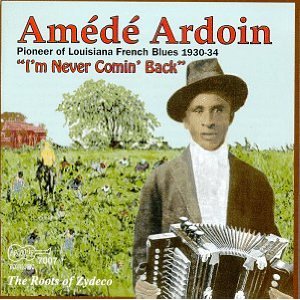
Many Cajuns found greener pastures through opportunities provided by the petroleum industry both across the Sabine and in their own backyards as fields cropped up throughout Acadiana, inspiring Amede Ardoin's 1934 Decca recording "La Valse des Chantiers Pétrolifères (Waltz of the Oil Field)" (#17002). Sometimes listed as simply "Valse Des Chantiers".
O, moi je m'en vas, moi je m'en vas
Moi je m'en vas à la maison moi tout seul
Moi je m'en vas, moi j'après dire
Toi, ouais, tu fais, ô viens donc, me voir.
Pour ça tu me fais moi je m'en va
Moi, j'suis parti à puit d'huile, pour aller au bal,
Pour allerau bal, c'est voir, ô, ouais, les jolies femmes
C'est là-bas il faut tu vas.
O, c'est beau!
O, pour ça tu me fais moi je m'en vas, ouais, à puit d'huile,
Pour moi être capable aller me promener
Je vas au bal pour me voir des jolies femmes
O, c'est là-bas il faut tu vas pour t'amuser.
Toi, tu me fais, toi, ouais, catin,
Moi, j'suis tout seul, mon je m'en vas à puit d'huile,
Je vas jamais encore revenir pour moi,
Je te voir, pour ça toi t'après me faire.
Amede Ardoin
The first oil well in Louisiana was drilled in 1901 in a rice field on the "Mamou Prairie" in the community of Evangeline near Jennings. The owner of the property, Jules Clement, had noticed bubbles rising from a spot in one of his rice fields when it flooded. With the recent discovery in Spindle Top in mind, he conducted an experiment. He stood on an old stovepipe over the bubbles, lit a match and threw it into the pipe. Gas from the bubbles ignited. By the 1930s, the industry had moved from south east Texas towards the Cajun prairies around near places Ardoin would perform. Ardoin's song (sometimes misspelled as "pétrolipères") reflected the socio-economic changes brought to south Louisiana by technological change, as people abandoned farming for more lucrative work in the oilfield. Amede Ardoin appears solo; his accordion being the lone accompaniment on his singularly complex rhythmic song.
Oh I'm going by myself, I'm going,
I am going to my house by myself,
I'm going, I tell you,
You, yeah, oh do come see me.
For what you've done, I will be by myself,
For me, I'm leaving the oil fields and going to the dance,
Going to the dance, to see, oh yeah, pretty women,
You must go there.
O, how beautiful!
Oh, for this is why i'm leaving, yeah, the oil field,
To be able to go for a walk,
I am going to the dance to see the pretty women,
Oh, you must go and have fun.
You, you've made me this way, you, yeah, pretty doll,
By myself, I'm all alone, I'm headed to the oil fields,
I'll never come back,
I'll show you, after all, you've done this.
Jennings Oil Field, 1912
Many more Cajun songs throughout the 30s would hint at the fact in which the industry was affecting the community. Songs about travelling to and from Texas, such as Cleoma Breaux Falcon's "When I Left Home For Texas", Dennis McGee's "Blues de Texas" and "Valse de Puit D'Huile", would underline the importance of the culture adapting.
Find: I'm Never Comin Back: Roots of Zydeco (Arhoolie, 1995) Cajun: Rare & Authentic (JSP, 2008) Mama I'll Be Long Gone: The Complete Recordings of Amede Ardoin (Tompkins Square, 2011)
When discussing the music of south Louisiana, you will hear about several musicians which had their influences come from Cajun music. Lewis Lincoln Davis, better known as Link Davis, was one of those musicians. His music was more of a country sound concentrating on lyrics about Louisiana life. While not exactly Cajun music as most know it, he helped expose the lifestyle of Cajun outside of Louisiana with his western swing style sound. Billed as "Cajun Rock" or "Cajun Blues", his initial start was playing fiddle in Fort Worth in the 1930s. He moved to south-east Texas and worked with many groups. After serving in the Army, in 1944, he joined Cliff Bruner’s Texas Wanderers in Houston playing the tenor sax. By 1945, he moved to Port Arthur and married a Cajun girl and formed The Bluebonnet Playboys.
You played around with every gal in town,
You made me love you and then you let me down,
Now I sit and pine, you're always on my mind,
You broke my heart when you played around.
I put all my trust in you,
I loved you from the start,
I believe you loved me,
Then you up and broke my heart.
I hope you're satisfied since our love has died
Why did you have to go and play around?
My darling how I cried when I found you lied,
You broke my heart when you played around.
I shed a million tears, the nights all seemed like years,
You loved me dear for such a little while,
Our love can never be, wish you were here with me,
You broke my heart when you played around.
I thought maybe you'd be true,
And someday there would be,
A cottage small just built for two,
And someday maybe three.
Now all my hopes are gone, it's hard to carry on,
I guess you'll always be the one I love,
I know there'll never be, another love for me,
You broke my heart when you played around.
Link Davis
Bayou Records was started in the spring of 1953 by record producer Franklin Kort who was originally with the Recorded In Hollywood label. There is some confusion about the record's history. Possibly recorded at the KRIC Radio Station in Beaumont, TX or the Rice Hotel in Houston, it seems Lew Chudd's Imperial label recorded Davis' "You Played Around" (#3001) around 1947 but released it on Bayou Records much later on after the label was absorbed by the company in the summer of 1953. The song contains possibly Clyde Brewer on fiddle, Lee Bell on guitar, possibly Deacon Anderson on steel guitar, Mancel Tierney on piano, Shang Kennedy on bass and Merle Powell on drums. Through his wife’s musical heritage and by working in honky tonks and beer joints around the Piney Woods of south-east Texas and western Louisiana, Link became exposed to, and developed a unique understanding of Cajun music. Steve Poncio, the right man at Macy Lela Henry’s Macy’s label, commented to researcher Ray Topping:
“Sure, I remember Link Davis very well. He was always hanging round looking for work. We used him on some of our sessions.”
By 1949, he moved to Oklahoma City when Harry Choates offered him a job. Link’s ex-wife, Doris Meadows, remembers:
“ Harry Choates sent him a telegram asking him to come back and play with him. He sent the telegram collect, and we were so poor I couldn’t afford to pay for it “.
Step Inn Club, 1985 Image courtesy of Johnnie Allan & the Center for Louisiana Studies, University of Louisiana at Lafayette
They continued to tour in a wide area – Port Arthur one night, Corpus Christi the next, and Pee Wee Calhoun remembered playing with Harry and Link as far away as Kilgore and Odessa, Texas. But most of their shows during this period occurred around Opelousas and Lawtell, where they had regular gigs at the Green Lantern, and the Step Inn Club.
“ Link and Harry would have some lively “ Battles of the fiddle “ with our singer/clarinetist Hub Sutter walking back and forth between them on stage at the Dessau Hall, building up to some pretty wild and frantic finales.”
Eventually, he started working for Huey Meaux during the 1960s and made many sessions in Houston and Pasadena, one of them with Louisiana accordion player, Marc Savoy. Over his career, Davis recorded for many different labels including "D", Al's, Venus, Kool, Paradise, All Boy, Crazy Cajun, Princess, Stoneway, Western, Odle, Goldstar, Starday, OKeh, Columbia, Nucraft, Sarg, and Allstar labels. His contemporaries were Harry Choates, Leo Soileau, Moon Mullican, J.B. Brinkley, Leon Selph and Bob Wills. Bayou folded in 1953 and in the 1970s, Floyd Soileau would create a separate label called Bayou to begin recording zydeco accordionist Clifton Chenier. The label eventually fell away, which soon led to the creation of Maison de Soul Records, which is the first record label dedicated to the soulful, upbeat style of music termed "Zydeco."
During the same recording session in 1929 that Amede Ardoin recorded in New Orleans, a musician named Sydney Landry recorded two songs for Columbia. Also influenced by the blues, Landry's style was a Cajun version of what blues guitarist Jimmie Rodgers was doing. He and Roy Gonzales were imitating this style during this time, recording them as Cajun tunes.
Si tu'm veux pas malheureux, c'est pas la peine tu dit ça,
Si tu’m veux pas malhuerse, c’est pas la peine tu dit ça, Haaa!
Parce que j’ai l’voir du ici et le Lulu garde à toi.
(yodel)
Dit pas quoi te fait, je vas dire pour mon seule, mais chere,
Dit pas ça te fait, je vas t’dit comment je me vu faire, Haaa!
Je soif pour ma bière et mon bon vieux père
(yodel)
Je assis mon tout seul avec mon couer qui fait mal,
Je assis mon tout seul avec mon couer qui fait mal, Haaa!
Je près d’ esperer pour mon couer pour ma femme.
Bien seul moi tout les ans personne vas me voulez voir,
Bien seul moi tout les ans personne vas me voulez voir,
Si la belle veux me voir c’est la seul moi l’amie voir.
The song "La Blouse Française" (#40516), known as "French Blues", is a simple hillbilly song played on guitar, sung in Cajun french, with a couple of instances of vocal yodeling.
If you don't want me unhappy, then don't say that,
If you don't want me unhappy, then don't say that, Haaa!
Because I see you've been here and Lulu's looking at you.
(yodel)
Don't tell me what to do, i'll do it myself, my dear,
Don't tell me what you do. I will tell you how I want to do it, Haaa!
I want my beer and my good old dad.
(yodel)
I am sitting here with my heart that is hurting,
I am sitting here with my heart that is hurting, Haaa!
I'm nearly desperate for the love of my wife.
Although I'm here all year, nobody wants to see me,
Although I'm here all year, nobody wants to see me,
If the beauty wants to see me, it's the only friend i'll see.
Not much is known about Landry since he was one of several musicians that showed up to record during these sessions and then left. Records show it's possible he was born in 1907 and lived in New Iberia, Louisiana but no one knows for sure. However, his music gives us a glimpse of what early Cajun music sounded like during the late 1920s. From what we can tell, he most probably went home to live an obscure life, never to record again.
Encyclopedia of the Blues edited by Edward Komara
Lyrics by Jerry M
Find: Cajun: Rare & Authentic (JSP, 2008) Cajun Music, The Pretty Girls Don't Want Me (Firefly, 2012) Cajun Swamp Stomp, Vol 1 (Lumi, 2012) The Very Best of Cajun: La Stomp Creole, Vol. 1 (Viper, 2016)
During the late 1950s, Cajun music was on a slow decline and rock music was taking over the area. However, it didn't stop Cajun musicians from recording or starting new record labels. Lawrence Walker was one of these who would keep the music alive. Walker would record on Floyd Soileau's VEE-PEE record label, named after the initials of Floyd's hometown of Ville Platte. One of these tunes was "Bon Ton Rouley" (#102).Although the song does not allude to it, Lawrence's band did play often at the Bon Ton Rouley dancehall in Lafayette.
C'est par rapports à ton papa et par rapports à ta maman,
Si moi j'peux p'us t'aimer, mais laissse le bon ton rouler.
J't'ai trouvè dans les grands mêches. j't'ai amené aux "Holly Beach",
Les maringoins sont aprés m'manger, mais laisse le bon temps rouler.
Ton pa pa il est fàcher et ta maman est pas contente,
Les marengoins sont aprés m'manger,
Mais laissse le bon ton rouler.
J't'ai trouvér dans les grande mêches, j't'ai amené aux "Hackberry",
Les maringoins sont aprés m'manger, mais laisse le bon temps rouler.
Ton papa aprés river, moi l'entende su' la galerie,
Ta mamam aprés quereller, les enfants sont aprés pleurer,
Les vaches sont pas tirés et les "gaimes" sont aprés chanter,
Les maringoins aprés m'manger, mais laisse le bon temps rouler.
Lawrence Walker
The Cajun word "gaime" refers to a rooster. The song's also listed as "Les bons temps rouler". The song is about a set of parents not allowing their young girl to be courted by a probably much older man. Even though he traveled with her to the towns of Holly Beach and Hackberry, completely bitten by mosquitoes in the marshy countryside, he shrugs if off saying "Let the good times roll". Floyd started his record label, Big Mamou Records, with the help of local bar owner, Ed Manuel. After this early attempt at recording, Lawrence Walker would record on Floyd Soileau's VEE-PEE record label, named after the initials of Floyd's hometown of Ville Platte. According to Floyd Soileau:
Then the late Lawrence Walker came in one day and says, 'I know you got a record company started, you making records. I did four sides at the radio station in Eunice and I'd like for you to release them. One of them, "Bon Ton Rouley," is going to be a real hit, I know--they're all good, but this particular one I've got a lot of hope for'"1
Lawrence had just invited Johnny Allan to play with his group, The Wandering Aces. They had traveled to Eunice in 1958 to record at KEUN radio station. There, they laid down two songs, "Bon Ton Rouley" and "Osson Two Step". Johnny Allan recalls:
After the radio station would go off the air at night, around seven or eight o’clock, they allowed us to use the microphones and the equipment and we recorded in the radio station. I was playing steel guitar at the time. I think I have a copy of that record, "Bon Ton Rouley" and the other side is the "Ossun Two-Step". On the VP label.
Floyd Soileau
After some bargaining, Floyd purchased the two sides from Lawrence for sixty dollars with a forty dollar option on another two if the first single was a success. But Floyd's partner, Ed, was no longer interested in the recording business; he had obtained the publicity he needed for his clubs. Soileau recalls:
So I changed the label to VEE PEE records c/o Floyd's Record Shop, and that issue was 'Bon Ton Rouley' and we used a 102 number on that because that was the second record release we had. It started selling very well. It got me in touch with some more operators and music stores. In fact, we got a good relationship built up as a result of this.1
Rock music influence would take over and Johnny Allan would leave Walker's group to start recording music for this new musical style; creating some of the first Louisiana rock and pop songs. Floyd's follow up artist would be Aldus Roger and then later Adam Hebert. By 1958, Floyd would focus on swamp pop, rock, and blues on his JIN label, named after his soon-to-be wife Jinver. At the same time, Floyd created his Swallow label for all Cajun music recordings; a play on the pronunciation of his name.
It's because of your dad and mom,
I'm not allowed to love you, well, let the good times roll.
I found you in the big marshy area. I brought you to Holly Beach,
The mosquitoes are eating me up, well, let the good times roll.
Your father is angry and your mom is not happy,
The mosquitoes are eating me up, well, let the good times roll.
I found you in the big marshy area. I brought you to Hackberry,
The mosquitoes are eating me up, well, let the good times roll.
Your dad is arriving, I hear him on the porch,
Your mom is quarreling, the children are crying,
The cows are not drawn in and the roosters are crowing,
The mosquitoes are eating me up, well, let the good times roll.
Crowley Daily Signal July 6, 1961
By 1961, Walker himself would succumb to the rock n roll fever sweeping the area by releasing songs such as "Lena Mae", "Allons Rock And Roll" and "Let's Do The Cajun Twist". But by then, Johnny's career was taking off and he convinced many of Lawrence's band to change their name to the Rhythm Rockers (soon renamed the Krazy Kats). A change of instruments accompanied the group's reorganization. Allan gave up steel guitar to sing and play rhythm guitar, rhythm guitarist Al Foreman switched to electric lead, fiddler U.J. Meaux switched to the piano and while Bhuel Hoffpauir remained on drums, the group hired Leroy Castille on sax. Johnny recalls:
The one we got in trouble with was the Big Oaks Club in Vinton. [Walker] found out that we had booked a rock and roll gig for the Friday night and we were playing there on the Saturday. So going back on Saturday, he was extremely perturbed about all of this. He said we could not do this. So U.J. Meaux, who was the fiddle player and who was playing keyboards in the rock and roll band said, "Well, if you don't like that, we all quit".
After being kicked out, Walker laments:
"So that's what happens when you put an old horse out to grass."
After making some of the first Cajun recordings in the late 1920s, Amidie Breaux (also spelled Amedie and Amedee) would return to the recording studio, after a 13 year absence, with a different group called The Acadian Aces for J.D Miller's Feature label. Legend has it that Breaux's sister, Cleoma, had written the lyrics to this old tune back in 1929 and with Amidie's brothers, they recorded the tune as "Ma Blonde Est Partie" for Okeh/Columbia.
Jolie blonde ! Tu m'as quitté pour t'en aller.
T'en aller, petite avec un autre.
Avec un autre oui que moi, malheureuse chère !
Quel espoir quel avenir, moi je peux avoir ?
Jolie blonde ! Tu m'as quitté pour t'en aller.
T'en aller, de ta famille.
Tu connais, t'as pas écouté tous les conseils de les autres.
Quel avenir avec moi aujourd'hui ?
Jolie Blonde ! Tu connais il y avait juste toi.
Y a pas juste toi dans le pays que moi j'aimais.
J'ai trouvé chez une autre que tes bras.
Oh je sais, babe moi j'aime ça !
Amidie Breaux
Miller was inspired by this early success, and when his family settled in Crowley in 1937, Miller began to play professionally in local groups. He played his first dance with the Breaux Brothers who were playing at the Cow Island nightclub that lacked an electrified sound system. Although the group was billed as "string" band, Miller recalls that it featured traditional Cajun musicians. He recalls:
"I'd never seen an accordion before. When [Amidie Breaux] pulled that thing out of the box, I didn't know what I'd gotten into!"2,3
With Harry Choate's "Jole Blon" in 1947, a revival of Breaux's earlier recording, Miller remembered Breaux's popularity among local folk from his early recordings with the accordion. As the surge of accordion tunes became popular again, Miller realized he could market Breaux's music again, this time with a much fuller band and backed up by a lap steel guitar. He brought the aging Breaux into the studio around 1950 and recorded "Jole Blonde" for his Feature label (#1023).
Crowley Daily Signal Aug 28, 1959
Pretty blonde! You left me and went away,
You went away, little girl, with another,
With another that I'm so unhappy, dear,
What hope, what future, I can have?
Pretty blonde! You left me and went away,
You went away, to your family,
You know, you have not listened to all the advice of others,
What does the future hold for me this day?
Pretty Blonde! You know, it was just you, however,
You're not the only one I love in this countryside,
I found another one's arms, other than yours,
Oh I know, babe, I love that!
The tune was much closer in similarity to Choate's modern version and Breaux was determined to capture the wider audience that fell in love with the song. Miller's recordings of Breaux are the one of the last recordings of the early Cajun musical accordion players.
Acadian All Star Special - The Pioneering Cajun Recordings Of J.D. Miller


 In 1978, he started the Sunday morning radio show called "Cajun Bandstand". With the powerful signal of KLVI Radio, Johnny Jano was a Sunday morning ritual through out bayous of South Louisiana, the plains of Southeast Texas and to piney woods near Lufkin. Johnny was being heard playing Cajun music and serving up "Dark Roast" Community Coffee to friends and listeners who would drop in to visit and chat.