A unique window into the world of Cajun music between 1928 and 1965. Compiled histories from websites, books, news articles, liner notes, and interviews. Most come from my personal 78 collection. Also covering Creole, Cajun-Country, and Cajun swing.
In 1936, with record sales holding up after the end of the Depression slump, the Victor mobile recording unit under the direction of Eli Oberstein visited New Orleans to record local hillbilly, blues and Cajun artists. In what was one of the last major field trips, mammoth sessions were held at the St. Charles Hotel, with more than twenty five titles recorded each day. The ensuing 78s were eventually released on Bluebird, Victor's subsidiary budget label, at a cost of thirty-five cents per copy. The early 2000 series had been set aside for it's Cajun artists.
Te m’a quitte chere jolie blonde,
T’on aller avis d’un autre,
Comment tu crois mon j’peu faire,
Mon tout seule à m’a maison?
Tu m’a promise ta vieux neg,
Avis tourner un jour avenir.
Eli Oberstein
In 1936, both the Hackberry Ramblers and the Merrymakers would enter the Bluebird makeshift studio in New Orleans on the same day. Both would be the first use the title "Jolie Blonde" however, the Hackberry Ramblers used the melody of "Ma Blonde Est Partie". The song would forever be known as by this name. J.B. Fuselier and Miller's Merrymakers used a different melody for their version called "Te Ma Lessa Jolie Blonde" (#2006) however, the theme of a "pretty blonde leaving" ties the songs together. The rest of the session would be filled up with Cajun songs from both groups, adding to the dozens recorded between 1936 and 1938. This is an older song, a heavy waltz with a beat that is slow and almost majestic. The vocal phrasing closely follows the fiddle in its extended tones, and the two alternate regularly through-out the song.
You left me, dear pretty blonde,
You've gone away, I've noticed, with another,
How do think I'll manage,
All alone in my house?
You promised me, your old man,
You'll come around in the future.
Miller used the phrase "te ma lessa jolie blond" (loosely translated to "you're my little pretty blonde") while the Ramblers chose to shorten the name to simply "jolie blonde". Beethoven Miller would eventually relieve himself from the group with J.B. Fuselier taking over command. Once in control, the group would go one to become one of the 1930s most successful string-band recording groups, laying down songs such as "Chere Tout Tout" and "Ma Chere Bassett".
South to Louisiana: The Music of the Cajun Bayous By John Broven
Liner notes. The Cajuns: Songs, Waltzes, and Two-Steps.
Lyrics by Jerry M
Find: The Cajuns: Songs, Waltzes, and Two-Steps (Smithsonian Folkways, 2004)
After Joe Falcon's success with music in the 1930s, one of his nieces, Marie Solange Falcon, (who is featured in the Les Blank film "French Dance Tonight") took up the guitar and with Clopha "Shuk" Richard, formed the L.A. Aces in the 1950s. They had a short career playing dancehalls around the area and recorded two records for George Khoury's label. One of those songs was the "Madame Entelle Two Step" using an old melody which would later become "Les Flammes d'Enfer", "Petite ou la Grosse", "Donnez Moi La", and "Madame Edouard".
Madame Entelle donnez-moi les,
Tout quell qui chose est tout le même prix,
Madame Entelle donnez-moi les,
Tout quell qui chose est tout le même prix.
Adieu Rosa, yaille, comment ça se fait, chère,
Quoi toi tu m' fais ? 'garde donc quoi tu m'fais.
Adieu Rosa, yaille, Comment ça se fait, 'tite fille.
Quoi tu m' fais ? 'garde donc toi t'après m'faire.
Madame Entelle donnez-moi les,
Tout quell qui chose est tout le même prix,
Madame Entelle donnez-moi les,
Tout quell qui chose est tout le même prix.
Hey, mais moi j'aime ça, chère,
Viens me voir mais m'en aller.
Plus personne mais pour m'aimer,
Plus personne m'appeler le sien.
Madame Entelle donnez-moi les,
Petite ou grosse c'est tout le même prix.
Eddie Richard, Jay Dartez, Shuk Richard on accordion, Marie Solange Falcon on guitar, Jack Brock (MC)
The song has a raucous, accordion driven sound, similar to much of the sound Khoury had on other recordings he produced. Even Marie's voice comes across as a series of yells rather than sung. Marie's song is the post-war version of the old Creole song called "Adieu Rosa" that Joe Falcon used to create his "Arcadian One Step". The song has a alternate take on the song "Madame Sostene" in which a lover is asking for one of the mother's daughers. In this case, either daughter, the big one or the small one, will do.
Mrs. Entelle, give one to me,
Any of them are the same to me,
Mrs. Entelle, give one to me,
Any of them are the same to me,
Farewell Rosa, yaille, how come you do this, dear?
What are you doing? Look at what you've done.
Farewell Rosa, yaille, how come you do this, little girl?
Do you know what you've done? Look at what you've done.
Mrs. Entelle, give one to me,
Any of them are the same to me,
Mrs. Entelle, give one to me,
Any of them are the same to me,
Hey, I love ya, dear,
Come see me, because I have to leave,
I have no one to love me,
No one calls me their own,
Mrs. Entelle, give one to me,
The big one or the small one, it's all the same.
Discussions with Neal P
Lyrics by Jerry M and Marc C
Release Info: -A Madame Entelle Two Step | Khoury's KH-622-A -B Chere Vere Naig | Khoury's KH-622-B Find: Cajun Music - The Early 50s (Arhoolie, 1969)
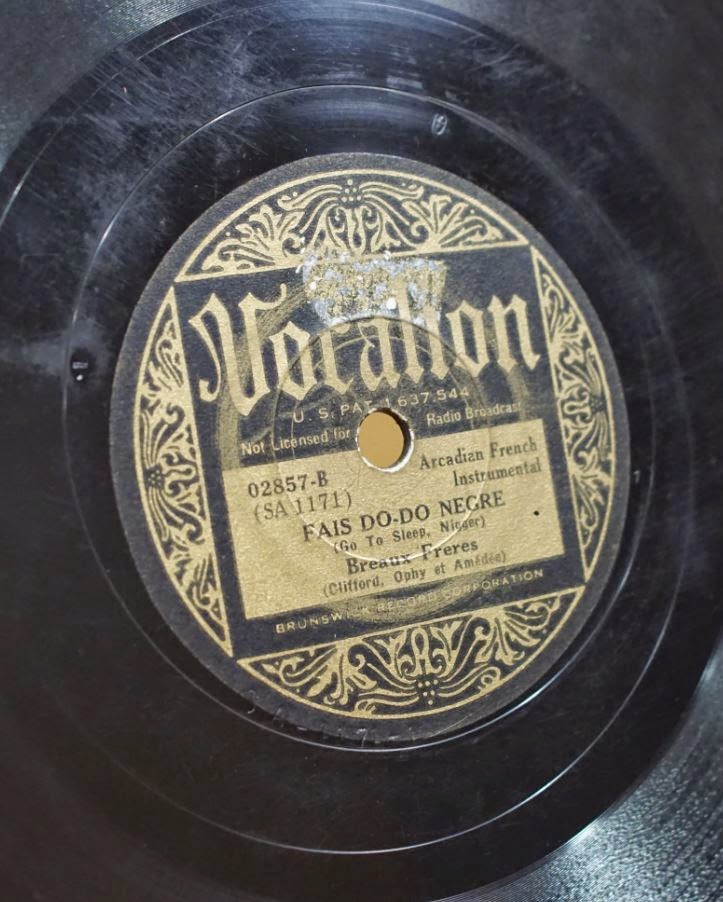
Once the Breaux brothers (listed as Breaux Freres) showed the recording industry the type of success they could generate by recording "Ma Blonde Est Partie" in 1929 for Columbia, the Vocalion label had them come to San Antonio in 1934 for a marathon recording session. There without Cleoma, they laid down many tracks which would become standards in years following. One of the tunes they recorded in October that year was "Fais Do Do Negre" (#2857) with Ophy Breaux on fiddle, Amadie Breaux on accordion and vocals, and Clifford Breaux on guitar.
Fais do-do, fais do-do mon nègre,
Dans les bras de ta chère vieille maman.
Va donc là-bas, réveille toi,
C’est l’heure d’aller à l’ouvrage.
Hey, vaurien !
Pour la cause tu connais (?)
‘Tit nègre mais chère maman
Réveille-toi, bon matin,
C’est l’heure d’aller à l’ouvrage.
Fais do-do ‘tit nègre,
Dans la bras d’ta mam,
Fais do-do, ‘tit nègre,
Réveille-toi.
Hey, hey.
Réveille-toi ils disent.
The song is a fast paced waltz, casually asking a little boy to sleep in his mother's arms followed by waking him up to go to work. It's one of the earliest Cajun songs to have developed in the prairies. It became one of the most favorite waltzes during the 1920s outside of "Jolie Blonde" and "Allons A Lafayette".3 Fais do-do is also a name for a Cajun dance party, originating before World War II. According to Mark Humphrey, the parties were named for "the gentle command (‘go to sleep’) young mothers offered bawling infants.” He quotes early Cajun musician Edwin Duhon of the Hackberry Ramblers,
“She’d go to the cry room, give the baby a nipple and say, ‘Fais do-do.’ She’d want the baby to go to sleep fast, ’cause she’s worried about her husband dancing with somebody else out there.”
Do-do itself is a shortening of the French verb dormir (to sleep), used primarily in speaking to small children. Comparable to the American English ‘”beddy-bye”, it is still commonly used by French-speaking people. According to author Stivale, "neg" and "negresse" are corrupted forms of the word "negre" which in Cajun french has an endearing meaning such as "hey, my man" or "hey, honey", completely void of racial tones.
"La Valse Du Pont d'Amour"! This tune would be Iry Lejeune's first recording and propel the accordion into Cajun music for good after WWII. Although history follows Iry's adventures and career with Eddie Shuler, his music didn't start with Shuler's label. His first recording would not be for Shuler but for a group of Texans, recording his first tune entitled "Love Bridge Waltz" (#105). Recorded for the Opera label in 1948 but probably released in 1949, it was based on a melody by Delin Guilory and fiddler Lewis Lafleur entitled "Alone At Home" recorded in 1929 for Victor but released in 1940. Benny Hess' recording of the Iry LeJeune’s “Love Bridge Waltz” resulted in the first good selling Cajun accordion record since the latter days of the 20s. It all began with Bennie Hess and Bill Quinn. Orville "Bennie" Hess had first started in the record business as one of Bill Quinn’s partners in the Gulf label in late 1944 or early 1945 before Quinn went out to greater success with his own Gold Star label. Some evidence exists that Hess may have been in partnership with engineer/producer Bill Quinn in launching it however it's not clear who helped him. According to Andrew Brown, Frank Sanborn and Hess were the original partners. However, he suggests W.Kendall Baker may have been involved rather than Hess. According to musicologist Paul Oliver, Vernon Woodworth, known as Woody Vernon, was his only business partner at the time.
Bennie Hess
Quinn's Gulf label issued records artists such as Woody Vernon (which may also be listed as Tex Moon), Jerry Irby, and Jesse Lockett and his Orchestra. The label only lasted a year. He struggled to get artists since Quinn had no pressing equipment. Quinn started his new Gold Star label and Hess parted ways.
Around this time period, however, Hess was apparently playing on KRLP radio’s Cornbread Matinee in Dallas. In 1947 he traveled to California and signed a contract with the Black & White label. His release, “Someday You’ll Know”/“You Just Won’t Do,” apparently earned him roles as a singing cowboy in some B-movie Westerns. The union recording ban took effect in 1948, forcing many labels to close down. However unconcerned by the union, Hess recorded a string of releases during this year ending up becoming his busiest period. The 1948 recording ban actually benefited him as did the resurgence of interest in French Cajun Music in the area of South Louisiana.
Hess, along with James Bryant, formed Opera and put out a series of fine fiddle Cajun records by Floyd LeBlanc and Charlie Broussard and achieved the distribution to get the records out there to Cajun homes and juke boxes. Probably because he was still under contract to Black & White Records, Hess released his first record on Opera under the name of Georgie Harrison with the Nation's Play Boys in 1948. Floyd, along with Bennie Hess, at some point formed a band called the Oklahoma Tornadoes with friend Virgil Bozman. The next influencial people to make an impact on this recording was Floyd Leblanc and Virgel Bozman. John Harvey "Virgel" Bozman was a rustic singer/guitarist and part-time comedian who sometimes billed himself, with tongue-in-cheek, as "The Arkansas Sinatra". He had apparently been a staple on the San Antonio music scene for some time and he awas in Houston recording for Bill Quinn by the end of 1945. While stationed at a San Antonio military base near the end of WWII, Floyd Leblanc befriended Bozman.
Iry with the Oklahoma Tornadoes Floyd Leblanc, Iry Lejeune, Ben Oldeg, Bennie Hess and Virgil Bozman
Iry happened to meet Virgil Bozman and Floyd Leblanc who played with the Oklahoma Tornadoes after that band's performance in Evangeline. The band was playing an engagement at the Pine Grove Club when Lejeune showed up unannounced to st in with his buddies. The Tornadoes were about to travel to Houston to record for Hess' Opera label and Iry asked Floyd to let him come along. Floyd, in return, asked Hess and Bryant if Iry could join them. Both label producers had witnessed first hand at the success of Choates' "Jole Blon" and recognized Lejeune's talent on the accordion in order to tap the lucrative Cajun music market. That year, in 1948, Iry would join them in the studio to make his first recording, and change his life forever.
He, 'tite fille, moi, je me vois, après, oui,
Partir mais m'en aller donc, si loin,
Oh, chere 'tite fille, quand-même tu voudrais t'en rev'nir ,
'Tit monde, 'garde donc, je veux plus de toi.
He, tu m'as dit, 'tite fille, criminelle,
'Tite tete noire, tu voulais plus m'aimer, malheureuse,
Tu connais, 'tite fille, que moi, j'ai pris ca dur,
Pris ca z-assez dur que moi j'ai pris le grands chemins.
Oublie, voir pas les conseils que t'as ecoutes,
C'est la que tu m'as dit que moi je pouvais plus aller te voir.
Oh, mon 'tit monde, moi je peux pas oublier ,
Les paroles tu m'as dit, et moi, je connais tu vas brailler.
Mike Leadbitter recalls:
His recording of Love Bridge Waltz was the turning point in his life and in French music. It was a strong seller at a time when accordion driven music had fallen out of style in favor of the fiddle. and for the first time in 10 years the accordion wailed from jukeboxes in Cajun country.
Iry Lejeune
It's a simple medium tempo number, one of the first accordion records in the era's dancehall style, made special by the desperately earnest quality in a voice steeped in loneliness and the squeezebox evoking generations of Acadian tradition. Author Kevin Fontenot explains the "dancehall" sound:
[It consists of] a driving, swinging accordion, accompanied by the fiddle, drums, guitar, and a "crying" steel guitar. The music was amplified to cut through the noise of the dancehall.
He, lil girl, afterwards I saw myself,
Leaving to go far away,
Oh, dear lil girl, anyway you want to come back,
Look, my all in all, I want more of you.
Hey, you told me, lil girl, criminal,
Lil brunette, you wanted to love me, unhappy,
You know, lil girl, I'm driving,
Taking this hard, I'm driving the big roads.
I've not forgotten the advice you've told me,
That's where you told me that I should not go to see you,
Oh, my all in all, I can not forget,
The words you said to me, and I know you'll scream.
"Love Bridge Waltz" has been dated to 1948 in most writings, however, surviving paperwork from the Opera label challenges this date. An artist's contract with Floyd Leblanc survives, dated May 3, 1947. Leblanc plays fiddle on Lejeune's record and Leblanc's debut release was just two numbers after 105. Another Opera artist, Charlie Broussard, is dated March 15, 1947. Therefore, it's most probable, Iry's song was recorded in the summer of 1947. Iry didn't stay with Opera for long. In a sense a victim of his own success, Virgel Bozman had by 1949 signed up Floyd LeBlanc for his new OT label while Eddie Shuler at the same time created a Folk Star label for the express purpose of recording Iry LeJeune.Shuler, owner of GoldBand and Folk-Star stated:
[Iry] had recorded one record for Opera and nobody could get the records. Him and a fiddle player, Floyd Leblanc, jumped in the car and decided to go to Houston and make a record. And Iry had all these people wanting his record, and nobody could ... buy it, because Opera didn't have any money or something. I don't know what their problem was but, you couldn't get the records.
Iry and I had a radio show on KPLC radio and Iry wanted to make another recording. I said "Well, I tell you what. I'll make one record, and if it's a success, me and you are in business, and if it doesn't, we are out!" And we shook hands.
According to Ron Yule, Lejeune's recordings on the Opera label in Houston and those at Goldband Studios in Lake Charles remain a source of study for accordion students today. Opera made no apparent effort to develop new artists, instead becoming purely an outlet for Bennie’s own releases, which become increasingly scarce after his Mercury firing. There was one exception with fiddler C. F. Pevoto at # 1021 before the label ended with its final Hess release.
Encyclopedia of Great Popular Song Recordings, Volume 2 By Steve Sullivan
In Austin Pitre's later recordings with J.D. Miller, he formed the LA. Rhythmaires and recorded a few tunes, one of them called the "Janot Special" on a vanity label called French "Hits" (#503). It contains elements of Aldus Roger's "Lafayette Two Step" melody and almost a direct copy of his High Point Two Step. The melody has a vague similarity to the an older tune by Joe Falcon called "Osson Two Step" recorded in 1929 and Amede Ardoin's "Tortope d'Osrun".
Hé, comment ça s'fait, jolie,
Tu vien pas a ton neg',
Quand meme un fois avant d'mourir.
J't'aurai voulu bébé t'en r'venir, catin,
Quand même une fois avant d'mourir,
J'te pardonerrai pour tout ça tout m'as fait.
Z’au jour d’hui, bebe, je prend ça dur, malheureuse.
Johnny Janot
The song is possibly an ode to John Remie Janot (better known as Johnny Jano), a radio broadcast DJ at KEUN in Eunice, LA, then at KPAC in Port Arthur, TX and again at KPLC in Lake Charles, LA where he placed rockabilly music in south Louisiana. He worked with, and later married, Lee Parsley as a duo at KLOU. The couple were known as "Mr & Mrs Radio" and were popular around the 1950s and 1960s.
Hey, how did that happen, pretty one,
You won't come to your man,
Even once before dying.
I would have wanted you to come back, pretty doll,
Even if one time before dying,
I would forgive you for all you did.
Today, baby, it's hard on me, unfortunately.
In the 1950s, he changed his name to Johnny Jano and became a rockabilly singer and performer. He also recorded for J. D. Miller in Crowley, LA, releasing his music on Excello Records, and with Eddie Shuler at Goldband Records in Lake Charles. In 1970, Johnny was in the pursuit of a new career as a Cajun/country music singer. In Beaumont, he teamed up with Cajun fiddler Manson Manuel and they formed a band and played the clubs and honky-tonks of southeast Texas. Johnny even opened his own club on Hwy 90, on Beaumont's west side. He performed at Gilley’s in Houston and made several appearances on Mickey Gilley's television show in Houston. He recorded songs such as "I'm Proud To Be A Cajun" and a french version of "A Closer Walk with Thee".
In 1978, he started the Sunday morning radio show called "Cajun Bandstand". With the powerful signal of KLVI Radio, Johnny Jano was a Sunday morning ritual through out bayous of South Louisiana, the plains of Southeast Texas and to piney woods near Lufkin. Johnny was being heard playing Cajun music and serving up "Dark Roast" Community Coffee to friends and listeners who would drop in to visit and chat.
Discussions with Milton Allen Graves
Lyrics by Jerry M and Bryan L
Find: Acadian All Star Special - The Pioneering Cajun Recordings Of J.D. Miller (Bear, 2011)
Leroy "Happy Fats" Leblanc would be J.D. Miller's first band to record on his new label Fais Do Do. It would be only the second studio setup to record in Louisiana and the first studio in Louisiana to focus on Cajun music. During the first session in 1947 in Crowley, they recorded an instrumental song in which they entitled it "Crowley Two Step" (#1020). Sometimes referred to as the "Old Crowley Two Step", it is not to be confused with the Breaux version which was popularized by Aldus Roger 1960s. Once Aldus reworked the Breaux tune, that song was considered the New Crowley Two Step.
Oran "Doc" Guidry
The song contains a swinging ride by a prolific fiddler known as Oran "Doc" Guidry. He had been playing with many bands throughout south Louisiana before the war and teamed up with Leblanc's group in the 30s. The steel guitar in the background is probably either Red Fabacher or Papa Cairo but it's undetermined. Both players worked with Leroy over the years. If you listen to the Hackberry Rambler's "La Breakdown A Pete", you may get a glimpse of the melody's origins. It's got some similarities to the popular song "Dance With A Dolly With A Hole In Her Stocking".1 Even with Happy's name on the record, most give authorship to Doc, given that it was his fiddle that made the song ride. The melody would find it's way into the Walter Mouton song "Scott Playboy's Special".
The Cajuns Songs, Waltzes, and Two Steps. Liner Notes.
Find: Fais Do Do Breakdown - Volume One - The Late 1940's (Flyright, 1986) Acadian All Star Special - The Pioneering Cajun Recordings Of J.D. Miller (Bear, 2011)
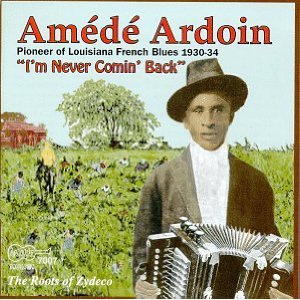
Many Cajuns found greener pastures through opportunities provided by the petroleum industry both across the Sabine and in their own backyards as fields cropped up throughout Acadiana, inspiring Amede Ardoin's 1934 Decca recording "La Valse des Chantiers Pétrolifères (Waltz of the Oil Field)" (#17002). Sometimes listed as simply "Valse Des Chantiers".
O, moi je m'en vas, moi je m'en vas
Moi je m'en vas à la maison moi tout seul
Moi je m'en vas, moi j'après dire
Toi, ouais, tu fais, ô viens donc, me voir.
Pour ça tu me fais moi je m'en va
Moi, j'suis parti à puit d'huile, pour aller au bal,
Pour allerau bal, c'est voir, ô, ouais, les jolies femmes
C'est là-bas il faut tu vas.
O, c'est beau!
O, pour ça tu me fais moi je m'en vas, ouais, à puit d'huile,
Pour moi être capable aller me promener
Je vas au bal pour me voir des jolies femmes
O, c'est là-bas il faut tu vas pour t'amuser.
Toi, tu me fais, toi, ouais, catin,
Moi, j'suis tout seul, mon je m'en vas à puit d'huile,
Je vas jamais encore revenir pour moi,
Je te voir, pour ça toi t'après me faire.
Amede Ardoin
The first oil well in Louisiana was drilled in 1901 in a rice field on the "Mamou Prairie" in the community of Evangeline near Jennings. The owner of the property, Jules Clement, had noticed bubbles rising from a spot in one of his rice fields when it flooded. With the recent discovery in Spindle Top in mind, he conducted an experiment. He stood on an old stovepipe over the bubbles, lit a match and threw it into the pipe. Gas from the bubbles ignited. By the 1930s, the industry had moved from south east Texas towards the Cajun prairies around near places Ardoin would perform. Ardoin's song (sometimes misspelled as "pétrolipères") reflected the socio-economic changes brought to south Louisiana by technological change, as people abandoned farming for more lucrative work in the oilfield. Amede Ardoin appears solo; his accordion being the lone accompaniment on his singularly complex rhythmic song.
Oh I'm going by myself, I'm going,
I am going to my house by myself,
I'm going, I tell you,
You, yeah, oh do come see me.
For what you've done, I will be by myself,
For me, I'm leaving the oil fields and going to the dance,
Going to the dance, to see, oh yeah, pretty women,
You must go there.
O, how beautiful!
Oh, for this is why i'm leaving, yeah, the oil field,
To be able to go for a walk,
I am going to the dance to see the pretty women,
Oh, you must go and have fun.
You, you've made me this way, you, yeah, pretty doll,
By myself, I'm all alone, I'm headed to the oil fields,
I'll never come back,
I'll show you, after all, you've done this.
Jennings Oil Field, 1912
Many more Cajun songs throughout the 30s would hint at the fact in which the industry was affecting the community. Songs about travelling to and from Texas, such as Cleoma Breaux Falcon's "When I Left Home For Texas", Dennis McGee's "Blues de Texas" and "Valse de Puit D'Huile", would underline the importance of the culture adapting.
Find: I'm Never Comin Back: Roots of Zydeco (Arhoolie, 1995) Cajun: Rare & Authentic (JSP, 2008) Mama I'll Be Long Gone: The Complete Recordings of Amede Ardoin (Tompkins Square, 2011)