If you like this information, there's no book that you can buy that contains it all. Instead of publishing this, I decided to create a volume of articles.
I decided to move 10 songs into the first volume on PDF. Feel free to share, store, email, and print the material as you wish. Over time, as information is added or corrected, I will update the version and keep the most current version located on this site.
Download Early Cajun Music, Volume 1
Tuesday, November 18, 2014

Monday, November 17, 2014
"Jole Blon" - Harry Choates

The original Cajun version is a brief address to a "pretty blonde" who had left the singer and moved back in with her family, and is also now in the arms of another man. The singer concludes that there are plenty other women, and pretty blonde women out there that he can find. The fiddle-based, instrumental melody of this song dates back before the 1900s. It's influence can be found in the Guidry Brother's "Homme Abandonne" introduction, Angelas Lejeune's "La Valse De La Veuve", and the Segura Brother's "La Fille De La Veuve".
As discussed in a previous article, the earliest recording of the song is believed to be a 1929 version by the family trio Breaux Brothers entitled "Ma blonde est partie", recorded in Atlanta. The title "Jolie Blonde" was first given to the melody by two bands separately: the Hackberry Ramblers version of "Jolie Blonde" and J. B. Fuselier and his Merrymakers' version of "Ta Ma Lessa Jolie Blonde", both during a New Orleans recording session in 1936. The melody also appears in "La Valse de La Lafayette" by the Jolly Boys of Lafayette and Happy Fats' "Nouveau Grand Gueydan" in 1937.
 |
| Harry Choates |
É ha ha!
Jolie blonde, jolie fille
Chère petite, jolie cœur
Tu m'as laissé pour t'en aller
Avec un autre, mais chère petite fille
Dans l'pays de la Louisiane
Mais malheureuse
Oh, mais jolie cœur
Ca t'as fait à ton pauvre papa
Tu m'as laissé, mais, chère petite
Mais moi tout seul
Mais malheureux
Quelle espoir, mais quel avenir
Mais moi j'peux avoir?
É hé hé!
Oh ha ha!
Chère petite, jolie blonde
Mais ca t'as dit, ma malheureuse
Quoi t'as fait? Tu vas avoir
Tu serais pitié
 |
| Daily Advertiser Nov 16, 1946 |
The popularization began in 1946 with Harry Choates and his French version of "Jole Blon" for Gold Star records (#1314). Harry Choates had his first stint playing with Leroy "Happy Fats" Leblanc and the Rayne-Bo Ramblers in 1939 in which Happy's band performed the song as "Nouveau Grand Gueydan". Eventually, Choates made his recording debut as fiddler with the band at a 1940 session in Dallas. Afterwards, Choates next started playing electric mandolin with Shelly Lee Alley and the Alley Cats. Later in 1941, he was playing guitar with Pancho and the Farmhands over in Beaumont. Around this time, Choates also played guitar and second fiddle for Leo Soileau’s Aces with Joe and Abe Manuel, and Francis “Red” Fabacher. Harry had been playing with Leo Soileau when he was exposed to their song "La Valse De Gueydan". According to Happy:
Harry had first performed the tune in Soileau's band but on his Gold Star recording he stepped up the key from G to A.4It was about this time when Happy Fats began toying around with the idea of recording "Jole Blon" with his group the Rayne-Bo Ramblers. According author to Andrew Brown, with the onset of WWII, Steve Sholes of RCA Victor records told a disappointed Leblanc that the session had to be cancelled because of wartime shellac rationing.13
In January of 1944, Choates was drafted into the army and shipped to California for basic training. After being discharged, back home, he played off and on with Leo Soileau’s Rhythm Boys, Toby Kelley’s Kings of Swing, Dean Rasberry’s Streamliners and as a solo performer. One night Choates passed out with a lit cigarette in his mouth and his bed caught on fire. Soileau and another bandmate pulled him, still unconscious, to safety. By late 1945, he quit the Rhythm Boys for good. Choates began playing jazz guitar with guitarist Esmond “Eddie” Pursely at The Club Irving, one of East Orange’s many nightclubs. His first wife, Helen Daenen Cundiff, drove their ‘38 Ford station wagon with “Harry Choates” painted on the side to performances where she sold tickets.10
 |
| Bill Quinn |
Pursely, now in Jimmy Foster & His Swingsters, tracked Choates down and convinced him to join that group. They consisted of James "Jimmie" Foster on bass, Eddie Pursley on acoustic lead guitar, B.D. Williams on rhythm guitar, Charlie Slagle on banjo and Bill Slay on piano. Before long, Choates took over the group’s direction. One night, whilst playing a honky-tonk on Beaumont Highway in Houston, a local record producer, Bill Quinn, caught a performance and, impressed with Choates’s playing, convinced the band to record for his pioneering independent label, Gold Star.
In 1946, Choates recorded his song "Jole Blon". It struck a nerve with the record-buying public and reached #4 on the Billboard charts in 1947, twice! Later, he would record an English version and several different versions, playing off of the name name Jole Blon, such as "Jole Blon's Gone" and "Mari Jole Blon". None of these garnered the success he had with the first recording.
At the time Quinn, a transplanted New Englander, entered the record business, however, the manufacture of phonograph records was a closely guarded secret by the major companies. It was something he had to largely figure out for himself, which took a lot of trial and error. He even tried melting down other people's records for his need of shellac materials. Quinn admits that many of the fragile acetate masters never materialized out of his homemade processing tank — and with no backup of any kind (audio tape was not in widespread use at the time) — the recording was simply lost forever.
 |
| Harry Choates '&&' His Fiddle |
Bill Quinn, "required at least a dozen takes" before he was satisfied with Choates’ rendition of “Jole Blon.” Choate's version took the traditional waltz and accelerated the tempo, adding a prominent piano accompaniment. Bill was not prepared by the response he got from that record. After a Houston DJ began playing the “Jole Blon,” the song exploded in popularity and Gold Star was unable to meet the public’s demand. A Galveston-based jukebox operator, Lester Bihari , convinced Quinn to license the track to his Modern Records, managed by Bihari's family. Harry's recording shows up on multiple labels and even multiple releases on the same label, such as Modern Music (#20-511), Starday (#187) in both English and French, D Records (#1024) and the Deluxe label (#6000).

The song appears in at least 3 different "Gold Star" labels, #1313, Quinn's address number on Dumble Street. The originals with the red/yellow label with gold print were on non-flexible acetate. A few have the mistaken double-ampersand "& &" printed on the label. Later, the ones on the red/yellow label with black print were pressed on vinyl. D-issues are recent and were pressed by the H.W. ‘Pappy” Daily distribution concern in Houston. The Modern Records version, outsourced to the Bihari Brother's label in California, was released listed as Harry Coates & his fiddle.
E ha ha!
Pretty blonde, pretty girl,
Dear little pretty heart,
You left me, went away,
With another, my dear,
Into the countryside of Louisiana,
Oh my! I'm miserable.
Oh, my pretty heart,
You did this to your poor papa,
You left me, but, my dear,
Oh my! I am all alone,
Oh my! I'm miserable,
What hope, what future can I have?
E heh heh!
Oh ha ha!
Dear pretty blonde
Oh my! I told you I'm unhappy
What did you do? Have mercy, would you?
 |
| Lake Charles American Press Oct 24, 1947 |
Jimmie Foster sued and was subsequently awarded a half cent for the first 50,000 recording sold, amounting to $250. An acute alcoholic, Choates sold the rights to "Jole Blon" for $100 and a bottle of whiskey. His habit of missing concerts led him to be blacklisted by the musicians union in San Antonio and resulted in his band breaking up. Quinn would go on to record other artists, including the famous Lightnin’ Hopkins, however, by 1952, Bill Quinn had simply had enough. With Lightnin’ recording for anyone who had the cash, the government breathing down his neck seeking to collect excise taxes on his record pressings, plus the untimely deaths of his big star, Harry Choates, and his first wife, Lona, to cancer — he folded up Gold Star and called it a day. His studio, however, stayed open for business.
By 1955, Harold "Pappy" Daily of Starday Records purchased the masters from Quinn and released them on his label in both French and a "new" version in English, even having Moon Mullican record it. The English version seems to be an unissued Quinn recording, which Daily decided to press. However, it's success was over. The last release was on Daily's "D" Records in 1959 on a 45. Billboard magazine listed it as:
A familiar country and Creole subject gets new treatment, although the voice is weakly recorded. Limited sectional appeal.
The song comes in at #99 out of Rolling Stone's "100 Greatest Country Songs of All Time".


NOTE: Don Pierce claimed that Buddy Dee (whose name appears on several Mercury-Starday 45s as writer) was actually a pseudonym for D. Kilpatrick and used to give monetary thanks to the man who created Mercury-Starday, though Kilpatrick (the former head of Mercury’s country division, who left to become the manager of the Grand Ole Opry in 1957) remembers nothing of the alter-ego. It very likely could have been used as a pseudonym for Pappy Daily instead.

- Poor Hobo: The Tragic Life of Harry Choates a Cajun Legend by Tim Knight
- House of Hits The Story of Houston's Gold Star/SugarHill Recording Studios By Andy Bradley and Roger Wood
- Lightnin' Hopkins: His Life and Blues By Alan B. Govenar
- South to Louisiana: The Music of the Cajun Bayous By John Broven
- “Jole Blon”—Harry Choates (1946) Added to the National Registry: 2005 Essay by Ryan Brasseaux
- http://www.rocky-52.net/chanteursc/choates_h.htm
- http://en.wikipedia.org/wiki/Jole_Blon
- http://bluesunlimited.podomatic.com/entry/2014-04-01T07_27_40-07_00
- http://www.rollingstone.com/music/pictures/100-greatest-country-songs-of-all-time-20140601/99-harry-choates-jole-blon-1946-0629823
- http://www.amoeba.com/music/artist/64745/bio
- Billboard Magazine, Apr 23, 1955
- "Harry Choates: Devil in the Bayou". Liner notes.
- Cajun Breakdown: The Emergence of an American-Made Music By Ryan Andre Brasseaux
- Lyrics by Neal P and Bryan L
Find:
Jole Blon (D, 1959)
Fiddle King of Cajun Swing (Arhoolie, 1982)
Cajun Fiddle King (AIM, 1999)
Jole Blon - 23 Artists One Theme (Bear, 2002)
Harry Choates: Devil In The Bayou - The Gold Star Recordings (Bear, 2002)
The Beginner's Guide to Cajun Music (Proper/Primo, 2008)
J'ai Ete Au Bal - Vol. 1 (I Went To The Dance) (Arhoolie, 2011)
GOLD STAR LABEL Classic Country Music (BACM, 2018)
Jole Blon - 23 Artists One Theme (Bear, 2002)
Harry Choates: Devil In The Bayou - The Gold Star Recordings (Bear, 2002)
The Beginner's Guide to Cajun Music (Proper/Primo, 2008)
J'ai Ete Au Bal - Vol. 1 (I Went To The Dance) (Arhoolie, 2011)
GOLD STAR LABEL Classic Country Music (BACM, 2018)
Sunday, November 16, 2014
"Acadian All-Star Special" - Lee Sonnier

The song is a standard accordion-driven instrumental. Miller tapped a lucrative market that also enabled him to wax father-in-law Lee Sonnier in addition to his ever-growing stable of artists. The success of Harry Choates’s “Jole Blon” convinced Miller that there was still a commercial audience for what was then known as “French music.” Some of the many gems that Miller produced include early recordings by Happy, Doc & The Boys (his first and most successful signing); Lionel Cormier & The Sundown Playboys (who released a 45 on Apple records in 1972); Aldus Roger & The Lafayette Playboys; Austin Pitre (also listed as Austin Pete) and Chuck Guillory & His Rhythm Boys.
- http://driftwoodmagazine.wordpress.com/2011/08/30/feature-review-acadian-all-star-special-the-pioneering-cajun-recordings-of-j-d-miller/
- http://www.offbeat.com/2011/07/01/various-artists-acadian-all-star-special-the-pioneering-cajun-recordings-of-j-d-miller-bear-family-records/
- Discussions with Neal P
Find:
Fais Do Do Breakdown - Volume One - The Late 1940's (Flyright, 1986)
Acadian All Star Special - The Pioneering Cajun Recordings Of J.D. Miller (Bear, 2011)
Friday, November 14, 2014
"High Point Two Step" - Austin Pitre
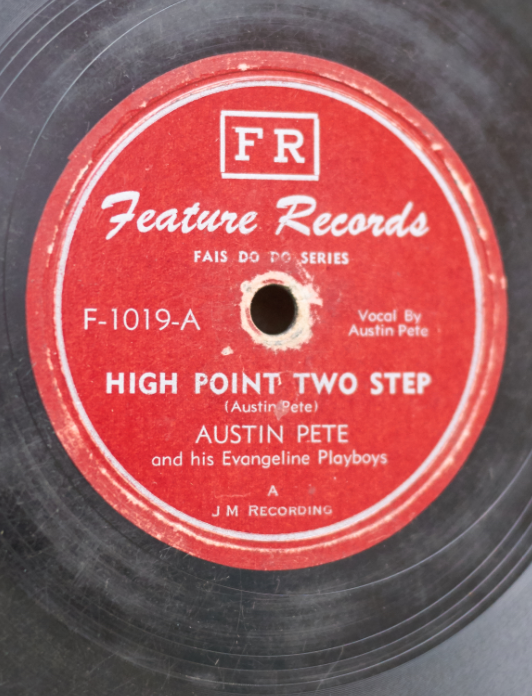 After WWII, other small Cajun labels popped up around south Louisiana. One of these was Fais Do Do records started by Jay Miller in 1946. A year later, he changed it to Feature Records that recorded many people such as Austin Pitre and Aldus Roger. In 1948, Austin would record his first record with Feature called "Evangeline Playboy Special" after the name of his band.
 Hey, mais malheureuse, toi 'tit monde,Quoi t'as fait, 'tit monde, avec ton nèg',Moi j'connais, c'est toi j'aime tant, tu vas aller,Avec un autre, malheureuse, que t'aimes pas mieux.Hey gardé donc , quoi ta pres faire,Avec ton neg t-monde toi te cannialle,Je tout l’temps ici, une jour avenir bébé,Avant longtemp tu vas venir c’est cera trops tard.Hey mais tout les soir ton vieux neg,Garde voir, t-monde tu ma fait mal,Je tout l’temps dit, tu vas voir pour ton meme,Tu vas payée pour tout ça oui mon cher monde.

Pitre would kick off his career on this label with their best known song "Evangeline Playboys Special". On their second record in 1948, they recorded a song called "High Point Two Step" (#1019), named after a community in Evangeline Parish. It was the Cajun version of an old fiddle melody called "Rubber Dolly". It would become well known after many musicians covered the tune including Mississippi John Hurt, Ray Price, Bill Parsons, and Woody Guthrie. Other musicians around Louisiana would also cover the tune including a western swing version by Harry Choates in 1947 and a swamp pop version by Johnnie Allan in 1959.
Its a lively tune with a sad undercurrent. According to author Blair Kilpatrick,
Hey, oh my, my little everything,
What did you do, my little everything, with your old man.
I know it's you that I love, you went away,
With another, oh my, who doesn't love you more.
Hey, look at what you've done,
With your old man, little everything, you are mischievous,
I am always here, one day, (you'll) return to me, baby,
Before long, you are going to return, it'll be too late.Hey, every night, old friend,Look here, my everything, you made me hurt,I always told you, you will see for yourself,You will pay for that, my dear everything.
"The rhythm makes you want to dance however, the words if you let yourself feel them make you want to cry. A paradox you can't escape."
Its about someone asking to see his love one more time before he dies. The melody has a vague similarity to the an older tune by Joe Falcon called "Osson Two Step" recorded in 1929 and Amede Ardoin's "Tortope d'Osrun". He would use the melody again in his "Janot Special".

- Accordion Dreams: A Journey Into Cajun and Creole Music By Blair Kilpatrick
- Lyrics by Marc C and Jerry M
Find:
Acadian All Star Special - The Pioneering Cajun Recordings Of J.D. Miller (Bear, 2011)
Wednesday, November 12, 2014
"Pine Grove Blues" - Nathan Abshire

In 1948, Clobule and Ernest Thibodeaux asked him to join the Pine Grove Boys, house-band of the Pine Grove Inn. One day, the club owner, Telesphore Esthay, asked Thibodeaux to find an accordion player for the group. Partly due to Iry LeJeune’s success, the accordion was again popular in Louisiana. Esthay felt the addition of an accordion would be good for business. According to Jerry Esthay,
The Pine Grove Inn was in Acadia Parish on the way to Evangeline it was across Hwy. 97 from the Evangeline Refinery. My dad, Claude Esthay and grandfather Telesphore Esthay owned it. My dad is the one who went to get Nathan to play. My dad would drive them to other club's to play. They had a little house behind the Pine Grove Inn that the band would stay in.9
Upon Thibodeaux’s father’s recommendation—who played fiddle with Amédé Ardoin briefly—he approached Abshire. Abshire said he’d love to start playing music again, but unfortunately he didn’t have an accordion, and he couldn’t afford to buy one. The Pine Grove Boys went into their own pockets and bought a broken single row Sterling accordion for $75. No one locally could repair it, so they drove to Houston (possibly to Mrnustik's shop), where the repairs cost them another $150.7 The group played six out of seven days, alternating between both Quincy Davis’ clubs in Lake Charles, the Crystal Grill and the Broken Mirror in the evening, and on KPLC radio for a daily broadcast in the daytime.
Eddie Shuler, who worked for the station, but was too busy with the promotion of Iry LeJeune, put them in touch with businessman Virgil Bozman. Virgil, based in Westlake, Louisiana, signed them on his rising O.T. label, partially funded by George Khoury. Oklahoma Tornadoes was the name of the group formed by Virgil as the studio band for the Opera label run by James Bryant and Bennie Hess, based in Houston, Texas. Their fiddler being Floyd LeBlanc, of Mermentau with whom Nathan had played earlier on, probably put Nathan in touch with Bozman.
 |
| Earl DeMary, Wilson Granger, Eldrige Guidry, unknown on drums, Nathan Abshire, and Ernest Thibodeaux |
Quincy Davis fired the whole bunch that was playing with Nathan. He hired us, because they'd get drunk and want to fight. So, Quincy Davis, on Saturday nights, he'd give us a quart of whiskey. It was on the house. But then, they'd start wanting to fight. He said, "From now on, you pay for your whiskey if you want to drink some."8
It would be DeMary's band in which Nathan would record his signature tune. In May of 1949, Virgel gathered them in KPLC studio, located inside the Majestic Hotel in Lake Charles, to cut 8 tracks; the first of which was the legendary "Pine Grove Blues" for the O.T. label (#102). His Pine Grove Boys band included Roy Broussard and Ernest Thibodeaux on vocals, Earl DeMary or Ernest Thibodeaux on guitar, Atlas Fruge on lap steel, Jim Baker on bass guitar, Oziet Kegley on drums, and either Will Kegley or Wilson Granger on fiddle. Based on It would be Nathan's defining song in which he would re-record for several different labels and documentaries throughout the 50s, 60s, and 70s.
Hé, négresse!
ayoù toi t'as été hier au soir, ma négresse?
("J'ai été au bal, neg")
Hé, négresse!
ayoù toi t'as été hier au soir, ma négresse?
("J'ai été au bal, neg")
T'arriva à c'matin.
Soleil étais après s'lever, ma négresse.
Hé, négresse!
ayoù toi t'as passé hier au soir, ma négresse?("par la barrière, neg")Hé, négresse!ayoù toi t'as passé hier au soir, ma négresse?("passé la barrière")T'arriva à c'matin.Ta robe était toute déchiré.("J'ai passé la barrière")
 |
| KPLC, located inside the Majestic Hotel |
The singer is taking his girlfriend to task for being out all night... inferring that it's with someone else! The melody was inspired by Amédée Breaux's "Blues du 'Tit Chien" recorded for Vocalion Records in 1934. (Author John Broven mistakenly states the song was inspired by Columbus Frugé’s "Tite négresse"; a song Fruge never recorded.) Nathan's 1935 recording "One Step de Lacassine" clearly anticipates the melody. Author Shane Bernard notices lyrical similarities with a much older Creole tune called "Anons au bal Colinda". There are some similarities with Bob Wills' "Milk Cow Blues" recorded in 1946 and even a loose similarity with "In The Pines", which some have credited as Nathan's source. The phrases were shouted more than sung by Nathan, cheered by the interjections Ernest Thibodeaux, the same type of calls to his musicians used by Bob Wills in western swing. The accordion is hypnotic – not that it puts you to sleep, of course – and bewitching, relieved by a weft of fiddle and rhythmic guitar, the whole propelled by a powerful double bass. According to Eddie Shuler, Bozman’ recording methods were very strange. He recalls:
He kept the pot boiling by selling cowhorns (the famous Longhorns) and it is how he landed in Lake Charles one day. He discovered fast how I managed to get artists recorded by a third person and he decided to follow my steps. He arrived at the station studio, gave a bottle of booze to the sound engineer, asked him to cut an acetate, left with it and got it pressed somewhere else.
 |
| Virgel Bozman |
Hey, honey!Where did you go last night, my honey?(I went to the dance, my honey)Hey, honey!Where did you go last night, my honey?(I went to the dance, my honey)When you came back this morning.The sun was coming up.Hey, honey!Where did pass by last night, my honey?(I passed by the fence, honey)Hey, honey!Where did pass by last night, my honey?(I passed by the fence)You came back this morning.Your robe was all torn.

Khoury never registered the song but Nathan had recorded it as "Pine Grove Blues" for J.D. Miller. He registered it at BMI, but wasn’t paying Nathan royalties. I told Nathan that if he signed a publishing contract with me, I get him his writer’s royalties. I took him to a notary and he put his X on a contract. I cleared the song with BMI. J. D. contested it, but I had a contract. J.D. claimed his got burned in fire. But Dewey Balfa, who played on the Miller sessions, said nobody signed anything with J. D.”7
The song appears in 1967 for Swallow, in 1970 for a field recording in New York, in 1972 and in 1978 for LaLouisiane. In 1979, Swallow released an album with the name "Pine Grove Blues".
- South to Louisiana by John Broven
- Cajun Breakdown : The Emergence of an American-Made Music By Ryan Andre Brasseaux
- All Music Guide to Country: The Definitive Guide to Country Music edited by Vladimir Bogdanov
- Swamp Pop: Cajun and Creole Rhythm and Blues By Shane K. Bernard
- Encyclopedia of Music in the 20th Century edited by Lol Henderson
- http://www.bopping.org/nathan-abshire-pope-of-cajun-accordion/
- http://www.offbeat.com/2003/10/01/masters-of-louisiana-music-nathan-abshire/
- Wilson Granger interview. Andrew Brown. 2005.
- Discussions with Jerry Esthay. 2019.
- Lyrics by 'Ericajun'
Find:
Boppin' Hillbilly 26 (White Label/Collector Records)
Nathan Abshire & the Pine Grove Boys - French Blues (Arhoolie, 1993)
Les Cajuns Best Of 2002 Les Triomphes De La Country Volume 12 (Habana, 2002)
Boppin' Hillbilly 26 (White Label/Collector Records)
Nathan Abshire & the Pine Grove Boys - French Blues (Arhoolie, 1993)
Les Cajuns Best Of 2002 Les Triomphes De La Country Volume 12 (Habana, 2002)
The Beginner's Guide to Cajun Music (Proper/Primo, 2008)
Bayou Two-Step - Cajun Hits From Louisiana 1929-1962 (Jasmine, 2015)
Bayou Two-Step - Cajun Hits From Louisiana 1929-1962 (Jasmine, 2015)
"Mardi Gras Dance" - Aldus Roger
 "Lache aller!". Every Mardi Gras in the rural areas of south Louisiana, communities would gather around and chant "La Vielle Chanson de Mardi Gras". During the event known as the "courir", some of the participants will dance around to the playing of a Cajun accordion, simply known as the Mardi Gras dance.
 Eventually, around 1954, Aldus Roger would record an instrumental version of the song entitled "Mardi Gras Dance" (#2004) for J.D. Miller's Feature Records recorded in Miller's studio in Crowley, Louisiana. The label focused on recording Cajun music in the region. Roger's version would be would be a quick tempo, full-sounding instrumental with solos throughout the song. Unlike the early traditional chant, the "dance" would have a bluesy chord progression with room for different musicians to take lead. Roger's version of the deeply traditional Mardi Gras Dance went even further, being pepped up to a frenzy by rock'n'roll drumming.
 |
| Aldus Roger Courtesy of Emile Waagenaar www.emilecajun.com |
Known as the "King of the Accordion Players", Aldus would be known for his band The Lafayette Playboys and his Saturday afternoon music broadcast show on KLFY. His band consisted of a well talented group of musicians including Doc Guidry, Phillip Alleman, Johnny Credeaur, Tunice Abshire, and Fernice Abshire. He would also record for Quinn's Folkstar label out of Houston and Bob Tanner's T.N.T. label, recorded by Eddie Shuler in Lake Charles.
Rumor has it, it became the unofficial "official" song for the Tit Mamou Mardi Gras run. Also known as the "Mardi Gras Jig", the melody would find it's way into the 1971 popularized two-step by Nolan Cormier known as the "Hee Haw Breakdown", which would find it's way into a British telecom commercial. In it, the instrumental and vocal yells refer to the mardi gras participants attempting to hold back the jackasses along the trail... to no avail.
- http://www.theguardian.com/news/1999/jun/02/guardianobituaries2
- Discussions with Bryan L
Find:
Acadian All Star Special: The Pioneering Cajun Recordings of J.D. Miller (Bear Family, 2011)
Monday, November 10, 2014
"Sundown Playboys Special" - Lionel Cormier

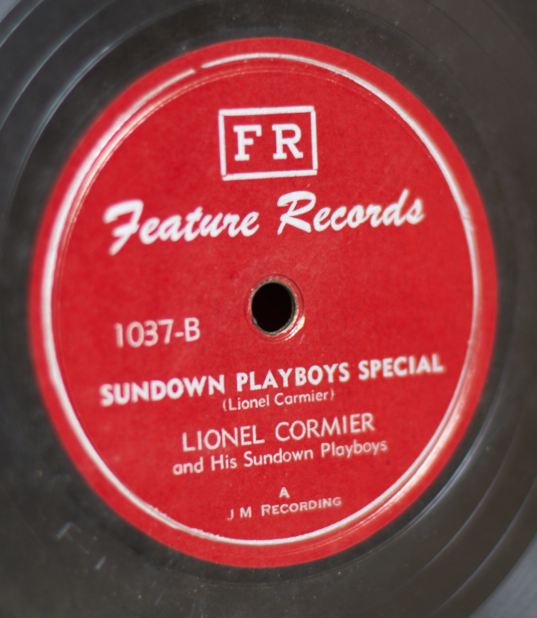
He began to join in as an accordionist at house dances and informal family get-togethers when he was 12 years old and moving to Elton, he took work in a sawmill.
 |
| Lionel Cormier |
Lionel would also record for Ed Shuler's Goldband Records. On June 5, 1971, after finishing the song "Church Point Two-Step", Cormier died of a heart attack unexpectedly with his boots on – onstage during a benefit dance at Lake Charles’ Bamboo Club, while taking a break as the emcee made announcements between songs.
Accordion player Pat Savant eventually joined the band and briefly knew Lionel; having met him only twenty minutes before the veteran played his last Church Point Two-Step. Pat would be known for recording "Saturday Night Special", released by either George Harrison or Ringo Starr of the Beatles on their lablel Apple Records.
- South to Louisiana: The Music of the Cajun Bayous By John Broven
- Meet The Sundown Playboys By Leslie Berman
- http://www.npr.org/templates/story/story.php?storyId=130836815
- http://www.allmusic.com/artist/lionel-cormier-and-the-sundown-playboys-mn0001577968/biography
- http://library.mcneese.edu/depts/archive/SWLAMusicians/encycloaj.htm
- http://www.hechicero.com/louisiana/sundownplayboys.html
Subscribe to:
Posts (Atom)