Saturday, December 6, 2014

"Mon Dernier Bon Soir" - Alleman and Walker

Even though Lawrence Walker would be known helping the resurgence in Cajun music after the war, few remember that his first entry in the music scene was in the mid 1930s during the Cajun string band craze.   Lawrence teamed up with his brothers for a recording session in New Orleans in 1935.   Fellow musician, Tony Alleman, tagged along and while they were there, Lawrence and Tony recorded "Mon Dernier Bon Soir" (#2193).


J'ai fait mon idée,

de m'en aller, chère

Quand je suis parti, belle,

c'est pour toujours

Observe-moi bien, chère,
pour la dernière fois
Donne moi ta petite main,
pour dire au revoir
(fait pas ça!)

Regarde voir le char neg,
Donne moi un ticket
Pour moi m'en aller,
si loin que je peux.

Et dans le tracas,
Je va t'oublier mon neg'
Faudra que je l'oublie chère,
Ou je va mourrir là.
Lawrence Walker

The simple song has Lawrence on vocals, however, there is some confusion on if Tony is on guitar or on fiddle.  According to Richard Spottswood, he lists Tony Alleman on vocal and Lawrence Walker on violin.  Lawrence Walker's recordings with Tony Alleman for the Bluebird label provide further evidence of Cajun musicians organizing Texas-tinged proto-Cajun swing.  The duo bristles with energy from the interplay between the song's Franco and Anglo components.


I have an idea,

To go away, my dear,

When I leave, my beautiful,

It will be forever.

Look at me good, my dear,
For the last time,
Give me your little hand,
In order to say goodbye.
(no not that!)

See the car, neg',
Give me a ticket,
In order for me to leave,
As far as I can,

And within these worries,
I will forget you, my neg',
I must forget you, my dear,
Or I will die.

This record would be the only one with Alleman.  Walker would record only once more before the war in 1936 at the National Folk Festival in Dallas, TX.   Afterwards, he stopped recording and began rice farming.   He wouldn't record again until Cajun music's popularity grew again in the 1950s; this time with an accordion led band.


  1. http://www.amazon.com/Cajun-Early-Recordings-Cajun-Early/dp/B0001ZXNS0
  2. The Encyclopedia of Country Music
  3. Cajun Breakdown : The Emergence of an American-Made Music By Ryan Andre Brasseaux
  4. Lyrics by 'ericajun' and Marc C
Find:
Louisiana Cajun Music Vol. 2: The Early 30s (Old Timey/Arhoolie, 1971)

Monday, December 1, 2014

Listen: ECM Radio Show on KPOO San Francisco 11-24-2014

The blog has garnered some attention, including a radio station in San Francisco.  On Nov 24th, I phoned into a radio station program called Gramophoney Baloney on KPOO.   I cover some of the articles I've posted here and listeners get to hear a selection of the tunes throughout the 2 hr show.

Enjoy!

Sunday, November 30, 2014

"Abbeville" - Jolly Boys of Lafayette

After 1933, Decca began looking to record more southern American music including hillbilly and Cajun music. Their A&R man, David Kapp, made pilgrimages through the south in areas such as Memphis, New Orleans, Dallas, San Antonio and Charlotte. He stated 
"In Dallas we got a lot of Cajuns coming in. I've seen some of those artists drive 500 miles in tumble-down cars to get an audition". 
One of those many Cajun bands was the Jolly Boys of Lafayette. Lafayette is a city in the heart of Cajun country. Composed of Leon "Crip" Credeur on fiddle and vocals, Joseph Fabacher on accordion and Francis "Red" Fabacher on guitar, they would travel to Dallas in 1937 and record 10 songs. Allegedly, Oran Doc Guidry claimed he and the band recorded earlier for Decca in 1934, however, there is no record of this in the Decca archives. 


S'en aller là bas à Abbeville

C'est pour voir ma chère mignonne petite veuve

Quelques jours passés, je lui ai envoyer une lettre

Elle m'a jamais renvoyé de ses nouvelles


Petit coeur tu connais t'auras du regret

D'avoir eu fait tous les misères que t'es après me faire

Mais oh y aïe moi j'connais tu vas pleurer

Tu vas pleurer, c'est pour ça que t'es après faire
Francis Fabacher

The Fabacher brothers descend from a Bavarian family that settled in the region during the 1870s. Joseph's German accordion would have been very familiar to the families older generation. One of the songs recorded included the country influenced entitled "Abbeville" (#17026), named after a town south of Lafayette. The tune is typical of the country-hillbilly sound which influenced Cajun music in the late 1930s. An old country-western tune called "Lonesome Pine", which Cleoma Breaux covered as "Pin Solitaire" in 1936, most likely was the influence.  The first recording of this melody as a Cajun tune was by the Guidry Brothers called "Le Garcon Negligent" in 1929.  The melody was previously recorded by her brothers the year before as "La Valse Du Bayou Plaquemine".  The melody would later influence "Alons Kooche Kooche" and "Grand Texastunes by Papa Cairo.  All of these tunes would lead to Hank Williams' "Jambalaya".


Going away to there Abbeville,
It's for my cute dear little widow,
Past few days, I've been sending letters,
She never sent me anything new.

Small heart, you know you'll regret this,
Having made me miserable after all of this,
But oh yaille, I know you're going to cry,
You're going to cry, it's what will happen.
Daily Advertiser
Apr 12, 1937
In the same fashion, the group would also record the song "Jolie Brunette", a different take on the famous "Jole Blon" melody. The group didn't last and disbanded. Francis would later end up playing guitar with Happy Fats and both steel guitar and electric guitar with Harry Choates. Leon would later work with Leroy Broussard of the Happy-Go-Lucky Band.  Joe is believed to have played with Pee Wee Broussard and the Melody Boys.


  1. Louisiana Fiddlers By Ron Yule
  2. Billboard Magazine. Hotel Room Recording Studios. Apr 3, 1971.
  3. Lyrics by 'ericajun'
Find:
Cajun: Rare & Authentic (JSP, 2008)

Tuesday, November 25, 2014

"La Manvais Femme" - Thibodeaux Boys

Bluebird had several Cajun swing musicians come to New Orleans for a marathon recording session on April 1938. Many of the musicians during that session would play along side different groups recording western swing music.  


7 ans avec la mauvaise femme,
C'est plus qu'un homme peut durer 
7 ans avec la mauvaise femme,
C'est assez pour jeuner un an
7 ans avec la mauvaise femme,
C'est assez pour tuer un bon homme
7 ans avec la mauvaise femme,
C'est assez pour jeuner un an

Garcon, si tu penses a t'marier,
Ecoute a quoi j'va t'dire!
Si tu maries la mauvaise femme,
C'est pire que vivre dans l'enfer
Si tu maries la mauvaise femme,
L'a juste une seul chose tu peux faire:
Fouille un trou et lance dedans
Et couvre tout avec la terre!
Joe Werner

One of the impromptu groups that formed was the Thibodeaux Boys. Composed of Erby Thibodeaux on fiddle and vocals, T.C. Thibodeaux on guitar, and Joe Werner on guitar, they recorded 12 songs for Bluebird. One of the songs they recorded would be "La Manvais Femme" (#2043) for Bluebird, which was based on an old time, hillbilly tune known as "Seven Years With The Wrong Woman". The title should have been spelled "la mauvais femme" which means "the wrong woman". Not much is known about this group. Only Joe continues to record afterwards, filling in and forming other bands such as Riverside Ramblers, Hackberry Ramblers, Louisiana Rounders, Joe's Acadians, and Happy Fats.


7 years with the wrong woman
This is more than a man can take
7 years with the wrong woman
That's enough for lunch for a year
7 years with the wrong woman
It is enough to kill a good man
7 years with the wrong woman
That's enough for lunch for a year

Son, if you thinking of marriage
Listen to what I'm going to say,
If you marry the wrong woman,
This is worse than living in hell
If you marry the wrong woman,
There is just one thing you can do:
Dig a hole and throw yourself in
And cover yourself with dirt!


Find:
Cajun: Rare & Authentic (JSP, 2008)

Saturday, November 22, 2014

"Hix Wagon Wheel Special" - Aldus Roger

This tune is one of many dancehall era songs made popular by Aldus Roger.  This would be  J.D. Miller's first recording of Aldus and his band, helping popularize the music being heard throughout the Cajun countryside.   The song is commonly played at the start of the night allowing musicians to warm up and get the patrons on the dance floor.  Sometimes spelled "Hicks", Miller released "Hix Wagon Wheel Special" (#1028) on his Feature label in the early 1950s with Roger on accordion and Roy Morgan on guitar.  The song is named after a popular dancehall near Opelousas, LA, owned by Hillred "Hicks" Sylvester, known as the Hicks' Wagonwheel Dancehall & Racetrack where Roger and other bands played.  The melody derives from a much older tune originally known as "La Queue d'Tortue" which influenced the Segura Brothers in their 1928 recording of "Bury Me In The Corner Of The Yard".
Aldus Roger and Lafayette Playboys
KLFY in Lafayette
Rodney Miller, Fernest "Man" Abshire,
Aldus Roger, Aldus "Popeye" Broussard,
Daemus Comeaux


Aldus Roger's father didn't want him to play accordion, however he would borrow one and play it in the barn.  By the 1950s, national programming dominated the airwaves, but like elsewhere, television stations in south Louisiana provided a few shows aimed solely at local audiences.  Shortly after KLFY began broadcasting in June 1955, it offered viewers a weekly half-hour Cajun music program featuring Roger and his band: the Lafayette Playboys.  Dixie 45 brand beer sponsored the program, and so successfully did Roger market the beverage taht even non-French speakers were known to refer to it offhandeldy as "Dixie quarante-cinq". 


Inside the Hick's Wagon Wheel, ca. 1944
Image courtesy of Johnnie Allan & the
Center for Louisiana Studies,
University of Louisiana at Lafayette
Roger led his group for over twenty years and set the standard by which Cajun dance bands are judged even today. He surrounded himself with some of the best backing musicians of his time -- some of whom are still the best today -- and helped bring Cajun music to a wider audience thanks to his weekly television program on Lafayette, Louisiana's KLFY Channel 10.  Roger paid tribute to the show in the mid 1950s with his recordings entitled "KLFY Waltz" and "Channel 10 Two Step".  In 1962, he represented Louisiana at the National Folklore Festival in Washington, D.C. 

Recently, a lost archival footage of the band playing during a KLFY taping of the show in 1968 surfaced from a French film website.

Daily World
Dec 23, 1952


  1. The Cajuns: Americanization of a People By Shane K. Bernard
  2. Historic Lafayette: An Illustrated History of Lafayette & Lafayette Parish By Michael S. Martin
  3. http://www.flattownmusic.com/Aldus-Roger-Legend-Series-Aldus-Roger-the-Lafayette-Playboys-CD-P3090.aspx
  4. Image by Cary Ginell
  5. Image identification by Michael Dupuy

Friday, November 21, 2014

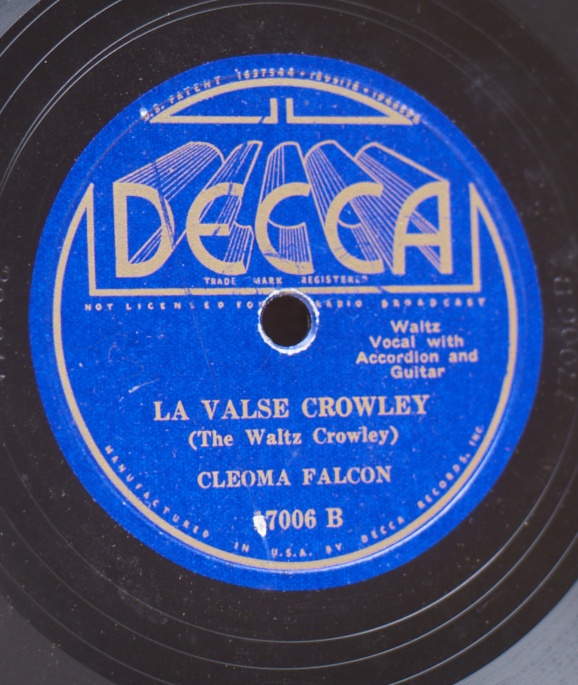
"La Valse Crowley" - Cleoma Breaux

In 1934, after the depression, record labels began recording Cajun music again. By August, Joe and Cleoma were in San Antonio and in December, they were on their way to New York City. They accompanied Amede Ardoin on a bus for a recording session with Decca. When they reached Hoboken, New Jersey, they boarded a ferry to cross the icy Hudson River. As the ferry crossed, it began to sink, with water filling up the bus. In the darkness, Cleoma's thoughts were on her daughter and began to think she'd never see her daughter again. After they were rescued, both of them arrived at the studio. Cleoma collected her emotions and wrote them into a song for her daughter: "La Valse Crowley" (#17006).  

Oh, ma chère ‘tite fille, 

Moi j’connais, j’suis si loin de toi mon nègre.

Ca me fait faire dans la peine de t’quitter,

Pour venir si loin de toi, malheureuse.

Prends courage, oui ma chère ‘tite fille,

Moi j’après m’en aller pour te r’joindre.


Tu connais, toi t’es bien soignée,

Mais j’peux pas m’empêcher d’m’ennuyer.

Moi j’après m’en aller de te r’joindre,

Prends courage, chère ‘tite fille, prends courage.

Moi j’après m’en aller, oui te r’joindre,
Ca s’ra pas longtemps, oui ma chère ‘tite fille.


Separately, Amede Ardoin recorded for Decca during the same session.  Twelve songs were recorded the session; location mistakenly listed as New Orleans, however, both the Breaux and the Ardoin family recall the session being in NYC.  Cleoma was from the town of Crowley, Louisiana and it's the town where both her and Joe settled after they got married.  The melody would later become the basis for the "Eunice Waltz" and Elise Deshotel's "La Vase De Temper Tate".   It even influenced Aldus Roger's recording of "Lafayette Playboys Waltz". 


Oh, my dear lil girl

I know I'm so far from you.

It makes me sorry to have left,

I've gone so far away from you, I'm unhappy.

Take care, my dear, please lil girl

After all of this, I will be with you.


I know you are well cared for

But I can not help but be lonely.

After all of this, I will be with you.

Take care, dear lil girl, take care.

After all of this, I will be with you.
It won't be long, yes, my dear lil girl.


  1. Louisiana Women: Their Lives and Times edited by Janet Allured
Find:
Cajun Early Recordings (JSP, 2004)
Prends Donc Courage - Early Black & White Cajun (Swamp Music Vol. VI) (Trikont, 2005)

Wednesday, November 19, 2014

"L'Abandoner" - Bartmon Montet & Joswell Dupuis

One of the earliest, fairly obscure, groups to record in New Orleans in the early years was Bartmon Montet & Joswell Dupuis.  In November 1929, this unknown duo recorded for Victor records, one of the first labels specifically looking for Cajun music.  

By the late 1920s, Victor Talking Machine Company was interested in selling more of their record players and realized in order to do this in the south, they were going to need to sell more regional records.  Victor had just traveled to Atlanta and recorded Leo Soileau and Mayeus Lafleur the previous year and enjoyed amazing sales of Cajun music.   During this session lasting from November 6th to the 16th, Victor would record musicians such as Bixy Guidry & Percy Babineaux, Soileau Cousins, Delin Guillory & Lewis Lafleur, Wilfred Fruge & Leo Soileau, Oscar Doucet & Alius Soileau, Joe Credeur & Albert Babineaux, and Joseph Landry.  

Oh quoi faire toi tu me dis,

Je m'ennuis de rester, qu'elle était mais si belle


Oh je connais aussi dur,

tu peux pas oublier ton p'tit neg et la terre!


Oh moi j'm'en va à la maison,

Pour mourir moi tout seul,

Pourquoi-donc tu viens pas?

The duo would only record 4 songs, one of them entitled "L'Abandoner (The Abandoned Waltz)" (#22211).  The song is jubilant yet doomed account of lost love buoyed by lively accordion and guitar.  Bartmon's name is listed in Victor's roster as "Berthmost" and "Bartmonse".   Montet plays the accordion and sings while Dupuis strums guitar.  Author and collector, Richard Spottwood, asserts that only 810 were sold.   

Oh, what do you say?

I'm bored staying here, but she's so beautiful,


Oh, I know it's just as hard,

You can't forget your little boy and the place of your home!


Oh, I'm going home,

To die by myself

So why don't you come with me?

Their tune would be resurrected by Iry Lejeune with is recording of "Convict Waltz". The duo would also record another song, "L'Eau Haute (High Water Waltz)" which was probably about the famous 1927 flood that hit Louisiana and the Mississippi River.


  1. Lyrics by 'Ericajun'
Find:
Cajun Capers: Cajun Music 1928-1954 (Proper, 2005)
Cajun Country, Vol. 2, More Hits from the Swamp (JSP, 2005)
The Best Of Cajun & Zydeco (Not Now, 2010)
Aimer Et Perdre: To Love & To Lose Songs, 1917-1934 (Tompkins Square, 2012)