Showing posts sorted by relevance for query Dennis McGee. Sort by date Show all posts

Sunday, March 8, 2020

"La Rille Cajen" - Dennis McGee & Ernest Fruge

The Cajun Reel!  Dennis McGee's Scots-Irish roots truly come to form in his renditions of old Appalachian reels.  From their Anglo-American neighbors, Cajun musicians learned jigs, hoedowns, and Virginia reels to enrich their growing repertoire which already included polkas, contredanses, varsoviennes and valses-à-deux-temps.3  Learning from his father John McGee, uncles Ulysses McGee and Joseph McGee, and his cousins Oscar McGee and Theodore McGee, Dennis played—and joined in—on many contra and square dances in his courting days.


Every week they would pass on horseback and knock on every door to tell the people where the dance was.  And, chère, I believed I danced!  When I danced, everyone left the floor because I was the best.  They couldn't dance like I could.2   

Dennis McGee

But not all reels were danced to in south Louisiana.  One genre of traditional songs provided a link between the dance band and home songs: the "reels a bouche," similar to Celtic "mouth music." These were tunes that were sung—in particularly by women—to accompany round dances during Lent when instrumental performances were not allowed. The verses and meters of these pieces are generally simpler than those of the home music, but they are still a more private mode of expression than the dance hall numbers.4  

At the makeshift studio, the duo was introduced to Cajun humorist Walter Coquille.  Walter was attending the Brunswick session to kick off his series of spoken word recordings and decided to introduce McGee and Fruge's song to the listening public as "genuine Cajun breakdown music".  His 1930 New Orleans recordings of "La Rille Cajen" (#512) and "Dance Caree" were both tunes used in square dances.   The reel required more movement than other dancing styles such as the contredanse français.  Dennis recalled, 
The reel was a difficult dance and it took good legs.  You had to jump around quite a bit.3  

You can hear Coquille calling out dance instructions: "Avancez!", "Famille tout le tour!",  "Tourne la dame!"  Dennis spent many of his later years playing these same reels at places such as weddings. Dennis recalls:


I remember an old Indian woman we called Ma Carreau who sang at all the wedding dances. She had blue eyes and frizzy hair. She was a midwife.  She knew all the wedding songs. Her husband played the violin.  We would play the reels for fancy stepping, "pour fair des pas".2     

Leleux Dancehall, 1938
Courtesy of LOC, Russell Lee Collection

Recorded in 1930 in New Orleans during the depth of the Great Depression, the recordings suffered from poor record sales and were mostly forgotten.   Not long afterwards, the accordion became the dominant instrument throughout much of Cajun music.  Author Barry Ancelet explains:


Dennis McGee was around when what we now call Cajun music was invented, or was developing.  Because of how he learned and who he learned from, he was one of the last living links to our musical past.  He performed in a style that went back before the accordion had affected Cajun music as much as it has today.1  


  1. "Cajun Fiddler Dead".  CPS. 1989.
  2. Dennis McGee ‎– The Complete Early Recordings.  Liner notes. 
  3. Cajun and Creole Music Makers By Barry Jean Ancelet
  4. http://www.louisianafolklife.org/LT/Articles_Essays/creole_art_pub_priv_cajunm.html


Release Info:

NO-6713 La Rille Cajen | Brunswick 512
NO-6714 La Danse Carre | Brunswick 512 

Find:
The Early Recordings Of Dennis McGee: Featuring Sady Courville & Ernest Fruge (Morning Star, 1977)
Dennis McGee ‎– The Complete Early Recordings (Yazoo, 2006)

Saturday, September 9, 2017

"Courville and McGee Waltz" - Sady Courville & Dennis McGee

The main instrument of the 19th century Cajun musician was the fiddle.   Traditional old-time Cajun bands often included a lead and a second fiddle. An excellent representation of this style was the early recordings of Dennis McGee and Sady Courville.  Dennis and Sady met in the mid-twenties. As it happens, they had much in common, starting with Gladys, Sady’s sister and Dennis’ wife. Both men were well-known musicians of the time, along with Amadee Ardoin, Angelais Lejeune, and Ernest Fruge, to name a few. Certainly they were among the most important and respected Cajun fiddlers of the day. For the next several years they played dances regularly, as had Sady’s predecessors, the Courville Brothers, before them.1   Dennis explained:
I was successful with my music. It wasn't that it was so good, but it was some old music that no one had head before.2    
Sady recalled his musical legacy:
My father and his brother Arville were both violin players who learned the music from their mother, my maternal grandmother, who was a Fruge.  Her family were all musicians and she knew the tunes her brother played. She'd sing these folk tunes to my father and brother. These folk tunes were brought here by the Cajuns back in the late 1700s.2  


Eraste Courville (Sady's father) & 
Arville Couville (Sady's uncle)
1900, Chataignier, LA

By 1929, the duo headed to New Orleans and recorded some of the earliest Cajun fiddle-led tunes, one of them being a self-entitled waltz simply called "Courville and McGee Waltz" (#315). Many professionals learned quite about bit about Cajun fiddling from this duo.  According to fiddler Tracy Schwarz:
The striking differences heard in Cajun fiddling from other U.S. folk styles can be traced primarily to the use of the following noting hand techniques: drones, octaves, unisons, open strings with a lower tuning, slides, trills, and lack of vibrata. Briefly, these can be described this way: Cajun fiddling abounds in a ringing, sustained treble tone achieved by wide separation of notes played in harmony on adjacent strings.1
In waltzes, the most strikingly different bowing technique is the marking of rhythm. Where country fiddlers will bow one continuous stroke to sustain a note, Cajun fiddlers change direction with each waltz beat, thereby providing rhythm alongside the melody. It must be cautioned here that this is a general discussion and that personal observation of Dennis McGee and Sady Courville leads to the conclusion that older bowing styles were more complicated than this, and also that there are a number of different bowing sub-styles under the general title of “Cajun fiddling.”1

The uniqueness about this recording is the fact that it's the only pressing that lists Courville's name on the label.  In fact at the time of the recording sessions, Sady requested of the company that his name be omitted from the labels when the records were released. And omitted it was: only “Dennis McGee” appears. It was the stigma: since the music embodied “Cajun” more dramatically than any other cultural form (except perhaps the language), it bore that stigma most directly.1  Sady recalled:
People used to make fun of me and other Cajuns who played Cajun music. That was the reason you won't find my name on some of the records Dennis McGee and I made. They asked me why I didn't want my name on those records. I said "Because people are making fun of me and I want to try and better myself".  But, I am for the program of Cajun culture. Then, the last number we made, I let them put on there Courville and McGee Waltz.   That's the only record my name was on.2  


  1. http://fieldrecorder.org/dennis-mcgee-and-sady-courville/
  2. Ye Yaille Chere by Raymond Francois
Find:
The Early Recordings Of Dennis McGee: Featuring Sady Courville & Ernest Fruge (Morning Star, 1977)
The Complete Early Recordings of Dennis McGee (Yazoo, 1994)

Monday, April 22, 2019

"Valse A Pap" - Dennis McGee & Ernest Fruge

Born in 1893, Dennis McGee absorbed the repertoire of a man who was almost one hundred years old at that time.  This music, which pre-dated the accordion by at least one hundred and fifty years, was destined to undergo many changes until it finally resulted, through the hands of countless musicians, in the synthesized form we know today.2 By the time he reached his 30s, he was offered three different recording opportunities in New Orleans.  On his third and last trip, he traveled with his accompanist fiddler Ernest Fruge and togther they recorded "Valse A Pap" (#532)  Dennis remembered the song being a very early tune that his father loved to play, who learned it from his father.  According to McGee:
His father played it too, Eraste Courville and John McGee. They liked this waltz very much.1  
Dennis McGee
Dennis spent much of his early years living at his grandmother's home.  It was here where he was initially exposed to his father's fiddle playing.  Dennis recalls,
Ninety years ago, I'd hear my daddy play.  He'd tap his foot like this and I'd sit on the floor and listen.  I learned my first tune with my daddy, "La Valse A Pop."  I learned to hold my bow like my daddy and I learned to move it just like him, back and forth just like him.3  

Dis "Bye bye," malheureuse, malheureuse, tous les jour,
Malheureuse, 'gardez-donc ça t'as fait,
Malheureuse, Dieu connaît tu vas pleurer.

Malheureuse, si t'aurais, mais, jamais écoute,
Ton papa et maman, ça c'aurait jamais arrive,
Malheureuse, le le rai!

Gardez-donc, malheureuse, gardez-donc, tu connais,
J'f'rais pas ça avec toi ça t'as fait avec moi,
Par rapport a toi, malheureuse.

(vocal rambling)

Daily Advertiser
May 1, 1931

Dennis McGee's father, John McGee Sr, was an accomplished fiddler in his own right. John had learned from his father, Pierre Hugo McGee of Irish ancestry.    When asked why he named it after his father, Dennis cried:
 When my father was dying, I went over to see him and he asked me to play this waltz. Afterwards, I promised that I would never play this waltz for anybody dying. He started to cry, the old man. It broke my heart. I played the waltz for him and I said, "Pop, I can't play if you cry."   And he said, "It's alright. Play it.  I know that I'm not going to be here for long."1  


Say "Bye-bye", oh my, oh my, always,

Oh my, so look at what you've done,

Oh my, the Lord knows you have cried.


Oh my, if you had, well, ever listened,
To your father and mother, that would have never happened,
Oh my, le le rai!

So look, oh my, so look, you know, 
I will not do that to you, that you've done to me,
Because of you, oh my.


  1. "Accordions, Fiddles, Two Step & Swing: A Cajun Music Reader" by Ron Brown, Ryan A. Brasseaux, and Kevin S. Fontenot
  2. The Eunice News (Eunice, Louisiana) 09 Nov 1989.  Marc Savoy.
  3. The Complete Early Recordings of Dennis McGee.  Liner notes. 

Release Info:
NO-6733 Valse A Pap | Brunswick 532
NO-6734 Two Step De Ville Platte | Brunswick 532
Find:

The Early Recordings Of Dennis McGee: Featuring Sady Courville & Ernest Fruge (Morning Star, 1977)
The Complete Early Recordings of Dennis McGee (Yazoo, 1994)

Monday, May 24, 2021

"One Step Des McGee" - Dennis McGee & Ernest Fruge

Fiddler Dennis McGee was born in Bayou Marron to John McGee, of Irish descent, and Amelia Lafleur, of French and Seminole Indian ancestry.2  Dennis first began learning the fiddle from his father, his favorite tune being "Valse de Pop."  In his youth, he went to live with his grandmother, where he was surrounded by fiddle players. As with many other rural fiddlers, music was a family affair with Dennis--listening to the playing of his uncles, Ulysses and Joseph McGee, and a cousin, Oscar McGee.1   

Ler-der-de-de-da-da-ler-der-der,
De-ler-der-der-de-der-de-ler-der-der,
'Garde-le mourir, c'est trop dur, 
Eh, moi tout seul, eh, malheureuse la belle,
Eh, 'gardez-donc, oh, mais, ça t'as fais,
Moi, j'connais t'as fais, malheureuse.

Malheureuse, jolie 'tit cœur,
Regarde (ce que) t'as fais dés (que) tu passes la porte, 
T’étais là bas, c’est tout t’as fait,
Mais, malheureuse, mais, malheureuse.

Ler-der-de, 'garde-donc, r'garde belle,
Mais, 'tit galop pour aller (à) la maison,
Mais, cours toujours, mais, t'en aller,
Mais, nous tous seul, mais-là, gallop.


Theodore McGee

After working with a cousin, Ben Courville on his farm, he moved and began living with another cousin, Theodore McGee.   Theodore took him to Ville Platte to buy a fiddle and withing six months he was attracting the attention of neighbors who would come to hear him play.1  He received his first shiny red fiddle when he was 15 years old.4  According to Dennis, 
I stayed with Theodore McGee and one day he said, "Well Mac, I believe I'll buy a violin for you.  I'm going to Ville Platte."  No strings!  There was nothing on it. He bought some strings and the pegs. He knew how to play a little. He tuned it up and played "Tout Les Deux Pour La Meme".  He said, "Now, you're on your own."3  
He started out playing for square dances with eight or ten couples in country homes for the grand sum of $1 a night.4   By 1929, he scored a contract to record with Vocalion records with Sady Courville and later, with Amede Ardoin with Colombia records.  By 1930, he and fiddler Ernest Fruge teamed up and headed to New Orleans where they recorded "One Step Des McGee" (#590) for Brunswick records, in honor of his McGee musical family.  Similar to his "One Step De Chupic", Dennis introduces the verses with nonsensical phrasing.  This style of singing could be used to evoke emotions or even memories in listeners that couldn't be put into words or ones that weren't terribly specific. It allows the listener's mind to wander where it will, guided by the singer, but not forced into a specific narrative. 


Ler-der-de-de-da-da-ler-der-der,
De-ler-der-der-de-der-de-ler-der-der,
Look at him dying, it's too hard,
Hey, i'm all alone, hey, naughty beauty,
Hey, so look, oh, well, at that you've done,
I know what you've done, naughty woman.

Naughty woman, pretty little sweetheart,
Look what you did as soon as you walked through the door,
You were there, it's all due to you,
Well, naughty woman, well, naughty woman.

Ler-der-de, so look, look at that beauty,
Well, galloping to the house,
Well, always running, well, I'm going,
Well, we're all alone, well there, (let's) gallop.


  1. Louisiana Fiddlers By Ron Yule, Bill Burge
  2. https://64parishes.org/entry/dennis-mcgee
  3. Ye Yaille Chere by Raymond Francois
  4. The Daily Advertiser (Lafayette, Louisiana) 12 Sep 1982
  5. Lyrics by Stephane F and Herman M
Release Info:
NO-6731 La Valse De Rosalie | Brunswick 590
NO-6732 One Step Des McGee | Brunswick 590

Find:
Dennis McGee ‎– The Complete Early Recordings (Yazoo, 2006)

Friday, December 1, 2017

"Happy One Step" - Sady Courville & Dennis McGee

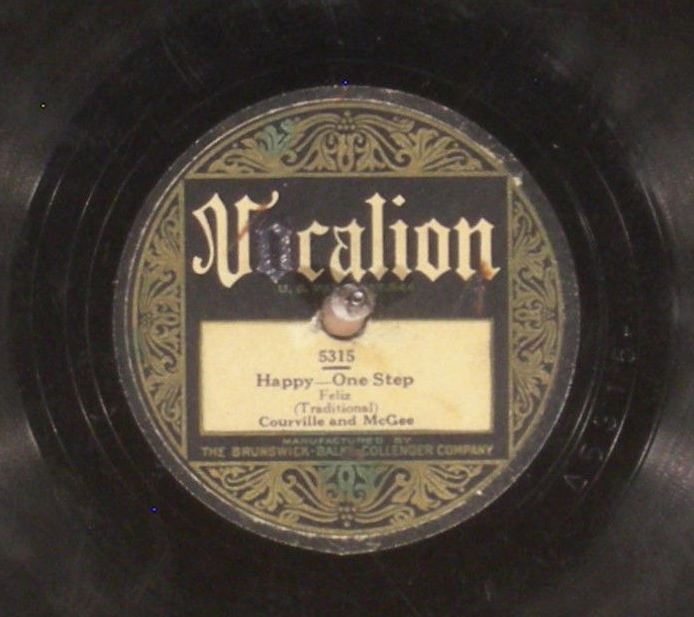
The Louisiana twin fiddling of Dennis McGee with Sady Courville, and later, Ernest Fruge is one of the great treasures of southern fiddling, past and present.  Dennis had a long musical career, with a repertoire extending back into the nineteenth century.  His local fame led him to start playing with accordionist Amede Ardoin, at a time when crossing racial lines was unusual.  Eventually, he would be invited to record for several labels, including this 1929 session for Vocalion in New Orleans which produced "Happy One Step" (#5315).  The recording  executive wanted two fiddles on the recording, so the two men set out on a train for the big city, fiddles in flour sacks.  Sady recalled,
We went to the second floor of an old building on St. Charles Street. There was a machine like a phonograph in a little room.  The machine made the recording on wax disks. The songs were supposed to be played not less than three minutes, not more than four. There were three or four lights on the machines, blue, yellow and red, that warned us when time was up.  

We recorded eight tunes. They let us choose the songs. I was young at the time so I asked them not to put my name on the record because I was afraid my friends would laugh at me.4   

McGee played with such Cajun artists as Amede Ardoin, Joe Falcon and Amede Breaux when the music was first being recorded in the late 1920s. He performed on the radio show "Prairie Home Companion" and often played at festivals.2  A National Heritage Award winner, Dennis McGee continued to be a favorite at
festivals and house parties until his death in 1989 at ninety-six.3   Author Blair Kilpatrick states:
The Happy One Step is beautiful--so spare and haunting--played simply on the fiddle.  There are no words to the Happy One Step, although the title suggests it is a cheerful song.1  


Dennis McGee & Sady Courville
Image courtesy of Johnnie Allan & the 
Center for Louisiana Studies, 
University of Louisiana at Lafayette


  1. Accordion Dreams: A Journey Into Cajun and Creole Music By Blair Kilpatrick
  2. The New Amberola Graphic, Volumes 67-82
  3. J'ai Ete Au Bal Vol. 1.  ARhoolie CD 331.  Liner notes.
  4. The Complete Early Recordings of Dennis McGee.  Liner notes.

Find:
The Early Recordings Of Dennis McGee: Featuring Sady Courville & Ernest Fruge (Morning Star, 1977)
The Complete Early Recordings of Dennis McGee (Yazoo, 1994)
Les Cajuns Best Of 2002 Les Triomphes De La Country Volume 12 (Habana, 2002)
J'ai Ete Au Bal - Vol. 1 (I Went To The Dance) (Arhoolie, 2011)

Wednesday, November 11, 2020

"Myself" - Dennis McGee & Sady Courville

Dennis McGee, regarded as the "Dean of Cajun fiddlers", kept the older Acadian fiddle sounds of the 1800s alive almost into the 1990s. He was one of the earliest Cajun fiddlers to be recorded.3  According to record producer Chris King:
Getting really obsessed with how the Cajun music can affect you so deeply, I got really curious on how McGee did it. Because, not only does he do it to me, but he does it to others.  And I was wondering 'What the hell he was doing?'1  


Dis, "Bye bye" à ton papa, ta maman, mais, t'en aller, malheureuse, 

Dis ,"Bye bye", t'(es) après t'en aller,

Avec mon bien aimé, pour toujours, mais, (chére*) Joline, malheureuse, 

Dis, "Bye bye", dis, 'Bye bye" à ta maman.


J'(suis) après m'en aller, m'en aller avec mon nég', malheureuse, 
Eh, dis "Bye bye" à ton pap et ta maman, 
Pour toujours nous en aller, s'en aller, mais, là joline, 
M'en aller avec mon bien aimé pour toujours et finir mes jours.


Eh, t'es jolie, t'es mignonne et t'es bien (ai)mable, malheureuse,
Eh, t'es jolie, t'es aimable joli cœur. 
Fais pas ça, ça fait moins cœur, ah oui, m'en aller,
Z-avec tous mes chagrins, malheureuse, dis "Bye bye".

(Re)gardez-donc, mais, joli cœur, comment-donc, mais, moi j'vas faire, 
Dis après me quitter par la faute à ta maman,
Oh, yéyaie, chérie, malheureuse, 
Mais, (re)gardez donc, j'vas m'ennuyer de toi.

Sady began playing music on the violin since the age of 16 when his father quit playing.  He played with Dennis for about eight years straight.6  Before the Dennis McGee and Sady Courville ever recorded, they were invited to play on KWKH in Shreveport in 1927 as part of a promotional campaign for Cajun music.  Courville recalled the Shreveport event:
Eunice News
Mar 22, 1929

There was an old man in the community who was always promoting different things. First of all, he got us to go to Shreveport to broadcast on the radio. "Old man Marks".  He was a sort of leader, you know.  He did a lot for the Boy Scouts and different things. So he asked Dennis and me to go to Shreveport. That was the closest broadcasting station around here outside of New Orleans.  So we went over there and broadcasted and we came back over here. That was about 1927.4 

In 1929, they were approached by Sady's employer, a local furniture store owner named Mattius "Mat" Fruge, to record in New Orleans.  Fruge had originally began as a door-to-door milkman as a boy.  After receiving education in Texas, he fought in WWI and returned to Eunice working in a cotton gin.  By 1924, he became manager, and later owner, of Teer Furniture Company where Sady worked as an assistant. It becomes Fruge's phonograph and record distribution connections to companies such as Okeh, Brunswick and Vocalion which provide Dennis and Sady's first recording opportunity.   Courville recalled carrying his fiddle to New Orleans in a flour sack.7  

Dennis McGee and Sady Courville


Say, "Bye bye" to your dad (and) your mom, well, you're going, oh my,

Say, "Bye bye", you're going to go,

With my beloved, forever, well, (dear*) Joline, oh my,

Say, "Bye bye", say "Bye bye" to your mom.


I am leaving, I'm going away with my man, oh my,
Hey, say "Bye bye" to your dad and your mom,
Always, we're going, going to go, well, over there, Joline,
I'm going away with my beloved forever and live out my days.

Hey, you're pretty, you're cute and you're sweet, oh my,
Hey, you're pretty, you're sweet, pretty sweetheart,
Don't do that, that's heartless, oh yeah, I'm going,
With all my sorrows, oh my, say, "Bye bye".

So look, well, pretty sweetheart, so how, well, will I handle this,
Told you I'm leaving because it's your mother's fault,
Oh, ye yaille, dearie, oh my,
Well, so look, I'll miss you.


Eunice News
Apr 14, 1927

McGee's tune "Myself" (#5348), with Sady Courville on second fiddle, represented the story of most of his recordings, a lover discussing leaving her mother to be wed.  Sady never recorded for a major label again however, he continued to be Fruge's top salesman throughout the 1930s.5  He played his last dance in Lacassine in September of 1929 and didn't pick up playing music again until 1968.6  Dennis McGee continued his commercial recording career, performing and recording with black accordionist Amede Ardoin in the late 1920s and early 1930s in the first racially mixed duo. Their music laid the groundwork for the style and repertoire of Cajun music as we know it today.3  In the 70s, the duo reunited for a series of field recordings as well as a studio session at Swallow records in Ville Platte. 

"Myself" is done in a different tuning, GDAG, which according to folklorist Will Spires was a popular tuning for old dances in the key of G. Both the fiddle and the vocal wail out on this number and Dennis displays his effortless high, piercing singing.8 It still resonates with musicologists today. According to record producer Chris King:
When you listen to this really closely, he's tuned wayyyyy low.  That's the thing about McGee that when he would go and record something, where as most people would keep their fiddle in standard or they might cross-tune, he re-tuned his fiddle for every piece he performed, because he realized, by changing the pitch this much, or increasing the pitch this much, it affected people in this particular way.1


  1. Vinyl Asides Episode 8 - Christopher King
  2. https://oldtimeparty.wordpress.com/2014/06/18/himself/#more-10194
  3. J'ai Ete Au Bal Vol. 1.  ARhoolie CD 331.  Liner notes.
  4. Ye Yaille Chere by Raymond Francois
  5. The Eunice News (Eunice, Louisiana) 14 Sep 1934
  6. The Eunice News (Eunice, Louisiana)12 Jun 1973
  7. The Ville Platte Gazette (Ville Platte, Louisiana) 07 Jan 1988
  8. Dennis McGee ‎– The Complete Early Recordings.  Liner notes.
  9. Lyrics by Stephane F

Release Info:
NO-110 Myself | Vocalion 5348
NO-111 Vous M'Avez Donne Votre Parole | Vocalion 5348 

Find:
Dennis McGee ‎– The Complete Early Recordings (Yazoo, 2006)

Tuesday, August 30, 2016

"Mon Chere Bebe Creole (My Creole Sweet Mama)" - Dennis McGee & Sady Courville

"My Dear Creole Baby!" One of the iconic songs by Cajun fiddler Dennis McGee is "Mon Chere Bebe Creole (My Creole Sweet Mama)" recorded for Vocalion in 1929.   Cajuns use of French words, and the dialect that came with it, illustrated how isolated the culture remained from much of the rest of country. This was most evident in the songs they sung.   According to musician Will Spires, Dennis explained the origins of the song to him:
It came to me in a dream and I woke up and I caught my violin and played that tune.7  

The Cajun music genre appears to have borrowed this peculiar intensity from traditional Cajun and black Creole music, which, while they capture a wide range of emotions, excel at conveying pathos and despair.2 Author Shane Bernard recounts Cajun fiddler Dewey Balfa's explanation:
In Cajun music you can hear the lonesome sound and the hurt...just like the blues sound of the black man is a sound deep hurt, deep sorrow.  The Acadians had it very tough from Nova Scotia down to Louisiana, and when they did get to Louisiana, they had a hard time.  And sometimes I feel that the Cajun sounds are of the loneliness and hardship they had back then.  This tendency emerges even in the earliest Cajun recordings, such as "Mon Chere Bebe Creole".2 

Regardez, donc, malheureuse,

Tu m'abandonnes pour toujours,

Malheureuse, aye yaille, j'suis après,

M'en aller, c'est pour mourir.


Dit "Bye Bye", chere maman,

Fais pas ca avec ton neg,

Eh, tu vas le faire mourir pour toujours,

Un de ces jours, Malheureuse,

Dit "Bye Bye" chere vielle maman.


Gardez donc, mais j'suis après,

Marcher, chere malheureuse,

Gardez donc pour toujours,

Malheureuse, malheureuse,

Dit "Bye bye" a ton pop et ta mom.


Gardez donc, fais pas ca,
Avec moi, chere petite, ah oui,
Maheureuse,
J'ai pas fait rien, chere, pour toi,
Fais pas ca avec moi, chere tite fille.

Gardez donc, malheureuse,
Mais gardez donc, jsuis après,
M'en aller dans les chemins,
Tous les jours, et les nuits,
C'est pour toi, malheureuse, si jolie.


Dennis McGee & Sady Courville
Those that lived here, with and without Acadian ancestry, sang songs that reflected the interracial dialogue between Cajuns and their Afro-Creole counterparts.   McGee continued to communicate musically cultural information about the influences and institutions that defined Cajun life before the Great Depression.3  

Cajun people remained largely un-Americanized until U.S. involvement in World War II. Swept up in the period's intense patriotism, Cajuns supported the massive war effort. In so doing Cajun GIs experienced a world much larger than the one back in Acadiana, while loved ones on the home-front pulled together to do their part for victory.4   By the 1950s, Happy Fats and Doc Guidry recorded the tune as "Dans La Platin".   


Look at that, oh my,

You left me forever,

So unhappy, aye yaille, afterwards,

I'm going away to die.


Say "Bye bye, dear mom",

Don't do this to your old man,

Hey, you're going to make him die, 

One of these days, oh my,

Say "Bye bye, dear old mom".


Look at this, well, I'm headed out,

Walking away, dear sad one,

So look at this always,

Oh my, unhappy one,

Say "Bye bye" to your dad and your mom.


So look, don't do this,
With me, my dear little one, oh yeh,
Oh my,
I have done nothing, dear, for you,
Don't do that with me, dear little girl.

So look at that, oh my,
Well, look at that always,
I'm headed down the road,
Every day and every night,
It's for you, oh my, so pretty.
McGee's use of the word "Creole" could be used in a variety of ways; a word hotly debated among those that are familiar with it.  Just writing about this word from an academic standpoint can cause controversy.  The term "Creole" was first used in the sixteenth century to identify descendants of French, Spanish, or Portuguese settlers living in the West Indies and Latin America. There is general agreement that the term "Creole" derives from the Portuguese word crioulo, which means a slave born in the master's household.5 

Determining the accepted definition in 1920 among Louisiana natives can be difficult.   During the early recording years, it's usage differed between New Orleans natives and the rest of the Cajun prairie people.  Even though many non-Acadians settled in the Cajun country, there's no doubt by the 1920s, many considered themselves Cajun and/or Creole.   Even in France today, there's a distinction between "creole noir" and "creole blanche".  Regardless of the accepted definition, historical literature proves the word had different meanings based on location and time period.   

The music itself became known as either Cajun and/or Creole music.  Even by 1939, accordion player Joe Falcon, of Cajun and Spanish ancestry, was a featured performer on what was known as the "Creole Hour" at the National Rice Festival.3   Yet, Canray Fontenot, notably considered one of the finest Creole fiddlers, personally regarded his fiddling technique not as a traditional Creole expression, but an interpretation of Harry Choates' style.3  What could McGee mean by the word "Creole"?    Is this something different than Cajun?   According to author Herman Fuselier, "ask 30 people and you'll get 30 different answers."6

Despite the dialect's decline, Cajun identity and ethnic pride remain strong to the present. The ethnic intermixing that created the Cajuns is still evident in the names of some of the most famous Cajun musicians: Nathan Abshire, Lawrence Walker, and Dennis McGee were all renowned Cajun musicians with surnames of non-Acadian origin. This paradoxical embrace of others while forging a strong Cajun identity can perhaps be summed up with this observation from Dennis: 
"McGee, that's a French name," he proclaimed. "I don't know anyone named McGee who doesn't speak French."4


  1. Dennis McGee & Sady Courville.  Jack Bond
  2. Swamp Pop: Cajun and Creole Rhythm and Blues By Shane K. Bernard
  3. Cajun Breakdown: The Emergence of an American-Made Music By Ryan Andre Brasseaux
  4. http://www.medschool.lsuhsc.edu/genetics_center/louisiana/article_acadianscajuns.htm
  5. Creoles by Helen Bush Caver and Mary T. Williams
  6. http://www.theadvertiser.com/story/entertainment/2015/07/09/mean-creole/29942095/
  7. Discussions with Will Spires
  8. Lyrics by Stephane F
Release Info:
NO-108 Madame Young Donnez Moi Votre Plus Jolie Blonde (Madame Young Give Me Your Sweetheart) | Vocalion 5319
NO-109 Mon Chere Bebe Creole (My Creole Sweet Mama) | Vocalion 5319

Find:
Louisiana Cajun Music Volume 1: First Recordings - The 1920's (Old Timey, 1970)
The Early Recordings Of Dennis McGee: Featuring Sady Courville & Ernest Fruge (Morning Star, 1977)
The Complete Early Recordings of Dennis McGee (Yazoo, 1994)

Thursday, May 30, 2024

"La Danse Carre" - Dennis McGee & Ernest Fruge

Music associated with French and American dance forms influenced much of early Cajun social life in the 1920s.  From their Anglo-American neighbors, Cajun musicians learned jigs, hoedowns, and Virginia reels to enrich their growing repertoire which already included polkas, contredanses, varsoviennes and valses-à-deux-temps.5  Similar to the contredanse (counter-dance), the Cajun French square dance embraced a loosely structured call-out routine throughout the dance number.  These Cajun dances appeared in Acadie in the 17th century and flourished throughout.  According to musician and Acadian music researcher, Devon Léger, 

"Reel de la Rivière à la Truite" from New Brunswick.  It actually corresponds to a Cajun tune.  The first and third parts of "La Danse Carre" correspond pretty closely to two different old Acadian tunes from Eastern Canada! It's clear that French songs travelled from W. France to Canada to Louisiana with Acadians, but it's been super hard to demonstrate anything with the tunes.  Another Acadian tune, called "Rabastan à Avila Leblanc", from the Magdalen Islands. These islands from the coast of Quebec were one of the last strongholds of old style Acadian fiddling, so they have a lot of the old beautiful tunes.  The second part of "Rabastan" is exactly like the third part of "La Danse Carre", which is a really interesting correlation between old Acadian fiddling from Quebec, New Brunswick, Nova Scotia and Cajun fiddling.6  

When George Washington Cable toured through Louisiana in 1888, he commented on the Cajun dance: When a girl was old enough to "move into society"—that is, for marriage—she was "meant to join in the contra-dance.4  Cable continues: 
The fiddler's seat is mounted on a table in the corner.  The fiddler is in it.  Each beau has led a maiden into the floor.  The sets are made for the contra-dance.  The young men stand expectant, their partners wait with downcast eyes and mute lips as Acadian damsels should. The music strikes up, and away they go!4  

Dennis McGee

Although fiddler Dennis McGee spoke little but Cajun French, he was known nationally form appearances on such shows as "Prairie Home Companion" and from stops at colleges and festivals around the country.   McGee's career spanned most of the 20th century.  When Cajun music was first being recorded in the late 1920s, he played with such artists as Amede Ardoin, Joe Falcon and Amede Breaux.2  As a fiddler, McGee was keenly aware of the popularity of square dance styles.  He recalled:
I would love to be twenty years old again.  They danced contredanses throughout my courting days.  The contredanse wasn't difficult. You just had to turn around, making little steps while you turned.5  

During a recording session in 1929, he and Ernest Fruge recorded "La Dance Carre" (#512). Directly translated to "The Square Dance", you can hear Walter Coquille, a Cajun humorist who was present at the session, calling out dance instructions. McGee recalled playing this style at house dances every Saturday and Sunday from seven o'clock until midnight, where he'd received one dollar a night. 
We played all kinds of dances.  In a dance-hall in Ville Platte, we'd play first a "danse carrée", then a waltz, then a "two-step".  The "danse carrée" was very popular back then.  They danced by six or eight pairs.  Somebody would call out "Famille en ronde" and the girl would hold the arm of her partner.  Then they'd all make a big circle and return to place.  Then two pairs would cross together.  Then they'd form two lines, boys in one line and girls in the other.  They'd go in and meet and turn, then the pair would go down the line together.3    
Leleux Dancehall, 1938
Courtesy of LOC, Russell Lee Collection

Sometimes referred to as une contredanse francaise, it seemed to fade out of popularity towards the late 1930s, in particularly the regions of St. Landry parish and Evangeline parish.  Although McGee continued to play square dances afterwards, however, Fruge never recorded commercially for a major recording label ever again.  According to music producer Christopher King, he states: 
Their recording session features this hypnotic, driving, in-your-head twin fiddle breakdown. Two violins: one playing the lead, the other playing rhythm. "La Dance Carre" not only reminds me of the Carter Brothers but also the driving, hypnotic music we would also hear all over the world.1


  1. http://ngradio.gr/blog/chris-king/chris-travels-78-rpm-im-no-lyre-radio-show-no-4/.   Chris travels at 78 RPM: “I’m No Lyre” – Episode 4.   Radio show.
  2. "Cajun Fiddler Dead".  CPS. 1989.
  3. Dennis McGee ‎– The Complete Early Recordings.  Liner notes. 
  4. Bonaventure: A Prose of Acadian Louisiana By George Washington Cable
  5. Cajun and Creole Music Makers By Barry Jean Ancelet
  6. Discussions with Devon Léger, March 4, 2023.

Release Info:
NO-6713 La Rille Cajen | Brunswick 512
NO-6714 La Danse Carre | Brunswick 512 

Find:

The Early Recordings Of Dennis McGee: Featuring Sady Courville & Ernest Fruge (Morning Star, 1977)
Dennis McGee ‎– The Complete Early Recordings (Yazoo, 2006)

Friday, March 2, 2018

"Allon A Tassone (Let's Go To Tassone)" - Dennis McGee & Sady Courville

Dennis McGee is credited with transforming French Louisiana music into a high-level cultural expression, elevating it to the status of "art" music.  During these early years, his most well known partner was a fellow fiddle player named Sady Courville.   According to author Sara Le Menestrel, "reversing the stereotype of plain or simple music, this comparison is suggestive of the existence of geniuses within French Louisiana music, like in any other genre."  Sady recalls the first session:
There was an old man in the community who was always promoting different things.  He asked this man that I was working with if he thought we would like to make some records. He said, "I wonder if Dennis and Sady would go and make some records".  That was the old 78s at that time.  So [Wade] Fruge asked me and I asked Dennis.  He had said, "They would pay all your expenses" but that was it.  Just our expenses you know.4   

Allons! Aller à grand Tasso, mais, c’est pour voir les belles petites chères,

Allons! Aller, mais, à grand Tasso, mais, c’est pour voir les belles bouclés,

Allons! Aller à grand Tasso pour voir les belles bouclés.

Gardez-donc, mais, ces belles jeunes, mais, ils sont si bonnes, mais, les danseurs,
Ça danse bien, mais, ç’a la bonne vie, c’était joli, les chers p’tit cœurs,
Gardez-donc, mais, c’est si mignonne, malheureuse, dit "Bye bye".

Je suis après, mais, m’en aller, mais ouais, là-bas, mais, à Tasso,
C’est pour voir les belles p’tites, oh yé yaille, malheureuse,
C’est là je vas m’en aller, si loin, mais, c’est pour voir, mais, les belles filles.

Allons! Aller, mais, s’en aller, oh là-bas, mais, p’tit monde, mais malheureuse,
Je vas aller, mais, m’en aller à Tasso, c’est pour voir les chères mignonnes.
Sady Courville 1

Courville and McGee took a trip to New Orleans in March of 1929 and recorded eight tunes for Vocalion records including this song.   Sady continues:
And I had this old fiddle here. I had it in a flour sack.  I didn't even have a case for it. So we got on a train here one morning and went to New Orleans, somewhere in the French Quarter on the second floor, and we made those records.  We made about either or ten of them.4

"Allon A Tassone" (#5334) is an ode to the Louisiana community of Tasso, east of Eunice, Louisiana where Dennis would visit and see the beautiful curly haired girls.  The term "tasso" first appears in the Louisiana documentary record in 1859 as the name of a prairie community near present-day Duson, in the heart of the early Cajun ranching country.  In 1880, Goerge Washington Cable collected notes on the Cajun community census report.  His notes revealed "tassao" as a "jerked beef" near the Carencro area.2  Today, tasso is a type of spicy, heavily peppered and smoked pork found in Louisiana.  Unlike ham, it's not made from the hind leg of a hog, but rather the hog's shoulder. 

Let's go! Going to big Tasso, well, it's to see the beautiful little darlings,

Let's go! Going, well, to big Tasso, well, it's to see the beautiful curly haired ones,

Let's go! Going to big Tasso to see the beautiful curly haired ones.

Look at that, well, those beautiful young ones, well, they are so good, well, dancers,
That dance well, well, life is good, it's beautiful, dear little sweethearts,
Look at that, well, it's so cute, oh my, say "bye bye".

I have, well, went away, well yeh, over there, well, to Tasso,
It's to see the little beauties, oh ye yaille, oh my,
That's where I'm going to go, so far, well, it's to see , well, the beautiful girls.

Let's go! Going to, well, go away, oh over there, well, my little everything, well oh my,
I am going to, well, go away to Tasso, it's to see the darling cuties. 

Like several of McGee's originals, the timing of the music seems to run everywhere.  According to perspective given by a musician from California:


You play that Dennis McGee stuff, if you haven't heard it before, you can't guess why it's gonna have like three measures, four measures, two measures... or how it's going to go.  You basically have to learn it and memorize it or count it... Alot of times playing with accordion, it is sort of like "Okay..." But when you start playing the Dennis McGee stuff, it's more intellectually challenging because you have to figure out where the song's going all the time... He reminds me of Mozart.1


  1. Negotiating Difference in French Louisiana Music: Categories, Stereotypes ... By Sara Le Menestrel
  2. Stir the Pot: The History of Cajun Cuisine By Marcelle Bienvenu, Carl A. Brasseaux, Ryan A. Brasseaux
  3. DENNIS MCGEE - Complete Early Recordings. Yazoo 1994. Liner notes.
  4. Cajun and Creole Music Makers By Barry Jean Ancelet
Find:
The Complete Early Recordings of Dennis McGee (Yazoo, 1994)
Cajun: Rare & Authentic (JSP, 2008)