Showing posts sorted by relevance for query Lawrence Walker. Sort by date Show all posts

Thursday, February 20, 2020

"Country Waltz" - Lawrence Walker

By the 1950s, it had been 15 years since Lawrence Walker had stepped into a recording studio.  No longer where the major recording labels, such as RCA and ARC, interested in his music.  It was during this time he got wind of an independent recording producer in Lake Charles who had made a name for himself recording the Cajun accordion music of Nathan Abshire.  It would be his first recording session since the 1930s and afterwards, his legacy would never be forgotten. 

Lawrence's path mimic'd the same one that Nathan had gone down.  Both were picked up briefly by RCA in the 1930s and both were dropped once the accordion was no longer in favor.  Since Lawrence was no longer playing with his brother as a duo, he formed a new group with Mitch David on fiddle, Valmont "Junior" Benoit on steel guitar and Simon Schexneider on drums.  Even Houston Fruge played with the band.  Together, they recorded the "Country Waltz" (#601), the tale of two estranged lovers, Adam "Tit 'Dom" Hanks and Alice Royer. 


Oh, Alice, vas-donc mettre ta 'tite robe de grandes barrées,

'Garde-donc quoi-ce-qui vient à travers du clos sur Grand Henri,
Tu m'as promis d'espérer et 'garde-donc voir quoi t’après faire aujourd'hui,
Petite, tu demandes une chance avant de mourir.

Oh, Alice, blâmes-donc pas les paroles dis, viens-moi Alice, tite monde,
Petite, tu connais surement la cause de tout ça,
Tu connais je prends ça dur mais de devoir t'en aller aussi loin de toi,
Oui, chère Alice, donnes-moi une chance avant de mourir.

Lawrence Walker

The well-known story of Alice, Adam, and his horse Henri was popular among those around Acadia Parish.  The story was first recorded by Pointe Noir native Angelas Lejeune in his locally popular tune "La Valse A Tidom Hanks".  Over time, the story made it's way into Lawrence Walker's repertoire and he used it to accompany his "Country Waltz".  Johnnie Allan, steel guitarist in Lawrence's later years, recalls the places where he and Lawrence used to play in the country:


We performed at clubs like the OST in Rayne, the Welcome Club in Crowley, the Jolly Rogers in Forked Island, the River Club in Mermentau, the Bon Ton Rouley in Lafayette, and the Blue Moon in Lake Charles.  None of the clubs was air conditioned and the cost was usually fifty cents per person. The audience varied in age from about fifteen years old to some in their seventies.1 


Oh, Alice, go put on your little striped dress,

So look, what's that who's coming across, riding on Big Henri,
You promised me hope and to keep watching what you're doing today,
Little one, you asked for one more chance before I die.

Oh, Alice, don't blame the words that were said, come to me Alice, my little everything,
Little one, you surely know the cause of all  of this,
You know I've taken it hard, well, having to go so far away from you,
Yes, dear Alice, give me another chance before I die. 


Rayne Tribune
Dec 2, 1954

Both Lawrence and Aldus Roger had popular bands that packed the same clubs, sometimes night after night.  Allan remembers:

Generally we played from nine to one o'clock with no intermission.  The band members pitched in to set up and tear down musical equipment, there were no roadies in those days!.1

By 1962, Walker re-recorded his tune for Swallow Records as "Chere Alice". 


  1. South to Louisiana: The Music of the Cajun Bayous By John Broven
  2. Lyrics by Stephane F

Release Info:
Country Waltz | Khoury's 601 A
Mamou Two Step | Khoury's 601 B

Find:
A Legend At Last (Swallow, 1983)
Cajun Honky Tonk: The Khoury Recordings, Volume 1 (Arhoolie, 1995)
A Tribute to the Late, Great Lawrence Walker (La Louisianne, 1995, 2000)
Essential Collection of Lawrence Walker (Swallow, 2010)

Friday, July 13, 2018

"Osson Two Step" - Lawrence Walker

In 1956, Cajun music was headed into a slump.   The most exciting accordion player of the time, Iry Lejeune, was gone and so was the the most influential Cajun swing player, Harry Choates.  Other Cajun artists like Nathan Abshire and Lawrence Walker kept the Cajun dancehall fire going but records sales weren't keeping up.   Record man Floyd Soileau saw an opportunity.   So in 1956, Soileau borrowed $500 from his parents to open Floyd’s Record Shop, a one-room, second-story office on the same floor as KVPI. 

After spending $50 for a phonograph and $300 for records, Soileau went to work selling the hits he played on the air as a deejay. Locals were soon standing in line after they heard the deejay in Ville Platte was selling records during his breaks. But when Soileau slapped a Christmas tape on the air during one of his breaks in July, the station manager told Soileau to make a decision–spin records or sell them. Soileau picked the recording and sales route, a decision that opened the doors of fate. Word spread that there was a record company in the most unlikely of places: Ville Platte.1 He stated:
And then word got out that somebody in Ville Platte was releasing French records again.   I say again because most--in fact, I think everybody, had stopped, they weren't selling enough French records.  Country music had come through and sorta swept around here and there was nobody interested in doing Cajun records anymore.  So we put that first record out. It sent the message that there was somebody releasing that kind of music again.2  
Jennings Daily News
Jul 2, 1959


Several local artists began to ask Soileau to release their work. His first label, Big Mamou, was quickly followed up by his next label, VEE PEE.   Lawrence Walker had just left Khoury's in Lake Charles, mainly since Khoury was then moving into the R&B and rock market.   Among these were Lawrence Walker and Aldus Roger.  The two musicians had some of the biggest crowds and often competed for opportunities, even recording many of the same tunes.  In 1957, Walker offered to sell Soileau four taped songs.   Soileau bought two for 60 dollars and optioned the others for 40.2  

One of those songs become what he referred to as the "Osson Two Step" (#102), not to be confused with Joe Falcon's "Osson One Step".   His recording was a change on what Aldus called the "Crowley Two Step", a variation of the Breaux Brother's "Le One Step a Martin". Lawrence had Uray Jules "U.J" Meaux on fiddle, Al Foreman on guitar, Bheul Hoffpauir on drums, and an upcoming young steel guitarist that would lead his own band for years to come, Johnnie Allen.    Osson was a community between Carencro and Lafayette that people like Lawrence and Aldus played in.  Aldus remembers playing in the town:
There were only two dance halls between Lafayette and Carencro, located between Vatican and Osson.  The entrance fee was ten cents to dance, but for a wedding dance, it was fifteen cents.  There were more people and the owner had to pay the wedding couple to celebrate at his place. Yes, he paid the wedding couple ten or fifteen dollars. It was in the country and, if it was too far for them to go on foot, there was a school bus or a truck that'd pass and pick up the people for five or ten cents a head.3  

Lawrence Walker, Aldus Roger and Adam Hebert, all soon-to-be Cajun music legends, beat a path to Soileau’s door to put their creations on vinyl. After releasing his earlier recordings on the Big Mamou and VEE PEE labels, Soileau decided on “Swallow” for his French records, a spin-off on the pronunciation on his last name. It's on this label he re-issued Walker's tune, changing the title to "Opelousas Two Step".  In order to score points with his soon-to-be wife Jinver Ortego, Soileau named a new label for her–Jin.1


  1. http://www.offbeat.com/articles/lifetime-achievement-award-floyd-soileau/
  2. http://www.louisianafolklife.org/LT/Articles_Essays/miller_and_soileau.html#N_3_
  3. Ye Yaille Chere by Raymond Francois

Release Info:
VP-102-A Osson Two Step | VEE PEE VP-102-A
VP-102-B Bon Ton Rouley | VEE PEE VP-102-B

Find:
Floyd's Early Cajun Singles (Ace, 1999)
Essential Collection of Lawrence Walker (Swallow, 2010)

Tuesday, May 2, 2017

"La Vie Malheureuse" - Walker Brothers

Cajun accordionist Lawrence Walker became well known in the 1930s both in Louisiana and in Texas, specifically Dallas.  Walker's first encounter with travelling to Dallas would be for Brunswick records in 1929.  There, he and his brother, Joseph Elton, recorded two sides, one being "La Vie Malheureuse" (#381).  It contained similarities with Joe Falcon's recording "Poche Town".  However, the music after 1930 began to change to the string sound.  Contemporaries of Lawrence used the melody in their string band recordings, such as Happy Fats' 1935 recording of "La Valse De L'Amour" and Cleoma Falcon's 1936 recording of "Mon Favori".  Even Walker's accordion finally succumbed to the flood of string bands during the late 1930s and early 40s.  


Oh, pourquoi donc tu fais ça. 
Tu connais j'mérite pas ça, 
Ça t'as fait, joli cœur.

Oh, j'ai prié, j'ai pleuré, 
Pour t'avoir plus personne,
Pourquoi donc tu viens pas?.

Oh, tous les soirs tu rouler,
Pour t'avoir plus personne,
Pour quoi donc ton tout seul.


Stephen Castille, Norris Mire,
Aldus "Popeye" Broussard
1936 Texas Centennial Tryouts

North Rayne Elementary 1,7

Folklorist Lauren Post gathered Lawrence for a Cajun music ensemble to be featured in that city.  Though Lawrence was not a "full-bred" Cajun, he spoke Cajun French well and put together a group to travel back to Dallas.4  In 1936, he was featured at the National Folk Festival in Dallas, Texas, accompanied by the Broussard Family Band.1,6  His band won rave reviews and came in first place.  It featured Aldus "Popeye" Broussard on fiddle, Sidney Broussard on fiddle, Junior Broussard on guitar, Norris Mire on accordion, and Evelyn Broussard on triangle and vocals.  Joining them was Elemore Sonnier, a solo vocalist from Scott.  These were the first appearances that brought Cajun music to the public's attention on a national level.1,3
Rayne Tribune
June 26, 1936


Over the years there were many other contests where he was challenged by the various other accordion players.  During these showdowns, the crowds were usually the judges.  Lawrence always won.  He was known far and wide as “King of the Accordion Players” at that time.  He was also quite well known for his great showmanship with his instrument.  It is said that he could completely captivate his audience in a way few accordion players ever have.5  


Oh, why have you done that,
You know I don't deserve that,
That you've done, pretty sweetheart.

Oh, I've prayed, I've cried,
For you have no one,
So, why don't you return?

Oh, every night, you roam around,
For you have no one,
That's why you're all alone.


Despite his notoriety as a musician, Walker made the bulk of his living as a rice farmer until after World War II, when he returned to Louisiana and played in clubs throughout southern Texas with his band the Wandering Aces.2    Nathan Abshire used it in his "Iota Two Step" in 1949.  Not to be outdone, Lawrence re-recorded the song as "Waltz of Regret" in 1955.  By the early 1960s, Aldus Roger stepped into the J.D. Miller studio and took Walker's "La Vie Malheureuse" and renamed it "La Valse De Misere. 


  1. Cajun Dancehall Heyday by Ron Yule
  2. http://www.mtv.com/artists/lawrence-walker/
  3. The Encyclopedia of Country Music
  4. South to Louisiana: The Music of the Cajun Bayous By John Broven
  5. http://art-good-pic-co.50webs.com/lawrence-walker-king-of-the-accordion-players-844103.html
  6. http://www.flattownmusic.com/Lawrence-Walker.aspx
  7. NOTE: The photo shown in this article has been historically mistaken as a photo of the Breaux brothers.  This photo has been officially corrected in this blog.
  8. NOTE: Cajun Early Recordings (JSP, 2004) has both Brunswick 381 sides reversed.
Release Info:
DAL-545 La Breakdown La Louisianne | Brunswick 381
DAL-546 La Vie Malheureuse | Brunswick 381

DAL-545 La Breakdown La Louisianne | Brunswick 80084
DAL-546 La Vie Malheureuse | Brunswick 80084

Find:
Louisiana Cajun Music Volume 1: First Recordings - The 1920's (Old Timey, 1970)
Cajun Early Recordings (JSP, 2004)

Friday, March 29, 2019

"Evangeline Waltz" - Lawrence Walker

During the 1940s, the talented first cousins, Cleveland Leger and Lawrence Walker, rivaled each other at the bandstands. Patrons began to argue about which one was the best "accordion hand" in southwest Louisiana.  The rivalry between the closely kin musicians was finally settled in 1948 at Club La Lune near Bosco.  The stage was set. Tickets were printed with space for balloting for the best player.  Over 4,000 people crowded into witness for themselves who was the best accordion player. And Walker won, three to one.

To mention only a few places, Walker played for 17 years at the old O.S.T. dance-hall located at the outskirts of Rayne.  And he played for two and a half years at Landry's Palladium near Lafayette. He got the job by filling up a nearly bankrupt club the first night and kept it that way every Sunday night of his booking.  By 1951, George Khoury, record producer in Lake Charles, had Walker record "Evangeline Waltz" (#615). 


J'sus assis dans la port de ma maison, après pleurer,

J'sus après pleurer pour tu t'en reviens à rejoindre ton nègre,
Oui, chère 'tit monde, quand t'as quitter d'la maison,
Tu m'as dit tu pouvais, mais, p'us m'aimer,
Oh, yé yaille, mon cœur me fais mal.  
J'ai p'us personne à la maison, mais, pour m'aimer.

Oui, chère 'tit monde, si tu voudrais t'en revenir,
J'te pardonnerais pour tout ça que tu m'as fait,
C'est d'voir, aujourd'hui, j'ai p'us personne pour m'aimer
J'sus moi, tout seul, après mourir dedans l'chagrin.
Oh, bébé, mon chère 'tit bébé,
J'ai p'us personne à la maison, mais, pour m'aimer.

J'sus assis dans la porte de ma maison, après jongler,
J'sus après jongler si jamais tu va revenir,
Oui, chère 'tit monde, quand t'as quitter d'la maison,
Tu m'as dit tu pouvais, mais, p'us m'aimer.


 According to musician Chas Justus:


One of the great things the Cajuns did is the blues waltz.  "The Evangeline Waltz", that Lawrence Walker stuff, those are just blues to a waltz and I never heard that so much in other kinds of music. 
"Evangeline Waltz", that goes to that four chord, it's like the flat seven and the four chord, so it's got the blues in it. It's really bluesy.2 

Khoury lined up Walker's group containing Uray Jules "U.J." Meaux on fiddle, Demus Comeaux on guitar, Valmont "Junior" Benoit on steel guitar, and Lawrence Trahan on drums.  Musicians used their opportunity to boast, even exaggerate their careers. According to Walker, he made over 120 records.  "Evangeline Waltz" was his biggest seller.  "They are still asking for that record."1  
Daily Advertiser
Nov 4, 1949

When Chris Strachwitz of Arhoolie records was slated to re-press some of Khoury's materials in 1969, George quickly responded:
Make this at once--will pay you for your trouble. Don't let no one have Evangeline Waltz!3  


I'm sitting in the door of my house, crying,

I'm crying for you to come back to your man,
Yes, my dear little everything, when you left the house,
You told me you couldn't, well, love me anymore,
Oh, yé yaille, my heart feels bad,
I have no one at home, well, to love me. 

Yes, my dear little everything, if you want to come back,
I would forgive you for all that you've done to me,
See, today, I have nobody to love me,
I'm by myself, all alone, dying in sorrow,
Oh baby, my dear little baby,
I have no one at home, well, to love me.

I'm sitting in the door of my house, reminiscing.
I'm reminiscing if you will ever come back,
Yes, my little everything, when you left the house,
You told me you couldn't, well, ever love me.


  1. Interview by Mona Mel Mouton.  Rayne Acadian Tribune.  Jan 18, 1968.
  2. Negotiating Difference in French Louisiana Music: Categories, Stereotypes ... By Sara Le Menestrel
  3. Cajun Honky Tonk: The Khoury Recordings, Vol. 2.  Liner notes.
Release Info:
Evangeline Waltz | Khoury's KH 615-A
Johnny Can't Dance | Khoury's KH 615-B

Find:
Cajun Honky Tonk: The Khoury Recordings, Volume 1 (Arhoolie, 1995)
A Tribute to the Late, Great Lawrence Walker (La Louisianne, 1995, 2000)
Essential Collection of Lawrence Walker (Swallow, 2010)

Tuesday, March 17, 2015

"Bon Ton Rouley" - Lawrence Walker

During the late 1950s, Cajun music was on a slow decline and rock music was taking over the area.  However, it didn't stop Cajun musicians from recording or starting new record labels.  Lawrence Walker was one of these who would keep the music alive. Walker would record on Floyd Soileau's VEE-PEE record label, named after the initials of Floyd's hometown of Ville Platte. One of these tunes was "Bon Ton Rouley" (#102).Although the song does not allude to it, Lawrence's band did play often at the Bon Ton Rouley dancehall in Lafayette.  


C'est par rapports à ton papa et par rapports à ta maman,  

Si moi j'peux p'us t'aimer, mais laissse le bon ton rouler.

J't'ai trouvè dans les grands mêches. j't'ai amené aux "Holly Beach",

Les maringoins sont aprés m'manger, mais laisse le bon temps rouler.


Ton pa pa il est fàcher et ta maman est pas contente, 
Les marengoins sont aprés m'manger, 
Mais laissse le bon ton rouler.
J't'ai trouvér dans les grande mêches, j't'ai amené aux "Hackberry",
Les maringoins sont aprés m'manger, mais laisse le bon temps rouler.

Ton papa aprés river, moi l'entende su' la galerie,
Ta mamam  aprés quereller, les enfants sont aprés pleurer,
Les vaches sont pas tirés et les "gaimes" sont aprés chanter, 
Les maringoins aprés m'manger, mais laisse le bon temps rouler.
Lawrence Walker

The Cajun word "gaime" refers to a rooster.   The song's also listed as "Les bons temps rouler". The song is about a set of parents not allowing their young girl to be courted by a probably much older man.  Even though he traveled with her to the towns of Holly Beach and Hackberry, completely bitten by mosquitoes in the marshy countryside, he shrugs if off saying "Let the good times roll".   Floyd started his record label, Big Mamou Records, with the help of local bar owner, Ed Manuel. After this early attempt at recording, Lawrence Walker would record on Floyd Soileau's VEE-PEE record label, named after the initials of Floyd's hometown of Ville Platte.  According to Floyd Soileau:


Then the late Lawrence Walker came in one day and says, 'I know you got a record company started, you making records.  I did four sides at the radio station in Eunice and I'd like for you to release them.  One of them, "Bon Ton Rouley," is going to be a real hit, I know--they're all good, but this particular one I've got a lot of hope for'"1  
Lawrence had just invited Johnny Allan to play with his group, The Wandering Aces.  They had traveled to Eunice in 1958 to record at KEUN radio station. There, they laid down two songs, "Bon Ton Rouley" and "Osson Two Step".  Johnny Allan recalls:


After the radio station would go off the air at night, around seven or eight o’clock, they allowed us to use the microphones and the equipment and we recorded in the radio station. I was playing steel guitar at the time. I think I have a copy of that record, "Bon Ton Rouley" and the other side is the "Ossun Two-Step". On the VP label.
Floyd Soileau

After some bargaining, Floyd purchased the two sides from Lawrence for sixty dollars with a forty dollar option on another two if the first single was a success.  But Floyd's partner, Ed, was no longer interested in the recording business; he had obtained the publicity he needed for his clubs. Soileau recalls:


So I changed the label to VEE PEE records c/o Floyd's Record Shop, and that issue was 'Bon Ton Rouley' and we used a 102 number on that because that was the second record release we had.  It started selling very well. It got me in touch with some more operators and music stores.   In fact, we got a good relationship built up as a result of this.1   

Rock music influence would take over and Johnny Allan would leave Walker's group to start recording music for this new musical style; creating some of the first Louisiana rock and pop songs.   Floyd's follow up artist would be Aldus Roger and then later Adam Hebert.  By 1958, Floyd would focus on swamp pop, rock, and blues on his JIN label, named after his soon-to-be wife Jinver.   At the same time, Floyd created his Swallow label for all Cajun music recordings; a play on the pronunciation of his name.  


It's because of your dad and mom,

I'm not allowed to love you, well, let the good times roll.


I found you in the big marshy area. I brought you to Holly Beach,

The mosquitoes are eating me up, well, let the good times roll.


Your father is angry and your mom is not happy,
The mosquitoes are eating me up, well, let the good times roll.

I found you in the big marshy area. I brought you to Hackberry,
The mosquitoes are eating me up, well, let the good times roll.

Your dad is arriving, I hear him on the porch,
Your mom is quarreling, the children are crying, 

The cows are not drawn in and the roosters are crowing,
The mosquitoes are eating me up, well, let the good times roll.
Crowley Daily Signal
July 6, 1961

By 1961, Walker himself would succumb to the rock n roll fever sweeping the area by releasing songs such as "Lena Mae", "Allons Rock And Roll" and "Let's Do The Cajun Twist".   But by then, Johnny's career was taking off and he convinced many of Lawrence's band to change their name to the Rhythm Rockers (soon renamed the Krazy Kats). A change of instruments accompanied the group's reorganization. Allan gave up steel guitar to sing and play rhythm guitar, rhythm guitarist Al Foreman switched to electric lead, fiddler U.J. Meaux switched to the piano and while Bhuel Hoffpauir remained on drums, the group hired Leroy Castille on sax.  Johnny recalls:

The one we got in trouble with was the Big Oaks Club in Vinton. [Walker] found out that we had booked a rock and roll gig for the Friday night and we were playing there on the Saturday.  So going back on Saturday, he was extremely perturbed about all of this.  He said we could not do this.  So U.J. Meaux, who was the fiddle player and who was playing keyboards in the rock and roll band said, "Well, if you don't like that, we all quit". 
 After being kicked out, Walker laments:


"So that's what happens when you put an old horse out to grass."


  1. South to Louisiana: The Music of the Cajun Bayous By John Broven
  2. Swamp Pop: Cajun and Creole Rhythm and Blues By Shane K. Bernard
  3. The Cajuns: Americanization of a People By Shane K. Bernard
  4. Lyrics by Jerry M
  5. Interview with Johnny Allan by Jim Bradshaw, 2007.
Find:
Floyd's Early Cajun Singles (Ace, 1999)
Essential Collection of Lawrence Walker (Swallow, 2010)
Bayou Two-Step - Cajun Hits From Louisiana 1929-1962 (Jasmine, 2015)

Tuesday, July 11, 2017

"Alberta" - Walker Brothers

By 1935, small acoustic accordion-based ensembles began to give way to more substantial string-based orchestras.  Lawrence Walker and Nathan Abshire, a pair of experimental accordionists who would become two of the leading proponents of the pot-WWII dancehall sound, recorded the clearest example of the shift to Cajun swing on the Bluebird record label.3  

In 1935, Lawrence recorded his version of the song "Corina, Corina", in English, entitled "Alberta" (#2199) in honor of his daughter Alberta.   Originally a Leadbelly song called "Roberta", it was also covered by the Mississippi Sheiks.  Lawrence joined his brother Elton Walker on violin, with  probably Junior Broussard on guitar, and possibly Aldus Broussard or Norris Mire on guitar.  According to producer Chris Strachwitz:


It is well known among jazz musicians in New Orleans.  I think it is a jazz tune with a Cajun accent.   This belongs to both black and white tradition in the South and was first popularized on record by the Mississippi Sheiks in the late 1920s.  Perhaps it was a popular tune long before then.  The accordion on this performance seems to show strong [Creole] Cajun influence and I think Lawrence Walker probably learned it from a [Creole] Cajun performer.1

Lawrence Walker, Lena Mae Menard Walker,
Alberta Walker, unknown

"Corina" was a "blues with a touch of jazz and a flavor of hillbilly" that by the 1930s was widely popular among blues and hillbilly artists, who also recorded the arrangement under the titles "Alberta" and "Roberta". The tune later became a fixture in the Western swing repertoire largely through the popularity of Bob Wills.3   Author Ryan Brasseaux writes:
In essence, "Alberta" can be equated with the Breaux family composition "Ma Blonde Est Parti" because both tunes describe an inconsolable man lamenting about the impenetrable boundaries that separate the protagonist from his belle.3


Alberta, Alberta, where have you been so long,
I ain't had no lovin', since you've been gone.

I met Alberta, way across the pond,
Didn't write me no letters, you didn't care for me.

Alberta, Alberta, tell the world "Adieu",
Just a little bit of lovin', let your heart be true.

Alberta, Alberta, where have you been so long,
I ain't had no lovin', since you've been gone.

Lawrence Walker transformed the Cajun accordion style by adding strong elements of swing to his playing. This transformation is revealed in this Bluebird recording.  Even so much that James Hancock (a Joe Davis pseudonym) had taken out a copyright to what he called Lawrence's "Alberta Blues".2


  1. Louisiana Cajun Music Volume 2 The Early 30s.  Chris Strachwitz.  Liner notes.
  2. The Melody Man: Joe Davis and the New York Music Scene, 1916-1978 By Bruce Bastin
  3. Cajun Breakdown: The Emergence of an American-Made Music By Ryan Andre Brasseaux
  4. Lyrics by Jerry M

Find:
Louisiana Cajun Music Vol. 2: The Early 30s (Old Timey/Arhoolie, 1971)
Cajun Louisiane 1928-1939 (Fremeaux, 2003)
I Saw The Light (Blues People 1934 -1935) (Blues Classics, 2015)

Tuesday, September 30, 2014

"Reno Waltz" - Lawrence Walker

After WWII, several Louisiana labels began recording Cajun music again, most of them locally. One of them was George Khoury, a Turkish-American businessman from Lake Charles and record store owner. He would record the earliest music by Lawrence Walker, who would have two hits with Khoury, "Evangeline Waltz" and "Reno Waltz" (#623) in the 1950s.   The original tune, "La Valse de la Grande Chenier" also inspired "T'es Petite et T'es Mignonne" and Lionel Cormier's "Welcome Club Waltz". 

His first band, Walker Brothers, consisted of himself on either accordion or violin and his brother Elton on violin. In 1929, they would record for Brunswick in Dallas and in 1935, record for Bluebird (later Montgomery Ward) in New Orleans. He appeared at the National Folk Festival in Dallas in 1936.

However, Lawrence is credited by many for developing what came to be called "new style" Cajun music in the 1950s. Walker's father, Allen, was a popular fiddler and introduced Walker to Cajun music.   A demanding bandleader, he tightened arrangements and smoothed the sound of his Wandering Aces, especially reducing the syncopation in his own accordion style. Walker was a perfectionist, who relentlessly drove his band to higher standards.  He would eventually initiate contact with the record-men of the area, certain of his ability to sell records.  He would record Reno Waltz again in 1961 for La Louisiane, however, this time he used different lyrics and replaced the steel guitar with a smooth dueling fiddle ride. 


Oui la place que moi, j'voudrais mourir

C'est dans les bras, de mon bébé

Demander pardon, pour ça que j'ai fait

là je serais d'accord de m'en aller, mais pour toujours


Quand je va mourir, j'aimerais que tu viens

Fermer mes yeux bébé, pour moi j'en va

Pour moi j'en va, mais pour toujours

Comme tu connais ça, c'est dur pour moi je l'aime

Lawrence Walker
In Cajun French, the verb "jongler" is a mysterious, old French word and seems to translate as "to think" or "reminiscence".   Reno was named after the Reno Dance Hall located between the towns of Kaplan and Gueydan in Louisiana. It was based on an older tune, "La Valse de Grand Chenier". Lawrence had gotten into a "spat" with the club owner Arestille "Dado" Seaux.  In order to make peace and have a chance to continue playing there, Walker named the song after the club.  Walker who grew up in Texas, would play both country and Cajun music in dancehalls across south Louisiana. Walker also recorded "Allons Rock N Roll", the first Cajun rock n roll tune, which he sung in English.   His popularity gained him the moniker "King of the Dancehalls". 
That's the place that I want to die
In the arms of my loved one
I ask your forgiveness for what I've done
I'd even agree to go away forever

When I will die 
I want you to come 
Close my eyes for me, little baby 
For me, i'm going away forever,
You know, it makes me sad
For I'm in love
Later he would record for Swallow Records. After Lawrence died unexpedly of heart failure, his fiddler, Lionel Leleux requested his friend Don Montoucet to fill in for the rest of their musical engagements.  Uneasy about filling in, Lionel just told him:
Oh don't worry about a thing.  Just do it like old Lawrence used to and everything will be just fine. 
In 2014, the University of Louisiana at Lafayette and LouisianaDancehalls.com posted a rare 1950s film of people dancing at the Reno Club. 


  1. South to Louisiana: The Music of the Cajun Bayous By John Broven
  2. Continuum Encyclopedia of Popular Music of the World Volume 8: Genres: North ... edited by John Shepherd
  3. All Music Guide: The Definitive Guide to Popular Music edited by Vladimir Bogdanov
  4. The Encyclopedia of Country Music
  5. Accordions, fiddles, two step & swing: a Cajun music reader by Ryan A. Brasseaux
  6. Cajun and Creole Music Makers
  7. Discussions with William S
  8. Lyrics by 'ericajun'
Find:
Allons Cajun Rock'n Roll (Ace, 1993)

Friday, March 23, 2018

"Mamou Two Step" - Lawrence Walker

One of Lawrence Walker's most recognized tunes.   It originally started as a recording by Nathan Abshire during his years playing with Happy Fats and his Rayne-Bo Ramblers.  The basic origins of the tune come from a song called "One Step De Morse", recorded in 1935 for Bluebird.  Lawrence would re-work the tune, adding it's signature bridge section and naming it after a small town in Evangeline Parish. According to author Sara Le Menestrel:
The replacement of one title with another in order to make a personal contribution to an existing song is a time-honored practice.  
Recorded as "Mamou Two Step" (#601) it was one of George Khoury's earliest pressings with one of his most well known and best selling artist.   The 1950 recording included possibly Houston Fruge on guitar, Mitch David on fiddle, possibly Valmont "Junior" Benoit on steel guitar, and possibly Simon Shexneider on drums.  Shelton Manuel, who occasionally played drums with Lawrence recalled:
Crowley Daily Signal
Nov 18, 1949


Lawrence Walker was a very good musician.  He was precise in his music, especially on his tune-ups.  He made sure everything was tuned right, and we wore uniforms back then. We wore white shirts with ties.  We'd travel around in a station wagon. We had a local broadcast at KPLC.2 

After Khoury folded up his Cajun music venture, Lawrence recorded shortly with Swallow records before moving over to La Louisianne Records in 1961.   There, he modernized the tune, adding a bass guitar and twin fiddles to the song. Modern artists such as Wayne Toups gave the song new life by recording it in rock n roll style during the 1980s. 


Mamou Two Step - Khoury's - 1950


Mamou Two Step - La Louisianne - 1961


  1. Negotiating Difference in French Louisiana Music: Categories, Stereotypes ... By Sara Le Menestrel
  2. Accordions, fiddles, two step & swing: a Cajun music reader by Ryan A. Brasseaux, Kevin S. Fontenot
Release Info:
A Country Waltz 601-A Khoury's
B Mamou Two Step 601-B Khoury's

Find:
Louisiana Cajun Music Volume 4: From The 30s To The 50s (Old Timey, 1972)
Cajun Honky Tonk: The Khoury Recordings, Volume 1 (Arhoolie, 1995)
A Tribute to the Late, Great Lawrence Walker (La Louisianne, 1995, 2000)
Cajun Capers: Cajun Music 1928-1954 (Proper, 2005)
Essential Collection of Lawrence Walker (Swallow, 2010)
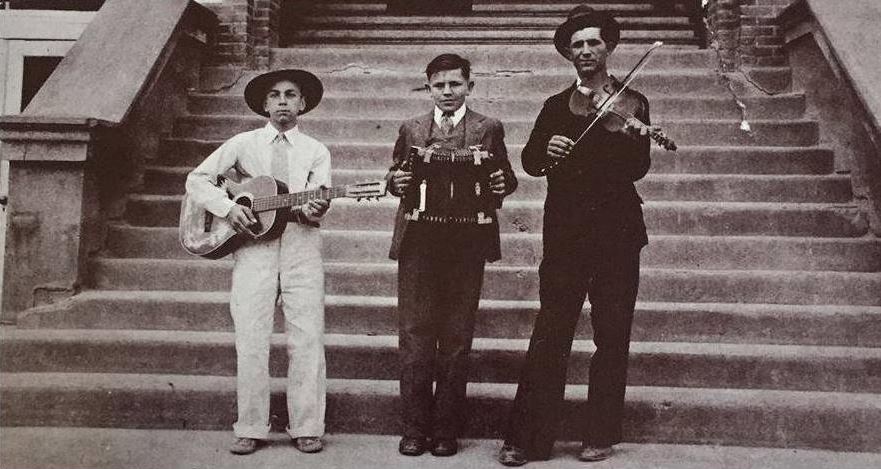
Saturday, December 6, 2014

"Mon Dernier Bon Soir" - Alleman and Walker

Even though Lawrence Walker would be known helping the resurgence in Cajun music after the war, few remember that his first entry in the music scene was in the mid 1930s during the Cajun string band craze.   Lawrence teamed up with his brothers for a recording session in New Orleans in 1935.   Fellow musician, Tony Alleman, tagged along and while they were there, Lawrence and Tony recorded "Mon Dernier Bon Soir" (#2193).


J'ai fait mon idée,

de m'en aller, chère

Quand je suis parti, belle,

c'est pour toujours

Observe-moi bien, chère,
pour la dernière fois
Donne moi ta petite main,
pour dire au revoir
(fait pas ça!)

Regarde voir le char neg,
Donne moi un ticket
Pour moi m'en aller,
si loin que je peux.

Et dans le tracas,
Je va t'oublier mon neg'
Faudra que je l'oublie chère,
Ou je va mourrir là.
Lawrence Walker

The simple song has Lawrence on vocals, however, there is some confusion on if Tony is on guitar or on fiddle.  According to Richard Spottswood, he lists Tony Alleman on vocal and Lawrence Walker on violin.  Lawrence Walker's recordings with Tony Alleman for the Bluebird label provide further evidence of Cajun musicians organizing Texas-tinged proto-Cajun swing.  The duo bristles with energy from the interplay between the song's Franco and Anglo components.


I have an idea,

To go away, my dear,

When I leave, my beautiful,

It will be forever.

Look at me good, my dear,
For the last time,
Give me your little hand,
In order to say goodbye.
(no not that!)

See the car, neg',
Give me a ticket,
In order for me to leave,
As far as I can,

And within these worries,
I will forget you, my neg',
I must forget you, my dear,
Or I will die.

This record would be the only one with Alleman.  Walker would record only once more before the war in 1936 at the National Folk Festival in Dallas, TX.   Afterwards, he stopped recording and began rice farming.   He wouldn't record again until Cajun music's popularity grew again in the 1950s; this time with an accordion led band.


  1. http://www.amazon.com/Cajun-Early-Recordings-Cajun-Early/dp/B0001ZXNS0
  2. The Encyclopedia of Country Music
  3. Cajun Breakdown : The Emergence of an American-Made Music By Ryan Andre Brasseaux
  4. Lyrics by 'ericajun' and Marc C
Find:
Louisiana Cajun Music Vol. 2: The Early 30s (Old Timey/Arhoolie, 1971)