A unique window into the world of Cajun music between 1928 and 1965. Compiled histories from websites, books, news articles, liner notes, and interviews. Most come from my personal 78 collection. Also covering Creole, Cajun-Country, and Cajun swing.
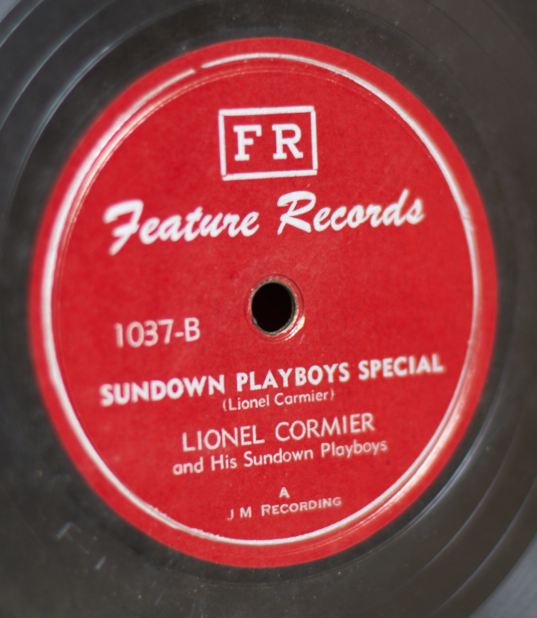
Cajun accordionist Lionel Cormier was one of the founding members of the Sundown Playboys in 1947. Originally called the Elton Playboys after the Louisiana town where Cormier and his family lived at the time, the group recorded for the first time in 1952. The result was a 78 rpm that featured "Sundown Playboys Special" for J.D. Miller's Feature Records (#1037). Cormier and his bandmates, including Percy Fuselier and Emory LaPoint, went on to record a number of other songs. The song is an instrumental two-step, named after the band. He began to join in as an accordionist at house dances and informal family get-togethers when he was 12 years old and moving to Elton, he took work in a sawmill.
Lionel Cormier
Lionel would also record for Ed Shuler's Goldband Records. On June 5, 1971, after finishing the song "Church Point Two-Step", Cormier died of a heart attack unexpectedly with his boots on – onstage during a benefit dance at Lake Charles’ Bamboo Club, while taking a break as the emcee made announcements between songs. Accordion player Pat Savant eventually joined the band and briefly knew Lionel; having met him only twenty minutes before the veteran played his last Church Point Two-Step. Pat would be known for recording "Saturday Night Special", released by either George Harrison or Ringo Starr of the Beatles on their lablel Apple Records.
Lionel Cormier began learning the accordion from his father, Arvilian, at an early age. By the age of 12 he was playing the accordion for family gatherings and house dances in the Acadia Parish region. After marriage and a move to Gueydan, in 1935, he settled in Elton where he continued to play the accordion, mainly at house parties and family gatherings. After playing a few dances following World War II, he joined Percy Fuselier in 1947 to form the Elton Playboys. Within a couple years he regrouped and headed the Sundown Playboys.2
Tu m'as quitte, pour t'en aller,
T'en aller avec un autre,
Moi, j'connais, merite pas ça,
Ça ta fais moi a pas longtemps.
Moi, j'ma va, mais, mon tout seul,
P'us personne, mais, pour m'maimer,
Moi, j'connais ça fais la peinne,
Moi, j'connais merite pas ça, mais, malheurese.
Wallace Touchet, Lesa Cormier, Lionel Cormier, Orsy "R.C" Vanicor, Howard Mire
Named after a popular dancehall in Acadia Parish, the "Welcome Club Waltz" (#1037) recorded in 1952, was named after the Welcome Club located in Crowley, Louisiana. Opened in the 1930s as the Delta Club, it hosted blues and jazz musicians throughout the 1940s. In 1951, Feature record producer, J.D. Miller, jumped into business with Welcome Club managers Henry Magnon and Leo Miller as part owner. The use of the club's name made sense, because it was one of many places Miller kept his jukeboxes playing his store's Feature records. Lionel's recording contained a melody similar to a version of "La Valse de Grand Chenier" and the old Creole tune "T'es Petite et T'es Mignonne". It's quite possible it also inspired Lawrence Walker's "Reno Waltz". By the late 1950s, the popular place became Club L'Acadien and remained that way for years.
You left me, you went away,
You went away with another,
I know I don't deserve that,
That you've done not long ago.
I'm going, well, all alone,
Nobody, well, to love me,
I know that it hurts me,
I know I do not deserve that, well, oh my.
Crowley Daily Signal May 13, 1955
The early band featured Lionel on accordion, Emory Lapoint on guitar and vocals, John Darbonne on drums, and Percy on fiddle. Darbonne played a short while and was replaced by Lionel’s son, Lesa. Also, Orsy Vanicor played the steel guitar for a while in late 1948, until he joined his family in Lacassine to play with Iry Lejeune and the Lacassine Playboys. Larry Miller from Iota replaced Vanicor on the steel guitar, and during 1949 Percy left the band and was replaced by Jake Bertrand. As personnel changed, Lesa renamed the band, the Sundown Playboys.2 By the time the band was in Miller's studio, it featured Howard Mire on guitar and vocals, Wallace ‘Red’ Touchet on fiddle, Larry Miller on steel guitar, and Tan Benoit on drums. Howard would continue on as a side musician with other Cajun artists such as Joe Falcon, Nathan Abshire, Lawrence Walker, Lionel Leleux, Don Montoucet, Blackie Fruge, Dick Richard, and his brother Jake Miers. Lionel was successful in landing radio airplay including places like KPLC in Lake Charles, KSUL in Sulphur and KJEF in Jennings. In 1971, KJEF announcer Jerry Dugas hosted a show at the Bamboo Club on Highway 14. The highlight of the event was not the music, but an unforeseen event. While Lionel Cormier and the Sundown Playboys were preparing to play, Lionel had a massive heart attack, fell to the bandstand, and died while Jerry was making announcements.2
Slim Harpo: Blues King Bee of Baton Rouge By Martin Hawkins
Reaching outside of the boundaries of early Cajun music, we visit the interesting story of the last Cajun recording pressed on 78 RPM. It was done so by none other than the British rock group The Beatles on their Apple Records label. So, how did this recording get pressed so late by a rock group un-affiliated with Cajun music? The Sundown Playboys was a group started by Lionel Cormier in the 1950s. The group continued to play until Lionel died of a heart-attack on stage in 1971. Accordion player Pat Savant eventually joined the band and briefly knew Lionel; having met him only twenty minutes before the veteran played his last song.
Oh, 'tite fille, moi'je connais heir soir,
Je partis d'a où j'etais,
Pour te joindre, jolie chère.
Oh, ye yaille, la promesse j't'ai mal y fait,
Les memes mots qu'j'ai dit à une,
Je les dis à une et l'autre.
Oh, tite fille, vingt ans moi je connais,
Moi je vais dire à cette heure,
La parole pour réparer.
Oh, ye yaille, il a dit, jolie cœur,
Pour demande des pardonnances,
Il connait il a près mal faire.
Sundown Playboys Sep 26, 1972
Before long, Pat was leading the group in local dance halls. A sophomore at a Lake Charles Catholic high school, he was given a chance to fill Cormier's shoes; while he was a novice in the frenzied atmosphere of Cajun dance halls, he became, at the age of 15, a Sundown Playboy.2Only a school kid at the time, Savant was a young accordion prodigy, meeting Lionel Cormier minutes before he died. So he was rather surprised when he was invited to step in and fill Lionel’s big shoes.5He and his group including Lionel's son, Lesa Cormier on drums, Wallace "Red" Touchet on fiddle, Darrell Higginbotham on voclas and guitar, Danny Cormier on bass and Larry Miller on steel, landed four songs on tape at Swallow studios for their next release 45 release. After a recording session with Floyd Soileau at Swallow Records, Pat Savant was in the record shop talking with another teenager about the group's latest recording efforts when the other youngster wondered aloud what the attitude of the famous Beatles would be towards this style of French music.6 Pat, known to be an aficionado of all things British, convinced Lesa and Swallow records producer Floyd Soileau to send a copy of the 45 RPM with a letter to George Harrison of The Beatles in 1971.1 He also noticed that the record bins in K-Mart were filled with Apple product, so he mailed a copy of the single addressed ‘The Beatles, London, England’.5 According to Darrell's son David,
Pat sent a copy of the recording to the Beatles' George Harrison as a joke. The joke turned out to be on Pat because George Harrison sent a letter back asking for permission to release it on the "Apple label".
Oh, little girl, I know last night,
I left from where I was,
To return to you, pretty girl.
Oh, ye yaille, the promise I poorly made to you,
The same words that I said to one person,
I say them to one and another.
Oh, little girl, twenty years old, I know,
I'm going to say right now,
Words to make amends.
Oh, ye yaille, he has said, pretty sweetheart,
Begging for forgiveness,
He knows he's doing something wrong.
Sundown Playboys
According to legend, George Harrison heard the record and loved it. Apple Record's A&R manager Tony King wrote back within two weeks to say that Apple would put out the single over the pond.5,6The response came as a surprise to everyone. According to Floyd Soileau,
It was a typical French group from Lake Charles, typical record, there was no big thing about it. Even when I had a call from Apple's New York office, I still couldn't believe what was happening. I have a back-page ad they ran in Billboard,. I've got the sample promotion kit 'Back to Mono' with the 78 copy and the 45 copy and the promo stuff they had inside. And I love to tell the story because it's one of the carziest things that can happen in this business.4
In the summer of '72 Apple released the same recordings that Swallow had already pressed the "Saturday Night Special" and "La Valse de Soleil Couché (The Sundown Waltz)" in both the U.S. and Europe. It was pressed as a promotion on 45RPM and surprisingly on 78RPM as part of Apple's short-lived novelty "Back to Mono" campaign. Though Apple bought a full back page ad in Billboard, the record did not receive the wide airplay that it reportedly had in Europe,2 but was used in the movie Sister, Sister in 1988.3 Later, the recording was released on the CD "Come and Get It: The Best of Apple Records." The Sundown Playboys became a major influence on the Smiths’ lead singer Morrissey, who included their single on his 2003 release Under the Influence, explaining in the extensive liner notes that the shock of “Saturday Nite Special”’s never-before heard sound had haunted him for years without any context or reference point, and without even knowing the name of the song or the band, he’d remembered the tune after hearing it only four times!5 Because of the scarcity of the 78RPM pressing (some estimates place it as low as 150 pressings), the value of a copy can reach in to hundreds of dollars.
After WWII, several Louisiana labels began recording Cajun music again, most of them locally. One of them was George Khoury, a Turkish-American businessman from Lake Charles and record store owner. He would record the earliest music by Lawrence Walker, who would have two hits with Khoury, "Evangeline Waltz" and "Reno Waltz" (#623) in the 1950s. The original tune, "La Valse de la Grande Chenier" also inspired "T'es Petite et T'es Mignonne" and Lionel Cormier's "Welcome Club Waltz". His first band, Walker Brothers, consisted of himself on either accordion or violin and his brother Elton on violin. In 1929, they would record for Brunswick in Dallas and in 1935, record for Bluebird (later Montgomery Ward) in New Orleans. He appeared at the National Folk Festival in Dallas in 1936.
However, Lawrence is credited by many for developing what came to be called "new style" Cajun music in the 1950s. Walker's father, Allen, was a popular fiddler and introduced Walker to Cajun music. A demanding bandleader, he tightened arrangements and smoothed the sound of his Wandering Aces, especially reducing the syncopation in his own accordion style. Walker was a perfectionist, who relentlessly drove his band to higher standards. He would eventually initiate contact with the record-men of the area, certain of his ability to sell records. He would record Reno Waltz again in 1961 for La Louisiane, however, this time he used different lyrics and replaced the steel guitar with a smooth dueling fiddle ride.
Oui la place que moi, j'voudrais mourir
C'est dans les bras, de mon bébé
Demander pardon, pour ça que j'ai fait
là je serais d'accord de m'en aller, mais pour toujours
Quand je va mourir, j'aimerais que tu viens
Fermer mes yeux bébé, pour moi j'en va
Pour moi j'en va, mais pour toujours
Comme tu connais ça, c'est dur pour moi je l'aime
Lawrence Walker
In Cajun French, the verb "jongler" is a mysterious, old French word and seems to translate as "to think" or "reminiscence". Reno was named after the Reno Dance Hall located between the towns of Kaplan and Gueydan in Louisiana. It was based on an older tune, "La Valse de Grand Chenier". Lawrence had gotten into a "spat" with the club owner Arestille "Dado" Seaux. In order to make peace and have a chance to continue playing there, Walker named the song after the club. Walker who grew up in Texas, would play both country and Cajun music in dancehalls across south Louisiana. Walker also recorded "Allons Rock N Roll", the first Cajun rock n roll tune, which he sung in English. His popularity gained him the moniker "King of the Dancehalls".
That's the place that I want to die
In the arms of my loved one
I ask your forgiveness for what I've done
I'd even agree to go away forever
When I will die
I want you to come
Close my eyes for me, little baby
For me, i'm going away forever,
You know, it makes me sad
For I'm in love
Later he would record for Swallow Records. After Lawrence died unexpedly of heart failure, his fiddler, Lionel Leleux requested his friend Don Montoucet to fill in for the rest of their musical engagements. Uneasy about filling in, Lionel just told him:
Oh don't worry about a thing. Just do it like old Lawrence used to and everything will be just fine.
In 2014, the University of Louisiana at Lafayette and LouisianaDancehalls.com posted a rare 1950s film of people dancing at the Reno Club.
Livaudais "Lee" Sonnier of Crowley was the first Cajun to record with the accordion following World War II and the first to record with his son-in-law, Jay Miller, at his studio in Crowley including the "Acadian All Star Special" (#1041). Jay Miller's Feature Records, which released plenty of Cajun music between 1947 and 1964, recorded 8 songs with Lee, sometimes spelling his last name Snownier and Sonier. The song is a standard accordion-driven instrumental. Miller tapped a lucrative market that also enabled him to wax father-in-law Lee Sonnier in addition to his ever-growing stable of artists. The success of Harry Choates’s “Jole Blon” convinced Miller that there was still a commercial audience for what was then known as “French music.” Some of the many gems that Miller produced include early recordings by Happy, Doc & The Boys (his first and most successful signing); Lionel Cormier & The Sundown Playboys (who released a 45 on Apple records in 1972); Aldus Roger & The Lafayette Playboys; Austin Pitre (also listed as Austin Pete) and Chuck Guillory & His Rhythm Boys.
Find: Fais Do Do Breakdown - Volume One - The Late 1940's (Flyright, 1986) Acadian All Star Special - The Pioneering Cajun Recordings Of J.D. Miller (Bear, 2011)
Nathan Abshire was a musician that helped ressurect the Cajun accordion after WWII. He recorded for George Khoury in Lake Charles for years between 1949 and 1957. Eventually, Khoury—who was also now recording rhythm and blues and country music—shifted Abshire to the Lyric and then the Khoury imprint. Abshire recorded for Khoury until 1956, cutting several classics including “La Valse de Holly Beach,” “Musical Five Special” “Lu Lu Boogie” and “Shamrock Waltz.” Abshire didn’t record in the late 1950s, but he and Pine Grove Boys stayed busy, working for several years at the infamous Shamrock Club in Lake Charles. His melody, previously recorded by Lionel Cormier as the Welcome Club Waltz, was an ode to this popular dancehall.
Tu m'a quitté, pour t'en aller,
T'en aller au Shamrock,
Tu connais ça t'as fais,
Avec moi il y a pas longtemps.
Ils rappelle, tout ça t'as fais,
Ça fais moi (z)avant d'partir,
Tu connais j'ai pris ça dur,
Pas connais, tu vas te voir.
Milton Vanicor recalls that, while he was playing with Iry Lejeune, many times Nathan Abshire and Dewey, after playing at Jones Bar north of Lake Charles, would come to the Shamrock Club in north Lake Charles and play until 1:00 a.m. The two groups would join in a jam session everyone enjoyed.3 Around 1965, Jo-El Sonnier moved to Lake Charles from his Acadia Parish home and played with Robert Bertrand and the Louisiana Ramblers at the Shamrock. The place featured other Cajun musicians such as Phil Menard and Bobby Leger.4 They played the Shamrock Club, the hot-spot at the time, as well as other local clubs.”2 Bands that were featured at the Shamrock advertised via radio many times from the dancehall's stage with a live performance.4 One local remembered it most out of all the other clubs:
I believe the Shamrock was the very largest. The walls breathed in and out on Friday and Saturday nights at that place.
Shamrock Club Larry Miller, Cleveland "Cat" Deshotel, Nathan Abshire, Thomas Langley, Jr. Benoit Photo from the Johnnie Allan Collection Center for Louisiana Studies University of Louisiana at Lafayette
Celebrating his success at the club, Nathan recorded one of his last songs for Khoury in Lake Charles in 1956 known as the "Shamrock Waltz" (#652). It's possible the vocalist is drummer Thomas Langley, but it's unclear. He had Junior Benoit on guitar, possibly Cleveland Deshotel on either fiddle or bass, and either Darius LeBlanc or Jake Miere on steel guitar.
You have left, you went away,
You went away to the Shamrock,
You know what you've done,
With me, over there, not long ago.
They remember, all that you've done,
That was done to me, before leaving,
You know I took it hard,
Don't you know, you're going to see.
By the mid-1950s, many Cajuns had relocated from Southwestern Louisiana to points as remote as New Orleans, Baton Rouge, Morgan City, Houston, Beaumont and even California in search of employment. They enjoyed their newly found wealth, but they still loved their food, culture and music. As a result Abshire and the Pine Grove Boys started traveling to dances far from home. Eventually Khoury began recording rhythm and blues and country music, however, kept his music store open for business. As far as the building, patrons had fond memories of the place:
Parking was tight. The club was a long narrow building parallel to the highway. On the other side was a chain link fence about 3 or 4 feet from the building. On the other side of the fence was a grave yard. People would say "When I die I won't have far to go".5
In 1968, Nathan used the title "Shamrock" for a fast accordion-driven instrumental, similar in feel to the better known "Zydeco Sont Pas Sale".
J'Ai Ete au Bal! First recorded by Iry in 1954 and released in 1957 for Ed Shuler's label Goldband and Folk Star, this song is one of the most covered and recorded Cajun tunes today. The title would be used in several Cajun music compilations and a documentary film on Louisiana French and Zydeco music produced in 1989 by Les Blank, Chris Strachwitz and Maureen Gosling.
Iry Lejeune played in an ornate driving style that was loved by dancers, listeners and musicians alike. Lejeune came from a farming family that loved music. He was born with poor eyesight and became interested in music at an early age.
J’ai été-z-au bal hier au soir
Je va’s retourner encore à soir
Si l’occasion se présente
Je va’s retourner demain au soir.
Iry Lejeune
’Gardez donc les jolies filles,
Celles-là que j'aime autant,
Moi, je connais tout l'amour
Que j'ai eu pour toi.
J’ai été.z au bal hier au soir
Elle était tous habillée.z.en noir,
J’ai fait serment jamais de boire
Pour courtiser ma fille
J’ai été.z.au bal à soir
Elle est tous habillée.z.en bleu,
C’est ça l’habit que moi j’aime
Pour courtiser ma belle.
J’ai été-z-au bal hier au soir
Je va’s retourner encore à soir
Si l’occasion se présente
Je va’s retourner demain au soir.
’Gardez donc les jolies filles,
Personne qui veut m’aimer
Gardons voir si ça c’est pas
Mais misérable pour moi
Ed Shuler, owner of Goldband records, claims to have first met LeJeune as he walked down a dusty road, carrying his accordion in a flour sack. It was the first accordion the music producer had ever seen.
“He walked up to me and asked me about making records,” recalls Shuler, who agreed to take a chance. “In those days the Cajuns didn’t write no letters and things; they shook hands, and that was their contract.”
Ed Shuler
The title can be found spelled in a variety of ways: J’Etais Au Bal, J’ai etais au bal, J’ai été-z-au bal and J’ai été au bal. It's origins can be found in a variety of places. According to Raymond Francois says he believe it is related to the songs "Oh Susannah" and "Get Along Cindy".2 The melody has eerie similarity to two songs recorded in 1929: a Paramount recording by John Bertrand and Milton Pitre in Chicago called "The Rabbit Stole The Pumpkin" and a Victor recording by Percy Babineaux & Bixy Guidry called "J'vai Jouer Celea Pour Toi". In 1934, Joe Falcon and Cleoma Breaux use the melody for their Decca recording of "Ne Buvez Plus Jamais". This original melody may have also influenced Lawrence Walker's "Jolie (Johnny) Can't Dance". The song is a fast paced, two-step that discusses a man's love interest at a dancehall "last night" and how he plans to go see her again, in a different color, if he gets the chance. Recorded at Iry's house, the group consisted of Iry on accordion, Alfred "Duckhead" Cormier on guitar, and Wilson Granger on fiddle. Eddie wanted something with a more upbeat tempo. Shuler, for reasons unknown, would issue this record with the same #1041 as another release. The other #1041 release contains "Grande Bosco" and an alternate take of "Duraldo Waltz". The song would be later recorded by many local musicians such as Eddie Lejeune, Walter Mouton, Lionel Leleux, Michael Doucet, Steve Riley, and Wayne Toups. The Balfas would be documented performing a version using a unique percussion technique called "fiddlesticks".
I was at the dance last night
I'll be back again tonight
And if I get a chance
I'll be there tomorrow night.
Keep the pretty girls for me,
The ones I love so well,
I know all about love
From being in love with you.
I was at the dance last night
She was all dressed in black,
I swore I'd never drink
When I'm courting my girl
I was at the dance last night
She was all dressed in blue
That's the colour I like best
When I'm courting my girl
I was at the dance last night
I'll be back again tonight
And if I get a chance
I'll be there tomorrow night.
Keep the pretty girls for me,
No one wants to love me
Let's see if that's the case
But it's miserable for me
Author Ron Yule states:
The mention of his presence at a dance would fill the hall. He played dance halls from China, [Louisiana] and Port Arthur, Texas to New Orleans ... even traveling with the Oklahoma Tornados to Nashville for a few weeks. Many who attended dances have stated, ‘If Iry was going to be there, I went.' He was a great singer and his wailin' bluesy vocal style is still recognizable today.